


 |
市場調查報告書
商品編碼
2097304
多層紙板:市場佔有率分析、產業趨勢與統計、成長預測(2025-2030)Multi-layer Paperboard - Market Share Analysis, Industry Trends & Statistics, Growth Forecasts (2025 - 2030) |
||||||

※ 本網頁內容可能與最新版本有所差異。詳細情況請與我們聯繫。
根據 Mordor Intelligence 預測,多層紙板市場規模預計到 2025 年將達到 5,547 萬噸,到 2030 年將達到 6,798 萬噸,年複合成長率為 4.15%。
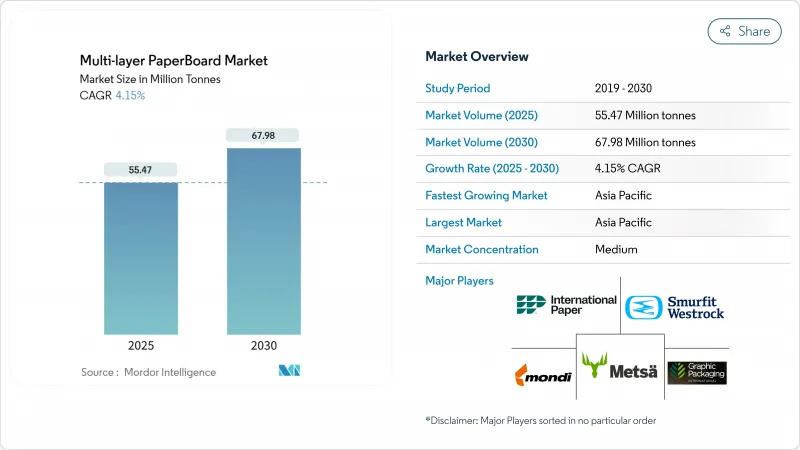
本報告按等級(例如,折疊盒用紙板、未漂白硫酸鹽紙漿紙板)、原料來源(未使用紙漿、再生紙漿)、最終用途(例如,食品和飲料包裝、化妝品和個人護理用品、藥品)以及地區進行細分。市場預測以數量(噸)為單位。
全球多層紙板市場趨勢與洞察
電子商務主導紡織品二次包裝的爆炸性成長。
全球線上零售市場持續擴張,每個小包裹都需要堅固耐用且可印刷的二級包裝。亞馬遜等電商平台指定使用能夠承受多地運輸過程中擠壓和潮濕的高強度紙板,這加速了對多層結構包裝的需求。國際紙業工業包裝部門2023年的銷售額達到156億美元,凸顯了紡織品在履約網路中的核心地位。折疊紙板和固態硫酸漿紙的市場佔有率正在不斷成長,因為它們能夠提供品牌所需的可印刷表面,從而創造「第一印象」。北美產能的提升使得2023年包裝紙產量成長了4.8%,與電商的銷售成長趨勢相符。能夠合理平衡未使用紙漿和再生紙漿的製造商,在縮短線上經銷商前置作業時間的同時,也能應對二手瓦楞紙板(OCC)價格的波動。
品牌所有者為替代塑膠所做的努力
大型消費品公司已承諾在2030年實現所有零售包裝可回收或可重複使用,從而確保紡織品的長期需求。 Graphic Packaging公司證實,光是2023年,該公司就減少了4.5億個塑膠包裝,並用可回收紙板取而代之。目前,該公司的採購政策優先考慮經認證的紡織品,即使價格較高,只要其展示效果不受影響即可。 WestRock公司透露,其2024年產品系列中已有97.8%符合可回收或可堆肥標準,與客戶的藍圖相符。這些自願性目標的訂定,正值生產者延伸責任制(EPR)費用不斷上漲,塑膠製品受到懲罰之際,這使得企業的願景宣言轉化為切實的成本差異。
再生紙(OCC)價格的長期波動
再生紙漿的成本在一個季度內波動幅度通常超過40%,這使得含再生紙漿等級的預算編制變得困難。當出口目的地消化過剩的瓦楞紙箱,或由於歐盟季節性需求激增導致國內需求增加時,就會出現供應緊張的情況。根據歐洲造紙工業聯合會(CEPI)的報告,預計2023年再生纖維的消費量將下降7%,凸顯了原料供應的不穩定性。儘管一體化集團試圖透過調整未使用紙漿的比例來緩衝價格波動,但依賴再生纖維的造紙廠在價格飆升時卻面臨著息稅折舊攤銷前利潤(EBITDA)的急劇下降。
細分市場分析
2024年,折疊紙盒在多層紙板市場中佔據最大佔有率,達到39.68%。本產品廣泛應用於對印刷清晰度和適中剛性有要求的日常消費品。電商對美觀的家居產品展示的需求,以及監管機構對無墨印刷的偏好(即對淺色基材的需求),都推動了這一細分市場的發展。未漂白硫酸紙漿板雖然規模較小,但其複合年成長率(CAGR)最高,達5.43%。這是因為高階化妝品和高級糖果甜點需要純淨無雜質的白色表面,且原料來自回收材料。未漂白紙板和塗佈未漂白牛皮紙主要用於對強度要求較高的包裝,例如飲料包裝盒和DIY工具,但由於品牌商越來越重視商店的美觀性,它們的成長速度落後於高階產品。多層複合板(MFC)的輕量化特性進一步凸顯了高級產品的差異化優勢,並允許在保持邊緣抗壓強度的同時,使用更薄的紙板。擁有自己的蒸餾蒸煮和熱封阻隔材料塗層生產線的製造商可以確保更高的加工利潤,尤其是在符合證明萃取物含量低的藥品審核標準的情況下。
區域分析
2024年,亞太地區佔最大市場佔有率,達43.15%,這主要得益於中國包裝產業的蓬勃發展以及印度學名藥生產產業泡殼包裝需求的成長。該地區以5.37%的複合年成長率(CAGR)實現擴張,這主要歸功於可支配收入的增加和電子產品組裝線的轉移,這兩方面都推動了對內包裝和零售外包裝的需求。北美市場已趨於成熟,但全通路零售的需求正在穩步成長,快速消費品營運商對緩衝和退貨處理設計的需求日益成長。歐洲的需求成長相對緩慢,能源價格上漲給造紙廠的盈利帶來了壓力,但歐洲在監管創新方面處於領先地位,引入了生產者延伸責任制(EPR)和全氟烷基和多氟烷基物質(PFAS)法規,這些法規隨後將推廣至全球。南美的造紙廠正利用桉樹硬木的成本優勢,既滿足國內日常消費品(FMCG)市場的需求,又出口到美國。中東和非洲是新興市場,基礎設施投資和人口成長正推動人均包裝使用量從低水準上升。全球領先企業正擴大與當地加工商合作,以應對複雜的進口關稅。
其他好處:
- Excel格式的市場預測(ME)表
- 3個月的分析師支持
目錄
第1章:引言
- 研究假設和市場定義
- 調查範圍
第2章:調查方法
第3章執行摘要
第4章 市場狀況
- 市場概覽
- 市場促進因素
- 電子商務的擴張導致紡織品基二次包裝需求激增
- 品牌所有者為替代塑膠所做的努力(2030 年目標)
- 拉丁美洲未利用纖維的過剩產能降低了原料成本。
- 輕量化技術(微纖化纖維素層)
- 用於店面銷售的多件裝產品,其 SKU 尺寸難以回收。
- 有利於紡織品的生產者延伸責任制(EPR)費用
- 市場限制因素
- OCC(廢棄紙板)價格的長期波動
- 在具有 3 層或更多層的基板上轉換線路時遇到瓶頸
- 逐步淘汰 PFAS 將增加阻隔塗層的成本。
- 數位化發展導致印刷和平面設計用紙的需求下降。
- 產業價值鏈分析
- 監理情勢
- 技術展望
- 波特五力分析
第5章 市場規模與成長預測
- 按年級
- 折疊紙板(FBB)
- 實心漂白硫酸鹽板(SBS)
- 塗佈未漂白牛皮紙 (CUK)
- 白色線條塑合板(WLC)
- 未漂白單層板(SUB)
- 按醬汁配料
- 未使用的纖維
- 再生纖維
- 按最終用途
- 食品和飲料包裝
- 化妝品和個人護理
- 製藥
- 家用物品/消費品
- 工業與電子
- 按地區
- 北美洲
- 美國
- 加拿大
- 墨西哥
- 南美洲
- 巴西
- 阿根廷
- 其他南美國家
- 歐洲
- 德國
- 英國
- 法國
- 義大利
- 俄羅斯
- 其他歐洲國家
- 亞太地區
- 中國
- 印度
- 日本
- 韓國
- 印尼
- 泰國
- 其他亞太國家
- 中東和非洲
- 中東
- 沙烏地阿拉伯
- 阿拉伯聯合大公國
- 土耳其
- 其他中東國家
- 非洲
- 南非
- 埃及
- 其他非洲國家
- 中東
- 北美洲
第6章 競爭情勢
- 市場集中度
- 策略趨勢
- 市佔率分析
- 公司簡介
- International Paper Company
- Smurfit Westrock plc
- Mondi plc
- Graphic Packaging Holding Co.
- Metsa Board Corporation
- Stora Enso Oyj
- Billerud AB
- Nippon Paper Industries Co., Ltd.
- Oji Holdings Corporation
- Rengo Co., Ltd.
- Mayr-Melnhof Karton AG
- Huhtamaki Oyj
- Georgia-Pacific LLC
- Packaging Corporation of America
- Nine Dragons Paper(Holdings)Ltd.
- Lee and Man Paper Manufacturing Ltd.
- Asia Pulp and Paper(APP)
- Clearwater Paper Corporation
- JK Paper Ltd.
- ITC Limited-Paperboards and Specialty Papers Div.
- Sappi Limited
- Klabin SA
第7章 市場機會與未來展望
According to Mordor Intelligence, the multi-Layer paperboard market size stood at 55.47 million tonnes in 2025 and is forecast to reach 67.98 million tonnes by 2030, expanding at a 4.15% CAGR.
This report is Segmented by Grade (Folding Boxboard, Solid Bleached Sulfate Board, and More), Raw Material Source (Virgin Fiber, Recycled Fiber), End-Use Application (Food and Beverages Packaging, Cosmetics and Personal Care, Pharmaceuticals, and More), and Geography. The Market Forecasts are Provided in Terms of Volume (Tonnes).
Global Multi-layer Paperboard Market Trends and Insights
E-commerce-led explosion in fiber-based secondary packaging
Global online retail continues to scale, and each parcel demands robust, printable secondary packaging. Amazon and other marketplaces specify heavier-basis paperboard that resists crush and moisture during multi-node shipping, accelerating demand for multi-ply constructions. International Paper's Industrial Packaging segment recorded USD 15.6 billion sales in 2023, underscoring fiber's central role in fulfilment networks. Folding Boxboard and Solid Bleached Sulfate grades win share because they offer the print surfaces brands need for unboxing impressions. Capacity additions in North America lifted packaging paper output by 4.8% in 2023, mirroring e-commerce volume curves. Producers that can balance virgin and recycled furnish navigate Old Corrugated Container (OCC) volatility while trimming lead times for online sellers.
Brand-owner plastics-substitution commitments
Leading consumer-goods companies pledge that every retail pack will be recyclable or reusable by 2030, locking in long-term fiber demand. Graphic Packaging verified the elimination of 450 million plastic packs in 2023 alone, channeling that volume into recyclable paperboard. Procurement policies now prefer certified fiber even at price premiums, provided shelf appeal remains intact. WestRock disclosed that 97.8% of its 2024 portfolio already meets recyclability or compostability benchmarks, aligning with customers' roadmaps. The voluntary goals sit atop a rising layer of EPR fees that penalize plastics, converting corporate vision statements into enforceable cost differentials.
Chronic OCC price volatility
Recovered fiber costs often swing more than 40% within one quarter, complicating budgets for recycled-content grades. Supply tightness arises when export buyers absorb surplus containers, or when seasonal e-commerce surges elevate domestic demand. The Confederation of European Paper Industries reported a 7% drop in recycled-fiber consumption during 2023, underscoring destabilised feedstock flows. Integrated groups buffer volatility by dialing virgin-pulp ratios up or down, but mills dependent on secondary fiber face sharp EBITDA compression during spikes.
Other drivers and restraints analyzed in the detailed report include:
- Surplus virgin-fiber capacity in LATAM lowering input costs
- Lightweighting tech (micro-fibrillated cellulose layers)
- Converting-line bottlenecks for >3-ply boards
For complete list of drivers and restraints, kindly check the Table Of Contents.
Segment Analysis
Folding Boxboard retained the largest 39.68% share of the Multi-Layer Paperboard market in 2024, serving fast-moving consumer goods that reward print clarity and moderate rigidity. The segment benefits from e-commerce's need for attractive in-home presentation and from regulatory de-inking requirements that favor light-colored substrates. Solid Bleached Sulfate Board, though smaller, records the fastest 5.43% CAGR because luxury cosmetics and premium confectionery demand bright white surfaces free of recycled contaminants. Solid Unbleached Board and Coated Unbleached Kraft supply strength-critical packs for beverage carriers and DIY tools, but they trail premium grades in growth as brand owners elevate shelf aesthetics. Lightweighting enabled by MFC further differentiates premium offerings, allowing down-gauging while upholding edge crush ratings. Producers with in-house coating lines for retortable or heat-seal barriers monetize higher conversion margins, especially when aligned with pharmaceutical audits that certify low extractables.
Complete Report Scope:
- By Grade
- Folding Boxboard (FBB)
- Solid Bleached Sulfate Board (SBS)
- Coated Unbleached Kraft (CUK)
- White-lined Chipboard (WLC)
- Solid Unbleached Board (SUB)
- By Raw Material Source
- Virgin Fiber
- Recycled Fiber
- By End-use Application
- Food and Beverages Packaging
- Cosmetics and Personal Care
- Pharmaceuticals
- Household and Consumer Goods
- Industrial and Electronics
- By Geography
- North America
- United States
- Canada
- Mexico
- South America
- Brazil
- Argentina
- Rest of South America
- Europe
- Germany
- United Kingdom
- France
- Italy
- Russia
- Rest of Europe
- Asia-Pacific
- China
- India
- Japan
- South Korea
- Indonesia
- Thailand
- Rest of Asia-Pacific
- Middle East and Africa
- Middle East
- Saudi Arabia
- United Arab Emirates
- Turkey
- Rest of Middle East
- Africa
- South Africa
- Egypt
- Rest of Africa
- Middle East
- North America
Geography Analysis
Asia-Pacific generated the lion's 43.15% share in 2024, led by China's packaging boom and India's blister-pack growth in generics manufacturing. Regional expansion at 5.37% CAGR stems from climbing disposable incomes and relocation of electronics assembly lines, both driving inner cartons and retail-ready outers. North America, although mature, enjoys steady uplift from omnichannel retail, with quick-commerce players demanding cushioning and return-ready designs. European demand grows more modestly as energy-price pressure hampers mill economics, yet the continent anchors regulatory innovation, adopting EPR and PFAS curves that later migrate worldwide. South American mills leverage hardwood eucalyptus cost advantages to feed both domestic FMCG and export linkages into the United States. Middle East and Africa represent nascent nodes, where infrastructure spend and population growth raise per-capita packaging usage from a low base; global majors increasingly partner with local converters to navigate complex import tariffs.
- International Paper Company
- Smurfit Westrock plc
- Mondi plc
- Graphic Packaging Holding Co.
- Metsa Board Corporation
- Stora Enso Oyj
- Billerud AB
- Nippon Paper Industries Co., Ltd.
- Oji Holdings Corporation
- Rengo Co., Ltd.
- Mayr-Melnhof Karton AG
- Huhtamaki Oyj
- Georgia-Pacific LLC
- Packaging Corporation of America
- Nine Dragons Paper (Holdings) Ltd.
- Lee and Man Paper Manufacturing Ltd.
- Asia Pulp and Paper (APP)
- Clearwater Paper Corporation
- JK Paper Ltd.
- ITC Limited - Paperboards and Specialty Papers Div.
- Sappi Limited
- Klabin S.A.
Additional Benefits:
- The market estimate (ME) sheet in Excel format
- 3 months of analyst support
TABLE OF CONTENTS
1 INTRODUCTION
- 1.1 Study Assumptions and Market Definition
- 1.2 Scope of the Study
2 RESEARCH METHODOLOGY
3 EXECUTIVE SUMMARY
4 MARKET LANDSCAPE
- 4.1 Market Overview
- 4.2 Market Drivers
- 4.2.1 E-commerce led explosion in fiber-based secondary packaging
- 4.2.2 Brand-owner plastics-substitution commitments (2030 targets)
- 4.2.3 Surplus virgin-fiber capacity in LATAM lowering input costs
- 4.2.4 Lightweighting tech (micro-fibrillated cellulose layers)
- 4.2.5 Retail-ready multipacks for hard-to-recycle SKU sizes
- 4.2.6 Extended Producer Responsibility (EPR) fees favoring fiber
- 4.3 Market Restraints
- 4.3.1 Chronic OCC (old-corrugated-container) price volatility
- 4.3.2 Converting-line bottlenecks for >3-ply boards
- 4.3.3 PFAS phase-out raising barrier-coating costs
- 4.3.4 Growing digitalisation cutting print and graphical board demand
- 4.4 Industry Value Chain Analysis
- 4.5 Regulatory Landscape
- 4.6 Technological Outlook
- 4.7 Porter's Five Forces Analysis
- 4.7.1 Bargaining Power of Suppliers
- 4.7.2 Bargaining Power of Buyers
- 4.7.3 Threat of New Entrants
- 4.7.4 Threat of Substitutes
- 4.7.5 Competitive Rivalry
5 MARKET SIZE AND GROWTH FORECASTS (VOLUME)
- 5.1 By Grade
- 5.1.1 Folding Boxboard (FBB)
- 5.1.2 Solid Bleached Sulfate Board (SBS)
- 5.1.3 Coated Unbleached Kraft (CUK)
- 5.1.4 White-lined Chipboard (WLC)
- 5.1.5 Solid Unbleached Board (SUB)
- 5.2 By Raw Material Source
- 5.2.1 Virgin Fiber
- 5.2.2 Recycled Fiber
- 5.3 By End-use Application
- 5.3.1 Food and Beverages Packaging
- 5.3.2 Cosmetics and Personal Care
- 5.3.3 Pharmaceuticals
- 5.3.4 Household and Consumer Goods
- 5.3.5 Industrial and Electronics
- 5.4 By Geography
- 5.4.1 North America
- 5.4.1.1 United States
- 5.4.1.2 Canada
- 5.4.1.3 Mexico
- 5.4.2 South America
- 5.4.2.1 Brazil
- 5.4.2.2 Argentina
- 5.4.2.3 Rest of South America
- 5.4.3 Europe
- 5.4.3.1 Germany
- 5.4.3.2 United Kingdom
- 5.4.3.3 France
- 5.4.3.4 Italy
- 5.4.3.5 Russia
- 5.4.3.6 Rest of Europe
- 5.4.4 Asia-Pacific
- 5.4.4.1 China
- 5.4.4.2 India
- 5.4.4.3 Japan
- 5.4.4.4 South Korea
- 5.4.4.5 Indonesia
- 5.4.4.6 Thailand
- 5.4.4.7 Rest of Asia-Pacific
- 5.4.5 Middle East and Africa
- 5.4.5.1 Middle East
- 5.4.5.1.1 Saudi Arabia
- 5.4.5.1.2 United Arab Emirates
- 5.4.5.1.3 Turkey
- 5.4.5.1.4 Rest of Middle East
- 5.4.5.2 Africa
- 5.4.5.2.1 South Africa
- 5.4.5.2.2 Egypt
- 5.4.5.2.3 Rest of Africa
- 5.4.5.1 Middle East
- 5.4.1 North America
6 COMPETITIVE LANDSCAPE
- 6.1 Market Concentration
- 6.2 Strategic Moves
- 6.3 Market Share Analysis
- 6.4 Company Profiles (includes Global level Overview, Market level overview, Core Segments, Financials as available, Strategic Information, Market Rank/Share for key companies, Products and Services, and Recent Developments)
- 6.4.1 International Paper Company
- 6.4.2 Smurfit Westrock plc
- 6.4.3 Mondi plc
- 6.4.4 Graphic Packaging Holding Co.
- 6.4.5 Metsa Board Corporation
- 6.4.6 Stora Enso Oyj
- 6.4.7 Billerud AB
- 6.4.8 Nippon Paper Industries Co., Ltd.
- 6.4.9 Oji Holdings Corporation
- 6.4.10 Rengo Co., Ltd.
- 6.4.11 Mayr-Melnhof Karton AG
- 6.4.12 Huhtamaki Oyj
- 6.4.13 Georgia-Pacific LLC
- 6.4.14 Packaging Corporation of America
- 6.4.15 Nine Dragons Paper (Holdings) Ltd.
- 6.4.16 Lee and Man Paper Manufacturing Ltd.
- 6.4.17 Asia Pulp and Paper (APP)
- 6.4.18 Clearwater Paper Corporation
- 6.4.19 JK Paper Ltd.
- 6.4.20 ITC Limited - Paperboards and Specialty Papers Div.
- 6.4.21 Sappi Limited
- 6.4.22 Klabin S.A.
7 MARKET OPPORTUNITIES AND FUTURE OUTLOOK
- 7.1 White-space and Unmet-need Assessment

 紙板市場規模、佔有率和成長分析:按產品類型、等級、厚度、應用、最終用途產業和地區分類-2026-2033年產業預測
 全球層壓紙板包裝市場規模、佔有率、趨勢和成長分析報告(2026-2034年)
 工業紙板隔間市場按材料類型、隔間類型、厚度等級、最終用途產業和分銷管道分類-2026-2032年全球預測
 全球實心板材市場
 VCM層壓板市場報告:至2031年的趨勢、預測與競爭分析灰銅卡紙市場報告:至2031年的趨勢、預測與競爭分析實心紙板市場報告:至2031年的趨勢、預測與競爭分析
 2030 年紙板隔間市場預測:按產品、等級、組件、技術、應用、最終用戶和地區進行的全球分析
 中東和非洲的紙和紙板:市場佔有率分析、行業趨勢和成長預測(2025-2030)