


 |
市場調查報告書
商品編碼
2097279
人工智慧工具包:市場佔有率分析、行業趨勢和統計數據、成長預測(2025-2030 年)AI Toolkit - Market Share Analysis, Industry Trends & Statistics, Growth Forecasts (2025 - 2030) |
||||||

※ 本網頁內容可能與最新版本有所差異。詳細情況請與我們聯繫。
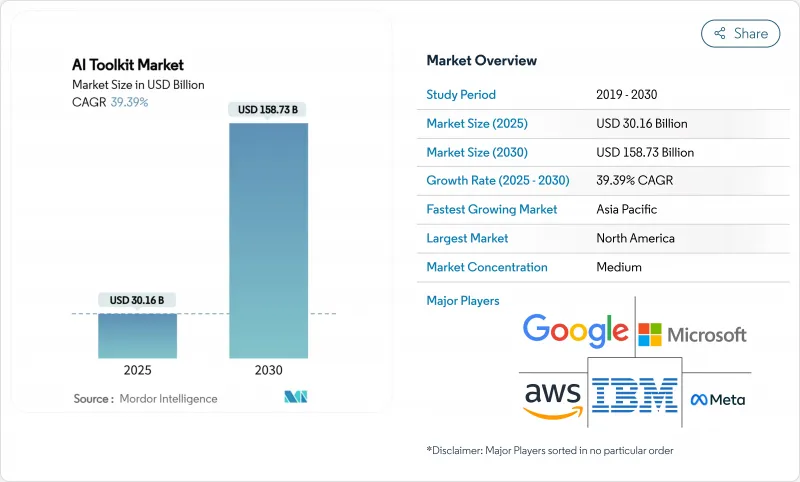
根據 Mordor Intelligence 預測,人工智慧工具包市場規模預計將在 2025 年達到 301.6 億美元,到 2030 年達到 1,587.3 億美元,2025 年至 2030 年的複合年成長率為 39.39%。
本報告按部署模式(雲端、本地部署、混合部署)、組件(軟體庫和框架、預訓練模型、SDK 和 API、端到端平台)、最終用戶行業(銀行、金融服務和保險 (BFSI)、醫療保健和生命科學、零售和電子商務、製造業等)、組織規模(大型企業和中小企業)以及地區進行細分。市場預測以美元 (USD) 為單位。
全球人工智慧工具包市場趨勢與洞察
企業快速採用生成式人工智慧工作負載
生成式人工智慧已度過實驗階段。目前,78% 的公司已部署了運作系統,87% 的公司已將未來兩年的進一步部署納入累計。製造業是這項轉變的典型代表,93% 的製造業企業計劃在 2024 年啟動新的人工智慧項目,其目標不僅是降低成本,還要提高產量和品質。通訊業者預計,到 2025 年,基於代理商的人工智慧將透過最佳化網路拓撲和預測性維護,每年帶來 110 億美元的收入。早期採用者報告稱,在 12 個月內生產力提高了 20-30%,從而形成良性循環,內部成功案例激勵進一步的投資。
超大規模資料中心業者雲端人工智慧服務降低了進入門檻
Google Cloud 的 Hugging Face 整合使開發者能夠無縫存取 35 萬個型號和低成本的 TPU,從而消除了傳統的預算和技能門檻。 Azure AI Foundry Agent Service 等標準化多代理工具包降低了編配的複雜性,而 Model Context Protocol 等開放式協定則簡化了跨廠商整合。競爭壓力比以往任何時候都更加推動雲端多元化發展。 ChatGPT 現在運作在 Google、Oracle、CoreWeave 和 Microsoft Azure 等五大國家的基礎架構上,提高了延遲容忍度和價格談判能力。
高技能人工智慧工程師短缺
對多模態模型操作、快速工程和倫理人工智慧領域專家的需求遠超供給,儘管亞太地區60%的公司計劃培養本地人才,但仍面臨招聘缺口。領先的科技公司正在重組員工隊伍;Salesforce裁員1000人,同時招募具備人工智慧技能的銷售負責人,並已凍結2025年軟體開發人員的淨招募。中小企業在薪資方面難以與大型企業競爭,被迫轉向託管服務和自動化流程。
細分市場分析
混合配置是成長最快的方案,年複合成長率高達 40.31%,企業正尋求在資料主權和彈性運算之間取得平衡。儘管到 2024 年,雲端運算仍將佔據 AI 工具包市場 61.23% 的佔有率,但美國企業對本地部署解決方案的興趣正在復甦,他們正在建立內部 GPU叢集以減少出站流量。混合模式允許敏感資料集保留在本地,同時在雲端處理突發工作負載,從而提高了合規性和災害復原能力。
邊緣技術的進步正在進一步加速這項轉型。預計到2030年,邊緣人工智慧收入將達到496億美元,這主要得益於與可在現有硬體上運行的緊湊型模型的協同效應。中小企業正專注於管治入口網站以簡化多重雲端環境,而大型企業則在就預留實例的折扣進行談判,以平衡長期總擁有成本 (TCO)。總體而言,預計到2030年,與混合解決方案相關的人工智慧工具包市場將成長兩倍,採購重點也將轉向連接性、可觀測性和模型生命週期管理工具。
2024年,軟體庫佔人工智慧工具包市場的37.15%,但預訓練模型正以41.62%的複合年成長率快速成長,因為企業可以避免從頭開始進行高成本的訓練。 Hugging Face擁有35萬個程式碼庫(價值45億美元),透過提供可即時部署的查核點,正在推動這項轉變。 SDK的普及主要受行動需求驅動,到2032年,人工智慧應用的收入可能達到7,774億美元。
競爭格局的核心在於平台覆蓋範圍和代幣價格。 Anthropic 的「Claude 3.5 Sonnet」下載量在三個月內從 3.8 萬次激增至 10 萬次,憑藉其速度和價格優勢贏得了開發者的支持。產業整合仍在繼續,Snowflake 以 10 億美元收購 Reka AI,將其多模態資產整合到自身資料雲端。這與 Databricks 以 13 億美元收購 MosaicML 的舉措相呼應。隨著框架的日趨成熟,人工智慧工具包市場正受益於整合門檻的降低和概念驗證(PoC) 週期的縮短。
區域分析
2024年,北美在人工智慧工具包市場維持了32.43%的佔有率,這主要得益於企業資本投資、美國國家標準與技術研究院(NIST)的人工智慧風險管理框架以及蓬勃發展的新創企業生態系統。聯邦政府的採購也與商業發展保持同步,美國國防部價值8億美元的多供應商LLM合約進一步推動了安全自主工作流程的需求。
亞太地區正經歷最快的成長,預計到2030年將達到43.08%的複合年成長率。這主要得益於中國在生成式人工智慧領域21億美元的投資以及日本10兆美元(約695億美元)的半導體項目,這些投資正在增強兩國的國內生產能力。區域內的企業正著力發展區域性語言模型。亞太地區60%的企業表示,計劃在2025年前實施各自的語言模型,以反映文化差異。新加坡的「AI-Verify」和印度的「數位印度」加速器等政府藍圖,正透過提供監管指引和雲端信用額度,促進國內生態系統的發展。
歐洲正積極推動「歐盟人工智慧法」的實施,這推動了對管治模組和可解釋性儀錶板的需求,供應商將這些模組和儀表板整合到合規工具包中。南美洲和中東及非洲地區仍在發展中,但具有重要的戰略意義。阿拉伯聯合大公國的目標是到2031年透過人工智慧提升其GDP,而沙烏地阿拉伯的「2030願景」則包含智慧城市試點計畫的巨額投資。這種跨區域的部署使人工智慧工具包市場的收入來源多元化,並使供應商能夠減輕特定地區經濟放緩的影響。
其他好處:
- Excel格式的市場預測(ME)表
- 3個月的分析師支持
目錄
第1章:引言
- 研究假設和市場定義
- 調查範圍
第2章:調查方法
第3章執行摘要
第4章 市場狀況
- 市場概覽
- 市場促進因素
- 企業快速採用生成式人工智慧工作負載
- 超大規模資料中心業者雲端人工智慧服務正在降低進入門檻。
- 加速開發者生態系的開放原始碼框架
- 模型管治和可解釋性要求(GxP/AI 法規)
- 領域特定平台模式的興起
- 基於訂閱的「工具包即服務」包
- 市場限制因素
- 高技能人工智慧工程師短缺
- 關於資料主權和隱私的法規
- GPU供應鏈瓶頸
- 相互競爭的人工智慧運算堆疊之間的碎片化
- 價值鏈分析
- 監理情勢
- 技術展望
- 波特五力分析
第5章 市場規模與成長預測
- 按部署模式
- 基於雲端的
- 現場
- 混合
- 按組件
- 軟體庫和框架
- 預訓練模型
- SDK 和 API
- 端到端平台
- 按組織規模
- 大公司
- 中小企業
- 按最終用戶行業分類
- 銀行、金融服務和保險(BFSI)
- 醫療保健和生命科學
- 零售與電子商務
- 製造業
- 資訊科技/通訊
- 政府/國防
- 其他終端用戶產業
- 按地區
- 北美洲
- 美國
- 加拿大
- 墨西哥
- 歐洲
- 德國
- 英國
- 法國
- 義大利
- 西班牙
- 俄羅斯
- 其他歐洲國家
- 亞太地區
- 中國
- 日本
- 韓國
- 印度
- 澳洲
- 其他亞太國家
- 南美洲
- 巴西
- 阿根廷
- 智利
- 哥倫比亞
- 其他南美國家
- 中東和非洲
- 中東
- 沙烏地阿拉伯
- 阿拉伯聯合大公國
- 土耳其
- 其他中東國家
- 非洲
- 南非
- 奈及利亞
- 肯亞
- 其他非洲國家
- 中東
- 北美洲
第6章 競爭情勢
- 市場集中度
- 策略趨勢
- 市佔率分析
- 公司簡介
- Google LLC
- Microsoft Corporation
- Meta Platforms Inc.
- IBM Corporation
- Amazon Web Services Inc.
- NVIDIA Corporation
- OpenAI LP
- Hugging Face SA
- Databricks Inc.
- Snowflake Inc.
- Anthropic PBC
- Cohere Technologies Inc.
- DataRobot Inc.
- H2O.ai Inc.
- Anaconda Inc.
- RapidMiner Inc.
- TDK Corporation
- SAP SE
- Oracle Corporation
- Salesforce Inc.
第7章 市場機會與未來展望
According to Mordor Intelligence, the AI toolkit market size stands at USD 30.16 billion in 2025 and is projected to reach USD 158.73 billion by 2030, expanding at a 39.39% CAGR during 2025-2030.
This report is Segmented by Deployment Model (Cloud-Based, On-Premise, and Hybrid), Component (Software Libraries and Frameworks, Pre-Trained Models, Sdks and APIs, and End-To-End Platforms), End-User Industry (BFSI, Healthcare and Life Sciences, Retail and E-Commerce, Manufacturing, and More), Organization Size (Large Enterprises, and SMEs), and Geography. The Market Forecasts are Provided in Terms of Value (USD).
Global AI Toolkit Market Trends and Insights
Rapid Enterprise Adoption of Generative-AI Workloads
Generative-AI has crossed the experimentation threshold; 78% of enterprises now deploy live systems and 87% budget for further roll-outs within two years. Manufacturers illustrate the pivot, with 93% initiating new AI projects in 2024 to pursue gains in throughput and quality rather than narrow cost cuts. Telcos anticipate USD 11 billion annual revenue from agentic AI that optimizes network topology and predictive maintenance by 2025. Early adopters report 20-30% productivity lifts inside twelve months, creating a flywheel as internal success stories spur fresh investment.
Hyperscaler Cloud AI Services Lowering Entry Barriers
Google Cloud's Hugging Face integration gives developers frictionless access to 350,000 models plus low-cost TPUs, stripping away historic budget and skills hurdles. Standardized multi-agent toolkits such as Azure AI Foundry Agent Service reduce orchestration complexity, while open protocols like Model Context Protocol streamline cross-vendor integrations. Competitive pressure is driving unprecedented cloud diversification; ChatGPT now runs on Google, Oracle, CoreWeave, and Microsoft Azure footprints across five countries, enhancing latency resilience and pricing leverage.
Shortage of Advanced AI Engineering Talent
Demand for multimodal model-ops, prompt-engineering, and ethical-AI specialists outstrips supply, with 60% of APAC firms planning to train local talent yet facing hiring gaps. Tech majors are reallocating headcount: Salesforce cut 1,000 roles while hiring AI-skilled sellers and freezing net new software-developer positions for 2025. SMEs struggle to match compensation, pushing them toward managed services and automated pipelines.
Other drivers and restraints analyzed in the detailed report include:
- Open-Source Frameworks Accelerating Developer Ecosystems
- Rise of Domain-Specific Foundation Models
- GPU Supply-Chain Bottlenecks
For complete list of drivers and restraints, kindly check the Table Of Contents.
Segment Analysis
Hybrid configurations are the fastest-rising approach, expanding at 40.31% CAGR as firms balance sovereignty with elastic compute. In 2024, cloud maintained 61.23% AI toolkit market share, but on-premises interest is resurging among US enterprises building internal GPU clusters to trim egress fees. Hybrid models allow sensitive datasets to stay on-site while burst workloads tap the cloud, improving compliance posture and disaster recovery.
Edge advances intensify the pivot. Forecasts place edge AI revenue at USD 49.6 billion by 2030, aligning with compact models able to run on existing hardware. SMEs value governance portals that rationalize multi-cloud estates, while large firms negotiate reserved-instance discounts that flatten long-term TCO. Overall, the AI toolkit market size tied to hybrid solutions is poised to triple by 2030, reshaping procurement priorities toward connectivity, observability, and model-lifecycle tooling.
Software libraries delivered 37.15% of the AI toolkit market size in 2024, but pre-trained models grow fastest at 41.62% CAGR as firms skip costly green-field training. Hugging Face's 350,000-strong repository, valued at USD 4.5 billion, anchors this shift by offering immediately deployable checkpoints. SDK uptake is buoyed by mobile demand; AI-ready apps could reach USD 777.4 billion revenue by 2032.
Competitive dynamics revolve around platform breadth and cost-per-token. Anthropic's Claude 3.5 Sonnet downloads leaped from 38,000 to 100,000 within three months, winning developer mindshare on speed and pricing. Consolidation continues-Snowflake paid USD 1 billion for Reka AI to fold multimodal assets into its data-cloud, echoing Databricks' USD 1.3 billion MosaicML purchase. As frameworks mature, the AI toolkit market benefits from reduced integration friction and faster proof-of-concept cycles.
Complete Report Scope:
- By Deployment Model
- Cloud-based
- On-premise
- Hybrid
- By Component
- Software Libraries and Frameworks
- Pre-trained Models
- SDKs and APIs
- End-to-End Platforms
- By Organization Size
- Large Enterprises
- Small and Medium-sized Enterprises (SMEs)
- By End-User Industry
- Banking, Financial Services and Insurance (BFSI)
- Healthcare and Life Sciences
- Retail and E-commerce
- Manufacturing
- IT and Telecom
- Government and Defense
- Other End-user Industries
- By Geography
- North America
- United States
- Canada
- Mexico
- Europe
- Germany
- United Kingdom
- France
- Italy
- Spain
- Russia
- Rest of Europe
- Asia-Pacific
- China
- Japan
- South Korea
- India
- Australia
- Rest of Asia-Pacific
- South America
- Brazil
- Argentina
- Chile
- Colombia
- Rest of South America
- Middle East and Africa
- Middle East
- Saudi Arabia
- United Arab Emirates
- Turkey
- Rest of Middle East
- Africa
- South Africa
- Nigeria
- Kenya
- Rest of Africa
- Middle East
- North America
Geography Analysis
North America retained 32.43% AI toolkit market share in 2024 on the back of enterprise capex, the NIST AI Risk-Management Framework, and a dense startup ecosystem. Federal procurement aligns with commercial advances; the Pentagon's USD 800 million multi-vendor LLM contracts deepen demand for secure, agentic workflows.
Asia-Pacific is the fastest riser, posting a 43.08% CAGR through 2030 as China's USD 2.1 billion generative-AI outlay and Japan's JPY 10 trillion (USD 69.5 billion) semiconductor plan feed domestic capacity. Regional players emphasize localized language models; 60% of APAC firms intend to deploy home-grown LLMs by 2025 to reflect cultural nuance. Government blueprints such as Singapore's AI-Verify and India's Digital India accelerator supply regulatory clarity and cloud credits that nurture domestic ecosystems.
Europe advances under the EU AI Act, generating pull-through for governance modules and explainability dashboards that vendors bundle into compliance toolkits. South America and the Middle East & Africa remain nascent but strategically important: the UAE targets AI-enabled GDP uplift by 2031, while Saudi Arabia's Vision 2030 invests heavily in smart-city pilots. This multi-regional canvas ensures diversified revenue for the AI toolkit market and cushions suppliers against single-region slowdowns.
- Google LLC
- Microsoft Corporation
- Meta Platforms Inc.
- IBM Corporation
- Amazon Web Services Inc.
- NVIDIA Corporation
- OpenAI LP
- Hugging Face SA
- Databricks Inc.
- Snowflake Inc.
- Anthropic PBC
- Cohere Technologies Inc.
- DataRobot Inc.
- H2O.AI Inc.
- Anaconda Inc.
- RapidMiner Inc.
- TDK Corporation
- SAP SE
- Oracle Corporation
- Salesforce Inc.
Additional Benefits:
- The market estimate (ME) sheet in Excel format
- 3 months of analyst support
TABLE OF CONTENTS
1 INTRODUCTION
- 1.1 Study Assumptions and Market Definition
- 1.2 Scope of the Study
2 RESEARCH METHODOLOGY
3 EXECUTIVE SUMMARY
4 MARKET LANDSCAPE
- 4.1 Market Overview
- 4.2 Market Drivers
- 4.2.1 Rapid enterprise adoption of generative-AI workloads
- 4.2.2 Hyperscaler cloud AI services lowering entry barriers
- 4.2.3 Open-source frameworks accelerating developer ecosystems
- 4.2.4 Model-governance and explainability mandates (GxP/AI Act)
- 4.2.5 Rise of domain-specific foundation models
- 4.2.6 Subscription-based "toolkit-as-a-service" packaging
- 4.3 Market Restraints
- 4.3.1 Shortage of advanced AI engineering talent
- 4.3.2 Data-sovereignty and privacy regulations
- 4.3.3 GPU supply-chain bottlenecks
- 4.3.4 Fragmentation across competing AI compute stacks
- 4.4 Value Chain Analysis
- 4.5 Regulatory Landscape
- 4.6 Technological Outlook
- 4.7 Porter's Five Forces Analysis
- 4.7.1 Threat of New Entrants
- 4.7.2 Bargaining Power of Suppliers
- 4.7.3 Bargaining Power of Buyers
- 4.7.4 Threat of Substitutes
- 4.7.5 Competitive Rivalry
5 MARKET SIZE AND GROWTH FORECASTS (VALUES)
- 5.1 By Deployment Model
- 5.1.1 Cloud-based
- 5.1.2 On-premise
- 5.1.3 Hybrid
- 5.2 By Component
- 5.2.1 Software Libraries and Frameworks
- 5.2.2 Pre-trained Models
- 5.2.3 SDKs and APIs
- 5.2.4 End-to-End Platforms
- 5.3 By Organization Size
- 5.3.1 Large Enterprises
- 5.3.2 Small and Medium-sized Enterprises (SMEs)
- 5.4 By End-User Industry
- 5.4.1 Banking, Financial Services and Insurance (BFSI)
- 5.4.2 Healthcare and Life Sciences
- 5.4.3 Retail and E-commerce
- 5.4.4 Manufacturing
- 5.4.5 IT and Telecom
- 5.4.6 Government and Defense
- 5.4.7 Other End-user Industries
- 5.5 By Geography
- 5.5.1 North America
- 5.5.1.1 United States
- 5.5.1.2 Canada
- 5.5.1.3 Mexico
- 5.5.2 Europe
- 5.5.2.1 Germany
- 5.5.2.2 United Kingdom
- 5.5.2.3 France
- 5.5.2.4 Italy
- 5.5.2.5 Spain
- 5.5.2.6 Russia
- 5.5.2.7 Rest of Europe
- 5.5.3 Asia-Pacific
- 5.5.3.1 China
- 5.5.3.2 Japan
- 5.5.3.3 South Korea
- 5.5.3.4 India
- 5.5.3.5 Australia
- 5.5.3.6 Rest of Asia-Pacific
- 5.5.4 South America
- 5.5.4.1 Brazil
- 5.5.4.2 Argentina
- 5.5.4.3 Chile
- 5.5.4.4 Colombia
- 5.5.4.5 Rest of South America
- 5.5.5 Middle East and Africa
- 5.5.5.1 Middle East
- 5.5.5.1.1 Saudi Arabia
- 5.5.5.1.2 United Arab Emirates
- 5.5.5.1.3 Turkey
- 5.5.5.1.4 Rest of Middle East
- 5.5.5.2 Africa
- 5.5.5.2.1 South Africa
- 5.5.5.2.2 Nigeria
- 5.5.5.2.3 Kenya
- 5.5.5.2.4 Rest of Africa
- 5.5.5.1 Middle East
- 5.5.1 North America
6 COMPETITIVE LANDSCAPE
- 6.1 Market Concentration
- 6.2 Strategic Moves
- 6.3 Market Share Analysis
- 6.4 Company Profiles (includes Global-level Overview, Market-level Overview, Core Segments, Financials as available, Strategic Information, Market Rank/Share for key companies, Products and Services, and Recent Developments)
- 6.4.1 Google LLC
- 6.4.2 Microsoft Corporation
- 6.4.3 Meta Platforms Inc.
- 6.4.4 IBM Corporation
- 6.4.5 Amazon Web Services Inc.
- 6.4.6 NVIDIA Corporation
- 6.4.7 OpenAI LP
- 6.4.8 Hugging Face SA
- 6.4.9 Databricks Inc.
- 6.4.10 Snowflake Inc.
- 6.4.11 Anthropic PBC
- 6.4.12 Cohere Technologies Inc.
- 6.4.13 DataRobot Inc.
- 6.4.14 H2O.ai Inc.
- 6.4.15 Anaconda Inc.
- 6.4.16 RapidMiner Inc.
- 6.4.17 TDK Corporation
- 6.4.18 SAP SE
- 6.4.19 Oracle Corporation
- 6.4.20 Salesforce Inc.
7 MARKET OPPORTUNITIES AND FUTURE OUTLOOK
- 7.1 White-space and Unmet-need Assessment


