


 |
市場調查報告書
商品編碼
2097265
汽車物聯網:市場佔有率分析、產業趨勢與統計、成長預測(2025-2030 年)Automotive IoT - Market Share Analysis, Industry Trends & Statistics, Growth Forecasts (2025 - 2030) |
||||||

※ 本網頁內容可能與最新版本有所差異。詳細情況請與我們聯繫。
根據 Mordor Intelligence 預測,汽車物聯網市場規模預計將在 2025 年達到 1,898.7 億美元,到 2030 年達到 4,416.7 億美元,在此期間的複合年成長率將達到 18.39%。
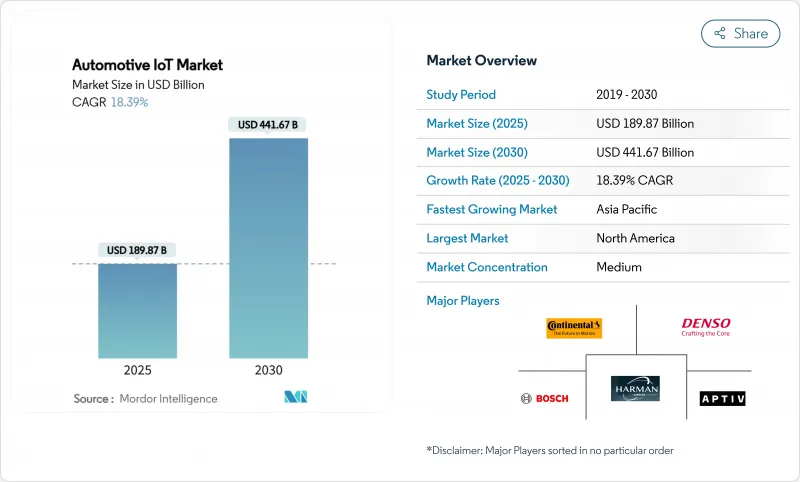
本報告按組件(硬體、軟體、服務)、連接類型(嵌入式、網路共享、整合式)、應用程式(車載資訊服務、車載資訊娛樂和車載服務、高級駕駛輔助系統 (ADAS) 和安全、車隊管理、預測性維護)、網路技術(蜂窩網路、藍牙/BLE、其他)和地區進行細分。市場預測以美元 (USD) 為單位。
全球汽車物聯網市場趨勢與洞察
原始設備製造商 (OEM) 快速轉向軟體定義汽車 (SDV)
汽車製造商正圍繞集中式網域控制器重建其電氣和電子 (E/E) 架構。這使得可以透過空中下載 (OTA) 更新部署功能,從而縮短開發週期並創造訂閱收入。 BMW已在其所有車型中部署季度軟體更新,效仿特斯拉長期以來的更新周期。集中式網路還簡化了硬體差異,從而降低零件成本並提高現場診斷的準確性。供應商也在積極回應。博世在 2024 年投資 33.9 億美元用於擴展其車輛雲平台,大陸集團則將其 40% 的工程人員重新培訓為軟體相關崗位。這些發展表明,競爭優勢正從機械工程能力轉向持續的軟體創新,從而推動了整個汽車物聯網市場的需求。
關於緊急呼叫和遠端資訊處理的強制性法規
歐盟已強制規定,自2018年3月起所有獲得型式認證的新車都必須配備「eCall」系統。該系統可在發生嚴重碰撞時自動通知緊急救援服務,從而將平均回應時間縮短高達50%。中國、巴西和印度也實施了類似的法規,其中印度的AIS-140法規也涵蓋商用車輛。由於這些法規的合規性是強制性的,即使在宏觀經濟低迷時期,市場需求也能得到保障。這將帶來規模經濟效益,降低零件價格,並促進物聯網在中端價位車型的應用。因此,即使自由裁量權消費支出放緩,汽車物聯網市場仍將保持活力。
透過 CAN 總線進行傳統系統整合時始終存在瓶頸
控制器區域網路 (CRA) 的通訊速度限制在 10 Mbps 左右,這限制了高解析度感測器融合和連續資料上傳。向汽車乙太網路過渡需要對安全關鍵領域進行廣泛的重新檢驗,而且平台專案通常跨越多個車型年份。大眾汽車在三年內花費了 20 億歐元,在其 MEB 架構上改造集中式網路,這清楚地表明了此次過渡涉及的巨大成本。這種延遲減緩了數據密集型功能的應用,暫時穩定了汽車物聯網市場的潛在市場總值 (TAV)。
細分市場分析
到2024年,硬體仍將佔汽車物聯網市場收入的46.83%,主要得益於所有連網平台捆綁的感測器、閘道器和天線。同時,服務領域呈現最快成長態勢,預計到2030年將以20.94%的複合年成長率成長,這主要得益於原始設備製造商(OEM)將數據儀錶板、功能解鎖和預測性維護等訂閱服務商業化。與服務相關的汽車物聯網市場規模反映了導航、娛樂和保險附加服務服務中「按需付費」收費的日益普及。硬體的商品化體現在模組平均售價(ASP)的下降和平台間相容性的增強,這給一級供應商的利潤率帶來了壓力。
特斯拉垂直整合的全端架構最大限度地提高了軟體收入,並樹立了競爭對手競相效仿的標竿。為此,大陸集團正在進行軟體編配的重組,博世則已撥款33.9億美元用於強化其中間件工具鏈。這些措施旨在確保在以服務為中心的汽車物聯網市場中佔據佔有率,在該市場中,客戶終身價值(CLV)取決於每月有效用戶而非出貨量。硬體生產的外包(難以區分)預計將進一步增加,使資源能夠重新分配到雲端分析、基於機器學習的個人化以及車載應用生態系統。
到2024年,51.34%的聯網汽車將配備嵌入式調變解調器,凸顯了消費者對無縫、始終在線連接的需求,這種連接方式無需再像以前那樣使用智慧型手機進行資料共享。汽車物聯網嵌入式解決方案的市佔率成長主要源自於汽車製造商對資料流和安全金鑰管理的需求。整合式、反應迅速的架構,將嵌入式基頻板與可互換的通訊前端結合,正以20.45%的複合年成長率快速成長。這些架構兼顧了面向未來的相容性和成本控制,無需完全重新設計即可更換5G和衛星通訊模組。
例如,福特在2024款F-150 Lightning皮卡中採用嵌入式5G技術,使得連網服務註冊量成長了60%,而與連網相關的保固索賠減少了50%。雖然網路共享解決方案在低價位車型和售後改裝中仍然普遍存在,但用戶體驗的差異限制了收入成長的潛力。隨著5G覆蓋範圍的擴大,整合平台有望透過結合嵌入式SIM卡的持久性和模組化射頻前端的柔軟性來彌合這一差距,從而進一步推動汽車物聯網市場的發展。
區域分析
北美保持著明顯的領先地位,預計到2024年將佔據汽車物聯網市場39.45%的佔有率。成熟的5G網路覆蓋範圍、消費者對訂閱模式的接受度以及健全的資料管治框架正在推動技術的普及。汽車製造商與科技公司之間的合作,例如寶馬、通用汽車和現代汽車參與的高功率充電項目,展現了一種協作式的基礎設施建設模式,這種模式正在加速新型資訊服務的上市週期。在政策層面,隱私問題日益受到關注,提案的《汽車資料隱私和自主法案》要求跨境資料傳輸必須獲得明確同意,並強制汽車製造商加強加密並在國內處理資料。雖然這些措施確保了信任,但也增加了合規成本,只有大規模平台才能承擔這些負擔,因此有利於成熟企業的發展。
亞太地區是成長最快的地區,預計到2030年複合年成長率將達到21.78%。在中國,新能源汽車佔輕型汽車銷售的40%以上,所有車型均需要將數據上傳至政府伺服器進行空中下載(OTA)診斷。以舊換新補助和增值稅進一步加速了更換。在印度,正著手將Bharat NCAP的安全評級星級系統與互聯互通能力(可能包括V2X就緒度指標)對接。本土化的車載資訊服務供應商正在湧現,以利用快速發展的4G+網路並滿足價格敏感型市場的需求。比亞迪和上汽等區域性汽車製造商正在以與傳統車載主機相當的組件成本整合物聯網閘道器,這凸顯了其結構性的成本優勢,並將進一步鞏固汽車物聯網市場。
歐洲汽車銷售排名第三,但它正在影響全球監管的走向。 「eCall」的強制實施為互聯互通奠定了基礎,而即將訂定的「資料法」將明確所有權,並可能重振第三方服務生態系統。像FORVIA這樣的供應商正與亞洲汽車製造商合作,在匈牙利建立組裝廠,確保本地生產支援物聯網的駕駛座,並出口到歐盟各地。根據聯合國歐洲經濟委員會WP.29工作小組的要求,網路安全認證必須持續進行修補程式管理,凸顯了軟體更新能力的重要性。儘管整體汽車銷售保持平穩,但由於高階互聯功能的搭載率,汽車物聯網市場仍在穩步成長。
其他好處:
- Excel格式的市場預測(ME)表
- 3個月的分析師支持
目錄
第1章:引言
- 研究假設和市場定義
- 調查範圍
第2章:調查方法
第3章執行摘要
第4章 市場狀況
- 市場概覽
- 市場促進因素
- 原始設備製造商正在迅速向軟體定義汽車轉型。
- 關於強制性電子呼叫和遠端資訊處理的法規(歐盟、中國、巴西、印度)
- 降低汽車蜂窩模組的成本
- 高頻寬V2X 邊緣和雲端基礎設施的擴展
- 里程保險中遠端資訊處理合作關係的興起
- 對空中下載 (OTA) 網路安全更新的需求日益成長
- 市場限制因素
- CAN總線舊有系統整合中仍然存在的瓶頸
- 原始設備製造商、經銷商和車隊之間的數據所有權糾紛
- 半導體供應鏈的地緣政治變化
- 新興市場聯網汽車服務的投資報酬率有限。
- 供應鏈分析
- 技術展望
- 監理情勢
- 波特五力分析
第5章 市場規模與成長預測
- 按組件
- 硬體
- 軟體
- 服務
- 按連線類型
- 嵌入式
- 繫繩類型
- 融合的
- 透過使用
- 車載資訊系統
- 車載資訊娛樂和車載服務
- 高級駕駛輔助系統 (ADAS) 和安全性
- 車隊管理
- 預測性保護
- 透過網路技術
- 行動電話(3G/4G/5G)
- Wi-Fi/Wi-Fi HaLow
- Bluetooth/BLE
- 衛星和全球導航衛星系統
- NFC和UWB
- 按地區
- 北美洲
- 美國
- 加拿大
- 墨西哥
- 歐洲
- 德國
- 英國
- 法國
- 義大利
- 西班牙
- 俄羅斯
- 其他歐洲國家
- 亞太地區
- 中國
- 日本
- 印度
- 韓國
- 澳洲
- 其他亞太國家
- 中東和非洲
- 中東
- 阿拉伯聯合大公國
- 沙烏地阿拉伯
- 土耳其
- 其他中東國家
- 非洲
- 南非
- 奈及利亞
- 其他非洲國家
- 中東
- 南美洲
- 巴西
- 阿根廷
- 其他南美國家
- 北美洲
第6章 競爭情勢
- 市場集中度
- 策略趨勢
- 市佔率分析
- 公司簡介
- Robert Bosch GmbH
- Continental AG
- Denso Corporation
- Aptiv plc
- Harman International Industries Incorporated
- Visteon Corporation
- Verizon Communications Inc.
- AT&T Inc.
- NXP Semiconductors NV
- Intel Corporation
- Qualcomm Incorporated
- Vodafone Group Public Limited Company
- Huawei Technologies Co., Ltd.
- International Business Machines Corporation
- LG Electronics Inc.
- Valeo SE
- ZF Friedrichshafen AG
- TomTom NV
- Garmin Ltd.
- Sierra Wireless, Inc.
第7章 市場機會與未來展望
According to Mordor Intelligence, the automotive ioT market size stands at USD 189.87 billion in 2025 and is forecast to reach USD 441.67 billion by 2030, advancing at an 18.39% CAGR in that period.
This report is Segmented by Component (Hardware, Software, and Services), Connectivity Form (Embedded, Tethered, and Integrated), Application (Telematics, Infotainment and In-Car Services, Advanced Driver Assistance Systems and Safety, Fleet Management, Predictive Maintenance), Network Technology (Cellular, Bluetooth/BLE, and More), and Geography. The Market Forecasts are Provided in Terms of Value (USD).
Global Automotive IoT Market Trends and Insights
Rapid OEM Shift toward Software-Defined Vehicles
Automakers are rebuilding electrical-electronic (E/E) architectures around centralized domain controllers that allow feature deployment through over-the-air updates, shortening development cycles and unlocking subscription revenues. BMW already pushes quarterly software releases to its full range, mirroring Tesla's long-running update cadence. Centralized networks also simplify hardware variants, lowering bill-of-materials costs and improving in-field diagnostics accuracy. Suppliers are responding: Bosch invested USD 3.39 billion in 2024 to scale its vehicle-cloud platform, while Continental re-skilled 40% of its engineering staff toward software roles. These moves illustrate how competitive advantage is shifting from mechanical prowess to continuous software innovation, reinforcing demand across the Automotive IoT market.
Mandatory eCall and Telematics Regulations
The European Union requires every new car type-approved after March 2018 to ship with eCall, a system that automatically contacts emergency services after a severe crash, cutting average response times by up to 50%. China, Brazil and India enforce comparable rules, and India's AIS-140 mandate covers commercial fleets as well. Because compliance is non-negotiable, volumes are guaranteed even during macroeconomic downturns. This creates scale economies that reduce component prices and broaden IoT inclusion across mid-price segments, sustaining the Automotive IoT market even when discretionary spending slows.
Persistent CAN Bus Legacy Integration Bottlenecks
Controller Area Network links top out near 10 Mbps, a ceiling that constrains high-resolution sensor fusion and continuous data upload. Migrating to automotive Ethernet demands extensive re-validation of safety-critical domains, often stretching platform programs by multiple model years. Volkswagen spent EUR 2 billion over three years to retrofit a centralized network into its MEB architecture, illustrating the substantial transition cost. The lag slows adoption of data-rich functions and temporarily caps total addressable value within the Automotive IoT market.
Other drivers and restraints analyzed in the detailed report include:
- Falling Cost of Automotive-Grade Cellular Modules
- Expansion of High-Bandwidth V2X Edge-Cloud Infrastructure
- Data-Ownership Disputes between OEMs, Dealers and Fleets
For complete list of drivers and restraints, kindly check the Table Of Contents.
Segment Analysis
Hardware still delivered 46.83% of Automotive IoT market revenue in 2024, anchored by sensors, gateways, and antennas bundled with every connected platform. Services, however, deliver the fastest upside, advancing at 20.94% CAGR to 2030 as OEMs commercialize data dashboards, feature unlocks, and predictive maintenance subscriptions. The Automotive IoT market size attached to services reflects the widening acceptance of pay-as-you-drive models for navigation, entertainment, and insurance add-ons. Hardware commoditization is visible in falling module ASPs and rising cross-platform interchangeability, compressing margins for tier-one suppliers.
Tesla's vertically integrated full-stack architecture maximizes software capture and sets a benchmark that peers are racing to emulate. Continental responded by reorganizing toward software orchestration, while Bosch earmarked USD 3.39 billion to accelerate middleware toolchains. These moves are designed to secure share of a services-heavy Automotive IoT market, where customer lifetime value depends on active monthly users rather than unit shipments. Outsourcing of non-differentiated hardware production is likely to intensify, freeing resources for cloud analytics, machine-learning personalization, and in-cabin app ecosystems.
Embedded modems equipped 51.34% of connected cars in 2024, confirming consumer appetite for seamless always-on services free from smartphone tethering hassles. The Automotive IoT market share attached to embedded options is supported by automaker desire to control data flows and security keys. Integration-ready architectures, combining embedded baseband boards with replaceable communication front-ends, are accelerating at 20.45% CAGR. They strike a balance between future-proofing and cost control, enabling 5G or satellite module swaps without full redesigns.
Case in point: Ford's switch to embedded 5G in the 2024 F-150 Lightning drove a 60% jump in connected-service enrollment and halved connectivity-related warranty claims. Tethered solutions persist in low-cost vehicles and aftermarket retrofits, but user experience gaps limit incremental revenue potential. As 5G coverage expands, integrated platforms will likely bridge the divide by combining the permanence of embedded SIMs with modular RF front-end flexibility, further lifting the Automotive IoT market.
Complete Report Scope:
- By Component
- Hardware
- Software
- Services
- By Connectivity Form
- Embedded
- Tethered
- Integrated
- By Application
- Telematics
- Infotainment and In-Car Services
- Advanced Driver Assistance Systems (ADAS) and Safety
- Fleet Management
- Predictive Maintenance
- By Network Technology
- Cellular (3G/4G/5G)
- Wi-Fi / Wi-Fi HaLow
- Bluetooth / BLE
- Satellite and GNSS
- NFC and UWB
- by Geography
- North America
- United States
- Canada
- Mexico
- Europe
- Germany
- United Kingdom
- France
- Italy
- Spain
- Russia
- Rest of Europe
- Asia-Pacific
- China
- Japan
- India
- South Korea
- Australia
- Rest of Asia-Pacific
- Middle East and Africa
- Middle East
- United Arab Emirates
- Saudi Arabia
- Turkey
- Rest of Middle East
- Africa
- South Africa
- Nigeria
- Rest of Africa
- Middle East
- South America
- Brazil
- Argentina
- Rest of South America
- North America
Geography Analysis
North America maintains clear leadership with a 39.45% Automotive IoT market share in 2024. Mature 5G coverage, consumer acceptance of subscription models and robust data-governance frameworks underpin adoption. Automaker-tech coalitions such as the high-power charging venture involving BMW, General Motors, Hyundai and others demonstrate a coordinated infrastructure approach that shortens go-to-market cycles for new data services. Policy focus is intensifying on privacy; the proposed Auto Data Privacy and Autonomy Act would require explicit consent for cross-border data transfers, compelling OEMs to reinforce encryption and in-country processing. These measures ensure trust yet raise compliance costs that only large platforms can absorb, favoring incumbents.
Asia-Pacific is the fastest-growing region, posting a 21.78% CAGR through 2030. China's new energy vehicle penetration exceeds 40% of light-vehicle sales and every model must log data to government servers for over-the-air diagnostics. Trade-in subsidies and value-added tax rebates further accelerate replacement cycles. India is preparing to tie Bharat NCAP safety stars to connectivity readiness, which may include V2X handling metrics. Localized telematics service providers are emerging to navigate pricing sensitivities while leveraging fast-growing 4G+ networks. Regional OEMs such as BYD and SAIC integrate IoT gateways at bill-of-materials parity with legacy head units, confirming structural cost advantages that amplify Automotive IoT market momentum.
Europe ranks third in revenue but sets global regulatory tone. The eCall mandate created baseline connectivity while the upcoming Data Act clarifies ownership, potentially unlocking third-party service ecosystems. Suppliers like FORVIA are coupling with Asian OEMs to establish assembly hubs in Hungary, ensuring localized production of IoT-equipped cockpits for export across the EU. Cybersecurity certification under UNECE WP.29 forces continuous patch management, pushing software-update capabilities to the fore. Although overall vehicle sales remain flat, higher attach rates for premium connected options keep the Automotive IoT market expanding steadily.
- Robert Bosch GmbH
- Continental AG
- Denso Corporation
- Aptiv plc
- Harman International Industries Incorporated
- Visteon Corporation
- Verizon Communications Inc.
- AT&T Inc.
- NXP Semiconductors N.V.
- Intel Corporation
- Qualcomm Incorporated
- Vodafone Group Public Limited Company
- Huawei Technologies Co., Ltd.
- International Business Machines Corporation
- LG Electronics Inc.
- Valeo SE
- ZF Friedrichshafen AG
- TomTom N.V.
- Garmin Ltd.
- Sierra Wireless, Inc.
Additional Benefits:
- The market estimate (ME) sheet in Excel format
- 3 months of analyst support
TABLE OF CONTENTS
1 INTRODUCTION
- 1.1 Study Assumptions and Market Definition
- 1.2 Scope of the Study
2 RESEARCH METHODOLOGY
3 EXECUTIVE SUMMARY
4 MARKET LANDSCAPE
- 4.1 Market Overview
- 4.2 Market Drivers
- 4.2.1 Rapid OEM shift toward software-defined vehicles
- 4.2.2 Mandatory e-Call and telematics regulations (EU, CN, BR, IN)
- 4.2.3 Falling cost of automotive-grade cellular modules
- 4.2.4 Expansion of high-bandwidth V2X edge-cloud infrastructure
- 4.2.5 Rise of usage-based insurance telematics partnerships
- 4.2.6 Growing demand for over-the-air (OTA) cybersecurity updates
- 4.3 Market Restraints
- 4.3.1 Persistent CAN bus legacy integration bottlenecks
- 4.3.2 Data-ownership disputes between OEMs, dealers and fleets
- 4.3.3 Semiconductor supply-chain geopolitical volatility
- 4.3.4 Limited ROI for connected-vehicle services in emerging markets
- 4.4 Supply-Chain Analysis
- 4.5 Technological Outlook
- 4.6 Regulatory Landscape
- 4.7 Porter's Five Forces Analysis
- 4.7.1 Threat of New Entrants
- 4.7.2 Bargaining Power of Suppliers
- 4.7.3 Bargaining Power of Buyers
- 4.7.4 Threat of Substitutes
- 4.7.5 Industry Rivalry
5 MARKET SIZE AND GROWTH FORECASTS (VALUE)
- 5.1 By Component
- 5.1.1 Hardware
- 5.1.2 Software
- 5.1.3 Services
- 5.2 By Connectivity Form
- 5.2.1 Embedded
- 5.2.2 Tethered
- 5.2.3 Integrated
- 5.3 By Application
- 5.3.1 Telematics
- 5.3.2 Infotainment and In-Car Services
- 5.3.3 Advanced Driver Assistance Systems (ADAS) and Safety
- 5.3.4 Fleet Management
- 5.3.5 Predictive Maintenance
- 5.4 By Network Technology
- 5.4.1 Cellular (3G/4G/5G)
- 5.4.2 Wi-Fi / Wi-Fi HaLow
- 5.4.3 Bluetooth / BLE
- 5.4.4 Satellite and GNSS
- 5.4.5 NFC and UWB
- 5.5 by Geography
- 5.5.1 North America
- 5.5.1.1 United States
- 5.5.1.2 Canada
- 5.5.1.3 Mexico
- 5.5.2 Europe
- 5.5.2.1 Germany
- 5.5.2.2 United Kingdom
- 5.5.2.3 France
- 5.5.2.4 Italy
- 5.5.2.5 Spain
- 5.5.2.6 Russia
- 5.5.2.7 Rest of Europe
- 5.5.3 Asia-Pacific
- 5.5.3.1 China
- 5.5.3.2 Japan
- 5.5.3.3 India
- 5.5.3.4 South Korea
- 5.5.3.5 Australia
- 5.5.3.6 Rest of Asia-Pacific
- 5.5.4 Middle East and Africa
- 5.5.4.1 Middle East
- 5.5.4.1.1 United Arab Emirates
- 5.5.4.1.2 Saudi Arabia
- 5.5.4.1.3 Turkey
- 5.5.4.1.4 Rest of Middle East
- 5.5.4.2 Africa
- 5.5.4.2.1 South Africa
- 5.5.4.2.2 Nigeria
- 5.5.4.2.3 Rest of Africa
- 5.5.4.1 Middle East
- 5.5.5 South America
- 5.5.5.1 Brazil
- 5.5.5.2 Argentina
- 5.5.5.3 Rest of South America
- 5.5.1 North America
6 COMPETITIVE LANDSCAPE
- 6.1 Market Concentration
- 6.2 Strategic Moves
- 6.3 Market Share Analysis
- 6.4 Company Profiles (includes Global level Overview, Market level overview, Core Segments, Financials as available, Strategic Information, Market Rank/Share, Products and Services, Recent Developments)
- 6.4.1 Robert Bosch GmbH
- 6.4.2 Continental AG
- 6.4.3 Denso Corporation
- 6.4.4 Aptiv plc
- 6.4.5 Harman International Industries Incorporated
- 6.4.6 Visteon Corporation
- 6.4.7 Verizon Communications Inc.
- 6.4.8 AT&T Inc.
- 6.4.9 NXP Semiconductors N.V.
- 6.4.10 Intel Corporation
- 6.4.11 Qualcomm Incorporated
- 6.4.12 Vodafone Group Public Limited Company
- 6.4.13 Huawei Technologies Co., Ltd.
- 6.4.14 International Business Machines Corporation
- 6.4.15 LG Electronics Inc.
- 6.4.16 Valeo SE
- 6.4.17 ZF Friedrichshafen AG
- 6.4.18 TomTom N.V.
- 6.4.19 Garmin Ltd.
- 6.4.20 Sierra Wireless, Inc.
7 MARKET OPPORTUNITIES AND FUTURE OUTLOOK
- 7.1 White-space and Unmet-Need Assessment

 汽車物聯網全球市場規模、佔有率、趨勢和成長分析報告(2026-2034)
 V2I(車路通訊)市場-2026-2032年全球市場預測
 汽車數位轉型市場規模、佔有率和成長分析:按解決方案類型、組件、部署模式、最終用戶、應用、企業規模和地區分類-2026-2033年產業預測汽車物聯網市場:按組件、連接方式、應用、車輛類型和最終用戶分類-2026-2032年全球市場預測
 汽車物聯網市場預測至2034年:按組件、連接技術、車輛類型、應用和區域分類的全球分析
 汽車物聯網市場:按交付方式、連接形式、通訊方式、應用和區域分類
 2026年全球車輛和基礎設施通訊市場報告汽車網際網路市場:按服務、連接技術、車輛類型、應用和最終用戶分類-2026-2032年全球市場預測2026年全球汽車物聯網市場報告
 汽車物聯網市場規模、佔有率和成長分析:按通訊方式、交付方式、連接方式、應用、最終用戶和地區分類-產業預測(2026-2033 年)