


 |
市場調查報告書
商品編碼
2097261
高空作業平台:市場佔有率分析、產業趨勢與統計、成長預測(2026-2031 年)Aerial Work Platform - Market Share Analysis, Industry Trends & Statistics, Growth Forecasts (2026 - 2031) |
||||||

※ 本網頁內容可能與最新版本有所差異。詳細情況請與我們聯繫。
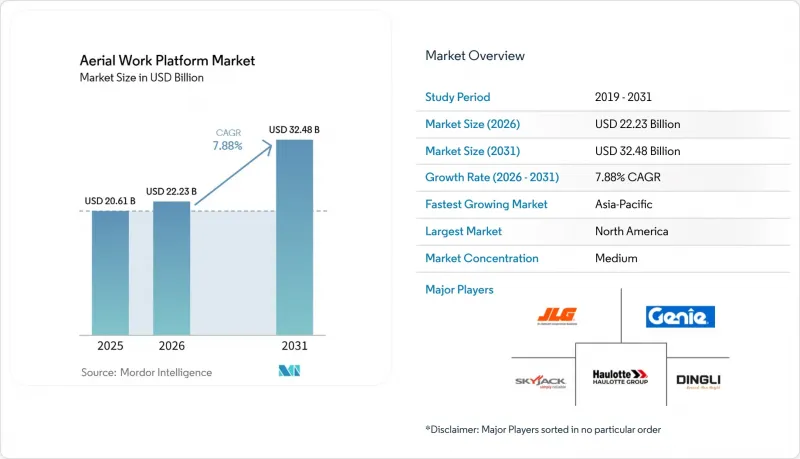
根據 Mordor Intelligence 預測,高空作業平台市場規模將從 2025 年的 206.1 億美元成長到 2026 年的 222.3 億美元,然後在 2031 年達到 324.8 億美元,2026 年至 2031 年的複合年成長率為 7.8%。
本報告按產品類型(臂式升降機、剪式升降機、垂直升降機、拖車式升降機)、驅動系統(內燃機、電動、混合動力)、工作高度(20英尺以下、21-50英尺、51-100英尺、100英尺以上)、應用領域(建築、公共產業、其他)和地區進行細分。市場預測以美元計價。
全球高空作業平台市場趨勢與洞察
全球基礎設施與商業建築熱潮
在美國、加拿大和印度的基礎設施獎勵策略推動下,大型企劃不斷湧現,持續帶動高空作業平台設備升級的需求。光是美國《基礎設施投資與就業法案》就已確保了多年資金,用於公路、橋樑和公共產業的維修。隨著資料中心、超級工廠和多層工業廠房等建築結構日益複雜,兼具長臂作業能力和緊湊底盤尺寸的高空作業設備需求也日益成長。因此,製造商紛紛推出更高承載能力的鉸接式臂架高空作業平台,這些平台配備了符合ANSI A92安全使用規範的輔助保護裝置和即時負載感測模組。租賃公司向終端用戶提供這些功能升級,即使部分細分領域的整體建築支出有所下降,運轉率保持強勁。
加強有關工人安全的法規
美國職業安全與健康管理局 (OSHA) 標準 1926.453 和 1910.67,以及 2018 年對 ANSI A92 標準的全面修訂,均強制要求雇主為所有移動式高空作業平台 (MEWP) 提供特定型號的培訓、防墜落保護和記錄在案的檢查。這套法規大幅增加了部署過時或未經認證設備的成本,促使承包商轉向採用新型設備,這些新設備配備了傾斜警告、平台載荷感測器和自動下降控制等功能。合規性審核日益頻繁,專案客戶也擴大將 MEWP 認證作為預篩選分包商的基準。設備製造商正積極回應,推出創新技術,例如 Haulotte 的 FASTN 安全繩錨點檢測功能,該功能榮獲 2024 年「最佳安全創新獎」。這種安全文化的持續轉變進一步提升了整合合規功能的設備的溢價潛力。
高初始投資成本與傳統工作方法的比較
2020年至2024年間,鋼鐵和電子元件成本飆升,導致新型中檔剪式升降機的標價上漲近30%,與支架和梯子等替代方案的價格差距進一步拉大。因此,小規模企業難以證明購買此類設備的合理性,他們往往選擇短期租賃或重新採用勞動密集的傳統低空作業方式。同時,自動化和安全措施帶來的成本降低正在抵銷部分初始投資。製造商正透過提供模組化組件來滿足這一需求,這些組件可以降低運輸成本,並提供管道支架和麵板托架等多功能配件,從而提高單一設備的運轉率。
細分市場分析
預計到2025年,臂式升降機將佔據高空作業平台市場最大佔有率,達到43.24%,其地位得以維持,因為在擁擠的工地上,多功能性仍然是多工種作業的首要考慮因素。鉸接式升降機具有靈活的作業角度,無需改變底盤位置即可避開鋼結構和暖通空調管道,從而提高作業效率。 Haulotte公司於2024年推出的「HA20 RTJ PRO」標誌著高空作業平台的發展方向轉向效能指標,例如更快的提升速度和負載感應底盤,該底盤可在最大負載容量下實現全高度作業。剪式升降機在涉及多名工人的室內施工中仍然佔據主導地位,但持續的商品化正在對其價格構成下行壓力。受倉庫業者對零轉彎半徑的優先考慮,垂直桅杆式升降機預計將以8.84%的複合年成長率實現最高成長率。拖車式臂架升降機在公共產業和電信業者的維護工作中仍然發揮著重要作用,但自行式升降機在農村地區可能會超過重量限制,違反道路法規。
隨著時間的推移,製造商已在其所有產品線中實現了遠端資訊處理硬體的標準化,使得租賃公司能夠將臂式升降機和剪式升降機的性能數據整合到一個統一的儀錶板中。為了符合城市排放氣體法規,配備引擎關閉時電動蠕行模式的混合動力傳動系統正從高階臂式升降機逐步推廣到中階剪式升降機。臂式升降機的二手價格仍然是所有類別中最高的,這促使車隊所有者將不成比例的大量資金投入到這些機型上,進一步鞏固了它們在高空作業平台市場的主導地位。
即使到了2025年,內燃機仍將佔據高空作業平台61.74%的市場佔有率,但電動高空作業平台的市佔率成長速度遠超其他任何動力系統。隨著都市區法規逐步淘汰重啟工程的柴油使用,電動高空作業平台市場正以10.26%的複合年成長率高速成長。鋰離子電池組在低谷時段充電後,可為一台40英尺剪式升降機提供一次班次的運作時間,同時與同等丙烷動力設備相比,能源成本降低約30%。混合動力配置為充電基礎設施不完善的偏遠地區應用提供了一種過渡方案,透過將小型引擎與再生煞車相結合,延長了運作時間。
原始設備製造商 (OEM) 面臨著電池金屬價格飆升的不可避免的風險,但許多製造商正透過與汽車製造商簽訂聯合正極材料供應協議來規避這一風險。英國的 HS2 高速鐵路網正在試驗建設現場快速充電站,預計在聯邦基礎設施津貼的支持下,類似的舉措將在北美高速公路上推廣。安全標準也不斷發展,在一系列由鋰離子電池組引發的火災後,UL 2580 防火認證已成為主要租賃公司的採購標準之一。因此,儘管電池的絕對成本預計將在 2027 年後逐步下降,但電氣化的推進將進一步鞏固高空作業平台市場的高階細分市場。
區域分析
到2025年,北美將在高空作業平台市場佔據34.76%的市場。持續的更新換代週期,得益於ANSI A92標準的合規性和聯邦政府的大規模支持,推動了對配備遠端資訊處理系統的新型車輛的需求。像聯合租賃(United Rentals)這樣的公司展現了支撐主導地位的規模。加拿大的成長主要集中在資源產業的擴張和強制性的城市維修上,而墨西哥的近岸外包熱潮則推動了汽車和電子工廠對中高空電動高空作業平台的需求。
亞太地區預計將實現9.27%的最高複合年成長率,這主要得益於快速的都市化和產業多元化。儘管中國整體施工機械市場在2023年出現萎縮,但從2024年中期開始趨於穩定,寬鬆的貨幣政策有望活性化都市區計畫和資料中心走廊的高空作業平台訂單。印度市場正因大規模鐵路和機場項目的擴張而成長。東南亞國家——印尼、越南和菲律賓——正崛起為新的成長中心,區域電商營運商不斷建造多層履約中心,從而推動了對30-40英尺電動高空作業平台的需求。
歐洲市場雖然依然成熟,但同時也是一個高度創新導向的市場。 2023年,德國和芬蘭的車輛新增量均達到兩位數,而西班牙等南歐國家則受到財政限制,導致復甦步伐不平衡。更嚴格的第五階段排放氣體法規正在加速柴油剪式升降機被混合動力或純電動車型取代。這一趨勢在荷蘭和斯堪地那維亞國家尤為明顯,這些國家強制要求城市項目實現「區域內零排放」。在中東,沙烏地阿拉伯NEOM新城的大型專案對高空作業的需求不斷增加。非洲和南美洲仍處於相對發展階段,但隨著基礎設施資金籌措的改善,二手設備的進口量正在逐漸增加。總而言之,這些區域特徵凸顯了高空作業平台市場整體上雖不均衡但呈上升趨勢的態勢。
其他好處:
- Excel格式的市場預測(ME)表
- 3個月的分析師支持
目錄
第1章:引言
- 研究假設和市場定義
- 調查範圍
第2章:調查方法
第3章執行摘要
第4章 市場狀況
- 市場概覽
- 市場促進因素
- 全球基礎設施和商業建築的蓬勃發展
- 加強職業安全法規
- 提高高空作業平台租賃滲透率
- 電子商務物流倉儲自動化技術的快速發展
- 利用遠端資訊處理進行預測性維護和遠距離診斷
- 在電影和媒體製作以及活動組織中的應用日益廣泛。
- 市場限制因素
- 高資本成本與傳統接取方式的比較
- 低成本二手設備和替換件的供應
- 電動高空作業平台所用電池的金屬供應瓶頸
- 事故發生後責任險費用不斷上漲。
- 監理情勢
- 技術展望
- 波特五力分析
第5章 市場規模與成長預測
- 依產品
- 臂式升降機
- 剪式升降機
- 垂直升降
- 拖車式升降機
- 依推進類型
- 內燃機(ICE)
- 電的
- 混合
- 按提升高度
- 不到20英尺
- 21-50英尺
- 51-100英尺
- 超過100英尺
- 透過使用
- 建造
- 公用事業
- 物流/運輸
- 製造業
- 其他
- 按地區
- 北美洲
- 美國
- 加拿大
- 其他北美國家
- 南美洲
- 巴西
- 阿根廷
- 其他南美國家
- 歐洲
- 德國
- 英國
- 法國
- 義大利
- 西班牙
- 其他歐洲國家
- 亞太地區
- 中國
- 印度
- 日本
- 韓國
- 澳洲
- 其他亞太國家
- 中東和非洲
- 沙烏地阿拉伯
- 阿拉伯聯合大公國
- 南非
- 其他中東和非洲國家
- 北美洲
第6章 競爭情勢
- 市場集中度
- 策略趨勢
- 市佔率分析
- 公司簡介
- JLG Industries(Oshkosh Corp.)
- Genie-Terex Corporation.
- Haulotte Group
- Skyjack-Linamar Corporation
- Zhejiang Dingli Machinery
- MEC Aerial Work Platforms
- Aichi Corporation
- Tadano Ltd.
- Bronto Skylift
- Niftylift Ltd.
- Sinoboom Intelligent Equipment
- Manitou Group
- Snorkel International
- Palfinger AG
- CTE SpA
- Ruthmann Holdings
- DINO LIFT OY
- Magni Telescopic Handlers
- Runshare Heavy Industry
- Mantall Heavy Industry
第7章 市場機會與未來展望
According to Mordor Intelligence, the aerial work platform market size is expected to grow from USD 20.61 billion in 2025 to USD 22.23 billion in 2026, and is forecast to reach USD 32.48 billion by 2031, at a 7.88% CAGR over 2026-2031.
This report is Segmented by Product (Boom Lifts, Scissor Lifts, Vertical Lifts, and Trailer-Mounted Lifts), Propulsion Type (Internal-Combustion Engine, Electric, and Hybrid), Lifting Height (Below 20 Ft, 21-50 Ft, 51-100 Ft, and Above 100 Ft), Application (Construction, Utilities, and More), and Geography. The Market Forecasts are Provided in Terms of Value (USD).
Global Aerial Work Platform Market Trends and Insights
Global Infrastructure and Commercial Construction Boom
Mega-projects backed by infrastructure stimulus in the United States, Canada, and India inject sustained demand for fleet replacement into the aerial work platforms market. The U.S. Infrastructure Investment and Jobs Act alone has unlocked multi-year funding that covers highways, bridges, and utility upgrades. Heightened structural complexity-data centers, gigafactories, and multi-story industrial plants-requires access equipment that combines long outreach with compact chassis footprints. Manufacturers are therefore debuting higher-capacity articulating booms fitted with secondary guarding and real-time load-sensing modules that comply with ANSI A92 safe-use rules. Rental companies pass these feature upgrades through to end users, and utilization rates have remained resilient even as broader construction spend ebbs in some sub-segments.
Stricter Worker-Safety Regulations
OSHA standards 1926.453 and 1910.67, and the 2018 ANSI A92 overhaul, require employers to provide machine-specific training, fall-arrest equipment, and documented inspections for all mobile elevating work platforms . The rule set has effectively raised the entry cost for older or uncertified units, steering contractors toward newer fleets that embed tilt alarms, platform load sensors, and automated descent controls. Compliance audits have become more frequent, and project owners increasingly pre-qualify subcontractors based on MEWP certification. Equipment makers answer this with innovations such as Haulotte's FASTN lanyard-anchorage detection, which secured Best Safety Innovation honors in 2024. The ongoing safety culture shift thus reinforces premium pricing power for devices with integrated compliance features.
High Capital Costs vs. Conventional Access Methods
List prices for new mid-range scissor lifts rose nearly 30% between 2020 and 2024 as steel and electronics costs spiked, widening the gap against scaffolding or ladder alternatives. Smaller trades, therefore, struggle to justify ownership, opting instead for short-term rentals or reverting to labor-intensive solutions for lower-height jobs. While automation and safety savings partly offset upfront outlays. Manufacturers are responding with modular components that reduce transport costs and multifunctional accessories, such as pipe racks or panel cradles, that increase the utilization of single machines.
Other drivers and restraints analyzed in the detailed report include:
- Telematics-Enabled Predictive Maintenance and Remote Diagnostics
- Rising Use in Film/Media Production and Event Staging
- Availability of Low-Cost Used Equipment and Substitutes
For complete list of drivers and restraints, kindly check the Table Of Contents.
Segment Analysis
Boom lifts held the largest share, at 43.24%, of the aerial work platforms market in 2025, a position they are projected to defend as multi-trade versatility remains paramount on congested job sites. Articulating models integrate outreach angles that enable operators to clear steel structures and HVAC ductwork without repositioning base vehicles, boosting cycle productivity. Haulotte's HA20 RTJ PRO, launched in 2024, is emblematic of the category's pivot toward performance metrics such as faster lift speeds and load-sensing chassis that enable full-height operation at full load capacity. Scissor lifts dominate multi-worker indoor fit-out tasks, but steady commoditization keeps their price points under downward pressure. Vertical mast lifts are on track for the fastest 8.84% CAGR, driven by warehouse operators who value their zero-turn radii. Trailer-mounted booms remain relevant for utilities and telecoms maintenance, whereas self-propelled units would exceed weight limits in rural areas and breach road regulations.
Over time, manufacturers standardize telematics hardware across product families, enabling rental companies to consolidate boom-lift and scissor performance data into a single dashboard. Hybrid powertrains with engine-off electric creep modes are migrating from high-end booms into midsize scissors, aligning with city-center emissions bylaws. Because boom-lift resale values remain highest among all categories, fleet owners allocate disproportionate capital toward these units, reinforcing their primacy in the aerial work platforms market.
Internal-combustion engines still capture 61.74% market share in the aerial work platforms market in 2025, yet electric variants capture an incremental share faster than any other propulsion cohort. The aerial work platforms market size for electric models is expanding at a double-digit 10.26% CAGR as urban ordinances phase out diesel on redevelopment sites. Lithium-ion packs now deliver full-shift autonomy for a 40-ft scissor at an energy cost about 30% lower than propane equivalents when charged overnight on the grid. Hybrid configurations provide bridge solutions in remote applications lacking charging infrastructure, combining downsized engines with regenerative braking to extend runtime.
OEMs face unavoidable exposure to battery-metal price surges, but many hedge by signing cathode-material contracts alongside automakers. On-site fast-charge stations are being trialed on United Kingdom. HS2 rail lots and will likely cascade into North American highways funded by federal infrastructure grants. Safety codes are also evolving; UL 2580 fire-resistance certification has become a purchasing criterion for rental majors following several high-profile lithium-pack fires. Consequently, electric adoption will reinforce the premium tier of the aerial work platforms market even as absolute battery costs gradually trend lower post-2027.
Complete Report Scope:
- By Product
- Boom Lifts
- Scissor Lifts
- Vertical Lifts
- Trailer-Mounted Lifts
- By Propulsion Type
- Internal-Combustion Engine (ICE)
- Electric
- Hybrid
- By Lifting Height
- Below 20 ft
- 21 - 50 ft
- 51 - 100 ft
- Above 100 ft
- By Application
- Construction
- Utilities
- Logistics and Transportation
- Manufacturing
- Others
- By Geography
- North America
- United States
- Canada
- Rest of North America
- South America
- Brazil
- Argentina
- Rest of South America
- Europe
- Germany
- United Kingdom
- France
- Italy
- Spain
- Rest of Europe
- Asia-Pacific
- China
- India
- Japan
- South Korea
- Australia
- Rest of Asia-Pacific
- Middle East and Africa
- Saudi Arabia
- United Arab Emirates
- South Africa
- Rest of Middle East and Africa
- North America
Geography Analysis
North America commanded 34.76% market share in the aerial work platforms market in 2025. Continuous replacement cycles driven by ANSI A92 compliance and large federal funding allocations sustain demand for new telematics-equipped fleets. Companies like United Rentals evidence the scale underpinning this geographic leadership. Canadian growth centers on resource-sector expansion and retrofit mandates in urban cores, whereas Mexico's near-shoring boom stimulates purchases of mid-height electrics for automotive and electronics plants.
Asia-Pacific is on track to achieve the fastest CAGR at 9.27%, supported by rapid urbanization and industrial diversification. While China's broader construction equipment market shrank in 2023, stabilization began in mid-2024, and policy credit easing is expected to rekindle AWP orders for metro projects and data-center corridors. The Indian market is growing through the expansion of mega rail and airport projects. Southeast Asian economies-Indonesia, Vietnam, and the Philippines-are emerging hotspots as regional e-commerce players replicate multi-level fulfillment hubs, fuelling appetite for 30- to 40-ft electrics.
Europe remains a mature but innovation-oriented market. Germany and Finland saw double-digit fleet additions in 2023, but southern states such as Spain wrestled with fiscal constraints, producing uneven recovery patterns. Stricter Stage V emissions standards accelerate replacement of diesel scissors with hybrid or fully electric alternatives, particularly in the Netherlands and Scandinavia, where zero-local-emission mandates apply to city-center projects. The Middle East is ramping up ultra-high-reach needs for giga-projects across Saudi Arabia's NEOM zones. Africa and South America remain comparatively nascent, yet gain incremental imports of used units as infrastructure financing improves. Together, these regional nuances underline the non-uniform but overall upward trajectory of the aerial work platforms market.
- JLG Industries (Oshkosh Corp.)
- Genie - Terex Corporation.
- Haulotte Group
- Skyjack - Linamar Corporation
- Zhejiang Dingli Machinery
- MEC Aerial Work Platforms
- Aichi Corporation
- Tadano Ltd.
- Bronto Skylift
- Niftylift Ltd.
- Sinoboom Intelligent Equipment
- Manitou Group
- Snorkel International
- Palfinger AG
- CTE SpA
- Ruthmann Holdings
- DINO LIFT OY
- Magni Telescopic Handlers
- Runshare Heavy Industry
- Mantall Heavy Industry
Additional Benefits:
- The market estimate (ME) sheet in Excel format
- 3 months of analyst support
TABLE OF CONTENTS
1 Introduction
- 1.1 Study Assumptions & Market Definition
- 1.2 Scope of the Study
2 Research Methodology
3 Executive Summary
4 Market Landscape
- 4.1 Market Overview
- 4.2 Market Drivers
- 4.2.1 Global Infrastructure and Commercial Construction Boom
- 4.2.2 Stricter Worker-Safety Regulations
- 4.2.3 Growing Rental Penetration of AWPs
- 4.2.4 Rapid Warehouse Automation in E-Commerce Logistics
- 4.2.5 Telematics-Enabled Predictive Maintenance and Remote Diagnostics
- 4.2.6 Rising Use in Film/Media Production and Event Staging
- 4.3 Market Restraints
- 4.3.1 High Capital Costs Vs. Conventional Access Methods
- 4.3.2 Availability of Low-Cost Used Equipment and Substitutes
- 4.3.3 Battery-Metals Supply Bottlenecks for Electric AWPs
- 4.3.4 Escalating Liability-Insurance Costs After Accidents
- 4.4 Regulatory Landscape
- 4.5 Technological Outlook
- 4.6 Porter's Five Forces Analysis
- 4.6.1 Threat of New Entrants
- 4.6.2 Bargaining Power of Suppliers
- 4.6.3 Bargaining Power of Buyers
- 4.6.4 Threat of Substitutes
- 4.6.5 Competitive Rivalry
5 Market Size & Growth Forecasts
- 5.1 By Product
- 5.1.1 Boom Lifts
- 5.1.2 Scissor Lifts
- 5.1.3 Vertical Lifts
- 5.1.4 Trailer-Mounted Lifts
- 5.2 By Propulsion Type
- 5.2.1 Internal-Combustion Engine (ICE)
- 5.2.2 Electric
- 5.2.3 Hybrid
- 5.3 By Lifting Height
- 5.3.1 Below 20 ft
- 5.3.2 21 - 50 ft
- 5.3.3 51 - 100 ft
- 5.3.4 Above 100 ft
- 5.4 By Application
- 5.4.1 Construction
- 5.4.2 Utilities
- 5.4.3 Logistics and Transportation
- 5.4.4 Manufacturing
- 5.4.5 Others
- 5.5 By Geography
- 5.5.1 North America
- 5.5.1.1 United States
- 5.5.1.2 Canada
- 5.5.1.3 Rest of North America
- 5.5.2 South America
- 5.5.2.1 Brazil
- 5.5.2.2 Argentina
- 5.5.2.3 Rest of South America
- 5.5.3 Europe
- 5.5.3.1 Germany
- 5.5.3.2 United Kingdom
- 5.5.3.3 France
- 5.5.3.4 Italy
- 5.5.3.5 Spain
- 5.5.3.6 Rest of Europe
- 5.5.4 Asia-Pacific
- 5.5.4.1 China
- 5.5.4.2 India
- 5.5.4.3 Japan
- 5.5.4.4 South Korea
- 5.5.4.5 Australia
- 5.5.4.6 Rest of Asia-Pacific
- 5.5.5 Middle East and Africa
- 5.5.5.1 Saudi Arabia
- 5.5.5.2 United Arab Emirates
- 5.5.5.3 South Africa
- 5.5.5.4 Rest of Middle East and Africa
- 5.5.1 North America
6 Competitive Landscape
- 6.1 Market Concentration
- 6.2 Strategic Moves
- 6.3 Market Share Analysis
- 6.4 Company Profiles (includes Global-level Overview, Market-level Overview, Core Segments, Financials, Strategic Information, Market Rank/Share for key companies, Products & Services, Recent Developments)
- 6.4.1 JLG Industries (Oshkosh Corp.)
- 6.4.2 Genie - Terex Corporation.
- 6.4.3 Haulotte Group
- 6.4.4 Skyjack - Linamar Corporation
- 6.4.5 Zhejiang Dingli Machinery
- 6.4.6 MEC Aerial Work Platforms
- 6.4.7 Aichi Corporation
- 6.4.8 Tadano Ltd.
- 6.4.9 Bronto Skylift
- 6.4.10 Niftylift Ltd.
- 6.4.11 Sinoboom Intelligent Equipment
- 6.4.12 Manitou Group
- 6.4.13 Snorkel International
- 6.4.14 Palfinger AG
- 6.4.15 CTE SpA
- 6.4.16 Ruthmann Holdings
- 6.4.17 DINO LIFT OY
- 6.4.18 Magni Telescopic Handlers
- 6.4.19 Runshare Heavy Industry
- 6.4.20 Mantall Heavy Industry
7 Market Opportunities & Future Outlook

 2026-2030年全球車載式高空作業平台(AWP)市場
 高空雲梯消防車市場規模、佔有率和成長分析:按車輛類型、雲梯高度、應用、最終用戶和地區分類-2026-2033年產業預測
 路燈安裝用移動式升降工作平台市場:全球市場預測,2026-2032年套筒式高空作業平台市場:全球市場預測(2026-2032年)
 2026-2034年全球高空作業平台車市場規模、佔有率、趨勢和成長分析報告全球高空作業平台市場規模、佔有率、趨勢和成長分析報告(2026-2034年)高空作業平台市場規模、佔有率、成長、全球產業分析、區域趨勢及2026年至2034年預測。車載式高空作業平台市場-2026-2032年全球市場預測高空作業平台市場:按類型、驅動系統、平台高度、輪胎類型、應用和最終用戶分類-2026-2032年全球市場預測
 高空作業平台租賃市場:市場機會、成長促進因素、產業趨勢分析及未來預測(2026-2035)