


 |
市場調查報告書
商品編碼
2097197
中東和非洲的人工智慧、網路安全和巨量資料分析:市場佔有率分析、行業趨勢和統計數據以及成長預測(2026-2031 年)MEA AI, Cybersecurity and Big Data Analytics - Market Share Analysis, Industry Trends & Statistics, Growth Forecasts (2026 - 2031) |
||||||

※ 本網頁內容可能與最新版本有所差異。詳細情況請與我們聯繫。
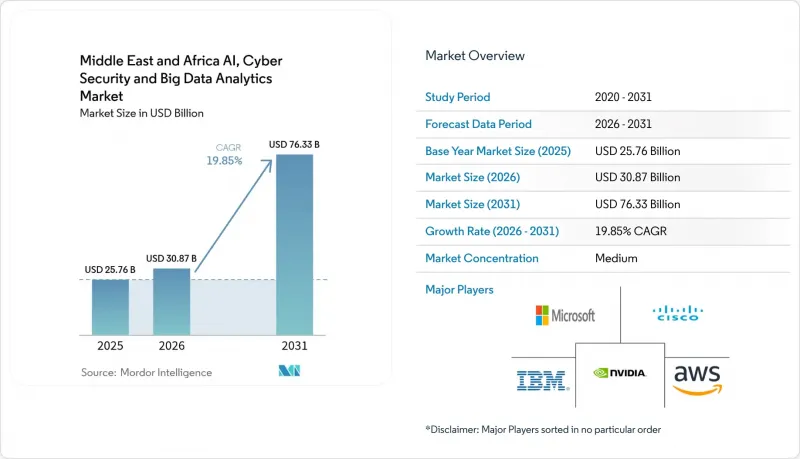
據 Mordor Intelligence 稱,中東和非洲地區的人工智慧、網路安全和巨量資料分析市場規模預計在 2025 年為 257.6 億美元,2026 年為 308.7 億美元,到 2031 年將達到 763.3 億美元,預計在預測期(2026-2031 年將達到 763.3 億美元,預計在預測期(2026-2031 年年成長率為 19.199.8%。
本報告按組件(硬體、軟體、服務)、安全類型(網路安全等)、分析類型(資料發現和視覺化等)、最終用戶產業(IT和電信等)、最終用戶公司規模(大型企業、中小企業)以及地區(阿拉伯聯合大公國等)進行細分。市場預測以美元計價。
中東和非洲(MEA)人工智慧、網路安全和巨量資料分析市場的趨勢和洞察
政府支持的人工智慧基金正在海灣合作理事會各國不斷擴大,改變該地區的創新格局。
海灣合作理事會(GCC)主權財富基金在2024年至2025年間將其在人工智慧領域的投資增加了五倍。值得關注的例子包括阿布達比的MGX,目標是在人工智慧基礎設施方面投資1,000億美元;以及沙烏地阿拉伯的公共投資基金(PIF),該基金向創投夥伴關係撥款400億美元。這些投資優先用於國內模型訓練、資料中心容量擴容以及語言調查(主要針對阿拉伯語),旨在建立一個能夠為3.5億阿拉伯語使用者提供符合其文化背景的解決方案的本地供應商生態系統。政府資金也透過合資企業吸引國際合作夥伴,這些合資企業在加速技術轉移的同時,也確保了資料居住要求的合規性。
「雲端優先」政策的加速推進正在推動公共部門的數位轉型。
沙烏地阿拉伯的DEEM計畫整合了237個機構的175個資料中心,節省了13.3億美元的成本。這清楚地展現了強制採用雲端運算帶來的財務和營運效益。阿拉伯聯合大公國和卡達也在推行類似的舉措,要求兩國政府將其工作負載遷移到本地超大規模資料中心。這導致與零信任控制、雲端存取安全仲介和自動化合規管理相關的採購激增。
缺乏以阿拉伯語為母語的人工智慧人才和數據標註的專業知識,限制了實施速度。
僅有12%的受訪公司表示已為人工智慧實施做好充分準備,這反映出能夠建立高品質語料庫(用於模型微調)的阿拉伯語資料科學家和標註人員短缺。這套頸部延長了概念驗證(PoC)階段,並增加了對託管服務的依賴。
細分市場分析
到2025年,軟體收入佔比將達到48.18%,這主要得益於SIEM、XDR和視覺化解決方案的普及,這些解決方案構成了企業安全架構的基礎。然而,隨著各組織採購諮詢、整合和全天候託管檢測服務以應對全部區域的人才短缺問題,服務板塊預計將以21.78%的複合年成長率創造大部分新增價值。隨著超大規模資料中心業者完成新的可用區建設並運作GPU即服務叢集,服務板塊在中東和非洲人工智慧、網路安全和巨量資料分析市場的佔有率預計將進一步擴大。
由於硬體屬於高資本密集產業,其成長速度正在放緩,企業傾向採用計量收費模式,將GPU折舊免稅額轉嫁給服務供應商。因此,在銀行、金融和保險(BFSI)以及醫療保健等需要全天候運作的行業,託管安全和AIOps訂閱已成為核心交付方式。
隨著通訊業者加強其5G基礎設施抵禦訊號風暴和DDoS攻擊的能力,網路保護工具市場預計到2025年將達到28.55%的市場佔有率。由於公共部門的「雲端優先」政策和企業的混合策略要求在多重雲端環境中持續進行安全態勢管理,雲端安全預計將以20.92%的複合年成長率成長。在中東和非洲,由於資料外洩通知義務可能導致高達200萬迪拉姆的罰款,人工智慧、網路安全和巨量資料分析市場的雲端安全領域規模進一步擴大,迫使董事會優先考慮集中管理。
API、OT 和 ID 層的整合正在推動整合策略引擎的發展,同時也催生了專門的模型一致性掃描器,用於檢測生成式 AI 應用中「幻覺」和「提示注入」的風險。
其他好處:
- Excel格式的市場預測(ME)表
- 3個月的分析師支持
目錄
第1章:引言
- 市場定義與研究假設
- 調查範圍
第2章:調查方法
第3章執行摘要
第4章 市場狀況
- 市場概覽
- 市場促進因素
- 海灣合作理事會地區擴大人工智慧相關政府資金投入
- 公部門加速推行「雲端優先」政策
- 零售和銀行、金融服務及保險(BFSI)產業為實現高度個人化的客戶體驗而展開的競爭
- 5G和物聯網的普及正在推動邊緣分析的需求。
- 強制性資料本地化和網路彈性相關法規
- 利用基因人工智慧的大規模阿拉伯語模型的興起
- 市場限制因素
- 缺乏精通阿拉伯語的人工智慧人才和數據標註的專業知識。
- 碎片化的傳統OT網路阻礙了零信任的採用。
- GPU基礎設施整體擁有成本高,且大量使用矽晶圓
- 地緣政治網路風險加劇,推高了保險費。
- 價值鏈分析
- 重要法規結構的評估
- 對關鍵相關人員的影響評估
- 技術展望
- 波特五力分析
- 宏觀經濟因素的影響
第5章 市場規模與成長預測
- 按組件
- 硬體
- AI加速器(GPU/ASIC)
- 邊緣設備和感測器
- 軟體
- 安全平台(SIEM/XDR/SASE)
- 分析和視覺化套件
- 服務
- 專業(諮詢、整合)
- 託管式(MSSP、AIOps、DAaaS)
- 硬體
- 按安全類型
- 網路
- 雲
- 應用
- 端點
- 無線/物聯網
- 其他新興領域(API、OT)
- 按分析類型
- 數據發現與視覺化
- 進階分析/預測分析
- 即時串流分析
- 按最終用戶行業分類
- 資訊科技/通訊
- 零售與電子商務
- 公共部門和智慧城市
- BFSI
- 製造業/建築業
- 醫療保健和生命科學
- 能源公用事業
- 運輸和物流
- 其他行業(教育、媒體)
- 按最終用戶公司規模分類
- 大公司
- SME
- 國家
- 阿拉伯聯合大公國
- 沙烏地阿拉伯
- 卡達
- 土耳其
- 埃及
- 南非
第6章 競爭情勢
- 市場集中度
- 策略趨勢
- 市佔率分析
- 公司簡介
- Microsoft Corporation
- NVIDIA Corporation
- Amazon Web Services, Inc.
- Cisco Systems, Inc.
- IBM Corporation
- SAP SE
- Oracle Corporation
- Palo Alto Networks, Inc.
- Trend Micro Incorporated
- Fortinet, Inc.
- Check Point Software Technologies Ltd.
- Darktrace plc
- SAS Institute Inc.
- QlikTech International AB
- Teradata Corporation
- Tableau Software LLC(Salesforce, Inc.)
- TIBCO Software Inc.
- AvidBeam Technologies
- Synapse Technology Corporation
- NEC Corporation
- StarLink
第7章 市場機會與未來趨勢
- 評估未開發的領域和未滿足的需求
According to Mordor Intelligence, the middle east and Africa AI, Cybersecurity, and Big Data Analytics market size was valued at USD 25.76 billion in 2025 and estimated to grow from USD 30.87 billion in 2026 to reach USD 76.33 billion by 2031, at a CAGR of 19.85% during the forecast period (2026-2031).
This report is Segmented by Component (Hardware, Software, Services), Security Type (Network, and More), Analytics Type (Data Discovery and Visualization, and More), End-User Industry (IT and Telecom, and More), End-User Enterprise Size (Large Enterprises, Smes), and Geography (UAE, and More). The Market Forecasts are Provided in Terms of Value (USD).
MEA AI, Cybersecurity and Big Data Analytics Market Trends and Insights
Expanding sovereign AI funds across the GCC transforms regional innovation
GCC sovereign wealth vehicles quintupled AI allocations during 2024-25, exemplified by Abu Dhabi's MGX targeting USD 100 billion for AI infrastructure and Saudi Arabia's Public Investment Fund earmarking USD 40 billion for venture partnerships . Investment prioritizes domestic model training, data-center capacity, and Arabic-centric language research, creating local vendor ecosystems able to serve 350 million Arabic speakers with culturally relevant solutions. Sovereign capital also crowds in foreign partners through joint ventures that accelerate technology transfer while ensuring data residency compliance.
Accelerated cloud-first mandates drive public-sector digital transformation
Saudi Arabia's DEEM program consolidated 175 data centers across 237 entities and saved USD 1.33 billion, showcasing the fiscal and operational gains of mandatory cloud adoption. Parallel initiatives in the UAE and Qatar mandate migration of government workloads to local hyperscale regions, prompting a surge in procurement for zero-trust controls, cloud access security brokers, and automated compliance management.
Scarcity of Arabic AI talent and data-labeling expertise limits deployment speed
Only 12% of enterprises surveyed feel fully prepared for AI adoption, reflecting shortages of native Arabic data scientists and annotators able to curate high-quality corpora for model fine-tuning. This bottleneck prolongs proof-of-concept phases and elevates the dependence on managed services.
Other drivers and restraints analyzed in the detailed report include:
- Retail and BFSI race for hyper-personalized CX
- 5G-IoT proliferation fuels edge analytics demand
- Fragmented legacy OT networks hinder zero-trust rollouts
For complete list of drivers and restraints, kindly check the Table Of Contents.
Segment Analysis
Software retained 48.18% of 2025 revenue due to entrenched SIEM, XDR, and visualization deployments that anchor enterprise security architectures. Yet services will generate the bulk of incremental value at a 21.78% CAGR as organizations procure consulting, integration, and 24/7 managed detection in response to region-wide talent gaps. The Middle East and Africa AI, Cybersecurity, and Big Data Analytics market share for services is projected to widen once hyperscalers complete new availability zones and activate GPU-as-a-Service clusters.
Hardware growth tempers because of high capital intensity, with enterprises favoring consumption-based models that shift GPU depreciation to service providers. Consequently, managed security and AIOps subscriptions become core delivery mechanisms across BFSI and healthcare cohorts confronting 24/7 uptime mandates.
Network protection tools held a 28.55% stake in 2025 as telecom operators hardened 5G infrastructure against signaling storms and DDoS attacks. Cloud security will log a 20.92% CAGR because public-sector cloud-first edicts and enterprise hybrid strategies require continuous posture management across multi-cloud estates. The Middle East and Africa AI, Cybersecurity, and Big Data Analytics market size for cloud security is further amplified by mandatory breach-notification laws carrying fines up to AED 2 million, pushing boards to prioritize centralized controls.
Convergence of API, OT, and identity layers drives unified policy engines, while specialized model-integrity scanners emerge to detect hallucination or prompt-injection risks in generative AI applications.
Complete Report Scope:
- By Component
- Hardware
- AI Accelerators (GPU/ASIC)
- Edge Devices and Sensors
- Software
- Security Platforms (SIEM/XDR/SASE)
- Analytics and Visualization Suites
- Services
- Professional (Consulting, Integration)
- Managed (MSSP, AIOps, DAaaS)
- Hardware
- By Security Type
- Network
- Cloud
- Application
- End-point
- Wireless / IoT
- Other Emerging (API, OT)
- By Analytics Type
- Data Discovery and Visualization
- Advanced / Predictive Analytics
- Real-time Streaming Analytics
- By End-user Industry
- IT and Telecom
- Retail and e-Commerce
- Public Sector and Smart Cities
- BFSI
- Manufacturing and Construction
- Healthcare and Life Sciences
- Energy and Utilities
- Transport and Logistics
- Other Industries (Education, Media)
- By End-user Enterprise Size
- Large Enterprises
- SMEs
- By Country
- United Arab Emirates
- Saudi Arabia
- Qatar
- Turkey
- Egypt
- South Africa
List of Companies Covered in this Report:
- Microsoft Corporation
- NVIDIA Corporation
- Amazon Web Services, Inc.
- Cisco Systems, Inc.
- IBM Corporation
- SAP SE
- Oracle Corporation
- Palo Alto Networks, Inc.
- Trend Micro Incorporated
- Fortinet, Inc.
- Check Point Software Technologies Ltd.
- Darktrace plc
- SAS Institute Inc.
- QlikTech International AB
- Teradata Corporation
- Tableau Software LLC (Salesforce, Inc.)
- TIBCO Software Inc.
- AvidBeam Technologies
- Synapse Technology Corporation
- NEC Corporation
- StarLink
Additional Benefits:
- The market estimate (ME) sheet in Excel format
- 3 months of analyst support
TABLE OF CONTENTS
1 INTRODUCTION
- 1.1 Market Definition and Study Assumptions
- 1.2 Scope of the Study
2 RESEARCH METHODOLOGY
3 EXECUTIVE SUMMARY
4 MARKET LANDSCAPE
- 4.1 Market Overview
- 4.2 Market Drivers
- 4.2.1 Expanding sovereign AI funds across GCC
- 4.2.2 Accelerated cloud-first mandates in public sector
- 4.2.3 Retail and BFSI race for hyper-personalized CX
- 4.2.4 5G-IoT proliferation fuelling edge analytics demand
- 4.2.5 Mandatory data-localization and cyber-resilience regulations
- 4.2.6 Rise of GenAI-powered Arabic large language models
- 4.3 Market Restraints
- 4.3.1 Scarcity of Arabic AI talent and data-labeling expertise
- 4.3.2 Fragmented legacy OT networks hindering zero-trust roll-outs
- 4.3.3 High TCO for silicon-heavy GPU infrastructure
- 4.3.4 Escalating geopolitical cyber-risk raising insurance premiums
- 4.4 Value Chain Analysis
- 4.5 Evaluation of Critical Regulatory Framework
- 4.6 Impact Assessment of Key Stakeholders
- 4.7 Technological Outlook
- 4.8 Porter's Five Forces Analysis
- 4.8.1 Bargaining Power of Suppliers
- 4.8.2 Bargaining Power of Consumers
- 4.8.3 Threat of New Entrants
- 4.8.4 Threat of Substitutes
- 4.8.5 Intensity of Competitive Rivalry
- 4.9 Impact of Macro-economic Factors
5 MARKET SIZE AND GROWTH FORECASTS (VALUE)
- 5.1 By Component
- 5.1.1 Hardware
- 5.1.1.1 AI Accelerators (GPU/ASIC)
- 5.1.1.2 Edge Devices and Sensors
- 5.1.2 Software
- 5.1.2.1 Security Platforms (SIEM/XDR/SASE)
- 5.1.2.2 Analytics and Visualization Suites
- 5.1.3 Services
- 5.1.3.1 Professional (Consulting, Integration)
- 5.1.3.2 Managed (MSSP, AIOps, DAaaS)
- 5.1.1 Hardware
- 5.2 By Security Type
- 5.2.1 Network
- 5.2.2 Cloud
- 5.2.3 Application
- 5.2.4 End-point
- 5.2.5 Wireless / IoT
- 5.2.6 Other Emerging (API, OT)
- 5.3 By Analytics Type
- 5.3.1 Data Discovery and Visualization
- 5.3.2 Advanced / Predictive Analytics
- 5.3.3 Real-time Streaming Analytics
- 5.4 By End-user Industry
- 5.4.1 IT and Telecom
- 5.4.2 Retail and e-Commerce
- 5.4.3 Public Sector and Smart Cities
- 5.4.4 BFSI
- 5.4.5 Manufacturing and Construction
- 5.4.6 Healthcare and Life Sciences
- 5.4.7 Energy and Utilities
- 5.4.8 Transport and Logistics
- 5.4.9 Other Industries (Education, Media)
- 5.5 By End-user Enterprise Size
- 5.5.1 Large Enterprises
- 5.5.2 SMEs
- 5.6 By Country
- 5.6.1 United Arab Emirates
- 5.6.2 Saudi Arabia
- 5.6.3 Qatar
- 5.6.4 Turkey
- 5.6.5 Egypt
- 5.6.6 South Africa
6 COMPETITIVE LANDSCAPE
- 6.1 Market Concentration
- 6.2 Strategic Moves
- 6.3 Market Share Analysis
- 6.4 Company Profiles (includes Global level Overview, Market level overview, Core Segments, Financials as available, Strategic Information, Market Rank/Share for key companies, Products and Services, and Recent Developments)
- 6.4.1 Microsoft Corporation
- 6.4.2 NVIDIA Corporation
- 6.4.3 Amazon Web Services, Inc.
- 6.4.4 Cisco Systems, Inc.
- 6.4.5 IBM Corporation
- 6.4.6 SAP SE
- 6.4.7 Oracle Corporation
- 6.4.8 Palo Alto Networks, Inc.
- 6.4.9 Trend Micro Incorporated
- 6.4.10 Fortinet, Inc.
- 6.4.11 Check Point Software Technologies Ltd.
- 6.4.12 Darktrace plc
- 6.4.13 SAS Institute Inc.
- 6.4.14 QlikTech International AB
- 6.4.15 Teradata Corporation
- 6.4.16 Tableau Software LLC (Salesforce, Inc.)
- 6.4.17 TIBCO Software Inc.
- 6.4.18 AvidBeam Technologies
- 6.4.19 Synapse Technology Corporation
- 6.4.20 NEC Corporation
- 6.4.21 StarLink
7 MARKET OPPORTUNITIES AND FUTURE TRENDS
- 7.1 White-space and Unmet-need Assessment


