


 |
市場調查報告書
商品編碼
2097196
亞太地區醫藥用PET包裝:市場佔有率分析、產業趨勢與統計及成長預測(2026-2031年)Asia-Pacific Pharmaceutical PET Packaging - Market Share Analysis, Industry Trends & Statistics, Growth Forecasts (2026 - 2031) |
||||||

※ 本網頁內容可能與最新版本有所差異。詳細情況請與我們聯繫。
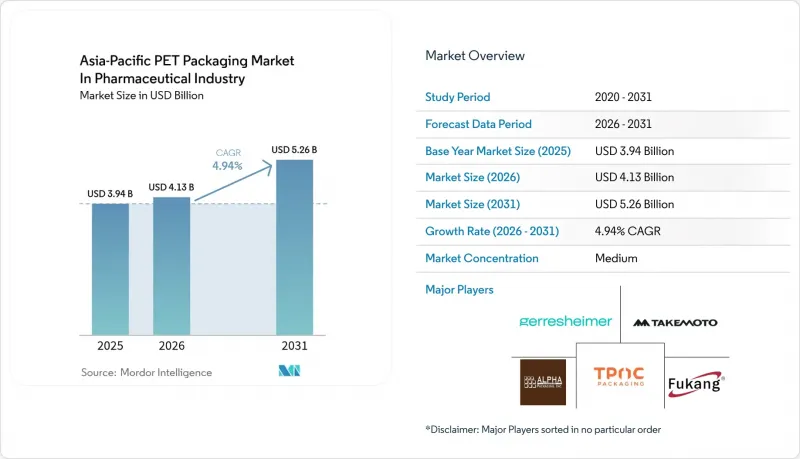
據 Mordor Intelligence 稱,亞太地區醫藥產業的 PET 包裝市場預計到 2026 年價值 41.3 億美元,高於 2025 年的 39.4 億美元,預計到 2031 年將達到 52.6 億美元。
預計從 2026 年到 2031 年,其複合年成長率將達到 4.94%。
本報告按產品類型(藥錠瓶、管瓶等)、顏色(透明、琥珀色、其他顏色)、容量(小於50毫升、51-100毫升、其他)、生產流程(拉伸吹塑成型、注塑吹塑成型等)、最終用戶(製藥公司等)和國家細分。市場預測以美元(USD)計價。
亞太地區醫藥PET包裝市場趨勢及洞察。
亞太地區藥品生產與出口的擴張
到2024年,中國和印度將供應全球62%的學名藥產量,而二級和三級包裝業務已集中在鼓勵出口導向生產的保稅製造區。越南的藥品產量增加了14%,獲得泰國投資促進委員會(BOI)優惠待遇的工廠也都在其廠區內增設了寶特瓶吹塑成型線,顯著縮短了運輸緩衝時間和庫存成本。跨國公司正日益將灌裝和包裝流程整合到原料採購地點附近,將前置作業時間從數週縮短至數天。然而,這種高度集中也增加了風險。例如,韓國PTA工廠的意外停產在72小時內就擾亂了亞洲多條供應鏈。整體而言,產量的成長正在支撐樹脂加工能力,擴大加工商的訂單積壓,並提振未來五年亞太PET包裝市場的成長前景。
過渡到輕便耐用的包裝解決方案
2020年至2024年間,製藥公司透過最佳化瓶坯延伸率和提高瓶頸強度,在不影響跌落測試性能的前提下,將瓶身重量降低了12%。對運輸條件敏感的生物製藥托運商報告稱,由於每1000瓶重量減輕了500克,從印度到撒哈拉以南非洲的空運成本降低了兩位數百分比。 PET的抗衝擊性凸顯了其耐用性,區域運輸中PET的破損率低於0.3%,而玻璃瓶的破損率為1.8%,這便是最好的證明。日本厚生勞動省等監管機構現在允許非無菌口服固體製劑使用較薄的壁厚,前提是能夠證明其阻隔性能等效,從而提高了設計的靈活性。耐用性和體重減輕的結合正在提高盈利,提升品牌在非處方藥局的形象,並加速亞太地區PET包裝市場的普及。
監管機構正在加強對塑膠廢棄物和一次性包裝的監管。
日本2024年的修正案規定,到2028年,藥品用寶特瓶必須使用30%的再生材料,不合規者的處置費用將逐步提高。在韓國,企業正面臨簽訂長期rPET供應合約的壓力,因為違反法律的生產線將面臨高達5,000萬韓元(約3.75萬美元)的罰款。中國的生產者延伸責任制(EPR)草案也將經濟責任延伸至加工商,導致全部區域的合規情況更加分散。食品級rPET的價格比原生樹脂高出34%,擠壓了利潤空間,縮小了PET的成本優勢。購買力有限的中小型製藥公司可能會推遲向PET的轉型,這可能會減緩亞太地區PET包裝市場的成長勢頭。
細分市場分析
到2025年,糖漿瓶包裝將佔亞太地區PET包裝市場銷售額的34.32%,並構成亞太地區口服液PET包裝市場佔有率的基礎,這些口服液需要寬口、標準化瓶蓋和紫外線防護。這一主導地位反映了兒童止咳藥和綜合維他命的強勁銷售量,尤其是在中國和印度尼西亞,這兩個國家的政府處方藥目錄推薦使用散裝液體製劑。儘管糖漿瓶包裝仍佔據領先地位,但隨著加工商生產線產能達到極限以及學名藥轉向單劑量製劑,其需求正在放緩。
儘管管瓶的市佔率較小,但其複合年成長率 (CAGR) 仍高達 6.12%,這主要得益於生物製藥研發管線和生物相似藥上市對 10-30 毫升規格精密容器的需求。管瓶採用注塑吹塑成型,瓶頸尺寸精度可達 ±0.05 毫米,確保了與注射器的兼容性和無菌性,因此在亞太 PET 包裝市場佔據了高階定價地位。片劑和眼藥水瓶的市佔率也在穩定成長,但成長速度較慢。同時,疫情期間激增的乾洗手劑容器需求量持續穩定在 2019 年的基準值以上,這為專注於快速換模的利基製造商創造了市場需求。
琥珀色瓶在2025年佔了45.98%的銷售額,這得益於其卓越的紫外線阻隔性能,這對光敏感抗生素和維生素組合藥物至關重要。這一佔有率反映了數十年來藥典標準對琥珀色瓶的嚴格規定。透明瓶的年複合成長率為6.56%,這主要得益於中國和印度強制實施的序列化政策,在這些國家,透明瓶壁便於高對比條碼掃描。儘管需要使用紫外線穩定的輔料,但已採用機器視覺檢測系統的製藥生產線正在轉向使用透明瓶,因為透明瓶可以提高6-8%的加工效率。
在亞太地區的PET包裝市場,透明容器的市場規模也因消費者對電商通路的信心增強而提升,電商通路尤其重視查看產品填充量的功能。此外,日本的監管指南進一步認可了對光不敏感藥品使用透明包裝的合法性,加速了這一轉變。雖然特殊顏色包裝目前仍屬於小眾市場,但它們可以帶來兩位數的溢價,使品牌能夠在不增加大量行銷成本的情況下,實現非處方藥產品的差異化。
其他好處:
- Excel格式的市場預測(ME)表
- 3個月的分析師支持
目錄
第1章:引言
- 研究假設和市場定義
- 調查範圍
第2章:調查方法
第3章執行摘要
第4章 市場狀況
- 市場概覽
- 市場促進因素
- 亞太地區藥品生產與出口的擴張
- 過渡到輕便耐用的包裝解決方案
- PET和玻璃替代品的成本效益和多功能性
- 線上藥局和低溫運輸物流的激增推動了對防篡改寶特瓶的需求增加。
- 透過政府主導的醫療保健准入支持措施,擴大學名藥的分銷範圍。
- 根據區域循環經濟目標,在藥品包裝中採用再生PET(rPET)。
- 市場限制因素
- 監管機構正在加強對塑膠廢棄物和一次性包裝的監管。
- PET樹脂價格波動是因為原物料價格波動所造成的。
- PET耐熱性差,限制了其在無菌注射包裝的應用。
- 消費者對非處方藥中可生物分解聚合物的認知變化
- 產業價值鏈分析
- 監理情勢
- 宏觀經濟因素對市場的影響
- 技術展望
- 波特五力分析
第5章 市場規模與成長預測
- 依產品類型
- 藥片瓶
- 糖漿瓶
- 管瓶
- 滴管瓶
- 洗手劑和乾洗手劑液瓶
- 漱口水瓶
- 其他產品類型
- 按顏色
- 透明的
- 琥珀色
- 其他顏色
- 按產能
- 少於 50 毫升
- 51 mL~100 mL
- 101 mL~250 mL
- 超過 250 毫升
- 透過製造技術
- 拉伸吹塑成型
- 注塑吹塑成型
- 擠出吹塑成型
- 其他製造技術
- 最終用戶
- 製藥公司
- 契約製造組織
- 其他最終用戶
- 國家
- 中國
- 印度
- 日本
- 韓國
- 其他亞太國家
第6章 競爭情勢
- 市場集中度
- 策略趨勢
- 市佔率分析
- 公司簡介
- Gerresheimer AG
- Alpha Packaging Holdings Inc.
- Takemoto Packaging Inc.
- TPAC Packaging India Private Limited
- Dongguan Fukang Plastic Products Co. Limited
- Ganesh Pet Private Limited
- Senpet Polymers LLP
- AG Poly Packs Private Limited
- Ideal PET Industries
- Kang-Jia Plastic Company Limited
- Ningbo Zhongyue Packaging Material Co. Ltd
- Zibo Euro-Asia Packaging Co. Ltd
- KK Polymers(India)Private Limited
- Mitolo Family Farms Packaging(Asia)Pty Ltd
- Kyodo Plastic Co. Ltd
- Jiangsu Skypet Co. Ltd
- Polycone India Private Limited
- Taiyo Plastic Corporation
- Indian Packaging Products Private Limited
- Jash Packaging India Private Limited
第7章 市場機會與未來展望
According to Mordor Intelligence, the Asia-Pacific PET packaging market size in the pharmaceutical sector market size in 2026 is estimated at USD 4.13 billion, growing from 2025 value of USD 3.94 billion with 2031 projections showing USD 5.26 billion, growing at 4.94% CAGR over 2026-2031.
This report is Segmented by Product Type (Tablet Bottles, Vials, and More), Color (Transparent, Amber, Other Colors), Capacity (Below 50 ML, 51-100 ML, and More), Manufacturing Technology (Stretch Blow Molding, Injection Blow Molding, and More), End-Users (Pharmaceutical Manufacturers, and More), and Country. The Market Forecasts are Provided in Terms of Value (USD).
Asia-Pacific Pharmaceutical PET Packaging Market Trends and Insights
Growing Pharmaceutical Production and Exports in the Asia-Pacific
China and India supplied 62% of global generic-drug volumes in 2024, drawing secondary and tertiary packaging operations into bonded manufacturing zones that reward export-oriented output. Vietnam's 14% rise in pharmaceutical production and Thailand's green-lit plants under Board of Investment incentives have each added on-site PET bottle blow-molding lines, slashing transit buffers and inventory costs. Multinational firms are increasingly co-locating filling and packaging near ingredient sites, which reduces lead times from weeks to days. This tight clustering, however, magnifies risk; an unplanned PTA outage in South Korea disrupted several Asian supply chains within 72 hours. Overall, elevated output sustains resin throughput, expands converter order books, and lifts the Asia-Pacific PET packaging market's five-year growth outlook.
Shift Toward Lightweight Durable Packaging Solutions
Between 2020 and 2024, pharmaceutical companies cut bottle weight by 12% without losing drop-test integrity, thanks to refined preform stretch ratios and stronger neck finishes. Freight-sensitive biologics shippers report that trimming 500 g per 1,000 bottles lowers air-cargo fees on lanes from India to sub-Saharan Africa by double-digit percentages. PET's shatter resistance, evidenced by breakage rates below 0.3% versus 1.8% for glass during rural distribution, underpins its durability appeal. Regulatory bodies, such as Japan's Ministry of Health, now permit thinner walls for non-sterile oral solids once barrier equivalence is proven, thereby broadening the design envelope. The durability plus lightweight combination lifts profitability, improves brand perception in over-the-counter aisles, and drives faster adoption across the Asia-Pacific PET packaging market.
Intensifying Regulatory Scrutiny on Plastic Waste and Single-Use Packaging
Japan's draft 2024 amendments require 30% recycled content in pharmaceutical PET bottles by 2028, with non-compliance triggering escalating disposal levies. South Korea imposes fines up to KRW 50 million (USD 37,500) on delinquent lines, pushing firms to lock long-term rPET supply contracts. China's extended producer responsibility draft extends financial accountability to converters, fragmenting compliance regimes across the region. Food-grade rPET trades at a 34% premium over virgin resin, squeezing margins and narrowing PET's cost advantage. Smaller pharmaceutical players with limited purchasing power may delay PET migration, thereby slowing the growth momentum of the Asia-Pacific PET packaging market.
Other drivers and restraints analyzed in the detailed report include:
- Cost Efficiency and Versatility of PET Versus Glass Alternatives
- Surge in Online Pharmacy and Cold Chain Logistics Demanding Tamper-Evident PET Bottles
- Volatility in PET Resin Prices Due to Feedstock Fluctuations
For complete list of drivers and restraints, kindly check the Table Of Contents.
Segment Analysis
The syrup-bottle segment accounted for 34.32% of 2025 sales, anchoring the Asia-Pacific PET packaging market share for oral liquids that demand wide mouths, calibrated caps, and ultraviolet protection. This dominance reflects robust pediatric cough and multivitamin volumes, especially in China and Indonesia, where government formularies favor bulk liquid prescriptions. Despite its lead, syrup bottle uptake is moderating as converters reach high line-speed ceilings while generics pivot to unit-dose regimens.
Vials, although a smaller slice, are rising at a 6.12% CAGR, aligned with biologics pipelines and biosimilar launches, which require precision containers of 10-30 milliliters. Injection blow molding's +-0.05 millimeter neck-finish accuracy supports syringe compatibility and sterility, giving vials a premium price position within the Asia-Pacific PET packaging market. Tablet and dropper bottles offer steady but slower growth, while pandemic-fueled hand sanitizer formats have normalized at above-2019 baselines, supplying niche converters specializing in mold change agility.
Amber bottles secured 45.98% of 2025 revenue, thanks to their superior UV shielding, which is vital for photosensitive antibiotics and vitamin blends. This share embodies decades of pharmacopeial specifications that list amber as the default. Transparent bottles, advancing at a 6.56% CAGR, are driven by mandatory serialization in China and India, which favors clear sidewalls for high-contrast barcode scans. Pharmaceutical lines equipped with machine-vision inspection achieve 6-8% higher throughput with clear bottles, incentivizing changeovers despite the need for UV-stabilizing excipients.
The Asia-Pacific PET packaging market size for transparent formats is also boosted by consumer confidence in e-commerce channels that value visible fill levels. Regulatory guidance in Japan further legitimizes clear packaging for non-photosensitive drugs, accelerating migration. Specialty hues, although niche, fetch double-digit price premiums, allowing brands to differentiate OTC variants without incurring extensive marketing costs.
Complete Report Scope:
- By Product Type
- Tablet Bottles
- Syrup Bottles
- Vials
- Dropper Bottles
- Handwash and Hand Sanitizer Bottles
- Mouthwash Bottles
- Other Product Types
- By Color
- Transparent
- Amber
- Other Colors
- By Capacity
- Below 50 mL
- 51 mL-100 mL
- 101 mL-250 mL
- Above 250 mL
- By Manufacturing Technology
- Stretch Blow Molding
- Injection Blow Molding
- Extrusion Blow Molding
- Other Manufacturing Technologies
- By End-users
- Pharmaceutical Manufacturers
- Contract Manufacturing Organizations
- Other End-users
- By Country
- China
- India
- Japan
- South Korea
- Rest of Asia-Pacific
List of Companies Covered in this Report:
- Gerresheimer AG
- Alpha Packaging Holdings Inc.
- Takemoto Packaging Inc.
- TPAC Packaging India Private Limited
- Dongguan Fukang Plastic Products Co. Limited
- Ganesh PET Private Limited
- Senpet Polymers LLP
- AG Poly Packs Private Limited
- Ideal PET Industries
- Kang-Jia Plastic Company Limited
- Ningbo Zhongyue Packaging Material Co. Ltd
- Zibo Euro-Asia Packaging Co. Ltd
- K. K. Polymers (India) Private Limited
- Mitolo Family Farms Packaging (Asia) Pty Ltd
- Kyodo Plastic Co. Ltd
- Jiangsu Skypet Co. Ltd
- Polycone India Private Limited
- Taiyo Plastic Corporation
- Indian Packaging Products Private Limited
- Jash Packaging India Private Limited
Additional Benefits:
- The market estimate (ME) sheet in Excel format
- 3 months of analyst support
TABLE OF CONTENTS
1 INTRODUCTION
- 1.1 Study Assumptions and Market Definition
- 1.2 Scope of the Study
2 RESEARCH METHODOLOGY
3 EXECUTIVE SUMMARY
4 MARKET LANDSCAPE
- 4.1 Market Overview
- 4.2 Market Drivers
- 4.2.1 Growing Pharmaceutical Production and Exports in Asia-Pacific
- 4.2.2 Shift Toward Lightweight Durable Packaging Solutions
- 4.2.3 Cost Efficiency and Versatility of PET Versus Glass Alternatives
- 4.2.4 Surge in Online Pharmacy and Cold Chain Logistics Demanding Tamper Evident PET Bottles
- 4.2.5 Government-Led Healthcare Access Schemes Expanding Generic Drug Distribution
- 4.2.6 Adoption of Recycled PET (rPET) in Pharma Packaging Following Regional Circular Economy Targets
- 4.3 Market Restraints
- 4.3.1 Intensifying Regulatory Scrutiny on Plastic Waste and Single-Use Packaging
- 4.3.2 Volatility in PET Resin Prices Due to Feedstock Fluctuations
- 4.3.3 Low Heat Resistance Limiting PET Usage for Sterile Injectable Packaging
- 4.3.4 Consumer Perception Shift Toward Biodegradable Polymers in OTC Products
- 4.4 Industry Value Chain Analysis
- 4.5 Regulatory Landscape
- 4.6 Impact of Macroeconomic Factors on the Market
- 4.7 Technological Outlook
- 4.8 Porter's Five Forces Analysis
- 4.8.1 Bargaining Power of Suppliers
- 4.8.2 Bargaining Power of Consumers
- 4.8.3 Threat of New Entrants
- 4.8.4 Threat of Substitute Products
- 4.8.5 Intensity of Competitive Rivalry
5 MARKET SIZE AND GROWTH FORECASTS (VALUE)
- 5.1 By Product Type
- 5.1.1 Tablet Bottles
- 5.1.2 Syrup Bottles
- 5.1.3 Vials
- 5.1.4 Dropper Bottles
- 5.1.5 Handwash and Hand Sanitizer Bottles
- 5.1.6 Mouthwash Bottles
- 5.1.7 Other Product Types
- 5.2 By Color
- 5.2.1 Transparent
- 5.2.2 Amber
- 5.2.3 Other Colors
- 5.3 By Capacity
- 5.3.1 Below 50 mL
- 5.3.2 51 mL-100 mL
- 5.3.3 101 mL-250 mL
- 5.3.4 Above 250 mL
- 5.4 By Manufacturing Technology
- 5.4.1 Stretch Blow Molding
- 5.4.2 Injection Blow Molding
- 5.4.3 Extrusion Blow Molding
- 5.4.4 Other Manufacturing Technologies
- 5.5 By End-users
- 5.5.1 Pharmaceutical Manufacturers
- 5.5.2 Contract Manufacturing Organizations
- 5.5.3 Other End-users
- 5.6 By Country
- 5.6.1 China
- 5.6.2 India
- 5.6.3 Japan
- 5.6.4 South Korea
- 5.6.5 Rest of Asia-Pacific
6 COMPETITIVE LANDSCAPE
- 6.1 Market Concentration
- 6.2 Strategic Moves
- 6.3 Market Share Analysis
- 6.4 Company Profiles (includes Global level Overview, Market level overview, Core Segments, Financials as available, Strategic Information, Market Rank/Share for key companies, Products and Services, and Recent Developments)
- 6.4.1 Gerresheimer AG
- 6.4.2 Alpha Packaging Holdings Inc.
- 6.4.3 Takemoto Packaging Inc.
- 6.4.4 TPAC Packaging India Private Limited
- 6.4.5 Dongguan Fukang Plastic Products Co. Limited
- 6.4.6 Ganesh Pet Private Limited
- 6.4.7 Senpet Polymers LLP
- 6.4.8 AG Poly Packs Private Limited
- 6.4.9 Ideal PET Industries
- 6.4.10 Kang-Jia Plastic Company Limited
- 6.4.11 Ningbo Zhongyue Packaging Material Co. Ltd
- 6.4.12 Zibo Euro-Asia Packaging Co. Ltd
- 6.4.13 K. K. Polymers (India) Private Limited
- 6.4.14 Mitolo Family Farms Packaging (Asia) Pty Ltd
- 6.4.15 Kyodo Plastic Co. Ltd
- 6.4.16 Jiangsu Skypet Co. Ltd
- 6.4.17 Polycone India Private Limited
- 6.4.18 Taiyo Plastic Corporation
- 6.4.19 Indian Packaging Products Private Limited
- 6.4.20 Jash Packaging India Private Limited
7 MARKET OPPORTUNITIES AND FUTURE OUTLOOK
- 7.1 White-Space and Unmet-Need Assessment
