


 |
市場調查報告書
商品編碼
2097182
車輛聲學預警系統:市佔率分析、產業趨勢與統計、成長預測(2026-2031)Acoustic Vehicle Alerting System - Market Share Analysis, Industry Trends & Statistics, Growth Forecasts (2026 - 2031) |
||||||

※ 本網頁內容可能與最新版本有所差異。詳細情況請與我們聯繫。
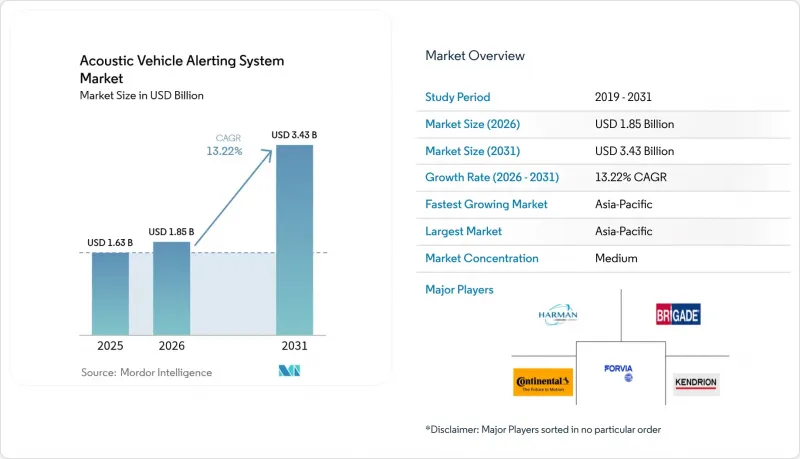
根據 Mordor Intelligence 預測,聲學車輛預警系統 (AVAS) 的市場規模預計將從 2025 年的 16.3 億美元成長到 2026 年的 18.5 億美元,然後在 2031 年達到 34.3 億美元,2026 年至 2031 年的複合年成長率為 13.2%。
本報告按車輛類型(乘用車、摩托車和微型交通工具等)、動力系統(電池式電動車、插電式混合動力汽車和混合動力汽車)、銷售管道(OEM 和售後市場)、系統元件(揚聲器等)和地區進行細分。市場預測以美元計價。
全球車輛聲學預警系統市場趨勢及洞察
遵守行人安全標準的監管要求
在澳大利亞,自2025年11月起,所有新電動車都必須配備自動駕駛輔助系統(AVAS),此前歐盟、加拿大和美國已實施相關法規。聯合國歐洲經濟委員會(UNECE)R138號法規規定,車輛在0-20公里/小時的速度範圍內必須發出人工噪音,並規定了最低聲級和隨速度變化的漸進頻率(unece.org)。加拿大已將其CMVSS 141法規與這些指南保持一致,從而統一了北美地區的安全標準。這種統一的、非優惠性法規將使在受監管地區註冊車輛時必須配備聲學系統,從而消除AVAS市場需求的不確定性。隨著每個合規週期的到來,汽車製造商(OEM)的採購部門都在確保訂購更多AVAS,並為模組供應商鎖定未來的累積訂單。
全球電動車產量快速成長
2024年,全球電動車產量達1,730萬輛,較2023年成長25%。其中,中國佔比超過70%。這些工廠生產的每輛電動車都需要一個AVAS模組,聲學供應商的表現與電動車的強勁成長密切相關。汽車多樣化也不斷推進,預計到2026年,不同電動車車型的數量將超過1000種。這其中包括許多需要額外聲學調校的大型SUV。由於規模經濟效應,換能器和擴大機的成本已經下降,即使在價格敏感的細分市場,也促進了其快速普及。插電式混合動力汽車進一步擴大了目標市場,因為它們即使在內燃機停止運轉時也需要產生人工聲音。
缺乏全球統一的噪音水準法規
儘管聯合國歐洲經濟委員會 (UNECE) 的法規是標準,但美國採用的是 FMVSS 141 標準,該標準在頻譜和分貝目標值方面略有不同,迫使原始設備製造商 (OEM) 開發多種硬體和軟體版本。這種法規差異增加了檢驗成本,因為每個聲學配置都必須經過當地認證,從而減緩了全球同步上市的速度。全球汽車法規工作小組 (GlobalAutoRegs) 內部的談判仍在進行中,但由於各國在行人安全和社區噪音法規方面的優先事項不同,全面統一的進程被推遲。這種技術負擔對缺乏資源維護多條產品線的中型供應商影響最大,導致其短期成長受阻。
細分市場分析
到2025年,乘用車將主導車輛聲音警示系統市場,佔62.74%的市場佔有率,反映出全球原始設備製造商(OEM)合規專案的成熟度。供應商受益於所有車型系統的整合,並獲得可預測的大批量訂單契約,從而強化了生產計畫。摩托車和微型出行領域正經歷最快成長,複合年成長率(CAGR)達16.94%。這一快速成長歸功於監管機構擴大了安全措施的範圍,將都市區的小型車輛納入其中。經合組織(OECD)的傷害統計數據顯示,與無聲摩托車相關的行人事故增加,城市正在推動強制安裝聲音警告系統。因此,專注於這些小型外形規格的專業供應商正在車輛聲音警告系統市場中佔據重要地位。
受車隊採購週期和可靠硬體的需求驅動,商用車採用率正穩定提升。然而,高流量配送路線上該細分市場的風險狀況正在催生持續而漸進的需求。歐盟第168/2013號法規對L類車輛的功能安全進行了規定,確保微型出行設備製造商在型式認證過程中必須安裝聲學裝置。受監管車輛類別的不斷擴展正在鞏固AVAS市場的多重細分成長。
預計到2025年,電池式電動車(BEV)將佔據車輛聲學警示系統(AVAS)市場65.22%的佔有率,複合年成長率(CAGR)最高,達到14.35%,證實了純電動驅動系統仍是聲音警告需求的主要驅動力。由於純電動車在低速行駛時完全靜音,因此與混合動力汽車相比,它們在法規合規方面的寬限期更長,這使得AVAS的安裝變得至關重要。插電式混合動力汽車(PHEV)也推動了市場成長,因為它們在純電動行駛模式下,車速低於20公里/小時時,必須發出人工聲音。
設計的複雜程度取決於動力系統。純電動車 (BEV) 需要持續的電源管理以最大限度地減少電池電量消耗,而插電式混合動力汽車 (PHEV) 則需要在引擎啟動時開啟和關閉聲音輸出。混合動力汽車的運行範圍較窄,但仍需要產生噪音。每種配置的這些細微差別為控制單元供應商提供了透過軟體效率實現差異化的機會,從而進一步擴大了自動駕駛輔助系統 (AVAS) 市場。
區域分析
亞太地區在車輛聲學預警系統(AVAS)市場佔據主導地位,預計2025年將佔全球銷售額的43.10%,並以14.98%的複合年成長率領先市場。中國的GB/T 37153-2018標準強制要求所有低速純電動車(BEV)、混合動力車(HEV)和燃料電池汽車(FCEV)發布校準後的聲學特徵,從而提供了統一的監管基礎。鑑於中國佔全球電動車產量的70%,該法規確保了大規模的國內消費基礎。香港已全面強制所有電動車安裝AVAS,進一步刺激了市場需求。與此同時,日本和印度正在考慮採取類似措施,這可能進一步推動市場需求成長。上海和深圳正在進行的基礎設施試點計畫已開始向AVAS控制器傳輸V2X數據,為未來的系統整合鋪平了道路。
北美在車輛聲學警示系統市場佔據第二大市場佔有率,這主要得益於美國聯邦機動車輛安全標準141(FMVSS 141)和加拿大統一的加拿大機動車輛安全標準141(CMVSS 141)。聯邦政府對V2X走廊的投資正在強化技術藍圖,並為該地區成為互聯聲學服務的先驅奠定基礎。總部位於美國的知名品牌正日益將其可客製化的聲音產品組合商業化,從而推動了區域車輛聲學警示系統市場的高利潤成長。
在歐洲,所有新型電動和混合動力汽車都受惠於2021年7月初生效的新規。 2019/2144號法規強制要求安裝先進的安全系統,以保護弱勢道路使用者,其中包括聲音警告裝置。歐洲汽車製造商正利用多年來的聲學研究成果,將音樂原理融入符合法規的噪音中,從而創造出獨特的音調,提升品牌形象。此外,歐洲綠色交易的城市噪音目標正在推動自適應車輛聲音警告系統的研發,該系統能夠抑制安靜區域的過度噪音,並促進對情境察覺訊號處理的研究。
其他好處:
- Excel格式的市場預測(ME)表
- 3個月的分析師支持
目錄
第1章:引言
- 研究假設和市場定義
- 調查範圍
第2章:調查方法
第3章執行摘要
第4章 市場狀況
- 市場概覽
- 市場促進因素
- 行人安全監理要求
- 全球電動車產量快速成長
- 品牌專屬客製外觀音效
- 將AVAS與V2X和智慧城市基礎設施整合
- 微型出行電動車類別的擴張
- 低功耗換能器技術的進步
- 市場限制因素
- 缺乏全球統一的噪音水準法規
- 大眾市場純電動車(BEV)的物料清單成本壓力日益增加
- 車廂靜謐性目標與NVH(噪音、振動與不平順性)之間的權衡
- 價格敏感型市場中消費者意識較低
- 價值供應鏈分析
- 監理情勢
- 技術展望
- 波特五力分析
第5章 市場規模與成長預測
- 車輛類型
- 搭乘用車
- 摩托車和微型交通工具
- 商用車輛
- 透過驅動系統
- 電池式電動車(BEV)
- 插電式混合動力車(PHEV)
- 混合動力電動車(HEV)
- 按銷售管道
- 原廠適配
- 售後市場
- 按系統元件
- 揚聲器(外部音源)
- 電控系統
- 軟體/DSP演算法
- 線路和線束
- 按地區
- 北美洲
- 美國
- 加拿大
- 其他北美國家
- 南美洲
- 巴西
- 阿根廷
- 其他南美國家
- 歐洲
- 德國
- 英國
- 法國
- 義大利
- 西班牙
- 其他歐洲國家
- 亞太地區
- 中國
- 日本
- 印度
- 韓國
- 其他亞太國家
- 中東和非洲
- 沙烏地阿拉伯
- 阿拉伯聯合大公國
- 南非
- 其他中東和非洲國家
- 北美洲
第6章 競爭情勢
- 市場集中度
- 策略趨勢
- 市佔率分析
- 公司簡介
- HELLA GmbH & Co. KGaA(FORVIA Hella)
- Harman International Industries Inc.
- Continental Engineering Services GmbH
- Kendrion NV
- Brigade Electronics Group plc
- Robert Bosch GmbH
- Valeo SA
- DENSO Corp.
- Hyundai Mobis Co. Ltd.
- Aptiv plc
- ZF Friedrichshafen AG
- SoundRacer AB
第7章 市場機會與未來展望
According to Mordor Intelligence, the acoustic vehicle alerting system (AVAS) market size is expected to grow from USD 1.63 billion in 2025 to USD 1.85 billion in 2026 and is forecast to reach USD 3.43 billion by 2031 at 13.22% CAGR over 2026-2031.
This report is Segmented by Vehicle Type (Passenger Cars, Two-Wheelers and Micro Mobility, and More), Propulsion (Battery Electric Vehicles, Plug-In Hybrid Electric Vehicles, and Hybrid Electric Vehicles), Sales Channel (OEM and Aftermarket), System Component (Speakers, and More), and Geography. The Market Forecasts are Provided in Terms of Value (USD).
Global Acoustic Vehicle Alerting System Market Trends and Insights
Regulatory Mandates for Pedestrian-Safety Compliance
Australia will require AVAS on all new electric vehicles starting November 2025, adding to mandates already in force across the EU, Canada, and the United States. UNECE Regulation R138 compels vehicles to emit artificial noise at 0-20 km/h, specifying minimum sound levels and gradual frequency shifts correlating with speed unece.org. Canada aligned its CMVSS 141 rule set with these guidelines, synchronising safety expectations throughout North America. Such uniform, non-negotiable rules eliminate demand uncertainty for the AVAS market by making acoustic systems a prerequisite for vehicle registration in regulated zones. With every compliance cycle, OEM purchasing departments lock in higher AVAS volumes, anchoring the forward order books of module suppliers.
Rapid Growth in Global EV Production Volumes
In 2024, global electric car production reached 17.3 million units, up 25% from 2023, with China responsible for more than 70% of the total. Each vehicle built in these plants requires an AVAS module, knitting the fortunes of acoustic suppliers to the robust EV growth curve. Model proliferation is also broadening, with the number of distinct electric car nameplates expected to top 1,000 by 2026, including many large SUVs that generate additional acoustic tuning work. Scaling effects are already driving down transducer and amplifier costs, encouraging faster adoption even in price-sensitive segments. Plug-in hybrids further enlarge the target pool because they must still emit artificial sound whenever the internal-combustion engine is off.
Lack of Globally Harmonised Sound-Level Regulations
UNECE rules serve as a baseline, yet the United States imposes slightly different spectral and decibel targets under FMVSS 141, obliging OEMs to engineer multiple hardware-software variants. That fragmentation raises validation costs and slows simultaneous global launches because each acoustic profile must pass local certification. Working-group negotiations at GlobalAutoRegs continue, but national priorities diverge between pedestrian safety and community noise control, delaying full convergence. The engineering burden lands hardest on mid-tier suppliers that lack the resources to maintain multiple product lines, thereby tempering short-term growth
Other drivers and restraints analyzed in the detailed report include:
- Rising OEM Focus on Brand-Customised Exterior Sound Signatures
- Integration of AVAS with V2X and Smart-City Infrastructure
- Incremental BOM Cost Pressure for Mass-Market BEVs
For complete list of drivers and restraints, kindly check the Table Of Contents.
Segment Analysis
In 2025, passenger cars dominated the Acoustic Vehicle Alerting System market, holding a 62.74% share, underscoring the maturity of compliance programs among global OEMs. Suppliers benefit from fleetwide integrations, securing predictable, high-volume contracts that bolster production planning. Two-wheelers and micromobility are witnessing the fastest growth, with a CAGR of 16.94%. This surge is attributed to regulators extending their safety focus to compact urban vehicles. OECD injury statistics highlight a growing number of pedestrian incidents tied to silent two-wheelers, prompting cities to enforce audible warning mandates. Consequently, specialist suppliers catering to these compact form factors are carving out a significant presence in the AVAS market.
Commercial vehicles adopt at a steadier pace, buffered by fleet procurement cycles and the need for ruggedized hardware. Yet the segment's risk profile in dense delivery corridors still spurs gradual but persistent demand. EU Regulation 168/2013, which sets functional safety rules for L-category vehicles, guarantees that micromobility makers will require acoustics during type approval. The widening scope of regulated vehicle classes cements multi-segment growth for the AVAS market.
Battery electric vehicles owned 65.22% of the Acoustic Vehicle Alerting System market share in 2025 and carry the highest forecast CAGR at 14.35%, confirming that fully electric drivetrains remain the prime catalyst for acoustic alerting demand. Because BEVs are silent in every low-speed phase, their compliance windows are broader than those of hybrids, making AVAS non-negotiable. Plug-in hybrids contribute incremental volume because their electric-only mode requires artificial sound below 20 km/h.
Design complexity varies by propulsion. BEVs need continuous output management that minimizes battery drain, while PHEVs must toggle the sound on and off when engines start. Hybrid electric vehicles present narrower activation windows yet still create obligatory volume. Each configuration nuance gives control unit suppliers opportunities to differentiate through software efficiency, further deepening the AVAS market.
Complete Report Scope:
- By Vehicle Type
- Passenger Cars
- Two-Wheelers and Micromobility
- Commercial Vehicles
- By Propulsion Type
- Battery Electric Vehicles (BEV)
- Plug-in Hybrid Electric Vehicles (PHEV)
- Hybrid Electric Vehicles (HEV)
- By Sales Channel
- OEM-fitted
- Aftermarket
- By System Component
- Speakers (External Sound Emitters)
- Electronic Control Units
- Software / DSP Algorithms
- Wiring and Harness
- By Geography
- North America
- United States
- Canada
- Rest of North America
- South America
- Brazil
- Argentina
- Rest of South America
- Europe
- Germany
- United Kingdom
- France
- Italy
- Spain
- Rest of Europe
- Asia-Pacific
- China
- Japan
- India
- South Korea
- Rest of Asia-Pacific
- Middle East and Africa
- Saudi Arabia
- United Arab Emirates
- South Africa
- Rest of Middle East and Africa
- North America
Geography Analysis
Asia-Pacific dominates the Acoustic Vehicle Alerting System market with a 43.10% revenue share in 2025 and a leading 14.98% CAGR outlook. China's GB/T 37153-2018 standard obliges every low-speed BEV, HEV, and FCEV to emit a calibrated sound signature, providing a uniform regulatory bedrock. Coupled with China's 70% share of global EV manufacturing, this rule guarantees a large local consumption base. Hong Kong's blanket requirement for AVAS on all electrified vehicles adds another layer of demand, while Japan and India review similar measures that could unlock further volume. Infrastructure pilots in Shanghai and Shenzhen already feed V2X data into Acoustic Vehicle Alerting System controllers, signaling future integration pathways.
North America ranks second in the Acoustic Vehicle Alerting System market, propelled by FMVSS 141 in the United States and Canada's harmonized CMVSS 141 regulation. Federal investment in V2X corridors enhances the technology roadmap and positions the region to pioneer connected acoustic services. Luxury brands headquartered in the United States increasingly monetize customizable sound portfolios, reinforcing high-margin growth within the regional Acoustic Vehicle Alerting System market.
Europe benefits from its early July 2021 mandate that covers every new electric or hybrid vehicle. Regulation 2019/2144 obliges advanced safety systems that protect vulnerable road users, including acoustic alerting devices. European OEMs leverage long-standing acoustics research to overlay musical principles onto compliant noise, creating signature tones that elevate brand perceptions. Additionally, the European Green Deal's urban noise objectives encourage adaptive Acoustic Vehicle Alerting System outputs that curtail excessive sound in quiet zones, stimulating research into context-aware signal processing
- HELLA GmbH & Co. KGaA (FORVIA Hella)
- Harman International Industries Inc.
- Continental Engineering Services GmbH
- Kendrion N.V.
- Brigade Electronics Group plc
- Robert Bosch GmbH
- Valeo SA
- DENSO Corp.
- Hyundai Mobis Co. Ltd.
- Aptiv plc
- ZF Friedrichshafen AG
- SoundRacer AB
Additional Benefits:
- The market estimate (ME) sheet in Excel format
- 3 months of analyst support
TABLE OF CONTENTS
1 Introduction
- 1.1 Study Assumptions & Market Definition
- 1.2 Scope of the Study
2 Research Methodology
3 Executive Summary
4 Market Landscape
- 4.1 Market Overview
- 4.2 Market Drivers
- 4.2.1 Regulatory Mandates For Pedestrian-Safety Compliance
- 4.2.2 Rapid Growth in Global EV Production Volumes
- 4.2.3 Brand-Customised Exterior Sound Signatures
- 4.2.4 Integration Of AVAS With V2X And Smart-City Infrastructure
- 4.2.5 Expansion Of Micromobility EV Categories
- 4.2.6 Advances in Low-Power Transducer Technologies
- 4.3 Market Restraints
- 4.3.1 Lack of Globally Harmonised Sound-Level Regulations
- 4.3.2 Incremental BOM Cost Pressure For Mass-Market Bevs
- 4.3.3 NVH Trade-Offs With Cabin Quietness Targets
- 4.3.4 Limited Consumer Awareness in Price-Sensitive Markets
- 4.4 Value / Supply-Chain Analysis
- 4.5 Regulatory Landscape
- 4.6 Technological Outlook
- 4.7 Porter's Five Forces Analysis
- 4.7.1 Threat of New Entrants
- 4.7.2 Bargaining Power of Buyers/Consumers
- 4.7.3 Bargaining Power of Suppliers
- 4.7.4 Threat of Substitute Products
- 4.7.5 Intensity of Competitive Rivalry
5 Market Size & Growth Forecasts (Value)
- 5.1 By Vehicle Type
- 5.1.1 Passenger Cars
- 5.1.2 Two-Wheelers and Micromobility
- 5.1.3 Commercial Vehicles
- 5.2 By Propulsion Type
- 5.2.1 Battery Electric Vehicles (BEV)
- 5.2.2 Plug-in Hybrid Electric Vehicles (PHEV)
- 5.2.3 Hybrid Electric Vehicles (HEV)
- 5.3 By Sales Channel
- 5.3.1 OEM-fitted
- 5.3.2 Aftermarket
- 5.4 By System Component
- 5.4.1 Speakers (External Sound Emitters)
- 5.4.2 Electronic Control Units
- 5.4.3 Software / DSP Algorithms
- 5.4.4 Wiring and Harness
- 5.5 By Geography
- 5.5.1 North America
- 5.5.1.1 United States
- 5.5.1.2 Canada
- 5.5.1.3 Rest of North America
- 5.5.2 South America
- 5.5.2.1 Brazil
- 5.5.2.2 Argentina
- 5.5.2.3 Rest of South America
- 5.5.3 Europe
- 5.5.3.1 Germany
- 5.5.3.2 United Kingdom
- 5.5.3.3 France
- 5.5.3.4 Italy
- 5.5.3.5 Spain
- 5.5.3.6 Rest of Europe
- 5.5.4 Asia-Pacific
- 5.5.4.1 China
- 5.5.4.2 Japan
- 5.5.4.3 India
- 5.5.4.4 South Korea
- 5.5.4.5 Rest of Asia-Pacific
- 5.5.5 Middle East and Africa
- 5.5.5.1 Saudi Arabia
- 5.5.5.2 United Arab Emirates
- 5.5.5.3 South Africa
- 5.5.5.4 Rest of Middle East and Africa
- 5.5.1 North America
6 Competitive Landscape
- 6.1 Market Concentration
- 6.2 Strategic Moves
- 6.3 Market Share Analysis
- 6.4 Company Profiles (includes Global level Overview, Market level overview, Core Segments, Financials as available, Strategic Information, Market Rank/Share for key companies, Products & Services, and Recent Developments)
- 6.4.1 HELLA GmbH & Co. KGaA (FORVIA Hella)
- 6.4.2 Harman International Industries Inc.
- 6.4.3 Continental Engineering Services GmbH
- 6.4.4 Kendrion N.V.
- 6.4.5 Brigade Electronics Group plc
- 6.4.6 Robert Bosch GmbH
- 6.4.7 Valeo SA
- 6.4.8 DENSO Corp.
- 6.4.9 Hyundai Mobis Co. Ltd.
- 6.4.10 Aptiv plc
- 6.4.11 ZF Friedrichshafen AG
- 6.4.12 SoundRacer AB
7 Market Opportunities & Future Outlook
- 7.1 White-space & Unmet-Need Assessment

 全球聲學車輛預警系統市場規模、佔有率、趨勢及成長分析報告(2026-2034)
 聲學車輛預警系統市場:按組件、聲音類型、車輛驅動系統、整合技術、車輛類型和最終用途分類-2026-2032年全球市場預測
 聲學車輛預警系統市場預測至2034年-按車輛類型、動力系統、安裝位置、應用和區域分類的全球分析
 2026年全球車輛接近預警系統(AVAS)市場報告
 聲學車輛預警系統市場分析及預測(至2035年):依類型、產品、技術、組件、應用、最終用戶、功能、安裝類型及模式分類
 全球聲學車輛預警系統市場,2025-2029年
 電動二輪車聲學預警系統市場規模、佔有率及成長分析(按電動二輪車、安裝位置、推進方式、電動車、銷售管道和地區分類)-產業預測(2026-2033 年)
 車輛接近通報設備 (AVAS) 市場評估:車輛類型·推動因素·銷售管道·各地區的機會及預測 (2018-2032年)