


 |
市場調查報告書
商品編碼
2097143
電動公車充電基礎設施:市場佔有率分析、產業趨勢與統計及成長預測(2026-2031 年)Electric Bus Charging Infrastructure - Market Share Analysis, Industry Trends & Statistics, Growth Forecasts (2026 - 2031) |
||||||

※ 本網頁內容可能與最新版本有所差異。詳細情況請與我們聯繫。
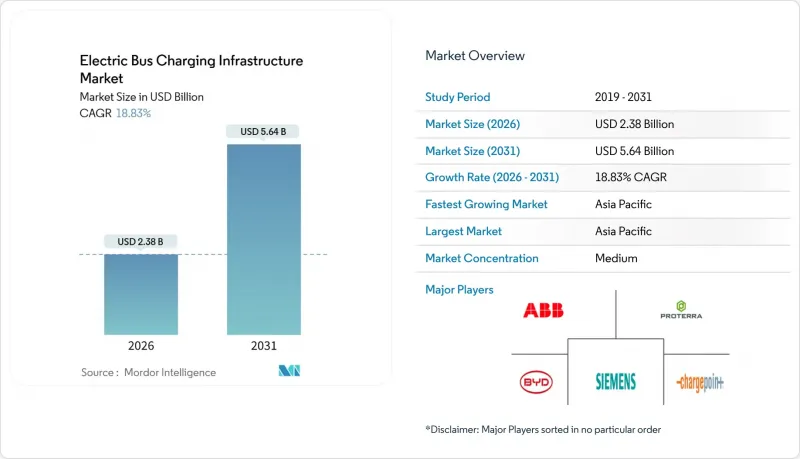
根據 Mordor Intelligence 預測,電動巴士充電基礎設施市場規模預計將在 2026 年達到 23.8 億美元,到 2031 年達到 56.4 億美元,預測期內複合年成長率為 18.83%。
本報告按充電器類型(慢充和快充)、充電方式(交流充電和直流充電)、連接器類型(CHAdeMO、組合充電系統及其他)、充電等級(1級及以上)、連接方式(非連網充電站和連網充電站)以及地區(北美等)進行細分。市場預測以美元計價。
全球電動巴士充電基礎設施市場趨勢與洞察
政府強制引進零排放公車。
重點地區實施的強制性採購要求使得公共運輸系統沒有推遲電氣化的空間。加州的「先進清潔車隊」法規要求公共運輸業者從2029年起必須採購零排放公車,並在2040年前滿足所有車輛要求。歐盟修訂後的《清潔車輛指令》規定,到2035年,所有新投入使用的城市公車必須100%達到零排放。這些同步實施的法規建構了可預測的需求管道,使電力公司和車輛段承包商能夠投資於多年期的基礎設施發展項目。
磷酸鐵鋰電池價格將跌破90美元/kWh(2025年)
到2025年,磷酸鋰鐵(LFP)電池組的價格將降至每千瓦時90美元以下,這將進一步凸顯電動公車在總擁有成本(TCO)方面相對於柴油公車的成本優勢。目前,較小的電池組足以滿足正常的運作週期,從而降低了尖峰時段充電功率需求,並減少了每個車庫所需的高容量充電樁數量。預計這一價格趨勢將進一步推動新興市場中型營運商採用電動公車,這些營運商此前可能面臨資金限制。即使採用150千瓦快速充電樁和250千瓦時電池組的組合,營運商也能保持線路的柔軟性。考慮到燃料和維護成本的降低,投資回收期可以縮短至七年以內。
此車輛段前置作業時間為 24 個月或更長。
在主要大都會圈,電力公司為多兆瓦車庫充電設施接入電網的等待時間長達24至36個月,這造成了嚴重的瓶頸,延緩了車輛電氣化的進程,迫使運輸業者分階段採購公車。因此,運輸業者必須在預定公車交付日期前兩到三年就確保接入電網,這不僅使採購流程更加複雜,也增加了專案風險。雖然一些地區已製定了公共交通電氣化計畫的優先程序,但這些程序的覆蓋範圍仍然有限,而且申請數量激增。
細分市場分析
至2025年,快速充電樁將佔電動公車充電基礎設施市場的64.34%。這主要得益於運輸公司對白天充電的需求,以確保公車的正常運作。預計到2031年,該細分市場將以20.55%的複合年成長率成長。額定輸出功率為150-350千瓦的快速充電樁可在60分鐘內將電量充至80%,使車輛每個班次能夠完成2-3次完整的充電循環。公車場營運商透過將少量快速充電樁與大量專用於夜間充電的慢速充電樁相結合,最佳化了其資本投資。
隨著商用電池循環壽命超過4000次滿電循環,快速充電的經濟效益顯著提升,人們對效能衰減的擔憂也隨之減輕。快速公車系統(BRT)受益於快速充電最為顯著,因為其10-15分鐘的終點站停靠時間便於自動受電弓連接,從而維持較短的發車間隔。雖然慢速充電器的作用相對較小,但對於停靠時間較長且日行駛里程較低的車輛來說,它們仍然是一個不錯的選擇。
至2025年,直流(DC)設備將佔電動公車充電基礎設施市場規模的72.51%,預計到2031年將以22.38%的複合年成長率成長。這反映了各機構對兩小時以內週轉時間的重視,以確保車輛正常運作。營運商優先考慮近95%的轉換效率,以減少能源損耗並降低營運成本。液冷式電纜和密封機櫃即使在環境溫度超過40 度C的情況下也能確保持續的高功率供應,防止夏季尖峰時段期因高溫導致的功率下降。模組化架構確保車庫最初配備150千瓦的機櫃,並可隨著車輛數量的增加通過添加功率模組擴展至600千瓦,從而避免初始投資浪費。
在車輛數量少、線路短,且升級電網成本過高的情況下,交流充電器仍有其市場需求。額定輸出功率為 22-43 千瓦的交流充電器比同等功率的直流系統便宜得多,使得企業只需花費一台 350 千瓦直流充電器的成本,即可為一個擁有五輛公車的停車場實現電氣化。現有的三相線路(通常用於維修車間)只需進行少量改造即可重新利用,從而將工程工期縮短數月。此外,交流埠在直流充電器維護期間提供冗餘,確保公車能夠按時運作。
區域分析
預計到2025年,亞太地區將佔據電動公車充電基礎設施市場41.87%的佔有率,並將以19.81%的複合年成長率持續成長至2031年。中國計劃在2027年實現省會城市全面電動公車部署,這正在加速充電站建設和電網強化。在印度,政府透過競標提供多年期充電服務包,轉移資本風險,並加速私部門的參與。在日本和韓國,政府提供定向補貼,以促進區域營運商融入電氣化體系;而在中國,政府正透過換電試點計畫測試一種能夠實現極高正常運轉率的模式。
南美洲預計將以18.22%的複合年成長率成長,這主要得益於巴西聖保羅承諾在2028年前透過公私合營資金籌措模式實現2,600多輛公車的電動化。在智利首都,太陽能發電設施和充電樁正在整合,以應對電網波動風險;在哥倫比亞首都波哥大,計劃在公車樞紐站安裝120個快速充電樁,以支持分階段的車輛部署。西亞地區預計將以17.98%的複合年成長率成長,沙烏地阿拉伯的1,000輛公車競標是該地區多元化發展舉措的一部分。
北美和歐洲的複合年成長率預計分別為13.88%和13.55%,但由於併網需要24至36個月的前置作業時間,成長預計將受到限制。在加州,2029年起強制購買零排放公車的法規將使200多家公車公司進入採購週期。歐盟2035年的零排放目標是基於一項數十億歐元的補貼計畫。這兩個地區都在投資簡化核准程序和預先已通過核准的變電站升級,以緩解電網連接瓶頸。
其他好處:
- Excel格式的市場預測(ME)表
- 3個月的分析師支持
目錄
第1章:引言
- 研究假設和市場定義
- 調查範圍
第2章:調查方法
第3章執行摘要
第4章 市場狀況
- 市場概覽
- 市場促進因素
- 政府強制引進零排放公車。
- 磷酸鐵鋰電池價格將跌破90美元/kWh(2025年)
- 兆瓦級充電系統(MCS)標準最終確定(2024 年)
- 智慧充電站軟體可降低需求費用 25-40%。
- 透過「能源即服務」資金籌措將能夠用於該倉庫的資本投資。
- 中國的換電站將等待時間縮短至5分鐘內。
- 市場限制因素
- 車輛段併網建置前置作業時間超過24個月
- 都市區1兆瓦及以上變電站用地短缺
- 受電弓互通性差距(SAE J3105 的各種變體)
- 合格高壓安裝技術人員短缺,拖慢了實施進度。
- 價值供應鏈分析
- 監理情勢
- 技術展望
- 波特五力模型
第5章 市場規模與成長預測
- 充電器類型
- 慢速充電器
- 快速充電器
- 透過充電方法
- 交流充電
- 直流充電
- 依連接器類型
- CHAdeMO
- 組合充電系統(CCS)
- 其他
- 按充電等級
- 一級
- 二級
- 3級
- 連結性別
- 斷開的站點
- 連接站
- 按地區
- 北美洲
- 美國
- 加拿大
- 其他北美國家
- 南美洲
- 巴西
- 阿根廷
- 其他南美國家
- 歐洲
- 英國
- 德國
- 西班牙
- 義大利
- 法國
- 俄羅斯
- 其他歐洲國家
- 亞太地區
- 印度
- 中國
- 日本
- 韓國
- 其他亞太國家
- 中東和非洲
- 阿拉伯聯合大公國
- 沙烏地阿拉伯
- 土耳其
- 埃及
- 南非
- 其他中東和非洲國家
- 北美洲
第6章 競爭情勢
- 市場集中度
- 策略趨勢
- 市佔率分析
- 公司簡介
- ABB Ltd.
- Siemens AG
- Heliox BV
- ChargePoint Inc.
- Proterra Inc.
- Efacec Power Solutions
- Kempower Oyj
- Alstom SA
- Schneider Electric SE
- Star Charge
- TGOOD Global Ltd.
- Tritium DCFC Ltd.
- EnBW AG
- EVgo Inc.
第7章 市場機會與未來展望
According to Mordor Intelligence, the electric bus charging infrastructure market size stands at USD 2.38 billion in 2026 and is projected to reach USD 5.64 billion by 2031, reflecting an 18.83% CAGR during the forecast period.
This report is Segmented by Charger Type (Slow Charger and Fast Charger), Charging Type (AC Charging and DC Charging), Connector Type (CHAdeMO, Combined Charging System, and Others), Level of Charging (Level 1 and More), Connectivity (Non-Connected Stations and Connected Stations), and Geography (North America and More). The Market Forecasts are Provided in Terms of Value (USD).
Global Electric Bus Charging Infrastructure Market Trends and Insights
Government Zero-Emission Bus Mandates
Binding purchase requirements introduced in leading regions have eliminated transit agencies' ability to delay electrification. California's Advanced Clean Fleets rule obliges public operators to buy only zero-emission buses from 2029, with complete fleet compliance by 2040. The European Union's revised Clean Vehicles Directive mandates that 100% of new urban buses be zero-emission by 2035. These synchronized mandates create a predictable demand pipeline, enabling utilities and depot contractors to invest in multi-year infrastructure programs.
Falling LFP Battery Prices Below USD 90/kWh (2025)
Lithium-iron-phosphate pack prices dropped below USD 90 per kilowatt-hour in 2025, sharpening the cost advantage of electric buses over diesel on a total cost of ownership basis. More miniature battery packs now suffice for regular duty cycles, which in turn lowers peak charging power requirements and reduces the number of high-capacity chargers per depot. The price trend supports wider adoption by medium-sized agencies in emerging markets that previously faced capital constraints. Operators can now pair 150-kilowatt fast chargers with 250-kilowatt-hour packs and still maintain route flexibility, shortening payback periods to under seven years when fuel and maintenance savings are considered.
Depot Grid-Connection Lead Times >=24 Months
Utility interconnection queues for multi-megawatt depot charging sites have extended to 24 to 36 months in major metropolitan areas, creating a critical bottleneck that delays fleet electrification timelines and forces transit agencies to phase bus procurements. Transit agencies must therefore secure grid connections 2 to 3 years before planned bus deliveries, which complicates procurement processes and increases project risk. Some regions offer expedited pathways for transit electrification projects, but geographical coverage remains limited and heavily oversubscribed.
Other drivers and restraints analyzed in the detailed report include:
- Megawatt Charging System Standard Finalization (2024)
- Depot Smart-Charging Software Cuts Demand Fees 25-40%
- Urban Land Scarcity for >=1 MW Substations
For complete list of drivers and restraints, kindly check the Table Of Contents.
Segment Analysis
Fast chargers held 64.34% of the electric bus charging infrastructure market share in 2025, fueled by agencies that require mid-day top-ups to keep buses on schedule. The segment is projected to advance at a 20.55% CAGR through 2031. Fast-charging hardware, rated at 150-350 kilowatts, enables 80% state of charge in under 60 minutes, allowing vehicles to perform two or three complete cycles per shift. Depot operators optimize capital expenditures by pairing a limited number of fast chargers with a larger pool of slow units dedicated to overnight replenishment.
The economics of fast charging have improved as commercial battery cycle life has extended beyond 4,000 full-equivalent cycles, mitigating concerns about degradation. Bus rapid transit systems benefit most from fast charging, as terminal dwell times of 10-15 minutes accommodate automated pantograph connections that maintain tight headways. Slow chargers, while secondary, still appeal to fleets with generous dwell periods and lower daily mileage.
DC equipment accounted for 72.51% of the electric bus charging infrastructure market size in 2025 and is projected to post a 22.38% CAGR to 2031, reflecting agencies' preference for sub-two-hour turnarounds that keep vehicles on the road. Operators value conversion efficiencies near 95%, which trim energy losses and lower operating expenses. Liquid-cooled cables and sealed cabinets allow continuous high-power delivery even when ambient temperatures exceed 40 °C, preventing thermal derating during summer peaks. Modular architectures let depots start with 150-kilowatt cabinets and add power blocks to reach 600 kilowatts as fleet size grows, so early investments never become stranded.
AC chargers keep a niche where fleets are small, routes are short, and grid upgrades are cost-prohibitive. Units rated 22-43 kilowatts cost significantly less than comparable DC systems, allowing agencies to electrify a five-bus garage for roughly the price of one 350-kilowatt DC dispenser. Existing three-phase wiring, often installed for maintenance workshops, can be reused with minimal modification, shortening project timelines by several months. AC ports also serve as redundancy when DC dispensers undergo maintenance, ensuring buses can still depart on schedule.
Complete Report Scope:
- By Charger Type
- Slow Charger
- Fast Charger
- By Charging Type
- AC Charging
- DC Charging
- By Connector Type
- CHAdeMO
- Combined Charging System (CCS)
- Others
- By Level of Charging
- Level 1
- Level 2
- Level 3
- By Connectivity
- Non-connected Stations
- Connected Stations
- By Geography
- North America
- United States
- Canada
- Rest of North America
- South America
- Brazil
- Argentina
- Rest of South America
- Europe
- United Kingdom
- Germany
- Spain
- Italy
- France
- Russia
- Rest of Europe
- Asia-Pacific
- India
- China
- Japan
- South Korea
- Rest of Asia-Pacific
- Middle East and Africa
- United Arab Emirates
- Saudi Arabia
- Turkey
- Egypt
- South Africa
- Rest of Middle-East and Africa
- North America
Geography Analysis
Asia-Pacific accounted for 41.87% of the electric bus charging infrastructure market share in 2025 and is projected to expand at a 19.81% CAGR through 2031. China's directive to achieve full electric bus penetration in provincial capitals by 2027 is driving rapid depot construction and grid reinforcement. Indian tenders bundle multi-year charging services, transferring capital risk and accelerating private participation. Japan and South Korea offer targeted subsidies to bring regional operators into the electrification fold, while battery-swapping pilots in China test ultra-high utilization models.
South America is forecasted to grow at an 18.22% CAGR, anchored by Brazil's Sao Paulo commitment to electrify over 2,600 buses by 2028 under public-private financing structures. Chile's capital integrates solar arrays with depot chargers to hedge against grid volatility, and Colombia's Bogota system schedules 120 fast chargers across terminal stations to support phased vehicle deployment. Western Asia, led by Saudi Arabia's 1,000-bus tender, is expected to expand at a 17.98% CAGR as part of broader diversification initiatives.
North America and Europe anticipate CAGRs of 13.88% and 13.55% respectively, tempered by 24-36-month grid-connection lead times. California's mandate to purchase zero-emission buses from 2029 brings over 200 transit agencies into the procurement cycle. The European Union's binding 2035 zero-emission target underpins multi-billion-euro subsidy programs. Both regions invest in streamlined permit processes and pre-approved substation upgrades to alleviate interconnection bottlenecks.
- ABB Ltd.
- Siemens AG
- Heliox BV
- ChargePoint Inc.
- Proterra Inc.
- Efacec Power Solutions
- Kempower Oyj
- Alstom SA
- Schneider Electric SE
- Star Charge
- TGOOD Global Ltd.
- Tritium DCFC Ltd.
- EnBW AG
- EVgo Inc.
Additional Benefits:
- The market estimate (ME) sheet in Excel format
- 3 months of analyst support
TABLE OF CONTENTS
1 Introduction
- 1.1 Study Assumptions and Market Definition
- 1.2 Scope of the Study
2 Research Methodology
3 Executive Summary
4 Market Landscape
- 4.1 Market Overview
- 4.2 Market Drivers
- 4.2.1 Government Zero-Emission Bus Mandates
- 4.2.2 Falling LFP Battery Prices Below USD 90/kWh (2025)
- 4.2.3 Megawatt Charging System (MCS) Standard Finalisation (2024)
- 4.2.4 Depot Smart-Charging Software Cuts Demand Fees 25 to 40%
- 4.2.5 Energy-as-a-Service Financing Unlocks Depot CAPEX
- 4.2.6 Battery-Swapping Depots in China Cut Dwell Time to Less than 5 Min
- 4.3 Market Restraints
- 4.3.1 Depot Grid-Connection Lead Times above 24 Months
- 4.3.2 Urban Land Scarcity for 1 MW+ Substations
- 4.3.3 Pantograph Interoperability Gaps (SAE J3105 Variants)
- 4.3.4 Shortage of Certified HV Installers Slows Roll-Outs
- 4.4 Value / Supply-Chain Analysis
- 4.5 Regulatory Landscape
- 4.6 Technological Outlook
- 4.7 Porter's Five Forces
- 4.7.1 Threat of New Entrants
- 4.7.2 Bargaining Power of Suppliers
- 4.7.3 Bargaining Power of Buyers
- 4.7.4 Threat of Substitutes
- 4.7.5 Industry Rivalry
5 Market Size and Growth Forecasts (Value (USD))
- 5.1 By Charger Type
- 5.1.1 Slow Charger
- 5.1.2 Fast Charger
- 5.2 By Charging Type
- 5.2.1 AC Charging
- 5.2.2 DC Charging
- 5.3 By Connector Type
- 5.3.1 CHAdeMO
- 5.3.2 Combined Charging System (CCS)
- 5.3.3 Others
- 5.4 By Level of Charging
- 5.4.1 Level 1
- 5.4.2 Level 2
- 5.4.3 Level 3
- 5.5 By Connectivity
- 5.5.1 Non-connected Stations
- 5.5.2 Connected Stations
- 5.6 By Geography
- 5.6.1 North America
- 5.6.1.1 United States
- 5.6.1.2 Canada
- 5.6.1.3 Rest of North America
- 5.6.2 South America
- 5.6.2.1 Brazil
- 5.6.2.2 Argentina
- 5.6.2.3 Rest of South America
- 5.6.3 Europe
- 5.6.3.1 United Kingdom
- 5.6.3.2 Germany
- 5.6.3.3 Spain
- 5.6.3.4 Italy
- 5.6.3.5 France
- 5.6.3.6 Russia
- 5.6.3.7 Rest of Europe
- 5.6.4 Asia-Pacific
- 5.6.4.1 India
- 5.6.4.2 China
- 5.6.4.3 Japan
- 5.6.4.4 South Korea
- 5.6.4.5 Rest of Asia-Pacific
- 5.6.5 Middle East and Africa
- 5.6.5.1 United Arab Emirates
- 5.6.5.2 Saudi Arabia
- 5.6.5.3 Turkey
- 5.6.5.4 Egypt
- 5.6.5.5 South Africa
- 5.6.5.6 Rest of Middle-East and Africa
- 5.6.1 North America
6 Competitive Landscape
- 6.1 Market Concentration
- 6.2 Strategic Moves
- 6.3 Market Share Analysis
- 6.4 Company Profiles (Includes Global Level Overview, Market Level Overview, Core Segments, Financials as Available, Strategic Information, Market Rank/Share for Key Companies, Products and Services, SWOT Analysis, and Recent Developments)
- 6.4.1 ABB Ltd.
- 6.4.2 Siemens AG
- 6.4.3 Heliox BV
- 6.4.4 ChargePoint Inc.
- 6.4.5 Proterra Inc.
- 6.4.6 Efacec Power Solutions
- 6.4.7 Kempower Oyj
- 6.4.8 Alstom SA
- 6.4.9 Schneider Electric SE
- 6.4.10 Star Charge
- 6.4.11 TGOOD Global Ltd.
- 6.4.12 Tritium DCFC Ltd.
- 6.4.13 EnBW AG
- 6.4.14 EVgo Inc.
7 Market Opportunities and Future Outlook
- 7.1 White-space and Unmet-Need Assessment


