


 |
市場調查報告書
商品編碼
2097059
汽車防鎖死煞車系統和電子穩定控制系統:市場佔有率分析、行業趨勢和統計數據以及成長預測(2026-2031 年)Automotive Anti-Lock Braking System and Electronic Stability Control - Market Share Analysis, Industry Trends & Statistics, Growth Forecasts (2026 - 2031) |
||||||

※ 本網頁內容可能與最新版本有所差異。詳細情況請與我們聯繫。
據 Mordor Intelligence 稱,2025 年汽車防鎖死煞車系統 (ABS) 和電子穩定控制 (ESC) 市場價值為 573.1 億美元,預計到 2031 年將達到 919.5 億美元,而 2026 年為 620.2 億美元,預測期為 2026-203%(2026-2031% 20312 年)的複合年成長率(2026-2031% 20312 年)。
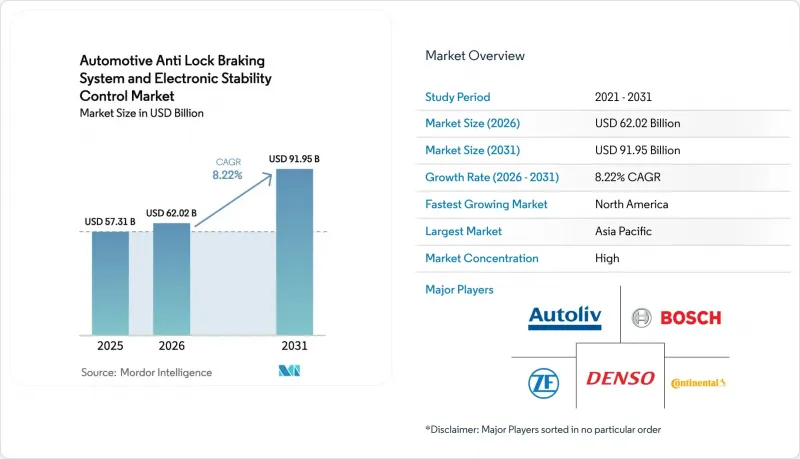
本報告按車輛類型(摩托車等)、零件(電控系統(ECU)等)、ABS類型(四通道等)、技術(液壓ABS等)、最終用戶(OEM原廠配套等)和地區進行細分。市場預測以價值(美元)和銷售(輛)表示。
全球汽車防鎖死煞車系統及電子穩定控制系統市場趨勢及洞察
促進全球採用ABS的安全法規
諸如聯合國摩托車法規R78、美國聯邦機動車輛安全標準FMVSS-122以及印度AIS-150等嚴格法規,正推動新摩托車ABS的搭載率接近100%。隨著美國國家公路交通安全管理局(NHTSA)強制要求在2029年前強制使用自動緊急煞車系統,ABS已成為實現合規的核心要素。在歐洲,排氣量超過125cc的踏板摩托車已強制安裝ABS,東南亞國協產生了影響。印度也正在效仿,敦促供應商提供成本最佳化的單一通路解決方案。聯合國亞洲及太平洋經濟社會委員會(UN ESCAP)估計,摩托車ABS可將死亡人數減少31%(unescap.org),進一步增強了監管機構的信心。
全球汽車產量的成長正在推動ABS市場的擴張。
疫情後製造業復甦在亞太地區最為顯著,中國產能已全面恢復,印度摩托車產量在2024年創下歷史新高。產量成長與ABS需求的持續成長直接相關,尤其是在ABS從選配變成標配的過程中。博世指出,先進的ABS可以預防40%的摩托車事故,這項數據引起了消費者和政策制定者的共鳴。
成本壁壘阻礙了價格敏感型市場的廣泛應用。
在印度、印尼和巴西,ABS的價格溢價在低價摩托車和入門級汽車領域仍然是一個挑戰,因為幾美元的差價就可能決定消費者的購買決定。由於OEM廠商的平均利潤率約為7.2%,供應商的利潤率徘徊在5.5%左右,因此廠商幾乎沒有空間來承擔ABS的成本。為了實現合理的價格,一級供應商正在重新設計液壓單元以簡化閥門結構,採用通用ECU,並實現本地化生產。
細分市場分析
到2025年,乘用車將成為汽車防鎖死煞車系統(ABS)市場的主要驅動力,佔總銷量的46.85%,這主要得益於歐洲、中國和北美地區的強制性設備要求。穩定的乘用車需求以及日益完善的駕駛輔助系統確保了其穩固的收入基礎。儘管隨著高級駕駛輔助系統(ADAS)的普及,該細分市場預計也將成長,但成長速度將低於摩托車市場。預計乘用車防鎖死煞車系統市場將以7.98%的複合年成長率成長,這主要得益於汽車製造商(OEM)對煞車控制、主動式車距維持定速系統控制功能的整合。
電動摩托車正以15.05%的複合年成長率快速推動市場成長。在印度和歐洲,排氣量125cc及以上的摩托車必須配備ABS防鎖死煞車系統,這促進了單通道架構的普及,因為這種架構比四輪車輛的解決方案更輕、更經濟。電動踏板車在中國和東南亞地區廣受歡迎,因此再生煞車技術更受青睞,迫使供應商將ABS演算法與能源回收邏輯整合。博世預測,到2026年,騎乘輔助功能將在市場上廣泛應用,凸顯了摩托車主動安全功能在各地區的高需求。
預計到2025年,電控系統(ECU)仍將是最大的零件細分市場,佔總銷售額的33.20%。這一佔有率的成長主要得益於不斷成長的運算需求。目前,人工智慧韌體能夠即時分析車輪速度數據、路面摩擦係數和車輛負載,從而實現預測性煞車。這項功能預計使ECU的複合年成長率達到11.95%,顯著優於其他零件。車輪速度感測器受益於能夠承受摩托車和重型卡車振動的固態設計,佔據了第二大銷售額細分市場。
針對液壓控制單元,目前正在進行重新設計,以減輕重量並提高電池式電動車(BEV) 的效率,因為即使增加一公斤的重量也會直接影響續航里程。閥門和執行器採用輕質鋁製外殼和先進的機電一體化技術來縮短反應時間。隨著人工智慧向中央網域控制器發展,ECU 供應商正透過提供空中下載 (OTA) 更新來應對這一變化,以確保網路安全合規性,從而緩解軟體定義煞車系統面臨的主要阻礙因素之一。
區域分析
亞太地區以36.10%的市佔率領先汽車防鎖死煞車系統(ABS)市場,主要得益於中國的生產規模和印度日益嚴格的法規。在印度,摩托車強制安裝ABS的範圍顯著擴大,供應商紛紛建立本地ECU工廠以規避進口關稅。在中國,乘用車強制安裝ABS和電子穩定控制系統(ESC)使得國內一級供應商能夠與跨國公司競爭。日本和韓國的整車製造商(OEM)正透過將ABS整合到其混合動力系統中,進一步鞏固其在該地區的技術領先地位。
到2031年,北美將以13.28%的複合年成長率(CAGR)實現最高成長,這主要得益於美國即將實施的自動緊急制動(AEB)法規以及加拿大在遵守聯邦機動車輛安全標準(FMVSS)方面取得的進展。在保險公司提供多項保險折扣的地區,商用車輛車隊的改裝正在加速推進。墨西哥的出口市場組裝廠正在將ABS作為車輛的標準配置,以滿足美國和歐盟的型式認證要求。在中東、非洲和南美等規模較小但成長迅速的市場,巴西強制所有新摩托車配備ABS,沙烏地阿拉伯則為採用先進安全配置的車輛提供誘因。
歐洲也紛紛效仿,強制所有新車安裝ABS防鎖死煞車系統,並由歐盟通用安全法規予以支持,該法規將自動緊急煞車系統(AEB)納入更廣泛的檢驗框架。德國仍然是該地區的創新中心,供應商正在試驗性地利用基於ABS的緊急煞車數據來改進路面摩擦力映射。 Gapwaves指出,AEB所需的額外雷達感測器與ABS訊號互補,確保冗餘性。東歐的組裝廠正在將AEB的應用範圍擴大到入門級車型,以確保統一的安全標準。
其他好處:
- Excel格式的市場預測(ME)表
- 3個月的分析師支持
目錄
第1章:引言
- 研究假設和市場定義
- 調查範圍
第2章:調查方法
第3章執行摘要
第4章 市場狀況
- 市場概覽
- 市場促進因素
- 強制性安全法規(UN R78、FMVSS-122、AIS-150)
- 新冠疫情後,全球乘用車和摩托車產量增加並實現復甦。
- 擴大配備主動安全功能的車輛的保險福利範圍。
- 需要整合線控刹車的電氣化平台
- 二手車隊對基於遠端資訊處理技術的UBI(二手付費)改造需求迅速成長
- 來自一級供應商的ABS和ADAS網域控制器組合
- 市場限制因素
- 新興市場低價摩托車和乘用車零件成本高昂
- 與傳統液壓架構整合的複雜性
- 2023年及以後半導體供應鏈所面臨的限制因素
- 軟體定義煞車系統的網路安全認證出現延誤
- 價值/供應鏈分析
- 監理情勢
- 技術展望
- 波特五力模型
第5章 市場規模與成長預測
- 車輛類型
- 摩托車
- 搭乘用車
- 輕型商用車
- 中型和大型商用車輛
- 按組件
- 電控系統(ECU)
- 液壓控制單元
- 車輪速度感測器
- 閥門和執行器
- ABS型
- 4個頻道
- 3個通道
- 單通道(摩托車)
- 透過技術
- 液壓ABS
- 電動ABS
- 氣動ABS
- 最終用戶
- 供OEM使用
- 售後改裝
- 按地區
- 北美洲
- 美國
- 加拿大
- 其他北美國家
- 南美洲
- 巴西
- 阿根廷
- 其他南美國家
- 歐洲
- 德國
- 英國
- 法國
- 西班牙
- 俄羅斯
- 其他歐洲國家
- 亞太地區
- 中國
- 日本
- 印度
- 韓國
- 其他亞太國家
- 中東和非洲
- 土耳其
- 沙烏地阿拉伯
- 阿拉伯聯合大公國
- 南非
- 其他中東和非洲國家
- 北美洲
第6章 競爭情勢
- 市場集中度
- 策略趨勢
- 市佔率分析
- 公司簡介
- Robert Bosch GmbH
- Continental AG
- ZF Friedrichshafen AG
- DENSO Corporation
- Mando Corporation
- Hyundai Mobis Co., Ltd.
- Hitachi Astemo, Ltd.
- Brembo SpA
- Knorr-Bremse AG
- WABCO(ZF CVCS)
- Haldex AB
- Nissin Kogyo Co., Ltd.
- ADVICS Co., Ltd.
- Aptiv PLC
- Delphi Technologies(BorgWarner)
- Veoneer Holding LLC
- Autoliv Inc.
- BWI Group
- Maruichi Machine
- Federal-Mogul Motorparts
第7章 市場機會與未來展望
According to Mordor Intelligence, the automotive anti-Lock braking system and Electronic Stability Control Market size was valued at USD 57.31 billion in 2025 and estimated to grow from USD 62.02 billion in 2026 to reach USD 91.95 billion by 2031, at a CAGR of 8.22% during the forecast period (2026-2031).
This report is Segmented by Vehicle Type (Two-Wheelers, and More), Component (Electronic Control Unit (ECU), and More), ABS Type (4-Channel, and More), Technology (Hydraulic ABS, and More), End User (OEM-Fitment, and More) and Geography. The Market Forecasts are Provided in Terms of Value (USD) and Volume (Units).
Global Automotive Anti-Lock Braking System and Electronic Stability Control Market Trends and Insights
Mandatory Safety Regulations Driving Global ABS Adoption
Stringent policies such as UN R78 for motorcycles, FMVSS-122 in the United States, and AIS-150 in India are pushing ABS fitment toward 100% in new vehicles. The U.S. National Highway Traffic Safety Administration's rule requiring automatic emergency braking by 2029 makes ABS core to achieving compliance. Europe already enforces motorcycle ABS on scooters above 125 cc, influencing ASEAN nations that rely heavily on two-wheelers. India mirrored this trend, compelling suppliers to release cost-optimized single-channel solutions. UN ESCAP estimates that motorcycle ABS can cut fatalities by 31% unescap.org, reinforcing regulators' confidence.
Rising Global Vehicle Production Expanding ABS Market Footprint
Post-pandemic manufacturing recovery is most pronounced in Asia Pacific, where China returned to full-scale capacity and India's two-wheeler output set new highs in 2024. Increased unit volumes translate directly into greater ABS demand, especially as ABS migrates from optional to standard equipment. Bosch notes that advanced ABS can prevent 40% of two-wheeler crashes, a statistic resonating with consumers and policymakers.
Cost Barriers Limiting Penetration in Price-Sensitive Markets
ABS price premiums remain challenging for low-cost motorcycles and entry-level cars in India, Indonesia, and Brazil, where a few USD can sway purchase decisions. OEM margins average 7.2%, while suppliers hover near 5.5%, limiting room to absorb ABS costs. Tier-1 vendors therefore re-engineer hydraulic units to remove valving complexity, adopt shared ECUs, and localize production to achieve viable price points.
Other drivers and restraints analyzed in the detailed report include:
- Growing Insurance Incentives for Active-Safety Equipped Vehicles
- Electrification Platforms Transforming ABS Architecture
- Semiconductor Supply Constraints Impacting Production Capacity
For complete list of drivers and restraints, kindly check the Table Of Contents.
Segment Analysis
Passenger cars anchored the automotive anti-lock braking system market in 2025, delivering 46.85% revenue thanks to mandatory fitment in Europe, China, and North America. Stable car demand, paired with increasingly sophisticated driver assistance packages, ensures a consistent revenue base. The segment will grow in tandem with ADAS penetration, though at a slower pace than two-wheelers. The automotive anti-lock braking system market size for passenger cars is projected to expand at 7.98% CAGR, supported by OEM integration of brake control with lane-keeping and adaptive cruise functions.
Electric two-wheelers inject faster momentum at 15.05% CAGR. Mandates in India and Europe require ABS on motorcycles above 125 cc, propelling single-channel architectures that weigh and cost less than four-wheel solutions. Electric scooters popular in China and Southeast Asia favor regenerative braking, forcing suppliers to fuse ABS algorithms with energy-recovery logic. Bosch forecasts mass-market rider assistance deployment by 2026, underscoring regional appetite for active safety on two-wheelers.
Electronic control units remained the largest component segment in 2025 at 33.20% revenue, a share lifted by rising computational needs. AI firmware now interprets wheel-speed data, road friction coefficients, and vehicle load in real time, enabling predictive braking. This functionality drives a 11.95% CAGR outlook for ECUs, well ahead of other components. Wheel-speed sensors follow in value, benefiting from solid-state designs that withstand vibration on two-wheelers and heavy trucks.
Hydraulic control units face weight and efficiency redesigns for battery electric vehicles, where every kilogram impacts range. Valves and actuators exploit lightweight aluminum housings and advances in mechatronics to cut response times. As AI moves onto central domain controllers, ECU suppliers adapt by offering over-the-air update capabilities to maintain cyber compliance, mitigating one of the key restraints on software-defined braking.
Complete Report Scope:
- By Vehicle Type
- Two-Wheelers
- Passenger Cars
- Light Commercial Vehicles
- Medium and Heavy Commercial Vehicles
- By Component
- Electronic Control Unit (ECU)
- Hydraulic Control Unit
- Wheel Speed Sensors
- Valves & Actuators
- By ABS Type
- 4-Channel
- 3-Channel
- Single-Channel (Motorcycle)
- By Technology
- Hydraulic ABS
- Electric ABS
- Pneumatic ABS
- By End User
- OEM-Fitment
- Aftermarket Retrofit
- By Geography
- North America
- United States
- Canada
- Rest of North America
- South America
- Brazil
- Argentina
- Rest of South America
- Europe
- Germany
- United Kingdom
- France
- Spain
- Russia
- Rest of Europe
- Asia Pacific
- China
- Japan
- India
- South Korea
- Rest of Asia Pacific
- Middle East and Africa
- Turkey
- Saudi Arabia
- United Arab Emirates
- South Africa
- Rest of Middle East and Africa
- North America
Geography Analysis
Asia Pacific leads the automotive anti-lock braking system market with 36.10% market share, propelled by China's production scale and India's regulatory surge. India's ABS mandate on motorcycles is growing significantly, with suppliers establishing local ECU plants to avoid import tariffs. China pairs ABS with compulsory electronic stability control on passenger cars, keeping domestic tier-1 suppliers in lockstep with multinational competitors. Japanese and South Korean OEMs integrate ABS with proprietary hybrid systems, sharpening regional technology leadership.
North America expands at highest CAGR at 13.28% by 2031, with U.S. demand buoyed by upcoming AEB rules and Canada aligning with FMVSS standards. Commercial fleet retrofits gain traction where insurers offer multiline discounts. Mexico's assembly plants, serving export markets, pre-install ABS to satisfy both U.S. and EU homologation. Smaller yet growing markets in the Middle East, Africa, and South America witness Brazil mandating ABS on all new motorcycles, and Saudi Arabia incentivizing fleets that adopt advanced safety packages.
Europe follows, underpinned by the EU General Safety Regulation that obliges ABS on all new vehicles and positions it within broader AEB validation. Germany remains the region's innovation hub, with suppliers piloting ABS-based harsh-brake data to improve road-friction mapping. Gapwaves notes that extra radar sensors required for AEB complement ABS signals for redundancy. Eastern European assembly plants extend adoption to entry-level cars, ensuring uniform safety standards.
- Robert Bosch GmbH
- Continental AG
- ZF Friedrichshafen AG
- DENSO Corporation
- Mando Corporation
- Hyundai Mobis Co., Ltd.
- Hitachi Astemo, Ltd.
- Brembo S.p.A.
- Knorr-Bremse AG
- WABCO (ZF CVCS)
- Haldex AB
- Nissin Kogyo Co., Ltd.
- ADVICS Co., Ltd.
- Aptiv PLC
- Delphi Technologies (BorgWarner)
- Veoneer Holding LLC
- Autoliv Inc.
- BWI Group
- Maruichi Machine
- Federal-Mogul Motorparts
Additional Benefits:
- The market estimate (ME) sheet in Excel format
- 3 months of analyst support
TABLE OF CONTENTS
1 Introduction
- 1.1 Study Assumptions & Market Definition
- 1.2 Scope of the Study
2 Research Methodology
3 Executive Summary
4 Market Landscape
- 4.1 Market Overview
- 4.2 Market Drivers
- 4.2.1 Mandatory safety regulations (UN R78, FMVSS-122, AIS-150)
- 4.2.2 Rising global passenger-car & 2-wheeler production rebounding post-COVID
- 4.2.3 Growing insurance incentives for active-safety equipped vehicles
- 4.2.4 Electrification platforms requiring brake-by-wire integration
- 4.2.5 Rapid retrofit demand in used-vehicle fleets for telematics-based UBI
- 4.2.6 Tier-1 suppliers bundling ABS with ADAS domain controllers
- 4.3 Market Restraints
- 4.3.1 High BOM cost for low-end 2-wheelers & emerging-market cars
- 4.3.2 Integration complexity with legacy hydraulic architectures
- 4.3.3 Semiconductor supply-chain constraints post-2023
- 4.3.4 Cyber-security certification delays for software-defined braking
- 4.4 Value/Supply-Chain Analysis
- 4.5 Regulatory Landscape
- 4.6 Technological Outlook
- 4.7 Porter's Five Forces
- 4.7.1 Threat of New Entrants
- 4.7.2 Bargaining Power of Buyers
- 4.7.3 Bargaining Power of Suppliers
- 4.7.4 Threat of Substitutes
- 4.7.5 Competitive Rivalry
5 Market Size & Growth Forecasts (Value (USD) and Volume (Units))
- 5.1 By Vehicle Type
- 5.1.1 Two-Wheelers
- 5.1.2 Passenger Cars
- 5.1.3 Light Commercial Vehicles
- 5.1.4 Medium and Heavy Commercial Vehicles
- 5.2 By Component
- 5.2.1 Electronic Control Unit (ECU)
- 5.2.2 Hydraulic Control Unit
- 5.2.3 Wheel Speed Sensors
- 5.2.4 Valves & Actuators
- 5.3 By ABS Type
- 5.3.1 4-Channel
- 5.3.2 3-Channel
- 5.3.3 Single-Channel (Motorcycle)
- 5.4 By Technology
- 5.4.1 Hydraulic ABS
- 5.4.2 Electric ABS
- 5.4.3 Pneumatic ABS
- 5.5 By End User
- 5.5.1 OEM-Fitment
- 5.5.2 Aftermarket Retrofit
- 5.6 By Geography
- 5.6.1 North America
- 5.6.1.1 United States
- 5.6.1.2 Canada
- 5.6.1.3 Rest of North America
- 5.6.2 South America
- 5.6.2.1 Brazil
- 5.6.2.2 Argentina
- 5.6.2.3 Rest of South America
- 5.6.3 Europe
- 5.6.3.1 Germany
- 5.6.3.2 United Kingdom
- 5.6.3.3 France
- 5.6.3.4 Spain
- 5.6.3.5 Russia
- 5.6.3.6 Rest of Europe
- 5.6.4 Asia Pacific
- 5.6.4.1 China
- 5.6.4.2 Japan
- 5.6.4.3 India
- 5.6.4.4 South Korea
- 5.6.4.5 Rest of Asia Pacific
- 5.6.5 Middle East and Africa
- 5.6.5.1 Turkey
- 5.6.5.2 Saudi Arabia
- 5.6.5.3 United Arab Emirates
- 5.6.5.4 South Africa
- 5.6.5.5 Rest of Middle East and Africa
- 5.6.1 North America
6 Competitive Landscape
- 6.1 Market Concentration
- 6.2 Strategic Moves
- 6.3 Market Share Analysis
- 6.4 Company Profiles
- 6.4.1 Robert Bosch GmbH
- 6.4.2 Continental AG
- 6.4.3 ZF Friedrichshafen AG
- 6.4.4 DENSO Corporation
- 6.4.5 Mando Corporation
- 6.4.6 Hyundai Mobis Co., Ltd.
- 6.4.7 Hitachi Astemo, Ltd.
- 6.4.8 Brembo S.p.A.
- 6.4.9 Knorr-Bremse AG
- 6.4.10 WABCO (ZF CVCS)
- 6.4.11 Haldex AB
- 6.4.12 Nissin Kogyo Co., Ltd.
- 6.4.13 ADVICS Co., Ltd.
- 6.4.14 Aptiv PLC
- 6.4.15 Delphi Technologies (BorgWarner)
- 6.4.16 Veoneer Holding LLC
- 6.4.17 Autoliv Inc.
- 6.4.18 BWI Group
- 6.4.19 Maruichi Machine
- 6.4.20 Federal-Mogul Motorparts
7 Market Opportunities & Future Outlook
- 7.1 White-space & unmet-need assessment

 汽車速度編碼器市場:按類型、應用、技術、解析度、銷售管道、國家和地區分類-產業分析、市場規模、市場佔有率和預測(2026-2033 年)
 防鎖死煞車系統 (ABS) 和電子穩定控制系統 (ESC) 市場:按車輛類型、系統類型、驅動方式、通道數、功能和銷售管道分類—2026-2032 年全球市場預測汽車防鎖死煞車系統(ABS)市場:按組件、車輛類型、類型和分銷管道分類-2026-2032年全球市場預測
 汽車ABS馬達市場分析及至2035年預測:類型、產品、技術、組件、應用、最終用戶、功能、安裝類型、解決方案、模式防鎖死煞車系統市場分析及預測(至2035年):類型、產品、技術、組件、應用、最終用戶、功能、安裝方式、解決方案汽車ABS馬達電路市場:依車輛類型、通路、組件、國家及地區分類-全球產業分析、市場規模、市場佔有率及2026年至2033年預測
 2034年防鎖死煞車系統(ABS)市場預測-按產品類型、子系統類型、車輛類型、組件類型、最終用戶和地區分類的全球分析
 汽車ABS馬達電路市場-全球產業規模、佔有率、趨勢、機會、預測:按車輛類型、通路、組件、地區和競爭格局分類的市場佔有率分析(2021-2031年)
 防鎖死煞車系統 (ABS) 市場報告:按組件、車輛類型、應用和地區分類 (2026–2034)
 2026年全球汽車防鎖死煞車系統與電子穩定控制系統市場報告