


 |
市場調查報告書
商品編碼
2073630
法國潮汐能:市場佔有率分析、產業趨勢與統計及成長預測(2026-2031)France Tidal Power - Market Share Analysis, Industry Trends & Statistics, Growth Forecasts (2026 - 2031) |
||||||

※ 本網頁內容可能與最新版本有所差異。詳細情況請與我們聯繫。
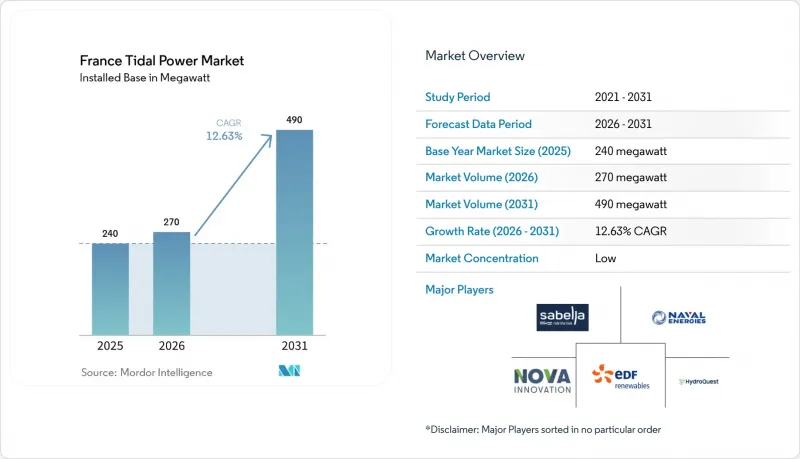
根據 Mordor Intelligence 預測,法國潮汐能市場規模(按裝置容量計算)預計將從 2025 年的 240 兆瓦擴大到 2026 年的 270 兆瓦,然後從 2026 年到 2031 年以 12.63% 的複合年成長率成長,到 2031 年達到 490 兆瓦。
本報告按發電方式(潮汐堰、浮體式潮汐發電平台、潮流發電、動態潮汐發電)、能量轉換設備(水平軸渦輪機、垂直軸渦輪機及其他)、應用領域(發電、海水淡化、船舶推進等)、最終用戶(公共產業/獨立發電商 (IPP)、工業、商業)和地區(法國)進行分類。市場預測以發電量(兆瓦)為單位。
法國潮汐能市場的趨勢與洞察
政府主導,為潮汐能研究和開發提供強而有力的資金支持。
多年來,法國一直依靠公共支持發展潮汐能市場。這種支援逐步擴展,從單一單元的測試發展到大規模陣列,從而能夠在實際運行條件下檢驗安裝、維護和收益模式。光是NH1計畫就獲得了歐盟創新基金3,130萬歐元(3,410萬美元)的資助。這項資助,加上「法國2030」計畫的推動,減輕了這項全球首個商業先導計畫的負擔,並向貸款機構發出了更強烈的公共政策訊號。該項目還接受了歐洲投資銀行對其成本降低路徑的獨立檢驗。這一點至關重要,因為未來法國潮汐能市場的計畫不僅要評估渦輪機的設計,還要評估其降低發電成本的路徑對投資人的可信度。公共資金也帶來了更廣泛的益處。在Raze Blanchard收集的環境和運作資料可以重複用於後續設施,從而減少重複的研究工作,並縮短每個新專案的學習週期。這在法國潮汐能市場意義重大。早期專案需要耗費大量時間收集數據,因此,可重複使用的資料集越多,後續專案就越容易獲得授權和資金籌措。從長遠來看,這種方法將使政府支持從單純的資金援助轉變為共用知識庫,從而改善整個產業的風險狀況。
拉茲布蘭查德和潘波爾-布雷哈特即將開展的商業規模項目
法國潮汐能市場短期內最大的成長要素來自拉茲布蘭查德(Raz Blanchard)潮汐電站從原型機向預商業化電站的過渡,以及潘波爾-布雷哈(Paimpoll-Breha)作為認證電站的持續發展。 FloWatt公司的17兆瓦潮汐能電廠計畫進展順利,六台HQ 2.8型渦輪機正在法國國家造船廠(CMN)瑟堡工廠生產,該計畫獲得了法國政府7500萬歐元(約8,180萬美元)的資金支持,並享有為期20年的上網電價補貼(FIT)計畫。該項目計劃於2028年投入運作。 NH1公司也在類似的大型開發區新增12兆瓦的潮汐能電站,同樣計畫於2028年運作。這將使法國潮汐能市場不僅能夠根據試點渦輪機的數據進行評估,還能根據實際電站的運作進行評估。這些項目的意義不僅在於其總發電量(兆瓦),更在於它們為國內製造商、海底設備供應商和海洋服務公司提供了可複製的商業模式,有助於降低未來電站的單位成本。 Pampol-Brehat 透過提供並網站點,進一步強化了這項轉型。開發商可以在這些站點檢驗電力特性和運作性能,然後再進行大規模的專案。因此,法國潮汐能市場正逐漸形成一個環環相扣的流程,測試、製造和部署環節相互銜接,而非一系列孤立的工程實驗。
高水準平準化電力成本(LCOE)與離岸風力發電的比較
高昂的發電成本仍然是法國潮汐能市場的主要限制因素,因為正在進行的潮汐發電工程仍需要相應的支援系統來應對部署初期階段的風險以及有限的裝置容量。根據現有數據,目前潮汐能的平準化電力成本(LCOE)為每兆瓦時150至350歐元(每兆瓦時163至381美元),這一水平仍然遠高於更成熟的海上可再生能源技術的預期成本。 Tethys Engineering和ORE Catapult引用的一項獨立研究表明,大幅降低成本取決於累積裝置容量,到2030年,法國至少需要783兆瓦的裝置容量才能將成本降至每兆瓦時116歐元以下。這項閾值意義重大,因為目前250兆瓦的政策目標雖然正在推動法國潮汐能市場的發展,但尚未達到能夠充分發揮製造環節學習效應和供應鏈規模經濟效益的水平。 FloWatt的上網電價補貼(FIT)方案表明,政策制定者已經意識到這個問題,並試圖在產業規模擴大的同時,保護早期設施免受直接競爭的影響。在更多兆瓦的裝置容量投入運作之前,成本仍將是決定哪些項目能夠推進以及私人資本進入該領域速度的關鍵因素。
細分市場分析
截至2025年,潮汐堰將佔法國潮汐裝置容量的42.3%,成為法國潮汐發電市場最大的發電方式。這主要得益於法國現有堰壩基礎設施的持續存在。這些安裝基礎使該領域能夠保持基於現有資產的優勢,而非成為未來專案最活躍的來源。潮流潮汐發電排名第二,但卻是法國潮汐發電行業中最具商業性驅動力的領域,尤其得益於Raz Blanchard公司的在建項目。動態潮汐發電在法國仍處於概念階段,目前在發電裝置容量結構中尚未得到實質部署。預計到2031年,浮體式潮汐平台將以19.4%的複合年成長率成長,成為該類別中成長最快的領域。其吸引力在於能夠在深水、水流湍急的水域運行,而固定式海底平台在這些區域難以安裝、維護或擴展。在像拉茲布蘭查德這樣水深和運作條件可能限制傳統基礎結構實用化的位置,這一點至關重要。因此,浮體式系統正從一種小眾工程理念轉變為法國潮汐能市場成長的真正驅動力。
這項發展的第二個面向更體現在營運層面而非純粹的技術層面。浮體式系統可以在陸地上組裝和檢驗,然後再拖至海上,從而減少工人在惡劣海洋環境中作業的時間。這在高能量水域尤其重要,因為這些水域的良好天氣期短暫,船舶成本高昂,即使是較小的海上作業區域也能顯著影響專案的經濟效益。 EEL Energy計劃在2026年前完成1兆瓦仿生潮汐發電機的海上試驗,這顯示即使市場正圍繞大型陣列開發商進行整合,新的平台方案仍在不斷湧現。法國海洋能源公司(France Energies Marines)也透過其潮汐流項目,重點介紹其在布蘭查德島(Raz Blanchard)開展的動態和環境研究,這些數據將有助於確定未來平台部署的陣列位置。從實際角度來看,浮體式系統不僅新增了一個設備類別,也擴大了法國潮汐能市場的安裝地點選擇範圍。此外,部分作業可透過拖曳而非大型海上吊運作業完成,從而提高了開發商維護策略的柔軟性。安裝地點的便利性和海上安裝週期的縮短,共同解釋了為何該行業的成長前景比更成熟的堰式發電領域更為強勁。這也表明,未來裝置容量的成長將更取決於安裝和維護的便利性,而非現有基礎設施。
到2025年,水平軸風力渦輪機將佔法國潮汐裝置容量的61.5%,預計到2031年將以17.4%的複合年成長率成長。這使其成為法國潮汐能市場中規模最大、成長最快的變流器類型,佔據獨特的地位。這項優勢源自於科技的成熟、貸款機構的廣泛認可,以及與目前正在邁向商業運營的法國大型計畫的直接合作。 NH1計畫採用一台3兆瓦的Proteus AR3000風力渦輪機,其轉子直徑為24米,其成本計畫已通過歐洲投資銀行(EIB)的獨立檢驗。鑑於法國潮汐能市場開始更加重視銀行融資的確定性和標準化,而非單純追求創新,該計畫成為水平軸風力渦輪機領域的一個強力的案例研究。與技術尚不成熟的替代方案相比,該類別還具有優勢,能夠從大規模專案中收集更系統化的效能論證資料。這對於商業化的早期階段至關重要。這是因為開發商需要一種能夠同時滿足保險公司、公共資金提供者和貸款機構需求的技術。目前,水平軸風力渦輪機最接近滿足這項要求。因此,水平軸風力渦輪機的持續推廣應用將對未來專案的供應鏈和資金籌措標準產生影響。
垂直軸渦輪機仍發揮重要作用。這主要是因為HydroQuest的設計是FloWatt電站的基礎,該電站已在潘波勒-布雷阿(Paimpol-Brehat)的嚴苛運作條件下進行了測試。 FloWatt報告稱,在測試場地運行兩年後,已達到全面運轉率,這為垂直軸概念提供了實際運行記錄,儘管其市場佔有率小於水平軸渦輪機。其他潮汐轉換器,包括仿生系統,在安裝規模方面仍然相對小規模,但在擴大法國潮汐發電行業的創新基礎方面發揮著至關重要的作用。 EEL Energy開發的膜裝置表明,在開發商認為水流捕獲、耐久性或易於維護方面具有潛在優勢的領域,替代架構仍在探索之中。然而,認證標準和投資者的期望仍然傾向於經過更廣泛測試和擁有成熟運作經驗的發電機。因此,預計短期市場將以更成熟的渦輪機系列為中心。未來,替代能源發電系統或許更適合特定應用或嚴苛的安裝環境,而非成為大規模陣列的首批應用對象。基於目前的整體證據,我們認為,在目前的預測期內,法國潮汐能市場的基準設計仍然是水平軸渦輪機。
其他好處:
- Excel格式的市場預測(ME)表
- 3個月的分析師支持
目錄
第1章:引言
- 研究假設和市場定義
- 調查範圍
第2章:調查方法
第3章執行摘要
第4章 市場狀況
- 市場概覽
- 裝置容量及預測(兆瓦)
- 市場促進因素
- 政府為潮汐發電的研究和開發提供了充足的資金。
- 即將進行的商業規模項目(Raz Blanchard、Pampol-Breja)
- 緩解沿海電網擁塞的機會
- 關於海事叢集脫碳的義務
- 市場限制因素
- 平均發電成本與離岸風力發電的比較
- 環境核准流程耗時更長。
- 由於缺乏足夠的貸款記錄,潛在投資者不願意提供貸款。
- 稀土元素磁鐵礦開採面臨非政府組織的反對。
- 供應鏈分析
- 監理情勢
- 技術展望
- PESTLE分析
- 波特五力模型
第5章 市場規模與成長預測
- 透過發電方法
- 潮汐能大壩
- 浮體式潮汐發電平台
- 潮汐發電
- 動態潮汐發電
- 按類型分列的潮汐發電設備
- 水平軸風力渦輪機
- 垂直軸風力渦輪機
- 其他潮汐發電裝置
- 透過使用
- 發電
- 海水淡化
- 船舶推進系統
- 數據和線上平台
- 最終用戶
- 公共產業及獨立電力生產商(IPP)
- 產業
- 商業的
第6章 競爭情勢
- 市場集中度
- 策略趨勢
- 市佔率分析
- 公司簡介
- Sabella SAS
- HydroQuest SAS
- EEL Energy
- Guinard Energies Nouvelles
- Naval Energies
- Nova Innovation Ltd
- SIMEC Atlantis Energy Ltd
- Orbital Marine Power Ltd
- Minesto AB
- Andritz Hydro GmbH
- Voith Hydro GmbH & Co. KG
- EDF Renewables
- ENGIE SA
- GE Vernova(ex-Alstom Ocean Energy)
- Tocardo BV
- Verdant Power Inc.
- HydroWing Ltd
- Seaturns SAS
- Blue Shark Power System
- Hydrokinetic Energy Corp.
第7章 市場機會與未來展望
According to Mordor Intelligence, the france tidal power market size in terms of installed base is expected to grow from 240 megawatt in 2025 to 270 megawatt in 2026 and is forecast to reach 490 megawatt by 2031 at 12.63% CAGR over 2026-2031.
This report is Segmented by Generation Method (Tidal Barrage, Floating Tidal Platform, Tidal Stream, Dynamic Tidal Power), Energy Converters (Horizontal Axis Turbine, Vertical Axis Turbine, Other), Application (Power Generation, Desalination, Marine Propulsion, and More), End-User (Utilities and IPPs, Industrial, Commercial), and Geography (France). The Market Forecasts are Provided in Terms of Volume (MW).
France Tidal Power Market Trends and Insights
Robust State-Backed Tidal R&D Funding
France has spent years building the France tidal power market through public support that moved step by step from isolated device trials toward larger arrays that can test installation, maintenance, and revenue models under real operating conditions. The NH1 project alone received EUR 31.3 million, or USD 34.1 million, from the EU Innovation Fund, and that support sits alongside France 2030 backing, which lowers the burden on a first-of-a-kind commercial pilot and gives lenders a stronger public policy signal.The same project also received independent validation from the European Investment Bank on its cost reduction path, which matters because future projects in the France tidal power market will be judged not only on turbine design but also on how credible their path to lower power costs looks to investors. Public funding is also creating a wider benefit because environmental and operating data gathered at Raz Blanchard can be reused by later arrays, which reduces duplicated study work and shortens the learning cycle for each new development. This matters in the France tidal power market because early projects carry a high information burden, and every dataset that becomes reusable makes the next project easier to permit and finance. Over time, this approach turns state support from simple capital aid into a shared knowledge base that improves the sector's overall risk profile.
Forthcoming Commercial-Scale Projects at Raz Blanchard and Paimpol-Brehat
The strongest near-term growth driver in the France tidal power market is the move from prototypes to pre-commercial arrays at Raz Blanchard and the continued role of Paimpol-Brehat as a qualification site. FloWatt's 17 MW farm is progressing with 6 HQ 2.8 turbines being built at CMN's Cherbourg facility, backed by EUR 75 million, or USD 81.8 million, in French government support and a 20-year feed-in tariff, while commissioning is targeted for 2028. NH1 adds another 12 MW at the same broad development corridor and is also targeted for operation in 2028, which means the France tidal power market will soon be assessed on real array performance rather than only on pilot turbine data. These projects matter beyond their megawatt totals because they are giving domestic manufacturers, subsea suppliers, and marine service companies repeatable work packages that can support lower unit costs on future arrays. Paimpol-Brehat continues to strengthen this transition because it offers a grid-connected site where developers can validate power curves and operating behavior under French marine conditions before moving into larger projects. As a result, the France tidal power market is starting to look less like a collection of isolated engineering experiments and more like a pipeline with linked testing, manufacturing, and deployment stages.
High Levelised Cost Versus Offshore Wind
High power cost remains the main brake on the France tidal power market because current tidal projects still need support structures that reflect early-stage deployment risk and limited installed volume. The supplied material places current tidal LCOE in a EUR 150 to EUR 350 per MWh range, or USD 163 to USD 381 per MWh, and that level is still well above the cost base expected from more mature offshore renewable technologies. Independent work referenced through Tethys Engineering and ORE Catapult showed that meaningful cost reduction depends on cumulative deployment, with at least 783 MW in France needed to push the cost path below EUR 116 per MWh by 2030. That threshold is important because the current 250 MW policy target helps the France tidal power market, but it is still below the level at which stronger manufacturing learning and supply chain scale effects would be expected to show fully. FloWatt's feed-in tariff structure suggests policymakers recognize this issue and are protecting early arrays from direct cost competition while the sector builds volume. Until more megawatts are installed and operated, cost will continue to shape which projects move first and how quickly private capital becomes comfortable with the sector.
Other drivers and restraints analyzed in the detailed report include:
- Coastal Grid-Congestion Relief Opportunities
- Maritime Cluster Decarbonisation Mandates
- Lengthy Environmental Approval Cycles
For complete list of drivers and restraints, kindly check the Table Of Contents.
Segment Analysis
Tidal barrage accounted for 42.3% of installed capacity in 2025, which made it the largest power generation method in the France tidal power market because France still carries a legacy base of barrage infrastructure. That installed base gives the segment a lead that is rooted in existing assets rather than in the strongest future project flow. Tidal stream generation ranked behind barrage, but it is a part of the France tidal power industry that is receiving the clearest commercial momentum from the Raz Blanchard pipeline. Dynamic tidal power remained at a conceptual stage in France, with no meaningful installed position in the current capacity mix. Floating tidal power platforms are forecast to expand at 19.4% CAGR through 2031, which makes them the strongest growth pocket within this split. Their appeal comes from the ability to work in deeper and faster-flowing waters where bottom-fixed designs are harder to deploy, maintain, or scale. This matters at sites such as Raz Blanchard, where water depth and operating conditions can limit the practical use of conventional foundations. As a result, floating systems are moving from a niche engineering idea toward a real growth lever for the France tidal power market.
The second part of the story is operational rather than purely technical, because floating systems can be assembled and checked onshore before tow-out, which reduces the time crews need to spend in harsh marine conditions. That matters in high-energy channels where weather windows are short and vessel costs are high, since a smaller offshore work scope can visibly change project economics. EEL Energy is targeting in-situ marine testing for its 1 MW biomimetic tidal generator by 2026, which shows that new platform approaches are still entering the field even as the market begins to consolidate around larger array developers. France Energies Marines has also highlighted hydrodynamic and environmental research at Raz Blanchard through its tidal stream programs, and those data will support better array layout decisions for future platform deployments. In practical terms, the floating segment expands site accessibility for the France tidal power market rather than simply adding another device category. It also gives developers more flexibility on maintenance strategy because some interventions can be done with tow-back procedures instead of full offshore heavy-lift work. That combination of broader site access and shorter marine installation windows explains why the growth outlook is stronger here than in the more mature barrage segment. It also suggests that future capacity additions will be shaped more by deployability and serviceability than by installed legacy infrastructure.
Horizontal axis turbines held 61.5% of installed capacity in 2025 and are also projected to grow at 17.4% CAGR through 2031, which gives them a rare position as both the largest and the fastest-growing converter type in the France tidal power market size. That lead reflects a mix of technical maturity, wider lender familiarity, and direct alignment with flagship French projects that are now moving toward commercial operation. The NH1 project is built around Proteus AR3000 turbines rated at 3 MW each with a 24-meter rotor diameter, and the project's cost pathway received independent validation through the European Investment Bank process. This gives the horizontal axis category a strong reference point at a time when the France tidal power market is starting to value bankability and standardization more heavily than novelty alone. The category also benefits from the fact that larger projects can source more structured performance evidence from these machines than from less mature alternatives. In an early commercial market, that matters because developers need technologies that can satisfy insurers, public funders, and debt providers at the same time. For now, horizontal-axis turbines sit closest to that requirement set. Their continued scale-up should therefore shape both the supply chain and the financing standards applied across future projects.
Vertical axis turbines still retain a meaningful role, largely because HydroQuest's design is the basis of the FloWatt farm and has already been tested at Paimpol-Brehat under demanding operating conditions. FloWatt reported full availability over a 2-year campaign at the test site, which gives the vertical axis concept a practical operating credential, even though its market position is smaller than that of horizontal axis turbines. Other tidal energy converters, including biomimetic systems, remain small in installed terms but still matter because they expand the innovation base of the France tidal power industry. EEL Energy's work on a membrane-based device shows that alternative architectures are still being pursued where developers see potential gains in flow capture, durability, or maintenance handling. Even so, qualification standards and investor expectations continue to favor converters with stronger testing histories and clearer operating records. This is why the near-term market will likely stay centered on the more established turbine families. Over time, alternative converters may find room in specialized applications or difficult site conditions rather than in the first wave of larger arrays. The balance of evidence still points to horizontal axis machines as the reference design for the France tidal power market over the current forecast period.
Complete Report Scope:
- By Power Generation Method
- Tidal Barrage
- Floating Tidal Power Platform
- Tidal Stream Generation
- Dynamic Tidal Power
- By Tidal Energy Converters
- Horizontal Axis Turbine
- Vertical Axis Turbine
- Other Tidal Energy Converters
- By Application
- Power Generation
- Desalination
- Marine Propulsion
- Data & Telecom Platforms
- By End-User
- Utilities and IPPs
- Industrial
- Commercial
List of Companies Covered in this Report:
- Sabella SAS
- HydroQuest SAS
- EEL Energy
- Guinard Energies Nouvelles
- Naval Energies
- Nova Innovation Ltd
- SIMEC Atlantis Energy Ltd
- Orbital Marine Power Ltd
- Minesto AB
- Andritz Hydro GmbH
- Voith Hydro GmbH & Co. KG
- EDF Renewables
- ENGIE SA
- GE Vernova (ex-Alstom Ocean Energy)
- Tocardo BV
- Verdant Power Inc.
- HydroWing Ltd
- Seaturns SAS
- Blue Shark Power System
- Hydrokinetic Energy Corp.
Additional Benefits:
- The market estimate (ME) sheet in Excel format
- 3 months of analyst support
TABLE OF CONTENTS
1 Introduction
- 1.1 Study Assumptions & Market Definition
- 1.2 Scope of the Study
2 Research Methodology
3 Executive Summary
4 Market Landscape
- 4.1 Market Overview
- 4.2 Installed Capacity & Forecast (MW)
- 4.3 Market Drivers
- 4.3.1 Robust state-backed tidal R&D funding
- 4.3.2 Forthcoming commercial-scale projects (Raz Blanchard, Paimpol-Brehat)
- 4.3.3 Coastal grid-congestion relief opportunities
- 4.3.4 Maritime cluster decarbonisation mandates
- 4.4 Market Restraints
- 4.4.1 High levelised cost versus offshore wind
- 4.4.2 Lengthy environmental approval cycles
- 4.4.3 Limited bankable track record deterring financiers
- 4.4.4 Mining of rare-earth magnets facing NGO opposition
- 4.5 Supply-Chain Analysis
- 4.6 Regulatory Landscape
- 4.7 Technological Outlook
- 4.8 PESTLE Analysis
- 4.9 Porter's Five Forces
- 4.9.1 Threat of New Entrants
- 4.9.2 Bargaining Power of Suppliers
- 4.9.3 Bargaining Power of Buyers
- 4.9.4 Threat of Substitutes
- 4.9.5 Competitive Rivalry
5 Market Size & Growth Forecasts
- 5.1 By Power Generation Method
- 5.1.1 Tidal Barrage
- 5.1.2 Floating Tidal Power Platform
- 5.1.3 Tidal Stream Generation
- 5.1.4 Dynamic Tidal Power
- 5.2 By Tidal Energy Converters
- 5.2.1 Horizontal Axis Turbine
- 5.2.2 Vertical Axis Turbine
- 5.2.3 Other Tidal Energy Converters
- 5.3 By Application
- 5.3.1 Power Generation
- 5.3.2 Desalination
- 5.3.3 Marine Propulsion
- 5.3.4 Data & Telecom Platforms
- 5.4 By End-User
- 5.4.1 Utilities and IPPs
- 5.4.2 Industrial
- 5.4.3 Commercial
6 Competitive Landscape
- 6.1 Market Concentration
- 6.2 Strategic Moves
- 6.3 Market Share Analysis
- 6.4 Company Profiles {(includes Global level Overview, Market level overview, Core Segments, Financials as available, Strategic Information, Market Rank/Share for key companies, Products & Services, and Recent Developments)}
- 6.4.1 Sabella SAS
- 6.4.2 HydroQuest SAS
- 6.4.3 EEL Energy
- 6.4.4 Guinard Energies Nouvelles
- 6.4.5 Naval Energies
- 6.4.6 Nova Innovation Ltd
- 6.4.7 SIMEC Atlantis Energy Ltd
- 6.4.8 Orbital Marine Power Ltd
- 6.4.9 Minesto AB
- 6.4.10 Andritz Hydro GmbH
- 6.4.11 Voith Hydro GmbH & Co. KG
- 6.4.12 EDF Renewables
- 6.4.13 ENGIE SA
- 6.4.14 GE Vernova (ex-Alstom Ocean Energy)
- 6.4.15 Tocardo BV
- 6.4.16 Verdant Power Inc.
- 6.4.17 HydroWing Ltd
- 6.4.18 Seaturns SAS
- 6.4.19 Blue Shark Power System
- 6.4.20 Hydrokinetic Energy Corp.
7 Market Opportunities & Future Outlook
- 7.1 White-space & Unmet-Need Assessment


