


 |
市場調查報告書
商品編碼
2073550
中東太陽能市場:市場佔有率分析、產業趨勢與統計及成長預測(2026-2031 年)Middle East Solar Power - Market Share Analysis, Industry Trends & Statistics, Growth Forecasts (2026 - 2031) |
||||||

※ 本網頁內容可能與最新版本有所差異。詳細情況請與我們聯繫。
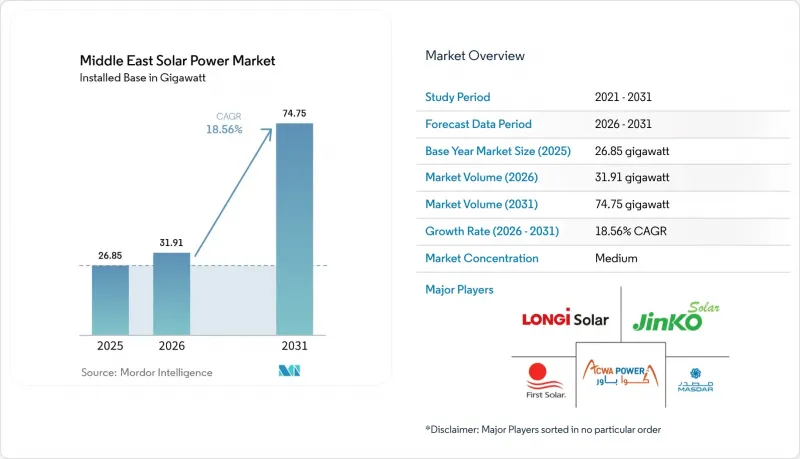
根據 Mordor Intelligence 預測,中東太陽能市場規模(以裝置容量計算)預計將從 2025 年的 26.85 吉瓦擴大到 2026 年的 31.91 吉瓦,並將從 2026 年到 2031 年以 18.56% 的複合成長率 2026 年到 2031 年以 18.56% 的複合成長率成長,達到 2037.5757.375 年。
本報告按技術(光伏和聚光型太陽光電)、電網類型(併網和離網)、最終用戶(公用事業規模、商業和工業、住宅)以及地區(沙烏地阿拉伯、阿拉伯聯合大公國、阿曼、科威特、卡達、巴林、約旦、以色列和其他中東國家)進行細分。市場規模和預測以裝置容量(吉瓦)為單位。
中東太陽能市場趨勢與洞察
各國可再生能源目標與大規模競標
這項全國性計畫已從試點競標擴展到吉瓦級項目,為中東太陽能市場建立了穩定的購電管道。 2025年10月,沙烏地阿拉伯第六輪競標以1.09682美分/度數的歷史最低價格中標,共8個地點,總裝機容量4.5吉瓦,凸顯了沙烏地阿拉伯政府致力於將太陽能打造為基本負載電力的決心。隨後,阿拉伯聯合大公國電力公司EWEC發布了一份提案書(RFP),計劃建造1吉瓦太陽能發電項目,並配套400兆瓦電池儲能系統,這不僅要求電力供應可靠,也顯示了向可調節可再生能源轉型的趨勢。隨著阿曼Ibli III計畫和科威特Al Dibudiba競標的最終中標,全部區域太陽能計畫總裝置容量已超過15吉瓦。競標規則現已強制要求獲得IEC-61215和IEC-61730認證,提高了品質標準,降低了品質保證風險。從競標到完成融資的時間縮短至 15 個月,迫使供應商在該地區持有庫存,使傳統的採購週期縮短了近 40%。
MonoPERC 和 TOPCon 太陽能模組的平準化度電成本下降
拓普康(TOPCon)技術的快速普及使得組件轉換效率超過25%,與PERC組件相比的價格溢價已縮小至5%以下。晶科能源與沙烏地阿拉伯公共投資基金(PIF)成立的10億美元拓普康合資企業預計將於2026年初開始每年供應10吉瓦的組件,從而降低高達12%的落地成本。沙漠科技公司(Desert Technologies)於2024年在吉達運作的5吉瓦電廠將進一步擴大當地的供應系統。雙面拓普康組件將在沙漠高反照率地區額外提供10%至15%的發電量。這將擴大當地發電規模,透過在競標框架中使用國產組件的折扣降低電價,進一步拉大與天然氣發電的成本差距,並推動中東太陽能市場接近全面普及。
電網擁塞和間歇性管理成本
電網升級未能跟上公用事業規模部署的步伐,迫使開發商承擔變電站建設成本,導致資本支出(CAPEX)增加高達12%。在沙烏地阿拉伯東部省份,中午時段平均限電8%至15%,降低了內部報酬率(IRR)。陽光電源在2024年中標的7.8吉瓦時電池儲能競標,目標是在2030年實現10吉瓦的儲能容量,但磷酸鋰鐵系統的成本為每千瓦時250至350美元,這將使內部收益率降低150至200個基點。阿拉伯聯合大公國北部酋長國也面臨類似的挑戰,阿拉伯聯合大公國電力公司(EWEC)正在尋求400兆瓦/800兆瓦時的儲能容量。在科威特的迪布迪巴(Al Dibudiba)專案中,由於需要一條專用的400千伏輸電線路,建設週期延長至七年,電網投資增加了1.8億美元。強制性的無功功率供應和同步電容器的引入進一步增加了系統外設備(BOS)的預算,從而抑制了中東太陽能市場的短期擴張。
細分市場分析
到2025年,太陽能發電裝置容量將佔中東太陽能市場的96.5%。到2026年,中東太陽能市場裝置容量將超過30吉瓦,在新建設的經濟效益方面超越所有其他能源。 TOPCon技術效率超過25%,雙面照明效率提升約12%,這些優勢正在降低土地利用密度和每瓦的資本支出。晶科能源在沙烏地阿拉伯的10吉瓦合資計畫已向ACWA Power的Haden和Al-Khushaybi計畫預售了部分電力,並簽署了未來10年的購電協議。
聚光型太陽光電(CSP)目前僅佔3.5%的市場佔有率,但預計到2031年將以30.44%的複合年成長率成長。杜拜950兆瓦的MBR四期項目仍然是其旗艦項目,該項目結合了700兆瓦的聚光光伏發電、250兆瓦的太陽能發電和5907兆瓦時的熔鹽儲熱。由於聚光光伏發電的成本高達每千瓦4500至5500美元,其部署僅限於混合項目以及那些要求本地製造定日鏡的項目。在幾乎所有情況下,太陽能發電與電池儲能結合的方案都比聚光光伏發電的平準化成本更低,預計未來中東太陽能市場的裝置容量將轉向太陽能發電。
其他好處:
- Excel格式的市場預測(ME)表
- 3個月的分析師支持
目錄
第1章:引言
- 研究假設和市場定義
- 調查範圍
第2章:調查方法
第3章執行摘要
第4章 市場狀況
- 市場概覽
- 市場促進因素
- 各國可再生能源目標與大規模競標
- MonoPERC 和 TOPCon 太陽能模組的平準化度電成本降低
- 高太陽輻射量(2,000 kWh/m2/年或以上)
- 海灣合作理事會跨境電網交易計劃
- 資料中心和工業叢集之間的公司間購電協議 (PPA) 激增。
- 利用太陽能作為原料開發公用事業規模的綠色氫能
- 市場限制因素
- 電網擁塞和間歇性管理成本
- 沙漠氣候下,運作維護過程中污染程度高,用水量大。
- 政治風險溢酬導致企劃案融資成本上升
- 由於依賴進口而易受貿易法規影響
- 供應鏈分析
- 監理情勢
- 技術展望
- 波特五力模型
第5章 市場規模與成長預測
- 透過技術
- 太陽能發電(PV)
- 聚光型太陽熱能發電(CSP)
- 按網格類型
- 併網
- 離網
- 最終用戶
- 公用事業規模
- 商業和工業(C&I)
- 住宅
- 按成分(定性分析)
- 太陽能模組/面板
- 逆變器(組串式、集中式、微型)
- 安裝和追蹤系統
- 系統周邊設備和電氣設備
- 儲能和混合整合
- 按地區
- 沙烏地阿拉伯
- 阿拉伯聯合大公國
- 阿曼
- 科威特
- 卡達
- 巴林
- 約旦
- 以色列
- 其他中東國家
第6章 競爭情勢
- 市場集中度
- 策略趨勢(併購、聯盟、購電協議)
- 市場佔有率分析(主要公司的市場排名和佔有率)
- 公司簡介
- ACWA Power
- Masdar(Abu Dhabi Future Energy Co.)
- JinkoSolar Holding Co. Ltd.
- First Solar Inc.
- Trina Solar Co. Ltd.
- JA Solar Technology Co. Ltd.
- Canadian Solar Inc.
- Longi Green Energy Technology Co. Ltd.
- Sungrow Power Supply Co. Ltd.
- Huawei Digital Power
- Enerwhere Sustainable Energy DMCC
- Hitachi Energy Ltd.
- Array Technologies Inc.
- Nextracker Inc.
- Alsa Solar Systems LLC
- Enviromena Power Systems
- ACWA POWER BARKA SAOG
- Desert Technologies(KSA)
- Yellow Door Energy
- TotalEnergies Renewables Middle East
第7章 市場機會與未來展望
According to Mordor Intelligence, the middle east solar power market size in terms of installed base is expected to grow from 26.85 gigawatt in 2025 to 31.91 gigawatt in 2026 and is forecast to reach 74.75 gigawatt by 2031 at 18.56% CAGR over 2026-2031.
This report is Segmented by Technology (Solar Photovoltaic and Concentrated Solar Power), Grid Type (On-Grid and Off-Grid), End-User (Utility-Scale, Commercial and Industrial, and Residential), and Geography (Saudi Arabia, United Arab Emirates, Oman, Kuwait, Qatar, Bahrain, Jordan, Israel, and Rest of Middle East). The Market Sizes and Forecasts are Provided in Terms of Installed Capacity (GW).
Middle East Solar Power Market Trends and Insights
National Renewable-Energy Targets And Mega-Tenders
Nationwide programs are scaling from pilot auctions to multi-gigawatt blocks, creating a stable offtake pipeline for the Middle East solar power market. Saudi Arabia's Round 6 tender in October 2025 awarded 4.5 GW across eight sites at a record 1.09682 US cents/kWh, underscoring sovereign resolve to treat solar as a baseload asset. The UAE's utility EWEC followed with a 1 GW solar plus 400 MW battery RFP that required firm power delivery, signaling a shift to dispatchable renewables. Oman's Ibri III shortlist and Kuwait's Al Dibdibah tender round out a region-wide queue topping 15 GW. Tender rules now mandate IEC-61215 and IEC-61730 certification, lifting quality standards and reducing warranty risk. Compressed bid-to-financial-close milestones of 15 months are forcing suppliers to hold inventory regionally, shortening historical procurement cycles by almost 40%.
Falling LCOE Of Mono-PERC And TOPCon PV Modules
Rapid diffusion of TOPCon has pushed module conversion efficiencies beyond 25% while narrowing price premiums to under 5% relative to PERC. JinkoSolar's USD 1 billion TOPCon joint venture with Saudi Arabia's Public Investment Fund will deliver 10 GW/year from early 2026, cutting landed costs by up to 12%. A 5 GW plant inaugurated by Desert Technologies in Jeddah in 2024 further broadens local supply. Bifacial TOPCon modules yield an additional 10% to 15% in the desert's high-albedo terrain, pushing the Middle East solar power market toward near-universal PV adoption as localized output scales and tender frameworks grant bid discounts for domestic content, lowering tariffs and deepening the cost gap with gas generation.
Grid Congestion And Intermittency Management Costs
Transmission upgrades lag utility-scale rollouts, forcing developers to fund substations that add as much as 12% to capex. Curtailment in Saudi Arabia's Eastern Province averages 8%-15% at midday, eroding internal rates of return. A 7.8 GWh battery tender awarded to Sungrow in 2024 aims for 10 GW of storage by 2030, yet lithium-iron-phosphate systems cost USD 250-350/kWh and trim IRR by 150-200 bps. The UAE's Northern Emirates mirror the challenge, with EWEC seeking 400 MW/800 MWh of storage capacity. Kuwait's Al Dibdibah timeline doubled to seven years due to the need for a dedicated 400 kV line, adding USD 180 million in grid spend. Reactive-power mandates and synchronous condensers further inflate balance-of-system budgets, tempering short-term expansion in the Middle East solar power market.
Other drivers and restraints analyzed in the detailed report include:
- High Solar Irradiation Exceeding 2,000 kWh/m2/yr
- GCC Cross-Border Grid Trade Initiatives
- High Soiling And Water-Intensive O&M In Desert Climates
For complete list of drivers and restraints, kindly check the Table Of Contents.
Segment Analysis
Photovoltaic installations represented 96.5% of the Middle East solar power market in 2025. The Middle East solar power market size for PV surpassed 30 GW in 2026, outpacing every other generation source on new-build economics. TOPCon efficiencies above 25% and bifacial gains around 12% are lowering land-use intensity and capex per watt. JinkoSolar's 10 GW Saudi venture has already pre-sold production to ACWA Power's Haden and Al-Khushaybi projects, locking in offtake through the decade.
Concentrated solar power clings to a 3.5% niche share but is projected to expand at a 30.44% CAGR to 2031. Dubai's 950 MW MBR Phase 4 remains the flagship, combining 700 MW of CSP with 250 MW of PV and 5,907 MWh molten-salt storage. CSP's USD 4,500-5,500/kW price tag confines replication to hybrid projects or mandates for local heliostat manufacturing. Battery-paired PV now beats CSP on levelized cost in almost every scenario, steering future capacity toward photovoltaics inside the Middle East solar power market.
Complete Report Scope:
- By Technology
- Solar Photovoltaic (PV)
- Concentrated Solar Power (CSP)
- By Grid Type
- On-Grid
- Off-Grid
- By End-User
- Utility-Scale
- Commercial and Industrial (C&I)
- Residential
- By Component (Qualitative Analysis)
- Solar Modules/Panels
- Inverters (String, Central, Micro)
- Mounting and Tracking Systems
- Balance-of-System and Electricals
- Energy Storage and Hybrid Integration
- By Geography
- Saudi Arabia
- United Arab Emirates
- Oman
- Kuwait
- Qatar
- Bahrain
- Jordan
- Israel
- Rest of Middle East
List of Companies Covered in this Report:
- ACWA Power
- Masdar (Abu Dhabi Future Energy Co.)
- JinkoSolar Holding Co. Ltd.
- First Solar Inc.
- Trina Solar Co. Ltd.
- JA Solar Technology Co. Ltd.
- Canadian Solar Inc.
- Longi Green Energy Technology Co. Ltd.
- Sungrow Power Supply Co. Ltd.
- Huawei Digital Power
- Enerwhere Sustainable Energy DMCC
- Hitachi Energy Ltd.
- Array Technologies Inc.
- Nextracker Inc.
- Alsa Solar Systems LLC
- Enviromena Power Systems
- ACWA POWER BARKA SAOG
- Desert Technologies (KSA)
- Yellow Door Energy
- TotalEnergies Renewables Middle East
Additional Benefits:
- The market estimate (ME) sheet in Excel format
- 3 months of analyst support
TABLE OF CONTENTS
1 Introduction
- 1.1 Study Assumptions & Market Definition
- 1.2 Scope of the Study
2 Research Methodology
3 Executive Summary
4 Market Landscape
- 4.1 Market Overview
- 4.2 Market Drivers
- 4.2.1 National renewable-energy targets & mega-tenders
- 4.2.2 Falling LCOE of mono-PERC & TOPCon PV modules
- 4.2.3 High solar irradiation (above 2,000 kWh/m2/yr)
- 4.2.4 GCC cross-border grid trade initiatives
- 4.2.5 Surge in corporate PPAs from data-center & industrial clusters
- 4.2.6 Utility-scale green-hydrogen developments needing solar feedstock
- 4.3 Market Restraints
- 4.3.1 Grid congestion & intermittency management costs
- 4.3.2 High soiling & water-intensive O&M in desert climates
- 4.3.3 Political-risk premium elevating project finance costs
- 4.3.4 Import-dependency exposure to trade restrictions
- 4.4 Supply-Chain Analysis
- 4.5 Regulatory Landscape
- 4.6 Technological Outlook
- 4.7 Porter's Five Forces
- 4.7.1 Bargaining Power of Suppliers
- 4.7.2 Bargaining Power of Buyers
- 4.7.3 Threat of New Entrants
- 4.7.4 Threat of Substitutes
- 4.7.5 Competitive Rivalry
5 Market Size & Growth Forecasts
- 5.1 By Technology
- 5.1.1 Solar Photovoltaic (PV)
- 5.1.2 Concentrated Solar Power (CSP)
- 5.2 By Grid Type
- 5.2.1 On-Grid
- 5.2.2 Off-Grid
- 5.3 By End-User
- 5.3.1 Utility-Scale
- 5.3.2 Commercial and Industrial (C&I)
- 5.3.3 Residential
- 5.4 By Component (Qualitative Analysis)
- 5.4.1 Solar Modules/Panels
- 5.4.2 Inverters (String, Central, Micro)
- 5.4.3 Mounting and Tracking Systems
- 5.4.4 Balance-of-System and Electricals
- 5.4.5 Energy Storage and Hybrid Integration
- 5.5 By Geography
- 5.5.1 Saudi Arabia
- 5.5.2 United Arab Emirates
- 5.5.3 Oman
- 5.5.4 Kuwait
- 5.5.5 Qatar
- 5.5.6 Bahrain
- 5.5.7 Jordan
- 5.5.8 Israel
- 5.5.9 Rest of Middle East
6 Competitive Landscape
- 6.1 Market Concentration
- 6.2 Strategic Moves (M&A, Partnerships, PPAs)
- 6.3 Market Share Analysis (Market Rank/Share for key companies)
- 6.4 Company Profiles (includes Global level Overview, Market level overview, Core Segments, Financials as available, Strategic Information, Products & Services, and Recent Developments)
- 6.4.1 ACWA Power
- 6.4.2 Masdar (Abu Dhabi Future Energy Co.)
- 6.4.3 JinkoSolar Holding Co. Ltd.
- 6.4.4 First Solar Inc.
- 6.4.5 Trina Solar Co. Ltd.
- 6.4.6 JA Solar Technology Co. Ltd.
- 6.4.7 Canadian Solar Inc.
- 6.4.8 Longi Green Energy Technology Co. Ltd.
- 6.4.9 Sungrow Power Supply Co. Ltd.
- 6.4.10 Huawei Digital Power
- 6.4.11 Enerwhere Sustainable Energy DMCC
- 6.4.12 Hitachi Energy Ltd.
- 6.4.13 Array Technologies Inc.
- 6.4.14 Nextracker Inc.
- 6.4.15 Alsa Solar Systems LLC
- 6.4.16 Enviromena Power Systems
- 6.4.17 ACWA POWER BARKA SAOG
- 6.4.18 Desert Technologies (KSA)
- 6.4.19 Yellow Door Energy
- 6.4.20 TotalEnergies Renewables Middle East
7 Market Opportunities & Future Outlook
- 7.1 White-space & Unmet-Need Assessment

 英國太陽能發電:市場佔有率分析、行業趨勢和統計數據以及成長預測(2026-2031 年)
 2034年太陽能市場預測—全球技術、組件、安裝類型、併網類型、容量、應用、最終用戶、連接類型、所有權類型和區域分析
 太陽能電錶市場 - 全球產業規模、佔有率、趨勢、機會、預測:按類型、測量方法、最終用戶、外形規格、地區和競爭格局分類,2021-2031年
 太陽能市場規模、佔有率和成長分析:按技術、應用、最終用戶和地區分類-2026-2033年產業預測
 2026年全球太陽能電能表市場報告
 日本太陽能發電設備市場規模、佔有率、趨勢和預測:按設備類型、應用和地區分類,2026-2034年2026年超高效能太陽能發電全球市場報告
 太陽能即時預測市場:2026-2032年全球預測(依最終用戶、技術、部署類型、預測類型和服務產品分類)
 太陽能光電設備市場規模、佔有率及成長分析(按產品類型、來源、最終用途和地區分類)-產業預測,2026-2033年全球光電市場:預測至2032年-按組件、部署方式、技術、最終用戶和地區分類的分析