


 |
市場調查報告書
商品編碼
2073534
語言服務:市場佔有率分析、產業趨勢與統計、成長預測(2026-2031)Language Services - Market Share Analysis, Industry Trends & Statistics, Growth Forecasts (2026 - 2031) |
||||||

※ 本網頁內容可能與最新版本有所差異。詳細情況請與我們聯繫。
根據 Mordor Intelligence 預測,語言服務市場規模預計將在 2025 年達到 718.4 億美元,2026 年達到 755.3 億美元,到 2031 年達到 969.7 億美元,2026 年至 2031 年的複合年成長率為 5.12%。
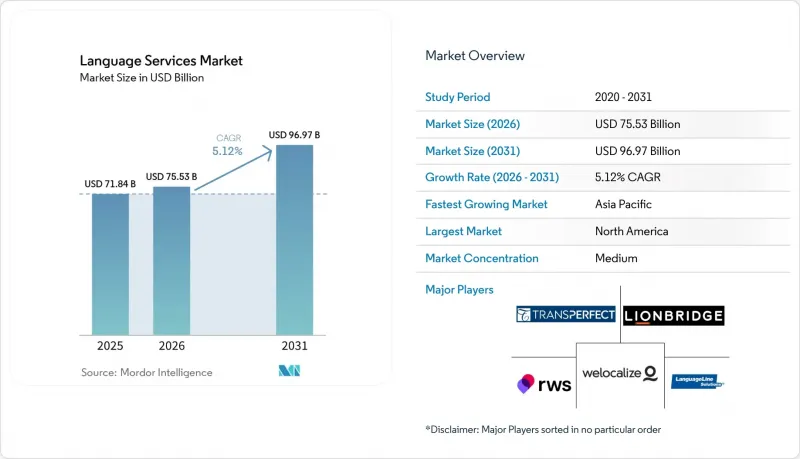
本報告按服務類型(筆譯、在地化、口譯等)、終端用戶產業(生命科學、媒體與娛樂、法律、金融與專利、電子商務與零售、IT與電信等)、交付方式(現場、遠端等)、技術(純人工翻譯、純機器翻譯等)以及地區進行細分。市場預測以美元計價。
全球語言服務市場趨勢與洞察
商業全球化浪潮正在加速需求成長。
尋求跨境營收的企業正在將在地化專家融入其設計和產品團隊,將翻譯視為成長的驅動力而非成本中心。母語支付流程、客戶支援入口網站和合規文件能夠降低購買放棄率,並加速市場准入,尤其是在分散的東南亞電子商務市場。 TransPerfect 的 GlobalLink 平台已成功幫助 AIG 等客戶縮短了 20% 的內容交付時間,並透過工作流程自動化實現了每年 25 萬美元的成本節約。因此,對高品質在地化的需求正在發生結構性轉變,即使在宏觀經濟週期波動的情況下,也能支撐語言服務市場的成長。擁有全球語言專家網路和符合 ISO 標準的安全協議的供應商正在獲得多年期主契約,這構成了可預測現金流的基礎。
多語言數位內容製作的爆炸性成長
串流媒體巨頭、遊戲發行商和社群媒體平台如今正以數十種語言同步發布作品和劇集,僅靠人力難以完成這項任務。 Deepdub 的 80 種語言專案證明了這一點:將人工智慧驅動的配音與語言專家的後製相結合的混合工作流程,可以將發佈時間縮短高達 70%,成本降低 50%。 Synthesia 的合成語音平台支援超過 130 種語言,並通過了 ISO 42001 認證,展現出企業級的可靠性。這種速度使得製作量與人員配置脫鉤,拓展了可處理的服務範圍,涵蓋了長尾語言對,並擴大了整個語言服務市場。然而,通用專案面臨著利潤率的壓力,因此各機構正透過專業知識、具有文化意識的翻譯創作和專有人工智慧引擎來脫穎而出。
開放原始碼機器翻譯正在將基礎內容商品化。
像 Meta 的 NLLB-200 和谷歌翻譯這樣的免費神經網路模型,在常用語言對上的準確率已經接近人類水平,這使得企業能夠自行翻譯手冊和評論。這削弱了通用文字的定價權,迫使企業重新評估其作為託管服務合作夥伴的定位,最佳化開放原始碼引擎,將機器翻譯整合到內容技術堆疊中,並確保輸出品質。雖然高價值項目(例如受監管項目和創新項目)受到的影響較小,但基礎內容利潤率的壓縮正在減緩語言服務市場的整體成長。
細分市場分析
預計到2025年,翻譯服務將佔總收入的42.52%,鞏固其作為語言服務市場基礎組成部分的地位。客戶依賴這些服務來處理法律合約、產品文件和合規性申報,而服務提供者則正在整合自動化品質保證(QA)、桌面排版和術語管理等技術,以保持版面和品牌基調的一致性。然而,成長動力正轉向人工智慧驅動的在地化,透過提供與敏捷產品發布同步更新的自適應輸出,以6.16%的複合年成長率快速成長。
在地化工作流程如今整合了文化適應、使用者介面測試和多媒體工程,使其成為軟體、遊戲和電子商務產品發布不可或缺的一部分。口譯服務正朝著按需遠端管道和麵向會議及法庭的精細化同聲傳譯方向發展,而字幕和旁白的需求則因串流媒體和企業培訓的興起而激增。高階創譯服務根據目標文化對創新素材進行重構,從而推高價格並增強服務提供者的差異化優勢。在統一管治下整合機器翻譯、人工後製編輯和文化諮詢的服務,持續擴大語言服務市場的整體規模。
生命科學領域受多語言標籤、藥物安全監測報告以及FDA和EMA要求的臨床試驗數據等因素驅動,預計2025年將佔支出的18.36%。對審計追蹤和術語準確性的需求支撐了高價位和可預測的需求,即使在景氣衰退時期也能穩定收入。
電子商務和零售業預計將以7.32%的複合年成長率成長。這主要是由於跨境市場需要近乎即時地在地化產品描述、支付流程和客戶支援腳本。隨著區域支付法規的不斷完善,準確的翻譯對於支付流程的合規性和提高轉換率至關重要,從而推動了零售相關語言服務的市場佔有率成長。媒體娛樂、法律、金融、專利以及IT和電信等產業也帶來了多元化的專案需求。同時,諸如Accolad的歐盟監管相關合約等政府計畫也展現了公共部門翻譯領域的大規模商機。
區域分析
受藥品申請、跨境電子取證和軟體全球化等因素的推動,北美預計將在2025年佔據37.26%的收入佔有率。美國客戶向認證譯員支付高額費用,並推高了語言服務市場的平均發票金額。加拿大的聯邦雙語政策推動了對英語和法語的需求,而墨西哥的近岸外包熱潮則促進了對英語和西班牙語技術文件的需求。
亞太地區成長最快,複合年成長率達7.36%。除了印度部署支援30多種語言的語音助理外,日本和韓國政府對文化產出的補貼也催生了大量的語音和字幕製作計畫。中國大型電商企業正在將產品目錄和聊天機器人在地化為東南亞當地語言,從而擴大了該地區的語言服務市場。澳洲和紐西蘭則扮演品質保證中心的角色,為全天候全球交貨提供支援。
歐洲依然是強勁需求的中心,這主要得益於歐盟法規強制要求使用24種官方語言進行多語言包裝、臨床試驗材料和公共部門溝通。德國、法國和英國在歐洲大陸的語言服務市場佔有較高的附加價值佔有率,汽車、化學和奢侈品行業聚集了大量專業語言專家。中東、非洲和南美洲預計將迎來進一步成長,這主要得益於沙烏地阿拉伯「2030願景」推動的阿拉伯語、葡萄牙語和非洲語言計畫的擴展,以及巴西零售業自由化和南非公共衛生舉措的推進。
其他好處:
- Excel格式的市場預測(ME)表
- 3個月的分析師支持
目錄
第1章:引言
- 研究假設和市場定義
- 調查範圍
第2章:調查方法
第3章執行摘要
第4章 市場狀況
- 市場概覽
- 市場促進因素
- 商業全球化浪潮正在加速需求成長。
- 多語言數位內容的爆炸性成長
- 生命科學領域監管的加強刺激了對受監管內容的加值服務的需求。
- 生成式人工智慧正在推動處理能力的提升和利潤率的提高。
- 即時微定位對於打造高度個人化、多語言的客戶體驗至關重要。
- 新興市場語音助理的興起,使得音訊的大規模在地化成為可能。
- 市場限制因素
- 開放原始碼機器翻譯正在將基礎內容商品化。
- 小眾領域語言專家短缺
- 嚴格的資料主權法律限制了跨境語言資料集的使用。
- 客戶方不斷上漲的整合成本正成為更換供應商的一大障礙。
- 產業價值鏈分析
- 監理情勢
- 技術展望
- 基於雲端的TMS和CAT平台
- 使用大規模語言模型的神經翻譯和機器翻譯
- 媒體在地化技術、合成配音、SDH
- 具備網路安全措施的語言工作台
- 波特五力分析
- 投資與資金籌措分析
- 宏觀經濟因素對市場的影響
第5章 市場規模與成長預測
- 按服務類型
- 翻譯服務
- 在地化服務
- 口譯服務
- 字幕和說明文字
- 桌面出版(DTP)
- 創譯
- 其他服務類型
- 按最終用戶行業分類
- 生命科學
- 媒體與娛樂
- 法律事務、財務、專利
- 電子商務與零售
- 資訊科技/通訊
- 政府/公共部門
- 製造業和工業
- 其他終端用戶產業
- 按服務交付方式
- 現場
- 偏僻的
- 電話口譯(OPI)
- 視訊遠距口譯(VRI)
- 混合
- 透過技術
- 僅限人類
- 純機器翻譯
- 機器翻譯後編輯(PEMT)
- 人工智慧驅動的本地化
- 其他技術
- 按地區
- 北美洲
- 美國
- 加拿大
- 墨西哥
- 南美洲
- 巴西
- 阿根廷
- 其他南美國家
- 歐洲
- 德國
- 英國
- 法國
- 義大利
- 西班牙
- 俄羅斯
- 其他歐洲國家
- 亞太地區
- 中國
- 日本
- 韓國
- 印度
- 澳洲
- 紐西蘭
- 其他亞太國家
- 中東
- 阿拉伯聯合大公國
- 沙烏地阿拉伯
- 土耳其
- 其他中東國家
- 非洲
- 南非
- 奈及利亞
- 肯亞
- 其他非洲國家
- 北美洲
第6章 競爭情勢
- 市場集中度
- 策略趨勢
- 市佔率分析
- 公司簡介
- TransPerfect Global Inc.
- RWS Holdings plc
- Lionbridge Technologies Inc.
- LanguageLine Solutions
- Welocalize Inc.
- Acolad Group
- Keywords Studios plc
- Semantix AB
- Summa Linguae Technologies
- United Language Group
- Straker Translations Ltd.
- Appen Ltd.
- Pactera EDGE
- Honyaku Center Inc.
- PGLS
- Atlas Language Services Inc.
- Globe Language Services Inc.
- Iyuno-SDI Group
- Smartling Inc.
- LILT Inc.
第7章 市場機會與未來展望
According to Mordor Intelligence, the language services market size is projected to be USD 71.84 billion in 2025, USD 75.53 billion in 2026, and reach USD 96.97 billion by 2031, growing at a CAGR of 5.12% from 2026 to 2031.
This report is Segmented by Service Type (Translation, Localisation, Interpreting, and More), End-User Vertical (Life Sciences, Media and Entertainment, Legal Finance and Patents, E-Commerce and Retail, IT and Telecom, and More), Delivery Mode (On-Site, Remote, and More), Technology (Human-Only, Pure MT, and More), and Geography. The Market Forecasts are Provided in Terms of Value (USD).
Global Language Services Market Trends and Insights
Corporate Globalization Wave Intensifies Demand
Enterprises pursuing cross-border revenue embed localization experts into design and product teams, reframing translation as a growth lever rather than a cost center. Native-language checkout flows, customer support portals, and compliance documentation reduce abandonment and expedite market entry, especially across the fragmented Southeast Asian e-commerce landscape. Success stories on TransPerfect's GlobalLink platform show clients such as AIG cutting content turnaround by 20% and saving USD 250,000 annually through workflow automation. The outcome is a structural shift in premium localization demand that sustains the language services market's trajectory even as macroeconomic cycles fluctuate. Vendors with global linguist networks and ISO-aligned security protocols secure multi-year master agreements, which anchor predictable cash flow.
Explosive Multilingual Digital-Content Creation
Streaming giants, game publishers, and social-media platforms now launch titles and episodes in dozens of languages simultaneously, overwhelming purely human capacity. Hybrid workflows that blend AI dubbing and linguist post-production cut release times by up to 70% and costs by 50%, as demonstrated by Deepdub's 80-language projects. Synthesia's synthetic-voice platform spans 130+ languages and holds ISO 42001 certification, signaling enterprise-grade reliability. This velocity decouples output from head-count, expanding feasible coverage to long-tail language pairs and enlarging the overall language services market. However, generic volumes face margin pressure, so agencies differentiate through domain expertise, cultural transcreation, and proprietary AI engines.
Open-Source Machine Translation Commoditizes Basic Content
Freely available neural models such as Meta's NLLB-200 and Google Translate now reach near-human parity on common language pairs, enabling firms to translate manuals or reviews in-house. This erodes pricing power on commodity text and forces agencies to reposition as managed-service partners that fine-tune open engines, integrate MT into content stacks, and certify output quality. Although higher-value regulated and creative projects remain insulated, margin compression on basic content trims overall growth in the language services market.
Other drivers and restraints analyzed in the detailed report include:
- Stricter Life-Science Compliance Triggers Premium Regulated-Content Services
- Generative AI Boosts Throughput And Margin Expansion
- Talent Scarcity For Niche Domain Linguists
For complete list of drivers and restraints, kindly check the Table Of Contents.
Segment Analysis
Translation Services contributed 42.52% of 2025 revenue, cementing its role as the foundational engine of the language services market. Clients rely on it for legal contracts, product documentation, and compliance filings, and providers have embedded automated QA, desktop publishing, and terminology management to preserve layout and brand tone. Yet growth momentum is shifting toward AI-Enabled Localization, which is advancing at a 6.16% CAGR by delivering adaptive output that updates alongside agile product releases.
Localization workflows now bundle cultural adaptation, UI testing, and multimedia engineering, making them indispensable for software, gaming, and e-commerce launches. Interpreting Services are splitting into on-demand remote channels and high-touch simultaneous sessions for conferences and courts, while subtitling and captioning volumes surge on the back of streaming and corporate training. Premium transcreation reimagines creative assets for target cultures, commanding higher fees and reinforcing provider differentiation. Integrated offerings that weave machine translation, human post-editing, and cultural consulting under unified governance continue to expand total language services market size.
Life Sciences captured 18.36% of 2025 spending, underpinned by multilingual labeling, pharmacovigilance reports, and clinical-trial materials required by the FDA and EMA. The need for audit trails and terminological precision supports premium pricing and predictable demand, insulating revenue during economic downturns.
E-Commerce and Retail is forecast to grow at a 7.32% CAGR because cross-border marketplaces must localize product descriptions, payment flows, and customer-support scripts in near real time. As regional payment regulations proliferate, accurate translation becomes essential to checkout compliance and conversion uplift, enlarging the language services market share tied to retail. Media and Entertainment, Legal Finance and Patents, and IT and Telecom add diversified volume streams, while Government projects such as Acolad's EU regulation contract illustrate scale opportunities in public-sector translation.
Complete Report Scope:
- By Service Type
- Translation services
- Localisation services
- Interpreting services
- Subtitling and captioning
- Desktop publishing (DTP)
- Transcreation
- Other Service Types
- By End-User Vertical
- Life sciences
- Media and entertainment
- Legal, finance and patents
- E-commerce and retail
- IT and telecom
- Government and public sector
- Manufacturing and industrial
- Other End-User Verticals
- By Service Delivery Mode
- On-site
- Remote
- Over-the-Phone Interpreting (OPI)
- Video Remote Interpreting (VRI)
- Hybrid
- By Technology
- Human-only
- Pure machine translation
- Post-edited machine translation (PEMT)
- AI-enabled localisation
- Other Technologies
- By Geography
- North America
- United States
- Canada
- Mexico
- South America
- Brazil
- Argentina
- Rest of South America
- Europe
- Germany
- United Kingdom
- France
- Italy
- Spain
- Russia
- Rest of Europe
- Asia Pacific
- China
- Japan
- South Korea
- India
- Australia
- New Zealand
- Rest of Asia Pacific
- Middle East
- United Arab Emirates
- Saudi Arabia
- Turkey
- Rest of Middle East
- Africa
- South Africa
- Nigeria
- Kenya
- Rest of Africa
- North America
Geography Analysis
North America generated 37.26% of 2025 revenue, powered by pharmaceutical filings, cross-border e-discovery, and software globalization. United States buyers pay premium rates for certified linguists, lifting average invoice values inside the language services market. Canada's federal bilingualism drives English-French demand, while Mexico's near-shoring boom boosts English-Spanish technical documentation.
Asia Pacific posts the fastest expansion at a 7.36% CAGR. Voice-assistant rollouts covering 30+ Indian languages, plus Japanese and Korean state subsidies for cultural exports, add high-volume audio and subtitle work. China's e-commerce giants localize catalog listings and chat-bots into Southeast Asian vernaculars, lifting regional language services market size. Australia and New Zealand act as quality-assurance hubs that support 24-hour global delivery.
Europe remains a stalwart demand center because EU regulations mandate multilingual packaging, clinical-trial dossiers, and public-sector communications across 24 official languages. Germany, France, and the United Kingdom concentrate specialist linguists in automotive, chemical, and luxury fields, preserving the continent's high-value share of the language services market. The Middle East and Africa and South America contribute incremental upside as Saudi Vision 2030, Brazilian retail liberalization, and South African public-health initiatives unlock Arabic, Portuguese, and African-language projects.
- TransPerfect Global Inc.
- RWS Holdings plc
- Lionbridge Technologies Inc.
- LanguageLine Solutions
- Welocalize Inc.
- Acolad Group
- Keywords Studios plc
- Semantix AB
- Summa Linguae Technologies
- United Language Group
- Straker Translations Ltd.
- Appen Ltd.
- Pactera EDGE
- Honyaku Center Inc.
- PGLS
- Atlas Language Services Inc.
- Globe Language Services Inc.
- Iyuno-SDI Group
- Smartling Inc.
- LILT Inc.
Additional Benefits:
- The market estimate (ME) sheet in Excel format
- 3 months of analyst support
TABLE OF CONTENTS
1 INTRODUCTION
- 1.1 Study Assumptions and Market Definition
- 1.2 Scope of the Study
2 RESEARCH METHODOLOGY
3 EXECUTIVE SUMMARY
4 MARKET LANDSCAPE
- 4.1 Market Overview
- 4.2 Market Drivers
- 4.2.1 Corporate Globalisation Wave Intensifies Demand
- 4.2.2 Explosive Multilingual Digital-Content Creation
- 4.2.3 Stricter Life-Science Compliance Triggers Premium Regulated-Content Services
- 4.2.4 Generative Ai Boosts Throughput And Margin Expansion
- 4.2.5 Hyper-Personalised Multilingual Cx Mandates Real-Time Micro-Localisation
- 4.2.6 Rise Of Voice Assistants In Emerging Markets Unlocks Mass Audio Localisation
- 4.3 Market Restraints
- 4.3.1 Open-Source Machine Translation Commoditises Basic Content
- 4.3.2 Talent Scarcity For Niche Domain Linguists
- 4.3.3 Stringent Data-Sovereignty Laws Restrict Cross-Border Linguistic Datasets
- 4.3.4 Rising Client-Side Integration Costs Create Vendor-Switching Friction
- 4.4 Industry Value Chain Analysis
- 4.5 Regulatory Landscape
- 4.6 Technological Outlook
- 4.7 Cloud-based TMS and CAT platforms
- 4.8 Neural and large-language-model machine translation
- 4.9 Media-localisation technology, synthetic dubbing, SDH
- 4.10 Cyber-secure language workbenches
- 4.11 Porter's Five Forces Analysis
- 4.11.1 Bargaining power of suppliers
- 4.11.2 Bargaining power of buyers
- 4.11.3 Threat of new entrants
- 4.11.4 Threat of substitutes
- 4.11.5 Intensity of competitive rivalry
- 4.12 Investment and Funding Analysis
- 4.13 Impact of Macroeconomic Factors on the Market
5 MARKET SIZE AND GROWTH FORECASTS (VALUE)
- 5.1 By Service Type
- 5.1.1 Translation services
- 5.1.2 Localisation services
- 5.1.3 Interpreting services
- 5.1.4 Subtitling and captioning
- 5.1.5 Desktop publishing (DTP)
- 5.1.6 Transcreation
- 5.1.7 Other Service Types
- 5.2 By End-User Vertical
- 5.2.1 Life sciences
- 5.2.2 Media and entertainment
- 5.2.3 Legal, finance and patents
- 5.2.4 E-commerce and retail
- 5.2.5 IT and telecom
- 5.2.6 Government and public sector
- 5.2.7 Manufacturing and industrial
- 5.2.8 Other End-User Verticals
- 5.3 By Service Delivery Mode
- 5.3.1 On-site
- 5.3.2 Remote
- 5.3.2.1 Over-the-Phone Interpreting (OPI)
- 5.3.2.2 Video Remote Interpreting (VRI)
- 5.3.3 Hybrid
- 5.4 By Technology
- 5.4.1 Human-only
- 5.4.2 Pure machine translation
- 5.4.3 Post-edited machine translation (PEMT)
- 5.4.4 AI-enabled localisation
- 5.4.5 Other Technologies
- 5.5 By Geography
- 5.5.1 North America
- 5.5.1.1 United States
- 5.5.1.2 Canada
- 5.5.1.3 Mexico
- 5.5.2 South America
- 5.5.2.1 Brazil
- 5.5.2.2 Argentina
- 5.5.2.3 Rest of South America
- 5.5.3 Europe
- 5.5.3.1 Germany
- 5.5.3.2 United Kingdom
- 5.5.3.3 France
- 5.5.3.4 Italy
- 5.5.3.5 Spain
- 5.5.3.6 Russia
- 5.5.3.7 Rest of Europe
- 5.5.4 Asia Pacific
- 5.5.4.1 China
- 5.5.4.2 Japan
- 5.5.4.3 South Korea
- 5.5.4.4 India
- 5.5.4.5 Australia
- 5.5.4.6 New Zealand
- 5.5.4.7 Rest of Asia Pacific
- 5.5.5 Middle East
- 5.5.5.1 United Arab Emirates
- 5.5.5.2 Saudi Arabia
- 5.5.5.3 Turkey
- 5.5.5.4 Rest of Middle East
- 5.5.6 Africa
- 5.5.6.1 South Africa
- 5.5.6.2 Nigeria
- 5.5.6.3 Kenya
- 5.5.6.4 Rest of Africa
- 5.5.1 North America
6 COMPETITIVE LANDSCAPE
- 6.1 Market Concentration
- 6.2 Strategic Moves
- 6.3 Market Share Analysis
- 6.4 Company Profiles (includes global-level overview, market-level overview, core segments, financials as available, strategic information, market rank or share for key companies, products and services, and recent developments)
- 6.4.1 TransPerfect Global Inc.
- 6.4.2 RWS Holdings plc
- 6.4.3 Lionbridge Technologies Inc.
- 6.4.4 LanguageLine Solutions
- 6.4.5 Welocalize Inc.
- 6.4.6 Acolad Group
- 6.4.7 Keywords Studios plc
- 6.4.8 Semantix AB
- 6.4.9 Summa Linguae Technologies
- 6.4.10 United Language Group
- 6.4.11 Straker Translations Ltd.
- 6.4.12 Appen Ltd.
- 6.4.13 Pactera EDGE
- 6.4.14 Honyaku Center Inc.
- 6.4.15 PGLS
- 6.4.16 Atlas Language Services Inc.
- 6.4.17 Globe Language Services Inc.
- 6.4.18 Iyuno-SDI Group
- 6.4.19 Smartling Inc.
- 6.4.20 LILT Inc.
7 MARKET OPPORTUNITIES AND FUTURE OUTLOOK
- 7.1 White-Space and Unmet-Need Assessment

 語言服務市場-2026-2032年全球市場預測
 口譯服務市場規模、佔有率和成長分析:按服務類型、應用領域、服務形式、組織規模、銷售管道和地區分類-2026-2033年產業預測
 醫療語言市場:按服務類型、交付方式、應用程式和最終用戶分類
 2026年全球語言服務市場報告
 語言服務市場規模、佔有率、趨勢和預測:按服務、組件、應用和地區分類,2026-2034 年
 2026-2030年全球語言服務市場
 語言服務市場規模、佔有率、成長及全球產業分析:按類型、應用和地區劃分的洞察,2026-2034 年
 語言服務市場規模、佔有率和成長分析(按服務、最終用戶產業、交付類型和地區分類)-2026-2033年產業預測