


 |
市場調查報告書
商品編碼
2073471
智慧電錶:市場佔有率分析、產業趨勢與統計及成長預測(2026-2031)Smart Electricity Meter - Market Share Analysis, Industry Trends & Statistics, Growth Forecasts (2026 - 2031) |
||||||

※ 本網頁內容可能與最新版本有所差異。詳細情況請與我們聯繫。
據 Mordor Intelligence 稱,智慧電錶市場預計到 2026 年價值 150.2 億美元,高於 2025 年的 137.4 億美元,預計到 2031 年將達到 234.6 億美元。
預計從 2026 年到 2031 年,其複合年成長率將達到 9.31%。
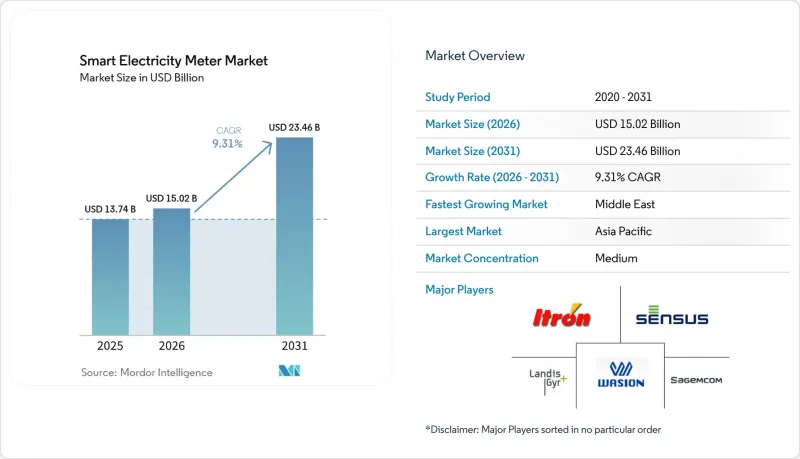
本報告按相位(單相和三相)、通訊技術(電力線通訊 (PLC) 及其他)、技術(高級計量基礎設施 (AMI) 及其他)、最終用戶(住宅、商業、工業)、安裝類型(新安裝和維修/更換)以及地區進行細分。市場預測以美元 (USD) 為單位。
全球智慧電錶市場趨勢及洞察
歐盟強制要求在2025年前更換三相電錶
歐洲一項具有法律約束力的三相電錶更換計畫正迫使電力公司在2027年前更換數百萬個商業和工業用電錶。電力公司正抓住這項契機,部署能夠收集詳細間隔資料並支援分錶計量服務的智慧計量基礎設施(AMI)平台。電錶供應商受益於更高的平均售價,約為單相電錶的三倍,而軟體供應商則透過數據管理合約獲得持續收入。用於合規的資本投資也加速了資料中心的建設,這些資料中心支持收費系統創新和需求面柔軟性計劃。
中國大規模競標NB-IoT智慧電錶
中國國家電網公司2025年競標600萬台雙模NB-IoT電錶,鞏固了蜂窩網路連接作為價格競爭力強的選擇的地位。大量採購降低了全球買家的組件成本,並縮短了數據機供應商的認證週期。電錶的雙頻設計使其能夠面向未來部署,為2G服務終止做好準備;而雲端原生前端系統則簡化了軟體升級。這些營運優勢引起了東南亞電力公司的共鳴,這些公司面臨類似的城市人口密度挑戰,並正在將中國的設計模式打造成為事實上的標準。
ASIC供應鏈短缺導致物料清單成本上升。
專用處理器長期短缺導致電錶製造成本上漲15%至25%。小規模供應商正在重新設計基板以使用通用微控制器(MCU),這延長了檢驗週期並增加了營運資金。北美多家地方政府電力公司已將第二階段部署延後至2027年,希望計畫於2026年運作的晶圓廠能夠緩解供不應求。這種供應緊張對高級計量基礎設施(AMI)電錶的影響最為嚴重,因為此類電錶需要加密處理加速和邊緣分析內核。
細分市場分析
儘管預計到2025年單相電錶將佔據市場主導地位,佔總銷量的63.25%,但三相電錶預計到2031年將以9.05%的複合年成長率成長。電力公司更傾向於在中壓饋線、可再生能源逆變器和電動車快速充電器等需要高諧波負載特性的應用中使用三相電錶。相較之下,單相電錶在銷售上仍佔據主導地位,但受網路安全和韌體升級需求的驅動,其產品正逐步更新換代。在非線性負載環境下久經考驗的高精度正在消除工業自動化用戶採用三相電錶的傳統障礙,導致德國、義大利和波蘭的電錶原始設備製造商(OEM)累積訂單增加。
歐盟法規強制要求智慧電錶具備電壓驟降記錄和整合跳脫繼電器等先進的三相功能,這正推動著該細分市場的發展。因此,智慧電錶市場的價值重心正明顯轉向利潤更高的工業合約。三相電錶的平均售價約為住宅電錶的2.8倍,擴大了用於商業和工業應用的智慧電錶的市場規模。供應商正將電能品質模組和碳排放報告功能捆綁銷售,以實現產品差異化;而電力公司則透過推出基於訂閱的分析服務來應對這一趨勢,從而將這些新的數據流貨幣化。
電力線通訊 (PLC) 憑藉其在歐洲低壓 (LV) 網路中的高滲透率,預計到 2025 年將保持 44.10% 的市場佔有率。然而,蜂窩 NB-IoT 和 LTE-M 模組正在縮小與 PLC 的成本差距,預計到 2031 年將以 11.62% 的複合年成長率成長。在中國,大規模競標的成功使得蜂窩網路在人口密集的都市區的部署速度比 PLC 快了最多六個月。智慧電錶市場正在向混合架構轉型,其中射頻網狀網路負責郊區的回程傳輸,而蜂窩技術則為高層建築群提供覆蓋,從而確保無需中繼網路即可實現持續覆蓋。
eSIM 的引入簡化了配置流程,並可將營運成本 (OPEX) 降低高達 35%,因為公共產業無需現場訪問即可切換通訊業者。在巴西進行的現場測試證實,NB-IoT 在地下室和電錶房的滲透率比傳統網狀網路系統高出 22 個百分點。蜂窩通訊的蓬勃發展正在擴大以運營商為中心的通訊業者在智慧電錶市場的佔有率,這些供應商將硬體和託管連接服務捆綁在一起。隨著漫遊成本的下降,非洲電力公司正在利用跨境蜂窩通訊協定來標準化 AMI 配置,從而降低與專有網狀無線設備相關的進口關稅。
區域分析
預計到2025年,亞太地區將佔據智慧電錶市場47.55%的佔有率,並在全球出貨量中佔據重要地位,持續推動智慧電錶市場需求。光是在中國,26個省份就已部署了5.9億個AMI終端,為本地供應商提供了無與倫比的規模優勢。在印度,一項由聯邦政府主導的計畫正在推進,目標是在2027年前部署2.5億個預付式智慧電錶,該計畫旨在促進公私合作,並推動第三方資金籌措結構的建立。在日本和韓國的高密度都市區,AMI 2.0的部署正在穩步推進,透過收集亞秒事件數據,加強電力品質監測系統,以應對屋頂太陽能發電裝置的快速成長。
預計2026年至2031年間,中東智慧電錶市場將以10.18%的強勁成長率擴張。這項快速成長主要得益於波灣合作理事會(GCC)成員國電力公司積極推動電網數位化、實施分時電價機制以及重視需求面管理。在沙烏地阿拉伯、阿拉伯聯合大公國和阿曼等國,高級計量基礎設施(AMI)的廣泛應用提高了計費準確性,並有助於在停電期間掌握情況。此外,該地區的這一發展勢頭還得益於屋頂太陽能發電的日益普及、監管改革以及雄心勃勃的能源效率目標。
在北美,預計到2024年,智慧電網的普及率將達到77%。電力公司目前正在用整合了故障檢測演算法和電動車負載預測功能的設備替換第一代智慧電網設備。美國能源局提供的105億美元電網韌性建設津貼,正協助中型城市實施包括以電錶為中心的故障定位程序在內的升級改造。該地區對Wi-SUN等開放標準的堅持,正在培育一個可互通的軟體供應商生態系統,從而促進競爭並降低生命週期成本。
歐洲以政策主導的模式以嚴格的網路安全和資料隱私法規為特徵。截至2022年底,已有56%的用戶使用智慧電錶,目前正在努力協調數據訪問,使零售商能夠跨境提供靈活的費率方案。一項50億歐元的創新基金旨在2027年實現90%的智慧電錶普及率,其中人工智慧驅動的負載預測是一項關鍵成果。從2025年開始強制過渡到三相供電系統,正在加速工業領域的智慧電錶普及,尤其是在德國、西班牙和北歐國家。
其他好處
- Excel格式的市場預測(ME)表
- 3個月的分析師支持
目錄
第1章:引言
- 研究假設和市場定義
- 調查範圍
第2章:調查方法
第3章執行摘要
第4章 市場狀況
- 市場概覽
- 市場促進因素
- 歐盟2025年三相電力替代義務
- 中國大規模競標購買NB-IoT智慧電錶
- 美國和日本的需量反應AMI部署
- 大洋洲產消者支出激增
- 推動南方地區電網現代化的因素
- 海灣合作理事會引進分時定價系統
- 市場限制因素
- ASIC供應鏈短缺導致物料清單成本上升。
- 英國註冊會計師/歐盟RED網路認證延誤
- 法國和加拿大對射頻輻射法規的抵制
- 與撒哈拉以南非洲公共產業中傳統的SCADA系統不相容
- 產業價值鏈分析
- 監理展望
- 技術展望
- 波特五力分析
第5章 市場規模與成長預測
- 愛別
- 單相
- 三相
- 透過通訊技術
- 電力線路通訊(PLC)
- 無線頻率網狀網路
- 蜂窩網路(NB-IoT/LTE-M)
- 混合型/其他
- 透過技術
- 先進計量基礎設施(AMI)
- 自動抄表(AMR)
- 最終用戶
- 住宅
- 商業
- 產業
- 按安裝類型
- 新安裝
- 維修和更換
- 按地區
- 北美洲
- 美國
- 加拿大
- 墨西哥
- 南美洲
- 巴西
- 智利
- 哥倫比亞
- 其他南美國家
- 歐洲
- 英國
- 德國
- 法國
- 西班牙
- 義大利
- 北歐的
- 比荷盧經濟聯盟
- 其他歐洲國家
- 亞太地區
- 中國
- 印度
- 日本
- 韓國
- 東南亞
- 其他亞太國家
- 中東
- GCC
- 土耳其
- 以色列
- 其他中東國家
- 非洲
- 南非
- 埃及
- 其他非洲地區
- 北美洲
第6章 競爭情勢
- 市場集中度
- 策略趨勢
- 市佔率分析
- 公司簡介
- Landis+Gyr Group AG
- Itron Inc.
- Sagemcom SAS
- Honeywell International Inc.(Elster)
- Kamstrup A/S
- Wasion Group Holdings
- Jiangsu Linyang Energy Co. Ltd
- Ningbo Sanxing Electric Co. Ltd
- Hexing Electric Company Ltd
- Holley Technology Ltd
- Nanjing Xinlian Electronics Co. Ltd
- Sensus USA Inc.(Xylem Inc.)
- ABB Ltd.
- Siemens AG
- Schneider Electric SE
- General Electric Co.
- Aclara Technologies LLC
- EDMI Ltd
- Genus Power Infrastructures Ltd
- ZENNER International GmbH and Co. KG
- Secure Meters Ltd
第7章 市場機會與未來展望
According to Mordor Intelligence, smart electricity meter market size in 2026 is estimated at USD 15.02 billion, growing from 2025 value of USD 13.74 billion with 2031 projections showing USD 23.46 billion, growing at 9.31% CAGR over 2026-2031.
This report is Segmented by Phase (Single-Phase and Three-Phase), Communication Technology (Power-Line Communication (PLC), and More), Technology (Advanced Metering Infrastructure (AMI) and More), End-User (Residential, Commercial, and Industrial), Installation Mode (New Installations and Retrofits / Replacements), and Geography. The Market Forecasts are Provided in Terms of Value (USD).
Global Smart Electricity Meter Market Trends and Insights
Mandatory EU-2025 Three-Phase Replacement Mandates
Europe's legally binding schedule to swap legacy three-phase meters forces utilities to replace millions of commercial and industrial units before 2027. Utilities are seizing the window to roll out AMI platforms that capture granular interval data and support sub-metering services. Meter vendors benefit from a higher average selling price, roughly triple that of single-phase units, while software providers gain recurring revenue through data-management contracts. Capital spending earmarked for compliance is also accelerating investment in data hubs that will underpin tariff innovation and demand-side flexibility programs.
China NB-IoT Smart-Meter Mega-Tenders
The State Grid Corporation's 2025 tender for 6 million dual-mode NB-IoT meters cements cellular connectivity as a price-competitive option. Bulk procurement compresses component costs for global buyers and speeds certification cycles for modem vendors. The meters' dual-band design future-proofs deployments against 2G sunsets, while cloud-native head-end systems streamline software upgrades. These operational gains resonate with Southeast Asian utilities that share similar urban density challenges, reinforcing China's design template as a de-facto standard.
ASIC Supply-Chain Shortages Inflate BOM Costs
Persistent scarcity of specialized processors continues to lift meter manufacturing expenses by 15-25%. Smaller vendors are redesigning boards to use multi-purpose MCUs, extending validation cycles and inflating working capital. Several North American municipal utilities have postponed tranche-two deployments until 2027 in the hope that wafer fabs coming online in 2026 will relieve shortages. The squeeze is most acute for AMI meters that require cryptographic acceleration and edge-analytics cores
Other drivers and restraints analyzed in the detailed report include:
- U.S.-Japan Demand-Response AMI Roll-Outs
- Prosumer Billing Surge in Oceania
- UK CPA/EU RED Cyber-Certification Delays
For complete list of drivers and restraints, kindly check the Table Of Contents.
Segment Analysis
Single-phase meters led with a 63.25% revenue share in 2025, whereas three-phase devices are projected to grow at a 9.05% CAGR through 2031. Utilities favor them for medium-voltage feeders, renewable inverters, and EV fast-chargers that demand harmonic-rich load profiling. In contrast, single-phase units, although still numerically dominant, are shifting toward replacement cycles driven by cybersecurity and firmware upgrade requirements. Field-proven accuracy in non-linear load environments has removed a historic adoption barrier for industrial automation users, boosting order backlogs among meter OEMs in Germany, Italy, and Poland.
The segment benefits from the EU mandate that forces advanced three-phase functions such as voltage sag logging and integrated disconnect relays. As a result, the smart electricity meter market is experiencing a clear shift in value towards higher-margin industrial contracts. Three-phase shipments command average selling prices roughly 2.8 times that of residential units, thereby enlarging the smart electricity meter market size for commercial and industrial applications. Vendors are bundling power-quality modules and carbon-intensity reporting to differentiate, and utilities are responding by launching subscription-based analytics that monetize the new data stream.
Power-Line Communication (PLC) retained a 44.10% share in 2025, underpinned by deep penetration in Europe's LV networks. Yet cellular NB-IoT and LTE-M modules are closing the cost gap and are on track for a 11.62% CAGR through 2031. Successful Chinese mega-tenders showcase deployment timelines that beat PLC by six months in dense urban corridors. The smart electricity meter market is shifting toward hybrid architectures, where RF mesh backhauls the outskirts while cellular technology covers high-rise clusters, ensuring contiguous coverage without the need for repeater farms.
eSIM adoption simplifies provisioning because utilities can switch carriers without truck rolls, cutting opex by up to 35%. Field trials in Brazil confirm that NB-IoT penetration into basements and meter rooms outperforms legacy mesh by 22 percentage points. The cellular uptrend expands the smart electricity meter market share of telecom-centric vendors that bundle managed connectivity with hardware. As roaming costs decline, African utilities are utilizing cross-border cellular agreements to standardize AMI formats, thereby reducing import duties associated with proprietary mesh radios.
Complete Report Scope:
- By Phase
- Single-Phase
- Three-Phase
- By Communication Technology
- Power-Line Communication (PLC)
- Radio-Frequency Mesh
- Cellular (NB-IoT / LTE-M)
- Hybrid / Others
- By Technology
- Advanced Metering Infrastructure (AMI)
- Automatic Meter Reading (AMR)
- By End-user
- Residential
- Commercial
- Industrial
- By Installation Mode
- New Installations
- Retrofits / Replacements
- By Geography
- North America
- United States
- Canada
- Mexico
- South America
- Brazil
- Chile
- Colombia
- Rest of South America
- Europe
- United Kingdom
- Germany
- France
- Spain
- Italy
- Nordics
- Benelux
- Rest of Europe
- Asia Pacific
- China
- India
- Japan
- South Korea
- Southeast Asia
- Rest of Asia Pacific
- Middle East
- GCC
- Turkey
- Israel
- Rest of Middle East
- Africa
- South Africa
- Egypt
- Rest of Africa
- North America
Geography Analysis
Asia Pacific held a revenue share of 47.55% in the smart electricity meter market in 2025 and contributed a significant share of global shipments in 2025, continuing to be the volume engine of the smart electricity meter market. China alone has deployed 590 million AMI endpoints across 26 provinces, giving local suppliers unrivaled scale advantages. India's federal push toward 250 million prepaid smart meters by 2027 is spurring public-private joint ventures and unlocking third-party financing structures. High-density urban nodes in Japan and South Korea are rolling out AMI 2.0 to capture sub-second event data, thereby enhancing their power-quality oversight amid the surge in rooftop solar installations.
From 2026 to 2031, the Middle East's smart electricity meter market is set to grow at a robust rate of 10.18%. This surge is largely driven by utilities in the Gulf Cooperation Council (GCC) pushing for grid digitalization, implementing time-of-use tariffs, and emphasizing demand-side management. In countries such as Saudi Arabia, the UAE, and Oman, extensive rollouts of Advanced Metering Infrastructure (AMI) are enhancing billing precision and visibility during power outages. Additionally, the region's momentum is bolstered by a rising adoption of rooftop solar, updates in regulations, and ambitious efficiency targets.
North America achieved 77% penetration by 2024, with utilities now swapping first-wave AMI units for devices that integrate outage-detection algorithms and EV-load forecasting. The U.S. Department of Energy's USD 10.5 billion grid-resilience grant scheme helps mid-size municipals justify upgrades that include meter-centric fault-isolation routines. The region's insistence on open-standards such as Wi-SUN cultivates an ecosystem of interoperable software vendors, thereby increasing competitive tension and driving down lifecycle costs.
Europe's policy-driven landscape stands out for its strict cybersecurity and data-privacy mandates. With 56% of customers already on smart meters by end-2022, the continent pivots toward harmonizing data access so that retailers can offer flexible tariffs across borders.A EUR 5 billion innovation fund aims for 90% coverage by 2027 and earmarks AI-enabled load forecasting as a critical deliverable. The mandatory three-phase replacement starting in 2025 is accelerating industrial uptake, especially in Germany, Spain and the Nordic bloc.
- Landis+Gyr Group AG
- Itron Inc.
- Sagemcom SAS
- Honeywell International Inc. (Elster)
- Kamstrup A/S
- Wasion Group Holdings
- Jiangsu Linyang Energy Co. Ltd
- Ningbo Sanxing Electric Co. Ltd
- Hexing Electric Company Ltd
- Holley Technology Ltd
- Nanjing Xinlian Electronics Co. Ltd
- Sensus USA Inc. (Xylem Inc.)
- ABB Ltd.
- Siemens AG
- Schneider Electric SE
- General Electric Co.
- Aclara Technologies LLC
- EDMI Ltd
- Genus Power Infrastructures Ltd
- ZENNER International GmbH and Co. KG
- Secure Meters Ltd
Additional Benefits:
- The market estimate (ME) sheet in Excel format
- 3 months of analyst support
TABLE OF CONTENTS
1 INTRODUCTION
- 1.1 Study Assumptions and Market Definition
- 1.2 Scope of the Study
2 RESEARCH METHODOLOGY
3 EXECUTIVE SUMMARY
4 MARKET LANDSCAPE
- 4.1 Market Overview
- 4.2 Market Drivers
- 4.2.1 Mandatory EU-2025 three-phase replacement mandates
- 4.2.2 China NB-IoT smart-meter mega-tenders
- 4.2.3 U.S.-Japan demand-response AMI roll-outs
- 4.2.4 Prosumer billing surge in Oceania
- 4.2.5 Grid-modernization stimulus in Southern Cone
- 4.2.6 GCC time-of-use tariff introduction
- 4.3 Market Restraints
- 4.3.1 ASIC supply-chain shortages inflate BOM costs
- 4.3.2 UK CPA/EU RED cyber-certification delays
- 4.3.3 RF-emission pushback in France and Canada
- 4.3.4 Legacy-SCADA incompatibility in Sub-Saharan utilities
- 4.4 Industry Value Chain Analysis
- 4.5 Regulatory Outlook
- 4.6 Technological Outlook
- 4.7 Porters Five Forces Analysis
- 4.7.1 Threat of New Entrants
- 4.7.2 Bargaining Power of Buyers
- 4.7.3 Bargaining Power of Suppliers
- 4.7.4 Threat of Substitutes
- 4.7.5 Competitive Rivalry
5 MARKET SIZE AND GROWTH FORECASTS (VALUE)
- 5.1 By Phase
- 5.1.1 Single-Phase
- 5.1.2 Three-Phase
- 5.2 By Communication Technology
- 5.2.1 Power-Line Communication (PLC)
- 5.2.2 Radio-Frequency Mesh
- 5.2.3 Cellular (NB-IoT / LTE-M)
- 5.2.4 Hybrid / Others
- 5.3 By Technology
- 5.3.1 Advanced Metering Infrastructure (AMI)
- 5.3.2 Automatic Meter Reading (AMR)
- 5.4 By End-user
- 5.4.1 Residential
- 5.4.2 Commercial
- 5.4.3 Industrial
- 5.5 By Installation Mode
- 5.5.1 New Installations
- 5.5.2 Retrofits / Replacements
- 5.6 By Geography
- 5.6.1 North America
- 5.6.1.1 United States
- 5.6.1.2 Canada
- 5.6.1.3 Mexico
- 5.6.2 South America
- 5.6.2.1 Brazil
- 5.6.2.2 Chile
- 5.6.2.3 Colombia
- 5.6.2.4 Rest of South America
- 5.6.3 Europe
- 5.6.3.1 United Kingdom
- 5.6.3.2 Germany
- 5.6.3.3 France
- 5.6.3.4 Spain
- 5.6.3.5 Italy
- 5.6.3.6 Nordics
- 5.6.3.7 Benelux
- 5.6.3.8 Rest of Europe
- 5.6.4 Asia Pacific
- 5.6.4.1 China
- 5.6.4.2 India
- 5.6.4.3 Japan
- 5.6.4.4 South Korea
- 5.6.4.5 Southeast Asia
- 5.6.4.6 Rest of Asia Pacific
- 5.6.5 Middle East
- 5.6.5.1 GCC
- 5.6.5.2 Turkey
- 5.6.5.3 Israel
- 5.6.5.4 Rest of Middle East
- 5.6.6 Africa
- 5.6.6.1 South Africa
- 5.6.6.2 Egypt
- 5.6.6.3 Rest of Africa
- 5.6.1 North America
6 COMPETITIVE LANDSCAPE
- 6.1 Market Concentration
- 6.2 Strategic Moves
- 6.3 Market Share Analysis
- 6.4 Company Profiles (includes Global level Overview, Market level overview, Core Segments, Financials as available, Strategic Information, Market Rank/Share for key companies, Products and Services, Recent Developments)
- 6.4.1 Landis+Gyr Group AG
- 6.4.2 Itron Inc.
- 6.4.3 Sagemcom SAS
- 6.4.4 Honeywell International Inc. (Elster)
- 6.4.5 Kamstrup A/S
- 6.4.6 Wasion Group Holdings
- 6.4.7 Jiangsu Linyang Energy Co. Ltd
- 6.4.8 Ningbo Sanxing Electric Co. Ltd
- 6.4.9 Hexing Electric Company Ltd
- 6.4.10 Holley Technology Ltd
- 6.4.11 Nanjing Xinlian Electronics Co. Ltd
- 6.4.12 Sensus USA Inc. (Xylem Inc.)
- 6.4.13 ABB Ltd.
- 6.4.14 Siemens AG
- 6.4.15 Schneider Electric SE
- 6.4.16 General Electric Co.
- 6.4.17 Aclara Technologies LLC
- 6.4.18 EDMI Ltd
- 6.4.19 Genus Power Infrastructures Ltd
- 6.4.20 ZENNER International GmbH and Co. KG
- 6.4.21 Secure Meters Ltd
7 MARKET OPPORTUNITIES AND FUTURE OUTLOOK
- 7.1 White-Space and Unmet-Need Assessment

 全球智慧電錶市場規模、佔有率、趨勢和成長分析報告(2026-2034年)
 智慧電錶市場:2026-2032年全球市場預測(依服務類型、連接技術、電錶類型、最終用戶和安裝方式分類)智慧電錶市場:按類型、相位、通訊技術、所有權、部署狀態、應用和分銷管道分類-2026-2032年全球市場預測
 商用智慧電錶市場-全球產業規模、佔有率、趨勢、機會、預測:按類型、階段、地區和競爭格局分類,2021-2031年智慧電錶市場-全球產業規模、佔有率、趨勢、機會、預測:按類型、階段、技術、最終用戶、地區和競爭格局分類,2021-2031年
 智慧電錶市場規模、佔有率、趨勢和預測:按類型、階段、最終用戶和地區分類,2026-2034年
 2026年智慧電網電力分錶計量全球市場報告2026-2034年全球三相智慧電錶市場規模、佔有率、趨勢和成長分析報告智慧電錶市場規模、佔有率、成長及全球產業分析:按類型、應用和地區分類的洞察,2026-2034 年預測2026年全球三相智慧電錶市場報告