


 |
市場調查報告書
商品編碼
2073468
中東和非洲電池市場:市場佔有率分析、行業趨勢和統計數據以及成長預測(2026-2031 年)Middle East and Africa Battery - Market Share Analysis, Industry Trends & Statistics, Growth Forecasts (2026 - 2031) |
||||||

※ 本網頁內容可能與最新版本有所差異。詳細情況請與我們聯繫。
根據 Mordor Intelligence 預測,中東和非洲的電池市場規模將從 2025 年的 97 億美元和 2026 年的 104.5 億美元成長到 2031 年的 158.1 億美元,2026 年至 2031 年的年複合成長率(CAGR)為 8.63%。
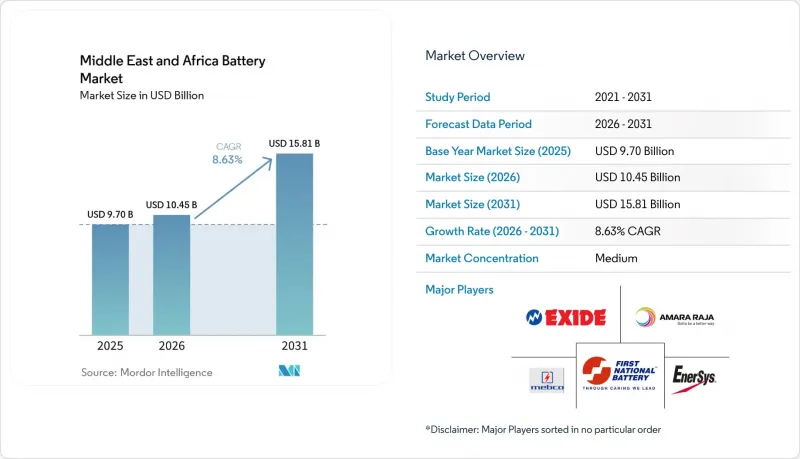
本報告按電池類型(一次電池)、技術(鉛酸電池、鋰離子電池、鎳氫電池、鎳鎘電池、鈉硫電池、全固體電池、液流電池和新興化學品電池)、應用(汽車、工業、攜帶式、電動工具、SLI 和其他應用)和地區(沙烏地阿拉伯、阿拉伯聯合大公國、阿曼、南非等)進行分類。
中東和非洲電池市場趨勢與洞察
鋰離子電池的價格正在下降。
鋰離子電池組的價格從2023年的每千瓦時139美元降至2025年12月的每千瓦時108美元,縮小了與鉛酸電池的成本差距,並降低了通訊備用電源和4小時儲能系統的總體擁有成本(TCO)。在沙烏地阿拉伯的塔布克和哈伊勒計畫中,採用HITHIUM公司的1175安時磷酸鐵鋰(LFP)電池,創下了每千瓦時73-75美元的區域紀錄。這凸顯了採購規模和中國供應鏈如何將成本優勢傳遞給買家。雖然這些成本節約在海灣合作理事會國家和南非的透明競標中立即體現出來,但由於進口關稅和外匯波動,肯亞和奈及利亞的受益相對有限。由多邊金融機構資助的埃及1.1吉瓦「方尖碑」太陽能發電和儲能聯合計畫表明,在日照強度高的市場,太陽能發電的平準化度電成本(LCOE)與天然氣發電高峰期的成本持平是完全可以實現的。整體而言,電池組成本的下降正推動中東和非洲的電池市場規模擴大,這一趨勢在那些因補貼和優惠貸款而進一步降低資金籌措成本的地區尤為明顯。
電動車的快速普及和海灣合作理事會國家的電氣化目標
沙烏地阿拉伯的「電動車綠色舉措」旨在到2030年使利雅德的電動車滲透率達到30%,該計劃得到了Ceer Motors的支持,並促成了沙烏地阿美與比亞迪之間關於電動車製造的合作備忘錄(MoU)。阿拉伯聯合大公國(阿拉伯聯合大公國)的目標是杜拜的電動車佔有率達到20%,阿布達比達到10%,並計畫在2024年底前安裝超過740個公共充電站。這些努力正在推動經濟多元化,擺脫對石油的依賴,並建立新的產業價值鏈,從而提振電池需求,刺激對回收的投資。卡達、阿曼和埃及正在小規模採用類似的模式,而摩洛哥政府向國鼎集團位於凱尼特拉的超級工廠投資3.46億美元,以支持出口導向的電池生產。因此,電動車的成長將促進當地電池生產,縮短對歐洲汽車製造商的供應路線,並將中東和非洲的電池市場融入全球汽車平台。
原料(鋰、鈷)供應受限
碳酸鋰現貨價格從2022年的每噸8萬美元暴跌至2024年的1萬美元,隨後在2025年初反彈至每噸1.15萬美元。這擾亂了合約談判,並擠壓了製造商的利潤空間。 70%的鈷仍集中在剛果民主共和國,而歐盟和美國電池法規下的ESG合規成本也不斷上升。為此,原始設備製造商(OEM)正在轉向使用不含鈷的磷酸鐵鋰(LFP)基化學成分,而摩洛哥則正在利用其磷酸鹽蘊藏量作為正極前驅體的原料。沙烏地阿拉伯和阿曼正在探索從油田海水中回收鋰的方法。因此,預計供應波動不會減緩或阻礙中東和非洲電池市場的成長勢頭。
細分市場分析
到2025年,可充電電池將佔據中東和非洲電池市場74.5%的佔有率,這反映了通訊基礎設施的快速擴張和電動車的普及。預計到2031年,該細分市場將以15.8%的複合年成長率成長,屆時中東和非洲的可充電電池市場規模預計將顯著超過120億美元。更長的循環壽命、更低的包裝成本和更豐富的資金籌措選擇正在推動可充電電池向不間斷電源(UPS)、微電網和動力電池等細分市場的滲透。
目前,一次電池主要應用於國防和遙感探測。儘管其能量密度高,但日益嚴格的廢棄物管理法規以及可充電電池不斷提升的經濟效益正在削弱其相對吸引力。隨著鐵塔營運商和工商業用戶在「按需付費」協議的推動下轉向鋰離子電池,鉛酸電池的市場佔有率逐年下降。在預測期內,隨著捐助者資助的電氣化計畫將社區系統電池循環壽命至少設定為2000次,可充電電池的普及率預計將進一步提高。
其他好處:
- Excel格式的市場預測(ME)表
- 3個月的分析師支持
目錄
第1章:引言
- 研究假設和市場定義
- 調查範圍
第2章:調查方法
第3章執行摘要
第4章 市場狀況
- 市場概覽
- 市場促進因素
- 鋰離子電池的價格正在下降。
- 電動車的快速普及和海灣合作理事會的電氣化目標
- 分散式太陽能發電和儲能系統在非洲離網地區的普及
- CellPak 超級工廠的位置(沙烏地阿拉伯、摩洛哥)
- 通訊塔維修為鋰電池
- 電網的不可靠性正在加速鉛酸電池的更換。
- 市場限制因素
- 原料(鋰、鈷)供應受限
- 非洲市場對價格敏感,初始成本較高
- 脆弱的回收生態系和鉛處理法規
- 中東各次區域政策與獎勵的差異
- 供應鏈分析
- 監理情勢
- 技術展望
- 波特五力模型
第5章 市場規模與成長預測
- 依電池類型
- 一次電池
- 輔助電池
- 透過技術
- 鉛酸
- Li-ion
- 鎳氫電池
- 鎳和鎘
- 鈉和硫
- 固態電池
- 液流電池
- 新興化學技術
- 透過使用
- 汽車(混合動力車、插電式混合動力車、電動車)
- 工業用途(移動式、固定式(通訊、UPS、ESS 等))
- 可攜式(家用電子電器等)
- 電動工具
- SLI
- 其他用途
- 按地區
- 中東
- 沙烏地阿拉伯
- 阿拉伯聯合大公國
- 卡達
- 科威特
- 阿曼
- 巴林
- 其他中東國家
- 非洲
- 南非
- 埃及
- 肯亞
- 奈及利亞
- 摩洛哥
- 衣索比亞
- 其他非洲國家
- 中東
第6章 競爭情勢
- 市場集中度
- 策略趨勢(併購、聯盟、購電協議)
- 市場佔有率分析(主要公司的市場排名和佔有率)
- 公司簡介
- Panasonic Corporation
- Saft Groupe SA
- Middle East Battery Company(MEBCO)
- Amara Raja Batteries Ltd
- First National Battery(Pty)Ltd
- EnerSys
- C&D Technologies Inc.
- East Penn Manufacturing Co.
- Exide Industries Ltd
- LG Energy Solution
- Samsung SDI
- Contemporary Amperex Tech(CATL)
- BYD Co. Ltd
- GS Yuasa Corp.
- Clarios(Johnson Controls spin-off)
- NorthStar Battery Co.
- Hitachi Energy
- Tesla Energy
- Duracell Inc.
- Toshiba Infrastructure Systems
第7章 市場機會與未來展望
According to Mordor Intelligence, the middle east and Africa Battery Market size is projected to expand from USD 9.70 billion in 2025 and USD 10.45 billion in 2026 to USD 15.81 billion by 2031, registering a CAGR of 8.63% between 2026 and 2031.
This report is Segmented by Battery Type (Primary Batteries and Secondary Batteries), Technology (Lead-Acid, Li-Ion, Nickel-Metal Hydride, Nickel-Cadmium, Sodium-Sulfur, Solid-State, Flow Battery, and Emerging Chemistries), Application (Automotive, Industrial, Portable, Power Tools, SLI, and Other Applications), and Geography (Saudi Arabia, United Arab Emirates, Oman, South Africa, and More).
Middle East and Africa Battery Market Trends and Insights
Declining Lithium-Ion Battery Prices
Lithium-ion pack prices slid to USD 108 per kilowatt-hour in December 2025, down from USD 139 in 2023, narrowing the cost gap with lead-acid batteries and improving total-cost-of-ownership for telecom backup and four-hour utility storage. Saudi Arabia's Tabuk and Hail projects set a regional record at USD 73-75 per kilowatt-hour by deploying HITHIUM's 1,175 Ah lithium-iron-phosphate (LFP) cells, underscoring how volume procurement and Chinese supply-chain scale pass through to buyers. Transparent tenders in GCC states and South Africa capture these savings immediately, while import duties and forex volatility moderate benefits in Kenya and Nigeria. Egypt's 1.1 GW Obelisk solar-plus-storage project, financed by multilateral lenders, shows that LCOE parity with natural-gas peakers is within reach in high-insolation markets. Overall, falling pack costs reinforce the Middle East and Africa battery market's path to scale, especially where subsidies or concessional debt further cut financing costs.
Rapid EV Adoption & GCC Electrification Targets
Saudi Arabia's EV Green Initiative aims for 30% EV penetration in Riyadh by 2030, catalyzed by Ceer Motors and a Saudi Aramco-BYD manufacturing MoU. The United Arab Emirates targets a 20% EV share in Dubai and 10% in Abu Dhabi, with more than 740 public chargers already installed by late 2024. These mandates diversify oil economies and anchor new industrial value chains, lifting battery demand and prompting recycling investments. Qatar, Oman, and Egypt replicate the model on a smaller scale, while Morocco's USD 346 million sovereign investment into Gotion's Kenitra gigafactory underpins export-oriented battery output. EV growth, therefore, pulls forward local cell production, shortens supply lines to European OEMs, and embeds the Middle East and Africa battery market in global automotive platforms.
Raw-Material Supply Constraints (Li, Co)
Lithium carbonate spot prices collapsed from USD 80,000 per ton in 2022 to USD 10,000 in 2024, then rebounded to USD 11,500 in early 2025, upsetting contract negotiations and squeezing manufacturer margins. Cobalt remains 70% concentrated in the Democratic Republic of Congo, raising ESG compliance costs under EU and U.S. battery rules. OEMs respond by pivoting to cobalt-free LFP chemistries, while Morocco leverages phosphate reserves for cathode precursors. Saudi Arabia and Oman explore lithium recovery from oil-field brines. Supply volatility, therefore, tempers but does not derail the Middle East and Africa battery market's growth trajectory.
Other drivers and restraints analyzed in the detailed report include:
- Distributed Solar + Storage Uptake in Off-Grid Africa
- Localization of Cell & Pack Gigafactories (KSA, Morocco)
- High Upfront Cost in Price-Sensitive African Markets
For complete list of drivers and restraints, kindly check the Table Of Contents.
Segment Analysis
Secondary batteries controlled 74.5% of the Middle East and Africa battery market share in 2025, reflecting soaring telecom retrofits and EV uptake. The segment is forecast to post a 15.8% CAGR through 2031, pushing the Middle East and Africa battery market size for rechargeables well above USD 12 billion by the end of the period. Rising cycle-life, declining pack costs, and growing financing options underpin penetration into UPS, mini-grid, and motive-power niches.
Primary batteries now occupy specialized roles in defense and remote sensing. Although they offer high energy density, tightening waste regulations and improving rechargeable economics erode their relative appeal. Lead-acid units lose share each year as tower-cos and C&I customers upgrade to lithium-ion, enabled by pay-as-you-save contracts. Over the forecast horizon, rechargeable penetration rises further as donor-funded electrification schemes specify minimum 2,000-cycle batteries for community systems.
Complete Report Scope:
- By Battery Type
- Primary Batteries
- Secondary Batteries
- By Technology
- Lead-acid
- Li-ion
- Nickel-metal hydride
- Nickel-cadmium
- Sodium-sulfur
- Solid-state
- Flow Battery
- Emerging chemistries
- By Application
- Automotive (HEV, PHEV, and EV)
- Industrial (Motive, Stationary (Telecom, UPS, ESS), etc.)
- Portable (Consumer Electronics, etc.)
- Power Tools
- SLI
- Other Applications
- By Geography
- Middle East
- Saudi Arabia
- United Arab Emirates
- Qatar
- Kuwait
- Oman
- Bahrain
- Rest of Middle East
- Africa
- South Africa
- Egypt
- Kenya
- Nigeria
- Morocco
- Ethiopia
- Rest of Africa
- Middle East
List of Companies Covered in this Report:
- Panasonic Corporation
- Saft Groupe SA
- Middle East Battery Company (MEBCO)
- Amara Raja Batteries Ltd
- First National Battery (Pty) Ltd
- EnerSys
- C&D Technologies Inc.
- East Penn Manufacturing Co.
- Exide Industries Ltd
- LG Energy Solution
- Samsung SDI
- Contemporary Amperex Tech (CATL)
- BYD Co. Ltd
- GS Yuasa Corp.
- Clarios (Johnson Controls spin-off)
- NorthStar Battery Co.
- Hitachi Energy
- Tesla Energy
- Duracell Inc.
- Toshiba Infrastructure Systems
Additional Benefits:
- The market estimate (ME) sheet in Excel format
- 3 months of analyst support
TABLE OF CONTENTS
1 Introduction
- 1.1 Study Assumptions & Market Definition
- 1.2 Scope of the Study
2 Research Methodology
3 Executive Summary
4 Market Landscape
- 4.1 Market Overview
- 4.2 Market Drivers
- 4.2.1 Declining lithium-ion battery prices
- 4.2.2 Rapid EV adoption & GCC electrification targets
- 4.2.3 Distributed solar + storage uptake in off-grid Africa
- 4.2.4 Localization of cell & pack gigafactories (KSA, Morocco)
- 4.2.5 Telecom-tower lithium retrofits
- 4.2.6 Grid unreliability driving lead-acid replacement
- 4.3 Market Restraints
- 4.3.1 Raw-material supply constraints (Li, Co)
- 4.3.2 High upfront cost in price-sensitive African markets
- 4.3.3 Weak recycling ecosystem & lead-handling regulation
- 4.3.4 Policy-incentive fragmentation across ME sub-regions
- 4.4 Supply-Chain Analysis
- 4.5 Regulatory Landscape
- 4.6 Technological Outlook
- 4.7 Porter's Five Forces
- 4.7.1 Bargaining Power of Suppliers
- 4.7.2 Bargaining Power of Buyers
- 4.7.3 Threat of New Entrants
- 4.7.4 Threat of Substitutes
- 4.7.5 Competitive Rivalry
5 Market Size & Growth Forecasts
- 5.1 By Battery Type
- 5.1.1 Primary Batteries
- 5.1.2 Secondary Batteries
- 5.2 By Technology
- 5.2.1 Lead-acid
- 5.2.2 Li-ion
- 5.2.3 Nickel-metal hydride
- 5.2.4 Nickel-cadmium
- 5.2.5 Sodium-sulfur
- 5.2.6 Solid-state
- 5.2.7 Flow Battery
- 5.2.8 Emerging chemistries
- 5.3 By Application
- 5.3.1 Automotive (HEV, PHEV, and EV)
- 5.3.2 Industrial (Motive, Stationary (Telecom, UPS, ESS), etc.)
- 5.3.3 Portable (Consumer Electronics, etc.)
- 5.3.4 Power Tools
- 5.3.5 SLI
- 5.3.6 Other Applications
- 5.4 By Geography
- 5.4.1 Middle East
- 5.4.1.1 Saudi Arabia
- 5.4.1.2 United Arab Emirates
- 5.4.1.3 Qatar
- 5.4.1.4 Kuwait
- 5.4.1.5 Oman
- 5.4.1.6 Bahrain
- 5.4.1.7 Rest of Middle East
- 5.4.2 Africa
- 5.4.2.1 South Africa
- 5.4.2.2 Egypt
- 5.4.2.3 Kenya
- 5.4.2.4 Nigeria
- 5.4.2.5 Morocco
- 5.4.2.6 Ethiopia
- 5.4.2.7 Rest of Africa
- 5.4.1 Middle East
6 Competitive Landscape
- 6.1 Market Concentration
- 6.2 Strategic Moves (M&A, Partnerships, PPAs)
- 6.3 Market Share Analysis (Market Rank/Share for key companies)
- 6.4 Company Profiles (includes Global level Overview, Market level overview, Core Segments, Financials as available, Strategic Information, Products & Services, and Recent Developments)
- 6.4.1 Panasonic Corporation
- 6.4.2 Saft Groupe SA
- 6.4.3 Middle East Battery Company (MEBCO)
- 6.4.4 Amara Raja Batteries Ltd
- 6.4.5 First National Battery (Pty) Ltd
- 6.4.6 EnerSys
- 6.4.7 C&D Technologies Inc.
- 6.4.8 East Penn Manufacturing Co.
- 6.4.9 Exide Industries Ltd
- 6.4.10 LG Energy Solution
- 6.4.11 Samsung SDI
- 6.4.12 Contemporary Amperex Tech (CATL)
- 6.4.13 BYD Co. Ltd
- 6.4.14 GS Yuasa Corp.
- 6.4.15 Clarios (Johnson Controls spin-off)
- 6.4.16 NorthStar Battery Co.
- 6.4.17 Hitachi Energy
- 6.4.18 Tesla Energy
- 6.4.19 Duracell Inc.
- 6.4.20 Toshiba Infrastructure Systems
7 Market Opportunities & Future Outlook
- 7.1 White-space & Unmet-need Assessment

 低功耗鋅碳電池市場:全球市場預測,2026-2032年
 免維護電池市場:按類型、應用、電池結構、國家和地區分類-全球產業分析、市場規模、市場佔有率及2026年至2033年預測主動式RFID電池市場:按電池類型、應用、最終用戶、技術、國家和地區分類-全球產業分析、市場規模、市場佔有率及2026年至2033年預測木質電池市場:依產品類型、應用、化學成分、材料、最終用戶、國家及地區分類-全球產業分析、市場規模、市場佔有率及2026年至2033年預測。
 印度逆變器電池:市場佔有率分析、產業趨勢與統計及成長預測(2026-2031)逆變器電池:市場佔有率分析、產業趨勢與統計、成長預測(2026-2031)逆變器電池補充液:市場佔有率分析、產業趨勢與統計、成長預測(2026-2031 年)
 2026-2030年全球電池市場中國電池市場:市場佔有率分析、產業趨勢與統計及成長預測(2026-2031年)印尼電池市場:市場佔有率分析、產業趨勢與統計及成長預測(2026-2031)