


 |
市場調查報告書
商品編碼
2073426
聚苯乙烯:市場佔有率分析、產業趨勢與統計、成長預測(2026-2031)Polystyrene - Market Share Analysis, Industry Trends & Statistics, Growth Forecasts (2026 - 2031) |
||||||

※ 本網頁內容可能與最新版本有所差異。詳細情況請與我們聯繫。
根據 Mordor Intelligence 預測,聚苯乙烯市場規模將從 2025 年的 1,740 萬噸和 2026 年的 1,819 萬噸成長到 2031 年的 2,272 萬噸,2026 年至 2031 年的年複合成長率(CAGR)為 4.55%。
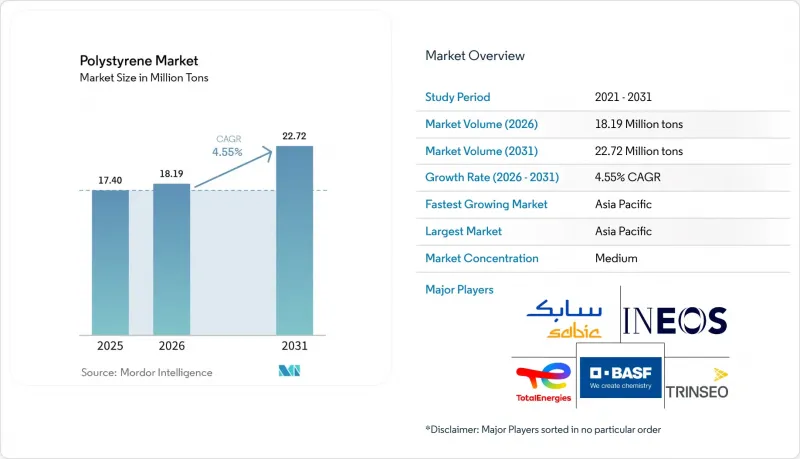
本報告按樹脂類型(通用聚苯乙烯、高抗衝聚苯乙烯等)、形態(發泡體、薄膜/片材等)、終端用戶行業(包裝、建築、電氣電子等)和地區(亞太地區、北美、歐洲、南美、中東和非洲)進行細分。市場預測以噸為單位。
全球聚苯乙烯市場趨勢與洞察
電子商務和食品服務業的包裝需求快速成長。
線上零售和快餐店的成長持續推動著防護包裝材料的出貨量。這一趨勢在亞太地區尤為顯著,因為該地區普遍存在監管豁免。由於基於體積重量的運費較低,輕質EPS緩衝材料正逐漸取代瓦楞紙板襯墊。拉丁美洲和東南亞的餐飲企業仍依賴保溫包裝來盛裝飲料杯和翻蓋式容器,因為替代性可堆肥聚合物的成本仍然過高。在北美,模塑纖維的投資正開始取代快餐包裝中的發泡材,但電子商務的巨大規模仍然推動聚苯乙烯市場的擴張。因此,品牌商正在採取雙通路籌資策略,以平衡成本、緩衝性能和消費者認知。
能源效率標準的提高正在推動對EPS/XPS隔熱材料。
2024 年國際節能規範 (IECC) 和 ASHRAE 90.1-2022 標準提高了牆體和地基的最低 R 值,這將使美國和歐洲對用於建築圍護結構的更厚 EPS 和 XPS 板材的需求在未來幾年持續成長。 2024 年修訂的歐盟建築能源性能指令 (EPBD) 要求在 2030 年新建築達到近零能耗標準。為此,BASF正在其位於路德維希港的工廠將 Neopor EPS 的產能提高 5 萬噸,預計將於 2027 年初運作。中國的 GB 55015-2021 標準也對高層住宅提出了類似的要求,隔熱材料作為結構成長支柱的地位,使其免受包裝行業短期經濟波動的影響。
禁止使用一次性聚苯乙烯泡沫塑膠和生產者延伸責任(EPR)費用
歐盟的《一次性塑膠指令》將於2024年全面實施,該指令規定了生產者延伸責任制(EPR)費用,這將使歐盟各成員國的聚苯乙烯食品容器成本上漲15%至25%。加州的SB 54法案要求到2032年,一次性包裝中必須含有25%的再生材料,這將加速向纖維翻蓋式容器和可堆肥聚合物的轉變。英國對再生材料含量低於30%的進口原生聚苯乙烯徵收塑膠包裝稅(每噸210.82英鎊),台北和首爾也已開始分階段禁止使用發泡聚苯乙烯外帶容器。這些措施正在將需求成長轉向隔熱材料、電子產品和其他耐用消費品。
細分市場分析
儘管發泡聚苯乙烯(PSPS)在2025年佔據了45.19%的主導市場佔有率,但預計通用聚苯乙烯(GPPS)的成長速度將超過整體市場,到2031年年複合成長率(CAGR)將達到5.51%。通用聚苯乙烯(GPPS)的加速成長主要得益於食品接觸包裝領域的創新,特別是射出成型杯、甜點容器和分裝托盤的廣泛應用,這些產品充分利用了GPPS的透明度、剛性和符合FDA標準的配方。高抗衝聚苯乙烯(HIPS)是第二大樹脂類型,廣泛應用於冷藏庫內襯、電視邊框和小家電機殼等耐用消費品領域,其韌性和尺寸穩定性使其價格高於通用聚苯乙烯(GPPS)。 HIPS的需求與消費性電子產品的產量密切相關。 2025 年上半年中國產量年增 11.77%,直接推動了射出成型製程中 HIPS 的消耗。
發泡聚苯乙烯(EPS)在產量方面仍保持領先地位,這主要得益於建築隔熱材料和防護包裝的需求,但由於餐飲服務業的監管阻力,其成長速度落後於GPPS。對隔熱材料的需求具有結構性,與IECC 2024和ASHRAE 90.1-2022等建築節能標準密切相關,這些標準要求商業和住宅建築圍護結構的R值更高。BASF計畫在路德維希港擴建其Neopor工廠,新增產能5萬噸,目標是在2027年初運作。此舉凸顯了該公司對EPS隔熱材料長期需求的信心,儘管一次性包裝已被禁止。
區域分析
預計到2025年,亞太地區將佔全球總產量的56.88%,並將以5.66%的複合年成長率持續成長至2031年。在中國,2025年上半年消費電子產品產量增加11.77%,支撐了對高抗衝聚苯乙烯(HIPS)的需求;同時,由於建築規範GB 55015-2021的實施,住宅高層建築對聚苯乙烯泡沫塑膠(EPS)的需求依然強勁。在印度,由於政府對醫藥低溫運輸的補貼,EPS運輸容器的使用量持續成長;此外,Styrenix收購INEOS泰國工廠後,為東南亞地區新增了10萬噸產能。
北美在原料方面保持成本優勢,其中苯乙烯(由乙烷衍生而來)是推動出口的主要因素,預計2025年將年增18%。儘管國內隔熱材料的需求受到IECC 2024等能源效率標準的支撐,但由於加州禁止使用一次性產品以及西雅圖和波特蘭的地方性法規,餐飲服務業對發泡塑膠的需求正在萎縮。加拿大供應鏈格局正在重組,此前英力士公司決定在2026年中期關閉其位於薩尼亞的苯乙烯工廠,並將出貨地轉移到墨西哥灣沿岸的樞紐。墨西哥則受惠於近岸外包,家電製造商正在蒙特雷和克雷塔羅的工業叢集中擴大射出成型線。
歐洲發泡聚苯乙烯(EPS)市場同時面臨兩大挑戰。一方面,由於《一次性塑膠指令》的嚴格課稅,一次性餐具的需求正在下降;另一方面,由於《建築能源性能指令》(EPBD)的修訂,EPS隔熱材料的需求正在穩步成長。BASF的Neopor業務擴張體現了與近零能耗建築要求相關的投資價值。英力士的Resolve專案符合英國的塑膠包裝稅收閾值和生產者延伸責任(EPR)收費系統,確保了其能夠進入高利潤應用領域。儘管成長速度落後於亞太地區,但符合循環經濟要求的細分市場仍保持著強勁的成長動能。
在南美洲,巴西是這一趨勢的核心,電子商務和住宅建設推動了GPPS和EPS的應用。在阿根廷,宏觀經濟逆風限制了建設活動,但科爾多瓦省的醫療設備組裝卻蓬勃發展。中東和非洲的需求仍處於起步階段,但正加速成長,這主要得益於沙烏地阿拉伯的「2030願景」基礎設施發展計畫和南非疫苗低溫運輸的擴建。儘管由於本地樹脂產量不足,這些地區仍依賴從亞太地區和歐洲進口,但提高保溫標準和擴大醫療領域的投資預示著長期的發展機會。
其他好處:
- Excel格式的市場預測(ME)表
- 3個月的分析師支持
目錄
第1章:引言
- 研究假設和市場定義
- 調查範圍
第2章:調查方法
第3章執行摘要
第4章 市場狀況
- 市場概覽
- 市場促進因素
- 電子商務和食品服務業的包裝蓬勃發展
- 能源效率標準的提高正在推動對EPS和XPS隔熱材料的需求。
- 電子設備及家用電器產量成長
- 化學回收領域的技術突破
- 新興市場的醫藥低溫運輸物流
- 市場限制因素
- 禁止使用一次性個人護理用品和生產者延伸責任計劃下的費用
- 高性能紙張和生物聚合物替代品
- 苯乙烯原料短缺是由於蒸汽裂解裝置使用輕質原料造成的。
- 價值鏈分析
- 波特五力模型
第5章 市場規模與成長預測
- 依樹脂類型
- 通用聚苯乙烯(GPPS)
- 高抗衝聚苯乙烯(HIPS)
- 發泡聚苯乙烯(EPS)
- 按形式
- 發泡體
- 薄膜
- 射出成型零件
- 其他形式(例如 3D 列印耗材)
- 按最終用戶行業分類
- 包裝
- 建築/施工
- 電氣和電子設備
- 消費品
- 其他終端使用者產業(汽車及運輸、醫療設備)
- 按地區
- 亞太地區
- 中國
- 印度
- 日本
- 韓國
- 其他亞太國家
- 北美洲
- 美國
- 加拿大
- 墨西哥
- 歐洲
- 德國
- 英國
- 法國
- 義大利
- 其他歐洲國家
- 南美洲
- 巴西
- 阿根廷
- 其他南美國家
- 中東和非洲
- 沙烏地阿拉伯
- 南非
- 其他中東和非洲地區
- 亞太地區
第6章 競爭情勢
- 市場集中度
- 策略趨勢
- 市佔率和排名分析
- 公司簡介
- Alpek SAB de CV
- Americas Styrenics LLC(AmSty)
- Atlas Molded Products
- BASF
- CHIMEI
- Dow
- Eni SpA
- Formosa Chemicals and Fibre Corp.
- INEOS
- Innova
- KUMHO PETROCHEMICAL
- LG Chem
- Loyal Group
- Ravago
- Sabert Corporation
- SABIC
- Supreme Petrochem Ltd
- Synthos
- TotalEnergies
- Trinseo
第7章 市場機會與未來展望
According to Mordor Intelligence, the polystyrene market size is projected to expand from 17.40 million tons in 2025 and 18.19 million tons in 2026 to 22.72 million tons by 2031, registering a CAGR of 4.55% between 2026 to 2031.
This report is Segmented by Resin Type (General-Purpose Polystyrene, High-Impact Polystyrene, and More), Form Type (Foams, Films and Sheets, and More), End-User Industry (Packaging, Building and Construction, Electrical and Electronics, and More), and Geography (Asia-Pacific, North America, Europe, South America, and the Middle-East and Africa). The Market Forecasts are Provided in Terms of Volume (tons).
Global Polystyrene Market Trends and Insights
E-commerce and Food-service Packaging Boom
Online retail and quick-service restaurant growth continue to lift protective packaging volumes, particularly in the Asia-Pacific where regulatory exemptions remain common. Lightweight EPS cushioning lowers dimensional-weight freight charges, securing its place versus corrugated inserts. Food-service operators in Latin America and Southeast Asia still rely on insulated beverage cups and clamshells because alternative compostable polymers remain cost-prohibitive. In North America, molded-fiber investments have started to displace foam in quick-service packaging, yet the sheer scale of e-commerce keeps the polystyrene market expanding. Brands balancing cost, cushioning performance, and consumer perceptions are therefore sustaining dual sourcing strategies.
Energy-Efficiency Codes Lifting EPS/XPS Insulation Demand
The 2024 International Energy Conservation Code and ASHRAE 90.1-2022 raised minimum R-values for walls and foundations, generating multi-year demand for thicker EPS and XPS boards in U.S. and European building envelopes. Europe's Energy Performance of Buildings Directive, recast in 2024, stipulates near-zero-energy standards for new structures by 2030. Responding, BASF is adding 50,000 tons of Neopor EPS capacity at Ludwigshafen to come online in early 2027. China's GB 55015-2021 mirrors these requirements for high-rise housing, entrenching EPS insulation as a structural growth pillar that is insulated from short-term cyclicality in packaging.
Single-use PS Bans and Extended Producer-Responsibility Fees
The EU Single-Use Plastics Directive, fully enforced in 2024, imposes EPR fees that lift polystyrene food-container costs by 15-25% across member states. California's SB 54 mandates 25% recycled content by 2032 for single-use packaging, accelerating the shift toward fiber clamshells and compostable polymers. The UK plastic packaging tax of GBP 210.82 per tonne penalizes virgin PS imports lacking 30% recycled content, and Taipei plus Seoul have initiated phased bans on foam take-out ware. These measures are redirecting volume growth toward insulation, electronics, and other durable segments.
Other drivers and restraints analyzed in the detailed report include:
- Electronics and Appliance Output Growth
- Technology Break-throughs in Chemical Recycling
- High-performance Paper and Bio-polymer Substitutes
For complete list of drivers and restraints, kindly check the Table Of Contents.
Segment Analysis
General-purpose polystyrene is set to outpace the broader market at 5.51% CAGR through 2031, despite expandable polystyrene's commanding 45.19% share in 2025. GPPS's acceleration stems from food-contact packaging innovations, particularly injection-molded yogurt cups, dessert containers, and portion-control trays that leverage its clarity, rigidity, and FDA-compliant formulations. High-impact polystyrene (HIPS), the second-largest resin type, serves durable-goods applications such as refrigerator liners, television bezels, and small-appliance housings, where its toughness and dimensional stability justify a price premium over commodity GPPS. HIPS demand correlates tightly with consumer electronics output; China's 11.77% year-over-year production growth in the first half of 2025 directly lifted HIPS consumption in injection-molding operations.
Expandable polystyrene remains the volume leader, driven by construction insulation and protective packaging, yet its growth rate lags GPPS due to regulatory headwinds in foodservice applications. EPS insulation demand is structural, tied to building energy codes such as IECC 2024 and ASHRAE 90.1-2022, which mandate higher R-values for commercial and residential envelopes. BASF's 50,000-tonne Neopor expansion at Ludwigshafen, targeting early 2027 commissioning, underscores confidence in long-term EPS insulation demand despite single-use packaging bans.
Complete Report Scope:
- By Resin Type
- General-Purpose Polystyrene (GPPS)
- High-Impact Polystyrene (HIPS)
- Expandable Polystyrene (EPS)
- By Form Type
- Foams
- Films and Sheets
- Injection-Molded Parts
- Other Form Types (3-D Printing Filaments,etc.)
- By End-user Industry
- Packaging
- Building and Construction
- Electrical and Electronics
- Consumer Goods
- Other End user Industries (Automotive and Transportation,Medical Devices)
- By Geography
- Asia-Pacific
- China
- India
- Japan
- South Korea
- Rest of Asia-Pacific
- North America
- United States
- Canada
- Mexico
- Europe
- Germany
- United Kingdom
- France
- Italy
- Rest of Europe
- South America
- Brazil
- Argentina
- Rest of South America
- Middle-East and Africa
- Saudi Arabia
- South Africa
- Rest Middle-East and Africa
- Asia-Pacific
Geography Analysis
Asia-Pacific commanded 56.88% of the 2025 volume and is forecast to deliver a 5.66% CAGR through 2031. In China, consumer electronics production, up 11.77% in the first half of 2025, underpins HIPS demand, while building-code GB 55015-2021 ensures steady EPS pull-through in residential high-rises. India's pharma cold-chain subsidies continue to boost EPS shipper usage, and Styrenix's acquisition of INEOS's Thailand site adds 100,000 tons of capacity to serve Southeast Asia.
North America enjoys feedstock-cost leadership, with ethane-based styrene driving exports that rose 18% year-on-year during 2025. Energy-efficiency codes such as IECC 2024 sustain domestic insulation demand, even as single-use bans in California and municipal ordinances in Seattle and Portland trim food-service foam. Canada's supply landscape is consolidating after INEOS decided to idle its Sarnia styrene plant by mid-2026, redirecting shipments to Gulf Coast hubs. Mexico gains from near-shoring as appliance assemblers add injection-molding lines in Monterrey and Queretaro industrial clusters.
The Europe expanded polystyrene (EPS) market faces a dual reality: rigorous Single-Use Plastics Directive levies reduce disposable food-ware volumes, yet the EPBD recast drives sustained EPS insulation growth. BASF's Neopor expansion exemplifies the investment case tied to near-zero-energy building requirements. INEOS's ResolVe program aligns with UK plastic-packaging-tax thresholds and EPR fee schedules, ensuring access to high-margin applications. Growth lags Asia-Pacific but remains durable in segments aligned with circular-economy mandates.
South America is anchored by Brazil, where e-commerce and residential construction lift GPPS and EPS usage. Argentina's macro-economic headwinds limit building activity, but medical-device assembly in Cordoba offers a pocket of strength. Middle East and Africa volumes are nascent yet accelerating, led by Saudi Arabia's Vision 2030 infrastructure pipeline and South Africa's vaccine cold-chain expansions. Lack of local resin production keeps these regions tied to imports from Asia-Pacific and Europe, but rising insulation standards and healthcare investments signal long-term opportunity.
- Alpek S.A.B. de C.V.
- Americas Styrenics LLC (AmSty)
- Atlas Molded Products
- BASF
- CHIMEI
- Dow
- Eni S.p.A
- Formosa Chemicals and Fibre Corp.
- INEOS
- Innova
- KUMHO PETROCHEMICAL
- LG Chem
- Loyal Group
- Ravago
- Sabert Corporation
- SABIC
- Supreme Petrochem Ltd
- Synthos
- TotalEnergies
- Trinseo
Additional Benefits:
- The market estimate (ME) sheet in Excel format
- 3 months of analyst support
TABLE OF CONTENTS
1 Introduction
- 1.1 Study Assumptions and Market Definition
- 1.2 Scope of the Study
2 Research Methodology
3 Executive Summary
4 Market Landscape
- 4.1 Market Overview
- 4.2 Market Drivers
- 4.2.1 E-commerce and Food-service Packaging Boom
- 4.2.2 Energy-Efficiency Codes Lifting EPS/XPS Insulation Demand
- 4.2.3 Electronics and Appliance Output Growth
- 4.2.4 Technology Break-throughs in Chemical Recycling
- 4.2.5 Cold-chain Pharma Logistics in Emerging Markets
- 4.3 Market Restraints
- 4.3.1 Single-use PS Bans and Extended Producer-Responsibility Fees
- 4.3.2 High-performance Paper and Bio-polymer Substitutes
- 4.3.3 Styrene Feedstock Tightness from Light-feed Steam Crackers
- 4.4 Value Chain Analysis
- 4.5 Porter's Five Forces
- 4.5.1 Bargaining Power of Suppliers
- 4.5.2 Bargaining Power of Buyers
- 4.5.3 Threat of New Entrants
- 4.5.4 Threat of Substitute Products
- 4.5.5 Degree of Competition
5 Market Size and Growth Forecasts (Volume)
- 5.1 By Resin Type
- 5.1.1 General-Purpose Polystyrene (GPPS)
- 5.1.2 High-Impact Polystyrene (HIPS)
- 5.1.3 Expandable Polystyrene (EPS)
- 5.2 By Form Type
- 5.2.1 Foams
- 5.2.2 Films and Sheets
- 5.2.3 Injection-Molded Parts
- 5.2.4 Other Form Types (3-D Printing Filaments,etc.)
- 5.3 By End-user Industry
- 5.3.1 Packaging
- 5.3.2 Building and Construction
- 5.3.3 Electrical and Electronics
- 5.3.4 Consumer Goods
- 5.3.5 Other End user Industries (Automotive and Transportation,Medical Devices)
- 5.4 By Geography
- 5.4.1 Asia-Pacific
- 5.4.1.1 China
- 5.4.1.2 India
- 5.4.1.3 Japan
- 5.4.1.4 South Korea
- 5.4.1.5 Rest of Asia-Pacific
- 5.4.2 North America
- 5.4.2.1 United States
- 5.4.2.2 Canada
- 5.4.2.3 Mexico
- 5.4.3 Europe
- 5.4.3.1 Germany
- 5.4.3.2 United Kingdom
- 5.4.3.3 France
- 5.4.3.4 Italy
- 5.4.3.5 Rest of Europe
- 5.4.4 South America
- 5.4.4.1 Brazil
- 5.4.4.2 Argentina
- 5.4.4.3 Rest of South America
- 5.4.5 Middle-East and Africa
- 5.4.5.1 Saudi Arabia
- 5.4.5.2 South Africa
- 5.4.5.3 Rest Middle-East and Africa
- 5.4.1 Asia-Pacific
6 Competitive Landscape
- 6.1 Market Concentration
- 6.2 Strategic Moves
- 6.3 Market Share(%)/Ranking Analysis
- 6.4 Company Profiles (includes Global level Overview, Market level overview, Core Segments, Financials as available, Strategic Information, Market Rank/Share for key companies, Products and Services, Recent Developments)
- 6.4.1 Alpek S.A.B. de C.V.
- 6.4.2 Americas Styrenics LLC (AmSty)
- 6.4.3 Atlas Molded Products
- 6.4.4 BASF
- 6.4.5 CHIMEI
- 6.4.6 Dow
- 6.4.7 Eni S.p.A
- 6.4.8 Formosa Chemicals and Fibre Corp.
- 6.4.9 INEOS
- 6.4.10 Innova
- 6.4.11 KUMHO PETROCHEMICAL
- 6.4.12 LG Chem
- 6.4.13 Loyal Group
- 6.4.14 Ravago
- 6.4.15 Sabert Corporation
- 6.4.16 SABIC
- 6.4.17 Supreme Petrochem Ltd
- 6.4.18 Synthos
- 6.4.19 TotalEnergies
- 6.4.20 Trinseo
7 Market Opportunities and Future Outlook
- 7.1 White-space and Unmet-Need Assessment
- 7.2 Ongoing Research and Development in Bio-based and Chemically Recycled Polystyrene

 2026年全球聚苯乙烯市場報告
 聚苯乙烯管材市場-2026-2032年全球市場預測聚苯乙烯市場:按類型、形狀、製造流程、密度、應用和分銷管道分類-2026-2032年全球市場預測特種聚苯乙烯樹脂市場:2026-2032年全球市場預測(依產品種類、樹脂形態、加工技術、聚合類型、分子量、應用及銷售管道)
 支援市場報告:趨勢、預測與競爭分析(至2035年)透明丙烯腈-丁二烯-聚苯乙烯樹脂市場:2026-2032年全球市場預測(依最終用途產業、加工方法、等級、應用與通路分類)
 聚苯乙烯市場規模、佔有率、成長及全球產業分析:按類型、應用和地區分類,並提供2026-2034年的洞察和預測2026-2034年全球特種聚苯乙烯樹脂市場規模、佔有率、趨勢和成長分析報告
 聚苯乙烯市場規模、佔有率和成長分析(按類型、應用、形態、最終用途產業和地區分類)-2026-2033年產業預測全球聚苯乙烯和發泡聚苯乙烯(EPS)市場規模、佔有率、趨勢和成長分析報告,2026-2034年