


 |
市場調查報告書
商品編碼
2073377
綜合風險管理:市場佔有率分析、產業趨勢與統計、成長預測(2026-2031)Integrated Risk Management - Market Share Analysis, Industry Trends & Statistics, Growth Forecasts (2026 - 2031) |
||||||

※ 本網頁內容可能與最新版本有所差異。詳細情況請與我們聯繫。
根據 Mordor Intelligence 預測,綜合風險管理市場預計將從 2025 年的 163.6 億美元成長到 2026 年的 177.6 億美元,到 2031 年達到 265.5 億美元,2026 年至 2031 年的複合年預計成長率為 8.38%。
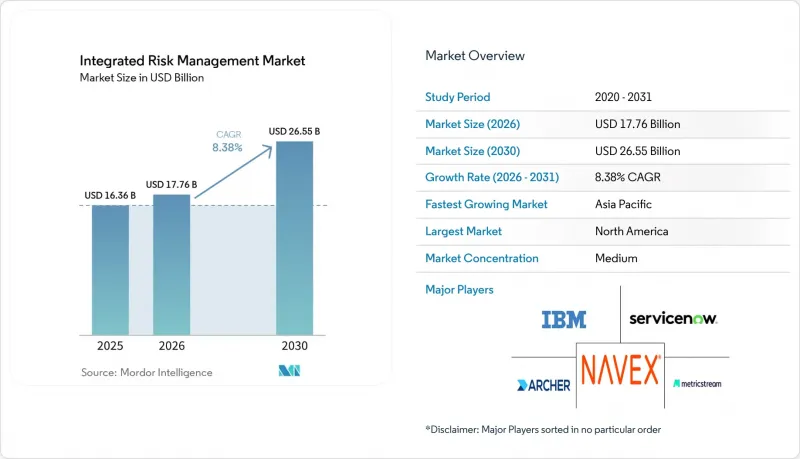
本報告按組件(軟體、解決方案、服務)、部署模式(雲端、本地部署)、企業規模(中小企業和大型企業)、最終用戶行業(銀行、金融服務和保險 (BFSI)、醫療保健、IT 和電信、零售、製造、能源、政府、交通運輸、教育)以及地區進行細分。市場預測以美元 (USD) 為單位。
全球綜合風險管理市場趨勢與洞察
全球法規結構日益複雜化
歐盟的《數位營運韌性法案》(DORA)將於2025年1月全面實施,要求金融機構在嚴格的報告期限內證明其在資訊和通訊技術方面的韌性。同時,諸如《企業永續性報告指令》和修訂後的《一般資料保護規範》(GDPR)同意規則等相關法規,要求企業將隱私、網路安全、環境、社會和治理(ESG)以及第三方風險整合到一個統一的系統中,從而推動了對整合風險管理市場平台的需求。跨國銀行也正努力應對DORA中禁止將業務外包給未獲得韌性認證的供應商的條款,這導致實質審查調查審計數量激增,而這些法規如今正在影響資金籌措管道。提交給歐洲證券和市場管理局(ESMA)的招股說明書必須包含永續性披露信息,而運營合規性是資金籌措的先決條件。這些壓力共同作用,正將風險管理從後勤部門職能轉變為董事會層級的關鍵議題。
網路安全威脅和資料外洩事件日益惡化
預計到2025年,勒索軟體攻擊將增加68%,每次事件的平均恢復成本將達到454萬美元,供應鏈風險管理對企業而言已成為更關鍵的問題。諸如2024年導致8,200家公司憑證遺失的雲端服務漏洞等複雜的供應鏈安全事件表明,僅靠邊界防禦已遠遠不夠。為了應對這項挑戰,各組織正在將事件回應工作流程整合到整合風險管理套件中,從而實現自動生成漏洞通知和即時更新熱圖。美國證券交易委員會(SEC)的規定要求上市公司在四個工作天內報告重大網路安全事件,這大大縮短了人工糾正措施的寬限期。此外,聯邦金融機構檢查委員會(FFIEC)也發布了新的指南,將網路風險評估的範圍擴大到包括四級分包商,從而加速了平台的採用。 IT 與操作技術(OT) 的整合進一步擴大了攻擊面,公共產業和製造企業擴大將 IT 警報和 OT 資產清單整合到單一儀表板中。
總擁有成本 (TCO) 高且引進週期長
實施成本(包括許可、整合和培訓)平均五年內達 320 萬美元,而本地部署可能需要長達 18 個月的時間。即使面臨罰款,小規模製造商也無法承擔組建一個六人企劃團隊如此長的時間。採用雲端技術可以將時間縮短到大約六個月,但 40% 的預算仍然用於配置和使用者培訓。專案經常失敗,原因在於資料清理的工作量被低估,例如,需要核對數百個電子表格中供應商名稱的不一致之處。隨著供應商用越來越昂貴的年費取代永久許可,「訂閱疲勞」日益嚴重,採購團隊在簽署多年合約之前,要求獲得更清晰的投資回報率指標。
細分市場分析
至2025年,軟體解決方案將佔據整合風險管理市場63.18%的佔有率。這反映出管理方式正從基於電子表格的模式轉向集中管理政策、事件和合規性證據的整合平台。由風險分析和報告模組組成的整合風險管理市場預計在2026年至2031年間將以9.11%的複合年成長率成長。這代表了軟體堆疊中最快的成長速度,主要得益於董事會對即時經營團隊儀錶板的強勁需求。領先的銀行正在部署自動化控制測試引擎以滿足DORA的季度評估規則,而醫療保健系統則正在採用事件管理模組來簡化HIPAA違規回應流程。
至2025年,服務支出將佔總支出的36.82%,其中服務分為專業服務和託管服務。德勤和普華永道等系統整合商將主導複雜的實施項目,而託管服務供應商目前則基於結果導向合約運作全天候平台。由於許多公司缺乏內部技能來最佳化分類、建立API和培訓分散用戶,因此對服務的需求預計將持續成長。但由於自動化和預先配置內容庫的普及,商品化任務的計費時間正在減少。
預計到2025年,雲端採用將佔整合風險管理市場71.24%的佔有率,並在2031年之前維持8.41%的複合年成長率。監管政策的澄清也起了推動作用。歐洲銀行管理局(EBA)確認,經過適當認證的SaaS平台符合DORA要求,這促進了歐洲金融機構的投資。多租戶架構使得每季發布新功能成為可能,ServiceNow僅在2025年就發布了四項重大功能增強,進一步提升了雲端的吸引力,同時又不會給客戶帶來升級負擔。
本地部署仍佔支出的 28.76%,主要集中在國防、政府和監管嚴格的金融領域,這些領域的資料主權法和 CUI(機密資訊)法規禁止將資料儲存在公共雲端中。混合部署方案正日益普及,該方案將敏感資料保留在本地,而將分析處理任務卸載到雲端,這表明遷移模式是分階段的,而非非此即彼的。
區域分析
2025年,北美在綜合風險管理市場中佔據41.84%的佔有率,這得益於美國證券交易委員會(SEC)針對氣候變遷和網路安全資訊揭露的嚴格監管、成熟的網路保險生態系統以及對資料外洩的高額罰款。加拿大更嚴格的隱私立法和墨西哥的金融科技措施也為該地區的發展注入了動力。 2025年,美國聯邦貿易委員會(FTC)就資料安全缺陷達成了12億美元的和解協議,顯示監管機構態度強硬,並敦促中型企業廣泛採取應對措施。
亞太地區預計將保持最高成長率,到2031年複合年成長率將達到11.42%,這主要得益於中國《個人資料保護法》和印度《數位個人資料保護法》的推動,這兩部法律正在促進風險登記在地化和自動化同意模組的採用。在日本,銀行業被要求每年進行勒索軟體桌面演練,這推動了情境規劃引擎的應用。同時,在澳大利亞,資料外洩事件激增,使得事件管理成為董事會的優先事項。東協在監管協調方面的努力進一步增加了跨境合規的需求,為擁有覆蓋多個司法管轄區的庫的供應商創造了機會。
預計到2025年,歐洲將維持28%的市場佔有率,這主要得益於2025年1月全面啟動的DORA以及CSRD的分階段實施,最終將涵蓋5萬家營業單位。德國聯邦金融監理局(BaFin)透過對第三方風險管理有缺陷的銀行採取多項糾正措施,進一步提高了合規的緊迫性。英國的營運彈性框架以及法國違反GDPR行為處以的巨額罰款,凸顯了監管模式從基於原則轉向可衡量控制體系的方向。南美洲和中東及非洲合計佔12%的總合。相關實施主要集中在巴西的金融業、海灣國家的智慧城市基礎設施以及南非的隱私執法領域,但基礎設施差異和外匯波動抑制了更廣泛的需求。
其他好處:
- Excel格式的市場預測(ME)表
- 3個月的分析師支持
目錄
第1章:引言
- 研究假設和市場定義
- 調查範圍
第2章:調查方法
第3章執行摘要
第4章 市場狀況
- 市場概覽
- 市場促進因素
- 全球法規結構(GDPR、DORA、CSRD)的複雜性
- 網路安全威脅和資料外洩事件日益惡化
- 快速數位轉型與雲端採用
- 拓展第三方和供應鏈生態系統
- 關於環境、社會及治理 (ESG) 和氣候風險的資訊揭露義務
- 利用數位雙胞胎進行關鍵基礎設施風險模擬
- 市場限制因素
- 總擁有成本高,引進週期長
- 合格的IRM短缺
- 供應商整合引發了人們對供應商鎖定問題的擔憂。
- 人工智慧管治標準因司法管轄區而異。
- 產業價值鏈分析
- 監理情勢
- 技術展望
- 波特五力分析
第5章 市場規模與成長預測
- 按組件
- 軟體解決方案
- 風險與合規管理
- 事件和問題管理
- 政策管理
- 風險分析和報告
- 服務
- 專業服務
- 託管服務
- 軟體解決方案
- 部署模式
- 雲
- 現場
- 按公司規模
- 中小企業
- 大公司
- 按最終用戶行業分類
- BFSI
- 醫療保健和生命科學
- 資訊科技/通訊
- 零售和消費品
- 製造業
- 能源公用事業
- 政府/公共部門
- 運輸
- 教育
- 按地區
- 北美洲
- 美國
- 加拿大
- 墨西哥
- 南美洲
- 巴西
- 阿根廷
- 其他南美國家
- 歐洲
- 德國
- 英國
- 法國
- 義大利
- 西班牙
- 其他歐洲國家
- 亞太地區
- 中國
- 日本
- 韓國
- 印度
- 澳洲
- 紐西蘭
- 其他亞太國家
- 中東和非洲
- 中東
- 阿拉伯聯合大公國
- 沙烏地阿拉伯
- 土耳其
- 其他中東國家
- 非洲
- 南非
- 奈及利亞
- 肯亞
- 其他非洲國家
- 中東
- 北美洲
第6章 競爭情勢
- 市場集中度
- 策略趨勢
- 市佔率分析
- 公司簡介
- IBM Corporation
- ServiceNow Inc.
- Archer Technologies LLC
- NAVEX Global Inc.
- MetricStream Inc.
- SAP SE
- LogicManager Inc.
- AuditBoard Inc.
- Onspring Technologies LLC
- Centraleyes Ltd.
- Riskonnect Inc.
- Diligent Corporation
- OneTrust LLC
- LogicGate Inc.
- Resolver Inc.
- RSA Security LLC
- SureCloud Ltd.
- IsoMetrix
- SAI360 Inc.
- Quantivate LLC
第7章 市場機會與未來展望
According to Mordor Intelligence, the integrated risk management market size is expected to increase from USD 16.36 billion in 2025 to USD 17.76 billion in 2026 and reach USD 26.55 billion by 2031, growing at a CAGR of 8.38% over 2026-2031.
This report is Segmented by Component (Software, Solutions, and Services), Deployment Mode (Cloud, and On-Premise), Enterprise Size (SMEs and Large Enterprises), End-User Industry (BFSI, Healthcare, IT and Telecommunications, Retail, Manufacturing, Energy, Government, Transportation, and Education), and Geography. The Market Forecasts are Provided in Terms of Value (USD).
Global Integrated Risk Management Market Trends and Insights
Complexity of Global Regulatory Frameworks
The European Union's Digital Operational Resilience Act entered full enforcement in January 2025 and obliges financial entities to prove the resilience of information and communication technologies within strict reporting windows. Parallel mandates such as the Corporate Sustainability Reporting Directive and revised GDPR consent rules compel firms to aggregate privacy, cyber, ESG, and third-party exposures in one system, elevating demand for integrated risk management market platforms. Multinational banks also face DORA clauses that ban outsourcing to vendors without resilience certifications, generating cascades of due diligence audits that spreadsheets cannot handle. Overlapping statutes now influence access to capital; prospectuses filed with the European Securities and Markets Authority must include sustainability disclosures, making operational compliance a prerequisite for fundraising. Together, these pressures transform risk management from a back-office function into a board-level imperative.
Escalating Cybersecurity Threats and Data Breaches
Ransomware assaults rose 68% in 2025, with average recovery costs of USD 4.54 million per incident, intensifying the focus on Supply Chain Risk Management as a critical enterprise priority. Sophisticated supply-chain compromises, such as the 2024 cloud-service breach that exposed credentials of 8,200 enterprises, reveal that perimeter defenses alone no longer suffice. In response, organizations embed incident workflows into integrated risk management market suites, enabling automatic breach-notification letters and real-time heat-map updates. SEC rules require public companies to report material cyber events within four business days, collapsing the window for manual remediation. Banks confront additional directives from the Federal Financial Institutions Examination Council that extend cyber-risk assessment across fourth-party subcontractors, boosting platform adoption. The convergence of IT and operational technology further enlarges the attack surface, encouraging utilities and manufacturers to unify IT alerts with OT asset inventories inside a single dashboard.
High Total Cost of Ownership and Long Implementation Cycles
Deployments average USD 3.2 million over five years, covering licenses, integration labor, and training, and on-premise rollouts can stretch to 18 months. Small manufacturers cannot field six-person project teams for such durations, even when fines loom. Although cloud delivery trims timelines to about six months, 40% of budgets still vanish into configuration and user enablement. Projects are often derailed by underestimated data-cleansing workloads, such as reconciling inconsistent vendor names across hundreds of spreadsheets. Subscription fatigue is rising as vendors replace perpetual licenses with escalating annual fees, forcing procurement teams to demand clearer ROI metrics before signing multiyear agreements.
Other drivers and restraints analyzed in the detailed report include:
- Rapid Digital Transformation and Cloud Adoption
- Expansion of Third-Party and Supply-Chain Ecosystems
- Shortage of IRM-Skilled Professionals
For complete list of drivers and restraints, kindly check the Table Of Contents.
Segment Analysis
Software solutions held 63.18% integrated risk management market share in 2025, reflecting the pivot from spreadsheet registers to unified platforms that centralize policies, incidents, and compliance evidence. The integrated risk management market size captured by risk analytics and reporting modules is projected to expand at a 9.11% CAGR between 2026 and 2031, the fastest pace inside the software stack as boards insist on real-time executive dashboards. Large banks deploy automated control-testing engines to meet DORA's quarterly assessment rules, while healthcare systems embrace incident modules that streamline HIPAA breach processes.
Services represented 36.82% of 2025 spending, split between professional and managed offerings. System integrators such as Deloitte and PwC dominate complex rollouts, whereas managed-service providers now operate 24/7 platforms under outcome-based contracts. Demand for services will persist because many enterprises lack in-house skills to fine-tune taxonomies, build APIs, and train distributed users, yet automation and preset content libraries are trimming billable hours for commoditized tasks.
Cloud deployments captured 71.24% of the integrated risk management market in 2025 and will maintain momentum with an 8.41% CAGR through 2031. Regulatory clarity helped: the European Banking Authority confirmed that properly certified SaaS platforms meet DORA expectations, unlocking investment across European finance houses. Multi-tenant architectures push quarterly feature drops, ServiceNow shipped four major enhancements in 2025 alone, without customer upgrade pain, reinforcing cloud's appeal.
On-premise installations still account for 28.76% of spending, concentrated in defense, government, and highly regulated financial segments where data-sovereignty laws or CUI mandates prohibit public-cloud storage. Hybrid approaches that keep sensitive data on-site while off-loading analytics to the cloud are gaining ground, signaling a phased, rather than binary, migration pattern.
Complete Report Scope:
- By Component
- Software Solutions
- Risk and Compliance Management
- Incident and Issue Management
- Policy Management
- Risk Analytics and Reporting
- Services
- Professional Services
- Managed Services
- Software Solutions
- By Deployment Mode
- Cloud
- On-Premise
- By Enterprise Size
- Small and Medium Enterprises (SMEs)
- Large Enterprises
- By End-User Industry
- BFSI
- Healthcare and Life Sciences
- IT and Telecommunications
- Retail and Consumer Goods
- Manufacturing
- Energy and Utilities
- Government and Public Sector
- Transportation
- Education
- By Geography
- North America
- United States
- Canada
- Mexico
- South America
- Brazil
- Argentina
- Rest of South America
- Europe
- Germany
- United Kingdom
- France
- Italy
- Spain
- Rest of Europe
- Asia Pacific
- China
- Japan
- South Korea
- India
- Australia
- New Zealand
- Rest of Asia-Pacific
- Middle East and Africa
- Middle East
- United Arab Emirates
- Saudi Arabia
- Turkey
- Rest of Middle East
- Africa
- South Africa
- Nigeria
- Kenya
- Rest of Africa
- Middle East
- North America
Geography Analysis
North America sustained 41.84% integrated risk management market share in 2025 due to formidable SEC climate- and cyber-disclosure rules, a mature cyber-insurance ecosystem, and high breach penalties. Canada's stricter privacy amendments and Mexico's fintech initiatives add regional tailwinds. The United States Federal Trade Commission collected USD 1.2 billion in settlements for lax data security in 2025, signaling regulators' rising intolerance and prompting widespread adoption in mid-market cohorts.
Asia-Pacific posts the fastest 11.42% CAGR through 2031 as China's Personal Information Protection Law and India's Digital Personal Data Protection Act drive localization of risk registers and automated consent modules. Japan's banking sector must run annual ransomware tabletop exercises, which fuels uptake of scenario-planning engines, while Australia's soaring breach numbers make incident management a board priority. ASEAN harmonization efforts further boost cross-border compliance needs, creating fertile ground for vendors with multi-jurisdiction libraries.
Europe retained 28% share in 2025, energized by the January 2025 go-live of DORA and phased CSRD rollouts that eventually cover 50,000 entities. Germany's BaFin issued multiple enforcement actions against banks found wanting in third-party risk, reinforcing compliance urgency. The United Kingdom's operational-resilience framework and France's sizeable GDPR fines underline a shift from principles-based supervision toward measurable controls. South America, the Middle East, and Africa together hold 12% share; adoption is concentrated in Brazilian finance, Gulf smart-city infrastructure, and South African privacy enforcement, though infrastructure gaps and currency volatility temper broader demand.
- IBM Corporation
- ServiceNow Inc.
- Archer Technologies LLC
- NAVEX Global Inc.
- MetricStream Inc.
- SAP SE
- LogicManager Inc.
- AuditBoard Inc.
- Onspring Technologies LLC
- Centraleyes Ltd.
- Riskonnect Inc.
- Diligent Corporation
- OneTrust LLC
- LogicGate Inc.
- Resolver Inc.
- RSA Security LLC
- SureCloud Ltd.
- IsoMetrix
- SAI360 Inc.
- Quantivate LLC
Additional Benefits:
- The market estimate (ME) sheet in Excel format
- 3 months of analyst support
TABLE OF CONTENTS
1 INTRODUCTION
- 1.1 Study Assumptions and Market Definition
- 1.2 Scope of the Study
2 RESEARCH METHODOLOGY
3 EXECUTIVE SUMMARY
4 MARKET LANDSCAPE
- 4.1 Market Overview
- 4.2 Market Drivers
- 4.2.1 Complexity of Global Regulatory Frameworks (GDPR, DORA, CSRD)
- 4.2.2 Escalating Cybersecurity Threats and Data Breaches
- 4.2.3 Rapid Digital Transformation and Cloud Adoption
- 4.2.4 Expansion of Third-Party and Supply-Chain Ecosystems
- 4.2.5 Mandatory ESG and Climate-Risk Disclosure Regimes
- 4.2.6 Digital-Twin Risk Simulation for Critical Infrastructure
- 4.3 Market Restraints
- 4.3.1 High Total Cost of Ownership and Long Implementation Cycles
- 4.3.2 Shortage of IRM-Skilled Professionals
- 4.3.3 Vendor Consolidation Creating Lock-In Concerns
- 4.3.4 Uncertain AI Governance Standards Across Jurisdictions
- 4.4 Industry Value-Chain Analysis
- 4.5 Regulatory Landscape
- 4.6 Technological Outlook
- 4.7 Porter's Five Forces Analysis
- 4.7.1 Bargaining Power of Buyers
- 4.7.2 Bargaining Power of Suppliers
- 4.7.3 Threat of New Entrants
- 4.7.4 Threat of Substitutes
- 4.7.5 Competitive Rivalry
5 MARKET SIZE AND GROWTH FORECASTS (VALUE)
- 5.1 By Component
- 5.1.1 Software Solutions
- 5.1.1.1 Risk and Compliance Management
- 5.1.1.2 Incident and Issue Management
- 5.1.1.3 Policy Management
- 5.1.1.4 Risk Analytics and Reporting
- 5.1.2 Services
- 5.1.2.1 Professional Services
- 5.1.2.2 Managed Services
- 5.1.1 Software Solutions
- 5.2 By Deployment Mode
- 5.2.1 Cloud
- 5.2.2 On-Premise
- 5.3 By Enterprise Size
- 5.3.1 Small and Medium Enterprises (SMEs)
- 5.3.2 Large Enterprises
- 5.4 By End-User Industry
- 5.4.1 BFSI
- 5.4.2 Healthcare and Life Sciences
- 5.4.3 IT and Telecommunications
- 5.4.4 Retail and Consumer Goods
- 5.4.5 Manufacturing
- 5.4.6 Energy and Utilities
- 5.4.7 Government and Public Sector
- 5.4.8 Transportation
- 5.4.9 Education
- 5.5 By Geography
- 5.5.1 North America
- 5.5.1.1 United States
- 5.5.1.2 Canada
- 5.5.1.3 Mexico
- 5.5.2 South America
- 5.5.2.1 Brazil
- 5.5.2.2 Argentina
- 5.5.2.3 Rest of South America
- 5.5.3 Europe
- 5.5.3.1 Germany
- 5.5.3.2 United Kingdom
- 5.5.3.3 France
- 5.5.3.4 Italy
- 5.5.3.5 Spain
- 5.5.3.6 Rest of Europe
- 5.5.4 Asia Pacific
- 5.5.4.1 China
- 5.5.4.2 Japan
- 5.5.4.3 South Korea
- 5.5.4.4 India
- 5.5.4.5 Australia
- 5.5.4.6 New Zealand
- 5.5.4.7 Rest of Asia-Pacific
- 5.5.5 Middle East and Africa
- 5.5.5.1 Middle East
- 5.5.5.1.1 United Arab Emirates
- 5.5.5.1.2 Saudi Arabia
- 5.5.5.1.3 Turkey
- 5.5.5.1.4 Rest of Middle East
- 5.5.5.2 Africa
- 5.5.5.2.1 South Africa
- 5.5.5.2.2 Nigeria
- 5.5.5.2.3 Kenya
- 5.5.5.2.4 Rest of Africa
- 5.5.5.1 Middle East
- 5.5.1 North America
6 COMPETITIVE LANDSCAPE
- 6.1 Market Concentration
- 6.2 Strategic Moves
- 6.3 Market Share Analysis
- 6.4 Company Profiles (includes Global Level Overview, Market Level Overview, Core Segments, Financials as available, Strategic Information, Market Rank/Share, Products and Services, Recent Developments)
- 6.4.1 IBM Corporation
- 6.4.2 ServiceNow Inc.
- 6.4.3 Archer Technologies LLC
- 6.4.4 NAVEX Global Inc.
- 6.4.5 MetricStream Inc.
- 6.4.6 SAP SE
- 6.4.7 LogicManager Inc.
- 6.4.8 AuditBoard Inc.
- 6.4.9 Onspring Technologies LLC
- 6.4.10 Centraleyes Ltd.
- 6.4.11 Riskonnect Inc.
- 6.4.12 Diligent Corporation
- 6.4.13 OneTrust LLC
- 6.4.14 LogicGate Inc.
- 6.4.15 Resolver Inc.
- 6.4.16 RSA Security LLC
- 6.4.17 SureCloud Ltd.
- 6.4.18 IsoMetrix
- 6.4.19 SAI360 Inc.
- 6.4.20 Quantivate LLC
7 MARKET OPPORTUNITIES AND FUTURE OUTLOOK
- 7.1 White-Space and Unmet-Need Assessment

 企業風險管理市場規模、佔有率和成長分析:按組件、部署類型、組織規模、產業和地區分類-2026-2033年產業預測
 風險管理諮詢服務市場:按類型、服務交付模式、服務內容、產業和客戶規模分類-2026-2032年全球市場預測
 Frost Radar™:企業風險緩解與管理平台,2026 年
 風險管理市場機會、成長促進因素、產業趨勢分析及2026-2035年預測。
 2026年全球主動式終端風險管理市場報告Markdown風險評分全球市場報告(2026年)2026年全球建築風險諮詢市場報告
 合規風險評分模型市場:預測至 2034 年-按組件、模型類型、風險類型、組織規模、應用、最終使用者和地區分類的全球分析
 對 2035 年前金融和風險管理應用市場進行分析和預測:按類型、產品、服務、技術、組件、應用、部署、最終用戶、模組和功能分類。營運風險管理解決方案市場分析與預測(至2035年):類型、產品類型、服務、技術、組件、應用、部署模式、最終用戶、模組、功能