


 |
市場調查報告書
商品編碼
2073376
藏紅花:市場佔有率分析、產業趨勢與統計、成長預測(2026-2031)Saffron - Market Share Analysis, Industry Trends & Statistics, Growth Forecasts (2026 - 2031) |
||||||

※ 本網頁內容可能與最新版本有所差異。詳細情況請與我們聯繫。
據 Mordor Intelligence 稱,2025 年藏紅花市場價值 14.2 億美元,預計到 2031 年將達到 20.6 億美元,而 2026 年為 15.1 億美元,預測期(2026-2031 年)複合年成長率為 6.36%。
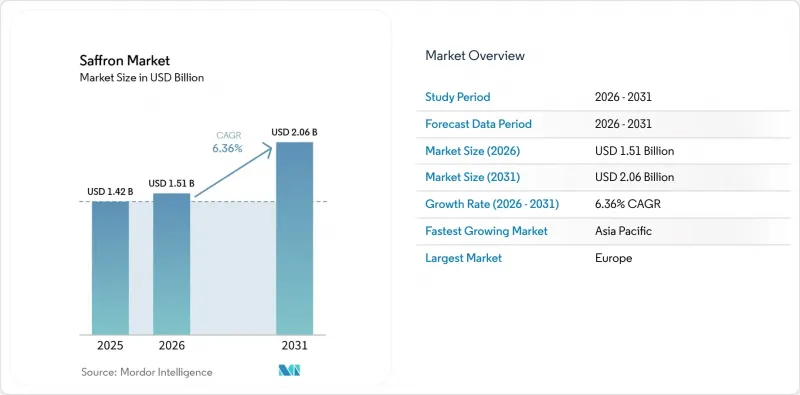
本報告按等級(一級、二級、其他)、應用(食品加工、其他)和地區(北美、歐洲、亞太、南美、中東和非洲)進行細分。報告內容包括生產分析、消費分析、進口分析、出口分析和價格趨勢分析。市場預測以價值(美元)和數量(公噸)兩種單位呈現。
全球藏紅花市場趨勢及洞察
即食民族食品的需求不斷成長
在大都會圈,即食的印度香飯、海鮮飯以及其他依賴藏紅花增添色澤和香氣的民族料理越來越受歡迎。食品加工商高度重視藏紅花無需使用合成添加劑即可實現這些功能的特性,這使得藏紅花能夠以更高的價格出售,並簡化配料標籤。在韓國1,370億美元的零售市場中,三分之一的進口食品來自美國,顯示消費者對便利的正宗風味有著廣泛的需求。
天然化妝品活性成分的優質化
在價值2800億美元的美容產業中,對植物來源活性成分的新投資正在不斷成長,用於化妝品的藏紅花價格約為每公斤1600美元。利用藏紅花素的抗氧化特性,外用產品可以宣稱具有改善肌膚光澤和增強皮膚屏障功能等功效,使品牌能夠將產品定位在高階價位。歐萊雅2024年的銷售額達到411.8億歐元(445.7億美元),這主要得益於其「綠色科技」系列產品的推出,顯示市場對檢驗的植物來源成分的需求持續旺盛。這一趨勢鞏固了對一級藏紅花的需求,促使生產商加大對更嚴格的採後處理和認證供應鏈的投資。
生產者價格波動劇烈
藏紅花價格隨降雨量波動。乾旱會降低產量,但通常會提高藏紅花素的濃度,從而推高溢價。相反,過多的降雨會損害開花,加劇價格波動。食品加工商和化妝品開發商正努力敲定生產預算,而價格的急劇上漲促使他們用合成色素和植物來源原料取代藏紅花。 2023年伊朗藏紅花產量的下降進一步加劇了下游用戶面臨的短期價格衝擊。
細分市場分析
到2025年,一級藏紅花將佔藏紅花市場規模的37.65%,預計到2031年將以6.12%的複合年成長率成長。這反映了終端用戶對藏紅花素含量最高、香氣最濃郁的藏紅花的偏好。藏紅花市場受益於高利潤率,足以涵蓋為應對氣候變遷影響而維修溫室設施的成本。二級藏紅花深受包裝米和糖果甜點製造商的青睞,其成長穩定但速度較慢。另一方面,三級和四級藏紅花則面臨著成本意識強的餐飲服務業中合成色素替代品的威脅。
改良的照明控制技術使藏紅花中的藏紅花素含量提高了18%,從而增強了一級藏紅花的供應。此外,臨床研究也證實了藏紅花對心理健康的益處,這對種植者來說無疑是一大福音。利用物聯網控制面板的種植者現在可以規劃帶有時間滯後的花期,並充分利用淡季價格上漲的機會,進一步鞏固了優質藏紅花的盈利優勢。
區域分析
到2025年,歐洲將佔全球藏紅花市場收入的36.25%。這主要歸功於嚴格的品質控制、原產地保護(PDO)以及熱處理要求,這些措施優先考慮優質批次而非散裝貨物。西班牙既是生產國又是收藏國,將精選批次的藏紅花再出口到整個歐洲貿易區。零售商正積極銷售帶有PDO(原產地保護)標誌的單一產地瓶裝產品,而經過認證的供應商也因歐盟新的標籤指令而獲得獎勵,該指令加大了對摻假行為的處罰力度。
預計到2031年,亞太地區將以8.12%的複合年成長率成長,這主要得益於中產階級收入的成長以及藏紅花在傳統醫學、現代保健品和即溶飲料中的應用日益廣泛。印度作為香辛料出口的主導,為高品質的克什米爾藏紅花提供了高效率的市場。中國醫藥產業對標準化萃取物的需求不斷成長,而韓國高達201億美元的農產品進口也反映出藏紅花速食食品越來越受到消費者的青睞。
在北美,機能性食品和潔淨標示膳食補充劑行業發展勢頭強勁。在中東,由於文化上的親和性,家庭需求保持穩定,但地緣政治緊張局勢正促使買家減少對單一國家的依賴,尋求採購多元化。智利和阿根廷的新興市場前景得益於與地中海地區的氣候相似性,這為擔憂伊朗水資源短缺的全球買家提供了長期風險對沖。
- Excel格式的市場預測(ME)表
- 3個月的分析師支持
目錄
第1章:引言
- 研究假設和市場定義
- 調查範圍
第2章:調查方法
第3章執行摘要
第4章 市場狀況
- 市場概覽
- 市場促進因素
- 消費者對即食異國食品的需求日益成長
- 為天然化妝品活性成分增添高價值
- 擴大含藏紅花素和藏紅花醛的營養補充劑的SKU範圍
- 數位化B2B香辛料交易平台正在提升其價格發現能力。
- 利用農場級物聯網最佳化微氣候以提高產量
- 加強對食品詐欺和可追溯性的監管
- 市場限制因素
- 農產品運輸價格波動劇烈
- 儘管機械化進程緩慢,但這項工作的勞動密集程度仍然很高。
- 食品服務業合成色素的替代日益增多
- 主要產區的水資源壓力
- 價值/供應鏈分析
- 監理情勢
- 技術展望
- 波特五力模型
第5章 市場規模與成長預測
- 按年級
- 一級
- 二級
- 三年級
- 四級或以下
- 透過使用
- 食品加工
- 食品服務
- 化妝品和個人護理
- 藥品和營養保健品
- 香水和其他
- 區域分析(生產分析、消費分析(數量和價值)、進口分析(數量和價值)、出口分析(數量和價值)、價格趨勢分析)
- 北美洲
- 美國
- 加拿大
- 墨西哥
- 歐洲
- 西班牙
- 義大利
- 法國
- 英國
- 希臘
- 俄羅斯
- 亞太地區
- 中國
- 印度
- 阿富汗
- 澳洲
- 南美洲
- 阿根廷
- 智利
- 中東
- 伊朗
- 土耳其
- UAE
- 沙烏地阿拉伯
- 非洲
- 南非
- 北美洲
第6章 競爭情勢
- List of Stakeholders
- Everest Spices.
- Azafranes Manchegos SL
- Mozaffari Saffron
- Baby Brand Saffron
- La Casa de los Aromas(HEA &CO)
- Taj Agro International(Taj pharmaceuticals limited)
- Veles Farming
- Heray Spice
- Rowhani Saffron Co.
- Tarvand Saffron Co.
- Gohar Saffron
- Novin Saffron(Golrang Industrial Group)
- Edman Saffron
第7章 市場機會與未來展望
According to Mordor Intelligence, the saffron market size was valued at USD 1.42 billion in 2025 and estimated to grow from USD 1.51 billion in 2026 to reach USD 2.06 billion by 2031, at a CAGR of 6.36% during the forecast period (2026-2031).
This report is Segmented by Grade (Grade I, Grade II, and More), by Application (Food Processing and More), and by Geography (North America, Europe, Asia-Pacific, South America, Middle East, and Africa). The Report Includes Production Analysis, Consumption Analysis, Import Analysis, Export Analysis, and Price Trend Analysis. The Market Forecasts are Provided in Terms of Value (USD) and Volume (Metric Tons).
Global Saffron Market Trends and Insights
Rising Demand from Ready-to-Eat Ethnic Foods
Large urban centers increasingly favor ready-to-eat biryanis, paellas, and other ethnic dishes that rely on saffron for color and aroma. Food processors value the spice's ability to deliver both functions without synthetic additives, enabling premium shelf pricing and cleaner ingredient decks. In South Korea's USD 137 billion retail market, one-third of imported foods originate from the United States, illustrating the broader appetite for authentic flavors in convenient formats.
Premiumization of Natural Cosmetic Actives
The beauty sector, valued at USD 280 billion, directs fresh investment toward plant-based actives, with saffron commanding roughly USD 1,600 per kilogram for cosmetic use. Topicals leveraging crocin's antioxidant properties promise claims tied to radiance and skin-barrier support, allowing brands to position products at prestige price points. L'Oreal's EUR 41.18 billion (USD 44.57 billion) 2024 revenue, buoyed by "green science" launches, showcases a sustained preference for verified botanical inputs. The trend locks in demand for Grade I saffron, encouraging growers to invest in stricter post-harvest handling and authenticated supply chains.
Volatile Farm-Gate Prices
Saffron prices swing with precipitation, drought lowers harvest volumes yet often boosts crocin concentration, lifting premiums, and the excessive rain damages blooms and increases volatility. Food processors and cosmetic formulators struggle to lock production budgets, and sudden spikes encourage substitution with synthetic colorants or competing botanicals. Iran's 2023 production slide amplified short-term price shocks for downstream users.
Other drivers and restraints analyzed in the detailed report include:
- Expansion of Nutraceutical SKUs Featuring Crocin and Safranal
- Farm-Level IoT for Micro-Climate Optimization, boosting yields
- Water Stress in Primary Producing Regions
For complete list of drivers and restraints, kindly check the Table Of Contents.
Segment Analysis
Grade I accounted for 37.65% of the saffron market size in 2025 and is growing at a 6.12% CAGR through 2031, reflecting an end-user preference for the deepest crocin levels and highest aromatic intensity. The saffron market benefits because higher margins fund the greenhouse retrofits needed to offset climate variability. Grade II, popular with packaged rice and confectionery makers, enjoys steady but slower growth, while Grades III and IV face substitution threats from synthetic colorants in cost-sensitive food-service channels.
Improvements in controlled lighting have been shown to lift crocin by up to 18%, bolstering Grade I supply, just as clinical research validates saffron's mental health benefits. Producers leveraging IoT dashboards can now schedule staggered flowering cycles and capture off-season pricing spikes, further entrenching premium grades' revenue dominance.
Complete Report Scope:
- By Grade (Value)
- Grade I
- Grade II
- Grade III
- Grade IV and below
- By Application (Value)
- Food Processing
- Food Service
- Cosmetics and Personal Care
- Pharmaceuticals and Nutraceuticals
- Fragrances and Others
- By Geography (Production Analysis (Volume), Consumption Analysis (Volume and Value), Import Analysis (Volume and Value), Export Analysis (Volume and Value), and Price Trend Analysis)
- North America
- United States
- Canada
- Mexico
- Europe
- Spain
- Italy
- France
- United Kingdom
- Greece
- Russia
- Asia-Pacific
- China
- India
- Afghanistan
- Australia
- South America
- Argentina
- Chile
- Middle East
- Iran
- Turkey
- UAE
- Saudi Arabia
- Africa
- South Africa
- North America
Geography Analysis
Europe generated 36.25% of global saffron market revenue in 2025, leveraging stringent quality checks, origin protections, and heat-treatment mandates that favor premium lots over bulk shipments. Spain functions as both producer and consolidator, re-exporting curated batches across the European trading bloc. Retailers increasingly promote single-origin jars featuring PDO seals, and new EU labeling directives heighten penalties for adulteration, thereby rewarding authenticated supply.
Asia-Pacific, forecast for an 8.12% CAGR to 2031, benefits from rising middle-class incomes and the integration of saffron into traditional medicine, modern supplements, and instant beverage sachets. India's spice-export leadership provides an efficient route to market for premium Kashmiri lots. China's pharma sector scales up demand for standardized extracts, while South Korea's USD 20.1 billion agricultural imports reflect openness to saffron-enhanced convenience meals.
North America shows healthy momentum in functional foods and clean-label supplements. In the Middle East, cultural affinity sustains stable household demand, yet geopolitical frictions motivate buyers to diversify away from single-country reliance. Emerging prospects in Chile and Argentina draw on climatic similarities with the Mediterranean basin, offering long-run hedging for global buyers concerned about Iranian water stress.
- The market estimate (ME) sheet in Excel format
- 3 months of analyst support
TABLE OF CONTENTS
1 Introduction
- 1.1 Study Assumptions and Market Definition
- 1.2 Scope of the Study
2 Research Methodology
3 Executive Summary
4 Market Landscape
- 4.1 Market Overview
- 4.2 Market Drivers
- 4.2.1 Rising demand from ready-to-eat ethnic foods
- 4.2.2 Premiumization of natural cosmetic actives
- 4.2.3 Expansion of nutraceutical SKUs featuring crocin and safranal
- 4.2.4 Digitised B2B spice exchanges improving price discovery
- 4.2.5 Farm-level IoT for micro-climate optimization boosting yields
- 4.2.6 Stricter food-fraud and origin-traceability regulations
- 4.3 Market Restraints
- 4.3.1 Volatile farm-gate prices
- 4.3.2 High labor intensity despite mechanization gaps
- 4.3.3 Rising synthetic colourant substitution in food service
- 4.3.4 Water-stress in primary producing regions
- 4.4 Value/Supply-Chain Analysis
- 4.5 Regulatory Landscape
- 4.6 Technological Outlook
- 4.7 Porter's Five Forces
- 4.7.1 Threat of New Entrants
- 4.7.2 Bargaining Power of Buyers
- 4.7.3 Bargaining Power of Suppliers
- 4.7.4 Threat of Substitutes
- 4.7.5 Intensity of Competitive Rivalry
5 Market Size and Growth Forecasts (Value and Volume)
- 5.1 By Grade (Value)
- 5.1.1 Grade I
- 5.1.2 Grade II
- 5.1.3 Grade III
- 5.1.4 Grade IV and below
- 5.2 By Application (Value)
- 5.2.1 Food Processing
- 5.2.2 Food Service
- 5.2.3 Cosmetics and Personal Care
- 5.2.4 Pharmaceuticals and Nutraceuticals
- 5.2.5 Fragrances and Others
- 5.3 By Geography (Production Analysis (Volume), Consumption Analysis (Volume and Value), Import Analysis (Volume and Value), Export Analysis (Volume and Value), and Price Trend Analysis)
- 5.3.1 North America
- 5.3.1.1 United States
- 5.3.1.2 Canada
- 5.3.1.3 Mexico
- 5.3.2 Europe
- 5.3.2.1 Spain
- 5.3.2.2 Italy
- 5.3.2.3 France
- 5.3.2.4 United Kingdom
- 5.3.2.5 Greece
- 5.3.2.6 Russia
- 5.3.3 Asia-Pacific
- 5.3.3.1 China
- 5.3.3.2 India
- 5.3.3.3 Afghanistan
- 5.3.3.4 Australia
- 5.3.4 South America
- 5.3.4.1 Argentina
- 5.3.4.2 Chile
- 5.3.5 Middle East
- 5.3.5.1 Iran
- 5.3.5.2 Turkey
- 5.3.5.3 UAE
- 5.3.5.4 Saudi Arabia
- 5.3.6 Africa
- 5.3.6.1 South Africa
- 5.3.1 North America
6 Competitive Landscape
- 6.1 List of Stakeholders
- 6.1.1 Everest Spices.
- 6.1.2 Azafranes Manchegos S.L.
- 6.1.3 Mozaffari Saffron
- 6.1.4 Baby Brand Saffron
- 6.1.5 La Casa de los Aromas (HEA&CO)
- 6.1.6 Taj Agro International (Taj pharmaceuticals limited)
- 6.1.7 Veles Farming
- 6.1.8 Heray Spice
- 6.1.9 Rowhani Saffron Co.
- 6.1.10 Tarvand Saffron Co.
- 6.1.11 Gohar Saffron
- 6.1.12 Novin Saffron (Golrang Industrial Group)
- 6.1.13 Edman Saffron
7 Market Opportunities and Future Outlook

 2026-2034年全球藏紅花市場規模、佔有率、趨勢和成長分析報告
 2026-2030年全球藏紅花市場
 藏紅花市場:按產品類型、應用、分銷管道和地區分類
 日本藏紅花市場報告:按類型、形態、用途和地區分類(2026-2034年)
 有機藏紅花市場-全球產業規模、佔有率、趨勢、機會及預測(依形態、應用、通路、地區及競爭格局分類,2021-2031年)
 藏紅花市場規模、佔有率和趨勢分析報告:按等級、類型、形態、產品、分銷、地區和細分市場預測,2026-2033年
 藏紅花市場規模、佔有率和成長分析(按等級、產品類型、形態、分銷管道、應用和地區分類)—產業預測(2026-2033 年)
 番紅花市場:全球產業分析、市場規模、佔有率、成長、趨勢與未來預測(2025-2032)
 番紅花的全球市場:不同形態,各用途,各流通管道,各地區,機會,預測,2018年~2032年
 藏紅花衍生物市場分析與預測(至2034年):類型、產品、應用、最終用戶、形式、流程、部署、技術