


 |
市場調查報告書
商品編碼
2073361
被盜車輛找回:市場佔有率分析、行業趨勢和統計數據、成長預測(2026-2031 年)Stolen Vehicle Recovery - Market Share Analysis, Industry Trends & Statistics, Growth Forecasts (2026 - 2031) |
||||||

※ 本網頁內容可能與最新版本有所差異。詳細情況請與我們聯繫。
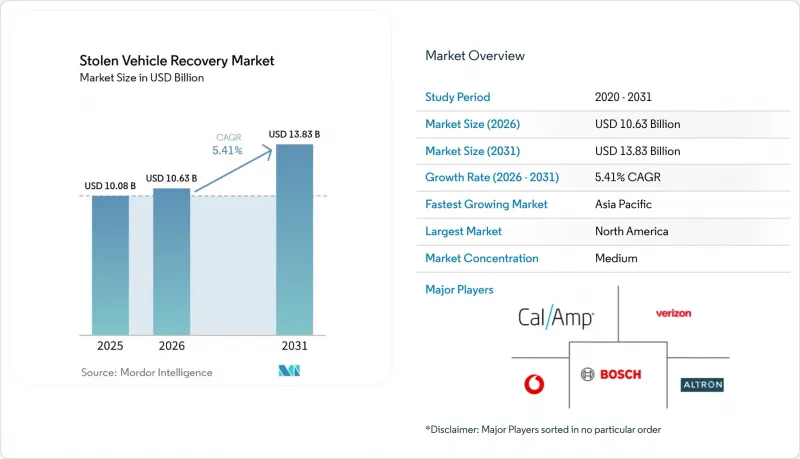
根據 Mordor Intelligence 預測,被盜車輛找回市場規模將從 2025 年的 100.8 億美元成長到 2026 年的 106.3 億美元,然後在 2031 年達到 138.3 億美元,2026 年至 2031 年的複合年成長率為 5.41%。
本報告按車輛類型(乘用車、輕型商用車等)、技術(GPS/GNSS、蜂窩網路(LTE/5G)等)、安全解決方案(追蹤和找回設備、防盜器等)、部署模式(OEM整合等)、最終用戶(個人車主等)和地區進行細分。市場預測以價值(美元)和數量(輛)兩種形式呈現。
全球被竊車輛找回市場趨勢及洞察
疫情後車輛失竊案增多
2023年,美國車輛被竊數量超過100萬輛,創下2008年以來的最高紀錄。然而,由於執法部門開展了有針對性的宣傳活動,加上製造商進行了軟體更新,到2024年,被盜車輛數量下降至850,708輛。社群媒體上流傳的「一鍵點火器」漏洞案例,凸顯了部分現代和起亞車型的安全隱患,促使製造商進行多層安全維修。澳洲維多利亞州也出現了類似的激增,由於犯罪分子使用電子重編程設備偽造鑰匙訊號,車輛失竊案數量達到20年來的最高水準。技術供應商隨即推出與GPS信標相連的即時防盜功能,事實證明,此功能具有顯著的威懾作用,尤其是在主要都市區道路上。因此,竊盜案的周期性波動使得售後市場套件和製造商提供的車輛追蹤模組的需求持續旺盛。
原始設備製造商必須嚴格強制使用遠端資訊處理/緊急呼叫系統
歐洲通用安全法規 (GSR II) 將智慧速度輔助、緊急煞車和事件記錄器作為所有新型輕型車輛的標配,從而建立了嵌入式連接,安全供應商可以利用這些連接來找回被盜車輛。俄羅斯的 ERA-GLONASS 和巴西的 SIMRAV 也提供了類似的監管依據,而美國聯邦通訊委員會 (FCC) 正在審查 V2V 通訊法規。一級供應商(例如大陸集團)正在將遠端防盜裝置、被盜車輛追蹤和增強型網路安全等安全功能打包成合規解決方案,供整合 GSR II 功能的汽車製造商使用。這些法規確保了可預測的部署數量,並且往往優先考慮與原始設備製造商 (OEM) 建立長期合作夥伴關係,而不是可自由支配的售後市場銷售。
設備和訂閱高成本
對於低收入用戶而言,價格仍然是一大障礙。 LoRa/NB-IoT標籤價格顯著降低,電池續航時間長達數年,並且由於搭載Semtech晶片的追蹤器而迅速普及。 Verizon Connect透過推出月度合約並幫助經銷商捆綁安全功能而無需長期合約,降低了准入門檻。然而,由於新興市場的許多消費者在權衡安全支出和基本交通支出時會做出取捨,因此整體普及速度正在放緩。
細分市場分析
就2025年的銷售量而言,乘用車在被盜車輛找回市場中仍將佔據59.64%的佔有率,而摩托車和強力運動市場預計到2031年將以7.71%的複合年成長率成長。在亞太地區人口稠密的都市區,人們依賴踏板車作為「最後一公里」的交通工具,這增加了車輛被竊的風險,也推動了這些系統的應用。博世正將其用於電動自行車的電池鎖技術應用於小型引擎車輛,該系統採用藍牙認證技術,可在檢測到未經授權的移動時禁用動力傳動系統(bosch.com)。
摩托車通常缺乏嵌入式的遠端資訊處理功能,因此,售後市場的GPS信標和動作感測器填補了這一空白,這些產品通常與付費使用制的應用程式訂閱服務捆綁銷售。零件價格的降低降低了整體擁有成本,推動了中檔車型的普及。車隊配送服務傾向於使用防篡改的防盜裝置來減少停機時間,這進一步凸顯了該細分市場相對於更重型車輛的卓越性能。
到2025年,GPS/GNSS解決方案將佔據被盜車輛追蹤市場62.12%的佔有率。然而,低功耗的LoRa和NB-IoT追蹤器正以9.38%的複合年成長率迅速擴大市場佔有率,因為它們可以使用紐扣電池供電數年,並且即使在GNSS訊號較弱的室內也能進行傳輸。混合型設備利用GNSS進行定位,並結合LoRa回程傳輸以降低SIM卡成本,對於自行車、拖車、施工機械等設備來說,是極具吸引力的選擇。
衛星通訊對於遠端採礦車輛和跨國海上運輸仍然至關重要,銥星公司(iridium.com)預測,到2024年,其商業物聯網用戶將成長8%,達到246萬,這便印證了這一點。 4G/5G蜂窩模組支援高頻寬影片串流和豪華汽車的無線韌體更新。供應商正在增加組合板的出貨量,這些組合板可在低功耗廣域網路(LPWAN)、蜂巢式網路和衛星通訊頻道之間自動切換,從而在最大限度擴大覆蓋範圍的同時,最佳化資料方案的成本效益。
區域分析
預計到2025年,北美將佔據被盜車輛找回市場36.22%的佔有率,這主要得益於嵌入式遠端資訊處理技術的廣泛應用以及保險公司提供的折扣。美國車輛失竊案數量在前一年超過100萬起,預計2024年將下降至850,708起。這表明盜竊模式正在靈活地適應有組織的打擊行動和軟體修補程式。現代等汽車製造商提供的無線韌體更新凸顯了透過雲端連接在無需實際召回的情況下遏制大規模盜竊宣傳活動的能力。加拿大與國際刑警組織合作,將2,000多輛被盜SUV和皮卡歸還給原籍國,凸顯了跨國走私的風險以及國際漫遊連結的必要性。
在歐洲,一般安全法規II(General Safety Regulations II)的法規澄清工作取得了成功。汽車製造商現在必須加裝事件資料記錄器)和車道維持輔助功能,這使得安全供應商能夠立即取得電源、天線和CAN匯流排資料。然而,歐洲的隱私框架也加重了合規的負擔。在德國和荷蘭等消費者團體對資料共用條款審查嚴格的國家,早期採用零知識加密的安全供應商享有市場優勢。安聯保險的消費者調查顯示,如果透明度明確保證,絕大多數駕駛者都願意以資料交換換取保險費折扣。
預計到2031年,亞太地區的複合年成長率將達到8.92%。中國汽車製造商正在將始終線上遙測功能作為電動車的標準配置,不僅可以實現遠距離診斷,還能起到防盜作用。印度的摩托車保有量超過2.2億輛,售價低於30美元的本地GPS設備在各大城市迅速普及。日本供應商正引領超寬頻(UWB)無鑰匙進入晶片組的研發,這些晶片組能夠抵禦繼電器攻擊,為全球設計模板奠定了基礎。韓國通訊業者正在將5G資料方案與車載資訊娛樂系統捆綁銷售,並增加防盜警報功能以提高每位用戶平均收入(ARPU)。國際刑警組織在2024年對西非地區的調查發現,大量車輛是從亞太地區的港口被盜的,凸顯了全球衛星備份對於跨洲資產追回的必要性。
其他好處:
- Excel格式的市場預測(ME)表
- 3個月的分析師支持
目錄
第1章:引言
- 研究假設和市場定義
- 調查範圍
第2章:調查方法
第3章執行摘要
第4章 市場狀況
- 市場概覽
- 市場促進因素
- 疫情後汽車竊盜案增多
- 原始設備製造商對車載資訊服務和緊急呼叫系統制定了嚴格的規定
- 保險相關的折扣和合作關係
- 鑰匙圈破解事件激增,推動了對多層SVR(未充分通報)的需求。
- 訂閱和汽車共享車隊需要即時資產回收能力(目前的報告功能不足)。
- 低成本的 LoRa/NB-IoT 標籤將使售後市場能夠大規模部署(這一點尚未充分報導)。
- 市場限制因素
- 設備價格高昂,且需支付高額使用費。
- 訊號干擾/設備竄改風險
- 限制持續追蹤的資料隱私法規(報告不足)
- 高階市場OEM整合式追蹤器的飽和度(未充分通報)
- 價值供應鏈分析
- 監理情勢
- 技術展望
- 波特五力模型
第5章 市場規模與成長預測
- 車輛類型
- 搭乘用車
- 輕型商用車(LCV)
- 中型和重型商用車輛(MHCV)
- 摩托車和強力運動
- 透過技術
- GPS/GNSS
- 蜂窩網路(LTE/5G)
- RF(VHF/UHF)
- LoRa/NB-IoT
- Bluetooth/BLE
- RFID標籤
- 超音波
- 衛星通訊
- 透過安全解決方案
- 追蹤和回收設備
- 防盜器
- 警報系統
- 中央門鎖和智慧鑰匙
- 入侵偵測感測器
- 電池供電警報器
- 不同的發展
- OEM嵌入式
- 經銷商安裝型
- 售後獨立式
- 最終用戶
- 私家車車主
- 車輛營運商和物流
- 租賃公司
- 保險和金融服務提供者
- 執法機關/政府
- 按地區
- 北美洲
- 美國
- 加拿大
- 其他北美國家
- 南美洲
- 巴西
- 阿根廷
- 其他南美國家
- 歐洲
- 德國
- 英國
- 法國
- 義大利
- 西班牙
- 俄羅斯
- 其他歐洲國家
- 亞太地區
- 中國
- 印度
- 日本
- 韓國
- 澳洲和紐西蘭
- 其他亞太國家
- 中東和非洲
- 阿拉伯聯合大公國
- 沙烏地阿拉伯
- 南非
- 埃及
- 其他中東和非洲國家
- 北美洲
第6章 競爭情勢
- 市場集中度分析
- 策略性舉措(併購、合資、資金籌措)
- 市佔率分析(2024 年)
- 公司簡介{包括全球概覽、市場概覽、主要業務板塊、財務資訊、策略資訊、市場排名及佔有率、產品和服務以及近期發展動態}
- CalAmp(LoJack)
- Vodafone Automotive SpA
- Robert Bosch GmbH
- Verizon Communications Inc.
- Altron Ltd(Netstar)
- Geotab Inc.
- Ituran Location & Control
- Mix Telematics
- Spireon Inc.
- RecovR(Kudelski Group)
- Teltonika Telematics
- Trimble Inc.
- TomTom Telematics
- Fleet Complete
- Quartix Technologies
第7章 市場機會與未來展望
According to Mordor Intelligence, the stolen vehicle recovery market size is expected to grow from USD 10.08 billion in 2025 to USD 10.63 billion in 2026 and is forecast to reach USD 13.83 billion by 2031 at 5.41% CAGR over 2026-2031.
This report is Segmented by Vehicle Type (Passenger Cars, Light Commercial Vehicles, and More), Technology (GPS / GNSS, Cellular (LTE/5G), and More), Security Solution (Tracking and Recovery Devices, Immobilizers, and More), Deployment (OEM-Embedded and More), End-User (Personal Vehicle Owners and More), and Geography. The Market Forecasts are Provided in Terms of Value (USD) and Volume (Units).
Global Stolen Vehicle Recovery Market Trends and Insights
Escalating Vehicle-Theft Incidence Post-Pandemic
Theft volumes surpassed 1 million units in the United States during 2023, the highest tally since 2008, before dropping to 850,708 in 2024 after targeted enforcement campaigns and manufacturer software fixes. Push-button ignition exploits, amplified on social media, highlighted vulnerabilities in certain Hyundai and Kia models and spurred multi-layer security retrofits. Similar spikes were recorded in Victoria, Australia, where electronic re-programming devices allowed criminals to mimic key signals, prompting a 20-year theft high. Technology suppliers responded by integrating real-time immobilization with GPS beacons, producing measurable deterrence, particularly in urban corridors. Therefore, the cyclical nature of theft keeps baseline demand solid for both aftermarket kits and factory-installed recovery modules.
Stringent OEM Telematics/eCall Mandates
Europe's General Safety Regulation II standardizes intelligent speed assistance, emergency braking, and event recorders on every new light vehicle, establishing built-in connectivity that security vendors can repurpose for theft recovery. Russia's ERA-GLONASS and Brazil's SIMRAV provide similar regulatory footholds, while the United States is reviewing V2V communication rules at the Federal Communications Commission. Tier 1 suppliers such as Continental have packaged security features-remote immobilization, stolen-vehicle tracking, and cyber-hardening-as compliance enablers for automakers integrating GSR II functions. These rules create predictable installation volumes and favor long-term OEM alliances over discretionary aftermarket sales.
High Device & Subscription Costs
Price remains the decisive hurdle among lower-income users. LoRa/NB-IoT tags offer multi-year battery life at materially lower costs and spread quickly through Semtech-powered trackers. Verizon Connect has eased entry barriers by introducing month-to-month contracts, helping dealers bundle security without long lock-ins. Even so, many emerging-market buyers weigh security outlays against basic mobility expenditures, tempering overall uptake.
Other drivers and restraints analyzed in the detailed report include:
- Insurance-Linked Discounts & Partnerships
- Key-Fob Hacking Surge
- Data-Privacy Regulations Curbing Continuous Tracking
For complete list of drivers and restraints, kindly check the Table Of Contents.
Segment Analysis
Passenger cars retained a 59.64% share in the stolen vehicle recovery market in 2025 revenue, but the motorcycle and power sports segment is growing at a 7.71% CAGR through 2031. Asia-Pacific's dense cities depend on scooters for last-mile transport, elevating theft risk and pushing system fit-outs. Bosch has migrated its eBike battery-lock technology to small-engine vehicles, using Bluetooth authentication to deactivate powertrains when unauthorized movement is detected bosch.com.
Two-wheelers typically lack embedded telematics, so aftermarket GPS beacons and motion sensors fill the gap, often bundled with pay-as-you-go app subscriptions. Declining component prices have reduced total ownership costs, expanding reach into mid-tier models. Fleet delivery services favor tamper-proof immobilizers that reduce downtime, reinforcing the segment's out-performance relative to heavier vehicle classes.
GPS/GNSS solutions represented 62.12% of the stolen vehicle recovery market size in 2025. Yet low-power LoRa and NB-IoT trackers are capturing share at a 9.38% CAGR as they operate on a coin-cell battery for multiple years and transmit indoors where GNSS signals fade. Hybrid devices pair GNSS for localization with LoRa backhaul to trim SIM fees, making them attractive for bikes, trailers, and construction equipment.
Satellite links remain vital for remote mining fleets and maritime cross-border shipments, evidenced by Iridium's 8% commercial IoT subscriber growth to 2.46 million in 2024, iridium.com. Cellular 4G/5G modules support high-bandwidth video and over-the-air firmware updates for premium passenger cars. Suppliers increasingly ship combo boards that automatically switch among LPWAN, cellular, and satellite channels, maximizing coverage while optimizing data-plan economics.
Complete Report Scope:
- By Vehicle Type
- Passenger Cars
- Light Commercial Vehicles (LCV)
- Medium & Heavy Commercial Vehicles (MHCV)
- Two-Wheelers & Powersports
- By Technology
- GPS / GNSS
- Cellular (LTE/5G)
- RF (VHF/UHF)
- LoRa / NB-IoT
- Bluetooth / BLE
- RFID Tags
- Ultrasonic
- Satellite-based
- By Security Solution
- Tracking & Recovery Devices
- Immobilizers
- Alarm Systems
- Central Locking and Smart Key
- Intrusion Sensors
- Battery-Backed Sirens
- By Deployment
- OEM-Embedded
- Dealer-Installed
- Aftermarket Stand-alone
- By End-User
- Personal Vehicle Owners
- Fleet Operators and Logistics
- Rental and Leasing Firms
- Insurance & Finance Providers
- Law-Enforcement / Government
- By Geography
- North America
- United States
- Canada
- Rest of North America
- South America
- Brazil
- Argentina
- Rest of South America
- Europe
- Germany
- United Kingdom
- France
- Italy
- Spain
- Russia
- Rest of Europe
- Asia-Pacific
- China
- India
- Japan
- South Korea
- Australia and New Zealand
- Rest of Asia-Pacific
- Middle East and Africa
- United Arab Emirates
- Saudi Arabia
- South Africa
- Egypt
- Rest of Middle East and Africa
- North America
Geography Analysis
North America contributed a 36.22% share in the stolen vehicle recovery market in 2025 revenue, anchored by embedded telematics penetration and insurer discounts. U.S. thefts fell to 850,708 in 2024 after topping 1 million the prior year, demonstrating the elasticity of theft patterns to coordinated crackdowns and software patches. Over-the-air firmware fixes issued by OEMs such as Hyundai highlight how cloud connectivity can blunt large-scale exploit campaigns without physical recalls. Canada's collaboration with INTERPOL, which repatriated more than 2,000 stolen SUVs and pickups, underscores cross-border trafficking risks and the need for international roaming connectivity.
Europe benefits from the regulatory certainty of General Safety Regulation II. Automakers must now integrate event data recorders and lane-keeping assistance, giving security vendors instant access to power, antennas, and CAN bus data. The European privacy framework, however, elevates compliance overhead. Security providers that adopted zero-knowledge encryption early enjoy a marketing edge in countries such as Germany and the Netherlands, where consumer associations scrutinize data-sharing clauses. Allianz's consumer survey confirms that most drivers will trade data for premium discounts, provided transparency is clear.
Asia-Pacific is growing at 8.92% CAGR through 2031. Chinese OEMs equip electric vehicles with always-connected telemetry as standard, enabling remote diagnoses that double as theft-mitigation channels. India's two-wheeler population exceeds 220 million units, and localized GPS devices priced below USD 30 are rapidly penetrating major metros. Japanese suppliers pioneer ultra-wideband keyless entry chipsets that resist relay attacks, seeding global design templates. South Korean carriers market bundled 5G data plans for car infotainment, adding theft-alert tiers to raise ARPU. INTERPOL's 2024 operation across West Africa found scores of vehicles stolen from APAC ports, reinforcing the necessity of global satellite backup for cross-continental asset recovery.
- CalAmp (LoJack)
- Vodafone Automotive S.p.A.
- Robert Bosch GmbH
- Verizon Communications Inc.
- Altron Ltd (Netstar)
- Geotab Inc.
- Ituran Location & Control
- Mix Telematics
- Spireon Inc.
- RecovR (Kudelski Group)
- Teltonika Telematics
- Trimble Inc.
- TomTom Telematics
- Fleet Complete
- Quartix Technologies
Additional Benefits:
- The market estimate (ME) sheet in Excel format
- 3 months of analyst support
TABLE OF CONTENTS
1 Introduction
- 1.1 Study Assumptions & Market Definition
- 1.2 Scope of the Study
2 Research Methodology
3 Executive Summary
4 Market Landscape
- 4.1 Market Overview
- 4.2 Market Drivers
- 4.2.1 Escalating vehicle-theft incidence post-pandemic
- 4.2.2 Stringent OEM telematics/eCall mandates
- 4.2.3 Insurance-linked discounts & partnerships
- 4.2.4 Key-fob hacking surge driving multilayer SVR demand (under-reported)
- 4.2.5 Subscription & car-sharing fleets need real-time asset recovery (under-reported)
- 4.2.6 Low-cost LoRa / NB-IoT tags enable mass aftermarket adoption (under-reported)
- 4.3 Market Restraints
- 4.3.1 High device & subscription costs
- 4.3.2 Signal jamming / device tampering risk
- 4.3.3 Data-privacy regulations curbing continuous tracking (under-reported)
- 4.3.4 OEM-embedded trackers saturating premium segment (under-reported)
- 4.4 Value / Supply-Chain Analysis
- 4.5 Regulatory Landscape
- 4.6 Technological Outlook
- 4.7 Porter's Five Forces
- 4.7.1 Threat of New Entrants
- 4.7.2 Bargaining Power of Buyers
- 4.7.3 Bargaining Power of Suppliers
- 4.7.4 Threat of Substitutes
- 4.7.5 Competitive Rivalry Intensity
5 Market Size & Growth Forecasts (Value, USD)
- 5.1 By Vehicle Type
- 5.1.1 Passenger Cars
- 5.1.2 Light Commercial Vehicles (LCV)
- 5.1.3 Medium & Heavy Commercial Vehicles (MHCV)
- 5.1.4 Two-Wheelers & Powersports
- 5.2 By Technology
- 5.2.1 GPS / GNSS
- 5.2.2 Cellular (LTE/5G)
- 5.2.3 RF (VHF/UHF)
- 5.2.4 LoRa / NB-IoT
- 5.2.5 Bluetooth / BLE
- 5.2.6 RFID Tags
- 5.2.7 Ultrasonic
- 5.2.8 Satellite-based
- 5.3 By Security Solution
- 5.3.1 Tracking & Recovery Devices
- 5.3.2 Immobilizers
- 5.3.3 Alarm Systems
- 5.3.4 Central Locking and Smart Key
- 5.3.5 Intrusion Sensors
- 5.3.6 Battery-Backed Sirens
- 5.4 By Deployment
- 5.4.1 OEM-Embedded
- 5.4.2 Dealer-Installed
- 5.4.3 Aftermarket Stand-alone
- 5.5 By End-User
- 5.5.1 Personal Vehicle Owners
- 5.5.2 Fleet Operators and Logistics
- 5.5.3 Rental and Leasing Firms
- 5.5.4 Insurance & Finance Providers
- 5.5.5 Law-Enforcement / Government
- 5.6 By Geography
- 5.6.1 North America
- 5.6.1.1 United States
- 5.6.1.2 Canada
- 5.6.1.3 Rest of North America
- 5.6.2 South America
- 5.6.2.1 Brazil
- 5.6.2.2 Argentina
- 5.6.2.3 Rest of South America
- 5.6.3 Europe
- 5.6.3.1 Germany
- 5.6.3.2 United Kingdom
- 5.6.3.3 France
- 5.6.3.4 Italy
- 5.6.3.5 Spain
- 5.6.3.6 Russia
- 5.6.3.7 Rest of Europe
- 5.6.4 Asia-Pacific
- 5.6.4.1 China
- 5.6.4.2 India
- 5.6.4.3 Japan
- 5.6.4.4 South Korea
- 5.6.4.5 Australia and New Zealand
- 5.6.4.6 Rest of Asia-Pacific
- 5.6.5 Middle East and Africa
- 5.6.5.1 United Arab Emirates
- 5.6.5.2 Saudi Arabia
- 5.6.5.3 South Africa
- 5.6.5.4 Egypt
- 5.6.5.5 Rest of Middle East and Africa
- 5.6.1 North America
6 Competitive Landscape
- 6.1 Market Concentration Analysis
- 6.2 Strategic Moves (M&A, JV, Funding)
- 6.3 Market Share Analysis (2024)
- 6.4 Company Profiles {includes Global level Overview, Market level overview, Core Segments, Financials as available, Strategic Information, Market Rank/Share, Products & Services, Recent Developments}
- 6.4.1 CalAmp (LoJack)
- 6.4.2 Vodafone Automotive S.p.A.
- 6.4.3 Robert Bosch GmbH
- 6.4.4 Verizon Communications Inc.
- 6.4.5 Altron Ltd (Netstar)
- 6.4.6 Geotab Inc.
- 6.4.7 Ituran Location & Control
- 6.4.8 Mix Telematics
- 6.4.9 Spireon Inc.
- 6.4.10 RecovR (Kudelski Group)
- 6.4.11 Teltonika Telematics
- 6.4.12 Trimble Inc.
- 6.4.13 TomTom Telematics
- 6.4.14 Fleet Complete
- 6.4.15 Quartix Technologies
7 Market Opportunities & Future Outlook

 車輛追蹤系統市場報告:按組件、類型、車輛類型、應用、行業和地區分類(2026-2034 年)
 拖車和貨櫃追蹤市場機會、成長要素、產業趨勢分析及 2026-2035 年預測。
 被盜車輛找回市場規模、佔有率、成長及全球產業分析:按類型、應用和地區分類的洞察,2026-2034 年預測車輛追蹤器市場規模、佔有率、成長率和全球產業分析:按類型、應用和地區分類的洞察,2026-2034 年預測
 2026年全球自動化垃圾收集車市場報告
 汽車追蹤系統市場:按類型、組件、技術、應用、最終用戶、銷售管道和分銷管道分類-2026-2032年全球市場預測
 車輛追蹤系統市場:按車輛類型、最終用途、技術類型、類別、組件類型和地區分類2026年全球車輛追蹤系統市場報告
 車輛追蹤系統市場:按組件、車輛類型、技術、類型、最終用途、國家和地區分類-全球產業分析、市場規模、市場佔有率及2025年至2032年預測全球車輛追蹤系統市場規模、佔有率、趨勢和成長分析報告(2026-2034年)