


 |
市場調查報告書
商品編碼
2073348
礦物芯地板:市場佔有率分析、產業趨勢與統計、成長預測(2026-2031)Mineral Core Flooring - Market Share Analysis, Industry Trends & Statistics, Growth Forecasts (2026 - 2031) |
||||||

※ 本網頁內容可能與最新版本有所差異。詳細情況請與我們聯繫。
根據 Mordor Intelligence 預測,礦物芯地板市場規模將從 2025 年的 87.2 億美元和 2026 年的 93.1 億美元成長到 2031 年的 132 億美元,2026 年至 2031 年的年複合成長率(CAGR)為 7.2%。
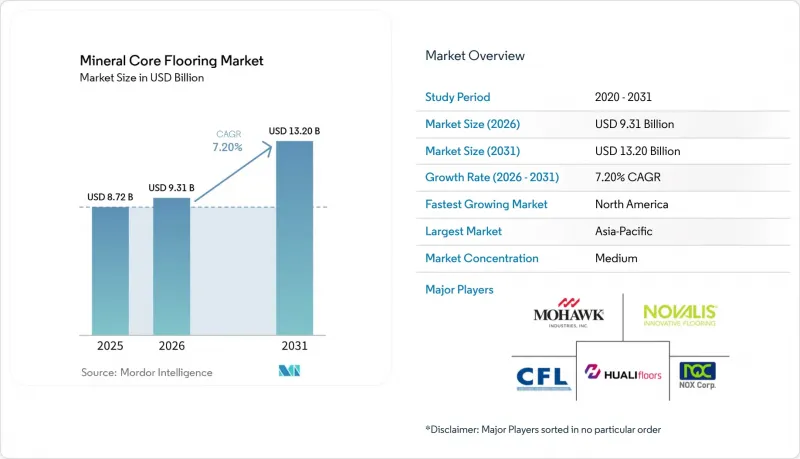
本報告按產品類型(SPC、WPC、其他)、形狀(板材、地磚、片材)、厚度(4毫米及以下、4-6毫米、6-8毫米、8毫米以上)、最終用戶(住宅、商業)、配銷通路(B2C/零售、B2B/承包商)和地區(北美、南美、歐洲、亞太地區、中東和非洲)進行細分。市場預測以美元計價。
全球礦物芯地板市場趨勢與洞察
卡扣式安裝方法降低了人事費用,促進了DIY的普及。
這種卡扣式系統只需極少的工具即可完成安裝,減少了對專業承包商的依賴,從而縮短了安裝時間,降低了住宅和專業人員的直接人事費用。憑藉整合式墊片和清晰的鎖定步驟文檔,產品系列可實現即時步行安裝,即使是小規模房間也能在一天內完成。零售商和自有品牌正將這些浮動系統定位為便利的黏合劑升級方案,簡化了表面處理和清潔工作。預計到2026年,大型家裝零售商將繼續強調DIY的價值,並專注於推廣自有品牌的防水硬芯產品。安裝促銷和品牌保固條款明確規定了卡扣式系統的基材和環境適應性要求,有助於減少住宅和小規模商業建築的重新安裝需求,並延長產品的使用壽命。
在潮濕地區,防水硬質芯材地板正在蠶食複合地板和實木地板的市場佔有率。
全防水硬芯結構仍然是廚房、浴室和地下室等潮濕區域的首選,其保固條款通常涵蓋液體潑濺和潮濕環境。對於承包商而言,在清潔乾燥的基材上進行浮動安裝可以提高工作效率,並且通常可以省去黏合劑乾燥時間。住宿設施、教育機構和醫療機構的採購團隊也更傾向於耐用的硬芯產品,因為這些產品需要承受人流和反覆清潔,同時最大限度地減少運作。 2026 年的零售商店平面圖顯示,專有防水硬芯表面材料將繼續擴張,促使消費者在高濕度區域放棄入門級層壓板產品。這種連鎖反應在北美和歐洲的一些市場尤其顯著,這些市場注重認證的買家會為公共或半公共項目尋找經過認證的產品。
PVC監管壓力以及廢棄產品回收的挑戰。
歐盟關於聚氯乙烯(PVC)中鉛含量及類似物質管制的法規,要求在整個地板價值鏈中實施嚴格的原料管理和文件記錄。這些法規對傳統添加劑的回收利用造成了壓力,並限制了缺乏先進分離和溶解技術的硬芯產品線中再生材料的選擇。儘管企業回收計畫和收集系統日趨成熟,但由於收集物流和品質保證方面的限制,擴大循環原料的使用規模仍然是一項複雜的挑戰。在北美,室內空氣品質和成分安全的第三方認證正在影響公共設施和學校的採購政策,並指導產品配方和供應鏈的指南。因此,符合嚴格標準的認證產品具有規格優勢,但製造商也面臨額外的成本和流程控制負擔。
細分市場分析
到2025年,石塑複合材料(SPC)將以65.0%的市場佔有率佔據全球礦物芯地板材料市場的主導地位,而木塑複合材料(WPC)將成為成長最快的產品類型,預計2026年至2031年複合年成長率將達到7.67%。在全球礦物芯地板材料市場,SPC因其即使在潮濕環境中也具有良好的抗凹陷性和卓越的尺寸穩定性而備受青睞,成為廚房和浴室的標準選擇。 WPC的產品開發則著重於提升腳感溫暖度和吸音性能,使其在多用戶住宅和豪華住宅的應用日益廣泛。零售商和複合材料業主優先考慮物流和安裝效率等因素,許多WPC產品系列在安裝人員負擔過重和電梯限制等問題上持續擴大市場佔有率。此外,創新趨勢顯示人們越來越關注材料健康和室內空氣質量,這推動了WPC在醫療、教育和政府機構中的應用。
SPC(表面拋光水晶)地板在需要耐磨損、耐水洗且能適應輕微基層不平整的項目中依然佔據重要地位。同時,WPC(木紋拋光水晶)地板的普及反映了多層住宅和多戶住宅對終端用戶舒適度和隔音性能日益成長的需求。在全球礦物芯地板市場,這兩種地板平台在鎖扣精度和表面耐磨性方面均有所提升,從而在各個價位段都實現了穩定的性能。製造商正專注於進行第三方檢驗,以解決品質問題並滿足公共開發項目的競標要求。同時,品牌策略正致力於豐富地板的外觀和紋理,以更真實地再現木材和石材的質感,進而影響零售市場的選擇。有鑑於這些產品趨勢,採購團隊會根據房間用途和噪音標準來選擇合適的安裝方案,從而延長安裝後的使用壽命。此外,更清晰的安裝指南和更完善的保固條款也使礦物芯地板行業受益匪淺,這些都反映了住宅和商業場所的現代應用場景。
預計到2025年,全球礦物芯材地板市場中,木紋地板將佔據70.0%的市場佔有率,而瓷磚地板的市場佔有率預計將在2031年之前以7.90%的複合年成長率成長。木紋地板因其安裝快速、木紋外觀符合消費者喜好,仍然是住宅裝修的首選。預計在2026年的促銷中,木紋地板將在門市保持最高的曝光率,進一步提升消費者認知度。瓷磚地板,包括預先灌漿的SPC板材,在需要類似陶瓷的美觀效果和快速完成的場合,正逐漸獲得市場認可。在預製地面上進行浮動安裝可以減少停工時間,從而滿足零售和酒店業緊迫的工期要求。
在商業維修工程中,由於重量限制、基材條件和聲學目標等因素,硬質芯材地磚比陶瓷地磚更具吸引力,從而推動了地磚的普及。全球礦物芯材地板市場也反映了這一轉變,除了防滑和防火性能數據外,還提供室內空氣品質認證信息,以滿足建築規範要求。製造商也不斷拓展產品線,推出人字形圖案和大尺寸設計,並透過改進鎖扣系統簡化複雜的鋪裝佈局。各品類的領導企業正與經銷合作夥伴緊密合作,確保現場備有足夠的面積,使承包商得以分階段順利完成每個房間的鋪裝。因此,在以往以陶瓷地磚為主的空間中,地磚正發揮越來越重要的作用,而且不會增加荷載或延長養護時間。
區域分析
到2025年,北美將佔全球市場佔有率的30.0%。這主要得益於自有品牌的擴張以及彈性地板材料品類國內產能的提升。該地區的大部分需求來自美國,籌資策略傾向於採用近岸和國內產品相結合的方式,以穩定前置作業時間。學校和醫療機構的認證要求將影響產品陣容和競標的資格預審流程。加拿大和墨西哥也屬於該地區,它們的業務活動與當地零售策略和目標商業項目相契合。大型連鎖企業繼續透過獨家項目和統一的庫存系統來鞏固銷售量。
亞太地區是全球礦物芯地板材料市場成長最快的地區,預計2026年至2031年將以8.5%的複合年成長率成長,這主要得益於不斷成長的都市區需求和持續的出口能力。買家在規劃面向北美和歐洲的跨境供應模式時,會仔細考慮各地區的政策和認證情況。出口商優先考慮能夠證明其符合低VOC和受管制物質要求的相關文件,以滿足目的地市場的檢驗要求。隨著客戶對更佳隔音效果和更牢固的鎖扣系統的需求,亞太地區的製造商正日益關注更厚的結構和更優質的飾面。
在歐洲,消費者正努力權衡影響地板材料PVC含量、標籤和環境聲明等政策變化所帶來的挑戰。政府和醫療保健相關採購仍需遵守嚴格的室內空氣品質和物質法規,這支撐了對經認證的硬芯產品的需求。儘管近岸外包的選擇正在增加以提高服務水平,但進口對於豐富產品種類仍然至關重要。歐洲也存在一些針對性的貿易措施,這些措施會影響相關地板材料品類的採購決策,顯示其採取了更為謹慎的立場。在這種情況下,產品設計團隊正專注於合規性、生命週期成本和快速安裝,以滿足維修要求。
其他好處:
- Excel格式的市場預測(ME)表
- 3個月的分析師支持
目錄
第1章:引言
- 研究假設和市場定義
- 調查範圍
第2章:調查方法
第3章執行摘要
第4章 市場狀況
- 市場概覽
- 市場促進因素
- 卡扣式安裝系統降低了人事費用,並且可以自行安裝。
- 在潮濕環境中,防水硬質芯材正在搶佔層壓板和實木的市場佔有率。
- 對底層結構缺陷接受度的提高正在加速翻新和更換的周期。
- 拓展家居裝飾商店和專賣店的自有品牌 / 快速輪換庫存商品
- 近岸外包和國內SPC產能的擴大將縮短和減少前置作業時間和供應風險。
- 低 VOC、PVC 輕質/礦物複合材料的創新正在刺激規格主導的需求。
- 市場限制因素
- 聚氯乙烯(PVC)相關的監管壓力以及廢棄產品回收所面臨的挑戰
- 品質參差不齊、仿冒品和低品質進口產品正在削弱消費者信心。
- 貿易和關稅風險,以及反傾銷和反補貼稅風險,正在推動價格波動。
- 由於中國產能過剩,特殊目的公司(SPC)正趨於商品化,對利潤率帶來壓力。
- 產業價值鏈分析
- 波特五力分析
- 洞察最新產業趨勢與創新
- 近期產業趨勢分析(新產品發布、策略性舉措、投資、合作、合資、業務擴張、併購等)
第5章 市場規模與成長預測
- 依產品類型
- SPC(石塑複合材料)
- 木塑複合材料(WPC)
- 其他產品類型
- 按格式
- 板
- 瓦
- 座位
- 按厚度
- 4毫米或更小
- 4~6 mm
- 6~8 mm
- 8毫米或以上
- 最終用戶
- 住宅
- 商業
- 辦公室
- 零售
- 飯店業
- 衛生保健
- 教育
- 其他商業終端用戶
- 透過分銷管道
- B2C/零售
- 家居建材商店
- 地板材料專賣店
- 線上
- 當地金屬製品(非正規市場)
- 其他分銷管道
- B2B/承包商/建築公司
- B2C/零售
- 按地區
- 北美洲
- 加拿大
- 美國
- 墨西哥
- 南美洲
- 巴西
- 秘魯
- 智利
- 阿根廷
- 其他南美國家
- 歐洲
- 英國
- 德國
- 法國
- 西班牙
- 義大利
- 比荷盧經濟聯盟(比利時、荷蘭、盧森堡)
- 北歐國家(丹麥、芬蘭、冰島、挪威、瑞典)
- 其他歐洲國家
- 亞太地區
- 印度
- 中國
- 日本
- 澳洲
- 韓國
- 東南亞
- 其他亞太國家
- 中東和非洲
- 阿拉伯聯合大公國
- 沙烏地阿拉伯
- 南非
- 其他中東和非洲國家
- 北美洲
第6章 競爭情勢
- 市場集中度
- 策略趨勢
- 市佔率分析
- 公司簡介
- CFL Flooring
- Mohawk Industries
- Shaw Industries Group
- Tarkett SA
- Gerflor
- Mannington Mills
- AHF Products(Armstrong Flooring brand)
- HMTX Industries(Halstead/Metroflor)
- NOX Corporation
- Novalis Innovative Flooring
- Karndean Designflooring
- LX Hausys(formerly LG Hausys)
- Beaulieu International Group(Beauflor/BerryAlloc)
- Forbo Flooring Systems
- Polyflor Ltd
- MSI Surfaces
- CALI Floors
- Taizhou Huali New Materials
- Zhejiang Walrus New Material
- Decno Group
第7章 市場機會與未來展望
According to Mordor Intelligence, the mineral core flooring market size is projected to expand from USD 8.72 billion in 2025 and USD 9.31 billion in 2026 to USD 13.20 billion by 2031, registering a CAGR of 7.2% between 2026 and 2031.
This report is Segmented by Product Type (SPC, WPC, Other), Format (Plank, Tile, Sheet), Thickness (<=4 Mm, 4-6 Mm, 6-8 Mm, >8 Mm), End User (Residential, Commercial), Distribution Channel (B2C/Retail, B2B/Contractors), and Geography (North America, South America, Europe, Asia-Pacific, Middle East & Africa). Market Forecasts are Provided in Value (USD).
Global Mineral Core Flooring Market Trends and Insights
Click-Lock Installation Reduces Labor Cost and Enables DIY Adoption
Click-lock systems enable tool-light installation with fewer trade dependencies, shortening job timelines and reducing direct labor for homeowners and pros alike. Product lines that ship with integrated pads and clear locking instructions enable walk-on use soon after installation, which supports a single-day project turnaround for small rooms. Retailers and private labels position these floating systems as accessible upgrades that do not require adhesives, which simplifies preparation and cleanup. In 2026, merchandising in large home centers continues to highlight waterproof rigid-core options under exclusive brands, which reinforces the do-it-yourself value story. Installer guidelines and brand warranty documents reinforce substrate and acclimation requirements for click systems, helping reduce callbacks and extend product life in residential and light commercial environments.
Waterproof Rigid Core Captures Share from Laminate and Wood in Wet Areas
Fully waterproof rigid-core constructions remain preferred in kitchens, baths, and basements where moisture exposure is frequent, and where warranties explicitly address spills and damp conditions. Contractor workflows benefit from floating installation over clean, dry substrates, which eliminates adhesive dry time from the project plan in many cases. Procurement teams in hospitality, education, and healthcare also favor resilient rigid-core, where downtime must be minimized while maintaining resistance to foot traffic and repeated cleaning. Retail planograms in 2026 continue to expand waterproof rigid-core facings under exclusive labels, which steer shoppers away from entry-grade laminates in high-moisture zones. This pull-through effect remains visible in North America and several European markets where certification-aware buyers demand listed products for public or semi-public projects.
PVC Regulatory Pressure and End-of-Life Recycling Challenges
EU restrictions on lead in PVC and similar substance controls require strict feedstock management and documentation throughout the flooring value chain. These rules place pressure on recycled streams when legacy additives remain present, limiting recycled-content options for rigid-core lines without advanced separation or dissolution technologies. Corporate recycling programs and take-back systems have matured, yet scaling circular feedstock remains complex due to collection logistics and quality assurance constraints. In North America, third-party certifications for indoor-air performance and ingredient health shape procurement policies for public buildings and schools, which guide product formulations and supply documentation. The combined effect is additional costs and process oversight for producers, alongside specification advantages for certified lines that meet strict criteria.
Other drivers and restraints analyzed in the detailed report include:
- Tolerance to Imperfect Subfloors Accelerates Remodeling and Replacement Cycles
- Private-Label Expansion at Home Centers/Specialty Retail Scales Fast SKU Rotation
- Quality Variance and Counterfeit or Low-Spec Imports Erode Buyer Confidence
For complete list of drivers and restraints, kindly check the Table Of Contents.
Segment Analysis
Stone plastic composite led with 65.0% in 2025 within the global mineral core flooring market, and Wood Plastic Composite is the fastest-growing product category with a 7.67% CAGR over 2026-2031. The global mineral core flooring market favors SPC for its dent resistance and strong dimensional stability in moisture-prone rooms, making it the default choice for kitchens and bathrooms. Product development in WPC highlights a warmer underfoot feel and acoustic damping, broadening its use in multi-family and premium residential applications. Retailers and project owners weigh logistics and installation ergonomic factors, and many WPC lines continue to gain share where installer fatigue and elevator constraints matter. Innovation pipelines also show increased attention to material health and indoor air, which supports specification in healthcare, education, and government buildings.
SPC maintains a stronger presence in projects that expect heavy use, wet cleaning, and tolerance to minor substrate variance. At the same time, WPC expansion reflects end-user comfort priorities and acoustic requirements for upstairs living or multi-tenant structures. The global mineral core flooring market sees both platforms improve locking precision and surface wear layers, which stabilizes performance across price tiers. Manufacturers highlight third-party verification to address quality concerns and to meet bid prerequisites on public developments. At the same time, brand strategies diversify visuals and textures to emulate better wood and stone formats that guide retail selection. In this product view, procurement teams match each construction to room usage and noise criteria to extend the installed lifecycle. The mineral core flooring industry also benefits from clearer installation guidance and expanded warranty language that reflect modern use cases in residential and Main Street commercial settings.
Planks accounted for 70.0% of the 2025 format share in the global mineral core flooring market size, while tile formats are on track to expand at a 7.90% CAGR through 2031. Planks remain the leading choice for residential replacements due to their installation speed and wood-look visuals that align with consumer preferences. Merchandising in 2026 continues to give plank formats the broadest in-store exposure, which reinforces consumer familiarity. Tile formats, including pre-grouted SPC, are gaining momentum where ceramic aesthetics are desired and faster project completion is desired. Floating assembly over prepared surfaces reduces downtime and supports tight retail and hospitality schedule windows.
Tile adoption is growing in commercial retrofit projects, where weight limits, subfloor conditions, or acoustic targets make rigid-core tiles more attractive than ceramic tiles. The global mineral core flooring market reflects this shift by showcasing slip and fire performance data to meet code requirements alongside indoor-air credentials. Producers also expand herringbone and larger-format visuals, simplifying complex layouts through updated locking systems. Category leaders work with distribution partners to stock critical square footage locally, which helps contractors stage rooms across phased projects. The result is an expanding role for tile in spaces that historically defaulted to ceramic, without increasing load or extending cure time.
Complete Report Scope:
- By Product Type
- Stone Plastic Composite
- Wood Plastic Composite
- Other Product Types
- By Format
- Plank
- Tile
- Sheet
- By Thickness
- <=4 mm
- 4-6 mm
- 6-8 mm
- Above 8 mm
- By End User
- Residential
- Commercial
- Offices
- Retail
- Hospitality
- Healthcare
- Education
- Other Commercial End Users
- By Distribution Channel
- B2C/Retail
- Home Centers
- Specialty Flooring Stores
- Online
- Local Hardware Shops (unorganized market)
- Other Distribution Channels
- B2B/Contractors/Builders
- B2C/Retail
- By Geography
- North America
- Canada
- United States
- Mexico
- South America
- Brazil
- Peru
- Chile
- Argentina
- Rest of South America
- Europe
- United Kingdom
- Germany
- France
- Spain
- Italy
- BENELUX (Belgium, Netherlands, Luxembourg)
- NORDICS (Denmark, Finland, Iceland, Norway, Sweden)
- Rest of Europe
- Asia-Pacific
- India
- China
- Japan
- Australia
- South Korea
- South-East Asia
- Rest of Asia-Pacific
- Middle East & Africa
- United Arab Emirates
- Saudi Arabia
- South Africa
- Rest of Middle East & Africa
- North America
Geography Analysis
North America accounted for 30.0% of the global market value in 2025, supported by private-label expansion and additional domestic capacity announced for resilient categories. The United States accounts for the majority of regional demand, and sourcing strategies favor a blend of nearshored and domestic lines that stabilize lead times. Certification requirements for schools and healthcare facilities shape assortments and bidder prequalification processes. Canada and Mexico round out the region, with activity aligned with local retail strategies and targeted commercial projects. Large chains continue to consolidate volume behind exclusive programs and consistent stocking positions.
Asia-Pacific is the fastest-growing region, with a 8.5% CAGR over 2026-2031 in the global mineral core flooring market, driven by rising urban demand and continued export capacity. Buyers weigh regional policy and certification landscapes as they plan cross-border supply models for North America and Europe. Exporters prioritize documentation that supports compliance with low-VOC and restricted substances requirements to satisfy destination-market checks. APAC producers are increasing attention to thicker construction and premium finishes as customers request better acoustics and robust locking systems.
Europe balances consumption with ongoing policy evolution that impacts PVC content, labeling, and environmental declarations in the flooring category. Procurement for government and healthcare projects maintains rigorous indoor-air and substance rules, which support certified rigid-core offerings. Nearshoring options expand to improve service levels, while imports remain important for the breadth of range. Europe also features targeted trade measures that influence sourcing decisions in related flooring categories and signal a more protective stance. In this context, specification teams focus on compliance, lifecycle cost, and fast installation to meet refurbishment timetables.
- CFL Flooring
- Mohawk Industries
- Shaw Industries Group
- Tarkett S.A.
- Gerflor
- Mannington Mills
- AHF Products (Armstrong Flooring brand)
- HMTX Industries (Halstead/Metroflor)
- NOX Corporation
- Novalis Innovative Flooring
- Karndean Designflooring
- LX Hausys (formerly LG Hausys)
- Beaulieu International Group (Beauflor/BerryAlloc)
- Forbo Flooring Systems
- Polyflor Ltd
- MSI Surfaces
- CALI Floors
- Taizhou Huali New Materials
- Zhejiang Walrus New Material
- Decno Group
Additional Benefits:
- The market estimate (ME) sheet in Excel format
- 3 months of analyst support
TABLE OF CONTENTS
1 Introduction
- 1.1 Study Assumptions & Market Definition
- 1.2 Scope of the Study
2 Research Methodology
3 Executive Summary
4 Market Landscape
- 4.1 Market Overview
- 4.2 Market Drivers
- 4.2.1 Click-lock installation reduces labor cost and enables DIY adoption
- 4.2.2 Waterproof rigid core captures share from laminate and wood in wet areas
- 4.2.3 Tolerance to imperfect subfloors accelerates remodeling and replacement cycles
- 4.2.4 Private-label expansion at home centers/specialty retail scales fast SKU rotation
- 4.2.5 Nearshoring and domestic SPC capacity cut lead times and supply risk
- 4.2.6 Low-VOC, PVC-lite/mineral composite innovations unlock spec-driven demand
- 4.3 Market Restraints
- 4.3.1 PVC regulatory pressure and end-of-life recycling challenges
- 4.3.2 Quality variance and counterfeit/low-spec imports erode buyer confidence
- 4.3.3 Trade/tariff exposure and AD/CVD risks drive pricing volatility
- 4.3.4 China overcapacity commoditizes SPC, compressing margins
- 4.4 Industry Value Chain Analysis
- 4.5 Porter's Five Forces Analysis
- 4.5.1 Threat of New Entrants
- 4.5.2 Bargaining Power of Suppliers
- 4.5.3 Bargaining Power of Buyers
- 4.5.4 Threat of Substitutes
- 4.5.5 Competitive Rivalry
- 4.6 Insights into the Latest Trends and Innovations in the Industry
- 4.7 Insights on Recent Developments (New Product Launches, Strategic Initiatives, Investments, Partnerships, JVs, Expansion, M&As, etc.) in the Industry
5 Market Size & Growth Forecasts (Value in USD Billion)
- 5.1 By Product Type
- 5.1.1 Stone Plastic Composite
- 5.1.2 Wood Plastic Composite
- 5.1.3 Other Product Types
- 5.2 By Format
- 5.2.1 Plank
- 5.2.2 Tile
- 5.2.3 Sheet
- 5.3 By Thickness
- 5.3.1 <=4 mm
- 5.3.2 4-6 mm
- 5.3.3 6-8 mm
- 5.3.4 Above 8 mm
- 5.4 By End User
- 5.4.1 Residential
- 5.4.2 Commercial
- 5.4.2.1 Offices
- 5.4.2.2 Retail
- 5.4.2.3 Hospitality
- 5.4.2.4 Healthcare
- 5.4.2.5 Education
- 5.4.2.6 Other Commercial End Users
- 5.5 By Distribution Channel
- 5.5.1 B2C/Retail
- 5.5.1.1 Home Centers
- 5.5.1.2 Specialty Flooring Stores
- 5.5.1.3 Online
- 5.5.1.4 Local Hardware Shops (unorganized market)
- 5.5.1.5 Other Distribution Channels
- 5.5.2 B2B/Contractors/Builders
- 5.5.1 B2C/Retail
- 5.6 By Geography
- 5.6.1 North America
- 5.6.1.1 Canada
- 5.6.1.2 United States
- 5.6.1.3 Mexico
- 5.6.2 South America
- 5.6.2.1 Brazil
- 5.6.2.2 Peru
- 5.6.2.3 Chile
- 5.6.2.4 Argentina
- 5.6.2.5 Rest of South America
- 5.6.3 Europe
- 5.6.3.1 United Kingdom
- 5.6.3.2 Germany
- 5.6.3.3 France
- 5.6.3.4 Spain
- 5.6.3.5 Italy
- 5.6.3.6 BENELUX (Belgium, Netherlands, Luxembourg)
- 5.6.3.7 NORDICS (Denmark, Finland, Iceland, Norway, Sweden)
- 5.6.3.8 Rest of Europe
- 5.6.4 Asia-Pacific
- 5.6.4.1 India
- 5.6.4.2 China
- 5.6.4.3 Japan
- 5.6.4.4 Australia
- 5.6.4.5 South Korea
- 5.6.4.6 South-East Asia
- 5.6.4.7 Rest of Asia-Pacific
- 5.6.5 Middle East & Africa
- 5.6.5.1 United Arab Emirates
- 5.6.5.2 Saudi Arabia
- 5.6.5.3 South Africa
- 5.6.5.4 Rest of Middle East & Africa
- 5.6.1 North America
6 Competitive Landscape
- 6.1 Market Concentration
- 6.2 Strategic Moves
- 6.3 Market Share Analysis
- 6.4 Company Profiles {(includes Global level Overview, Market level overview, Core Segments, Financials as available, Strategic Information, Market Rank/Share for key companies, Products & Services, and Recent Developments)}
- 6.4.1 CFL Flooring
- 6.4.2 Mohawk Industries
- 6.4.3 Shaw Industries Group
- 6.4.4 Tarkett S.A.
- 6.4.5 Gerflor
- 6.4.6 Mannington Mills
- 6.4.7 AHF Products (Armstrong Flooring brand)
- 6.4.8 HMTX Industries (Halstead/Metroflor)
- 6.4.9 NOX Corporation
- 6.4.10 Novalis Innovative Flooring
- 6.4.11 Karndean Designflooring
- 6.4.12 LX Hausys (formerly LG Hausys)
- 6.4.13 Beaulieu International Group (Beauflor/BerryAlloc)
- 6.4.14 Forbo Flooring Systems
- 6.4.15 Polyflor Ltd
- 6.4.16 MSI Surfaces
- 6.4.17 CALI Floors
- 6.4.18 Taizhou Huali New Materials
- 6.4.19 Zhejiang Walrus New Material
- 6.4.20 Decno Group
7 Market Opportunities & Future Outlook
- 7.1 Spec-grade low-VOC and circular rigid core lines (PVC-lite/bio-PVC; ASSURE-certified)
- 7.2 Pre-grouted, slip-rated click-lock SPC tile systems for rapid commercial retrofit

 全球架空地板市場:機會與策略展望(至2035年)
 高架地板市場規模、佔有率和成長分析:按材料、應用、承載能力、最終用途和地區分類-2026-2033年產業預測2026年全球架空地板市場報告2026年全球重型架空地板市場報告
 高架地板系統市場:2026-2032年全球市場預測(按應用、材料、最終用戶、承載能力、下部結構系統、面板高度和飾面分類)
 架空地板市場報告:按類型、應用和地區分類,2026-2034 年硫酸鈣網狀地板市場按產品類型、面板尺寸、安裝類型、最終用戶和分銷管道分類-2026-2032年全球預測資料中心架空地板市場按材料、面板尺寸、荷載等級、下部結構類型、應用和最終用戶分類,全球預測,2026-2032年
 架空地板系統市場-全球產業規模、佔有率、趨勢、機會和預測,按應用(住宅、商業)、按產品類型(鋼膠囊、硫酸鈣板)、按地區和競爭進行細分,2020-2030 年預測
 全球架空地板系統市場