


 |
市場調查報告書
商品編碼
2073275
媒體採購服務:市場佔有率分析、產業趨勢與統計、成長預測(2026-2031 年)Media Buying Services - Market Share Analysis, Industry Trends & Statistics, Growth Forecasts (2026 - 2031) |
||||||

※ 本網頁內容可能與最新版本有所差異。詳細情況請與我們聯繫。
根據 Mordor Intelligence 預測,媒體採購服務市場規模將從 2025 年的 1,058 億美元和 2026 年的 1,149 億美元成長到 2031 年的 1,741 億美元,2026 年至 2031 年的年複合成長率(CAGR)為 8.67%。
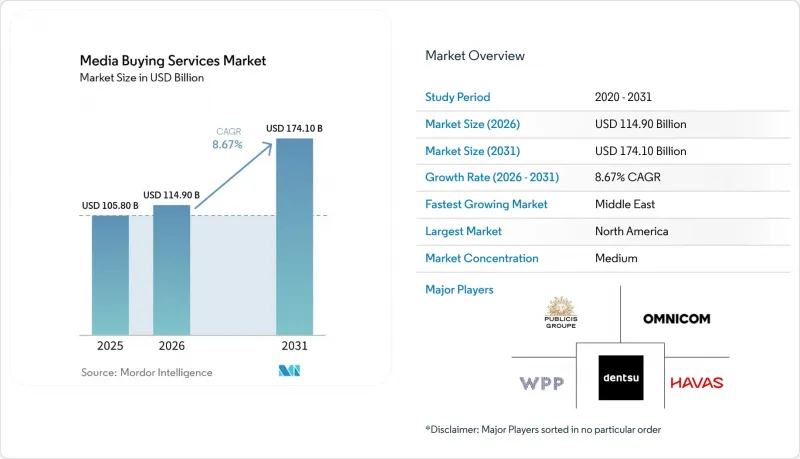
本報告按服務類型(媒體策略與規劃、媒體採購與談判、程序化購買和效果採購等)、媒體管道(社交媒體廣告、展示廣告等)、組織規模(大型企業等)、終端用戶行業(零售和電子商務、IT和電信等)以及地區進行細分。市場預測以美元計價。
全球媒體採購服務市場趨勢及洞察
程序化和人工智慧主導的採購將成為廣告公司的核心工作流程。
程序化廣告已從一項專門功能轉變為數位媒體的標準執行層。德國廣告主協會 (BVDW) 預測,到 2026 年,程式化採購將佔德國線上展示和影片市場 80% 的佔有率,達到 65 億歐元。以 2025 年的平均外匯計算,這相當於 70 億美元。這項變更也改變了廣告代理商的選擇標準。隨著大多數買家都能存取相同的發行管道,廣告進入許可權的重要性降低,而最佳化邏輯的重要性則日益凸顯。因此,媒體採購服務市場越來越重視身分基礎設施、資料模型和工作流程自動化,而非僅依賴人工執行。那些除了提供標準平台存取權限外,無法提供差異化人工智慧層的廣告代理商,在定價和客戶維繫將面臨更大的壓力。
預算轉向聯網電視、零售媒體和數位影片。
聯網電視和零售媒體在新廣告預算中所佔佔有率越來越大,這正在改變廣告公司創造價值的領域。電通預測,到2026年,全球聯網電視市場將成長11.5%,零售媒體市場將成長12.3%,證實了這兩個管道吸引的投資遠超整體廣告市場。零售媒體之所以備受關注,是因為它可以將購買意向數據轉化為可定向且注重隱私的廣告投放訊息,用於宣傳活動策劃。能夠將零售媒體訊號與聯網電視活化結合的廣告公司,正在建立廣告曝光與購買之間更緊密的閉迴路。這種融合已經開始影響基礎設施的選擇,例如,Stagwell於2026年4月與FreeWheel整合,創造了一個統一的聯網電視啟動層。
隱私法規和訊號損失會降低目標定位的準確性。
隱私法規不再只是合規問題,它們對可尋址媒體構成結構性限制。主流瀏覽器逐步淘汰 Cookie 以及蘋果的「應用追蹤透明度」框架減少了可用於規劃和最佳化的確定性識別碼的數量。這種訊號的缺失降低了開放網路上受眾覆蓋規劃的效率,並導致身分識別系統之間的碎片化加劇。在媒體採購服務市場,對於那些營運模式不包含法律、數據和工程支援的小規模代理商而言,這種負擔尤其沉重。因此,規劃環境比幾年前更具挑戰性,宣傳活動的精準度越來越依賴第一方資源以及與發布商的關係。
細分市場分析
2025年,媒體採購和談判服務佔業務收益的35.76%,繼續在媒體採購服務市場佔據核心地位。這一地位仍然穩固,因為聯網電視、體育賽事、新聞直播和其他高價值領域的優質廣告資源仍然高度依賴直接交易模式。在這些領域,買家仍然重視協商獲得的廣告進入許可權、價格控制以及相關的廣告管理。這意味著,即使大部分執行工作轉移到軟體平台,與仲介的人際關係仍然至關重要。由於客戶對優質廣告位和商業條款的確定性要求很高,媒體採購服務市場的這一細分領域依然保持強勁勢頭。
預計從2026年到2031年,程序化和效果採購的複合年成長率將達到9.46%,成為媒體採購服務市場中成長最快的服務類別。這一成長與預算向開放式網路程式化購買、私人市場、精選交易和即時最佳化模式的轉移密切相關。據PubMatic稱,其AgenticOS平台到2026年第一季將運行超過30個完全自主的端到端宣傳活動,這表明工作流程自動化正在迅速滲透到實際採購操作中。隨著交易採購的自動化程度越來越高,代理商越來越重視策略、分析和電商激活,將其作為媒體採購服務市場的收入來源。
到2025年,搜尋廣告將佔通路收入的31.44%,並繼續保持其在媒體採購服務市場的領先地位。搜尋廣告之所以能維持這一地位,是因為它能夠清楚地捕捉到下游轉換漏斗的意圖,並支持在眾多行業中實現品牌與結果之間的直接歸因。廣告主仍然將搜尋廣告作為其效果預算的基礎,尤其是在投資報酬率比品牌知名度更為重要的情況下。這種穩定性持續推動著對能夠管理競標、關鍵字、預算分配和跨通路投放的廣告代理商的需求。媒體採購服務市場仍然依賴搜尋廣告,因為它能夠兼顧支出控制和可衡量的結果。
預計到2031年,聯網電視和OTT影片將以10.14%的複合年成長率成長,成為媒體採購服務市場中成長最快的媒體管道。這一成長主要得益於廣告支援的串流媒體、觀看習慣的改變以及將商業數據整合到影片策劃中。在日本,網路廣告媒體支出預計到2025年將成長11.8%,主要由社群媒體上的垂直影片驅動,這與以影片主導的發現和活化方式的更廣泛趨勢相符。雖然展示廣告、數位影片、數位音訊、數位戶外廣告和零售媒體網路仍然很重要,但最顯著的變化發生在影片庫存、受眾數據和品管融合的領域。
區域分析
2025年,北美仍將是全球媒體採購服務市場最大的區域中心,約佔全球市場收入的41.48%。美國憑藉其廣告主支出集中度和成熟的程序化基礎設施,佔據了該地區的大部分收入。此外,該地區還擁有顯著的規模經濟效益,許多大型控股公司網路和採購技術合作夥伴均設於此。加拿大憑藉著顯著的數位化發展,仍然是強勁的第二大市場;而墨西哥雖然仍處於發展成熟階段,但正朝著行動優先的採購模式邁進。這種市場集中度,加上對數據利用、營運和平台依賴性日益成長的關注,意味著北美媒體採購服務市場競爭仍然異常激烈。
歐洲是媒體採購服務市場第二大區域。預計到2026年,德國的線上展示和影片廣告市場規模將達到82億歐元(89億美元),其中程式化廣告預計將佔交易總額的80%。法國的廣告市場在2025年達到198億歐元(214億美元)。同年,法國數位廣告市場成長了11%,預計2026年將進一步成長7.5%。基於用戶許可的數據法規以及優質出版商群體的不斷壯大,正促使歐洲買家越來越傾向於選擇程序化擔保和精選的私有市場交易,而非公開競標。亞太地區是媒體採購服務市場成長最快、大規模的區域叢集。預計到2025年,日本的廣告總支出將超過8.0623兆歐元(534億美元),其中網路廣告支出首次佔比超過50%。博報堂 DY ONE 於 2025 年 7 月開始透過日本電視台的 AdRM-Exchange 進行電視廣告程式化競價,並於 2025 年 10 月增加了一項獨特的覆蓋範圍最大化競標功能。這表明廣播廣告資源正在全部區域。
儘管規模不如北美和歐洲,南美仍透過主導廣告活動不斷擴大其數位採購基礎。中東和非洲雖然絕對規模仍然較小,但預計將成為成長最快的區域市場,2026年至2031年的複合年成長率將達到8.86%。這一成長得益於數位廣告投資的增加、聯網電視的快速普及、零售媒體生態系統的擴張,以及沙烏地阿拉伯和阿拉伯聯合大公國等國政府主導的數位轉型(DX)舉措。在那些能夠將全球工具與特定國家媒體系統整合的地區,媒體採購服務市場正以最快的速度擴張。
其他好處:
- Excel格式的市場預測(ME)表
- 3個月的分析師支持
目錄
第1章:引言
- 研究假設和市場定義
- 調查範圍
第2章:調查方法
第3章執行摘要
第4章 市場狀況
- 市場概覽
- 市場促進因素
- 程序化和人工智慧驅動的採購將成為廣告公司的核心工作流程。
- 預算轉向聯網電視、零售媒體和數位視訊。
- 對全通路衡量和廣告課責(ROAS)問責制的需求
- 利用第一方數據和受眾規劃時,要充分考慮隱私問題。
- 精心打造的市場和最佳化的供應鏈為專業採購合作夥伴帶來優勢。
- Agentic AI 擴大了中型品牌採購業務外包的範圍。
- 市場限制因素
- 隱私法規和訊號損失會降低目標定位的準確性。
- 與廣告詐騙、品牌安全和可見性相關的風險仍然存在。
- 「圍牆花園」中的衡量標準存在差距,阻礙了跨平台最佳化。
- 內部生產和平台自動化正在給利潤率帶來壓力。
- 產業價值鏈分析
- 監理情勢
- 技術展望
- 波特五力分析
第5章 市場規模與成長預測
- 按服務類型
- 媒體策略與規劃
- 媒體採購與談判
- 程序化採購和效果採購
- 宣傳活動管理與最佳化
- 測量與分析
- 其他(零售媒體和商業復興、影響者和創作者的媒體傳播、媒體諮詢和內部支持)
- 媒體頻道
- 搜尋廣告
- 社群媒體廣告
- 展示廣告
- 數位影片
- 聯網電視和OTT影片
- 其他(零售媒體網路、數位音訊和播客、廣播、印刷媒體、戶外廣告和數位戶外廣告)
- 按組織規模
- 大公司
- 小型企業
- 按最終用戶行業分類
- 零售與電子商務
- 媒體與娛樂
- BFSI
- 資訊科技/通訊
- 旅遊與飯店
- 衛生保健
- 其他(汽車、教育、公共部門)
- 按地區
- 北美洲
- 美國
- 加拿大
- 墨西哥
- 南美洲
- 巴西
- 阿根廷
- 智利
- 其他南美國家
- 歐洲
- 德國
- 英國
- 法國
- 義大利
- 西班牙
- 其他歐洲國家
- 亞太地區
- 中國
- 日本
- 印度
- 韓國
- 澳洲
- 其他亞太國家
- 中東
- 阿拉伯聯合大公國
- 沙烏地阿拉伯
- 卡達
- 其他中東國家
- 非洲
- 南非
- 埃及
- 奈及利亞
- 其他非洲國家
- 北美洲
第6章 競爭情勢
- 市場集中度
- 策略趨勢
- 市佔率分析
- 公司簡介
- WPP plc
- Omnicom Group Inc.
- Publicis Groupe SA
- Dentsu Group Inc.
- The Interpublic Group of Companies, Inc.
- Havas Group
- Hakuhodo DY Holdings Inc.
- Stagwell Inc.
- S4 Capital plc
- Accenture plc
- MiQ Digital Ltd.
- Horizon Media, Inc.
- PMG Worldwide LLC
- Tinuiti, Inc.
- The Trade Desk, Inc.
- Brandtech Group
- MiQ Digital
- Assembly Global
- Microsoft Corporation
- Criteo SA
- Adform A/S
- Viant Technology Inc.
- LiveRamp Holdings
- FreeWheel
第7章 市場機會與未來展望
According to Mordor Intelligence, the media buying services market size is projected to expand from USD 105.8 billion in 2025 and USD 114.9 billion in 2026 to USD 174.1 billion by 2031, registering a CAGR of 8.67% between 2026 to 2031.
This report is Segmented by Service Type (Media Strategy and Planning, Media Buying and Negotiation, Programmatic and Performance Buying, and More), Media Channel (Social Media Advertising, Display Advertising, and More), Organization Size (Large Enterprises, and More), End-User Industry (Retail and E-Commerce, IT and Telecom, and More), and Geography. The Market Forecasts are Provided in Terms of Value (USD).
Global Media Buying Services Market Trends and Insights
Programmatic And AI-Driven Buying Becomes Core Agency Workflow
Programmatic advertising has moved from a specialist capability to a default execution layer across digital media. In Germany, BVDW projected that programmatic buying would account for 80% of the country's online display and video market in 2026, reaching EUR 6.5 billion, which equals USD 7.0 billion at the 2025 IRS average exchange rate. That shift changes agency selection criteria, because inventory access matters less when most buyers can reach the same pipes, and optimization logic matters more. The media buying services market is therefore placing more value on identity infrastructure, data models, and workflow automation than on manual execution alone. Agencies that cannot show a differentiated AI layer on top of standard platform access are facing stronger pressure on pricing and retention.
Budget Migration Toward Connected TV, Retail Media, And Digital Video
Connected TV and retail media are taking a larger share of new ad budgets, and that is changing where agencies create value. Dentsu projected global connected TV growth of 11.5% in 2026 and global retail media growth of 12.3% in the same year, which confirms that both channels are attracting outsized investment compared with the wider ad market. Retail media is gaining traction because it turns purchase intent data into an addressable and privacy-safe input for campaign planning. Agencies that can combine retail media signals with connected TV activation are building a tighter loop between exposure and purchase. That convergence is already shaping infrastructure choices, as shown by Stagwell's April 2026 integration with FreeWheel to create a unified connected TV activation layer.
Privacy Regulation And Signal Loss Reduce Targeting Precision
Privacy regulation has become a structural limit on addressable media rather than a narrow compliance issue. Cookie deprecation in major browsers and Apple's App Tracking Transparency framework have reduced the volume of deterministic identifiers available for planning and optimization. That loss of signal has made audience reach planning less efficient across the open web and more fragmented across identity systems. In the media buying services market, the burden falls harder on smaller agencies that do not have legal, data, and engineering support built into their operating model. The result is a tougher planning environment where campaign precision depends more on first-party assets and publisher relationships than it did a few years ago.
Other drivers and restraints analyzed in the detailed report include:
- Demand For Omnichannel Measurement And ROAS Accountability
- First-Party Data Activation And Privacy-Safe Audience Planning
- Ad Fraud, Brand Safety, And Viewability Risks Persist
For complete list of drivers and restraints, kindly check the Table Of Contents.
Segment Analysis
Media buying and negotiation retained 35.76% of service revenue in 2025, which kept this function at the center of the media buying services market size. That position remained durable because premium inventory in connected TV, sports, live news, and other high-value environments still relies heavily on direct deal structures. Buyers continue to value negotiated access, pricing discipline, and adjacency control in these environments. Those conditions keep human broker relationships relevant even as more execution shifts into software. This part of the media buying services market stayed resilient because clients still need certainty around premium placements and commercial terms.
Programmatic and performance buying is projected to record a 9.46% CAGR from 2026 to 2031, which makes it the fastest-growing service category in the media buying services market. Growth is tied to budget movement into open-web programmatic, private marketplaces, curated deals, and real-time optimization models. PubMatic said its AgenticOS platform had executed more than 30 fully autonomous end-to-end campaigns by Q1 2026, which showed how quickly workflow automation is moving into live buying operations. As transactional buying becomes more automated, agencies are placing more emphasis on strategy, analytics, and commerce activation as the fee-bearing layers of the media buying services market.
Search advertising held 31.44% of channel revenue in 2025, which preserved its lead within the media buying services market. Search keeps that position because it captures clear lower-funnel intent and supports direct brand-to-outcome attribution across many verticals. Advertisers still rely on search to anchor performance budgets, especially when return visibility matters more than broad awareness. That stability creates consistent demand for agencies that can manage bidding, keywords, budget pacing, and cross-channel allocation. The media buying services market still leans on search because it combines spend discipline with measurable outcomes.
Connected TV and OTT video are projected to expand at a 10.14% CAGR through 2031, which makes it the fastest-growing media channel in the media buying services market. Growth is being pushed by ad-supported streaming, changing viewing habits, and the addition of commerce data into video planning. In Japan, internet advertising media expenditure grew 11.8% in 2025, driven mainly by SNS vertical video, which aligned with the broader move toward video-led discovery and activation. Display, digital video, digital audio, digital out-of-home, and retail media networks remain important, but the sharpest change is happening where video inventory, audience data, and quality controls now meet.
Complete Report Scope:
- By Service Type
- Media Strategy and Planning
- Media Buying and Negotiation
- Programmatic and Performance Buying
- Campaign Management and Optimization
- Measurement and Analytics
- Others (Retail Media and Commerce Activation, Influencer and Creator Media Amplification, Media Consulting and In-Housing Support)
- By Media Channel
- Search Advertising
- Social Media Advertising
- Display Advertising
- Digital Video
- Connected TV and Over-the-Top Video
- Others (Retail Media Networks, Digital Audio and Podcasts, Radio, Print, OOH and DOOH)
- By Organization Size
- Large Enterprises
- Small and Medium-Sized Enterprises
- By End-User Industry
- Retail and E-commerce
- Media and Entertainment
- BFSI
- IT and Telecom
- Travel and Hospitality
- Healthcare
- Others (Automotive, Education, and Public sector)
- By Geography
- North America
- United States
- Canada
- Mexico
- South America
- Brazil
- Argentina
- Chile
- Rest of South America
- Europe
- Germany
- United Kingdom
- France
- Italy
- Spain
- Rest of Europe
- Asia-Pacific
- China
- Japan
- India
- South Korea
- Australia
- Rest of Asia-Pacific
- Middle East
- United Arab Emirates
- Saudi Arabia
- Qatar
- Rest of Middle East
- Africa
- South Africa
- Egypt
- Nigeria
- Rest of Africa
- North America
Geography Analysis
North America remained the largest regional base in the media buying services market in 2025, accounting for approximately 41.48% of global market revenue. The United States drives most regional revenue because it combines concentrated advertiser spending with mature programmatic infrastructure. The region also hosts many of the largest holding company networks and buying technology partners, which keeps scale advantages high. Canada remains a solid secondary market with strong digital adoption, while Mexico is still earlier in maturity but is moving forward through mobile-first buying patterns. This concentration keeps the media buying services market highly competitive in North America, even as data use, conduct, and platform dependence draw more attention.
Europe represented the second-largest geography in the media buying services market. Germany's online display and video advertising market is forecast to reach EUR 8.2 billion, which equals USD 8.9 billion in 2026, and programmatic is expected to account for 80% of transactions. France's advertising market reached EUR 19.8 billion, which equals USD 21.4 billion in 2025. Digital grew 11% in that year, and digital is forecast to grow another 7.5% in 2026. Consent-driven data rules and a stronger premium publisher base continue to push European buyers toward programmatic guaranteed and curated private marketplace deals over open-auction buying. Asia-Pacific is the fastest-growing large regional cluster in the media buying services market. Japan's total advertising spend crossed JPY 8,062.3 billion, which equals USD 53.4 billion in 2025, and internet advertising surpassed 50% of total ad investment for the first time. Hakuhodo DY ONE began programmatic TV buying through NTV's AdRM-Exchange in July 2025 and added a unique-reach maximization bidding function in October 2025, demonstrating how broadcast inventory is being integrated into programmatic workflows across the region.
South America remains smaller than North America and Europe, but its digital buying base is still expanding through mobile-led advertising activity. The Middle East and Africa also remain smaller in absolute scale; however, the Middle East is projected to be the fastest-growing regional segment during 2026-2031, registering a CAGR of 8.86%. Growth is being supported by increasing digital advertising investments, rapid connected TV adoption, expanding retail media ecosystems, and government-backed digital transformation initiatives in countries such as Saudi Arabia and the United Arab Emirates. The media buying services market is widening fastest where local execution expertise can connect global tools with country-specific media systems.
- WPP plc
- Omnicom Group Inc.
- Publicis Groupe S.A.
- Dentsu Group Inc.
- The Interpublic Group of Companies, Inc.
- Havas Group
- Hakuhodo DY Holdings Inc.
- Stagwell Inc.
- S4 Capital plc
- Accenture plc
- MiQ Digital Ltd.
- Horizon Media, Inc.
- PMG Worldwide LLC
- Tinuiti, Inc.
- The Trade Desk, Inc.
- Brandtech Group
- MiQ Digital
- Assembly Global
- Microsoft Corporation
- Criteo S.A.
- Adform A/S
- Viant Technology Inc.
- LiveRamp Holdings
- FreeWheel
Additional Benefits:
- The market estimate (ME) sheet in Excel format
- 3 months of analyst support
TABLE OF CONTENTS
1 INTRODUCTION
- 1.1 Study Assumptions and Market Definition
- 1.2 Scope of the Study
2 RESEARCH METHODOLOGY
3 EXECUTIVE SUMMARY
4 MARKET LANDSCAPE
- 4.1 Market Overview
- 4.2 Market Drivers
- 4.2.1 Programmatic and AI-Driven Buying Becomes Core Agency Workflow
- 4.2.2 Budget Migration Toward Connected TV, Retail Media, and Digital Video
- 4.2.3 Demand for Omnichannel Measurement and ROAS Accountability
- 4.2.4 First-Party Data Activation and Privacy-Safe Audience Planning
- 4.2.5 Curated Marketplaces and Supply Path Optimization Favor Specialist Buying Partners
- 4.2.6 Agentic AI Expands Outsourced Buying Among Mid-Market Brands
- 4.3 Market Restraints
- 4.3.1 Privacy Regulation and Signal Loss Reduce Targeting Precision
- 4.3.2 Ad Fraud, Brand Safety, and Viewability Risks Persist
- 4.3.3 Walled-Garden Measurement Gaps Limit Cross-Platform Optimization
- 4.3.4 Margin Compression from In-Housing and Platform Automation
- 4.4 Industry Value Chain Analysis
- 4.5 Regulatory Landscape
- 4.6 Technological Outlook
- 4.7 Porter's Five Forces Analysis
- 4.7.1 Threat of New Entrants
- 4.7.2 Bargaining Power of Buyers
- 4.7.3 Bargaining Power of Suppliers
- 4.7.4 Threat of Substitutes
- 4.7.5 Intensity of Competitive Rivalry
5 MARKET SIZE AND GROWTH FORECASTS (VALUE)
- 5.1 By Service Type
- 5.1.1 Media Strategy and Planning
- 5.1.2 Media Buying and Negotiation
- 5.1.3 Programmatic and Performance Buying
- 5.1.4 Campaign Management and Optimization
- 5.1.5 Measurement and Analytics
- 5.1.6 Others (Retail Media and Commerce Activation, Influencer and Creator Media Amplification, Media Consulting and In-Housing Support)
- 5.2 By Media Channel
- 5.2.1 Search Advertising
- 5.2.2 Social Media Advertising
- 5.2.3 Display Advertising
- 5.2.4 Digital Video
- 5.2.5 Connected TV and Over-the-Top Video
- 5.2.6 Others (Retail Media Networks, Digital Audio and Podcasts, Radio, Print, OOH and DOOH)
- 5.3 By Organization Size
- 5.3.1 Large Enterprises
- 5.3.2 Small and Medium-Sized Enterprises
- 5.4 By End-User Industry
- 5.4.1 Retail and E-commerce
- 5.4.2 Media and Entertainment
- 5.4.3 BFSI
- 5.4.4 IT and Telecom
- 5.4.5 Travel and Hospitality
- 5.4.6 Healthcare
- 5.4.7 Others (Automotive, Education, and Public sector)
- 5.5 By Geography
- 5.5.1 North America
- 5.5.1.1 United States
- 5.5.1.2 Canada
- 5.5.1.3 Mexico
- 5.5.2 South America
- 5.5.2.1 Brazil
- 5.5.2.2 Argentina
- 5.5.2.3 Chile
- 5.5.2.4 Rest of South America
- 5.5.3 Europe
- 5.5.3.1 Germany
- 5.5.3.2 United Kingdom
- 5.5.3.3 France
- 5.5.3.4 Italy
- 5.5.3.5 Spain
- 5.5.3.6 Rest of Europe
- 5.5.4 Asia-Pacific
- 5.5.4.1 China
- 5.5.4.2 Japan
- 5.5.4.3 India
- 5.5.4.4 South Korea
- 5.5.4.5 Australia
- 5.5.4.6 Rest of Asia-Pacific
- 5.5.5 Middle East
- 5.5.5.1 United Arab Emirates
- 5.5.5.2 Saudi Arabia
- 5.5.5.3 Qatar
- 5.5.5.4 Rest of Middle East
- 5.5.6 Africa
- 5.5.6.1 South Africa
- 5.5.6.2 Egypt
- 5.5.6.3 Nigeria
- 5.5.6.4 Rest of Africa
- 5.5.1 North America
6 COMPETITIVE LANDSCAPE
- 6.1 Market Concentration
- 6.2 Strategic Moves
- 6.3 Market Share Analysis
- 6.4 Company Profiles (includes Global Level Overview, Market Level Overview, Core Segments, Financials as available, Strategic Information, Market Rank/Share, Products and Services, Recent Developments)
- 6.4.1 WPP plc
- 6.4.2 Omnicom Group Inc.
- 6.4.3 Publicis Groupe S.A.
- 6.4.4 Dentsu Group Inc.
- 6.4.5 The Interpublic Group of Companies, Inc.
- 6.4.6 Havas Group
- 6.4.7 Hakuhodo DY Holdings Inc.
- 6.4.8 Stagwell Inc.
- 6.4.9 S4 Capital plc
- 6.4.10 Accenture plc
- 6.4.11 MiQ Digital Ltd.
- 6.4.12 Horizon Media, Inc.
- 6.4.13 PMG Worldwide LLC
- 6.4.14 Tinuiti, Inc.
- 6.4.15 The Trade Desk, Inc.
- 6.4.16 Brandtech Group
- 6.4.17 MiQ Digital
- 6.4.18 Assembly Global
- 6.4.19 Microsoft Corporation
- 6.4.20 Criteo S.A.
- 6.4.21 Adform A/S
- 6.4.22 Viant Technology Inc.
- 6.4.23 LiveRamp Holdings
- 6.4.24 FreeWheel
7 MARKET OPPORTUNITIES AND FUTURE OUTLOOK
- 7.1 White-Space and Unmet-Need Assessment

 線上分類廣告平台市場規模、佔有率和成長分析:按類型、投放類別、收入模式、平台、最終用戶和地區分類-2026-2033年產業預測
 數位廣告平台市場:2026-2032年全球市場預測(依平台類型、設備類型、定價模式、資料來源、部署模式、組織規模、客戶群及最終用戶產業分類)
 元宇宙廣告平台市場規模、佔有率和成長分析:按服務類型、廣告格式、平台類型、最終用戶產業、企業規模、部署類型和地區分類-2026-2033年產業預測
 廣告看板和戶外廣告市場規模、佔有率和成長分析:按形式、應用、最終用戶產業、購買模式、顯示技術和地區分類-2026-2033年產業預測廣告與行銷市場:2026-2032年全球市場預測(按類型、形式、功能、銷售管道、宣傳活動持續時間、最終用戶、行業和公司規模分類)
 數位廣告市場規模、佔有率和趨勢分析報告:按平台、格式、產品/服務、類型、最終用戶、地區和細分市場分類的預測(2026-2033 年)
 全球多螢幕廣告市場規模、佔有率、趨勢及成長分析報告(2026-2034)
 點播影片廣告市場-全球產業規模、佔有率、趨勢、機會與預測:按類型、內容、地區和競爭格局分類,2021-2031年
 2026年全球媒體採購服務市場報告
 文案撰寫服務市場:按類型、應用程式和地區分類