


 |
市場調查報告書
商品編碼
2073131
虛擬桌面基礎架構 (VDI) 終端:市場佔有率分析、行業趨勢和統計數據以及成長預測 (2026-2031)Virtual Desktop Infrastructure (VDI) Endpoint - Market Share Analysis, Industry Trends & Statistics, Growth Forecasts (2026 - 2031) |
||||||

※ 本網頁內容可能與最新版本有所差異。詳細情況請與我們聯繫。
據 Mordor Intelligence 稱,2025 年虛擬桌面基礎架構 (VDI) 終端市場價值為 43.2 億美元,預計到 2031 年將達到 98.9 億美元,而 2026 年為 50.3 億美元,預測期(2026-2031 年)的複合年成長率為 14.48%。
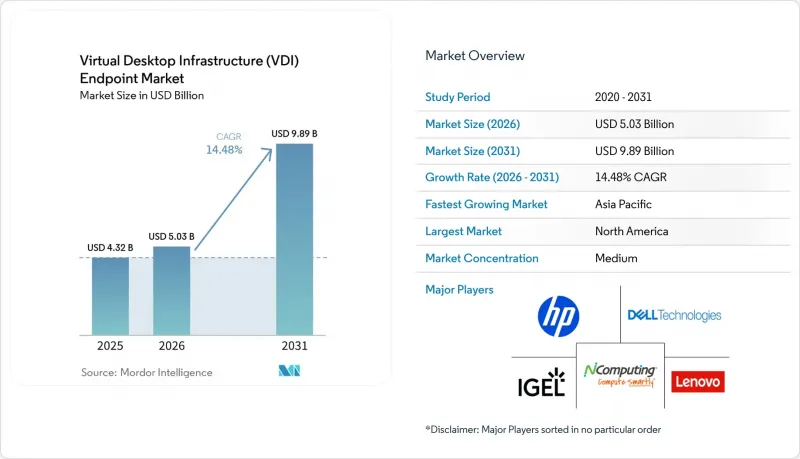
本報告按終端類型(精簡型用戶端、零客戶機、智慧型裝置/PC 等)、部署類型(本地部署、雲端託管、混合式部署)、企業規模(中小企業、大型企業)、產業(IT 和電信、銀行、金融服務和保險、醫療保健、政府等)以及地區進行細分。市場預測以美元計價。
全球虛擬桌面基礎架構 (VDI) 終端市場趨勢與洞察
混合辦公環境的轉型正在加速。
隨著混合辦公模式逐漸成為主流,IT 團隊需要為在家中、分店和第三方地點輪流辦公的員工提供一致且安全的桌面環境。虛擬桌面消除了與 PC 運輸相關的物流挑戰和安全風險,因為應用程式、資料和策略都保留在資料中心內。 2025 年 10 月,微軟為 Azure 虛擬桌面推出了臨時作業系統磁碟。這確保會話主機在每次登出後重置為乾淨的基準狀態,從而降低惡意軟體的持久性並簡化組織的映像管理。平台功能的增強(例如臨時作業系統磁碟)允許管理員在登出時將電腦重設為初始狀態,從而降低惡意軟體的持久性並簡化映像維護。協作性能也提升了。最佳化的轉碼器將媒體處理卸載到終端,即使在住宅寬頻連線下也能確保流暢的視訊會議。客服中心、現場服務團隊和顧問公司等大量合約員工透過共用池輪調使用,他們認為混合辦公模式的直接優勢在於加快了新員工入職速度並減少了服務台諮詢量。
零信任架構中對安全端點的需求
在零信任策略中,小型資料庫成為風險因素,因為需要持續檢驗使用者身分和裝置狀態。透過將整個桌面移轉到託管環境,虛擬桌面基礎架構 (VDI) 可確保敏感資訊保留在企業邊界內,並且所有操作都會被集中記錄。連接仲介和識別及存取管理 (IAM) 服務的整合使得應用上下文感知策略成為可能,從而可以即時阻止來自不合規設備和高風險網路的會話。金融服務公司和政府機構是早期採用者,因為虛擬桌面提供防篡改的審計追蹤,滿足嚴格的監管要求。隨著醫療保健、能源和關鍵基礎設施產業的監管機構強制要求採用零信任架構,虛擬桌面基礎架構終端市場正受益於強制升級。
高昂的初始基礎設施成本
建置本機虛擬桌面環境需要伺服器、儲存陣列、網路設備和虛擬機器管理程式的許可證,使用者才能登入。這對成本敏感型買家來說是一個巨大的障礙。一個典型的 500 用戶 VDI叢集需要 20 萬至 40 萬美元的初始硬體和軟體成本,此外還需要持續支付虛擬機器管理程式支援、儲存擴展以及資料中心電力和冷卻等費用。雖然雲端訂閱協議可以將支出轉移到營運成本,但如果企業員工穩定且員工傾向於長期留任,則月費可能會超過本地環境的攤銷成本。預測公共雲端中運算、儲存和頻寬消耗的波動仍然十分複雜,資源配置不當往往會導致意外費用,並抵銷成本節約。因此,在服務供應商提供虛擬桌面固定費率方案之前,中小企業往往不願意超越概念驗證(PoC) 試點階段。資金籌措計劃、計量收費付費的資料中心設備和託管服務旨在減輕初始投資的負擔,但它們在新興市場的普及速度仍然很慢。
細分市場分析
預計從2026年到2031年,基於軟體的終端將以15.48%的複合年成長率成長,這反映出企業傾向於將現有筆記型電腦和桌上型電腦轉換為虛擬桌面,而不是購買新硬體。即使到了2025年,精簡型用戶端仍將佔據虛擬桌面基礎架構(VDI)終端市場47.87%的佔有率,這主要得益於客服中心、醫療護士站和工廠自助服務終端等應用場景的需求,這些應用場景優先考慮無風扇設計和寬溫耐受範圍。實施轉換工具的企業可以將Windows和macOS筆記型電腦的使用壽命延長至多七年,以避免採購延誤並減少電子廢棄物。隨著人們對基於Linux的終端作業系統的理解不斷加深,使用者接受度正在降低,集中式修補程式管理也緩解了安全隱患。零客戶機仍然是一個小眾市場,主要受到禁止使用本地操作系統的國防機構的青睞,但有限的周邊設備支援阻礙了其發展。行動式精簡型用戶端筆記型電腦和加固型平板電腦正在為現場檢查員和緊急應變人員開闢新的角色,使他們能夠在遠離固定辦公桌的情況下存取虛擬桌面基礎架構 (VDI)。例如,10ZiG 的 7500qTAA 系列產品面向現場技術人員和經常出差的高管,他們需要在無需固定辦公桌的情況下訪問 VDI,同時兼顧便攜性以及符合美國聯邦採購中《貿易協定法》的要求。隨著各組織收緊硬體預算和永續性要求日益嚴格,預計在預測期內,面向軟體轉換設備的虛擬桌面基礎架構 (VDI) 終端市場規模將翻倍。
精簡型用戶端廠商正透過縮小安裝空間、提升多媒體卸載能力以及提供整合瀏覽器容器來滿足這一需求,從而模糊硬體和軟體解決方案之間的界限。自動印表機重定向、相機直通和多因素身份驗證模組正逐漸成為標準功能,縮小了專用設備和改造後的PC之間的功能差距。終端管理主機透過偵測、註冊和推播兩類設備的更新,為管理員提供統一的環境整體情況。這些進步增強了買家的信心,即使採用軟硬體混合策略,支援流程也不會出現碎片化,從而進一步擴大了虛擬桌面基礎架構 (VDI) 終端市場的潛在客戶群。
預計到2025年,本地部署將佔總收入的58.21%。這主要是由於金融服務、製造執行和對延遲敏感的工業控制付費使用制仍然依賴本地資料中心。然而,預計到2031年,雲端託管超大規模資料中心業者正在將身分管理、檔案服務和安全分析捆綁在一起,使即使是小規模團隊也能在數小時內啟動試點環境。雲端訂閱的虛擬桌面基礎架構 (VDI) 終端市場在零售連鎖店、設計工作室和經歷季節性或企劃為基礎需求高峰的專業服務公司中成長最為迅速。
混合架構透過結合本地叢集來應對正常、穩定的負載,並利用雲端爆發來應對高峰需求,從而最佳化成本和合規性。統一的控制平面編配跨站點的鏡像生命週期、使用者分配和遙測數據,從而隱藏了基礎設施的異質性。強制資料屏蔽的法律法規促使一些組織遷移到多重雲端拓撲結構,其中北美員工在本國區域運行虛擬桌面,而歐洲和亞洲的同事則連接到受其所在國家/地區管轄的實例。這種去中心化增加了對能夠抽象化提供者特定細節的策略引擎的需求,進一步推動了虛擬桌面基礎架構 (VDI) 終端市場的創新。
區域分析
預計亞太地區將成為所有地區中成長最快的地區,2026年至2031年的複合年成長率將達到15.26%。這主要得益於「數位印度」計畫、中國的《網路安全法》以及波灣合作理事會(GCC)的「2030願景」等舉措,後者將政府預算重新分配到主權雲端和零信任架構領域。包括微軟計劃於2026年下半年在沙烏地阿拉伯東部啟用的設施在內的新本地雲端區域,將使企業能夠在國內運行對延遲敏感的工作負載,從而加速能源、公共部門和金融服務等行業的終端升級。本地精簡型用戶端組裝和軟體經銷商正受益於公開競標中包含的“在地採購條款”,這為虛擬桌面基礎架構(VDI)終端市場注入了競爭活力。
北美地區在2025年佔全球銷售額的36.43%,憑藉其密集的超大規模超大規模資料中心業者網路、成熟的通路合作夥伴以及各行業的早期應用,持續維持著技術領先地位。紐約的金融機構正在部署支援GPU的虛擬桌面來模擬市場場景,而聯邦機構則強制要求安全設施使用符合《貿易協定法案》的終端設備。儘管採用率成長較為穩定而非爆發式成長,但持續的更新周期使得絕對支出維持在高位。
儘管歐洲的《一般資料保護規則》(GDPR) 建議採用混合部署和本地部署以避免跨境資料傳輸,但德國、法國和北歐國家雲端區域的加速推出正迫使企業遷移到託管桌面。同時,由於電信基礎設施不足和硬體進口關稅高昂,南美和非洲的採用速度較慢,但各國寬頻計畫和數位政府項目正在為虛擬桌面基礎架構 (VDI) 終端市場的未來擴張奠定基礎。
其他好處:
- Excel格式的市場預測(ME)表
- 3個月的分析師支持
目錄
第1章:引言
- 研究假設和市場定義
- 調查範圍
第2章:調查方法
第3章執行摘要
第4章 市場狀況
- 市場概覽
- 市場促進因素
- 加速向混合辦公模式轉型
- 零信任架構中對安全端點的需求
- 透過集中式桌面管理降低成本
- GPU虛擬桌面主流化
- 政府關於數據本地化的法規
- ARM架構精簡型用戶端的興起及其在能源效率方面的提升
- 市場限制因素
- 高昂的初始基礎設施成本
- 新興市場的頻寬限制
- 零客戶端周邊設備相容性的局限性
- VDI端點管理技能差距
- 宏觀經濟因素對市場的影響
- 產業價值鏈分析
- 監理情勢
- 技術展望
- 波特五力分析
第5章 市場規模與成長預測
- 按端點類型
- 精簡型用戶端
- 零客戶端
- 智慧型裝置/個人電腦
- 行動精簡型用戶端
- 基於軟體的終端
- 部署模式
- 現場
- 雲端託管
- 混合
- 按公司規模
- 小型企業
- 大公司
- 按行業分類
- IT/通訊
- BFSI
- 衛生保健
- 政府
- 教育
- 製造業
- 零售
- 其他工業部門
- 按地區
- 北美洲
- 美國
- 加拿大
- 墨西哥
- 南美洲
- 巴西
- 阿根廷
- 其他南美國家
- 歐洲
- 英國
- 德國
- 法國
- 義大利
- 西班牙
- 其他歐洲國家
- 亞太地區
- 中國
- 日本
- 印度
- 韓國
- 其他亞太國家
- 中東和非洲
- 中東
- 阿拉伯聯合大公國
- 沙烏地阿拉伯
- 其他中東國家
- 非洲
- 南非
- 埃及
- 其他非洲國家
- 中東
- 北美洲
第6章 競爭情勢
- 市場集中度
- 策略趨勢
- 市佔率分析
- 公司簡介
- Acer Inc.
- Advantech Co., Ltd.
- Amulet Hotkey Ltd.
- Atrust Computer Corp.
- Centerm Information Co., Ltd.
- ClearCube Technology, Inc.
- Dell Technologies Inc.
- Fujitsu Limited
- HP Inc.
- IGEL Technology GmbH
- Lenovo Group Limited
- LG Electronics Inc.
- NComputing Co., Ltd.
- 10ZiG Technology Inc.
- Parallels International GmbH
- Samsung Electronics Co., Ltd.
- Stratodesk Corporation
- Teradici Corporation
- ThinPrint GmbH
- VXL Instruments Limited
第7章 市場機會與未來展望
According to Mordor Intelligence, the virtual desktop infrastructure endpoint market size was valued at USD 4.32 billion in 2025 and is estimated to grow from USD 5.03 billion in 2026 to reach USD 9.89 billion by 2031, at a CAGR of 14.48% during the forecast period (2026-2031).
This report is Segmented by Endpoint Type (Thin Client, Zero Client, Smart Device/PC, and More), Deployment Mode (On-Premises, Cloud-Hosted, and Hybrid), Enterprise Size (Small and Medium Enterprises, and Large Enterprises), Industry Vertical (IT and Telecom, BFSI, Healthcare, Government, and More), and Geography. The Market Forecasts are Provided in Terms of Value (USD).
Global Virtual Desktop Infrastructure (VDI) Endpoint Market Trends and Insights
Accelerated Shift to Hybrid Work Environments
Hybrid schedules have become an entrenched operating norm, compelling information-technology teams to deliver identical, secure desktops to employees working alternately from home, branch offices, and third-party locations. Virtual desktops eliminate the logistics and security risks of shipping PCs, as applications, data, and policies remain in the data center. Microsoft introduced ephemeral operating-system disks for Azure Virtual Desktop in October 2025, allowing session hosts to reset to a clean baseline after each logoff, reducing persistent malware risk and simplifying image management for organizations. Platform enhancements, such as ephemeral operating-system disks, let administrators reset machines to a pristine state at log-off, reducing malware persistence and simplifying image maintenance. Collaboration performance has also improved; optimized codecs offload media to endpoints, enabling videoconferencing to function smoothly even over residential broadband. Contact centers, field service teams, and consultancies that rotate large numbers of contractors through shared pools cite faster onboarding and lower help-desk volumes as direct benefits of the hybrid-work model.
Demand for Secure Endpoints in Zero Trust Architectures
Zero-trust strategies require continuous verification of user identity and device posture, making local storage a liability. By shifting the entire desktop to a controlled environment, virtual desktop infrastructure ensures that sensitive information remains within the corporate perimeter and that every action is logged centrally. Integration between connection brokers and identity-and-access-management services now allows contextual policies that block sessions from non-compliant devices or risky networks in real time. Financial services firms and public agencies are early adopters because virtual desktops provide tamper-proof audit trails that meet stringent regulatory requirements. As regulators in healthcare, energy, and critical infrastructure specify zero-trust architectures, the virtual desktop infrastructure endpoint market gains from mandated upgrades.
Higher Up-Front Infrastructure Costs
Building an on-premises virtual desktop environment requires servers, storage arrays, networking gear, and hypervisor licenses before the first user signs in, a hurdle that weighs heavily on cost-sensitive buyers. A typical 500-seat VDI cluster requires USD 200,000 to USD 400,000 in initial hardware and software costs, plus ongoing costs for hypervisor support, storage expansion, and datacenter power and cooling.Although cloud subscriptions shift spending to operating expenditure, monthly fees can outpace amortized on-premises costs when organizations have stable, long-tenure workforces. Predicting variable compute, storage, and bandwidth consumption in public clouds remains complex, and mis-sizing often triggers unplanned bills that erode projected savings. Smaller businesses, therefore, hesitate to move past proof-of-concept pilots until service providers package virtual desktops as fixed-price bundles. Financing programs, pay-per-use data center appliances, and managed service offerings aim to smooth the capital hump, yet adoption in emerging markets still lags.
Other drivers and restraints analyzed in the detailed report include:
- Cost Savings From Centralised Desktop Management
- Mainstream Adoption of GPU-Enabled Virtual Desktops
- Bandwidth Limitations in Emerging Economies
For complete list of drivers and restraints, kindly check the Table Of Contents.
Segment Analysis
Software-based endpoints are forecast to grow at a 15.48% CAGR between 2026 and 2031, reinforcing the narrative that organizations prefer converting existing laptops and desktops rather than purchasing new hardware. In 2025, thin clients still commanded 47.87% of the virtual desktop infrastructure endpoint market share, underpinned by call centers, healthcare nursing stations, and factory kiosks that value fanless designs and extended temperature tolerance. Enterprises deploying conversion utilities extend a Windows or macOS laptop's usable life by up to 7 years, sidestepping procurement queues and reducing electronic waste. Growing familiarity with Linux-based endpoint operating systems has lowered user-acceptance barriers, while centralized patching allays security concerns. Zero clients remain niche, favored by defense agencies that forbid local operating systems, though limited peripheral support constrains growth. Mobile thin-client laptops and rugged tablets are carving out roles for field inspectors and emergency responders who need VDI access away from fixed desks. such as 10ZiG's 7500qTAA series, address field technicians and traveling executives who require VDI access without tethering to a desk, combining portability with Trade Agreements Act compliance for United States federal procurement. The virtual desktop infrastructure endpoint market size for software-converted devices is expected to double over the forecast period as organizations tighten hardware budgets and sustainability mandates take hold.
Thin-client vendors are responding with lighter footprints, improved multimedia off-load and integrated browser containers that blur the line between hardware and software solutions. Automatic printer redirection, webcam passthrough, and multi-factor authentication modules now ship as standard, reducing the functional gap between dedicated appliances and repurposed PCs.Endpoint management consoles detect, enroll,l and push updates to both categories, giving administrators a homogeneous fleet view. These advances reinforce buyer confidence that a mixed hardware-software strategy will not fracture support processes, further expanding the addressable pool for the virtual desktop infrastructure endpoint market.
On-premises deployments accounted for 58.21% of revenue in 2025, primarily because financial services, manufacturing execution, and latency-sensitive industrial control workloads remain tied to local data centers. However, cloud-hosted desktops are projected to expand at a 15.08% CAGR through 2031, narrowing the split as consumption-based pricing appeals to businesses lacking internal virtualization talent. Hyperscalers bundle identity management, file services, and security analytics, letting small teams spin up pilots in hours. The virtual desktop infrastructure endpoint market for cloud subscriptions is growing fastest in retail chains, design studios, and professional services firms that experience seasonal or project-based peaks.
Hybrid architectures combine local clusters for baseline steady-state loads with cloud bursting for high-demand periods, optimizing both cost and compliance. Unified control planes orchestrate image lifecycle, user assignments, and telemetry across sites, masking infrastructure heterogeneity. Legal mandates requiring data to remain within national borders are steering some organizations toward multi-cloud topologies, where North American employees run virtual desktops in domestic regions while colleagues in Europe or Asia connect to sovereign instances. Such fragmentation drives demand for policy engines that abstract from provider-specific details, further fueling innovation in the virtual desktop infrastructure endpoint market.
Complete Report Scope:
- By Endpoint Type
- Thin Client
- Zero Client
- Smart Device/PC
- Mobile Thin Client
- Software-based Endpoint
- By Deployment-Mode
- On-premises
- Cloud-hosted
- Hybrid
- By Enterprise Size
- Small and Medium Enterprises
- Large Enterprises
- By Industry Vertical
- IT and Telecom
- BFSI
- Healthcare
- Government
- Education
- Manufacturing
- Retail
- Other Industry Verticals
- By Geography
- North America
- United States
- Canada
- Mexico
- South America
- Brazil
- Argentina
- Rest of South America
- Europe
- United Kingdom
- Germany
- France
- Italy
- Spain
- Rest of Europe
- Asia-Pacific
- China
- Japan
- India
- South Korea
- Rest of Asia-Pacific
- Middle East and Africa
- Middle East
- United Arab Emirates
- Saudi Arabia
- Rest of Middle East
- Africa
- South Africa
- Egypt
- Rest of Africa
- Middle East
- North America
Geography Analysis
Asia-Pacific is projected to register the highest regional CAGR at 15.26% from 2026 to 2031, fueled by Digital India, China's Cybersecurity Law, and Gulf Cooperation Council Vision 2030 initiatives that channel government budgets into sovereign clouds and zero-trust architectures. New local cloud regions, including Microsoft's Saudi Arabia East facility slated for late 2026, will let enterprises run latency-sensitive workloads domestically, spurring endpoint upgrades across energy, public sector, and financial services verticals. Local thin-client assemblers and software resellers benefit from buy-local clauses embedded in public tenders, adding competitive dynamism to the virtual desktop infrastructure endpoint market.
North America, which captured 36.43% of 2025 revenue, maintains a technology leadership position thanks to dense hyperscaler footprints, mature channel partners, and early cross-industry adoption. Financial houses in New York deploy GPU-enabled virtual desktops to model market scenarios, while federal agencies mandate Trade Agreements Act-compliant endpoints for secure facilities. Adoption growth is steadier than spectacular, yet continual refresh cycles keep absolute spending high.
Europe's General Data Protection Regulation encourages hybrid and on-premises deployments to avoid cross-border data transfers, though accelerated cloud region launches in Germany, France, and the Nordics are nudging enterprises toward hosted desktops. Meanwhile, South America and Africa face slower uptake due to under-provisioned connectivity and higher import tariffs on hardware, but targeted national broadband plans and digital government programs are planting the seeds for future expansion in the virtual desktop infrastructure endpoint market.
- Acer Inc.
- Advantech Co., Ltd.
- Amulet Hotkey Ltd.
- Atrust Computer Corp.
- Centerm Information Co., Ltd.
- ClearCube Technology, Inc.
- Dell Technologies Inc.
- Fujitsu Limited
- HP Inc.
- IGEL Technology GmbH
- Lenovo Group Limited
- LG Electronics Inc.
- NComputing Co., Ltd.
- 10ZiG Technology Inc.
- Parallels International GmbH
- Samsung Electronics Co., Ltd.
- Stratodesk Corporation
- Teradici Corporation
- ThinPrint GmbH
- VXL Instruments Limited
Additional Benefits:
- The market estimate (ME) sheet in Excel format
- 3 months of analyst support
TABLE OF CONTENTS
1 INTRODUCTION
- 1.1 Study Assumptions and Market Definition
- 1.2 Scope of the Study
2 RESEARCH METHODOLOGY
3 EXECUTIVE SUMMARY
4 MARKET LANDSCAPE
- 4.1 Market Overview
- 4.2 Market Drivers
- 4.2.1 Accelerated Shift to Hybrid Work Environments
- 4.2.2 Demand for Secure Endpoints in Zero Trust Architectures
- 4.2.3 Cost Savings From Centralised Desktop Management
- 4.2.4 Mainstream Adoption of GPU-enabled Virtual Desktops
- 4.2.5 Government Mandates on Data Localisation
- 4.2.6 Rise of ARM-based Thin Clients for Energy Efficiency
- 4.3 Market Restraints
- 4.3.1 Higher Up-front Infrastructure Costs
- 4.3.2 Bandwidth Limitations in Emerging Economies
- 4.3.3 Limited Peripheral Compatibility in Zero Clients
- 4.3.4 Skills Gap in VDI Endpoint Management
- 4.4 Impact of Macroeconomic Factors on the Market
- 4.5 Industry Value Chain Analysis
- 4.6 Regulatory Landscape
- 4.7 Technological Outlook
- 4.8 Porter's Five Forces Analysis
- 4.8.1 Bargaining Power of Suppliers
- 4.8.2 Bargaining Power of Buyers
- 4.8.3 Threat of New Entrants
- 4.8.4 Threat of Substitutes
- 4.8.5 Intensity of Competitive Rivalry
5 MARKET SIZE AND GROWTH FORECASTS (VALUE)
- 5.1 By Endpoint Type
- 5.1.1 Thin Client
- 5.1.2 Zero Client
- 5.1.3 Smart Device/PC
- 5.1.4 Mobile Thin Client
- 5.1.5 Software-based Endpoint
- 5.2 By Deployment-Mode
- 5.2.1 On-premises
- 5.2.2 Cloud-hosted
- 5.2.3 Hybrid
- 5.3 By Enterprise Size
- 5.3.1 Small and Medium Enterprises
- 5.3.2 Large Enterprises
- 5.4 By Industry Vertical
- 5.4.1 IT and Telecom
- 5.4.2 BFSI
- 5.4.3 Healthcare
- 5.4.4 Government
- 5.4.5 Education
- 5.4.6 Manufacturing
- 5.4.7 Retail
- 5.4.8 Other Industry Verticals
- 5.5 By Geography
- 5.5.1 North America
- 5.5.1.1 United States
- 5.5.1.2 Canada
- 5.5.1.3 Mexico
- 5.5.2 South America
- 5.5.2.1 Brazil
- 5.5.2.2 Argentina
- 5.5.2.3 Rest of South America
- 5.5.3 Europe
- 5.5.3.1 United Kingdom
- 5.5.3.2 Germany
- 5.5.3.3 France
- 5.5.3.4 Italy
- 5.5.3.5 Spain
- 5.5.3.6 Rest of Europe
- 5.5.4 Asia-Pacific
- 5.5.4.1 China
- 5.5.4.2 Japan
- 5.5.4.3 India
- 5.5.4.4 South Korea
- 5.5.4.5 Rest of Asia-Pacific
- 5.5.5 Middle East and Africa
- 5.5.5.1 Middle East
- 5.5.5.1.1 United Arab Emirates
- 5.5.5.1.2 Saudi Arabia
- 5.5.5.1.3 Rest of Middle East
- 5.5.5.2 Africa
- 5.5.5.2.1 South Africa
- 5.5.5.2.2 Egypt
- 5.5.5.2.3 Rest of Africa
- 5.5.5.1 Middle East
- 5.5.1 North America
6 COMPETITIVE LANDSCAPE
- 6.1 Market Concentration
- 6.2 Strategic Moves
- 6.3 Market Share Analysis
- 6.4 Company Profiles (includes Global Level Overview, Market Level Overview, Core Segments, Financials as available, Strategic Information, Market Rank/Share, Products and Services, Recent Developments)
- 6.4.1 Acer Inc.
- 6.4.2 Advantech Co., Ltd.
- 6.4.3 Amulet Hotkey Ltd.
- 6.4.4 Atrust Computer Corp.
- 6.4.5 Centerm Information Co., Ltd.
- 6.4.6 ClearCube Technology, Inc.
- 6.4.7 Dell Technologies Inc.
- 6.4.8 Fujitsu Limited
- 6.4.9 HP Inc.
- 6.4.10 IGEL Technology GmbH
- 6.4.11 Lenovo Group Limited
- 6.4.12 LG Electronics Inc.
- 6.4.13 NComputing Co., Ltd.
- 6.4.14 10ZiG Technology Inc.
- 6.4.15 Parallels International GmbH
- 6.4.16 Samsung Electronics Co., Ltd.
- 6.4.17 Stratodesk Corporation
- 6.4.18 Teradici Corporation
- 6.4.19 ThinPrint GmbH
- 6.4.20 VXL Instruments Limited
7 MARKET OPPORTUNITIES AND FUTURE OUTLOOK
- 7.1 White-Space and Unmet-Need Assessment

 本地部署虛擬桌面市場:全球市場預測,2026-2032年雲端虛擬桌面市場:全球市場預測,2026-2032年桌面雲端融合整合伺服器市場:全球市場預測,2026-2032年
 託管虛擬桌面服務市場規模、佔有率和成長分析(按 VDI 架構、部署方法、企業規模、最終用戶產業和地區分類):產業預測(2026-2033 年)
 虛擬桌面基礎架構 (VDI) 市場規模、佔有率和趨勢分析報告:按組件、VDI 類型、部署模式、企業規模、最終用途、地區和細分市場預測 (2026–2033)
 零客戶端市場規模、佔有率和成長分析:按外形規格、連接協議、最終用戶產業、企業規模、分銷管道和地區分類-2026-2033 年產業預測
 2026年全球虛擬桌面增強器市場報告
 虛擬桌面基礎架構 (VDI) 市場:按組件、組織規模、VDI 類型、交付模式、最終用戶和地區分類
 雲端虛擬桌面基礎架構 (VDI) 市場規模、佔有率、趨勢和預測:按部署類型、最終用戶、產業和地區分類,2026-2034 年2026年全球虛擬桌面基礎架構市場報告