


 |
市場調查報告書
商品編碼
2073091
自願性碳排放:市場佔有率分析、產業趨勢與統計、成長預測(2026-2031 年)Voluntary Carbon - Market Share Analysis, Industry Trends & Statistics, Growth Forecasts (2026 - 2031) |
||||||

※ 本網頁內容可能與最新版本有所差異。詳細情況請與我們聯繫。
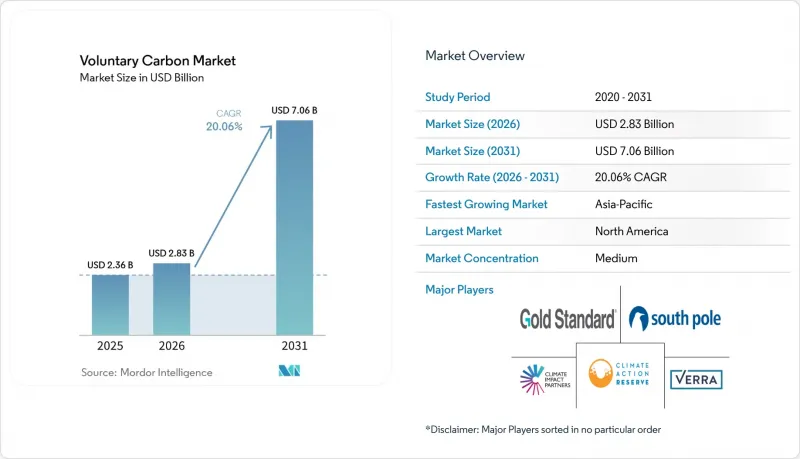
據 Mordor Intelligence 稱,2025 年自願碳市場價值 23.6 億美元,預計將從 2026 年的 28.3 億美元成長到 2031 年的 70.6 億美元,在 2026 年至 2031 年的預測期內,複合年成長率為 20.06%。
本報告按信用類型(減排/規避項目、消除項目)、項目類別(可再生能源項目、林業/土地利用項目、廢棄物管理/甲烷減量項目、其他)、交易類型(現貨交易、其他)、最終用戶產業(能源/公共產業、其他)和地區進行分類。市場預測以美元計價。
全球自願性碳市場趨勢與洞察
企業淨零排放承諾與範圍 3 目標
到2025年,將有超過12,000家公司設定了SBTi認證目標,這將為自願碳市場建立一個廣泛且永續的需求基礎,該需求基礎與正式的脫碳計劃而非可自由支配的支出掛鉤。隨著2030年這一里程碑的臨近,這些承諾正推動碳權額採購納入與供應鏈、產品標籤和投資者溝通相關的管理決策中。由於揭露要求不再局限於直接業務活動,範圍3排放的壓力進一步增加,迫使買家關注上下游活動的剩餘排放。這解釋了自願碳市場中對多年期採購結構的興趣日益濃厚,而非僅與年度報告週期掛鉤的一次性信用額兌換。這也解釋了為什麼買家將獲得可靠的未來供應視為一項策略挑戰,而非短期永續成本。
過渡到可靠的信貸和買家的審查
自願碳市場正朝著多元化方向發展,分為兩類:一類是可用於支持公眾聲明的優質碳權額度,另一類是需接受更嚴格審查的低階碳權額度,審查內容包括額外性和永久性。自2026年1月起,自願碳市場計劃(VCMI)強制要求在做出氣候變遷聲明時,必須使用經碳排放控制夥伴關係(CCP)批准的碳權額度或符合第六條第四款規定的碳權額度,這實際上提高了機構投資者的採購門檻。截至2026年4月,自願碳市場計劃(ICVCM)已批准了九個碳權項目,涵蓋約1.07億個合格CCP標準的碳權額度,擴大了符合更嚴格一致性審查標準的可用碳權額度範圍。此外,ICVCM報告稱,經CCP認證的碳權額度平均溢價約25%,顯示品質對價格形成的影響比以往任何時候都更加顯著。在自願性碳市場中,這增加了傳統「規避型」開發商的壓力,同時增強了擁有可審計且永續投資組合的供應商的地位。
圍繞學分品質、額外性和永久性的爭議
自願碳市場仍然面臨信譽問題,因為學術界和監管機構的審查如今直接影響買家的行為和採購規則。 2026年發表在《自然通訊》上的一項研究強調了森林碳權額系統性過度發行的風險,並指出基準通膨如何削弱已發行信用額的實際氣候效應。 《自然氣候變遷》也在2026年1月發出警告,指出《聯合國氣候變遷綱要公約》(UNFCCC)碳排放交易體系設計中尚未解決的缺陷可能會破壞氣候行動,包括一些獨立分析指出有信用額過度發行重大風險的案例。根據自願碳市場計劃(VCMI)的規則,如果已攤銷的信用額日後未能通過完整性測試,那麼公開宣稱其應對氣候變遷的公司將面臨越來越大的法律和聲譽風險。在自願性碳市場中,這種風險抑制了脆弱的排放需求,同時促使買家傾向於選擇具有更強永久性緩衝和更透明檢驗流程的信用額。
細分市場分析
到2025年,減排和規避項目佔自願碳市場佔有率的69.43%。這表明,目前的交易量仍然嚴重依賴可再生能源、林業、廢棄物和工業能效信用額度。自願碳市場繼續依賴這一廣泛的供應基礎,因為這些信用額度更容易獲得、更容易採購,對於需要立即兌現信用額度的買家來說也更熟悉。隨著更嚴格的審查標準縮小了可用於支持公開聲明的傳統信用額度的選擇範圍,價格環境正在改變。因此,自願碳市場中減排項目的供應商面臨更大的風險,包括品質審查、調查方法的變化以及利潤率的壓力。
預計從2026年到2031年,碳移除計畫將以23.71%的複合年成長率成長,使其成為自願碳排放產業中最具差異化成長的細分市場。隨著永續移除對於僅靠直接排放無法快速減少的殘餘排放變得日益重要,買家正轉向這一領域。據Carbon Direct稱,目前的碳移除市場規模僅800萬噸,遠未達到長期脫碳管道所需的規模。 2026年第一季,95%的已攤銷碳移除額度來自自然解決方案,而來自持久性人工方法的僅佔5%,這凸顯了檢驗的持久性供應的有限性。因此,儘管自願碳排放市場正將重點轉向碳移除,但規模而非需求形成仍然是主要限制因素。
至2025年,可再生能源專案佔自願碳市場規模的39.72%,由於其發行的碳權額度龐大且獲得註冊機構的高度認可,因此仍保持主要項目類別的地位。這些項目仍然支撐著當前自願碳市場的流動性,尤其是在發行成本低且買家需要便利通路進行持續碳權額度贖回的情況下。然而,太陽能和風能計畫的中期前景並不樂觀,因為在這些計畫無需補貼即可實現商業性可行性的市場中,其「額外性」的論證力度有所減弱。因此,計畫選擇的方向正開始轉向那些能夠展現更清晰的氣候影響和更強檢驗邏輯的項目類別。
預計從2026年到2031年,廢棄物管理和甲烷排放計畫將以21.83%的複合年成長率成長,成為自願性碳市場中成長最快的項目類別。甲烷減排專案因其能帶來更直接的氣候效益,且與傳統專案類型相比,買家更容易解釋其影響,因而越來越受到青睞。 2026年第一季,掩埋甲烷碳權達到歷史新高,佔總折舊額的10%,顯示買家對該類別的興趣日益濃厚。農業和藍碳計畫目前規模仍小規模,但2026年第一季,再生農業碳權額按年計算超過500萬份,海洋和紅樹林碳權額達到530萬份。此外,合格CORSIA標準的碳權額度約佔2026年第一季新發行額的50%,顯示航空相關品質標準對此專案類別的需求產生了廣泛影響。
區域分析
預計到2025年,北美將維持37.61%的市場佔有率,在當前的交易環境下,它仍將是規模最大、流動性最強的自願性碳市場。北美專案開發商供應了全球57%的投資合格「BBB+」評級額度,顯示該地區在創造和需求高評級信用額度方面實力雄厚。美國仍是需求的主要驅動力,其企業買家積極參與碳移除承購、結構化融資和大規模排放配額計畫等領域。 2025年5月,CO280和摩根大通達成協議,將在13年內以低於每噸200美元的價格購買45萬噸碳移除權(CDR)。這有助於為紙漿和造紙業的碳人工移除設定更具體的基準。加拿大也因其亞伯達儲存基礎設施和新的直接空氣捕獲(DAC)聯合項目,成為碳人工移除的生產中心,並因此備受關注。
2026年,歐洲佔據了以品質為導向的需求的大部分,歐盟和歐洲經濟區買家持有51%的高評級排放權。這表明,歐洲自願碳市場更多地受到對聲明、評級和揭露風險的嚴格審查的影響,而不是簡單的交易量。該地區在技術清除方面的供應深度也不斷增強,芬蘭Metsä集團在勞馬規劃興建一座商業化木質碳捕集工廠便是例證。這一發展表明,歐洲正開始將區域需求偏好與更可靠的國內清除管道相匹配。
預計到2031年,亞太地區的複合年成長率將達到22.19%,成為自願性碳市場中成長最快的區域。該地區的重要性日益凸顯,這得益於其作為需求中心的崛起,以及專案發現的機遇,並體現在其在未來高可靠性設備跨境核准中不斷擴大的作用。南美洲在供應方面仍然至關重要,尤其是在REDD+和ARR通路。 Silvera指出,南美洲REDD+信用額度的兌換量已經超過了新增供應量。中東和非洲仍然是重要的供應地區,其中非洲供應更多高等級的爐灶和廢棄物信用額度,而海灣國家的買家則透過國家層面的氣候變遷承諾和雙邊碳協議變得更加積極。
其他好處
- Excel格式的市場預測(ME)表
- 3個月的分析師支持
目錄
第1章:引言
- 研究假設和市場定義
- 調查範圍
第2章:調查方法
第3章執行摘要
第4章 市場狀況
- 市場概覽
- 市場促進因素
- 企業淨零排放承諾與範圍 3 目標
- 過渡到可靠的信貸和買家審查
- 數位化MRV、註冊機構間的互通性以及可追溯性工具的擴展。
- 在難以排放的行業中,對永久性碳清除的需求日益成長。
- 信用庫存的期貨合約和結構化融資
- 跨境互認高可靠碳單位取得進展
- 市場限制因素
- 關於信貸的品質、額外性和持久性的爭議
- 標準、註冊規則和法律授權的細分
- 價格波動與避免信貸未來前景的不確定性
- 長期承購合約中的交易對手風險與交付風險
- 監理情勢
- 產業價值鏈分析
- 技術展望
- 波特五力分析
- 宏觀經濟因素對市場的影響
第5章 市場規模與成長預測
- 按信用類型
- 避免並減少項目
- 移除項目
- 按項目類別
- 可再生能源項目
- 林業和土地利用項目
- 廢棄物管理和甲烷減量項目
- 農業項目
- 藍碳項目
- 其他
- 按交易類型
- 現貨交易
- 期貨交易
- 長期取貨合約
- 按最終用戶行業分類
- 能源與公共產業
- 製造業和工業
- 消費品和零售
- 運輸/物流
- 金融服務
- 科技與通訊
- 政府機構
- 非政府組織
- 個人
- 其他
- 按地區
- 北美洲
- 美國
- 加拿大
- 墨西哥
- 南美洲
- 巴西
- 阿根廷
- 智利
- 其他南美國家
- 歐洲
- 德國
- 英國
- 法國
- 義大利
- 西班牙
- 其他歐洲國家
- 亞太地區
- 中國
- 日本
- 印度
- 澳洲
- 韓國
- 新加坡
- 其他亞太國家
- 中東
- 沙烏地阿拉伯
- 阿拉伯聯合大公國
- 土耳其
- 其他中東國家
- 非洲
- 南非
- 埃及
- 奈及利亞
- 其他非洲地區
- 北美洲
第6章 競爭情勢
- 市場集中度
- 策略趨勢
- 市佔率分析
- 公司簡介
- Verra
- Gold Standard Foundation
- Climate Action Reserve
- South Pole
- Climate Impact Partners
- American Carbon Registry
- 3Degrees
- CBL Xpansiv
- Climate Impact X
- CEEZER
- Carbonfuture
- Patch
- Carbonplace
- Sylvera
- Nori
- KlimaDAO
- Allcot Group
- Everland
- Rubicon Carbon
- AirCarbon Exchange
第7章 市場機會與未來展望
According to Mordor Intelligence, the voluntary carbon market was valued at USD 2.36 billion in 2025 and is estimated to grow from USD 2.83 billion in 2026 to USD 7.06 billion by 2031, at a CAGR of 20.06% during the forecast period 2026-2031.
This report is Segmented by Credit Type (Avoidance and Reduction Projects, and Removal Projects), Project Category (Renewable Energy Projects, Forestry and Land Use Projects, Waste Management and Methane Avoidance Projects, and More), Transaction Type (Spot Transactions, and More), End-User Industry (Energy and Utilities, and More), and Geography. The Market Forecasts are Provided in Terms of Value (USD).
Global Voluntary Carbon Market Trends and Insights
Corporate Net-Zero Commitments and Scope 3 Targets
More than 12,000 companies had SBTi-approved targets in 2025, which gives the voluntary carbon market a broad and durable demand base tied to formal decarbonization plans rather than discretionary spending. As 2030 milestones approach, these commitments are pushing carbon credit procurement into operational decisions involving supply chains, product claims, and investor communication. The pressure is greater for Scope 3 emissions because disclosure expectations now reach beyond direct operations and force buyers to look at residual emissions across upstream and downstream activities. This is why the voluntary carbon market is seeing more interest in multi-year purchasing structures instead of one-time retirements linked only to annual reporting cycles. It also helps explain why buyers are treating access to credible future supply as a strategic issue rather than a short-term sustainability expense.
Shift Toward High-Integrity Credits and Buyer Scrutiny
The voluntary carbon market is separating into a premium tier of credits that can support public claims and a lower-priced tier that faces rising scrutiny on additionality and permanence. VCMI required CCP-approved or Article 6.4 credits for climate claims from January 2026, which raised the practical procurement threshold for institutional buyers. ICVCM had approved 9 carbon-crediting programs and covered around 107 million CCP-eligible credits by April 2026, which is expanding the addressable pool of credits that meet stronger integrity screens. ICVCM also reported that CCP-labeled credits were earning an average premium of around 25%, which shows that quality is influencing price formation in a more visible way. In the voluntary carbon market, this raises pressure on legacy avoidance developers while strengthening the position of suppliers with auditable and higher-durability portfolios.
Credit Quality, Additionality, and Permanence Controversies
The voluntary carbon market continues to face trust issues because academic and regulatory scrutiny is now directly affecting buyer behavior and procurement rules. A 2026 Nature Communications study highlighted systematic over-crediting risks in forest carbon credits and showed how baseline inflation can weaken the real climate effect of issued units. Nature Climate Change also warned in January 2026 that unresolved flaws in UNFCCC carbon trading design could undermine climate action, including cases where independent analysis pointed to major over-crediting risk. Under VCMI rules, companies making public climate claims now face greater legal and reputational exposure if retired credits later fail integrity tests. In the voluntary carbon market, that risk is suppressing weaker avoidance demand while shifting buyer preference toward credits with stronger permanence buffers and more transparent verification.
Other drivers and restraints analyzed in the detailed report include:
- Demand for Durable Carbon Removal for Hard-to-Abate Sectors
- Expansion of Digital MRV, Registry Interoperability, and Traceability Tools
- Fragmented Standards, Registry Rules, and Legal Recognition
For complete list of drivers and restraints, kindly check the Table Of Contents.
Segment Analysis
Avoidance and Reduction Projects captured 69.43% of the voluntary carbon market share in 2025, which shows how strongly current trading volumes still depend on renewable energy, forestry, waste, and industrial efficiency credits. The voluntary carbon market continues to rely on this broad supply base because these credits remain more available, easier to source, and more familiar to buyers with immediate retirement needs. Even so, the pricing environment is changing as stronger integrity screens narrow the pool of legacy credits that can support public claims. That is making avoidance suppliers more exposed to quality reviews, methodology changes, and margin pressure in the voluntary carbon market.
Removal Projects are projected to grow at a 23.71% CAGR from 2026 to 2031, which makes them the most differentiated expansion track in the voluntary carbon industry. Buyers are moving in this direction because durable removal is becoming more important for residual emissions that cannot be reduced quickly enough through direct abatement. Carbon Direct stated that the current CDR market stood at 8 million tonnes, which remains far below the scale required for long-term decarbonization pathways. In Q1 2026, 95% of retired CDR credits came from nature-based solutions while high-durability engineered approaches made up only 5% of supply, which underlines how constrained verified durable supply still is. The voluntary carbon market is therefore shifting in favor of removal, but scale-up remains the main constraint rather than demand formation.
Renewable Energy Projects accounted for 39.72% of the voluntary carbon market size in 2025, which kept them in the leading project category because of large credit volumes and broad registry familiarity. These projects still support current liquidity in the voluntary carbon market, especially where issuance costs are lower, and buyers need an accessible supply for ongoing retirement programs. Their medium-term position is less secure because additionality arguments weaken in markets where solar and wind projects are already commercially viable without subsidy. That is starting to reshape project selection toward categories that can show clearer climate impact and stronger verification logic.
Waste Management and Methane Avoidance Projects are projected to grow at a 21.83% CAGR from 2026 to 2031, making them the fastest-growing project category in the voluntary carbon market. Their appeal is rising because methane destruction delivers a more immediate climate effect and is easier for buyers to explain in impact terms than some older project types. Landfill methane credits reached their highest-ever retirement share at 10% of total retirements in Q1 2026, which points to stronger buyer traction for this category. Agriculture and Blue Carbon remained smaller categories, but regenerative agriculture credits surpassed 5 million annualized credits in Q1 2026 and marine and mangrove carbon credits reached 5.3 million. CORSIA-eligible credits also represented nearly 50% of new issuances in Q1 2026, which suggests that aviation-linked quality filters are influencing project category demand more broadly.
Complete Report Scope:
- By Credit Type
- Avoidance and Reduction Projects
- Removal Projects
- By Project Category
- Renewable Energy Projects
- Forestry and Land Use Projects
- Waste Management and Methane Avoidance Projects
- Agriculture Projects
- Blue Carbon Projects
- Other Project Categories
- By Transaction Type
- Spot Transactions
- Forward Transactions
- Long-Term Offtake Agreements
- By End User Industry
- Energy and Utilities
- Manufacturing and Industrial
- Consumer Goods and Retail
- Transportation and Logistics
- Financial Services
- Technology and Telecommunications
- Government Agencies
- Non-Governmental Organizations
- Individuals
- Other End User Industries
- By Geography
- North America
- United States
- Canada
- Mexico
- South America
- Brazil
- Argentina
- Chile
- Rest of South America
- Europe
- Germany
- United Kingdom
- France
- Italy
- Spain
- Rest of Europe
- Asia-pacific
- China
- Japan
- India
- Australia
- South Korea
- Singapore
- Rest of Asia-pacific
- Middle East
- Saudi Arabia
- United Arab Emirates
- Turkey
- Rest of Middle East
- Africa
- South Africa
- Egypt
- Nigeria
- Rest of Africa
- North America
Geography Analysis
North America retained 37.61% market share in 2025, and the region remained the deepest and most liquid voluntary carbon market in current trading conditions. North American project developers supplied 57% of global investment-grade BBB+ issuances, which shows the region's strength in higher-rated credit generation as well as demand. The United States remains the main demand engine because corporate buyers there are active across removal offtake, structured finance, and large retirement programs. CO280 and JPMorganChase agreed in May 2025 on a 450,000 metric tonne CDR offtake over 13 years at under USD 200 per tonne, which helped establish a more concrete benchmark for engineered removals from the pulp and paper pathway. Canada is also gaining visibility as a production hub for engineered removal, supported by Alberta's storage base and new direct air capture collaboration efforts.
Europe accounted for a large share of quality-sensitive demand in 2026, with EU and EEA buyers holding 51% of high-rated retirements. This signals that the voluntary carbon market in Europe is shaped less by raw volume and more by stronger screening of claims, ratings, and disclosure risks. The region is also building more supply-side depth in engineered removal, as shown by Metsa Group's planning work for a commercial wood-based carbon capture plant in Rauma, Finland. That development suggests Europe is starting to align local demand preferences with a more credible domestic removal pipeline.
Asia-Pacific is projected to grow at a 22.19% CAGR through 2031, which gives it the fastest regional expansion rate in the voluntary carbon market. The region is increasingly relevant because it combines rising demand centers with project origination opportunities and a greater role in future cross-border recognition of high-integrity units. South America remains essential on the supply side, especially for REDD+ and ARR pathways, and Sylvera noted that South American REDD+ retirements were already outpacing new supply issuance. Middle East and Africa also remain important supply regions, with Africa contributing more high-rated cookstove and waste credits while Gulf buyers are becoming more active through sovereign climate commitments and bilateral carbon arrangements.
- Verra
- Gold Standard Foundation
- Climate Action Reserve
- South Pole
- Climate Impact Partners
- American Carbon Registry
- 3Degrees
- CBL Xpansiv
- Climate Impact X
- CEEZER
- Carbonfuture
- Patch
- Carbonplace
- Sylvera
- Nori
- KlimaDAO
- Allcot Group
- Everland
- Rubicon Carbon
- AirCarbon Exchange
Additional Benefits:
- The market estimate (ME) sheet in Excel format
- 3 months of analyst support
TABLE OF CONTENTS
1 INTRODUCTION
- 1.1 Study Assumptions and Market Definition
- 1.2 Scope of the Study
2 RESEARCH METHODOLOGY
3 EXECUTIVE SUMMARY
4 MARKET LANDSCAPE
- 4.1 Market Overview
- 4.2 Market Drivers
- 4.2.1 Corporate Net-Zero Commitments and Scope 3 Targets
- 4.2.2 Shift Toward High-Integrity Credits and Buyer Scrutiny
- 4.2.3 Expansion Of Digital MRV, Registry Interoperability, and Traceability Tools
- 4.2.4 Demand for Durable Carbon Removal for Hard-to-Abate Sectors
- 4.2.5 Structured Finance for Forward Offtake and Credit Inventory
- 4.2.6 Emerging Cross-Border Recognition of High-Integrity Carbon Units
- 4.3 Market Restraints
- 4.3.1 Credit Quality, Additionality, and Permanence Controversies
- 4.3.2 Fragmented Standards, Registry Rules, and Legal Recognition
- 4.3.3 Volatile Prices And Weak Forward Visibility for Avoidance Credits
- 4.3.4 Counterparty and Delivery Risk in Long-Dated Offtake Contracts
- 4.4 Regulatory Landscape
- 4.5 Industry Value-Chain Analysis
- 4.6 Technological Outlook
- 4.7 Porter's Five Forces Analysis
- 4.7.1 Bargaining Power of Buyers
- 4.7.2 Bargaining Power of Suppliers
- 4.7.3 Threat of New Entrants
- 4.7.4 Threat of Substitutes
- 4.7.5 Industry Rivalry
- 4.8 Impact of Macroeconomic Factors on the Market
5 MARKET SIZE AND GROWTH FORECASTS (VALUE)
- 5.1 By Credit Type
- 5.1.1 Avoidance and Reduction Projects
- 5.1.2 Removal Projects
- 5.2 By Project Category
- 5.2.1 Renewable Energy Projects
- 5.2.2 Forestry and Land Use Projects
- 5.2.3 Waste Management and Methane Avoidance Projects
- 5.2.4 Agriculture Projects
- 5.2.5 Blue Carbon Projects
- 5.2.6 Other Project Categories
- 5.3 By Transaction Type
- 5.3.1 Spot Transactions
- 5.3.2 Forward Transactions
- 5.3.3 Long-Term Offtake Agreements
- 5.4 By End User Industry
- 5.4.1 Energy and Utilities
- 5.4.2 Manufacturing and Industrial
- 5.4.3 Consumer Goods and Retail
- 5.4.4 Transportation and Logistics
- 5.4.5 Financial Services
- 5.4.6 Technology and Telecommunications
- 5.4.7 Government Agencies
- 5.4.8 Non-Governmental Organizations
- 5.4.9 Individuals
- 5.4.10 Other End User Industries
- 5.5 By Geography
- 5.5.1 North America
- 5.5.1.1 United States
- 5.5.1.2 Canada
- 5.5.1.3 Mexico
- 5.5.2 South America
- 5.5.2.1 Brazil
- 5.5.2.2 Argentina
- 5.5.2.3 Chile
- 5.5.2.4 Rest of South America
- 5.5.3 Europe
- 5.5.3.1 Germany
- 5.5.3.2 United Kingdom
- 5.5.3.3 France
- 5.5.3.4 Italy
- 5.5.3.5 Spain
- 5.5.3.6 Rest of Europe
- 5.5.4 Asia-pacific
- 5.5.4.1 China
- 5.5.4.2 Japan
- 5.5.4.3 India
- 5.5.4.4 Australia
- 5.5.4.5 South Korea
- 5.5.4.6 Singapore
- 5.5.4.7 Rest of Asia-pacific
- 5.5.5 Middle East
- 5.5.5.1 Saudi Arabia
- 5.5.5.2 United Arab Emirates
- 5.5.5.3 Turkey
- 5.5.5.4 Rest of Middle East
- 5.5.6 Africa
- 5.5.6.1 South Africa
- 5.5.6.2 Egypt
- 5.5.6.3 Nigeria
- 5.5.6.4 Rest of Africa
- 5.5.1 North America
6 COMPETITIVE LANDSCAPE
- 6.1 Market Concentration
- 6.2 Strategic Moves
- 6.3 Market Share Analysis
- 6.4 Company Profiles (includes Global Level Overview, Market Level Overview, Core Segments, Financials as available, Strategic Information, Market Rank/Share, Products and Services, Recent Developments)
- 6.4.1 Verra
- 6.4.2 Gold Standard Foundation
- 6.4.3 Climate Action Reserve
- 6.4.4 South Pole
- 6.4.5 Climate Impact Partners
- 6.4.6 American Carbon Registry
- 6.4.7 3Degrees
- 6.4.8 CBL Xpansiv
- 6.4.9 Climate Impact X
- 6.4.10 CEEZER
- 6.4.11 Carbonfuture
- 6.4.12 Patch
- 6.4.13 Carbonplace
- 6.4.14 Sylvera
- 6.4.15 Nori
- 6.4.16 KlimaDAO
- 6.4.17 Allcot Group
- 6.4.18 Everland
- 6.4.19 Rubicon Carbon
- 6.4.20 AirCarbon Exchange
7 MARKET OPPORTUNITIES AND FUTURE OUTLOOK
- 7.1 White-Space And Unmet-Need Assessment

 雲端渲染軟體市場:全球市場預測,2026-2032年
 2026 年至 2035 年合規碳權市場的機會、成長要素、產業趨勢分析與預測。
 雲端渲染碳抵銷市場規模、佔有率和成長分析:按抵消類型、渲染工作負載、雲端部署、碳運算方法、最終用戶和地區分類-2026-2033年產業預測
 2026年全球雲端渲染軟體市場報告雲端渲染碳抵消全球市場報告(2026年)2026年全球智慧電商結帳碳抵銷市場報告
 碳金融服務(CFS)市場規模、佔有率和成長分析:按服務類型、技術平台、部署模式、計劃類型、組織規模、產業和地區分類 - 2026-2033 年產業預測
 全球碳排放交易市場規模、佔有率、趨勢和成長分析報告(2026-2034年)
 碳抵銷市場-全球產業規模、佔有率、趨勢、機會和預測:按類型、計劃類型、最終用戶、地區和競爭格局分類,2021-2031年以數位內容為導向的雲端渲染解決方案市場——按服務類型、渲染技術、內容類型、部署類型和最終用戶產業分類——2026年至2032年全球預測