


 |
市場調查報告書
商品編碼
2073072
IT-OT融合硬體:市場佔有率分析、產業趨勢與統計、成長預測(2026-2031年)IT-OT Convergence Hardware - Market Share Analysis, Industry Trends & Statistics, Growth Forecasts (2026 - 2031) |
||||||

※ 本網頁內容可能與最新版本有所差異。詳細情況請與我們聯繫。
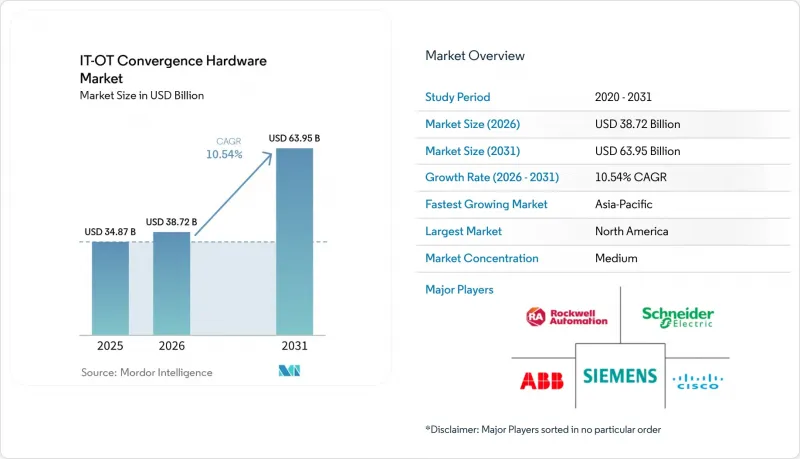
根據 Mordor Intelligence 預測,IT-OT 融合硬體市場預計將從 2025 年的 348.7 億美元成長到 2026 年的 387.2 億美元,到 2031 年達到 639.5 億美元,2026 年至 2031 年的複合年成長率預計為 10.54%。
本報告按組件(工業乙太網交換器和路由器、工業閘道和邊緣設備、其他)、產業(製造業、能源和公共產業、石油和天然氣、其他)、公司規模(大型企業、中小企業)、連接類型(有線、無線)和地區進行細分。市場預測以美元計價。
全球IT-OT融合硬體市場趨勢及洞察
擴大邊緣運算閘道器的部署
邊緣閘道器將運算處理從資料中心轉移到生產線,將往返延遲從 50-100 毫秒降低到 15 毫秒以下,滿足封閉回路型控制系統 20 毫秒以下的延遲要求。美國國家標準與技術實驗室 (NIST) 估計,到 2025 年,離散製造業邊緣計畫的投資報酬率將達到 10-20 倍,主要得益於停機時間的減少和頻寬成本的降低。隨著網路安全和基礎設施安全局 (CISA) 強制要求從 2025 年 12 月起使用加密設備 ID,閘道器供應商目前正在整合可信任平台模組 2.0 (TPM 2.0) 晶片。雙 SIM 卡 5G 無線模組和多埠千兆Gigabit正逐漸成為標準配置,從而實現混合回程傳輸通道,即使一條鏈路發生故障也能維持確定性流量。這些效能和安全性的提升正推動企業轉向分散式智慧架構,優先考慮邊緣硬體而非傳統交換器。
對跨 IT 和 OT 網路的整合網路安全的需求。
新規正在崩壞曾經保護營運技術 (OT) 的傳統「空氣間隙」模式。美國網路安全與基礎設施安全局 (CISA) 於 2025 年 8 月發布的指南強制要求對所有 OT 資產進行持續的被動檢測,並建議使用能夠在不干擾即時控制訊息的情況下檢查工業協議的設備。歐盟的 NIS2 指令對未通報安全事件的行為規定了嚴格的處罰,加速了 18 個關鍵產業的升級。硬體供應商正積極回應,努力獲得 IEC 62443-4-2 認證,其中 Fortinet 強大的防火牆系列是最早獲得認證的產品之一。德國修訂後的 KRITIS 法規將於 2025 年將類似的隔離規則擴展到公共產業和化工廠。這些法規共同作用,將安全功能從選用附加功能提升為核心採購標準。
舊有系統との非互換性と高額な維修コスト
許多工廠仍在運行上世紀90年代安裝的控制器,這些控制器缺少以太網端口,因此在添加閘道器時必須使用協議轉換器,並導致長時間停機。 2025年的一項調查顯示,60%的流程製造商至少維護一個空氣間隙網路,這導致資料分割,使分析變得複雜。根据IEC 61511标准对安全儀器系统进行重新檢驗可能需要6到12个月,导致整合项目被推迟到工厂的计划维护期。 Stuxnet攻擊的持續影響加劇了風險規避,使得經營團隊不願將遺留資產連接到企業網路。這些整合障礙導致人事費用高昂,使總成本比待開發區案加倍。
細分市場分析
邊緣設備因其快速成長而備受關注,年成長率高達 12.72%,但到 2025 年,工業乙太網交換器和路由器將以 31.35% 的市場佔有率主導 IT-OT 融合硬體市場。閘道器現在整合了容器運行時環境,透過在本地運行預測演算法來降低向雲端發送資料的成本。隨著企業採用零信任分段,通過 IEC 62443-4-2 認證的安全設備成為下一個成長最快的細分市場。同時,交換器廠商正透過整合入侵偵測功能來保護其業務基礎架構,但如果無法提供足以支撐溢價的分析功能,將面臨產品同質化的風險。
由於 OPC UA Field eXchange 透過其專有的現場匯流排威脅到廠商的壟斷地位,差異化競爭的重點正轉向網路安全、板載 AI 加速器和產業特定認證。戴尔和惠普企业 (HPE) 都发布了採用三防膠和宽温域的加固型边缘服务器,以扩大其在油田的部署。同時,基於 NVIDIA Jetson 的閘道器表明,機器視覺工作負載正從機架轉移到工廠車間。由此形成了一種多層架構:邊緣硬體即時解析資料流,而確定性交換器則確保對時間敏感的流量實現亞微秒同步,這使得這兩類硬體對於更廣泛的 IT-OT 融合硬體市場至關重要。
儘管製造業預計在2025年仍將保持其在銷售領域的領先地位,市場佔有率為41.27%,但能源和公共產業板塊預計將在2031年超越其他單一行業,實現11.93%的複合年成長率,這主要得益於電網的現代化。確定性乙太網路和抗電磁干擾的強大閘道器對於電動車充電、分散式太陽能併網以及即時數位孿生至關重要。海上油气平台正在使用防爆开关实现防喷系统的数字化,而化工厂则需要使用數位雙胞胎进行安全維修,这使得引入下一代防火墙变得至关重要。
在交通運輸業,港口自動化和鐵路號誌系統的發展推動了設備停機,停機可能會危及生命,因此需要部署SIL-4認證的設備。医疗机构将建築自動化与制药生产相结合,实现持续的环境监测,以满足FDA 21 CFR Part 11的审核要求。采矿业正在应用自动驾驶运输系统,高海拔矿井对能够在零下温度下可靠运行的工業用電腦的需求日益增长。儘管IT-OT融合硬體的市場佔有率因行業而異,取決於合規要求和延遲接受度,但向數位雙胞胎的全面轉型正在逐步擴大各行業的硬體部署規模。
區域分析
預計到2025年,北美將佔全球銷售額的35.19%,主要得益於汽車、航太和食品加工產業叢集強勁的自動化需求。聯邦政府根據《基礎設施投資與就業法案》提供的資金正在支持電網現代化項目,而網路安全和基礎設施安全局(CISA)的指導意見正在加速安全升級。加拿大礦業和墨西哥加工出口區(maquiladoras)的發展勢頭也日益強勁,儘管勞動力短缺推高了實施成本。政策支持和产业需求的双重推动预计将继续巩固该地区在先进网络部署领域的主導地位。
亞太地區預計年複合成長率將達到12.26%,受益於中國智慧製造的稅收優惠政策和印度與生產掛鉤的補貼政策(最高可報銷符合條件的硬體支出的一半)。在日本,「工業5.0」舉措正推動企業克服人口結構變化帶來的不利影響,積極採用智慧製造技術;而在韓國,機器人技術的廣泛應用正在彌補勞動力短缺。東南亞的電子產品出口國,例如越南和泰國,也正在投資建設確定性網路骨幹網,以滿足一級供應商的需求。強而有力的政府支持和出口導向製造業生態系統進一步鞏固了該地區的快速成長動能。
在歐洲,儘管能源價格波動抑制了成長,但成長仍保持在個位數中段的穩定水準。德國修訂後的KRITIS法規和法國的「未來工業」計畫正在推動非分段交換機的現代化。在中東,大量資金正湧入石化產業的數位化和智慧城市項目,利用主權財富來徹底改變傳統的架構。在南美洲,資金限制依然存在,但巴西礦業公司正在主導選擇性升級。同時,非洲的採用主要集中在南非的深層金礦和埃及新興的製造業走廊。區域政策框架和基礎設施優先事項繼續塑造著不均衡但不斷演變的採用模式。
其他好處
- Excel格式的市場預測(ME)表
- 3個月的分析師支持
目錄
第1章:引言
- 研究假設和市場定義
- 調查範圍
第2章:調查方法
第3章執行摘要
第4章 市場狀況
- 市場概覽
- 市場促進因素
- 邊緣運算閘道器的廣泛應用
- 對跨 IT 和 OT 網路的整合網路安全的需求。
- スマートファクトリーにおける工業IoTプラットフォームの拡大
- 5G專用網路在製造工廠的普及
- 預測性維護分析中的整合要求
- 政府激勵措施用於數位基礎設施現代化
- 市場限制因素
- 與舊有系統缺乏相容性,且維修成本高。
- IT-OT整合工程領域的技能差距
- データの所有者と管治に関する懸念
- 宏觀經濟放緩正在延緩資本投資週期。
- 產業價值鏈分析
- 監理情勢
- 技術展望
- 宏觀經濟因素對市場的影響
- 產業吸引力—五力分析
- 新進入者的威脅
- 買方的議價能力
- 供應商的議價能力
- 替代品的威脅
- 競爭公司之間的競爭
- 價格分析
第5章 市場規模與成長預測
- 按組件
- 工業乙太網交換器和路由器
- 工業閘道器和邊緣設備
- 工業用電腦、サーバー、HMI
- 網路安全設備
- 其他
- 按行業
- 製造業
- 能源與公共產業
- 石油和天然氣
- 運輸/物流
- 醫療保健和生命科學
- 礦業
- 其他行業領域
- 按組織規模
- 大公司
- 小型企業
- 透過連接方式
- 有線
- 無線的
- 按地區
- 北美洲
- 美國
- 加拿大
- 墨西哥
- 南美洲
- 巴西
- 阿根廷
- 其他南美國家
- 歐洲
- 德國
- 英國
- 法國
- 義大利
- 西班牙
- 俄羅斯
- 其他歐洲國家
- 亞太地區
- 中國
- 日本
- 韓國
- 印度
- 澳洲和紐西蘭
- 其他亞太國家
- 中東
- 沙烏地阿拉伯
- 阿拉伯聯合大公國
- 土耳其
- 其他中東國家
- 非洲
- 南非
- 埃及
- 其他非洲地區
- 北美洲
第6章 競爭情勢
- 市場集中度
- 策略趨勢
- 市佔率分析
- 公司簡介
- Cisco Systems Inc.
- Siemens AG
- Schneider Electric SE
- Rockwell Automation Inc.
- ABB Ltd.
- Belden Inc.
- Moxa Inc.
- Advantech Co. Ltd.
- HMS Networks AB
- Huawei Technologies Co. Ltd.
- Juniper Networks Inc.
- Fortinet Inc.
- Palo Alto Networks Inc.
- Dell Technologies Inc.
- Hewlett Packard Enterprise Company
- Phoenix Contact GmbH and Co. KG
- Delta Electronics Inc.
- Hirschmann Automation and Control GmbH
- Check Point Software Technologies Ltd.
- Trend Micro Inc.
第7章 市場機會與未來展望
According to Mordor Intelligence, the IT-OT convergence hardware market size is expected to increase from USD 34.87 billion in 2025 to USD 38.72 billion in 2026 and reach USD 63.95 billion by 2031, growing at a CAGR of 10.54% over 2026-2031.
This report is Segmented by Component (Industrial Ethernet Switches and Routers, Industrial Gateways and Edge Devices, and More), Industry Vertical (Manufacturing, Energy and Utilities, Oil and Gas, and More), Organization Size (Large Enterprises, and Small and Medium-Sized Enterprises), Connectivity (Wired, and Wireless), and Geography. The Market Forecasts are Provided in Terms of Value (USD).
Global IT-OT Convergence Hardware Market Trends and Insights
Rising Adoption of Edge Computing Gateways
Edge gateways relocate compute from data centers to production lines, cutting round-trip latency from 50-100 milliseconds to below 15 milliseconds, aligning with the sub-20-millisecond limits of closed-loop control systems. The National Institute of Standards and Technology estimated a 10-20X return on investment for discrete-manufacturing edge projects in 2025, primarily through reduced downtime and lower bandwidth costs. Gateway vendors now integrate Trusted Platform Module 2.0 chips after the Cybersecurity and Infrastructure Security Agency started requiring cryptographic device identity in December 2025. Dual-SIM 5G radios plus multi-port Gigabit Ethernet are becoming baseline specifications, enabling hybrid backhaul paths that sustain deterministic traffic even if one link fails. These performance and security improvements collectively push enterprises toward distributed intelligence architectures that favor edge hardware over legacy switches.
Demand for Unified Cybersecurity Across IT and OT Networks
New regulations are collapsing the traditional air gap that once protected operational technology. CISA's August 2025 guidance compels continuous, passive discovery of every OT asset, rewarding appliances that inspect industrial protocols without disturbing real-time control messages. The European Union's NIS2 Directive introduced stiff fines for failures to report incidents, accelerating upgrades across 18 critical sectors. Hardware vendors responded by earning IEC 62443-4-2 certification; Fortinet's rugged firewall series is one early example. Germany's updated KRITIS regulation extended similar segmentation rules to utilities and chemical plants in 2025. Together, these mandates elevate security capabilities from optional add-ons to core purchase criteria.
Legacy System Incompatibility and High Retrofit Costs
Many plants still operate controllers installed in the 1990s that lack Ethernet ports, forcing the use of protocol converters and long shutdowns when adding gateways. A 2025 survey found that 60% of process manufacturers maintain at least one air-gapped network, fragmenting data and complicating analytics. Safety-instrumented system revalidation under IEC 61511 can stretch 6-12 months, effectively deferring convergence projects until scheduled plant turnarounds. The lingering influence of the Stuxnet attack reinforces a risk-averse mindset, making executives hesitant to connect legacy assets to corporate networks. These integration hurdles add premium labor costs and double the total expense compared with greenfield deployments.
Other drivers and restraints analyzed in the detailed report include:
- Expansion of Industrial IoT Platforms in Smart Factories
- Mainstreaming of 5G Private Networks in Manufacturing Plants
- Skills Gap in IT-OT Integration Engineering
For complete list of drivers and restraints, kindly check the Table Of Contents.
Segment Analysis
Edge devices commanded the growth spotlight, expanding at 12.72% a year, whereas industrial Ethernet switches and routers delivered a dominant 31.35% share of the IT-OT convergence hardware market size in 2025. Gateways now bundle container runtime environments, allowing predictive algorithms to run locally and cut cloud egress costs. Security appliances certified to IEC 62443-4-2 are the next high-velocity line as enterprises adopt zero-trust segmentation. Switch vendors, meanwhile, defend their franchises by embedding intrusion-detection functions, although commoditization risk looms if they fail to add analytics that justify price premiums.
OPC UA Field eXchange threatens proprietary fieldbus lock-in, so differentiation is tilting toward cybersecurity, onboard AI accelerators, and vertical certifications. Dell and Hewlett-Packard Enterprise both released rugged edge servers with conformal coating and extended temperature support to penetrate oilfield deployments. At the same time, NVIDIA Jetson-powered gateways illustrate how machine-vision workloads are migrating from racks to the factory floor. The result is a layered architecture in which edge hardware interprets data streams in real time while deterministic switches guarantee sub-microsecond synchronization for time-critical traffic, keeping both categories indispensable to the broader IT-OT convergence hardware market.
Manufacturing retained the revenue lead with 41.27% share in 2025, but grid modernization is pushing energy and utilities to record an 11.93% CAGR through 2031, outpacing discrete industries. Electric-vehicle charging, distributed solar in-feed, and real-time digital twins require deterministic Ethernet and hardened gateways able to withstand electromagnetic interference. Oil and gas offshore platforms are digitizing blowout preventers with explosion-proof switches, while chemical plants face KRITIS-driven security retrofits that dictate next-generation firewalls.
Transportation, driven by port automation and rail signaling, orders SIL-4 certified equipment where downtime risks human life. Healthcare facilities converge building automation with pharmaceutical production for continuous environmental monitoring that satisfies FDA 21 CFR Part 11 audits. Mining operations embrace autonomous haulage, and their high-altitude sites create demand for industrial PCs that operate reliably below freezing. Across each vertical, the IT-OT convergence hardware market share fluctuates by compliance burden and latency tolerance, yet the overarching migration toward digital twins ensures every sector incrementally widens its hardware footprint.
Complete Report Scope:
- By Component
- Industrial Ethernet Switches and Routers
- Industrial Gateways and Edge Devices
- Industrial PCs, Servers, and HMIs
- Network Security Appliances
- Other Components
- By Industry Vertical
- Manufacturing
- Energy and Utilities
- Oil and Gas
- Transportation and Logistics
- Healthcare and Lifesciences
- Mining
- Other Industry Verticals
- By Organization Size
- Large Enterprises
- Small and Medium-Sized Enterprises
- By Connectivity
- Wired
- Wireless
- By Geography
- North America
- United States
- Canada
- Mexico
- South America
- Brazil
- Argentina
- Rest of South America
- Europe
- Germany
- United Kingdom
- France
- Italy
- Spain
- Russia
- Rest of Europe
- Asia-Pacific
- China
- Japan
- South Korea
- India
- Australia and New Zealand
- Rest of Asia-Pacific
- Middle East
- Saudi Arabia
- United Arab Emirates
- Turkey
- Rest of Middle East
- Africa
- South Africa
- Egypt
- Rest of Africa
- North America
Geography Analysis
North America generated 35.19% of 2025 revenue thanks to robust automation demand across automotive, aerospace, and food processing clusters. Federal funding from the Infrastructure Investment and Jobs Act underwrites grid-modernization projects, while Cybersecurity and Infrastructure Security Agency (CISA) guidance accelerates security upgrades. Canadian mining and Mexican maquiladoras add further momentum, though talent shortages inflate deployment costs. This combination of policy support and industrial demand continues to anchor the region's leadership in advanced networking deployments.
Asia-Pacific, projected at a 12.26% CAGR, benefits from China's intelligent-manufacturing tax incentives and India's production-linked subsidies that reimburse up to half of qualifying hardware spend. Japan's Society 5.0 initiative nudges enterprise uptake despite demographic headwinds, and South Korea offsets labor scarcity with aggressive robotics adoption. Southeast Asian electronics exporters in Vietnam and Thailand also invest in deterministic network backbones to comply with Tier-1 supplier requirements. Strong government backing and export-oriented manufacturing ecosystems further reinforce the region's rapid growth trajectory.
Europe maintains steady, mid-single-digit growth held back by energy price volatility, yet Germany's updated KRITIS rules and France's "Industrie du Futur" program stimulate replacements of non-segmented switches. The Middle East funds petrochemical digitization and smart-city initiatives, using sovereign wealth resources to leapfrog legacy architectures. South America remains currency-constrained, with Brazil's mining firms leading selective upgrades, while Africa's adoption is concentrated in South Africa's deep-level gold mines and Egypt's emerging manufacturing corridor. Regional policy frameworks and infrastructure priorities continue to shape uneven but progressing adoption patterns.
- Cisco Systems Inc.
- Siemens AG
- Schneider Electric SE
- Rockwell Automation Inc.
- ABB Ltd.
- Belden Inc.
- Moxa Inc.
- Advantech Co. Ltd.
- HMS Networks AB
- Huawei Technologies Co. Ltd.
- Juniper Networks Inc.
- Fortinet Inc.
- Palo Alto Networks Inc.
- Dell Technologies Inc.
- Hewlett Packard Enterprise Company
- Phoenix Contact GmbH and Co. KG
- Delta Electronics Inc.
- Hirschmann Automation and Control GmbH
- Check Point Software Technologies Ltd.
- Trend Micro Inc.
Additional Benefits:
- The market estimate (ME) sheet in Excel format
- 3 months of analyst support
TABLE OF CONTENTS
1 INTRODUCTION
- 1.1 Study Assumptions and Market Definition
- 1.2 Scope of the Study
2 RESEARCH METHODOLOGY
3 EXECUTIVE SUMMARY
4 MARKET LANDSCAPE
- 4.1 Market Overview
- 4.2 Market Drivers
- 4.2.1 Rising Adoption of Edge Computing Gateways
- 4.2.2 Demand for Unified Cybersecurity across IT and OT Networks
- 4.2.3 Expansion of Industrial IoT Platforms in Smart Factories
- 4.2.4 Mainstreaming of 5G Private Networks in Manufacturing Plants
- 4.2.5 Convergence Requirements for Predictive Maintenance Analytics
- 4.2.6 Government Incentives for Digital Infrastructure Modernization
- 4.3 Market Restraints
- 4.3.1 Legacy System Incompatibility and High Retrofit Costs
- 4.3.2 Skills Gap in IT-OT Integration Engineering
- 4.3.3 Data Ownership and Governance Concerns
- 4.3.4 Macroeconomic Slowdowns Delaying Capex Cycles
- 4.4 Industry Value Chain Analysis
- 4.5 Regulatory Landscape
- 4.6 Technological Outlook
- 4.7 Impact of Macroeconomic Factors on the Market
- 4.8 Industry Attractiveness - Porter's Five Forces Analysis
- 4.8.1 Threat of New Entrants
- 4.8.2 Bargaining Power of Buyers
- 4.8.3 Bargaining Power of Suppliers
- 4.8.4 Threat of Substitutes
- 4.8.5 Intensity of Competitive Rivalry
- 4.9 Pricing Analysis
5 MARKET SIZE AND GROWTH FORECASTS (VALUE)
- 5.1 By Component
- 5.1.1 Industrial Ethernet Switches and Routers
- 5.1.2 Industrial Gateways and Edge Devices
- 5.1.3 Industrial PCs, Servers, and HMIs
- 5.1.4 Network Security Appliances
- 5.1.5 Other Components
- 5.2 By Industry Vertical
- 5.2.1 Manufacturing
- 5.2.2 Energy and Utilities
- 5.2.3 Oil and Gas
- 5.2.4 Transportation and Logistics
- 5.2.5 Healthcare and Lifesciences
- 5.2.6 Mining
- 5.2.7 Other Industry Verticals
- 5.3 By Organization Size
- 5.3.1 Large Enterprises
- 5.3.2 Small and Medium-Sized Enterprises
- 5.4 By Connectivity
- 5.4.1 Wired
- 5.4.2 Wireless
- 5.5 By Geography
- 5.5.1 North America
- 5.5.1.1 United States
- 5.5.1.2 Canada
- 5.5.1.3 Mexico
- 5.5.2 South America
- 5.5.2.1 Brazil
- 5.5.2.2 Argentina
- 5.5.2.3 Rest of South America
- 5.5.3 Europe
- 5.5.3.1 Germany
- 5.5.3.2 United Kingdom
- 5.5.3.3 France
- 5.5.3.4 Italy
- 5.5.3.5 Spain
- 5.5.3.6 Russia
- 5.5.3.7 Rest of Europe
- 5.5.4 Asia-Pacific
- 5.5.4.1 China
- 5.5.4.2 Japan
- 5.5.4.3 South Korea
- 5.5.4.4 India
- 5.5.4.5 Australia and New Zealand
- 5.5.4.6 Rest of Asia-Pacific
- 5.5.5 Middle East
- 5.5.5.1 Saudi Arabia
- 5.5.5.2 United Arab Emirates
- 5.5.5.3 Turkey
- 5.5.5.4 Rest of Middle East
- 5.5.6 Africa
- 5.5.6.1 South Africa
- 5.5.6.2 Egypt
- 5.5.6.3 Rest of Africa
- 5.5.1 North America
6 COMPETITIVE LANDSCAPE
- 6.1 Market Concentration
- 6.2 Strategic Moves
- 6.3 Market Share Analysis
- 6.4 Company Profiles (includes Global Level Overview, Market Level Overview, Core Segments, Financials as available, Strategic Information, Market Rank/Share, Products and Services, Recent Developments)
- 6.4.1 Cisco Systems Inc.
- 6.4.2 Siemens AG
- 6.4.3 Schneider Electric SE
- 6.4.4 Rockwell Automation Inc.
- 6.4.5 ABB Ltd.
- 6.4.6 Belden Inc.
- 6.4.7 Moxa Inc.
- 6.4.8 Advantech Co. Ltd.
- 6.4.9 HMS Networks AB
- 6.4.10 Huawei Technologies Co. Ltd.
- 6.4.11 Juniper Networks Inc.
- 6.4.12 Fortinet Inc.
- 6.4.13 Palo Alto Networks Inc.
- 6.4.14 Dell Technologies Inc.
- 6.4.15 Hewlett Packard Enterprise Company
- 6.4.16 Phoenix Contact GmbH and Co. KG
- 6.4.17 Delta Electronics Inc.
- 6.4.18 Hirschmann Automation and Control GmbH
- 6.4.19 Check Point Software Technologies Ltd.
- 6.4.20 Trend Micro Inc.
7 MARKET OPPORTUNITIES AND FUTURE OUTLOOK
- 7.1 White-Space and Unmet-Need Assessment

