


 |
市場調查報告書
商品編碼
2073058
小型外形規格(SFF)個人電腦:市場佔有率分析、行業趨勢和統計數據以及成長預測(2026-2031 年)Small Form Factor (SFF) PC - Market Share Analysis, Industry Trends & Statistics, Growth Forecasts (2026 - 2031) |
||||||

※ 本網頁內容可能與最新版本有所差異。詳細情況請與我們聯繫。
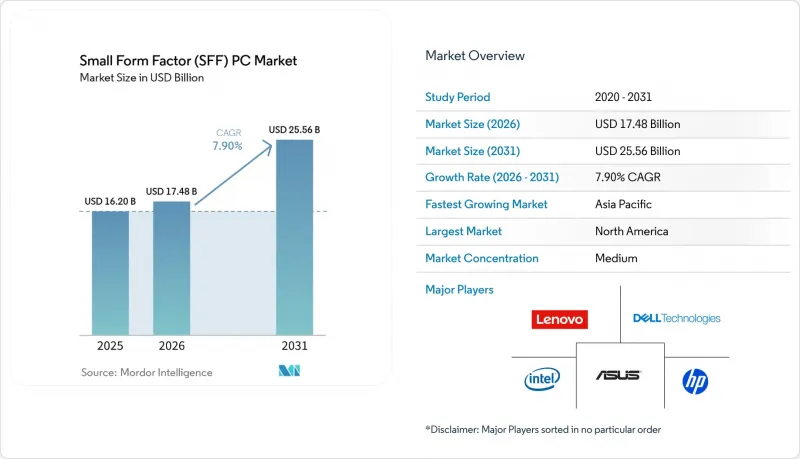
根據 Mordor Intelligence 預測,外形規格PC 的市場規模預計將從 2025 年的 162 億美元成長到 2026 年的 174.8 億美元,到 2031 年達到 255.6 億美元,2026 年至 2031 年的複合年預計成長率為 7.9%。
本報告外形規格(迷你塔式電腦、小型電腦、超外形規格電腦及其他)、組件(CPU、GPU、主機板、記憶體、儲存及其他)、最終用戶(普通消費者、商業辦公室、工業/製造業及其他)、分銷管道(電子商務、零售商店、B2B直銷及其他)和地區進行細分。市場預測以美元計價。
全球小型外形規格(SFF)PC市場趨勢與洞察
疫情後,人們對在家工作環境的需求增加。
隨著混合辦公模式的興起,在兩個地點辦公已成為常態,員工傾向於選擇既能節省桌面空間又不犧牲效能的系統。小型外形規格(SFF) PC 將高效能 CPU 和整合式顯示卡整合到僅 2 公升的機殼內,既能在家中使用多顯示器 4K 環境高效辦公,又能保持足夠的便攜性,方便在辦公室進行無固定辦公桌。企業 IT 部門更青睞這類機器,因為與傳統塔式 PC 相比,它們可以降低運輸、儲存和散熱成本。此外,在家使用小型桌上型電腦的員工往往也希望在職場使用類似的硬體,這推動了對迷你塔式和超小型 PC 升級的需求。
PC遊戲和電子競技的日益普及
在競技遊戲領域,體積小巧、機殼容積不超過3公升的系統被廣泛採用,這些系統整合了桌上型處理器和RTX系列GPU。 NVIDIA 2024年發布的外形規格指南對GPU的長度、高度和功耗設定了上限,旨在簡化SFF(小型外形規格)系統的設計,使用戶能夠選擇高效能顯示卡,而無需依賴散熱設計方面的猜測。這些輕巧的系統被廣泛應用於電競場館,以降低運輸成本和搭建時間;同時,內容創作者也非常青睞它們提供的額外桌面空間,方便放置直播設備。隨著WiFi 7的快速普及,可攜式遊戲桌上型電腦的效用更加凸顯,因為塔式PC失去了最後的優勢:有線連接。
與全塔式PC相比,升級柔軟性有限。
小型主機板、外部電源適配器和焊接式記憶體限制了使用者對儲存裝置和部分SO-DIMM記憶體條的升級,如果想要顯著提升效能,則必須更換整個系統。對於教育機構和小型企業而言,GPU和CPU的快速發展意味著,如果需要建立新系統,總成本會高於僅更換單一組件。在進口關稅較高的地區,整機更換的成本往往會阻礙人們採用旨在長期使用的小型硬體。
細分市場分析
在數位電子看板網路中,迷你電腦棒(stick PC)正以10.9%的複合年成長率(CAGR)呈現最快成長外形規格,因為它們無需單獨的機殼,只需將HDMI介面的設備直接連接到顯示器即可。相關的外形規格PC市場受惠於USB供電的無風扇設計,並支援POS終端機和會議室投影機的4K播放。迷你塔式電腦(mini-tower PC)由於企業對免工具維護和全高PCIe插槽的需求,預計到2025年將佔37.2%的銷售額,但隨著散熱性能的提升,其市場佔有率預計將逐漸被超小型機型取代。超小型和加固型機型正在增強交通運輸和製造業的邊緣分析節點,其抗震機殼和更寬的工作溫度範圍帶來了更高的利潤率。
伺服器級創新技術正逐漸滲透到消費級立方體PC中,使得65瓦的桌上型CPU能夠與筆記型電腦等級的RTX GPU共存。這使得遊戲玩家可以組裝重量不到3公斤、支援區域網路功能的PC。雖然棒狀外形規格PC在以金額為準方面仍佔市場佔有率較小,但在銷售方面卻佔據主導地位。這主要歸功於教育機構大量採購此類設備,將舊顯示器改造成類似Chromebox的終端。在醫療推車和醫院影像室中,體積小於1.5公升的桌上型電腦正逐漸被取代,這些電腦可以安裝在顯示器後面,從而避免走廊裡出現塔式機殼,並展現了成熟散熱解決方案所支援的應用的多功能性。
預計GPU出貨量將以每年11.1%的速度成長,超過整個系統的平均成長率,主要得益於獨立顯示卡和焊接式加速器在遊戲和AI邊緣節點領域的應用日益廣泛。整合外形規格的小型PC市場受益於NVIDIA的「SFF-Ready」計劃,該計劃限制了顯示卡的長度和功耗,並確保其能夠直接安裝到mini-ITX機箱中。 CPU銷售額仍佔材料清單(BOM)的23.8%,但隨著整合NPU將AI推理處理從中央核心分流出去,其成長速度正在放緩。隨著平台功率密度的提高,DDR5 SO-DIMM記憶體、PCIe 5.0 NVMe固態硬碟和小型GaN電源轉接器的佔有率正在擴大,而採用無風扇配置的高階主機也開始將固態AirJet散熱器納入物料清單。
組件供應商正受益於整個系統配置的改變。超小型PC主機板整合了Wi-Fi 7、雙2.5Gigabit乙太網路和Thunderbolt 4介面,儘管PCB尺寸較小,但平均售價(ASP)卻因此上漲。供應商也正在大力推廣用於遊戲主機的330瓦外置電源轉接器,透過銷售高利潤配件來提高單機毛收入。隨著CHIPS資助的晶圓廠推動供應鏈在地化,北美和日本的記憶體製造商可能會縮短小型化OEM廠商的前置作業時間,以幫助他們避免地緣政治風險。
區域分析
預計到2025年,亞太地區將佔全球銷售額的37.7%,並預計在2031年之前以11.3%的年均成長率成長,這主要得益於日本和台灣的半導體激勵政策、深圳和台北OEM廠商的集中以及印度可支配收入的成長。稅額扣抵正在推動本地組裝的迷你電腦發展,縮短供應鏈,並減少區域買家的前置作業時間。像MINISFORUM這樣的中國品牌正在利用深圳的生態系統,每季改進其產品設計,並以比跨國公司低20%的價格提供產品,從而提高其在國內市場的滲透率。儘管零件進口存在關稅,但印度公共服務和IT外包的數位化蓬勃發展正在推動客服中心和編碼中心對小型桌上型電腦的需求。
在北美,由於《晶片和儲存設備法案》(CHIPS Act)的資助,CPU和DRAM的生產實現了在地化,降低了來自亞洲的供應中斷風險,使其在企業設備更新周期中佔據主導地位。在美國,老舊的塔式電腦正被迷你桌上型電腦取代,以降低能源成本並更有效地利用辦公空間;教育機構也開始在實驗室引進類似Chromebook的迷你電腦。加拿大的銀行和政府機構也出現了類似的趨勢。由於能源效率法規的限制,消費者傾向選擇符合能源之星8.0標準且待機功耗低的產品。
歐洲的普及速度持續穩定提升,德國、法國和英國優先組裝、符合綠色採購標準且支援廢棄電子電氣設備(WEEE)回收義務的小型電腦。英國2025年的監理改革將取消小型電子設備的生產者責任成本,迫使供應商最佳化包裝和回收物流。在歐盟數位化津貼下,南歐和東歐國家正選擇環保小型機殼(SFF)進行工廠設備升級,而北歐國家則在採用零碳辦公空間方面處於領先地位,這些空間整合了由可再生能源微電網供電的無風扇桌上型電腦。
南美洲、中東和非洲在外形規格PC市場中所佔佔有率雖小,但正穩步成長。巴西政府正在採購低功耗迷你PC,以降低學校的能源成本。沙烏地阿拉伯和阿拉伯聯合大公國正在為智慧城市資訊亭和監控系統部署邊緣分析節點,但由於依賴進口組件,它們容易受到運輸波動的影響。奈及利亞和肯亞正在投資建造採用緊湊型桌上型電腦的共同工作中心,這些中心傾向於使用低功耗硬體作為備用電源系統,但不穩定的電網給大規模部署帶來了挑戰。
其他好處
- Excel格式的市場預測(ME)表
- 3個月的分析師支持
目錄
第1章:引言
- 研究假設和市場定義
- 調查範圍
第2章:調查方法
第3章執行摘要
第4章 市場狀況
- 市場概覽
- 市場促進因素
- 疫情後,人們對在家工作環境的需求增加。
- PC遊戲和電子競技的日益普及
- 高效能、低功耗組件的進步
- 企業向節省空間的IT基礎設施轉型
- 各OEM廠商對內建顯示器數位電子看板的採用情況
- 政府獎勵用於促進國內邊緣運算硬體的生產。
- 市場限制因素
- 與全塔式PC相比,升級柔軟性較低。
- 緊湊型底盤的溫度控管挑戰
- 高密度元件價格溢價
- 微型化系統中遵守電子廢棄物法規的成本增加
- 宏觀經濟因素對市場的影響
- 產業價值/價值鏈分析
- 監理情勢
- 技術展望
- 波特五力分析
第5章 市場規模與成長預測
- 按外形規格
- 迷你塔式電腦
- 小型桌上型電腦
- 超緊湊外形規格PC
- 棒狀電腦
- 堅固耐用的工業級小型電腦
- 按組件
- CPU
- GPU
- 主機板
- 記憶
- 貯存
- 電源
- 冷卻系統
- 最終用戶
- 一般消費者
- 商業辦公
- 工業和製造業
- 衛生保健
- 教育
- 媒體與娛樂
- 國防/航太
- 透過分銷管道
- 電子商務
- 零售店
- B2B直銷
- 系統整合商和加值經銷商
- 按地區
- 北美洲
- 美國
- 加拿大
- 其他北美國家
- 南美洲
- 巴西
- 阿根廷
- 其他南美國家
- 歐洲
- 德國
- 英國
- 法國
- 義大利
- 西班牙
- 俄羅斯
- 其他歐洲國家
- 亞太地區
- 中國
- 日本
- 韓國
- 印度
- 澳洲
- 其他亞太國家
- 中東
- 沙烏地阿拉伯
- 阿拉伯聯合大公國
- 土耳其
- 其他中東國家
- 非洲
- 南非
- 奈及利亞
- 肯亞
- 其他非洲地區
- 北美洲
第6章 競爭情勢
- 市場集中度
- 策略趨勢
- 市佔率分析
- 公司簡介
- ASUSTeK Computer Inc.
- Intel Corporation
- Dell Technologies Inc.
- HP Inc.
- Apple Inc.
- Lenovo Group Limited
- Acer Inc.
- Zotac Technology Limited
- Micro-Star International Co., Ltd.
- Gigabyte Technology Co., Ltd.
- Shenzhen Kang Wang Electronic Co., Ltd.
- Elitegroup Computer Systems Co., Ltd.
- ASRock Inc.
- Chuwi Innovation Limited
- Simply NUC, Inc.
- Compulab Ltd.
- Shuttle Inc.
- Hon Hai Precision Industry Co., Ltd.
- Falcon Northwest Computer Systems Inc.
- NZXT, Inc.
第7章 市場機會與未來展望
According to Mordor Intelligence, the small form factor pC market size increased from USD 16.2 billion in 2025 to USD 17.48 billion in 2026 and is projected to reach USD 25.56 billion by 2031, expanding at a 7.9% CAGR between 2026 and 2031.
This report is Segmented by Form Factor (Mini-Tower PCs, Small Desktop PCs, Ultra-Small Form Factor PCs, and More), Component (CPU, GPU, Motherboard, Memory, Storage, and More), End User (Consumer, Commercial Office, Industrial and Manufacturing, and More), Distribution Channel (E-Commerce, Retail Stores, Direct B2B Sales, and More), and Geography. The Market Forecasts are Provided in Terms of Value (USD).
Global Small Form Factor (SFF) PC Market Trends and Insights
Growing Demand for Home Office Setups Post Pandemic
Hybrid work has normalized dual-location computing, pushing employees to select systems that fit limited desk real estate without trading performance. Small Form Factor units pair high-core-count CPUs and integrated graphics inside a 2-liter chassis, enabling multi-monitor 4K productivity at home while remaining portable enough for office hot-desks. Corporate IT teams prefer these units because shipping, storage, and cooling costs fall versus traditional towers, and employees who enjoy compact desktops at home lobby for identical hardware at work, driving refresh orders toward mini-tower and ultra-small designs.
Rising Popularity of PC Gaming and Esports
Competitive gaming has embraced compact rigs that integrate desktop-class processors and RTX-series GPUs inside sub-3-liter cases. Form-factor guidelines published by NVIDIA in 2024 define GPU length, height, and power ceilings to streamline SFF builds, encouraging adopters to spec full-performance cards without thermal guesswork. Esports venues turn to these lighter systems to cut freight and setup time, while content creators value the freed desk space for streaming equipment. Rapid WiFi 7 adoption removes the last tethered advantage of tower PCs, further validating portable gaming desktops.
Limited Upgrade Flexibility Compared to Full-Tower PCs
SFF motherboards, external power bricks, and soldered memory curtail user upgrades to storage or select SO-DIMMs, forcing entire-unit replacements for major performance gains. Educational buyers and small businesses face a higher total cost when GPU or CPU leaps demand new systems rather than a single part swap. In regions with high import tariffs, the economics of full replacements discourage specification of SFF hardware for long-life deployments.
Other drivers and restraints analyzed in the detailed report include:
- Advances in High-Performance, Low-Power Components
- Shift Toward Space-Saving IT Infrastructure in Enterprises
- Thermal Management Challenges in Compact Chassis
For complete list of drivers and restraints, kindly check the Table Of Contents.
Segment Analysis
Stick PCs hold the fastest trajectory at a 10.9% CAGR as digital signage networks plug HDMI-sized units into displays, removing the need for separate housings. The Small Form Factor PC market size tied to this form factor benefits from fanless layouts that draw power over USB and support 4K playback for point-of-sale kiosks and meeting-room casting. Mini-tower PCs retained 37.2% of 2025 revenue, upheld by enterprise demand for tool-free maintenance and full-height PCIe slots, yet their share will gradually yield to ultra-smalls as thermals improve. Ultra-small and rugged variants empower edge analytics nodes in transportation and manufacturing, adding higher margins through shock-proof casings and extended temperature ratings.
Server-class innovation trickles into consumer cubes where 65-watt desktop CPUs now coexist with laptop-tier RTX GPUs, letting gamers assemble LAN-ready rigs under three kilograms. The Small Form Factor PC market share for stick models stays minor in value terms but leads volume count, as educational programs buy thousands of units to convert old monitors into Chromebox-style endpoints. Healthcare carts and hospital imaging suites migrate toward sub-1.5-liter desktops that mount behind displays to keep aisles free of tower bases, illustrating the application diversity supported by maturing thermal solutions.
GPU shipments are forecast to rise 11.1% each year, eclipsing average system growth because discrete cards or solder-down accelerators now appear in both gaming and AI edge nodes. The Small Form Factor PC market size for GPU-equipped models benefits from NVIDIA's SFF-Ready program that limits card length and power draw, guaranteeing drop-in fit for mini-ITX builders. CPU revenue still rules the bill of materials at 23.8%, but grows more modestly as integrated NPUs offload AI inference from central cores. DDR5 SO-DIMMs, PCIe 5.0 NVMe SSDs, and tiny GaN power adapters gain share as platform watt density climbs, and solid-state AirJet coolers slide into BOMs for fanless premium builds.
Component suppliers profit from balance-of-system shifts: motherboards for ultrasmalls embed WiFi 7, dual 2.5-gigabit Ethernet, and Thunderbolt 4, raising ASPs despite smaller PCB sizes. Vendors also push external 330-watt adapters for gaming cubes, selling high-margin accessories that lift total revenue per unit. As supply chains localize under CHIPS-funded fabs, North American and Japanese memory producers may shorten lead times for SFF OEMs seeking to hedge geopolitical risk.
Complete Report Scope:
- By Form Factor
- Mini-Tower PCs
- Small Desktop PCs
- Ultra-Small Form Factor PCs
- Stick PCs
- Rugged and Industrial SFF PCs
- By Component
- CPU
- GPU
- Motherboard
- Memory
- Storage
- Power Supply
- Cooling System
- By End User
- Consumer
- Commercial Office
- Industrial and Manufacturing
- Healthcare
- Education
- Media and Entertainment
- Defense and Aerospace
- By Distribution Channel
- E-Commerce
- Retail Stores
- Direct B2B Sales
- System Integrators and VARs
- By Geography
- North America
- United States
- Canada
- Rest of North America
- South America
- Brazil
- Argentina
- Rest of South America
- Europe
- Germany
- United Kingdom
- France
- Italy
- Spain
- Russia
- Rest of Europe
- Asia-Pacific
- China
- Japan
- South Korea
- India
- Australia
- Rest of Asia-Pacific
- Middle East
- Saudi Arabia
- United Arab Emirates
- Turkey
- Rest of Middle East
- Africa
- South Africa
- Nigeria
- Kenya
- Rest of Africa
- North America
Geography Analysis
Asia-Pacific drove 37.7% of 2025 revenue and is expected to grow 11.3% a year through 2031, propelled by semiconductor incentives in Japan and Taiwan, OEM density in Shenzhen and Taipei, and rising disposable incomes in India. Tokyo's subsidies for edge-AI hardware and Taiwan's R and D tax credits encourage locally assembled mini-PCs, shortening supply chains and lowering lead times for regional buyers. Chinese brands such as MINISFORUM leverage Shenzhen's ecosystem to iterate designs quarterly and price products 20% below multinational peers, widening domestic penetration. India's digitization of public services and the boom in IT outsourcing fuel demand for compact desktops in call centers and coding hubs despite import duties on components.
North America captures an outsized share of enterprise refresh cycles thanks to CHIPS Act funds that localize CPU and DRAM production and reduce risk of Asian supply disruptions. U.S. businesses replace aging towers with mini-desktops to reduce energy bills and free office real estate, while education districts deploy stick PCs for Chromebook-style labs. Canada follows similar patterns in banking and public administration. Energy-efficiency regulations steer buyers toward low-idle-power designs that meet ENERGY STAR 8.0 targets.
Europe remains a steady adopter, with Germany, France, and the United Kingdom meeting green-procurement criteria that favor compact PCs assembled with recycled plastic and supporting WEEE take-back mandates. The United Kingdom's 2025 regulatory update lifts producer-responsibility costs for miniaturized electronics, pressuring vendors to optimize packaging and recycling logistics. Southern and Eastern Europe select rugged SFF units for factory upgrades under EU digitalization grants, while Nordic countries pioneer zero-carbon offices that integrate fanless desktops powered by renewable microgrids.
South America, the Middle East, and Africa collectively represent a smaller yet rising slice of the Small Form Factor PC market size. Brazil's government IT buys low-power mini-PCs for schools to cut utility bills. Saudi Arabia and the United Arab Emirates deploy edge-analytics nodes for smart-city kiosks and surveillance, albeit dependent on imported parts that expose them to shipping volatility. Nigeria and Kenya invest in co-working hubs that rely on compact desktops where power-backup systems favor lower-wattage hardware, though inconsistent grid stability hampers mass adoption.
- ASUSTeK Computer Inc.
- Intel Corporation
- Dell Technologies Inc.
- HP Inc.
- Apple Inc.
- Lenovo Group Limited
- Acer Inc.
- Zotac Technology Limited
- Micro-Star International Co., Ltd.
- Gigabyte Technology Co., Ltd.
- Shenzhen Kang Wang Electronic Co., Ltd.
- Elitegroup Computer Systems Co., Ltd.
- ASRock Inc.
- Chuwi Innovation Limited
- Simply NUC, Inc.
- Compulab Ltd.
- Shuttle Inc.
- Hon Hai Precision Industry Co., Ltd.
- Falcon Northwest Computer Systems Inc.
- NZXT, Inc.
Additional Benefits:
- The market estimate (ME) sheet in Excel format
- 3 months of analyst support
TABLE OF CONTENTS
1 INTRODUCTION
- 1.1 Study Assumptions and Market Definition
- 1.2 Scope of the Study
2 RESEARCH METHODOLOGY
3 EXECUTIVE SUMMARY
4 MARKET LANDSCAPE
- 4.1 Market Overview
- 4.2 Market Drivers
- 4.2.1 Growing Demand for Home Office Setups Post-Pandemic
- 4.2.2 Rising Popularity of PC Gaming and Esports
- 4.2.3 Advances in High-Performance, Low-Power Components
- 4.2.4 Shift Toward Space-Saving IT Infrastructure in Enterprises
- 4.2.5 OEM Adoption of Compute in Display Digital Signage Deployments
- 4.2.6 Government Incentives for Edge Computing Hardware Localization
- 4.3 Market Restraints
- 4.3.1 Limited Upgrade Flexibility Compared to Full-Tower PCs
- 4.3.2 Thermal Management Challenges in Compact Chassis
- 4.3.3 Price Premium of High-Density Components
- 4.3.4 Rising E-Waste Regulation Compliance Costs for Miniaturized Systems
- 4.4 Impact of Macroeconomic Factors on the Market
- 4.5 Industry Value / Supply-Chain Analysis
- 4.6 Regulatory Landscape
- 4.7 Technological Outlook
- 4.8 Porter's Five Forces Analysis
- 4.8.1 Threat of New Entrants
- 4.8.2 Bargaining Power of Buyers
- 4.8.3 Bargaining Power of Suppliers
- 4.8.4 Threat of Substitutes
- 4.8.5 Competitive Rivalry
5 MARKET SIZE AND GROWTH FORECASTS (VALUE)
- 5.1 By Form Factor
- 5.1.1 Mini-Tower PCs
- 5.1.2 Small Desktop PCs
- 5.1.3 Ultra-Small Form Factor PCs
- 5.1.4 Stick PCs
- 5.1.5 Rugged and Industrial SFF PCs
- 5.2 By Component
- 5.2.1 CPU
- 5.2.2 GPU
- 5.2.3 Motherboard
- 5.2.4 Memory
- 5.2.5 Storage
- 5.2.6 Power Supply
- 5.2.7 Cooling System
- 5.3 By End User
- 5.3.1 Consumer
- 5.3.2 Commercial Office
- 5.3.3 Industrial and Manufacturing
- 5.3.4 Healthcare
- 5.3.5 Education
- 5.3.6 Media and Entertainment
- 5.3.7 Defense and Aerospace
- 5.4 By Distribution Channel
- 5.4.1 E-Commerce
- 5.4.2 Retail Stores
- 5.4.3 Direct B2B Sales
- 5.4.4 System Integrators and VARs
- 5.5 By Geography
- 5.5.1 North America
- 5.5.1.1 United States
- 5.5.1.2 Canada
- 5.5.1.3 Rest of North America
- 5.5.2 South America
- 5.5.2.1 Brazil
- 5.5.2.2 Argentina
- 5.5.2.3 Rest of South America
- 5.5.3 Europe
- 5.5.3.1 Germany
- 5.5.3.2 United Kingdom
- 5.5.3.3 France
- 5.5.3.4 Italy
- 5.5.3.5 Spain
- 5.5.3.6 Russia
- 5.5.3.7 Rest of Europe
- 5.5.4 Asia-Pacific
- 5.5.4.1 China
- 5.5.4.2 Japan
- 5.5.4.3 South Korea
- 5.5.4.4 India
- 5.5.4.5 Australia
- 5.5.4.6 Rest of Asia-Pacific
- 5.5.5 Middle East
- 5.5.5.1 Saudi Arabia
- 5.5.5.2 United Arab Emirates
- 5.5.5.3 Turkey
- 5.5.5.4 Rest of Middle East
- 5.5.6 Africa
- 5.5.6.1 South Africa
- 5.5.6.2 Nigeria
- 5.5.6.3 Kenya
- 5.5.6.4 Rest of Africa
- 5.5.1 North America
6 COMPETITIVE LANDSCAPE
- 6.1 Market Concentration
- 6.2 Strategic Moves
- 6.3 Market Share Analysis
- 6.4 Company Profiles (includes Global Level Overview, Market Level Overview, Core Segments, Financials as available, Strategic Information, Market Rank/Share, Products and Services, Recent Developments)
- 6.4.1 ASUSTeK Computer Inc.
- 6.4.2 Intel Corporation
- 6.4.3 Dell Technologies Inc.
- 6.4.4 HP Inc.
- 6.4.5 Apple Inc.
- 6.4.6 Lenovo Group Limited
- 6.4.7 Acer Inc.
- 6.4.8 Zotac Technology Limited
- 6.4.9 Micro-Star International Co., Ltd.
- 6.4.10 Gigabyte Technology Co., Ltd.
- 6.4.11 Shenzhen Kang Wang Electronic Co., Ltd.
- 6.4.12 Elitegroup Computer Systems Co., Ltd.
- 6.4.13 ASRock Inc.
- 6.4.14 Chuwi Innovation Limited
- 6.4.15 Simply NUC, Inc.
- 6.4.16 Compulab Ltd.
- 6.4.17 Shuttle Inc.
- 6.4.18 Hon Hai Precision Industry Co., Ltd.
- 6.4.19 Falcon Northwest Computer Systems Inc.
- 6.4.20 NZXT, Inc.
7 MARKET OPPORTUNITIES AND FUTURE OUTLOOK
- 7.1 White-Space and Unmet-Need Assessment

 全球直連結線市場規模、佔有率、趨勢及成長分析報告(2026-2034)
 2026-2030年全球小型外形規格(SFF)電路板市場
 直連線電纜市場規模、佔有率和成長分析:按產品類型、外形尺寸、資料速率等級、應用和地區分類-2026-2033年產業預測
 直連接線市場:按線纜類型、資料傳輸速率、應用和最終用戶產業分類-2026年至2032年全球預測按資料速率、連接器類型、組件類型、長度、應用和最終用戶分類的直連銅纜組件市場,全球預測,2026-2032年
 2026年全球直連結線市場報告
 直連線纜市場-全球產業規模、佔有率、趨勢、機會、預測:按類型、應用、地區和競爭格局分類,2021-2031年小型可插拔(SFP)模組市場 - 2026-2031年預測
 全球直連電纜市場
 全球直連電纜市場規模研究,按電纜類型、連接器類型、應用、電纜長度、最終用戶和2022-2032年區域預測