


 |
市場調查報告書
商品編碼
2073020
語音轉文字API:市場佔有率分析、產業趨勢與統計資料、成長預測(2026-2031年)Speech-to-Text API - Market Share Analysis, Industry Trends & Statistics, Growth Forecasts (2026 - 2031) |
||||||

※ 本網頁內容可能與最新版本有所差異。詳細情況請與我們聯繫。
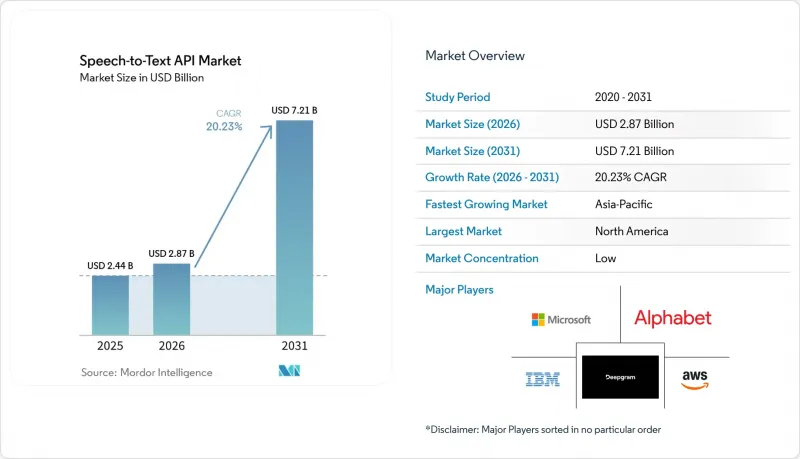
據 Mordor Intelligence 稱,2025 年語音轉文字 API 市值為 24.4 億美元,預計到 2031 年將達到 72.1 億美元,而 2026 年為 28.7 億美元,預測期(2026-2031 年)的複合年成長率為 20.23%。
本報告按組件(軟體和服務)、部署模式(雲端、本地部署等)、組織規模(大型企業和中小企業)、應用程式(內容轉錄、字幕製作等)、最終用戶行業(銀行、金融服務和保險、零售和電子商務等)以及地區進行細分。市場預測以美元計價。
全球語音轉文本API市場趨勢與洞察
企業中對話式人工智慧和語音代理的普及應用日益廣泛
企業支出已超越實驗階段,這項轉變正直接推動語音轉文本API市場的發展。 Rasa在2026年2月進行的一項調查發現,67%的企業決策者正在積極擴展或擴大互動式人工智慧專案在金融、醫療保健、零售、政府和電信等產業的應用。這顯示語音系統的引進週期正在加快。該報告也引用了麥肯錫的數據,顯示88%的公司在至少一項業務職能中定期使用生成式人工智慧,較去年同期成長10個百分點。這證實了軟體預算分配正普遍轉向人工智慧驅動的工作流程。在這轉變過程中,語音代理正成為標準應用模式,因為語音辨識是語音辨識轉文本API市場中路由、摘要和作業系統的起點。此外,採用單一語音層標準的公司通常會擴大其在語音辨識轉文本API市場的選擇範圍,並擴展到編配、監控和合規性工作流程,從而增加切換成本。 Deepgram 和 IBM 於 2026 年 2 月宣佈建立合作夥伴關係,旨在透過將語音功能直接整合到企業代理平台中,而不是讓提供者將轉錄作為獨立實用程式出售,來確保永續採用。
客服中心和會議中對即時轉錄的需求日益成長。
語音轉文字API市場成長的另一個原因是,即時轉錄正成為客服中心和企業會議的核心營運工具。由於即時轉錄有助於指導客服人員、自動進行品質檢查、監控合規性並在通話進行過程中總結通話內容,買家不再僅僅關注通話後的審核。這種轉變意義重大,因為即時處理正在改變轉錄的商業性價值,使其從後勤部門記錄保存轉變為語音轉文本API市場中的即時工作流程控制層。會議工作流程也朝著類似的方向發展,轉錄不僅用作會議記錄,還用於建立搜尋的組織記憶。 Otter.ai於2026年4月發布的「對話知識引擎」展示如何將語音資料轉化為結構化的企業上下文,並與其他職場工具協同工作,從而提升每次錄製互動的價值。因此,缺乏即時串流傳輸能力的供應商正在語音轉文字API市場中失去市場佔有率。這是因為在企業實施過程中,低延遲轉錄日益被視為一項基本要求,而非一項高階功能。
重音、和弦切換、雜訊和串音會導致準確度下降。
語音轉文本API市場的準確度差距仍然是一個真正的限制因素,尤其是在非標準英語語音環境下。一項在2026年EACL會議上發表的研究表明,在包含印度和非洲口音在內的多種口音評估資料集下,單字錯誤率急劇上升。這凸顯了實際效能可能與廠商基準測試的聲明有顯著偏差。語碼轉換進一步加劇了這個問題。此外,一項arXiv關於中英混合語音的研究表明,基於Whisper的模型雖然在單一語言語音環境下表現良好,但在基準測試任務中仍然可能出現超過60%的混合錯誤率。對於印度、東南亞以及中東和非洲地區的公司而言,這意味著當實際應用場景包含非標準口音、多說話人重疊或語音中語言變化時,語音轉文本API市場仍然存在營運風險。這些挑戰通常迫使買家增加人工審核和後處理步驟,或縮小部署範圍,從而降低語音轉文本API市場大規模部署的成本效益。在多語言支援和口音容忍度得到更持續的改善之前,這些限制將繼續影響供應商的聲譽和買家的信心。
細分市場分析
到 2025 年,解決方案將佔總收入的 70.23%,這意味著模型推理 API、SDK 授權和平台訂閱仍將是語音轉文字 API 市場的主要收入來源。這種主導地位反映出,企業預算的很大一部分仍然分配給了這些領域,因為企業在擴展到更高階的實施工作之前,會先購買識別模型、串流端點和核心平台功能的存取權。解決方案層也受益於重複使用,因為任何生產環境中的工作負載,例如會議、客服中心和工作流程自動化,都會在語音轉文字 API 市場中產生持續的 API 使用量。微軟於 2026 年 4 月發布的「MAI-Transcribe-1」進一步印證了這一點,該版本強調了其在 25 種語言中平均詞錯誤率低、每小時費率更低以及批處理速度比傳統的「Azure Fast」方法更快,從而提高了高容量轉錄工作負載的經濟效益。隨著模型效率的提高,供應商可以降低單價,同時擴大語音轉文字 API 市場中具有商業性可行性的用例數量。
預計到2031年,服務市場將以21.78%的複合年成長率成長,反映出企業營運日益複雜,而核心API的存取卻變得越來越容易。這種成長與監管合規實施、特定領域調優、運作保證、合規文件和架構支援等因素密切相關,所有這些都超出了基本API配置的範圍。實際上,部署到生產環境通常涉及詞彙適配、安全配置、工作流程整合和管治設計,因此許多買家需要圍繞這項技術的服務封裝。 Speechmatics於2026年1月與Sully.ai合作,專門為醫療保健產業提供自主轉錄服務,這表明託管服務可以部署在語音引擎之上,以各種部署模式(包括本地部署和私有雲端)提供臨床工作流程。這意味著語音轉文本API產業並沒有偏離解決方案本身,而是在故障成本高的部署環境中增加了更多服務價值。
到 2025 年,基於雲端的部署將佔總收入的 59.11%,這一領先優勢反映了雲端部署易於整合、付費使用制以及開發者可訪問性等特點,這些因素推動了語音轉文字 API 市場的擴張。對於希望快速部署但又不想建置自有語音基礎架構的買家而言,公共雲端仍然是最簡單的切入點。它還支援以較低的投入進行實驗,這對於產品團隊和數位化企業進入語音轉文字 API 市場至關重要。儘管如此,混合雲端和自主雲預計將以更快的速度成長,到 2031 年的複合年成長率將達到 22.43%,這表明隨著生產應用的擴展,採用趨勢正在轉變。根據 Rasa 發布的 2026 年企業調查,63% 的人工智慧領導者傾向於混合架構,而只有 17% 的領導者傾向於完全基於雲端的部署,這與買家對敏感工作負載控制日益成長的需求相吻合。
當資料在地化、內部安全策略或產業法規限制共用基礎架構的使用時,本地部署和私有雲端仍然具有重要的戰略意義。在這種環境下,部署模式不再是語音轉文字 API 市場的售後技術細節,而是影響購買決策的關鍵因素。微軟在歐洲擴展其主權雲端業務以及 AWS 的「歐洲主權雲端」舉措表明,基礎設施供應商正在加大投資,以刺激政府和關鍵產業(這些機構先前難以輕鬆採用公共雲端語音服務)的需求。這一趨勢正在推動語音轉文本 API 市場發生更廣泛的變化。雖然雲端規模在這一市場仍然至關重要,但確保部署柔軟性的能力正成為更強的競爭優勢。隨著合規性審查的日益嚴格,能夠支援公共雲端、混合雲和私有雲環境的供應商將繼續在高度監管的行業中保持有利地位。
區域分析
2025年,北美地區佔據全球整體語音轉文本API市場32.44%的收入佔有率,成為該地區最大的區域市場。該地區受益於API提供者和企業軟體買家的高度集中、醫療技術的快速普及以及人工智慧通訊工具的早期部署。隨著主要供應商不斷推出新的語音模型和串流媒體產品,價格競爭異常激烈,這不僅增加了買家的選擇,也給利潤率帶來了壓力。 OpenAI於2026年5月以每分鐘0.017美元的價格發布了“GPT-Realtime-Whisper”,進一步加劇了價格競爭,並表明捆綁式語音服務正在影響語音轉文本API市場買家的預期。此外,北美地區在臨床環境錄音和企業會議智慧方面的需求依然強勁,支撐著這些產品的持續使用和對高階功能的需求。
預計到2031年,亞太地區將以22.66%的複合年成長率成長,成為語音轉文本API市場成長最快的區域板塊。推動市場需求成長的因素包括語言多樣性、政府數位化專案以及印度、菲律賓和馬來西亞等國的大規模客服中心外包。此外,該地區更加重視本地語言、多語言語音和部署柔軟性,這為區域供應商與全球領先的語音轉文本API供應商競爭創造了空間。科大訊飛計畫於2026年在東南亞地區擴張,包括在新加坡提升處理能力並部署在地化的人工智慧技術,這反映了市場對在地化部署和語言支援的持續強勁需求。
歐洲在語音轉文本API市場中扮演著至關重要且複雜的角色,擁有強勁的需求和日益成長的合規性要求。微軟和AWS提供的自主部署和區域管理的基礎設施選項,正在幫助供應商解決企業在資料處理、資料居住和資源管理方面的擔憂。在中東和非洲地區,沙烏地阿拉伯和阿拉伯聯合大公國正在湧現新的機會。這些地區對阿拉伯語人工智慧的需求不斷成長,自主部署也日益受到重視,從而強化了語音轉文本API市場中特定區域的應用場景。南美洲也正在蓬勃發展,尤其是在客服中心自動化和金融服務工作流程領域,在地化服務和區域夥伴關係關係使得企業買家更容易採用語音技術。
其他好處:
- Excel格式的市場預測(ME)表
- 3個月的分析師支持
目錄
第1章:引言
- 研究假設和市場定義
- 調查範圍
第2章:調查方法
第3章執行摘要
第4章 市場狀況
- 市場概覽
- 宏觀經濟因素對市場的影響
- 市場促進因素
- 擴大對話式人工智慧和語音代理在企業中的應用
- 客服中心和會議中對即時轉錄的需求日益成長。
- 數位媒體的無障礙性和字幕合規性
- 擴展多語言和領域特定語音模型
- 生產環境中語音代理的延遲要求低於 300 毫秒
- 主權雲端和區域資料居住需求選項:刺激受監管的需求
- 市場限制因素
- 重音、和弦切換、雜訊和串音都會降低準確度。
- 語音資料的隱私、安全和合規負擔
- 歐盟人工智慧法案對情感推論的限制正在限制語音分析的發展潛力。
- GPU 和 AI 基礎設施成本的波動給 API 定價帶來了壓力。
- 產業價值鏈分析
- 監理情勢
- 技術展望
- 波特五力分析
第5章 市場規模及成長預測(價值單位:美元)
- 按組件
- 軟體
- 服務
- 專業服務
- 託管服務
- 按部署模式
- 基於雲端的
- 本地部署和私有雲端
- 混合雲端和主權雲
- 按組織規模
- 大公司
- 小型企業
- 透過使用
- 內容轉錄
- 客服中心和客戶管理
- 字幕和標題生成
- 詐欺檢測與預防
- 風險與合規管理
- 實現語音工作流程自動化並建立筆記
- 按最終用戶行業分類
- 資訊科技/通訊
- BFSI
- 醫療保健和生命科學
- 媒體與娛樂
- 零售與電子商務
- 政府/國防
- 教育
- 旅遊與飯店
- 按地區
- 北美洲
- 美國
- 加拿大
- 墨西哥
- 南美洲
- 巴西
- 阿根廷
- 其他南美國家
- 歐洲
- 德國
- 英國
- 法國
- 義大利
- 西班牙
- 俄羅斯
- 其他歐洲國家
- 亞太地區
- 中國
- 日本
- 印度
- 韓國
- 澳洲和紐西蘭
- 其他亞太國家
- 中東和非洲
- 沙烏地阿拉伯
- 阿拉伯聯合大公國
- 土耳其
- 南非
- 埃及
- 其他中東和非洲國家
- 北美洲
第6章 競爭情勢
- 市場集中度
- 策略趨勢
- 市佔率分析
- 公司簡介
- Alphabet Inc.
- Amazon.com, Inc.
- Microsoft Corporation
- International Business Machines Corporation
- Baidu, Inc.
- iFLYTEK Co., Ltd.
- Deepgram, Inc.
- AssemblyAI, Inc.
- Speechmatics Ltd.
- Rev.com, Inc.
- Verint Systems Inc.
- Verbit AI, Inc.
- Trint Limited
- Amberscript Global BV
- Otter.ai, Inc.
- Descript, Inc.
- Soniox, Inc.
- Voicegain, Inc.
- Nuance Communications, Inc.
- OpenAI OpCo, LLC
第7章 市場機會與未來展望
According to Mordor Intelligence, the speech-to-text API market size was valued at USD 2.44 billion in 2025 and estimated to grow from USD 2.87 billion in 2026 to reach USD 7.21 billion by 2031, at a CAGR of 20.23% during the forecast period (2026-2031).
This report is Segmented by Component (Software, and Services), Deployment Model (Cloud-Based, On-Premises, and More), Organization Size (Large Enterprises, and Small and Medium-Sized Enterprises), Application (Content Transcription, Subtitle and Caption Generation, and More), End-User Industry (BFSI, Retail and E-Commerce, and More), and Geography. The Market Forecasts are Provided in Terms of Value (USD).
Global Speech-to-Text API Market Trends and Insights
Rising Enterprise Adoption Of Conversational AI And Voice Agents
Enterprise spending has moved beyond experimentation, and that change is directly supporting the speech-to-text API market. A February 2026 survey by Rasa found that 67% of enterprise decision-makers were actively expanding or scaling conversational AI programs across sectors such as finance, healthcare, retail, government, and telecom, which points to faster production rollout cycles for voice-enabled systems. The same report also cited McKinsey data showing that 88% of enterprises regularly used generative AI for at least 1 business function, up 10 percentage points year over year, which supports a broader software budget shift toward AI-enabled workflows. Within that transition, voice agents are becoming a standard deployment pattern because speech recognition is the starting point for routing, summarization, and action-taking systems in the speech-to-text API market. This also increases switching costs because an enterprise that standardizes on a single speech layer often extends that choice across orchestration, monitoring, and compliance workflows in the speech-to-text API market. The Deepgram and IBM partnership announced in February 2026 shows how providers are seeking durable distribution by embedding speech capabilities directly inside enterprise agent platforms rather than selling transcription as a separate utility.
Growing Need For Real-Time Transcription In Contact Centers And Meetings
The speech-to-text API market is also growing because real-time transcription is becoming a core operating tool in contact centers and enterprise meetings. Buyers are no longer focused only on retrospective call review, because live transcription supports agent guidance, automated quality checks, compliance monitoring, and post-call summarization while the interaction is still active. This shift matters because real-time processing changes the commercial value of transcription from a back-office record to a live workflow control layer within the speech-to-text API market. Meeting workflows are evolving in the same direction, where transcription is being used to build searchable organizational memory rather than simple meeting notes. Otter.ai's April 2026 launch of its Conversational Knowledge Engine shows how speech data is being turned into a structured enterprise context that can connect with other workplace tools and expand the value of each recorded interaction. As a result, vendors that lack real-time streaming performance are losing ground in the speech-to-text API market because enterprise request processes increasingly treat low-latency transcription as a baseline requirement rather than an advanced feature.
Accuracy Degradation Across Accents, Code-Switching, Noise, And Cross-Talk
Accuracy gaps remain a real limit on the speech-to-text API market, especially outside clean English audio conditions. Research presented in the 2026 EACL proceedings through the AfriVox benchmark showed that word error rates rose sharply on accent-diverse evaluation sets, including Indian and African accented English, which confirms that production performance can diverge meaningfully from vendor benchmark claims. Code-switching adds another layer of difficulty, and arXiv research on Mandarin-English mixed speech showed that Whisper-family models could still post mixed error rates above 60% on benchmark tasks even when they performed well on monolingual audio. For enterprises in India, Southeast Asia, the Middle East, and Africa, this means the speech-to-text API market still carries execution risk whenever real traffic contains non-standard accents, overlapping speakers, or mid-sentence language changes. These gaps often force buyers to add human review, post-processing layers, or narrower deployment scopes, which weakens the cost-efficiency case for large-scale rollout in the speech-to-text API market. Until multilingual and accent-robust performance improves more consistently, this restraint will continue to shape vendor evaluation and buyer confidence.
Other drivers and restraints analyzed in the detailed report include:
- Sub-300 Millisecond Latency Requirements For Production Voice Agents
- Expansion Of Multilingual And Domain-Tuned Speech Models
- Voice Data Privacy, Security, And Compliance Burdens
For complete list of drivers and restraints, kindly check the Table Of Contents.
Segment Analysis
Solutions held 70.23% of revenue in 2025, which shows that model inference APIs, SDK licensing, and platform subscriptions remained the primary commercial engine of the speech-to-text API market. This dominance reflects where most buyer budgets still sit, because enterprises first purchase access to recognition models, streaming endpoints, and core platform features before they expand into deeper implementation work. The solutions layer also benefits from repeat usage because every production workload, whether in meetings, contact centers, or workflow automation, generates recurring API consumption inside the speech-to-text API market. Microsoft's April 2026 launch of MAI-Transcribe-1 reinforced that point by highlighting lower average word error rates across 25 languages, lower hourly pricing, and faster batch speed than the earlier Azure Fast approach, which improves the economics of high-volume transcription workloads. As model efficiency improves, providers can push lower unit pricing while expanding the number of use cases that remain commercially attractive in the speech-to-text API market.
Services are projected to expand at a 21.78% CAGR through 2031, which indicates that enterprise complexity is increasing even as core APIs become easier to access. The growth is tied to regulated deployments, domain tuning, uptime commitments, compliance documentation, and architecture support, all of which extend beyond basic API provisioning. In practice, many buyers need a service wrapper around the technology because production deployment often includes vocabulary adaptation, security configuration, workflow integration, and governance design. Speechmatics' January 2026 partnership with Sully.ai for healthcare-focused autonomous scribing illustrates how managed services can sit on top of a speech engine to deliver clinical workflows with different deployment modes, including on-premises and private cloud options. This means the speech-to-text API industry is not shifting away from solutions, but it is attaching more service value to deployments where the cost of failure is high.
Cloud-based deployment captured 59.11% of revenue in 2025, and that lead reflects the ease of integration, usage-based billing, and developer accessibility that helped scale the speech-to-text API market. Public cloud remains the simplest entry point for buyers who want fast deployment without building their own speech infrastructure. It also supports experimentation at lower commitment levels, which has been important for product teams and digital businesses entering the speech-to-text API market. Even so, hybrid and sovereign cloud is projected to grow at a faster 22.43% CAGR through 2031, which shows that deployment preference is shifting as production use expands. Rasa's 2026 enterprise survey found that 63% of AI leaders preferred hybrid architectures, while only 17% preferred fully cloud-based deployment, which aligns with stronger buyer demand for control over sensitive workloads.
On-premises and private cloud remain strategically important wherever data localization, internal security policy, or sector regulation limits the use of shared infrastructure. In those settings, the deployment model becomes part of the buying decision rather than a post-sale technical detail in the speech-to-text API market. Microsoft's sovereign cloud expansion in Europe and AWS's European Sovereign Cloud initiative show that infrastructure providers are investing to unlock demand from government and critical sectors that could not easily adopt public cloud speech services before. That trend supports a broader shift in the speech-to-text API market, where cloud scale still matters, but ownership of deployment flexibility is becoming a stronger competitive differentiator. As compliance scrutiny increases, vendors that can serve public cloud, hybrid, and private environments are likely to stay better positioned across regulated verticals.
Complete Report Scope:
- By Component
- Software
- Services
- Professional Services
- Managed Services
- By Deployment Model
- Cloud-based
- On-premises and Private cloud
- Hybrid and Sovereign Cloud
- By Organization Size
- Large Enterprises
- Small and Medium-sized Enterprises
- By Application
- Content Transcription
- Contact Center and Customer Management
- Subtitle and Caption Generation
- Fraud Detection and Prevention
- Risk and Compliance Management
- Voice-enabled Workflow Automation and Note Generation
- By End-User Industry
- IT and Telecommunications
- BFSI
- Healthcare and Life Sciences
- Media and Entertainment
- Retail and E-commerce
- Government and Defense
- Education
- Travel and Hospitality
- By Geography
- North America
- United States
- Canada
- Mexico
- South America
- Brazil
- Argentina
- Rest of South America
- Europe
- Germany
- United Kingdom
- France
- Italy
- Spain
- Russia
- Rest of Europe
- Asia-Pacific
- China
- Japan
- India
- South Korea
- Australia and New Zealand
- Rest of Asia-Pacific
- Middle East and Africa
- Saudi Arabia
- United Arab Emirates
- Turkey
- South Africa
- Egypt
- Rest of Middle East and Africa
- North America
Geography Analysis
North America held 32.44% of global revenue in 2025, giving it the largest regional position in the speech-to-text API market. The region benefits from a dense concentration of API providers, enterprise software buyers, healthcare technology adoption, and early production deployment of AI-enabled communication tools. Pricing competition is especially visible here because major vendors launched new voice models and streaming products in quick succession, which increased buyer choice and margin pressure at the same time. OpenAI's May 2026 release of GPT-Realtime-Whisper at USD 0.017 per minute added to that pricing pressure and showed how bundled voice offerings are influencing buyer expectations in the speech-to-text API market. North America also remains a major demand anchor for clinical ambient scribing and enterprise meeting intelligence, which helps sustain both usage volume and premium feature demand.
Asia-Pacific is projected to grow at a 22.66% CAGR through 2031, making it the fastest-growing regional block in the speech-to-text API market. Demand is being shaped by linguistic diversity, government digitization programs, and the large-scale contact center outsourcing in countries such as India, the Philippines, and Malaysia. The region also places stronger emphasis on localized languages, mixed-language speech, and deployment flexibility, which gives regional vendors room to compete with larger global providers in the speech-to-text API market. iFLYTEK's 2026 expansion in Southeast Asia, including stronger Singapore capacity and localized sovereign AI positioning, reflects that demand for region-aligned deployments and language support continues to rise.
Europe holds an important but more complex role in the speech-to-text API market because demand remains solid while compliance expectations continue to rise. Sovereign and region-controlled infrastructure options from Microsoft and AWS are helping vendors address enterprise concerns over data handling, residency, and procurement control. Middle East and Africa shows emerging opportunity in Saudi Arabia and the UAE, where Arabic-language AI demand and sovereign deployment priorities are strengthening regional use cases in the speech-to-text API market. South America is also gaining traction, especially in contact center automation and financial service workflows, as localized offerings and regional partnerships make speech deployment easier for enterprise buyers.
- Alphabet Inc.
- Amazon.com, Inc.
- Microsoft Corporation
- International Business Machines Corporation
- Baidu, Inc.
- iFLYTEK Co., Ltd.
- Deepgram, Inc.
- AssemblyAI, Inc.
- Speechmatics Ltd.
- Rev.com, Inc.
- Verint Systems Inc.
- Verbit AI, Inc.
- Trint Limited
- Amberscript Global B.V.
- Otter.ai, Inc.
- Descript, Inc.
- Soniox, Inc.
- Voicegain, Inc.
- Nuance Communications, Inc.
- OpenAI OpCo, LLC
Additional Benefits:
- The market estimate (ME) sheet in Excel format
- 3 months of analyst support
TABLE OF CONTENTS
1 INTRODUCTION
- 1.1 Study Assumptions and Market Definition
- 1.2 Scope of the Study
2 RESEARCH METHODOLOGY
3 EXECUTIVE SUMMARY
4 MARKET LANDSCAPE
- 4.1 Market Overview
- 4.2 Impact of Macroeconomic Factors on the Market
- 4.3 Market Drivers
- 4.3.1 Rising Enterprise Adoption of Conversational AI and Voice Agents
- 4.3.2 Growing Need for Real-Time Transcription in Contact Centers and Meetings
- 4.3.3 Accessibility and Captioning Compliance Across Digital Media
- 4.3.4 Expansion of Multilingual and Domain-Tuned Speech Models
- 4.3.5 Sub-300 Millisecond Latency Requirements for Production Voice Agents
- 4.3.6 Sovereign Cloud and Regional Data Residency Options Unlocking Regulated Demand
- 4.4 Market Restraints
- 4.4.1 Accuracy Degradation Across Accents, Code-Switching, Noise, and Cross-Talk
- 4.4.2 Voice Data Privacy, Security, and Compliance Burdens
- 4.4.3 EU AI Act Limits on Emotion Inference Reducing Speech Analytics Upside
- 4.4.4 GPU and AI Infrastructure Cost Volatility Pressuring API Pricing
- 4.5 Industry Value Chain Analysis
- 4.6 Regulatory Landscape
- 4.7 Technological Outlook
- 4.8 Porter's Five Forces Analysis
- 4.8.1 Threat of New Entrants
- 4.8.2 Bargaining Power of Suppliers
- 4.8.3 Bargaining Power of Buyers
- 4.8.4 Threat of Substitutes
- 4.8.5 Competitive Rivalry
5 MARKET SIZE AND GROWTH FORECASTS, VALUE (USD)
- 5.1 By Component
- 5.1.1 Software
- 5.1.2 Services
- 5.1.2.1 Professional Services
- 5.1.2.2 Managed Services
- 5.2 By Deployment Model
- 5.2.1 Cloud-based
- 5.2.2 On-premises and Private cloud
- 5.2.3 Hybrid and Sovereign Cloud
- 5.3 By Organization Size
- 5.3.1 Large Enterprises
- 5.3.2 Small and Medium-sized Enterprises
- 5.4 By Application
- 5.4.1 Content Transcription
- 5.4.2 Contact Center and Customer Management
- 5.4.3 Subtitle and Caption Generation
- 5.4.4 Fraud Detection and Prevention
- 5.4.5 Risk and Compliance Management
- 5.4.6 Voice-enabled Workflow Automation and Note Generation
- 5.5 By End-User Industry
- 5.5.1 IT and Telecommunications
- 5.5.2 BFSI
- 5.5.3 Healthcare and Life Sciences
- 5.5.4 Media and Entertainment
- 5.5.5 Retail and E-commerce
- 5.5.6 Government and Defense
- 5.5.7 Education
- 5.5.8 Travel and Hospitality
- 5.6 By Geography
- 5.6.1 North America
- 5.6.1.1 United States
- 5.6.1.2 Canada
- 5.6.1.3 Mexico
- 5.6.2 South America
- 5.6.2.1 Brazil
- 5.6.2.2 Argentina
- 5.6.2.3 Rest of South America
- 5.6.3 Europe
- 5.6.3.1 Germany
- 5.6.3.2 United Kingdom
- 5.6.3.3 France
- 5.6.3.4 Italy
- 5.6.3.5 Spain
- 5.6.3.6 Russia
- 5.6.3.7 Rest of Europe
- 5.6.4 Asia-Pacific
- 5.6.4.1 China
- 5.6.4.2 Japan
- 5.6.4.3 India
- 5.6.4.4 South Korea
- 5.6.4.5 Australia and New Zealand
- 5.6.4.6 Rest of Asia-Pacific
- 5.6.5 Middle East and Africa
- 5.6.5.1 Saudi Arabia
- 5.6.5.2 United Arab Emirates
- 5.6.5.3 Turkey
- 5.6.5.4 South Africa
- 5.6.5.5 Egypt
- 5.6.5.6 Rest of Middle East and Africa
- 5.6.1 North America
6 COMPETITIVE LANDSCAPE
- 6.1 Market Concentration
- 6.2 Strategic Moves
- 6.3 Market Share Analysis
- 6.4 Company Profiles (includes Global Level Overview, Market Level Overview, Core Segments, Financials as available, Strategic Information, Market Rank/Share, Products and Services, Recent Developments)
- 6.4.1 Alphabet Inc.
- 6.4.2 Amazon.com, Inc.
- 6.4.3 Microsoft Corporation
- 6.4.4 International Business Machines Corporation
- 6.4.5 Baidu, Inc.
- 6.4.6 iFLYTEK Co., Ltd.
- 6.4.7 Deepgram, Inc.
- 6.4.8 AssemblyAI, Inc.
- 6.4.9 Speechmatics Ltd.
- 6.4.10 Rev.com, Inc.
- 6.4.11 Verint Systems Inc.
- 6.4.12 Verbit AI, Inc.
- 6.4.13 Trint Limited
- 6.4.14 Amberscript Global B.V.
- 6.4.15 Otter.ai, Inc.
- 6.4.16 Descript, Inc.
- 6.4.17 Soniox, Inc.
- 6.4.18 Voicegain, Inc.
- 6.4.19 Nuance Communications, Inc.
- 6.4.20 OpenAI OpCo, LLC
7 MARKET OPPORTUNITIES AND FUTURE OUTLOOK
- 7.1 White-Space and Unmet-Need Assessment

 語音轉文本API市場:全球預測,2026-2032年
 語音轉文本API市場規模、佔有率和成長分析:按組件、部署模式、組織規模、應用、產業垂直領域和地區分類-2026年至2033年產業預測
 全球語音辨識應用市場規模、佔有率、趨勢和成長分析報告(2026-2034)
 語音辨識API市場分析及預測(至2035年):類型、產品類型、服務、技術、組件、應用、部署模式、最終用戶、功能
 2026年全球語音轉文本(STT)API市場報告
 語音辨識API市場-全球產業規模、佔有率、趨勢、機會及預測(依組件、部署方式、組織規模、應用、產業、區域及競爭格局分類),2021-2031年
 神經多樣性語音和通訊技術市場預測至2032年:按技術類型、部署方式、可訪問性、最終用戶和地區分類的全球分析
 語音轉文字 API 市場規模、佔有率和趨勢分析報告:按組件、按部署、按組織規模、按應用程式、按行業、按地區和細分市場預測,2025-2030 年