


 |
市場調查報告書
商品編碼
2072957
低功耗軟體設計架構:市場佔有率分析、產業趨勢與統計及成長預測(2026-2031)Low-Power Software Design Framework - Market Share Analysis, Industry Trends & Statistics, Growth Forecasts (2026 - 2031) |
||||||

※ 本網頁內容可能與最新版本有所差異。詳細情況請與我們聯繫。
據 Mordor Intelligence 稱,低功耗軟體設計框架的市場規模預計將從 2025 年的 21.4 億美元成長到 2026 年的 23.7 億美元,到 2031 年達到 42.3 億美元,預計 2026 年至 2031 年的複合年成長率為 12.28%。
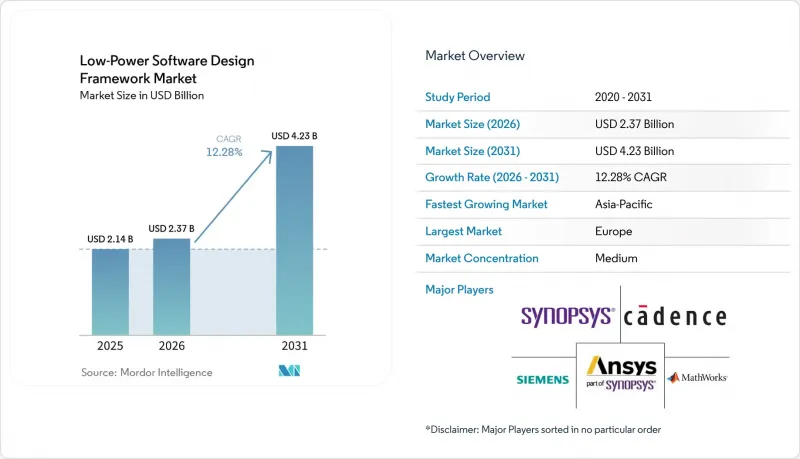
本報告按產品類型(設計和架構軟體等)、技術(基於模型的設計等)、部署模式(本地部署、雲端部署、混合部署)、應用領域(家用電子電器、汽車等)、最終用戶(半導體和無晶圓廠設計公司等)以及地區進行細分。市場預測以美元計價。
全球低功耗軟體設計架構市場趨勢及洞察
引進節能型邊緣人工智慧
節能型邊緣人工智慧的普及正成為推動低功耗軟體設計框架需求的最顯著市場促進因素之一。神經網路推理正逐步擴展到感測器和控制器層面,這些設備的功耗僅為毫瓦甚至亞毫瓦級別,因此低效的韌體行為是不可接受的。這種轉變迫使工程團隊在設計週期的早期階段就協調模型壓縮、記憶體使用和功耗狀態控制。於利希研究中心在2026年漢諾威工業博覽會上展示了「自動機引擎」項目,該項目將每瓦延遲作為其核心最佳化目標,表明邊緣人工智慧設計的重點正從追求峰值計算性能轉向實際的能效。 2026年4月,MathWorks發表了基於Simulink Copilot的R2026a版本,進一步強化了這個方向。此版本使工程師能夠在整合人工智慧輔助開發支援的通用工作流程中檢驗模型行為和嵌入式程式碼產生。隨著 TinyML 運行時標準化,低功耗軟體設計框架市場預計將出現更激烈的競爭,不僅針對基本推理部署,而且針對訓練和部署前檢驗中的工具鏈級能耗分析。
最佳化連網型設備的電池續航力
最佳化連網型設備的電池壽命正推動低功耗軟體設計框架市場朝向更深層、以軟體為中心的能源管理方向發展。大規模感測器模組、穿戴式裝置和遠端節點通常運行在手動更換電池成本高或不切實際的環境中,這意味著產品團隊不再僅僅將電池壽命視為硬體問題。 2025 年的一項研究表明,將自適應軟 Actor-Critic 強化學習應用於 NB-IoT 節能參數,無需硬體變更即可將電池壽命延長三倍以上。這進一步提升了韌體策略設計和檢驗工具的價值。 Nordic Semiconductor 於 2026 年 3 月發布了 nRF Fuel Gauge v2.0,加速了這一趨勢。此版本引入了自適應電池健康監測和即時健康報告功能,可應對各種放電條件。更廣泛地說,間歇性和自適應的能源行為必須在軟體中進行管理,而不僅僅是事後測量。因此,低功耗軟體設計框架市場對查核點、狀態保持和運行時調度技術的需求日益成長,這些技術能夠解決連網設備能源供應的不確定性。
檢驗跨領域權力模式的負擔
跨域功耗模型的高檢驗負擔仍然是低功耗軟體設計框架市場的一大限制。隨著SoC和嵌入式架構中電氣、熱學和機械行為的整合度越來越高,透過由各個工程團隊單獨管理的獨立工作流程來檢驗功耗行為已不再可行。在汽車、工業自動化和先進節點半導體專案中,這項挑戰尤其嚴峻,因為一個領域的設計變更可能會影響其他領域的時序、發熱量、漏電流和可靠性。 Synopsys在2026年推出Ansys 2026 R1及其「多物理場融合」方法時就強調了這個問題。此方法將多物理場引擎與EDA工具整合,截至2026年仍在客戶試用階段。即使整合度有所提高,每次功耗域變更或AI驅動的佈局決策,都需要驗證的互動數量也會增加,以確保符合功耗意圖並確保簽核的一致性。換句話說,低功耗軟體設計框架市場正面臨一個實際的限制:在要求最高的程式中,設計自動化的進步超過了完整檢驗能力的改進。
細分市場分析
預計到2025年,「功耗分析與最佳化軟體」將佔據低功耗軟體設計框架市場28.74%的佔有率,而「部署與生命週期管理軟體」預計到2031年將以13.45%的複合年成長率成長。 「功耗分析與最佳化軟體」的市場領先地位源於人們認知到,功耗驗收是流片前的最後一道關卡之一,尤其是在先進製程節點上,忽略功耗違規可能導致代價高昂的重新設計。在低功耗軟體設計框架市場中,該領域受益於漏電流、狀態轉換和熱互動不再被視為次要的調優問題,而是被視為大規模生產的風險。這種地位使得功耗分析工具即使在相鄰類別發展迅速的情況下也能維持穩定的收入基礎。
2025年3月,Cadence發布了Conformal AI Studio,其核心功能是Conformal AI低功耗技術,展示如何利用分層分散式檢驗流程在功耗簽核環境中管理設計規模。設計和架構、軟體、模擬和建模軟體的應用持續穩定成長,因為在正式簽核之前需要進行初步探索。檢驗和簽核軟體也受益於汽車和工業專案中日益成長的文件要求。在這些領域,功耗行為以及安全性和可靠性要求都必須可追蹤。同時,低功耗軟體設計框架產業在配置和生命週期管理軟體方面正經歷加速成長。這是因為空中下載(OTA)更新規劃、車隊能耗行為和長期設備維護正逐漸成為同一價值鏈的一部分。西門子在2026年發布了Fuse EDA AI Agent,進一步推動了這一趨勢。 Fuse EDA AI Agent將製造就緒性與設計工作流程更緊密地整合在一起,表明設計和運作層面的電源管理之間的界限正在逐漸模糊。
儘管預計到2025年基於模型的設計將佔據27.63%的市場佔有率,但到2031年,人工智慧輔助的低功耗設計預計將以14.12%的複合年成長率(CAGR)實現最高成長。基於模型的設計仍然是低功耗軟體設計框架市場的核心,因為它提供可追溯的工作流程,支援受監管的工程環境,並幫助團隊協調模擬和程式碼產生。其在汽車和航太領域的應用依賴一致的模型到程式碼的傳承關係和成熟的檢驗程序,因此短期內難以被取代。這使得現有的基於模型的工作流程在低功耗軟體設計框架市場中佔據穩固地位,即使以人工智慧為中心的新方法不斷湧現。
2026年4月,MathWorks發布了R2026a版本,其中包含Simulink Copilot,進一步強化了這一領域,並擴展了對瑞薩平台的嵌入式支援。這使得人工智慧驅動的開發與面向硬體的執行流程的整合更加直接。隨著功耗檢驗的範圍從邏輯行為擴展到更真實的運作條件,硬體在環(HIL)模擬、快速控制原型製作和嵌入式系統原型製作持續受到關注。人工智慧驅動的低功耗設計正從綜合後的調優轉向前端設計管治,發展速度也更快。這促成了更早的功耗限制和更系統化的處理。隨著分散式韌體團隊越來越需要共用環境來進行版本控制、模擬和跨站點功耗分析,雲端原生協作開發也不斷發展。因此,低功耗軟體設計框架產業正進入一個「兩極化」階段:成熟的工作流程穩定了現有基本客群,而人工智慧驅動的方法則應對了日益成長的複雜性和新計畫的推出。
區域分析
到2025年,亞太地區將佔據低功耗軟體設計框架市場36.45%的佔有率,成為領先的區域市場。該地區受惠於中國、日本、韓國和台灣地區蓬勃發展的半導體設計活動,這些地區先進的節點程式設計和大規模生產的嵌入式產品管線,持續推動著對功耗簽核、模擬和檢驗工具的需求。低功耗軟體設計框架市場在亞太地區尤為強勁,該地區各國將尖端的晶片設計生態系統與大規模的下游製造和產品開發能力相結合。隨著工程服務供應商在班加羅爾、海得拉巴和浦那等城市拓展業務,印度的重要性也日益凸顯,推動了對開發、原型製作和合規性軟體環境的需求成長。澳洲雖然規模較小,但透過在永續遙感探測和能源採集等互聯系統方面的研究和試點活動,發揮著舉足輕重的作用。
北美在低功耗軟體設計框架市場排名第二,這得益於超大規模資料中心業者晶片開發商的晶片項目、汽車半導體行業的活躍發展以及主要EDA廠商在該地區的業務佈局。美國仍然是該市場的核心,眾多平台廠商、先進設計團隊和人工智慧驅動的檢驗項目都集中在該地區。 2026年5月,Synopsys宣布有20家客戶正在評估基於代理的設計解決方案,這些方案涵蓋超過25種專用人工智慧代理,這反映出該地區正在積極檢驗下一代EDA方法。加拿大和墨西哥透過無晶圓廠設計和電子製造服務的成長推動了市場需求,從而帶動了該地區對以生命週期和部署為中心的工具的需求。
預計到2031年,歐洲將以13.92%的複合年成長率成長,成為低功耗軟體設計框架市場成長最快的區域市場。推動這一成長的主要因素是監管和產業因素,而非產量。新的待機功耗法規和網路安全義務正在改變產品團隊指定韌體和檢驗工具的方式。歐盟修訂了待機功耗限制,相關法規將於2025年5月生效,這將提高網路連接電子產品和消費性電子產品採購決策中能源預算和檢驗的優先順序。此外,《網路彈性法案》自2026年9月起新增了漏洞報告和軟體文件編制義務,這推動了對支援可審計韌體設計和軟體材料清單(SBOM)實踐以及電源狀態管理的框架的需求。德國憑藉其在工業自動化和先進EDA(電子設計自動化)方面的強大實力,仍然是該地區的中心樞紐。同時,中東、非洲和南美洲仍處於起步階段,主要集中在智慧城市和邊緣感知部署。
其他好處:
- Excel格式的市場預測(ME)表
- 3個月的分析師支持
目錄
第1章:引言
- 研究假設和市場定義
- 調查範圍
第2章:調查方法
第3章執行摘要
第4章 市場狀況
- 市場概覽
- 市場促進因素
- 引進節能型邊緣人工智慧
- 最佳化連網型設備的電池續航力
- 能源採集相容型MCU工具鏈的興起
- 面向始終運作設備的軟體定義電源預算管理
- 引入基於模型的早期功率檢驗設計
- “安全設計”韌體和合規性壓力
- 市場限制因素
- 檢驗跨領域權力模式的負擔
- 工具鏈碎片化,涉及 MCU、RTOS 和編譯器堆疊。
- 低功耗嵌入式系統檢驗人員短缺
- 使用人工智慧進行自動化產生認證的成本不斷上升。
- 產業價值鏈分析
- 監理情勢
- 宏觀經濟因素對市場的影響
- 波特五力分析
第5章 市場規模與成長預測
- 依產品類型
- 設計及建築軟體
- 模擬和建模軟體
- 檢驗和簽署軟體
- 功率分析和最佳化軟體
- 部署和生命週期管理軟體
- 透過技術
- 基於模型的設計
- 硬體在環仿真
- 快速控制原型製作
- 嵌入式系統原型製作
- 人工智慧驅動的低功耗設計
- 雲端原生協作開發
- 按部署模式
- 現場
- 基於雲端的
- 混合
- 透過使用
- 家用電子產品
- 車
- 工業自動化
- 醫療保健和穿戴式設備
- 航太/國防
- 物聯網和智慧設備
- 最終用戶
- 半導體和無晶圓廠設計公司
- 電子產品OEM製造商
- 工程服務供應商
- 學術和研究機構
- 按地區
- 北美洲
- 美國
- 加拿大
- 墨西哥
- 南美洲
- 巴西
- 其他南美國家
- 歐洲
- 德國
- 英國
- 法國
- 義大利
- 西班牙
- 俄羅斯
- 其他歐洲國家
- 亞太地區
- 中國
- 印度
- 日本
- 韓國
- 澳洲
- 其他亞太國家
- 中東
- 土耳其
- 沙烏地阿拉伯
- 阿拉伯聯合大公國
- 其他中東國家
- 非洲
- 南非
- 奈及利亞
- 其他非洲國家
- 北美洲
第6章 競爭情勢
- 市場集中度
- 策略趨勢
- 市佔率分析
- 公司簡介
- Synopsys, Inc.
- Cadence Design Systems, Inc.
- Siemens Industry Software Inc.
- Ansys, Inc.
- The MathWorks, Inc.
- Keysight Technologies, Inc.
- Altair Engineering Inc.
- Altium Limited
- Zuken Inc.
- Silvaco Group, Inc.
- Aldec, Inc.
- COMSOL AB
- Dassault Systemes
- Imperas Software Ltd.
- IAR Systems AB
- Xpeedic Technology Co., Ltd.
- Empyrean Technology Co., Ltd.
- Typhoon HIL, Inc.
- PTC Inc.
- Vector Informatik GmbH
第7章 市場機會與未來展望
According to Mordor Intelligence, the low-power software design framework market size is expected to increase from USD 2.14 billion in 2025 to USD 2.37 billion in 2026 and reach USD 4.23 billion by 2031, growing at a CAGR of 12.28% over 2026-2031.
This report is Segmented by Product Type (Design and Architecture Software, and More), Technology (Model-Based Design, and More), Deployment Model (On-Premises, Cloud-Based, and Hybrid), Application (Consumer Electronics, Automotive, and More), End User (Semiconductor and Fabless Design Houses, and More), and Geography. The Market Forecasts are Provided in Terms of Value (USD).
Global Low-Power Software Design Framework Market Trends and Insights
Energy-Efficient Edge AI Adoption
Energy-efficient edge AI adoption is becoming one of the clearest drivers of demand for the low-power software design framework market. Neural network inference is now moving closer to the sensor and controller levels, where devices operate at milliwatt or sub-milliwatt levels and cannot tolerate inefficient firmware behavior. That shift is forcing engineering teams to link model compression, memory use, and power-state control much earlier in the design cycle than before. Forschungszentrum Julich presented its Automaton Engine project at Hannover Messe 2026, with latency per watt as a core optimization target, demonstrating how edge AI design priorities are moving away from peak compute claims and toward usable energy efficiency. MathWorks reinforced this direction in April 2026, releasing R2026a with Simulink Copilot, which allows engineers to examine model behavior and embedded code generation within a common workflow that now includes AI-assisted development support. As TinyML runtimes become more standardized, the low-power software design framework market is likely to see stronger competition around toolchain-level energy profiling during training and pre-deployment validation, rather than just basic inference deployment.
Battery Lifetime Optimization in Connected Devices
Battery lifetime optimization in connected devices is pushing the low-power software design framework market toward deeper software-centric energy management. Product teams are no longer treating battery life as a hardware-only issue because large sensor fleets, wearables, and remote nodes often operate in places where manual battery replacement is expensive or impractical. Research published in 2025 showed that adaptive soft-actor-critic reinforcement learning applied to NB-IoT power-saving parameters could extend battery life by more than 3x without hardware changes, which shifts more value toward firmware policy design and verification tools. Nordic Semiconductor added to this trend in March 2026 with nRF Fuel Gauge v2.0, which introduced adaptive battery health monitoring and real-time state-of-health reporting across changing discharge conditions. The broader implication is that intermittent and adaptive energy behavior must now be managed in software, not just measured after the fact. That is why the low-power software design framework market is benefiting from demand for checkpointing, state retention, and runtime scheduling methods that can respond to the uncertainty of energy availability in connected devices.
High Verification Burden For Cross-Domain Power Models
The high verification burden for cross-domain power models remains a significant restraint on the market for low-power software design frameworks. As SoC and embedded architectures combine electrical, thermal, and mechanical behavior more tightly, teams can no longer validate power behavior through isolated workflows owned by separate engineering groups. The challenge becomes more severe in automotive, industrial automation, and advanced-node semiconductor programs where design changes in one domain can affect timing, heat, leakage, and reliability in another. Synopsys highlighted this issue in 2026 when it introduced Ansys 2026 R1 and its Multiphysics Fusion approach, which links multiphysics engines with EDA tools and was still in the process of expanding customer trials during 2026. Even with better integration, every change to power domains or AI-assisted layout decisions expands the number of interactions that must be checked for power-intent compliance and sign-off consistency. This means the low-power software design framework market faces a practical ceiling where design automation is advancing faster than full verification capacity in the most demanding programs.
Other drivers and restraints analyzed in the detailed report include:
- Rise of Energy-Harvesting MCU Toolchains
- Software-Defined Power Budgeting in Always-On Devices
- Fragmented Toolchains Across MCU, RTOS, And Compiler Stacks
For complete list of drivers and restraints, kindly check the Table Of Contents.
Segment Analysis
Power Analysis and Optimization Software held 28.74% of the low-power software design framework market size in 2025, while Deployment and Lifecycle Management Software is projected to grow at a 13.45% CAGR through 2031. The leadership of Power Analysis and Optimization Software recognizes that power sign-off remains one of the final gates before tapeout, especially at advanced nodes, where missed violations can trigger costly redesigns. In the low-power software design framework market, this type benefits from the fact that leakage, state transitions, and thermal interactions are now being treated as production risks rather than secondary tuning issues. That position gives power analysis tools a durable revenue base even as adjacent categories gain momentum.
Cadence introduced Conformal AI Studio in March 2025, featuring its Conformal AI Low Power capability, demonstrating how hierarchical and distributed verification flows are used to manage design scale in power sign-off environments. Design and Architecture, Software, Simulation, and Modeling Software continue to see stable adoption because teams still need early-stage exploration before sign-off begins. Verification and Sign-Off Software is also benefiting from stronger documentation requirements in automotive and industrial programs, where power behavior has to be traceable alongside safety and security expectations. At the same time, the low-power software design framework industry is seeing stronger growth in Deployment and Lifecycle Management Software because over-the-air update planning, fleet energy behavior, and long-term device maintenance are becoming part of the same value chain. Siemens supported this direction in 2026 with its Fuse EDA AI Agent, which more closely linked manufacturing readiness and design workflows and signaled that the boundary between design-time and operational power management is narrowing.
Model-Based Design accounted for 27.63% share in 2025, while AI-Assisted Low-Power Design is projected to record the fastest CAGR of 14.12% through 2031. Model-Based Design remains central to the low-power software design framework market because it offers traceable workflows, supports regulated engineering environments, and helps teams connect simulation with code generation. Its installed base in automotive and aerospace is difficult to displace quickly because those programs depend on consistent model-to-code lineage and established validation routines. In the low-power software design framework market, this gives incumbent model-based workflows a defensible position even as newer AI-centric methods expand.
MathWorks strengthened this segment in April 2026 when it released R2026a with Simulink Copilot and extended embedded support for Renesas platforms, which connected AI-assisted development more directly with hardware-oriented execution flows. Hardware-In-The-Loop Simulation, Rapid Control Prototyping, and Embedded System Prototyping continue to gain attention because power validation now extends beyond logic behavior into more realistic operating conditions. AI-Assisted Low-Power Design is advancing faster as it shifts from post-synthesis tuning toward front-end design governance, where power limits are introduced earlier and handled more systematically. Cloud-Native Collaborative Development is also advancing because distributed firmware teams increasingly need shared environments for versioning, simulation, and cross-site power analysis. The low-power software design framework industry is therefore entering a two-speed phase where mature workflows keep the installed base stable while AI-assisted methods capture incremental complexity and new project starts.
Complete Report Scope:
- By Product Type
- Design and Architecture Software
- Simulation and Modeling Software
- Verification and Sign-Off Software
- Power Analysis and Optimization Software
- Deployment and Lifecycle Management Software
- By Technology
- Model-Based Design
- Hardware-In-The-Loop Simulation
- Rapid Control Prototyping
- Embedded System Prototyping
- AI-Assisted Low-Power Design
- Cloud-Native Collaborative Development
- By Deployment Model
- On-Premises
- Cloud-Based
- Hybrid
- By Application
- Consumer Electronics
- Automotive
- Industrial Automation
- Healthcare and Wearables
- Aerospace and Defense
- IoT and Smart Devices
- By End User
- Semiconductor and Fabless Design Houses
- Electronic OEMs
- Engineering Service Providers
- Academic and Research Institutions
- By Geography
- North America
- United States
- Canada
- Mexico
- South America
- Brazil
- Rest of South America
- Europe
- Germany
- United Kingdom
- France
- Italy
- Spain
- Russia
- Rest of Europe
- Asia-Pacific
- China
- India
- Japan
- South Korea
- Australia
- Rest of Asia-Pacific
- Middle East
- Turkey
- Saudi Arabia
- United Arab Emirates
- Rest of Middle East
- Africa
- South Africa
- Nigeria
- Rest of Africa
- North America
Geography Analysis
Asia-Pacific accounted for 36.45% of the low-power software design framework market in 2025, making it the leading regional market. The region benefits from dense semiconductor design activity across China, Japan, South Korea, and Taiwan, where advanced-node programs and large-volume embedded product pipelines create a steady demand for power-signoff, simulation, and verification tools. The low-power software design framework market is particularly strong in Asia-Pacific, where countries combine leading chip design ecosystems with major downstream manufacturing and product development capacity. India is also becoming more important as engineering service providers expand in cities such as Bangalore, Hyderabad, and Pune, which increases demand for development, prototyping, and compliance-oriented software environments. Australia adds a smaller but relevant layer through research and pilot activity around sustainable remote sensing and energy-harvesting connected systems.
North America ranked second in the low-power software design framework market, supported by hyperscaler silicon programs, automotive semiconductor activity, and the regional presence of major EDA vendors. The United States remains central because many platform vendors, advanced design teams, and AI-driven verification programs are concentrated there. Synopsys stated in May 2026 that 20 customers were evaluating agentic design solutions across more than 25 specialized AI agents, reflecting the strong testing of next-generation EDA methods in the region. Canada and Mexico add supporting demand through fabless design growth and electronics manufacturing services, which increase the regional need for lifecycle- and deployment-focused tools.
Europe is projected to expand at a 13.92% CAGR through 2031, making it the fastest-growing regional segment in the low-power software design framework market. The main drivers are regulatory and industrial rather than volume-based, with new standby power rules and cybersecurity obligations changing how product teams specify firmware and validation tools. The EU updated standby power limits with a regulation effective from May 2025, which raised the priority of energy budgeting and verification in procurement decisions for networked and consumer devices. The Cyber Resilience Act also adds vulnerability reporting and software documentation obligations from September 2026, which increases demand for frameworks that can support auditable firmware design and software bill of materials practices alongside power-state management. Germany remains the regional center of gravity because industrial automation and advanced EDA collaboration are strong there, while the Middle East, Africa, and South America remain earlier-stage opportunities tied mainly to selective smart-city and edge-sensing deployments.
- Synopsys, Inc.
- Cadence Design Systems, Inc.
- Siemens Industry Software Inc.
- Ansys, Inc.
- The MathWorks, Inc.
- Keysight Technologies, Inc.
- Altair Engineering Inc.
- Altium Limited
- Zuken Inc.
- Silvaco Group, Inc.
- Aldec, Inc.
- COMSOL AB
- Dassault Systemes
- Imperas Software Ltd.
- IAR Systems AB
- Xpeedic Technology Co., Ltd.
- Empyrean Technology Co., Ltd.
- Typhoon HIL, Inc.
- PTC Inc.
- Vector Informatik GmbH
Additional Benefits:
- The market estimate (ME) sheet in Excel format
- 3 months of analyst support
TABLE OF CONTENTS
1 INTRODUCTION
- 1.1 Study Assumptions and Market Definition
- 1.2 Scope of the Study
2 RESEARCH METHODOLOGY
3 EXECUTIVE SUMMARY
4 MARKET LANDSCAPE
- 4.1 Market Overview
- 4.2 Market Drivers
- 4.2.1 Energy-Efficient Edge AI Adoption
- 4.2.2 Battery Lifetime Optimization in Connected Devices
- 4.2.3 Rise of Energy-Harvesting MCU Toolchains
- 4.2.4 Software-Defined Power Budgeting in Always-On Devices
- 4.2.5 Model-Based Design Adoption for Early Power Validation
- 4.2.6 Secure-By-Design Firmware and Compliance Pressure
- 4.3 Market Restraints
- 4.3.1 High Verification Burden for Cross-Domain Power Models
- 4.3.2 Fragmented Toolchains Across MCU, RTOS, and Compiler Stacks
- 4.3.3 Shortage of Low-Power Embedded Verification Talent
- 4.3.4 Higher Qualification Cost for AI-Assisted Autogeneration
- 4.4 Industry Value-Chain Analysis
- 4.5 Regulatory Landscape
- 4.6 Impact of Macroeconomic Factors on the Market
- 4.7 Porter's Five Forces Analysis
- 4.7.1 Bargaining Power of Suppliers
- 4.7.2 Bargaining Power of Buyers
- 4.7.3 Threat of New Entrants
- 4.7.4 Threat of Substitutes
- 4.7.5 Intensity of Competitive Rivalry
5 MARKET SIZE AND GROWTH FORECASTS (VALUE)
- 5.1 By Product Type
- 5.1.1 Design and Architecture Software
- 5.1.2 Simulation and Modeling Software
- 5.1.3 Verification and Sign-Off Software
- 5.1.4 Power Analysis and Optimization Software
- 5.1.5 Deployment and Lifecycle Management Software
- 5.2 By Technology
- 5.2.1 Model-Based Design
- 5.2.2 Hardware-In-The-Loop Simulation
- 5.2.3 Rapid Control Prototyping
- 5.2.4 Embedded System Prototyping
- 5.2.5 AI-Assisted Low-Power Design
- 5.2.6 Cloud-Native Collaborative Development
- 5.3 By Deployment Model
- 5.3.1 On-Premises
- 5.3.2 Cloud-Based
- 5.3.3 Hybrid
- 5.4 By Application
- 5.4.1 Consumer Electronics
- 5.4.2 Automotive
- 5.4.3 Industrial Automation
- 5.4.4 Healthcare and Wearables
- 5.4.5 Aerospace and Defense
- 5.4.6 IoT and Smart Devices
- 5.5 By End User
- 5.5.1 Semiconductor and Fabless Design Houses
- 5.5.2 Electronic OEMs
- 5.5.3 Engineering Service Providers
- 5.5.4 Academic and Research Institutions
- 5.6 By Geography
- 5.6.1 North America
- 5.6.1.1 United States
- 5.6.1.2 Canada
- 5.6.1.3 Mexico
- 5.6.2 South America
- 5.6.2.1 Brazil
- 5.6.2.2 Rest of South America
- 5.6.3 Europe
- 5.6.3.1 Germany
- 5.6.3.2 United Kingdom
- 5.6.3.3 France
- 5.6.3.4 Italy
- 5.6.3.5 Spain
- 5.6.3.6 Russia
- 5.6.3.7 Rest of Europe
- 5.6.4 Asia-Pacific
- 5.6.4.1 China
- 5.6.4.2 India
- 5.6.4.3 Japan
- 5.6.4.4 South Korea
- 5.6.4.5 Australia
- 5.6.4.6 Rest of Asia-Pacific
- 5.6.5 Middle East
- 5.6.5.1 Turkey
- 5.6.5.2 Saudi Arabia
- 5.6.5.3 United Arab Emirates
- 5.6.5.4 Rest of Middle East
- 5.6.6 Africa
- 5.6.6.1 South Africa
- 5.6.6.2 Nigeria
- 5.6.6.3 Rest of Africa
- 5.6.1 North America
6 COMPETITIVE LANDSCAPE
- 6.1 Market Concentration
- 6.2 Strategic Moves
- 6.3 Market Share Analysis
- 6.4 Company Profiles (includes Global Level Overview, Market Level Overview, Core Segments, Financials as available, Strategic Information, Market Rank/Share, Products and Services, Recent Developments)
- 6.4.1 Synopsys, Inc.
- 6.4.2 Cadence Design Systems, Inc.
- 6.4.3 Siemens Industry Software Inc.
- 6.4.4 Ansys, Inc.
- 6.4.5 The MathWorks, Inc.
- 6.4.6 Keysight Technologies, Inc.
- 6.4.7 Altair Engineering Inc.
- 6.4.8 Altium Limited
- 6.4.9 Zuken Inc.
- 6.4.10 Silvaco Group, Inc.
- 6.4.11 Aldec, Inc.
- 6.4.12 COMSOL AB
- 6.4.13 Dassault Systemes
- 6.4.14 Imperas Software Ltd.
- 6.4.15 IAR Systems AB
- 6.4.16 Xpeedic Technology Co., Ltd.
- 6.4.17 Empyrean Technology Co., Ltd.
- 6.4.18 Typhoon HIL, Inc.
- 6.4.19 PTC Inc.
- 6.4.20 Vector Informatik GmbH
7 MARKET OPPORTUNITIES AND FUTURE OUTLOOK
- 7.1 White-Space and Unmet-Need Assessment

 模擬與分析軟體市場-2026-2032年全球市場預測
 2026年垂直起降動力設計全球市場報告2026年全球軟體建模、分析與設計市場報告
 生命科學分析領域人工智慧市場規模、佔有率和成長分析:按組件、部署模式、應用、技術、最終用戶和地區分類——2026-2033年產業預測2026年全球多通路分析市場報告
 NPS軟體市場規模、佔有率和成長分析:按部署類型、採用因素、組織規模、最終用戶產業、銷售管道和地區分類-2026年至2033年產業預測2026年全球發射方位角分析軟體市場報告RadarLink全球市場報告20262026年全球情緒分析軟體市場報告2026年全球文本分析軟體市場報告