


 |
市場調查報告書
商品編碼
2072937
胺基酸檢測試劑盒:市場佔有率分析、產業趨勢與統計、成長預測(2026-2031)Amino Acid Assay Kit - Market Share Analysis, Industry Trends & Statistics, Growth Forecasts (2026 - 2031) |
||||||

※ 本網頁內容可能與最新版本有所差異。詳細情況請與我們聯繫。
根據 Mordor Intelligence 預測,胺基酸檢測試劑盒市場規模預計將在 2025 年達到 14.1 億美元,2026 年達到 15.2 億美元,到 2031 年達到 23 億美元,2026 年至 2031 年的複合年成長率為 8.5%。
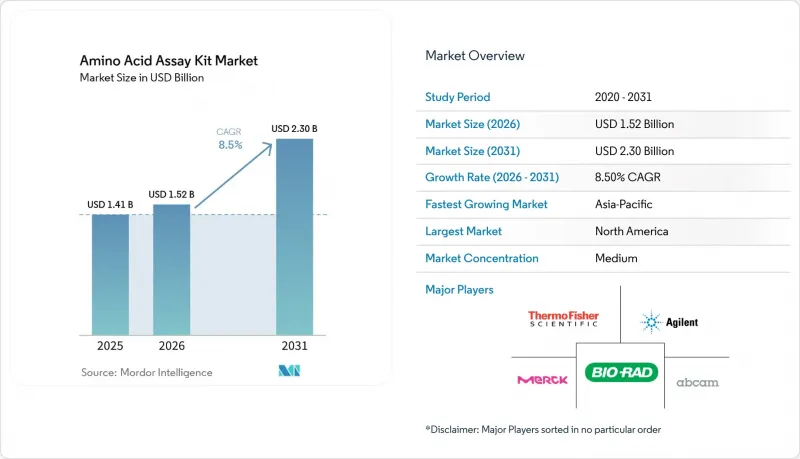
本報告按試劑盒類型(例如,比色法試劑盒、螢光試劑盒)、應用領域(例如,蛋白質定量、胺基酸分析)、最終用戶(例如,製藥、生物技術)和地區(例如,北美、歐洲、亞太地區)進行細分。市場預測以美元計價。
全球胺基酸檢測試劑盒市場趨勢及洞察
生命科學領域對定量氨基酸研究的需求日益成長。
代謝體學正從探索性工具轉變為藥物研發、轉化醫學和疾病篩檢的關鍵要素,從而拓展了氨基酸檢測試劑盒市場,使其應用於常規檢測領域。檢驗的胺基酸檢測組合如今已成為需要可重複且擴充性檢測的工作流程中不可或缺的組成部分。一項2025年的研究表明,血漿氨基酸濃度特徵能夠以78%的靈敏度和0%的假陽性率檢測四種主要癌症類型,在包含97個檢體的檢驗隊列中實現了0.95的AUROC值。該研究強調了胺基酸檢測在篩檢中的可行性顯著提高,因為它無需進行典型的檢體預處理步驟,為腫瘤檢測項目創造了新的機遇,並強調了在研究和診斷中保持臨床級一致性的必要性。
拓展蛋白質體學和生物標記發現項目
在蛋白質體學計畫中,胺基酸定量分析日益融入藥物研發流程,推動了對胺基酸檢測試劑盒的需求。賽默飛世爾科技於2024年收購了Olink公司,將胺基酸譜分析與英國生物銀行製藥蛋白質體學計畫連結起來。該計畫分析了來自60萬個樣本的5400多種蛋白質,用於生物標記的發現。這項擴展增加了對校準級定量試劑盒的需求,促進了酵素法和層析法試劑盒的成長,因為在進行高級分析之前,一致的蛋白質定量分析仍然至關重要。上游工程標準化和下游檢驗的雙重優勢,使得整個工作流程的通量得以提高,從而推動了市場的發展。
設備相關的性能和整合挑戰
儀器相容性仍然是胺基酸檢測試劑盒市場的主要限制因素,因為許多試劑盒都針對特定的螢光分析儀、離子交換分析儀或液相層析質譜聯用儀進行了最佳化。擁有多種儀器的實驗室在現有硬體上驗證新試劑盒時面臨挑戰,即使技術性能優異,也可能因此延遲試劑盒的推廣應用。這個過程需要大量的時間和資源用於檢測法遷移、文件編制和人員培訓。資源有限的中型機構尤其容易受到此問題的影響,即使有更優的替代方案,它們也往往優先選擇熟悉的、檢驗的試劑盒。能夠提供跨儀器和試劑的整合工作流程的供應商,可以透過降低實施過程中的不確定性來獲得競爭優勢。
細分市場分析
2025年,比色分析試劑盒佔胺基酸分析試劑盒市場的35.13%,並持續維持其在試劑盒類型中的領先地位。其受歡迎的原因在於與標準微孔盤讀數儀相容、操作流程簡單,且易於在食品、飲料和製藥行業的品管實驗室中使用。這些試劑盒採用酵素催化氧化法,對血清、尿液和組織勻漿等樣本的線性檢測範圍為3.3 µM至500 µM。酵素法試劑盒滿足了基材特異性選擇性的需求,而層析法盒儘管成本較高,但在需要可靠分析檢驗的法規環境中也越來越受歡迎。
市場區隔日益加劇,常規、大量處理的試劑盒與高性能、專業應用的試劑盒之間存在明顯的碎片化。螢光檢測試劑盒預計到2031年將以10.25%的複合年成長率成長,是成長最快的細分市場。與許多比色法相比,螢光檢測試劑盒的檢測極限提高了10到25倍,是乾血斑和微型生物反應器培養基等低濃度樣本的理想選擇。此外,這些試劑盒還能很好地整合到多重檢測和自動化工作流程中,從而增強了其在製藥業自動化流程中的作用。
區域分析
到2025年,北美將佔據胺基酸檢測試劑盒市場的領先地位,市佔率高達39.56%。這主要得益於美國強大的藥物研發實力、大規模的生物製藥製造地以及嚴格的蛋白質標籤法規。從區域來看,美國的需求量主導,加拿大則透過學術和政府研究做出貢獻,而墨西哥則透過藥物生產的近岸外包不斷擴大其市場佔有率。歐洲成為第二大市場,德國、法國和英國是其主要支撐。在這些國家,與大學合作的蛋白質體學研究中心以及完善的食品安全檢測系統維持了市場需求。默克集團透過擴大在愛爾蘭的業務,強調了歐洲市場的重要性,其中包括在布萊尼商業園區建造一座價值1.5億歐元(1.65億美元)的工廠,以及投資4.4億歐元(4.84億美元)。
預計到2031年,亞太地區將以10.12%的複合年成長率成長,成為成長最快的地區。這一成長主要得益於醫療保健支出增加、藥品生產規模擴大以及政府支持的新生兒篩檢計劃。中國在生物技術政策和基於MS/MS的低成本新生兒篩檢方面發揮核心作用。雖然日本和韓國等先進細分市場已廣泛應用成熟的分析儀器和自動化系統,但印度的合約研究基礎設施和澳洲充滿活力的大學研究網路正在進一步推動市場需求。
中東和非洲(MEA)以及南美洲是胺基酸檢測試劑盒的新興市場,其正規檢測基礎設施正在發展中。在中東和非洲地區,沙烏地阿拉伯和阿拉伯聯合大公國(阿拉伯聯合大公國)正在投資醫院新生兒篩檢,而南非的需求則主要由大學附屬醫療中心維持。在南美洲,巴西和阿根廷是主要的需求驅動力,其中巴西的製藥和食品檢測行業在採購方面處於領先地位。由於價格敏感且低溫運輸基礎設施不足,這些地區更傾向於使用比色法和酵素法的試劑盒,因此其產品組合與北美、歐洲和亞太等已開發地區有所不同。
其他好處:
- Excel格式的市場預測(ME)表
- 3個月的分析師支持
目錄
第1章:引言
- 研究假設和市場定義
- 調查範圍
第2章:調查方法
第3章執行摘要
第4章 市場狀況
- 市場概覽
- 市場促進因素
- 臨床代謝工作流程中對胺基酸定量測量的需求日益成長。
- 拓展生物製藥領域的蛋白質體學和生物標記發現流程
- 食品真偽鑑別檢驗和蛋白質標示要求。
- 快速比色法和螢光檢測法盒是即時檢測和小規模工作流程的首選。
- 研究機構中多重和高通量檢測方法的廣泛應用
- 促進診斷和營養領域氨基酸定量標準化的監管和品管。
- 市場限制因素
- 儀器相關的性能和對每種樣品基質的干擾敏感性。
- 通用分析格式差異化程度有限,給定價帶來了壓力。
- 不同應用情境下檢驗標準的不一致,減緩了常規臨床應用的進程。
- 某些試劑和酵素試劑盒的保存期限短,且依賴低溫運輸。
- 供應鏈與價值鏈分析
- 監理情勢
- 技術展望
- 波特五力分析
第5章 市場規模與成長預測
- 按檢測試劑盒類型分類
- 比色法檢測試劑盒
- 螢光檢測試劑盒
- 層析法分析試劑盒
- 酵素活性檢測試劑盒
- 透過使用
- 蛋白質定量
- 胺基酸譜分析
- 營養分析
- 醫學診斷
- 研究目標
- 最終用戶
- 製藥
- 生物技術
- 食品/飲料
- 診斷中心
- 其他
- 按地區
- 北美洲
- 美國
- 加拿大
- 墨西哥
- 歐洲
- 德國
- 英國
- 法國
- 義大利
- 西班牙
- 其他歐洲國家
- 亞太地區
- 中國
- 印度
- 日本
- 澳洲
- 韓國
- 其他亞太國家
- 中東和非洲
- GCC
- 南非
- 其他中東和非洲國家
- 南美洲
- 巴西
- 阿根廷
- 其他南美國家
- 北美洲
第6章 競爭情勢
- 市場集中度
- 市佔率分析
- 公司簡介
- Abcam plc
- Agilent Technologies, Inc.
- BioAssay Systems
- Bio-Rad Laboratories, Inc.
- BioVision, Inc.
- Cell Biolabs, Inc.
- Creative Enzymes
- CUSABIO Technology LLC
- Danaher Corporation
- Elabscience Biotechnology Inc.
- F. Hoffmann-La Roche AG
- GenScript Biotech Corporation
- Merck KGaA
- Promega Corporation
- Randox Laboratories Ltd.
- RayBiotech, Inc.
- Revvity, Inc.
- Thermo Fisher Scientific Inc.
第7章 市場機會與未來展望
According to Mordor Intelligence, the amino acid assay kit market size is projected to be USD 1.41 billion in 2025, USD 1.52 billion in 2026, and reach USD 2.30 billion by 2031, growing at a CAGR of 8.5% from 2026 to 2031.
This report is Segmented by Kit Type (Colorimetric Assay Kits, Fluorometric Assay Kits, and More), Application (Protein Quantification, Amino Acid Profiling, and More), End User (Pharmaceuticals, Biotechnology, and More), and Geography (North America, Europe, Asia-Pacific, and More). The Market Forecasts are Provided in Terms of Value (USD).
Global Amino Acid Assay Kit Market Trends and Insights
Rising Need for Quantitative Amino Acid Research Across Life Sciences
Metabolomics has transitioned from an exploratory tool to a critical component in pharmaceutical research, translational medicine, and disease screening, driving the amino acid assay kit market toward routine applications. Validated amino acid panels are now integral to workflows requiring repeatable and scalable testing. A 2025 study demonstrated that plasma amino acid concentration signatures detected four major cancer types with 78% sensitivity and a 0% false positive rate, achieving an AUROC of 0.95 in a validation cohort of 97 samples. The study's elimination of common sample pre-treatment steps enhances the feasibility of amino acid testing in frontline screening, creating opportunities in oncology testing programs and emphasizing the need for clinical-grade consistency in research and diagnostics.
Expanding Proteomics and Biomarker Discovery Programmes
Proteomics programs are increasingly incorporating amino acid quantification into drug discovery workflows, boosting demand in the amino acid assay kit market. Thermo Fisher Scientific's acquisition of Olink in 2024 linked amino acid profiling to the UK Biobank Pharma Proteomics Project, which analyzes over 5,400 proteins from 600,000 samples for biomarker discovery. This expansion drives the need for calibration-grade quantification kits and supports growth in enzymatic and chromatographic formats, as consistent protein quantification remains essential before advanced analyses. The market benefits from both upstream standardization and downstream validation, supporting volume growth across workflows.
Instrument-Dependent Performance and Integration Challenges
Instrument compatibility remains a significant limitation in the amino acid assay kit market, as many kits are optimized for specific fluorometric readers, ion-exchange analyzers, or LC-MS configurations. Laboratories with diverse instrument fleets face challenges in validating new kits on existing hardware, delaying adoption despite strong technical performance. The process requires substantial time and resources for method transfer, documentation, and staff training. Mid-tier institutions, with limited resources, are particularly affected, often favoring familiar, validated kits over superior alternatives. Suppliers offering integrated workflows across instruments and reagents hold a competitive edge by reducing implementation uncertainties.
Other drivers and restraints analyzed in the detailed report include:
- Food Authentication and Protein Label Verification Requirements
- Higher Adoption of Multiplex and High-Throughput Screening Platforms
- Short Shelf Life and Cold-Chain Dependence
For complete list of drivers and restraints, kindly check the Table Of Contents.
Segment Analysis
In 2025, colorimetric assay kits accounted for 35.13% of the amino acid assay kit market, maintaining their leading position among kit types. Their popularity stems from compatibility with standard microplate readers, simple workflows, and ease of use in quality control labs across food, beverage, and pharmaceutical industries. These kits utilize enzyme-catalyzed oxidation methods, offering linear detection ranges from 3.3 µM to 500 µM for samples like serum, urine, and tissue homogenates. Enzymatic assay kits cater to substrate-specific selectivity needs, while chromatographic kits, though costlier, are gaining traction in regulated environments requiring robust analytical validation.
The market is increasingly segmented between routine volume formats and high-performance specialty formats. Fluorometric assay kits, projected to grow at a 10.25% CAGR through 2031, are the fastest-growing segment. Their superior detection limits, 10 to 25 times better than many colorimetric alternatives, make them ideal for low-abundance samples like dried blood spots and microbioreactor media. These kits also align well with multiplexing and automated workflows, strengthening their role in pharmaceutical automation cycles.
Complete Report Scope:
- By Assay Kit Type
- Colorimetric Assay Kits
- Fluorometric Assay Kits
- Chromatographic Assay Kits
- Enzymatic Assay Kits
- By Application
- Protein Quantification
- Amino Acid Profiling
- Nutritional Analysis
- Medical Diagnostics
- Research Purposes
- By End User
- Pharmaceuticals
- Biotechnology
- Food and Beverage
- Diagnostic Centers
- Others
- By Geography
- North America
- United States
- Canada
- Mexico
- Europe
- Germany
- United Kingdom
- France
- Italy
- Spain
- Rest of Europe
- Asia-Pacific
- China
- India
- Japan
- Australia
- South Korea
- Rest of Asia-Pacific
- Middle East and Africa
- GCC
- South Africa
- Rest of Middle East and Africa
- South America
- Brazil
- Argentina
- Rest of South America
- North America
Geography Analysis
In 2025, North America led the amino acid assay kit market with a 39.56% share, driven by strong pharmaceutical R&D, a large biopharmaceutical manufacturing base, and stringent protein labeling regulations in the U.S. The U.S. dominated regional demand, while Canada contributed through academic and government research, and Mexico gained prominence with near-shoring in pharmaceutical manufacturing. Europe ranked as the second-largest market, supported by Germany, France, and the U.K., where university-linked proteomics centers and established food safety testing systems sustained demand. Merck KGaA emphasized Europe's importance with its Irish expansion, including a EUR 150 million (USD 165 million) facility at Blarney Business Park and a EUR 440 million (USD 484 million) investment.
Asia-Pacific is projected to grow at a 10.12% CAGR through 2031, making it the fastest-growing region. Growth is driven by rising healthcare spending, expanding pharmaceutical manufacturing, and government-backed newborn screening initiatives. China plays a central role due to biotechnology policy support and cost-effective MS/MS-based newborn screening. Japan and South Korea, as advanced sub-markets, utilize established analyzers and automated systems, while India's contract research base and Australia's active university research network further boost demand.
MEA and South America are emerging markets for amino acid assay kits, progressing toward formal testing infrastructure. In MEA, Saudi Arabia and the UAE are investing in hospital-based newborn screening, while South Africa maintains demand through academic medical centers. In South America, Brazil and Argentina anchor demand, with Brazil's pharmaceutical and food testing sectors leading purchases. Price sensitivity and inconsistent cold-chain systems in these regions favor colorimetric and enzymatic kits, resulting in a distinct product mix compared to North America, Europe, and advanced parts of Asia-Pacific.
- Abcam
- Agilent Technologies
- BioAssay Systems
- Bio-Rad Laboratories
- Biovision
- Cell Biolabs
- Creative Enzymes
- CUSABIO Technology LLC
- Danaher
- Elabscience Biotechnology
- Roche
- Genscript
- Merck
- Promega
- Randox Laboratories
- RayBiotech, Inc.
- Revvity, Inc.
- Thermo Fisher Scientific
Additional Benefits:
- The market estimate (ME) sheet in Excel format
- 3 months of analyst support
TABLE OF CONTENTS
1 Introduction
- 1.1 Study Assumptions & Market Definition
- 1.2 Scope of the Study
2 Research Methodology
3 Executive Summary
4 Market Landscape
- 4.1 Market Overview
- 4.2 Market Drivers
- 4.2.1 Rising Need for Quantitative Amino Acid Readouts in Clinical Metabolic Workflows
- 4.2.2 Expanding Proteomics and Biomarker Discovery Pipelines in Biopharma
- 4.2.3 Food Authentication and Protein Label Verification Requirements
- 4.2.4 Point-of-Care And Low-Volume Workflow Preference for Rapid Colorimetric and Fluorometric Kits
- 4.2.5 Higher Adoption of Multiplex and High-Throughput Assays in Research Labs
- 4.2.6 Regulatory and Quality-Control Push for Standardized Amino Acid Quantification in Diagnostics and Nutrition
- 4.3 Market Restraints
- 4.3.1 Instrument-Dependent Performance and Interference Sensitivity Across Sample Matrices
- 4.3.2 Limited Differentiation in Commodity Assay Formats Pressuring Pricing
- 4.3.3 Fragmented Validation Standards Across End Uses Slowing Routine Clinical Uptake
- 4.3.4 Short Shelf Life and Cold-Chain Dependence for Certain Reagents and Enzymatic Kits
- 4.4 Supply/Value Chain Analysis
- 4.5 Regulatory Landscape
- 4.6 Technological Outlook
- 4.7 Porter's Five Forces Analysis
- 4.7.1 Threat of New Entrants
- 4.7.2 Bargaining Power of Buyers
- 4.7.3 Bargaining Power of Suppliers
- 4.7.4 Threat of Substitutes
- 4.7.5 Intensity of Competitive Rivalry
5 Market Size & Growth Forecasts (Value, USD)
- 5.1 By Assay Kit Type
- 5.1.1 Colorimetric Assay Kits
- 5.1.2 Fluorometric Assay Kits
- 5.1.3 Chromatographic Assay Kits
- 5.1.4 Enzymatic Assay Kits
- 5.2 By Application
- 5.2.1 Protein Quantification
- 5.2.2 Amino Acid Profiling
- 5.2.3 Nutritional Analysis
- 5.2.4 Medical Diagnostics
- 5.2.5 Research Purposes
- 5.3 By End User
- 5.3.1 Pharmaceuticals
- 5.3.2 Biotechnology
- 5.3.3 Food and Beverage
- 5.3.4 Diagnostic Centers
- 5.3.5 Others
- 5.4 By Geography
- 5.4.1 North America
- 5.4.1.1 United States
- 5.4.1.2 Canada
- 5.4.1.3 Mexico
- 5.4.2 Europe
- 5.4.2.1 Germany
- 5.4.2.2 United Kingdom
- 5.4.2.3 France
- 5.4.2.4 Italy
- 5.4.2.5 Spain
- 5.4.2.6 Rest of Europe
- 5.4.3 Asia-Pacific
- 5.4.3.1 China
- 5.4.3.2 India
- 5.4.3.3 Japan
- 5.4.3.4 Australia
- 5.4.3.5 South Korea
- 5.4.3.6 Rest of Asia-Pacific
- 5.4.4 Middle East and Africa
- 5.4.4.1 GCC
- 5.4.4.2 South Africa
- 5.4.4.3 Rest of Middle East and Africa
- 5.4.5 South America
- 5.4.5.1 Brazil
- 5.4.5.2 Argentina
- 5.4.5.3 Rest of South America
- 5.4.1 North America
6 Competitive Landscape
- 6.1 Market Concentration
- 6.2 Market Share Analysis
- 6.3 Company Profiles (includes Global level Overview, Market-level Overview, Core Segments, Financials, Strategic Information, Market Rank/Share, Products & Services, Recent Developments)
- 6.3.1 Abcam plc
- 6.3.2 Agilent Technologies, Inc.
- 6.3.3 BioAssay Systems
- 6.3.4 Bio-Rad Laboratories, Inc.
- 6.3.5 BioVision, Inc.
- 6.3.6 Cell Biolabs, Inc.
- 6.3.7 Creative Enzymes
- 6.3.8 CUSABIO Technology LLC
- 6.3.9 Danaher Corporation
- 6.3.10 Elabscience Biotechnology Inc.
- 6.3.11 F. Hoffmann-La Roche AG
- 6.3.12 GenScript Biotech Corporation
- 6.3.13 Merck KGaA
- 6.3.14 Promega Corporation
- 6.3.15 Randox Laboratories Ltd.
- 6.3.16 RayBiotech, Inc.
- 6.3.17 Revvity, Inc.
- 6.3.18 Thermo Fisher Scientific Inc.
7 Market Opportunities & Future Outlook
- 7.1 White-space & Unmet-Need Assessment

 全球胺基酸市場規模、佔有率、趨勢和成長分析報告(2026-2034)
 2026-2030年全球胺基酸市場
 D-胺基酸市場:全球市場預測,2026-2032年
 農業胺基酸市場規模、佔有率和成長分析:按產品類型、形態、應用方法、作物類型、功能、最終用戶和地區分類-2026-2033年產業預測胺基酸市場:按類型、產品衍生物、原料、形態、功能、應用和終端用戶產業分類-2026-2032年全球市場預測
 胺基酸市場:依原料、畜牧業、產品、應用及地區分類
 2026年全球胺基酸市場報告丙胺酸市場:按類型、形態、等級和應用分類-2026-2032年全球市場預測D-高苯丙胺酸市場:依等級、生產流程、形態、應用及最終用戶分類-2026-2032年全球市場預測天冬醯胺市場:按形態、原料、類型和應用分類-2026-2032年全球市場預測