


 |
市場調查報告書
商品編碼
2072880
橡膠手套:市場佔有率分析、產業趨勢與統計、成長預測(2026-2031)Rubber Gloves - Market Share Analysis, Industry Trends & Statistics, Growth Forecasts (2026 - 2031) |
||||||

※ 本網頁內容可能與最新版本有所差異。詳細情況請與我們聯繫。
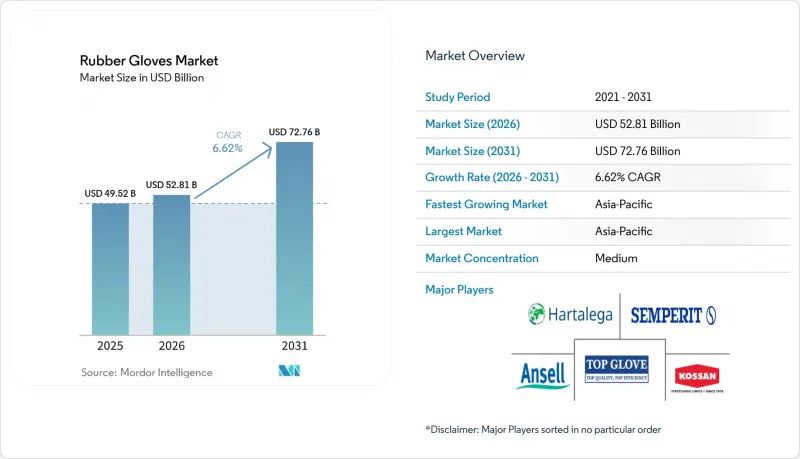
根據 Mordor Intelligence 預測,橡膠手套市場規模將從 2025 年的 495.2 億美元成長到 2026 年的 528.1 億美元,到 2031 年將達到 727.6 億美元,2026 年至 2031 年的年複合成長率(CAGR)為 6.62%。
本報告按產品類型(一次性橡膠手套和可重複使用橡膠手套)、最終用途(工業和住宅)以及地區(北美、歐洲、亞太、南美以及中東和非洲)進行細分。市場預測以價值(美元)和數量(噸)兩種單位呈現。
全球橡膠手套市場趨勢及洞察
醫療安全和感染控制標準
對醫療安全、感染預防和污染控制日益重視,推動了橡膠手套市場的擴張。醫療機構越來越重視嚴格的衛生規程,以最大限度地降低醫療相關感染(HAI)、交叉感染和接觸有害病原體的風險。橡膠手套在檢查、手術、診斷程序和患者照護活動中發揮至關重要的防護作用,為醫護人員提供保護屏障,因此被廣泛使用。嚴格的安全指南和感染控制措施的實施,增加了對高品質、耐用性、抗穿刺性和防護性能更佳的一次性無菌手套的需求。此外,醫療服務、臨床實驗室和預防醫學實踐的擴展也促進了手套的消耗。隨著醫護人員個人防護意識的提高以及對維護安全臨床環境重要性的認知不斷增強,預計全球對橡膠手套的需求將進一步成長。
外科手術和醫療治療的擴展
外科手術、醫療治療和臨床干預數量的不斷增加正在推動全球橡膠手套市場的擴張。對醫療保健服務日益成長的需求、不斷提高的患者照護需求以及醫院基礎設施的改善,都推動了對用於外科手術、檢查和診斷活動的無菌高性能手套的需求。橡膠手套對於維持無菌環境、防止交叉感染以及確保醫護人員和患者在醫療過程中的安全至關重要。此外,政府加強醫療衛生體系的措施也促進了市場成長。例如,中國的「健康中國2030」計畫加速了二、三線城市醫院的建設,擴大了手術能力,並刺激了對外科手套和檢查手套等醫療耗材的需求。隨著醫療衛生體系改善治療途徑和能力,對可靠的防護橡膠手套的需求預計將穩定成長。
原物料價格波動
原物料價格波動正嚴重阻礙全球橡膠手套市場的成長。製造商高度依賴天然橡膠乳膠、丁腈橡膠 (NBR) 和其他合成橡膠化合物等原料。橡膠的供應情況、供應條件、生產限制和價格波動直接影響製造成本,導致難以維持穩定的利潤率。投入成本的急劇上升會導致手套價格上漲,影響市場競爭,並可能影響終端用戶的購買決策。此外,對特定原料來源的依賴也使製造商面臨供應鏈的不確定性和成本壓力。這些價格波動使長期生產計畫變得複雜,迫使企業優先考慮成本最佳化、探索替代材料並提高營運效率,以減輕其對橡膠手套市場的影響。
細分市場分析
到2025年,一次性橡膠手套將佔橡膠手套市場78.92%的佔有率。這主要得益於其在對衛生、安全和污染控制要求極高的應用領域中的廣泛使用。隨著人們對感染預防、職場安全法規和嚴格衛生規範的日益重視,對一次性手套的需求顯著成長。這些手套提供一次性防護,並最大限度地降低交叉感染的風險。其便利性、經濟性、輕巧設計以及多種材質(如乳膠和丁腈橡膠)的選擇,使其在醫療保健、食品處理、實驗室、清潔和工業等領域中廣泛應用。手套製造技術的不斷進步,包括耐用性、抗穿刺性、舒適性和更多種類的無粉手套,進一步促進了其普及。
可重複使用的橡膠手套是成長最快的產品類別,預計從2026年到2031年將以7.32%的複合年成長率成長。這一成長主要得益於市場對耐用、經濟高效且永續的手部防護解決方案的需求不斷成長。隨著減少一次性用品廢棄物和推廣環保實踐的努力不斷加強,各行各業和消費者擴大採用持久耐用的可重複使用手套。這些手套具有卓越的強度、耐化學性和耐磨性,能夠經受反覆使用,使其成為清潔、化學品處理、製造、農業以及惡劣工作環境的理想選擇。材料技術的創新使可重複使用的手套在柔軟性、抓握力、舒適性和對惡劣工作環境的耐受性方面均得到提升,進一步推動了其普及。
區域分析
預計到2025年,亞太地區將佔全球橡膠手套市場佔有率的41.23%,並將繼續保持最快的成長速度,2026年至2031年的複合年成長率(CAGR)將達到7.23%。這一成長主要得益於強勁的生產能力、不斷成長的醫療需求、日益擴大的工業應用以及大規模手套製造商的存在。該地區擁有先進的橡膠加工基礎設施、豐富的原料供應以及持續擴大產能的投資,這些都為其發展提供了有利條件。醫療、食品加工、電子和製造業等行業需求的成長進一步推動了橡膠手套的消費。根據馬來西亞統計局的數據顯示,手套是橡膠製品中最大的出口商品,2024年10月出口額達15億馬幣,較2024年9月的12億馬幣增加21.8%。這進一步印證了該地區在全球橡膠手套生產和貿易中的重要地位。
北美是全球第二大橡膠手套區域市場,這得益於該地區嚴格的職場安全標準、先進的醫療保健基礎設施以及醫療和工業領域對個人防護設備)的廣泛應用。由於人們日益重視感染預防、遵守衛生標準、實驗室安全和工人保護,該地區的需求保持穩定。醫療機構、製藥企業、食品加工企業和高風險工業環境中丁腈手套和特殊手套的日益普及,正在推動市場成長。此外,旨在提高耐用性、舒適性、防過敏性和永續性的創新也正在推動全部區域產品的普及。
歐洲是橡膠手套的成熟市場,其特徵是需求受規格主導。該地區的成長得益於嚴格的監管要求、高品質的標準、永續性舉措以及醫療和工業領域對專用護手套的需求。對合規性和品質的重視持續影響歐洲市場的動態。南美洲、中東和非洲是新興市場,橡膠手套的需求日益成長。這些市場的成長得益於醫療保健服務的擴展、衛生意識的提高、工業安全措施的加強以及各行業防護設備使用量的增加。預計對醫療保健基礎設施、食品安全措施和工業發展的投資將支持這些發展中地區的長期需求。
其他好處:
- Excel格式的市場預測(ME)表
- 3個月的分析師支持
目錄
第1章:引言
- 研究假設和市場定義
- 調查範圍
第2章:調查方法
第3章執行摘要
第4章 市場狀況
- 市場概覽
- 市場促進因素
- 醫療安全和感染控制標準
- 外科手術和醫療治療的擴展
- 嚴格的職業安全與健康法規
- 手套製造技術的進步
- 永續性及環保橡膠手套的開發
- 由於擔心乳膠過敏,人們開始使用丁腈手套。
- 市場限制因素
- 原物料價格波動
- 與過敏和皮膚過敏相關的問題
- 合成橡膠手套的生物分解性低
- 替代手部防護材料的供應情況
- 消費行為分析
- 監理情勢
- 技術展望
- 波特五力分析
第5章 市場規模與成長預測
- 依產品類型
- 一次性橡膠手套
- 可重複使用的橡膠手套
- 按最終用途
- 產業
- 住宅
- 按地區
- 北美洲
- 美國
- 加拿大
- 墨西哥
- 其他北美國家
- 歐洲
- 德國
- 英國
- 義大利
- 法國
- 西班牙
- 荷蘭
- 波蘭
- 比利時
- 瑞典
- 其他歐洲國家
- 亞太地區
- 中國
- 印度
- 日本
- 澳洲
- 印尼
- 韓國
- 泰國
- 新加坡
- 其他亞太國家
- 南美洲
- 巴西
- 阿根廷
- 哥倫比亞
- 智利
- 秘魯
- 其他南美國家
- 中東和非洲
- 南非
- 沙烏地阿拉伯
- 阿拉伯聯合大公國
- 奈及利亞
- 埃及
- 摩洛哥
- 土耳其
- 其他中東和非洲國家
- 北美洲
第6章 競爭情勢
- 市場集中度
- 策略趨勢
- 市佔率分析
- 公司簡介
- Top Glove Corporation Bhd
- Hartalega Holdings Berhad
- Kossan Rubber Industries Bhd
- Ansell Limited
- Semperit AG Holding
- Supermax Corporation Berhad
- Cardinal Health, Inc.
- Medline Industries, LP
- Kimberly-Clark Corporation
- Honeywell International Inc.
- 3M Company
- McKesson Corporation
- Bunzl plc
- Unigloves(UK)Limited
- AMMEX Corporation
- YTY Industry Holdings Berhad
- Hextar Healthcare Berhad
- Rubberex Corporation(M)Berhad
- Sri Trang Gloves Public Company Limited
- Mapa Professional GmbH
第7章 市場機會與未來展望
According to Mordor Intelligence, the rubber gloves market is projected to grow from USD 49.52 billion in 2025 to USD 52.81 billion in 2026, reaching USD 72.76 billion by 2031, with a CAGR of 6.62% during 2026-2031.
This report is Segmented by Product Type (Disposable Rubber Gloves and Reusable Rubber Gloves), End Use (Industrial and Residential), and Geography (North America, Europe, Asia-Pacific, South America, Middle East and Africa). The Market Forecasts are Provided in Both Value (USD) and Volume (Tons).
Global Rubber Gloves Market Trends and Insights
Healthcare safety and infection prevention standards
The growing emphasis on healthcare safety, infection prevention, and contamination control is driving the expansion of the rubber gloves market. Healthcare facilities are increasingly prioritizing strict hygiene protocols to minimize the risk of healthcare-associated infections (HAIs), cross-contamination, and exposure to harmful pathogens. Rubber gloves play a vital role as a protective barrier for healthcare professionals during examinations, surgeries, diagnostic procedures, and patient care activities, contributing to their widespread use. The enforcement of stringent safety guidelines and infection control measures has heightened the demand for high-quality disposable and sterile gloves with improved durability, puncture resistance, and barrier protection. Furthermore, the expansion of medical services, laboratory testing, and preventive healthcare practices is boosting glove consumption. Rising awareness about personal protection among healthcare workers and the importance of maintaining safe clinical environments are expected to further drive the global demand for rubber gloves.
Expansion of surgical procedures and medical treatments
The growing number of surgical procedures, medical treatments, and clinical interventions is driving the expansion of the global rubber gloves market. The increasing demand for healthcare services, rising patient care needs, and the development of hospital infrastructure have heightened the requirement for sterile, high-performance gloves used in surgeries, examinations, and diagnostic activities. Rubber gloves are essential for maintaining aseptic conditions, preventing cross-contamination, and ensuring the safety of healthcare professionals and patients during medical procedures. Additionally, government initiatives to enhance healthcare capacity are contributing to market growth. For example, China's Health China 2030 initiative has accelerated hospital construction and expanded surgical capabilities in tier-2 and tier-3 cities, boosting the demand for medical consumables such as surgical and examination gloves . As healthcare systems improve treatment accessibility and procedural capacity, the demand for reliable protective rubber gloves is anticipated to grow steadily.
Fluctuating raw material prices
Fluctuations in raw material prices significantly restrain the growth of the global rubber gloves market. Manufacturers rely heavily on materials such as natural rubber latex, nitrile butadiene rubber (NBR), and other synthetic rubber compounds. Variability in raw material availability, supply conditions, production constraints, and rubber price volatility directly impact manufacturing costs, posing challenges to maintaining stable profit margins. Sudden increases in input costs can result in higher glove prices, affecting competitiveness and influencing purchasing decisions among end users. Furthermore, reliance on specific raw material sources exposes manufacturers to supply chain uncertainties and cost pressures. These price fluctuations complicate long-term production planning, compelling companies to prioritize cost optimization, explore alternative materials, and enhance operational efficiencies to mitigate their impact on the rubber gloves market.
Other drivers and restraints analyzed in the detailed report include:
- Stringent workplace safety regulations
- Advancements in glove manufacturing technologies
- Allergy and skin sensitivity issues
For complete list of drivers and restraints, kindly check the Table Of Contents.
Segment Analysis
Disposable rubber gloves accounted for 78.92% of the rubber gloves market in 2025, driven by their extensive use in applications requiring high standards of hygiene, safety, and contamination control. The growing emphasis on infection prevention, workplace safety regulations, and stringent hygiene protocols has significantly increased the demand for disposable gloves. These gloves offer single-use protection, minimizing the risk of cross-contamination. Their convenience, affordability, lightweight design, and availability in various materials, such as latex and nitrile, have made them widely adopted across sectors like healthcare, food handling, laboratories, cleaning, and industrial operations. Ongoing advancements in glove manufacturing, including improved durability, enhanced puncture resistance, better comfort, and powder-free options, have further contributed to their widespread acceptance.
Reusable rubber gloves are the fastest-growing product segment, with a projected CAGR of 7.32% during 2026-2031. This growth is fueled by the rising demand for durable, cost-effective, and environmentally sustainable hand protection solutions. Increasing efforts to reduce single-use waste and promote eco-friendly practices have encouraged industries and consumers to adopt reusable gloves with extended service life. These gloves offer superior strength, chemical resistance, abrasion resistance, and the ability to endure repeated use, making them ideal for tasks such as cleaning, chemical handling, manufacturing, agriculture, and heavy-duty applications. Innovations in material technologies have resulted in reusable gloves with improved flexibility, enhanced grip, greater comfort, and higher resistance to challenging working conditions, further driving their adoption.
Complete Report Scope:
- By Product Type
- Disposable Rubber Gloves
- Reusable Rubber Gloves
- By End Use
- Industrial
- Residential
- By Geography
- North America
- United States
- Canada
- Mexico
- Rest of North America
- Europe
- Germany
- United Kingdom
- Italy
- France
- Spain
- Netherlands
- Poland
- Belgium
- Sweden
- Rest of Europe
- Asia-Pacific
- China
- India
- Japan
- Australia
- Indonesia
- South Korea
- Thailand
- Singapore
- Rest of Asia-Pacific
- South America
- Brazil
- Argentina
- Colombia
- Chile
- Peru
- Rest of South America
- Middle East and Africa
- South Africa
- Saudi Arabia
- United Arab Emirates
- Nigeria
- Egypt
- Morocco
- Turkey
- Rest of Middle East and Africa
- North America
Geography Analysis
Asia-Pacific accounted for 41.23% of the rubber gloves market in 2025 and is projected to remain the fastest-growing region, with a CAGR of 7.23% during 2026-2031. This growth is driven by robust manufacturing capabilities, increasing healthcare needs, expanding industrial applications, and the presence of large-scale glove producers. The region benefits from advanced rubber processing infrastructure, abundant raw material availability, and ongoing investments in production capacity expansion. Rising demand from industries such as healthcare, food processing, electronics, and manufacturing has further boosted rubber glove consumption. According to the Department of Statistics Malaysia, gloves were the leading export category among rubber-based products, reaching RM1.5 billion in October 2024, a 21.8% increase from RM1.2 billion in September 2024 . This underscores the region's significant role in global rubber glove production and trade.
North America is the second-largest regional market for rubber gloves, supported by stringent workplace safety standards, advanced healthcare infrastructure, and widespread adoption of personal protective equipment in medical and industrial sectors. The region experiences consistent demand due to a growing focus on infection prevention, hygiene compliance, laboratory safety, and worker protection. Increased utilization of nitrile and specialty gloves in healthcare facilities, pharmaceutical operations, food handling, and high-risk industrial environments is driving market growth. Additionally, innovations aimed at improving durability, comfort, allergy prevention, and sustainability are enhancing product adoption across the region.
Europe represents a mature market for rubber gloves, characterized by specification-driven demand. Growth in this region is fueled by stringent regulatory requirements, high-quality standards, sustainability initiatives, and the need for specialized protective gloves in healthcare and industrial applications. The focus on compliance and quality continues to shape the market dynamics in Europe. South America, the Middle East, and Africa are emerging regions with increasing adoption opportunities for rubber gloves. Growth in these markets is driven by expanding healthcare services, improving hygiene awareness, rising industrial safety practices, and greater use of protective equipment across various sectors. Investments in healthcare infrastructure, food safety practices, and industrial development are expected to support long-term demand in these developing regions.
- Top Glove Corporation Bhd
- Hartalega Holdings Berhad
- Kossan Rubber Industries Bhd
- Ansell Limited
- Semperit AG Holding
- Supermax Corporation Berhad
- Cardinal Health, Inc.
- Medline Industries, LP
- Kimberly-Clark Corporation
- Honeywell International Inc.
- 3M Company
- McKesson Corporation
- Bunzl plc
- Unigloves (UK) Limited
- AMMEX Corporation
- YTY Industry Holdings Berhad
- Hextar Healthcare Berhad
- Rubberex Corporation (M) Berhad
- Sri Trang Gloves Public Company Limited
- Mapa Professional GmbH
Additional Benefits:
- The market estimate (ME) sheet in Excel format
- 3 months of analyst support
TABLE OF CONTENTS
1 INTRODUCTION
- 1.1 Study Assumptions and Market Definition
- 1.2 Scope of the Study
2 RESEARCH METHODOLOGY
3 EXECUTIVE SUMMARY
4 MARKET LANDSCAPE
- 4.1 Market Overview
- 4.2 Market Drivers
- 4.2.1 Healthcare safety and infection prevention standards
- 4.2.2 Expansion of surgical procedures and medical treatments
- 4.2.3 Stringent workplace safety regulations
- 4.2.4 Advancements in glove manufacturing technologies
- 4.2.5 Sustainability and development of eco-friendly rubber gloves
- 4.2.6 Adoption of nitrile gloves due to latex allergy concerns
- 4.3 Market Restraints
- 4.3.1 Fluctuating raw material prices
- 4.3.2 Allergy and skin sensitivity issues
- 4.3.3 Limited biodegradability of synthetic rubber gloves
- 4.3.4 Availability of alternative hand protection materials
- 4.4 Consumer Behavior Analysis
- 4.5 Regulatory Landscape
- 4.6 Technological Outlook
- 4.7 Porter's Five Forces Analysis
- 4.7.1 Threat of New Entrants
- 4.7.2 Bargaining Power of Buyers
- 4.7.3 Bargaining Power of Suppliers
- 4.7.4 Threat of Substitutes
- 4.7.5 Intensity of Competitive Rivalry
5 MARKET SIZE AND GROWTH FORECASTS (VALUE AND VOLUME)
- 5.1 By Product Type
- 5.1.1 Disposable Rubber Gloves
- 5.1.2 Reusable Rubber Gloves
- 5.2 By End Use
- 5.2.1 Industrial
- 5.2.2 Residential
- 5.3 By Geography
- 5.3.1 North America
- 5.3.1.1 United States
- 5.3.1.2 Canada
- 5.3.1.3 Mexico
- 5.3.1.4 Rest of North America
- 5.3.2 Europe
- 5.3.2.1 Germany
- 5.3.2.2 United Kingdom
- 5.3.2.3 Italy
- 5.3.2.4 France
- 5.3.2.5 Spain
- 5.3.2.6 Netherlands
- 5.3.2.7 Poland
- 5.3.2.8 Belgium
- 5.3.2.9 Sweden
- 5.3.2.10 Rest of Europe
- 5.3.3 Asia-Pacific
- 5.3.3.1 China
- 5.3.3.2 India
- 5.3.3.3 Japan
- 5.3.3.4 Australia
- 5.3.3.5 Indonesia
- 5.3.3.6 South Korea
- 5.3.3.7 Thailand
- 5.3.3.8 Singapore
- 5.3.3.9 Rest of Asia-Pacific
- 5.3.4 South America
- 5.3.4.1 Brazil
- 5.3.4.2 Argentina
- 5.3.4.3 Colombia
- 5.3.4.4 Chile
- 5.3.4.5 Peru
- 5.3.4.6 Rest of South America
- 5.3.5 Middle East and Africa
- 5.3.5.1 South Africa
- 5.3.5.2 Saudi Arabia
- 5.3.5.3 United Arab Emirates
- 5.3.5.4 Nigeria
- 5.3.5.5 Egypt
- 5.3.5.6 Morocco
- 5.3.5.7 Turkey
- 5.3.5.8 Rest of Middle East and Africa
- 5.3.1 North America
6 COMPETITIVE LANDSCAPE
- 6.1 Market Concentration
- 6.2 Strategic Moves
- 6.3 Market Share Analysis
- 6.4 Company Profiles (includes Global level Overview, Market level overview, Core Segments, Financials as available, Strategic Information, Market Rank/Share for key companies, Products and Services, and Recent Developments)
- 6.4.1 Top Glove Corporation Bhd
- 6.4.2 Hartalega Holdings Berhad
- 6.4.3 Kossan Rubber Industries Bhd
- 6.4.4 Ansell Limited
- 6.4.5 Semperit AG Holding
- 6.4.6 Supermax Corporation Berhad
- 6.4.7 Cardinal Health, Inc.
- 6.4.8 Medline Industries, LP
- 6.4.9 Kimberly-Clark Corporation
- 6.4.10 Honeywell International Inc.
- 6.4.11 3M Company
- 6.4.12 McKesson Corporation
- 6.4.13 Bunzl plc
- 6.4.14 Unigloves (UK) Limited
- 6.4.15 AMMEX Corporation
- 6.4.16 YTY Industry Holdings Berhad
- 6.4.17 Hextar Healthcare Berhad
- 6.4.18 Rubberex Corporation (M) Berhad
- 6.4.19 Sri Trang Gloves Public Company Limited
- 6.4.20 Mapa Professional GmbH
7 MARKET OPPORTUNITIES AND FUTURE OUTLOOK

 橡膠手套市場規模、佔有率和成長分析:按產品類型、材料類型、應用、形狀、最終用戶、分銷管道和地區分類-2026-2033年產業預測
 橡膠手套市場報告:按產品、類型、材料、最終用途行業和地區分類(2026-2034 年)
 全球橡膠手套市場規模、佔有率、趨勢和成長分析報告(2026-2034年)
 2026年全球橡膠手套市場報告全球橡膠手套市場:2025-2030 年預測
 全球橡膠手套市場規模研究,按材料、配銷通路、類型、產品、最終用途和區域預測 2022-2032
 橡膠手套市場規模、佔有率、趨勢分析報告:按材料、分銷管道、類型、產品、最終用途、地區、細分市場、預測,2025-2030 年