


 |
市場調查報告書
商品編碼
2072808
海藻飼料:市場佔有率分析、產業趨勢與統計、成長預測(2026-2031)Seaweed-Based Feed - Market Share Analysis, Industry Trends & Statistics, Growth Forecasts (2026 - 2031) |
||||||

※ 本網頁內容可能與最新版本有所差異。詳細情況請與我們聯繫。
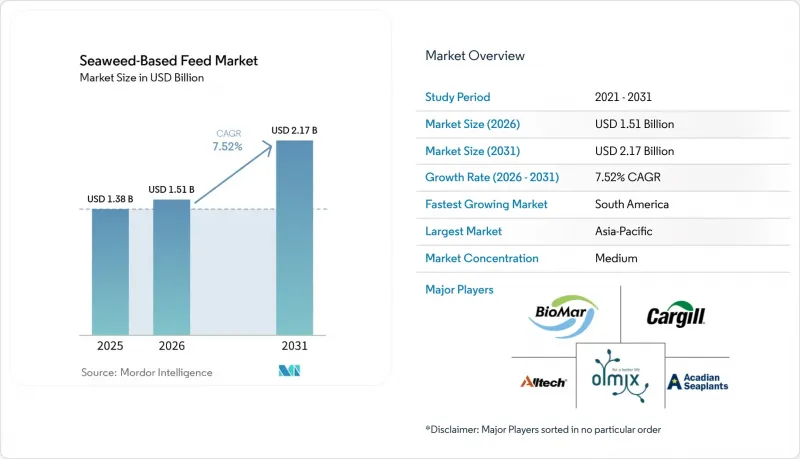
根據 Mordor Intelligence 預測,海藻衍生飼料市場規模預計將在 2025 年達到 13.8 億美元,從 2026 年的 15.1 億美元成長到 2031 年的 21.7 億美元,並在預測期(2026-2031 年)內實現 7.52% 的複合年成長率。
本報告按應用領域(水產養殖、畜牧業等)、藻類種類(褐藻、紅藻等)、形態(粉末、顆粒、液體提取物、片狀)、配銷通路(直接銷售(B2B)和間接銷售)以及地區(北美、南美、歐洲、亞太、中東和非洲)進行細分。市場預測以美元計價。
全球海藻飼料市場趨勢及洞察
對永續水產養殖飼料的需求不斷成長
為了實現永續性目標並提高飼料轉換率,養殖魚蝦生產商正以海藻衍生原料取代魚粉和豆粕。 2026年,BioMar集團推出了以孵化場為導向的功能性水產飼料,將海藻衍生成分定位為永續的解決方案。在印度,總理漁業財富計畫(Pradhan Mantri Matsya Sampada Yojana)使海藻產量在2024年成長了兩倍,達到74,083公噸,從而降低了成本,並鞏固了亞太地區在海帶飼料供應方面的地位。科學檢驗、產品創新和供應量的增加正在推動海藻在永續水產養殖營養中發揮重要作用。
對抗生素生長促進劑的監管限制
歐盟禁止預防性使用抗生素以及美國食品藥物管理局(FDA)的指導意見,迫使飼料生產商在生產過程中添加天然免疫增強劑。為了回應這些監管變化,嘉吉公司已在其肉雞幼畜飼料中添加海藻——結節藻(Ascophyllum nodosum),以滿足無抗生素標籤要求並保障動物健康。 2024年,加拿大批准在水產養殖飼料中使用藻類ω-3油,這標誌著海洋來源的生物活性物質在動物營養領域已被廣泛認可。該批准反映出監管機構對創新和永續飼料成分的接受度日益提高。此外,基於國際標準化組織(ISO)22000標準的可追溯性標準,目前優先考慮垂直整合的海洋水產養殖作業,以提升供應鏈的透明度和課責。
與傳統添加劑相比,加工成本更高
冷凍乾燥海藻的成本為每公斤 8 至 12 美元,遠高於標準礦物質預混合料每公斤 0.5 至 1.5 美元的成本,導致價格溢價至少 600%。 Cascadia Seaweed 公司於 2024 年獲得了 296 萬美元的資金,用於在不列顛哥倫比亞省建造一座生物精煉廠,但該公司需要每年生產超過 1 萬噸才能收回大豆蛋白濃縮物的成本。總部位於西澳大利亞的水產養殖公司 Fremantle Seaweed 於 2025 年獲得了 144 萬美元的資金,用於建造一個佔地 3000 公頃的海藻養殖場,但其產品的成本效益仍然低於 3-硝基氧丙醇抑製劑,這限制了對成本敏感的牛肉生產商的採用。在巴西和阿根廷,由於缺乏能源補貼,只能採用日曬乾燥法,這會導致熱敏性多醣劣化高達 40%。因此,其功能性降低,價格也必須降低。這些成本壁壘使得海藻衍生添加劑始終被歸類為小眾、高價成分,減緩了海藻飼料市場的成長。
細分市場分析
截至2025年,水產養殖業佔海藻飼料市場的46%,反映了數十年來海藻被添加到鮭魚、鱒魚和蝦類飼料的做法。預計2026年至2031年,畜牧業將以12.3%的複合年成長率佔據更大的海藻飼料市場佔有率,因為乳牛和肉牛生產商正在採用紅藻提取物來應對氣候變遷帶來的稅收。在禽類和豬類養殖業,儘管小規模試驗顯示出免疫益處,但由於監管機構要求提供更多消化率數據,其應用仍然有限。寵物食品製造商開始在其高階產品線中添加藻類來源的ω-3油,以使其產品脫穎而出,這些高階產品線已於2026年推出。歐洲循環水產養殖系統(RAS)的業者報告稱,添加1%的海帶粉可以提高顆粒飼料在水中的穩定性。
畜牧業的快速推廣取決於穩定的銷售管道。 Sea Forest公司已簽署契約,計劃到2025年供應12.3萬牛,並與Olfa公司合作開拓歐盟乳牛市場。 Simbrosia公司預計,其位於夏威夷的加工廠自2027年起每年可滿足140萬頭的需求。水產養殖領域的試驗也擴展到太平洋白蝦,添加2%的Asparagopsis藻類混合物後,蝦子的生長速度提高了30%。寵物食品品牌正在測試旨在保持寵物毛髮光澤和關節健康的微藻類混合物,但必須仔細考慮配方,以避免碘含量超過上限。一家家禽集團預計,如果多家工廠的研究表明,0.5%至1%的海帶混合物對所有肉雞品種都有效,那麼銷售量將會成長。
到2025年,褐藻將佔銷售額的42%,因為中國和日本的海帶供應鏈已經能夠向當地加工廠供貨。紅藻是成長最快的細分市場,預計到2031年複合年成長率將達到13.1%,隨著海帶供應量的增加,紅藻有望迅速擴大海藻飼料市場。綠藻的市佔率較小,但其蛋白質含量高,正吸引著陸基水產養殖業的注意。微藻類混合物在寵物食品和特種魚飼料等高階細分市場需求旺盛,價格超過每公斤15美元。
紅藻的發展勢頭得到了證實其有效性的數據支持。墨西哥於2025年批准使用「溴藻」(brominata),這為其在監管領域奠定了基礎。 CH4 Global的「生態園區」(EcoPark)將於2025年投入運作,每天為數萬牛提供飼料。褐藻憑藉BioMar於2025年推出的「POWER H2O」飼料,持續在水產養殖領域保持領先地位。 Marinova在2024年將其岩藻聚醣產量提高了兩倍,以滿足其業務擴張過程中對免疫調節劑日益成長的需求。 2024年的一項試驗表明,透過添加綠藻滸苔(Ulva),鵪鶉的飼料轉換率持續提高,這表明其在單胃動物中具有更廣泛的應用前景。
區域分析
亞太地區在2025年仍維持45%的最大市佔率。這反映了中國海帶供應鏈的成熟以及印度海帶養殖場的擴張。日本和韓國的生產商正在利用垂直整合模式來降低物流成本並加快批次級可追溯性。南美洲是成長最快的地區,2026年至2031年的複合年成長率將達到10.5%。這主要得益於智利鮭魚養殖場採用一體化的大規模海藻養殖系統以及巴西牛肉出口商將藍排碳權貨幣化。這些量化趨勢表明,主要且成長最快的地區正在推動整體市場成長動能。
在歐洲,挪威的褐藻生物精煉已達到商業規模,歐盟法規優先考慮天然飼料添加劑而非抗生素,因此市場需求仍然強勁。在北美,北大西洋褐藻的收穫以及大型酪農整合企業早期採用海藻補充劑,都推動了市場成長。在中東,進口粉劑被添加到家禽飼料中,使得褐藻的應用穩定成長。同時,非洲正在探索沿海水產養殖試點項目,但仍依賴來自亞洲的萃取物。儘管這些地區的絕對銷售額落後於主要地區,但由於技術轉移和監管協調,市場機會仍在不斷擴大。
預計到2031年,區域投資將推動海藻飼料市場成長。亞太地區各國政府正在資助育苗設施、乾燥設備和生物反應器建設,以降低新生產商的准入門檻;與此同時,澳洲的養殖場正在擴大繩索栽培蘆筍的生產規模,以減少甲烷排放。智利、挪威和加拿大正在改造生物煉製廠,以提高每公斤生質能的價值並增強成本競爭力。隨著可追溯供應鏈的成熟,所有地區都將更有能力提高海藻飼料在水產養殖、畜牧業和寵物食品領域的應用比例,進一步鞏固其長期成長動能。
其他好處:
- Excel格式的市場預測(ME)表
- 3個月的分析師支持
目錄
第1章:引言
- 研究假設和市場定義
- 調查範圍
第2章:調查方法
第3章執行摘要
第4章 市場狀況
- 市場概覽
- 市場促進因素
- 對永續水產養殖飼料的需求不斷成長
- 對抗生素生長促進劑的監管限制
- 海藻來源生物活性成分的功能效應
- 商業海水養殖能力的擴張
- 旨在減少甲烷排放的牛飼料示範試驗正在加速。
- 藍碳ESG信用貨幣化
- 市場限制因素
- 與傳統添加劑相比,加工成本更高
- 季節性收成導致供應波動
- 與重金屬污染相關的合規風險
- 缺乏關於各種消化率的資料集
- 監理情勢
- 技術展望
- 波特五力分析
第5章 市場規模與成長預測
- 目的
- 水產養殖
- 家畜
- 家禽
- 寵物食品
- 種子
- 褐藻
- 紅藻
- 綠藻
- 微藻類混合物
- 形式
- 粉末
- 顆粒
- 液體萃取物
- 薄片
- 分銷管道
- 直接(B2B)
- 間接
- 地區
- 北美洲
- 美國
- 加拿大
- 墨西哥
- 其他北美國家
- 南美洲
- 巴西
- 阿根廷
- 其他南美國家
- 歐洲
- 德國
- 英國
- 法國
- 義大利
- 西班牙
- 俄羅斯
- 其他歐洲國家
- 亞太地區
- 中國
- 日本
- 印度
- 韓國
- 澳洲和紐西蘭
- 其他亞太國家
- 中東
- 沙烏地阿拉伯
- 阿拉伯聯合大公國
- 其他中東國家
- 非洲
- 南非
- 肯亞
- 其他非洲國家
- 北美洲
第6章 競爭情勢
- 市場集中度
- 策略趨勢
- 市佔率分析
- 公司簡介
- Cargill, Incorporated
- Olmix SA
- BioMar Group A/S
- Acadian Seaplants Limited
- Alltech, Inc.
- Ocean Harvest Technology Group Limited
- DSM-Firmenich AG
- CP Kelco US, Inc.
- Algaia SA
- Seakura Ltd.
- Blue Ocean Barns, Inc.
- CH4 Global, Inc.
- Sea Forest Ltd.
- Symbrosia Inc.
- FutureFeed Pty Ltd.
第7章 市場機會與未來展望
According to Mordor Intelligence, the seaweed-based feed market was valued at USD 1.38 billion in 2025 and is projected to grow from USD 1.51 billion in 2026 to USD 2.17 billion by 2031, registering a CAGR of 7.52% during the forecast period (2026-2031).
This report is Segmented by Application (Aquaculture, Livestock, and More), by Species (Brown Seaweed, Red Seaweed, and More), by Form (Powder, Pellets, Liquid Extract, and Flakes), by Distribution Channel (Direct (B2B) and Indirect), and by Geography (North America, South America, Europe, Asia-Pacific, Middle East, and Africa). The Market Forecasts are Provided in Terms of Value (USD).
Global Seaweed-Based Feed Market Trends and Insights
Rising Demand for Sustainable Aquaculture Feed
Farmed fish and shrimp producers are replacing fishmeal and soy concentrate with seaweed-based ingredients to meet sustainability goals and improve feed-conversion ratios. In 2026, BioMar Group A/S launched functional aquafeed for hatcheries, highlighting seaweed derivatives as sustainable solutions. India's seaweed production tripled to 74,083 metric tons in 2024 under the Pradhan Mantri Matsya Sampada Yojana, reducing costs and strengthening Asia-Pacific's role in kelp-based feed supply. Scientific validation, product innovation, and increased supply are driving seaweed's role in sustainable aquaculture nutrition.
Regulatory Curbs on Antibiotic Growth Promoters
The European Union's ban on prophylactic antibiotics and the United States Food and Drug Administration's guidance have compelled feed mills to adopt natural immunity enhancers as part of their production processes. In response to these regulatory changes, Cargill has incorporated Ascophyllum nodosum, a type of seaweed, into broiler starter feeds to comply with antibiotic-free labeling requirements and support animal health. In 2024, Canada approved the use of algal omega-3 oil in aquafeeds, marking a significant step toward the acceptance of marine bioactives in animal nutrition. This approval reflects a growing openness among regulatory agencies to innovative, sustainable feed ingredients. Additionally, traceability standards under the International Organization for Standardization (ISO) 22,000 now favor vertically integrated ocean farming operations, promoting enhanced transparency and accountability in the supply chain.
High Processing Cost Versus Conventional Additives
Freeze-drying Asparagopsis costs USD 8-12 per kilogram, far higher than USD 0.50-1.50 for standard mineral premixes, creating a price premium of at least 600%. Cascadia Seaweed raised USD 2.96 million in 2024 for a British Columbia biorefinery but requires over 10,000 metric tons of annual output to match soy-protein concentrate costs. Fremantle Seaweed an aquaculture farm based in western Australia secured USD 1.44 million in 2025 for a 3,000-hectare Asparagopsis farm, but its product remains less cost-effective than 3-nitrooxypropanol inhibitors, limiting adoption among cost-sensitive beef producers. In Brazil and Argentina, sun-drying necessitated by the lack of energy subsidies degrades heat-sensitive polysaccharides by up to 40%, reducing functional value and forcing price discounts. These cost barriers keep seaweed additives classified as niche, premium inputs, slowing the growth of the seaweed-based feed market.
Other drivers and restraints analyzed in the detailed report include:
- Functional Benefits of Seaweed Bio-actives
- Expansion of Commercial Ocean Farming Capacity
- Supply Variability Due to Seasonal Harvests
For complete list of drivers and restraints, kindly check the Table Of Contents.
Segment Analysis
Aquaculture accounted for 46% of the seaweed-based feed market share in 2025, reflecting decades of established inclusion in the diets of salmon, trout, and shrimp. Livestock is anticipated to capture a larger share of the seaweed-based feed market, driven by 12.3% CAGR growth during 2026-2031, as dairy and beef operators adopt red seaweed extracts to meet climate levies. Poultry and swine remain minor users because regulators require more digestibility data, although small-scale trials show immune benefits. Pet food formulators are beginning to blend algal omega-3 oils to differentiate premium lines launched in 2026. Recirculating aquaculture system operators in Europe report improved pellet water stability when 1% kelp meal is added.
Rapid livestock uptake rests on secured offtake deals. Sea Forest signed agreements covering 123,000 cattle in 2025 and partnered with Orffa for European Union dairy channels. Symbrosia expects its Hawaii refinery to service 1.4 million head annually from 2027. Aquaculture trials have expanded to Pacific white shrimp, showing 30% growth gains at 2% Asparagopsis inclusion. Pet brands test microalgae blends for coat shine and joint health yet must formulate around iodine ceilings. Poultry integrators could unlock volume once multi-site studies validate 0.5-1% kelp inclusion across broiler breeds.
Brown seaweed retained 42% of revenue in 2025 because Laminaria supply chains in China and Japan already feed regional mills. Red seaweed is the fastest-growing segment, with a 13.1% CAGR through 2031, and is forecast to sharply expand the seaweed-based feed market once Asparagopsis volumes scale. Green seaweed holds a smaller slice but brings high protein concentrations that appeal to land-based aquaculture. Micro-algae blends attract premium niches in pet food and specialty fish diets at above USD 15 per kilogram.
Efficacy data underpins red seaweed momentum. Mexico's 2025 authorization of Brominata established a regulatory beachhead. CH4 Global's EcoPark came online in 2025 to serve tens of thousands of cattle daily. Brown seaweed maintains its aquaculture dominance through BioMar's POWER H2O feed launched in 2025. Marinova's 2024 expansion tripled fucoidan output to meet rising demand for immunomodulators. Green Ulva inclusion continued to improve quail feed conversion in 2024 trials, hinting at broader monogastric applications.
Complete Report Scope:
- Application
- Aquaculture
- Livestock
- Poultry
- Pet Food
- Species
- Brown seaweed
- Red seaweed
- Green seaweed
- Micro-algae blends
- Form
- Powder
- Pellets
- Liquid extract
- Flakes
- Distribution Channel
- Direct (B2B)
- Indirect
- Geography
- North America
- United States
- Canada
- Mexico
- Rest of North America
- South America
- Brazil
- Argentina
- Rest of South America
- Europe
- Germany
- United Kingdom
- France
- Italy
- Spain
- Russia
- Rest of Europe
- Asia-Pacific
- China
- Japan
- India
- South Korea
- Australia and New Zealand
- Rest of Asia-Pacific
- Middle East
- Saudi Arabia
- United Arab Emirates
- Rest of Middle East
- Africa
- South Africa
- Kenya
- Rest of Africa
- North America
Geography Analysis
Asia-Pacific retained the largest 45% market share in 2025, reflecting deep Laminaria supply chains in China and expanding kelp farms in India. Producers in Japan and South Korea leverage vertically integrated models that cut logistics costs and speed batch-level traceability. South America is the fastest region, advancing at a 10.5% CAGR over 2026-2031 as Chilean salmon companies adopt integrated macroalgae systems and Brazilian beef exporters monetize blue-carbon credits. These quantitative trends show that the leading, fastest territories drive overall market growth momentum.
Europe maintains robust demand as Norwegian brown-seaweed biorefineries reach commercial scale and European Union regulations favor natural feed additives over antibiotics. North America benefits from Ascophyllum harvests in the North Atlantic and early adoption of Asparagopsis supplements by large dairy integrators. The Middle East shows steady uptake through imported powders blended into poultry rations, while Africa relies on Asian extracts but explores coastal farming pilots. Although these areas trail the leaders in absolute revenue, technology transfer and regulatory alignment continue to widen their addressable opportunity.
Regional investments are anticipated to broaden the seaweed-based feed market size through 2031. Asia-Pacific governments fund nurseries, dryers and bioreactors that lower entry barriers for new growers, while Australian hubs scale rope-grown Asparagopsis for methane reduction. Chile, Norway and Canada refine biorefinery designs that squeeze more value from each kilogram of biomass, improving cost competitiveness. As traceable supply networks mature, all regions are positioned to raise inclusion rates across aquaculture, livestock and pet-food applications, reinforcing the long-term growth trajectory.
- Cargill, Incorporated
- Olmix SA
- BioMar Group A/S
- Acadian Seaplants Limited
- Alltech, Inc.
- Ocean Harvest Technology Group Limited
- DSM-Firmenich AG
- CP Kelco U.S., Inc.
- Algaia SA
- Seakura Ltd.
- Blue Ocean Barns, Inc.
- CH4 Global, Inc.
- Sea Forest Ltd.
- Symbrosia Inc.
- FutureFeed Pty Ltd.
Additional Benefits:
- The market estimate (ME) sheet in Excel format
- 3 months of analyst support
TABLE OF CONTENTS
1 Introduction
- 1.1 Study Assumptions and Market Definition
- 1.2 Scope of the Study
2 Research Methodology
3 Executive Summary
4 Market Landscape
- 4.1 Market Overview
- 4.2 Market Drivers
- 4.2.1 Rising demand for sustainable aquaculture feed
- 4.2.2 Regulatory curbs on antibiotic growth promoters
- 4.2.3 Functional benefits of seaweed bio-actives
- 4.2.4 Expansion of commercial ocean farming capacity
- 4.2.5 Methane-reducing cattle feed trials gain traction
- 4.2.6 Blue-carbon ESG credit monetization
- 4.3 Market Restraints
- 4.3.1 High processing cost versus conventional additives
- 4.3.2 Supply variability due to seasonal harvests
- 4.3.3 Heavy-metal contamination compliance risks
- 4.3.4 Sparse multi-species digestibility datasets
- 4.4 Regulatory Landscape
- 4.5 Technological Outlook
- 4.6 Porter's Five Forces Analysis
- 4.6.1 Threat of New Entrants
- 4.6.2 Bargaining Power of Suppliers
- 4.6.3 Bargaining Power of Buyers
- 4.6.4 Threat of Substitutes
- 4.6.5 Intensity of Competitive Rivalry
5 Market Size and Growth Forecasts (Value)
- 5.1 Application
- 5.1.1 Aquaculture
- 5.1.2 Livestock
- 5.1.3 Poultry
- 5.1.4 Pet Food
- 5.2 Species
- 5.2.1 Brown seaweed
- 5.2.2 Red seaweed
- 5.2.3 Green seaweed
- 5.2.4 Micro-algae blends
- 5.3 Form
- 5.3.1 Powder
- 5.3.2 Pellets
- 5.3.3 Liquid extract
- 5.3.4 Flakes
- 5.4 Distribution Channel
- 5.4.1 Direct (B2B)
- 5.4.2 Indirect
- 5.5 Geography
- 5.5.1 North America
- 5.5.1.1 United States
- 5.5.1.2 Canada
- 5.5.1.3 Mexico
- 5.5.1.4 Rest of North America
- 5.5.2 South America
- 5.5.2.1 Brazil
- 5.5.2.2 Argentina
- 5.5.2.3 Rest of South America
- 5.5.3 Europe
- 5.5.3.1 Germany
- 5.5.3.2 United Kingdom
- 5.5.3.3 France
- 5.5.3.4 Italy
- 5.5.3.5 Spain
- 5.5.3.6 Russia
- 5.5.3.7 Rest of Europe
- 5.5.4 Asia-Pacific
- 5.5.4.1 China
- 5.5.4.2 Japan
- 5.5.4.3 India
- 5.5.4.4 South Korea
- 5.5.4.5 Australia and New Zealand
- 5.5.4.6 Rest of Asia-Pacific
- 5.5.5 Middle East
- 5.5.5.1 Saudi Arabia
- 5.5.5.2 United Arab Emirates
- 5.5.5.3 Rest of Middle East
- 5.5.6 Africa
- 5.5.6.1 South Africa
- 5.5.6.2 Kenya
- 5.5.6.3 Rest of Africa
- 5.5.1 North America
6 Competitive Landscape
- 6.1 Market Concentration
- 6.2 Strategic Moves
- 6.3 Market Share Analysis
- 6.4 Company Profiles (Includes Global Level Overview, Market Level Overview, Core Segments, Financials as Available, Strategic Information, Market Rank/Share, Products and Services, and Recent Developments)
- 6.4.1 Cargill, Incorporated
- 6.4.2 Olmix SA
- 6.4.3 BioMar Group A/S
- 6.4.4 Acadian Seaplants Limited
- 6.4.5 Alltech, Inc.
- 6.4.6 Ocean Harvest Technology Group Limited
- 6.4.7 DSM-Firmenich AG
- 6.4.8 CP Kelco U.S., Inc.
- 6.4.9 Algaia SA
- 6.4.10 Seakura Ltd.
- 6.4.11 Blue Ocean Barns, Inc.
- 6.4.12 CH4 Global, Inc.
- 6.4.13 Sea Forest Ltd.
- 6.4.14 Symbrosia Inc.
- 6.4.15 FutureFeed Pty Ltd.


