


 |
市場調查報告書
商品編碼
2072759
凍乾設備:市場佔有率分析、產業趨勢與統計、成長預測(2026-2031 年)Freeze Drying Equipment - Market Share Analysis, Industry Trends & Statistics, Growth Forecasts (2026 - 2031) |
||||||

※ 本網頁內容可能與最新版本有所差異。詳細情況請與我們聯繫。
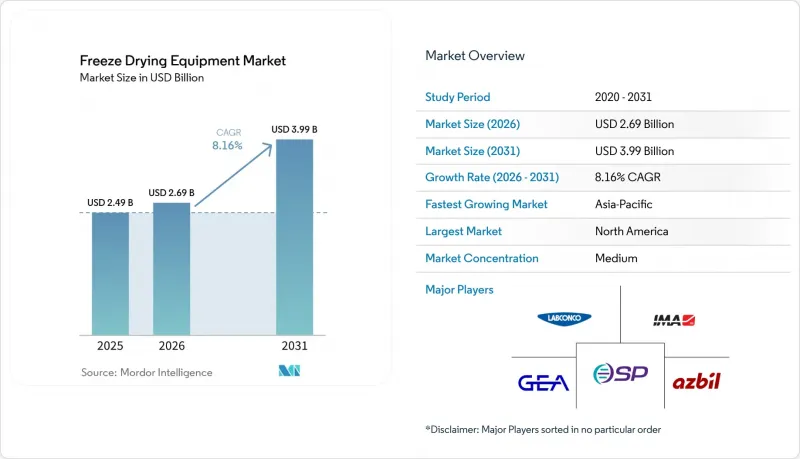
據 Mordor Intelligence 稱,2025 年冷凍乾燥設備市值為 24.9 億美元,預計到 2031 年將達到 39.9 億美元,而 2026 年為 26.9 億美元,預測期(2026-2031 年)的複合年成長率為 8.16%。
本報告按產品類型(托盤式、桌上型、工業型、實驗室冷凍乾燥機)、運作規模(實驗室規模、中試規模、工業規模)、應用領域(製藥、生物技術、食品加工、營養保健品及其他)和地區(北美、歐洲、亞太、南美)進行細分。市場預測以美元計價。
全球冷凍乾燥設備市場趨勢及洞察
擴大生物製藥、疫苗和注射劑的生產。
製藥公司越來越重視對生物製藥、疫苗和注射設備的投資。這些產品對溫度、濕度和儲存條件非常敏感,凸顯了冷凍乾燥技術在確保無菌生產穩定性方面的關鍵作用。因此,隨著注射劑產量的成長,冷凍乾燥設備市場對藥用級系統的需求也隨之增加。在處理受目標產品和出口項目的工廠中,這一點尤其明顯。製造商面臨越來越大的壓力,既要確保產品質量,也要確保已驗證循環的可重複性、有效控制污染,並能夠處理複雜的填充和包裝流程。
附件 1 以及透過無菌生產確保無菌性的壓力
歐盟藥品生產品質管理規範(EU GMP)附件1的修訂促使人們對傳統冷凍乾燥系統進行全面審查,並專注於其合規性。正如JUBILANT HOLLISTERSTIER所指出的,這項將於2024年8月生效的具有約束力的冷凍乾燥條款,提高了缺乏先進污染控制功能的手動裝載系統的操作要求。該框架建議使用隔離器、具有限制存取的屏障系統以及完善的污染控制策略,鼓勵採購商不再僅僅維護舊有系統,而是轉向現代化平台。加拿大衛生署對附件1的遵守進一步加劇了這種監管壓力,並將影響範圍從歐盟擴展到另一個重要的製藥市場。
與傳統乾燥方法相比,初始設備投資成本較高。
對於首次購買冷凍乾燥設備的消費者而言,資本投資成本仍然是一大障礙,尤其是將冷凍乾燥技術與成本更低的乾燥技術進行比較的契約製造生產商。生產規模的製藥系統前期投入成本高昂,而CIP和SIP基礎設施、潔淨公用設施、隔離裝置和屏障技術的加入會進一步增加成本。這些成本延長了投資回收期,並使系統對資金籌措條款、客戶預測和工廠運轉率假設高度敏感。印度和東南亞的中小型CDMO在進入冷凍乾燥設備市場時,往往會避開大規模一體化生產線,而更傾向於模組化或小規模系統。這造成了截然不同的需求層級:一方面是資本投資高的製藥設備,另一方面是仍在累積冷凍乾燥作業經驗的謹慎買家。
細分市場分析
到2025年,工業凍乾機將佔據45.67%的市場佔有率,凸顯其在大規模製藥和食品企業中的關鍵作用,這些企業需要高處理能力和穩定的生產週期。這些系統非常適合產品系列固定、需要無菌生產線並符合Annex 1標準的工廠,從而推動了對整合隔離器設備的需求。預計到2031年,托盤式凍乾機的複合年成長率將達到10.10%,其柔軟性使其在多品種生產基地和契約製造環境中越來越受歡迎。
旋轉式冷凍乾燥機因其連續旋轉運動的特性,在散裝粉末應用中更受歡迎,與擱架式系統相比,能夠改善粉末形態並加快乾燥速度。這些通用型系統在營養補充品和特殊化學品的加工領域中應用日益廣泛,吸引了許多無需完全驗證的製藥級配置的初次使用者。 2026年5月,IMA Life推出了F57 EVO COMPACT冷凍乾燥機,旨在為尋求緊湊型設計且具備生產級性能的製造商提供解決方案。 2026年2月,GEA透過ALUS自動化裝卸系統拓展了其高階產品線,該系統旨在最大限度地減少人工操作,並增強符合Annex 1標準的環境中的污染控制。這些進步表明市場正在轉向集裝卸、乾燥和處理於一體的整合解決方案。
區域分析
2025年,北美將佔全球冷凍乾燥設備市場39.25%的佔有率。這得益於其強大的製藥生產基礎、廣泛的合約研發產量機構(CDMO)網路以及嚴格的法律規範。美國仍然是主要的需求中心,無菌製造地正在擴大產能、實現傳統系統的自動化,並用符合監管要求的替代方案取代。生物製藥的研發進一步推動了創新公司和契約製造對經過驗證的製藥用冷凍乾燥機的需求。 2026年1月,IMA Life與Sharp Sterile Manufacturing合作,在麻薩諸塞州李市實施一項價值2,800萬美元的擴建計畫。該專案將透過安裝一條全自動隔離灌裝線和高性能凍乾機,使該基地的填充能力翻倍。在加拿大,由於對污染控制和無菌處理的期望不斷提高,符合附件1標準的指導方針正在推動升級改造需求的成長。
在歐洲,監管驅動的替換需求和強大的OEM製造基礎,共同推動了冷凍乾燥設備市場持續成長的重要性。德國憑藉其大規模的製藥製造地和主要設備供應商,在該地區佔據領先地位。 2026年2月,GEA在艾爾斯多夫開設了一家製藥凍乾技術中心,投資超過8,000萬歐元(約8,500萬美元),以擴大其研發、生產和服務能力。 2026年3月,LYOCONTRACT和Syntegon開始擴建位於德國伊爾森堡的冷凍乾燥工廠(投資5,000萬歐元,約5,300萬美元),一條新的管瓶生產線預計將於2027年夏季運作。
預計到2031年,亞太地區將以11.20%的複合年成長率成長,成為成長最快的區域市場。中國正透過建置符合國際監管標準的出口型生產能力,擴大對生物製藥設施的採購。印度正憑藉合約研發生產機構(CDMO)的擴張、無菌製劑的成長以及促進對製藥級設備需求的扶持政策,獲得發展動力。日本和韓國則透過先進的製藥和食品加工產業做出貢獻,這些產業專注於精密系統和製程控制。中東、非洲和南美洲是具有重要戰略意義的地區,儘管需求較小,但這主要是由於當地疫苗生產的需求成長以及對低溫運輸依賴性的降低,促使人們對國內凍乾產能產生了濃厚的興趣。
其他好處:
- Excel格式的市場預測(ME)表
- 3個月的分析師支持
目錄
第1章:引言
- 研究假設和市場定義
- 調查範圍
第2章:調查方法
第3章執行摘要
第4章 市場狀況
- 市場概覽
- 市場促進因素
- 對生物製藥、疫苗和注射劑的生產需求不斷增加。
- 高階營養食品和常溫零食領域對冷凍乾燥食品的需求不斷成長。
- 冷凍乾燥系統中的自動化、物聯網和流程分析技術應用
- 節能低碳凍乾設備的維修
- 低溫運輸的脆弱性和貨運中斷的風險促使人們需要擴大現場儲存能力。
- 透過附件 1 和無菌加工驗證來確保無菌性的壓力。
- 市場限制因素
- 初始投資成本高,且與傳統乾燥設備相比
- 過長的周期時間限制了吞吐量和基於部署的經濟效益。
- 能源強度和電力需求
- 複雜、多階段流程中熟練操作人員和驗證工作的負擔。
- 價值/供應鏈分析
- 監理情勢
- 技術展望
- 波特五力分析
第5章 市場規模與成長預測
- 依產品類型
- 托盤式冷凍乾燥機
- 歧管式冷凍乾燥機
- 旋轉式冷凍乾燥機
- 桌上型冷凍乾燥機
- 工業冷凍乾燥機
- 實驗室冷凍乾燥機
- 通用冷凍乾燥機
- 按運作規模
- 實驗室規模
- 中試規模
- 工業規模
- 透過使用
- 製藥
- 生物技術
- 食品加工
- 外科手術
- 營養保健品
- 冷凍乾燥設備中的其他應用
- 按地區
- 北美洲
- 美國
- 加拿大
- 墨西哥
- 歐洲
- 德國
- 英國
- 法國
- 義大利
- 西班牙
- 其他歐洲國家
- 亞太地區
- 中國
- 印度
- 日本
- 澳洲
- 韓國
- 其他亞太國家
- 中東和非洲
- GCC
- 南非
- 其他中東和非洲國家
- 南美洲
- 巴西
- 阿根廷
- 其他南美國家
- 北美洲
第6章 競爭情勢
- 市場集中度
- 市佔率分析
- 公司簡介
- Azbil Corporation
- Biopharma Process Systems Ltd.
- Buchi Labortechnik AG
- Christ Freeze Dryers GmbH
- Cuddon Freeze Dry
- GEA Group
- Harvest Right, LLC
- HOF Sonderanlagenbau GmbH
- IMA Group
- Kyowa Vacuum Engineering Co., Ltd.
- Labconco Corporation
- Martin Christ Gefriertrocknungsanlagen GmbH
- Millrock Technology, Inc.
- Optima Packaging Group GmbH
- SP Scientific LLC
- SPX Technologies, Inc.
- Thermo Fisher Scientific Inc.
- Tofflon Science and Technology Group Co., Ltd.
- Yamato Scientific Co., Ltd.
- ZIRBUS technology GmbH
第7章 市場機會與未來展望
According to Mordor Intelligence, the freeze drying equipment market size was valued at USD 2.49 billion in 2025 and is estimated to grow from USD 2.69 billion in 2026 to reach USD 3.99 billion by 2031, at a CAGR of 8.16% during the forecast period (2026-2031).
This report is Segmented by Product Type (Tray-Style, Bench Top, Industrial, and Laboratory Freeze Dryers), Scale of Operation (Laboratory, Pilot, and Industrial Scale), Application (Pharmaceuticals, Biotechnology, Food Processing, Nutraceuticals, and Others), and Geography (North America, Europe, Asia-Pacific, and South America). The Market Forecasts are Provided in Terms of Value (USD).
Global Freeze Drying Equipment Market Trends and Insights
Rising Biologics, Vaccines, and Injectable Manufacturing
Pharmaceutical manufacturers are increasingly prioritizing spending on equipment for biologics, vaccines, and injectable therapies. These products, sensitive to heat, moisture, and storage conditions, underscore the importance of lyophilization in ensuring stability during sterile manufacturing. Consequently, as the output of injectables rises, so does the demand for pharmaceutical-grade systems in the freeze-drying equipment market. This is particularly true for facilities handling regulated products and export programs. Manufacturers face heightened pressure to ensure validated cycle reproducibility, contamination control, and support for intricate fill-finish workflows, all while maintaining product quality.
Sterility Assurance Pressure from Annex 1 and Aseptic Manufacturing
The updated European Union GMP Annex 1 has catalyzed a compliance-driven overhaul of older lyophilization systems. Effective August 2024, the binding lyophilization section heightened operational demands on manually loaded systems lacking advanced contamination controls, as highlighted by JUBILANT HOLLISTERSTIER. The framework advocates for isolators, restricted access barrier systems, and robust contamination control strategies, nudging buyers towards modern platforms over mere maintenance of legacy systems. Health Canada's alignment with Annex 1 amplifies this regulatory pressure, extending its reach beyond the EU and into another significant pharmaceutical market.
High Upfront Capital Cost Versus Conventional Drying
Capital costs remain a significant barrier for first-time buyers, particularly contract manufacturers comparing lyophilization with lower-cost drying technologies. Production-scale pharmaceutical systems involve high acquisition expenses, which increase further with the addition of CIP and SIP infrastructure, clean utilities, containment features, and barrier technologies. These costs extend payback periods and make them sensitive to financing conditions, customer visibility, and plant utilization assumptions. Smaller CDMOs in India and Southeast Asia prefer modular or scaled-down installations when entering the freeze-drying equipment market, avoiding large integrated lines. This creates distinct demand tiers between high-capex pharmaceutical installations and cautious buyers still gaining experience in freeze-drying operations.
Other drivers and restraints analyzed in the detailed report include:
- Automation, IoT, and PAT Adoption in Lyophilization Systems
- Expanding Freeze-Dried Food Demand Across Premium and Functional Segments
- Energy Intensity and Utility Load Requirements
For complete list of drivers and restraints, kindly check the Table Of Contents.
Segment Analysis
In 2025, industrial freeze dryers captured 45.67% of the market, emphasizing their critical role in large-scale pharmaceutical and food operations that demand high throughput and consistent cycles. These systems are ideal for fixed product portfolios, aseptic lines, and facilities requiring Annex 1 compliance, driving demand for isolator-integrated setups. Tray-style freeze dryers, projected to grow at a 10.10% CAGR through 2031, are gaining popularity in multi-product sites and contract manufacturing environments due to their flexibility.
Rotary freeze dryers are preferred for bulk powder applications, utilizing continuous tumbling to improve morphology and accelerate drying compared to shelf-based methods. General-purpose systems are increasingly adopted in nutraceutical and specialty chemical processing, attracting first-time users who do not require fully validated pharmaceutical configurations. In May 2026, IMA Life launched the F57 EVO COMPACT freeze dryer, targeting manufacturers seeking production-grade performance in a compact design. GEA expanded the premium segment in February 2026 with its ALUS automatic loading and unloading systems, designed to minimize manual intervention and enhance contamination control in Annex 1-sensitive environments. These advancements indicate a market shift toward integrated solutions that combine loading, drying, and unloading.
Complete Report Scope:
- By Product Type
- Tray-Style Freeze Dryers
- Manifold Freeze Dryers
- Rotary Freeze Dryers
- Bench Top Freeze Dryers
- Industrial Freeze Dryers
- Laboratory Freeze Dryers
- General Purpose Freeze Dryers
- By Scale of Operation
- Laboratory Scale
- Pilot Scale
- Industrial Scale
- By Application
- Pharmaceuticals
- Biotechnology
- Food Processing
- Surgical Procedures
- Nutraceuticals
- Other Applications in Freeze Drying Equipment
- By Geography
- North America
- United States
- Canada
- Mexico
- Europe
- Germany
- United Kingdom
- France
- Italy
- Spain
- Rest of Europe
- Asia-Pacific
- China
- India
- Japan
- Australia
- South Korea
- Rest of Asia-Pacific
- Middle East and Africa
- GCC
- South Africa
- Rest of Middle East and Africa
- South America
- Brazil
- Argentina
- Rest of South America
- North America
Geography Analysis
In 2025, North America accounted for 39.25% of the global freeze-drying equipment market, driven by a strong pharmaceutical manufacturing base, an extensive CDMO network, and stringent regulatory oversight. The U.S. remains the primary demand center, with sterile manufacturing sites expanding capacity and replacing older systems with automated, compliant alternatives. Biologics development further sustains demand for validated pharmaceutical lyophilizers among innovators and contract producers. In January 2026, IMA Life partnered with Sharp Sterile Manufacturing on a USD 28 million expansion in Lee, Massachusetts, featuring a fully automated isolated filling line and a high-performance lyophilizer to double site filling capacity. In Canada, Annex 1-aligned guidance is driving replacement demand by raising expectations for contamination control and aseptic processing.
Europe combines regulatory-driven replacement demand with a strong OEM manufacturing base, maintaining its importance in the freeze-drying equipment market. Germany leads the region with large pharmaceutical manufacturing operations and key equipment suppliers. In February 2026, GEA opened its pharmaceutical freeze-drying technology center in Elsdorf, investing over EUR 80 million (approximately USD 85 million) to expand R&D, production, and service capabilities. In March 2026, LYOCONTRACT and Syntegon initiated a EUR 50 million (approximately USD 53 million) expansion of a freeze-drying facility in Ilsenburg, Germany, with a new vial line expected by summer 2027.
Asia-Pacific is projected to grow at an 11.20% CAGR through 2031, making it the fastest-growing regional market. China is increasing procurement at biologics facilities by aligning with international regulatory standards and building export-ready capacity. India is gaining traction with CDMO expansions, sterile dosage growth, and supportive policies driving demand for pharmaceutical-grade installations. Japan and South Korea contribute through advanced pharmaceutical and food processing sectors, emphasizing precision systems and process control. The Middle East, Africa, and South America, while smaller in demand, are strategically important as local vaccine manufacturing and reduced cold-chain dependency boost interest in domestic lyophilization capabilities.
- Azbil
- Biopharma Process Systems Ltd.
- Buchi Labortechnik
- Christ Freeze Dryers GmbH
- Cuddon Freeze Dry
- GEA Group
- Harvest Right, LLC
- HOF Sonderanlagenbau
- IMA Group
- Kyowa Vacuum Engineering Co., Ltd.
- Labconco
- Martin Christ Gefriertrocknungsanlagen
- Millrock Technology, Inc.
- Optima Packaging Group
- SP Scientific LLC
- SPX Technologies, Inc.
- Thermo Fisher Scientific
- Tofflon Science and Technology Group Co., Ltd.
- Yamato Scientific Co., Ltd.
- ZIRBUS technology
Additional Benefits:
- The market estimate (ME) sheet in Excel format
- 3 months of analyst support
TABLE OF CONTENTS
1 INTRODUCTION
- 1.1 Study Assumptions and Market Definition
- 1.2 Scope of the Study
2 RESEARCH METHODOLOGY
3 EXECUTIVE SUMMARY
4 MARKET LANDSCAPE
- 4.1 Market Overview
- 4.2 Market Drivers
- 4.2.1 Rising Biologics, Vaccines, and Injectable Manufacturing Needs
- 4.2.2 Expanding Freeze-Dried Food Demand Across Premium Nutrition and Shelf-Stable Snacking
- 4.2.3 Automation, IoT, and PAT Adoption in Lyophilization Systems
- 4.2.4 Energy-Efficient and Low-Carbon Freeze Drying Retrofits
- 4.2.5 Cold-Chain Fragility and Cargo Disruption Risk Driving On-Site Preservation Capacity
- 4.2.6 Sterility Assurance Pressure from Annex 1 and Aseptic Processing Validation
- 4.3 Market Restraints
- 4.3.1 High Upfront Capital Cost Versus Conventional Drying Equipment
- 4.3.2 Long Cycle Times Constraining Throughput and Installed Base Economics
- 4.3.3 Energy Intensity and Utility Load Requirements
- 4.3.4 Skilled Operator and Validation Burden for Complex Multi-Stage Processes
- 4.4 Value/Supply Chain Analysis
- 4.5 Regulatory Landscape
- 4.6 Technological Outlook
- 4.7 Porter's Five Forces Analysis
- 4.7.1 Threat of New Entrants
- 4.7.2 Bargaining Power of Suppliers
- 4.7.3 Bargaining Power of Buyers
- 4.7.4 Threat of Substitutes
- 4.7.5 Competitive Rivalry
5 MARKET SIZE AND GROWTH FORECASTS (VALUE, USD)
- 5.1 By Product Type
- 5.1.1 Tray-Style Freeze Dryers
- 5.1.2 Manifold Freeze Dryers
- 5.1.3 Rotary Freeze Dryers
- 5.1.4 Bench Top Freeze Dryers
- 5.1.5 Industrial Freeze Dryers
- 5.1.6 Laboratory Freeze Dryers
- 5.1.7 General Purpose Freeze Dryers
- 5.2 By Scale of Operation
- 5.2.1 Laboratory Scale
- 5.2.2 Pilot Scale
- 5.2.3 Industrial Scale
- 5.3 By Application
- 5.3.1 Pharmaceuticals
- 5.3.2 Biotechnology
- 5.3.3 Food Processing
- 5.3.4 Surgical Procedures
- 5.3.5 Nutraceuticals
- 5.3.6 Other Applications in Freeze Drying Equipment
- 5.4 By Geography
- 5.4.1 North America
- 5.4.1.1 United States
- 5.4.1.2 Canada
- 5.4.1.3 Mexico
- 5.4.2 Europe
- 5.4.2.1 Germany
- 5.4.2.2 United Kingdom
- 5.4.2.3 France
- 5.4.2.4 Italy
- 5.4.2.5 Spain
- 5.4.2.6 Rest of Europe
- 5.4.3 Asia-Pacific
- 5.4.3.1 China
- 5.4.3.2 India
- 5.4.3.3 Japan
- 5.4.3.4 Australia
- 5.4.3.5 South Korea
- 5.4.3.6 Rest of Asia-Pacific
- 5.4.4 Middle East and Africa
- 5.4.4.1 GCC
- 5.4.4.2 South Africa
- 5.4.4.3 Rest of Middle East and Africa
- 5.4.5 South America
- 5.4.5.1 Brazil
- 5.4.5.2 Argentina
- 5.4.5.3 Rest of South America
- 5.4.1 North America
6 COMPETITIVE LANDSCAPE
- 6.1 Market Concentration
- 6.2 Market Share Analysis
- 6.3 Company Profiles (includes Global Level Overview, Market Level Overview, Core Segments, Financials as available, Strategic Information, Market Rank/Share, Products and Services, Recent Developments)
- 6.3.1 Azbil Corporation
- 6.3.2 Biopharma Process Systems Ltd.
- 6.3.3 Buchi Labortechnik AG
- 6.3.4 Christ Freeze Dryers GmbH
- 6.3.5 Cuddon Freeze Dry
- 6.3.6 GEA Group
- 6.3.7 Harvest Right, LLC
- 6.3.8 HOF Sonderanlagenbau GmbH
- 6.3.9 IMA Group
- 6.3.10 Kyowa Vacuum Engineering Co., Ltd.
- 6.3.11 Labconco Corporation
- 6.3.12 Martin Christ Gefriertrocknungsanlagen GmbH
- 6.3.13 Millrock Technology, Inc.
- 6.3.14 Optima Packaging Group GmbH
- 6.3.15 SP Scientific LLC
- 6.3.16 SPX Technologies, Inc.
- 6.3.17 Thermo Fisher Scientific Inc.
- 6.3.18 Tofflon Science and Technology Group Co., Ltd.
- 6.3.19 Yamato Scientific Co., Ltd.
- 6.3.20 ZIRBUS technology GmbH
7 MARKET OPPORTUNITIES AND FUTURE OUTLOOK
- 7.1 White-Space and Unmet-Need Assessment

 凍乾市場-2026-2032年全球市場預測
 2026-2030年全球冷凍乾燥設備市場
 2026年全球桌上型冷凍乾燥機市場報告
 冷凍乾燥機市場:按產品類型、應用和地區分類
 凍乾設備市場規模、佔有率、趨勢和預測:按乾燥機類型、企業規模、應用和地區分類,2026-2034年
 凍乾設備市場規模、佔有率、成長和全球產業分析:按類型、應用和地區分類,並對 2026-2034 年進行洞察和預測。
 凍乾設備市場規模、佔有率和趨勢分析報告:按產品、應用、地區和細分市場預測(2026-2033 年)中試規模冷凍乾燥機市場:按類型、容量、機構、控制系統、應用、最終用戶產業分類,全球預測(2026-2032年)
 冷凍乾燥/冷凍乾燥市場分析及預測(至2035年):按類型、產品、服務、技術、應用、形式、材質、製程及最終用戶分類全球凍乾設備市場規模、佔有率、趨勢及成長分析報告(2026-2034年)