


 |
市場調查報告書
商品編碼
2072750
棉花收割機械:市場佔有率分析、產業趨勢與統計、成長預測(2026-2031)Cotton Harvesting Machinery - Market Share Analysis, Industry Trends & Statistics, Growth Forecasts (2026 - 2031) |
||||||

※ 本網頁內容可能與最新版本有所差異。詳細情況請與我們聯繫。
根據 Mordor Intelligence 預測,棉花收割機市場規模將從 2025 年的 53.4 億美元,2026 年至 2031 年的年複合成長率(CAGR)為 5.79%。
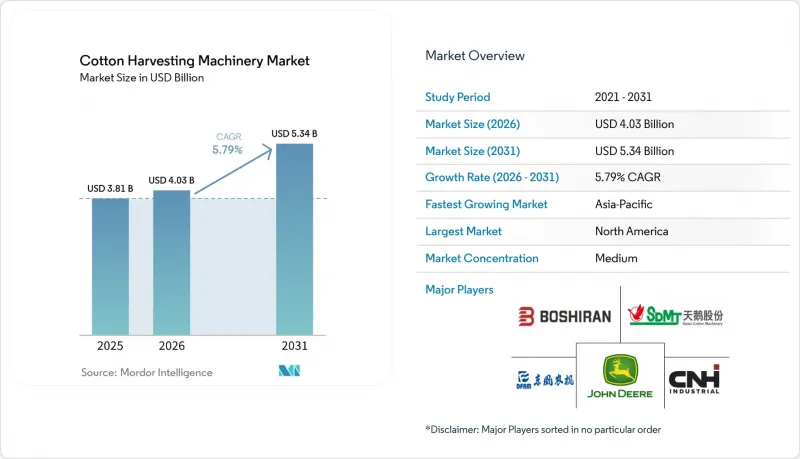
本報告按類型(主軸式採摘機和剝線鉗收割機)、驅動系統(自走式和曳引機式)、動力來源(柴油、電力及其他)和地區(北美、亞太及其他)進行細分。市場預測以美元計價。
全球棉花收割機械市場趨勢及洞察
農業勞動力短缺日益嚴重,薪資卻在上漲
2021年至2025年間,全部區域的採摘勞動力大幅減少,迫使生產者轉向機械化作業。儘管美國H-2A簽證計畫在2025會計年度批准了超過398,258個工作崗位,但主要農業州的季節性勞動力短缺問題依然存在。不斷上漲的工資水平,包括加州的工資上漲,增強了大規模機械化棉花採摘的經濟合理性。在中國新疆維吾爾自治區,農村人口向城市遷移的趨勢日益加劇,導致棉花採摘工人短缺,加速了全部區域機械化作業的普及。在印度,政府支持計畫擴大了對勞動力短缺地區農業機械的補貼,因為這些地區的人工採摘成本仍然很高。同樣面臨季節性農業勞動力短缺的澳大利亞,其主要棉花產區的生產商選擇租賃更多的採摘機,而不是增加人工採摘人員。勞動力和薪資方面的壓力加在一起,縮短了機械化收割的投資回收期,同時維持了對棉花收割設備的需求。
自動化、人工智慧和GPS導航推動精準收割技術迅速普及。
棉花收割機正朝著聯網精密農業平台的方向發展,旨在提升可追溯性、作業效率和纖維品管。在2024年國際消費電子展(CES)上,約翰迪爾展示了整合於其CP770棉花收割機中的自動化棉花收割技術,該技術能夠即時監測棉花產量、水分含量、重量、GPS定位和收割數據。該系統支援從棉花收割到棉花精煉(軋棉)管理的整個工作流程中的數位資料共用。這些先進的收割功能使種植者能夠最佳化收割決策,最大限度地減少人工勞動,並提高棉花從田間到最終用途的可追溯性。同時,製造商正在將先進的衛星導航自動駕駛技術整合到棉花收割機中,在提高田間作業精度和作業效率的同時,還能維持比進口導航系統更低的實施成本。這些技術進步正在立即帶來營運效益,儘管棉花價格波動,但美國、中國和澳洲等主要棉花生產國的種植者仍在加快設備升級。
高昂的初始購買成本和整個生命週期的維護成本
六行紡錘式採摘機的價格通常很高,這反映了其先進的自動化程度、大規模的採摘效率和強大的運作能力。其價格相當於古吉拉突邦或卡杜納州一個10公頃農場15-20年的淨利潤。年度維護成本包括紡錘更換、液壓系統檢修和遠端資訊處理使用費。儘管有補貼,生產者仍然面臨巨大的資金籌措需求,遠遠超過了典型的農村貸款限額。在非洲,儘管人事費用不斷上漲,但有限的低成本資金籌措管道和高利率限制了六行紡錘式採摘機的普及。在巴西,高昂的設備成本給中型農場帶來了沉重的負擔,影響了其年度利潤的很大一部分。由於專業金融機構承擔殘值風險,在種植面積逐年波動較大的地區,租賃協議的可用性有限。除非資本成本降低或出現更靈活的資金籌措模式,否則高昂的購買成本將繼續阻礙六行紡錘式採摘機在小規模農業地區的廣泛應用。
細分市場分析
到2025年,紡錘式棉花收割機將佔據棉花收割機市場54.2%的佔有率,這反映了其在高品質陸地棉和長絨棉生產中的主導地位。剝線鉗機將佔據第二大市場佔有率,是德克薩斯州、奧克拉荷馬州和澳洲等乾旱地區「一次性」種植的首選設備。其廣泛應用得益於低混入率、高纖維保留率以及與大規模機械化收割作業的兼容性。
隨著美國和巴西乾旱地區種植面積的擴大,預計從2026年到2031年,剝線鉗棉機將以6.4%的複合年成長率(CAGR)高速成長,而紡錘式棉花收割機同期成長速度預計會放緩。此高成長率得益於單次作業燃油消耗量降低18%、約翰迪爾CS770作業速度提升20%以及棉花品種對強力剝棉技術的耐受性增強。在中國和土耳其,對纖維品質的嚴格處罰措施將持續推動棉花收割機的更新換代需求,並繼續支撐紡錘式棉花收割機的銷售。綜合來看,預計到2031年,這些因素將使棉花收割機市場格局更加平衡,但紡錘式棉花收割機仍將保持其主導地位。對機械化投資的增加和收割技術的不斷進步預計將進一步擴大已開發棉花市場和新興棉花市場的需求。
區域分析
預計到2025年,北美將佔全球銷售額的36.8%,並有望繼續保持穩定成長,這主要得益於農業勞動力成本的上升以及機械化和精密農業技術的普及。主要設備製造商透過整合先進技術和自動化能力,不斷鞏固其市場地位,即使在棉花價格疲軟時期,也能滿足持續的更新換代需求。
亞太地區預計將維持最高成長率,到2031年年均複合成長率將達到8.3%,這主要得益於政府補貼和生產力提升計劃,這些措施縮短了機械化收割設備的投資回收期。在中國,高度機械化帶來了穩定的更新換代需求;而在澳大利亞,先進收割系統的應用依然強勁。在印度,小型且價格適中的收割機的研發有望加速目前依賴人工收割的小規模農戶採用機械化收割機,預計在土地所有權分散的地區,目標市場將顯著擴大。
在南美洲,預計市場將保持穩定成長,巴西將引領這一成長。在巴西,棉花種植面積的擴大和機械化程度的提高支撐了對設備的需求,而融資計劃則促進了價格更實惠的機械設備的引進。在阿根廷,進口限制和外匯波動持續影響消費者的購買行為。歐洲的銷售佔有率較小,儘管部分地區的種植面積有所擴大,但監管合規要求和高昂的營運成本限制了新設備的引進。中東和非洲的市佔率合計不高,但由於政策支持,部分市場的機械化進程正在推進。然而,有限的資金籌措機會和薄弱的服務基礎設施仍然限制在撒哈拉以南部分地區的大規模部署。
其他好處:
- Excel格式的市場預測(ME)表
- 3個月的分析師支持
目錄
第1章:引言
- 研究假設和市場定義
- 調查範圍
第2章:調查方法
第3章執行摘要
第4章 市場狀況
- 市場概覽
- 市場促進因素
- 農業勞動力短缺日益嚴重,薪資卻在上漲
- 自動化、人工智慧和GPS導航等技術的快速普及,使得精準收割得以快速發展。
- 中國、印度和美國政府的補貼計畫旨在加速機械化進程。
- 全球棉花消費量增加與種植面積擴大
- 車載式圓捆模組製造設備的廣泛應用降低了物流成本。
- 發展中市場中計量收費的「採集即服務」平台的興起
- 市場限制因素
- 初始購置成本高,且整個生命週期的維護成本也高。
- 棉花價格波動導致資本投資延遲。
- 經銷商缺乏遠端資訊處理基礎設施,阻礙了新興地區預測性維護的普及。
- 對土壤壓實和排放的更嚴格規定增加了重新設計和合規相關的成本。
- 監理情勢
- 技術展望
- 波特五力模型
第5章 市場規模與成長預測
- 按類型
- 主軸拾取器
- 剝線鉗收割機
- 透過機制
- 自推進式
- 聯結機式
- 透過動力來源
- 配備柴油引擎
- 電動驅動
- 混合動力汽車
- 按地區
- 北美洲
- 美國
- 加拿大
- 北美及其他地區
- 南美洲
- 巴西
- 阿根廷
- 南美洲其他地區
- 歐洲
- 德國
- 西班牙
- 希臘
- 其他歐洲國家
- 亞太地區
- 中國
- 印度
- 澳洲
- 其他亞太國家
- 中東
- 土耳其
- 以色列
- 其他中東國家
- 非洲
- 埃及
- 南非
- 其他非洲國家
- 北美洲
第6章 競爭情勢
- 市場集中度
- 策略趨勢
- 市佔率分析
- 公司簡介
- Deere & Company.
- CNH Industrial NV
- Mahindra and Mahindra Ltd.
- OJSC "Gomselmash"
- Shandong Swan Cotton Industrial Machinery Stock Co., Ltd.
- Changzhou Dongfeng Agricultural Machinery Group Co., Ltd.
- Xinjiang Boshiran Intelligent Agricultural Machinery Co., Ltd.
- Hubei Fotma Machinery Co., Ltd.
- Jiangsu World Agricultural Machinery Co., Ltd.
- ColhiCana Agricultural Machinery
第7章 市場機會與未來展望
According to Mordor Intelligence, the cotton harvester market size is projected to grow from USD 3.81 billion in 2025 and USD 4.03 billion in 2026 to USD 5.34 billion by 2031, registering a CAGR of 5.79% between 2026 and 2031.
This report is Segmented by Type (Spindle Pickers and Stripper Harvesters), by Mechanism (Self-Propelled and Tractor-Mounted), by Power Source (Diesel-Powered, Electric-Powered, and Others), and by Geography (North America, Asia-Pacific, and Others). The Market Forecasts are Provided in Terms of Value (USD).
Global Cotton Harvesting Machinery Market Trends and Insights
Escalating Farm-Labor Shortages and Wage Inflation
Cotton-picking labor pools shrank significantly across leading producing regions between 2021 and 2025, pushing growers toward mechanized solutions. The United States H-2A program certified more than 398,258 positions in fiscal 2025, yet seasonal labor shortages persisted in major agricultural states. Rising Adverse Effect Wage Rates, including increases in California, are strengthening the economic case for large-scale mechanized cotton harvesting. China's Xinjiang region experienced rural-to-urban migration, reducing the availability of cotton pickers and accelerating the adoption of mechanization across the region. In India, government support programs have increased subsidies for agricultural machinery in labor-deficit states where manual harvesting costs remain high. Australia also faced shortages of seasonal agricultural labor, prompting growers in key cotton-producing valleys to lease additional harvesters rather than expand manual crews. Together, these labor and wage pressures are shortening the payback period for mechanized harvesting and sustaining demand for cotton-harvesting equipment.
Rapid Adoption of Automation, Artificial Intelligence, and GPS-Guided Precision Harvesting
Cotton harvesters are evolving into connected, precision-agriculture platforms designed to enhance traceability, operational efficiency, and fiber-quality management. At the Consumer Electronics Show 2024, John Deere showcased automated cotton harvesting technologies integrated with the CP770 cotton picker, enabling real-time monitoring of module production, moisture, weight, GPS location, and harvest data. The system supports digital data sharing across cotton harvesting and gin-management workflows. These advanced harvesting capabilities enable growers to optimize harvesting decisions, minimize manual processes, and improve cotton traceability from the field to end use. Meanwhile, manufacturers are integrating advanced satellite-guided auto-steering technologies into cotton harvesters to enhance field precision and operational efficiency at lower implementation costs compared to imported navigation systems. These technological advancements are delivering immediate operational benefits, encouraging growers in major cotton-producing countries such as the United States, China, and Australia to accelerate equipment upgrades despite fluctuations in cotton prices.
High Upfront Purchase and Life-Cycle Maintenance Costs
A six-row spindle picker is typically priced at premium levels, reflecting its advanced automation, large-scale harvesting efficiency, and high operational capacity, equal to 15-20 years of net income for a 10-hectare farm in Gujarat or Kaduna. Annual upkeep includes spindle replacement, hydraulic rebuilds, and telematics fees. Even with subsidies, growers still face significant financing requirements that exceed typical rural credit ceilings. In Africa, limited access to affordable financing and high interest rates constrain adoption despite rising labor costs. Brazilian mid-sized farms face high equipment costs that absorb a large share of annual revenue. Specialty financiers carry residual-value risk, limiting lease offerings where acreage fluctuates significantly year to year. Until capital costs fall or flexible financing models expand, high entry prices will continue to restrict penetration in smallholder regions.
Other drivers and restraints analyzed in the detailed report include:
- Government Subsidy Programs Accelerating Mechanization in China, India, and the United States
- Rising Global Cotton Consumption and Acreage Expansion
- Cotton-Price Volatility Delaying Capital-Equipment Spending
For complete list of drivers and restraints, kindly check the Table Of Contents.
Segment Analysis
Spindle pickers accounted for 54.2% of the cotton harvester market share in 2025, reflecting their dominance in premium-grade upland and long-staple production. Stripper harvesters ranked second-largest, favored in once-over dryland operations across Texas, Oklahoma, and Australia. Their widespread adoption is driven by lower contamination rates, higher fiber retention efficiency, and compatibility with large-scale mechanized harvesting operations.
Stripper harvesters are projected to register the quickest 6.4% CAGR between 2026 and 2031 as dryland acreage expands in the United States and Brazil, while spindle units are set to advance more modestly over the same span. Fuel savings of 18% on once-over passes, a 20% speed gain on Deere's CS770, and rising cultivar tolerance for aggressive stripping methods all support the lead growth rate. Replacement demand in China and Turkey will still sustain spindle sales, as stringent fiber-quality penalties remain. The combined effect leaves the cotton harvester market size more balanced by 2031, without dislodging spindle leadership. Rising investments in mechanization and continuous advancements in harvesting technology are anticipated to further drive demand in both developed and emerging cotton markets.
Complete Report Scope:
- By Type
- Spindle Pickers
- Stripper Harvesters
- By Mechanism
- Self-propelled
- Tractor-mounted
- By Power Source
- Diesel-powered
- Electric-powered
- Hybrid-powered
- By Geography
- North America
- United States
- Canada
- Rest of the North America
- South America
- Brazil
- Argentina
- Rest of the South America
- Europe
- Germany
- Spain
- Greece
- Rest of Europe
- Asia-Pacific
- China
- India
- Australia
- Rest of Asia-Pacific
- Middle East
- Turkey
- Israel
- Rest of the Middle East
- Africa
- Egypt
- South Africa
- Rest of the Africa
- North America
Geography Analysis
North America generated 36.8% of 2025 revenue, and the region is projected to grow at a steady pace driven by rising farm-labor costs and increasing adoption of mechanized and precision agriculture practices. Leading equipment manufacturers continue to strengthen their presence through advanced technology integration and automation capabilities, supporting ongoing replacement and upgrade demand even during periods of cotton price softness.
Asia-Pacific is forecast to record the fastest 8.3% CAGR through 2031, supported by government subsidies and productivity improvement programs that reduce payback periods for mechanized harvesting equipment. High mechanization levels in China are generating steady replacement demand, while Australia continues to demonstrate strong adoption of advanced harvesting systems. In India, compact and affordable picker development is estimated to unlock adoption in smallholder farms that currently rely on manual harvesting, significantly expanding the addressable market across fragmented landholding structures.
South America is projected to advance steadily, led by Brazil where expanding cotton acreage and mechanization are supporting equipment demand, while credit programs are steering adoption toward more affordable machinery options. Argentina's import-related constraints and currency volatility continue to influence purchasing behavior. Europe holds a smaller share of revenue, with regulatory compliance requirements and higher operational costs limiting new equipment adoption despite underlying acreage expansion in select regions. The Middle East and Africa together account for a modest share, where policy support is improving mechanization in some markets, but limited financing access and weak service infrastructure continue to restrict large-scale adoption in several sub-Saharan regions.
- Deere & Company.
- CNH Industrial N.V.
- Mahindra and Mahindra Ltd.
- OJSC "Gomselmash"
- Shandong Swan Cotton Industrial Machinery Stock Co., Ltd.
- Changzhou Dongfeng Agricultural Machinery Group Co., Ltd.
- Xinjiang Boshiran Intelligent Agricultural Machinery Co., Ltd.
- Hubei Fotma Machinery Co., Ltd.
- Jiangsu World Agricultural Machinery Co., Ltd.
- ColhiCana Agricultural Machinery
Additional Benefits:
- The market estimate (ME) sheet in Excel format
- 3 months of analyst support
TABLE OF CONTENTS
1 Introduction
- 1.1 Study Assumptions and Market Definition
- 1.2 Scope of the Study
2 Research Methodology
3 Executive Summary
4 Market Landscape
- 4.1 Market Overview
- 4.2 Market Drivers
- 4.2.1 Escalating farm-labor shortages and wage inflation
- 4.2.2 Rapid adoption of automation, artificial intelligence, and GPS-guided precision harvesting
- 4.2.3 Government subsidy programs accelerating mechanization in China, India, and the United States
- 4.2.4 Rising global cotton consumption and acreage expansion
- 4.2.5 Proliferation of on-board round-bale module builders that cut logistics costs
- 4.2.6 Emergence of pay-per-use harvesting-as-a-service platforms in developing markets
- 4.3 Market Restraints
- 4.3.1 High upfront purchase and life-cycle maintenance costs
- 4.3.2 Cotton-price volatility delaying capital-equipment spending
- 4.3.3 Sparse dealer telematics infrastructure hindering predictive-maintenance adoption in emerging regions
- 4.3.4 Stricter soil-compaction and emission regulations raising redesign and compliance expenses
- 4.4 Regulatory Landscape
- 4.5 Technological Outlook
- 4.6 Porters Five Forces
- 4.6.1 Threat of New Entrants
- 4.6.2 Bargaining Power of Suppliers
- 4.6.3 Bargaining Power of Buyers
- 4.6.4 Threat of Substitute Products
- 4.6.5 Competitive Rivalry
5 Market Size and Growth Forecasts (Value)
- 5.1 By Type
- 5.1.1 Spindle Pickers
- 5.1.2 Stripper Harvesters
- 5.2 By Mechanism
- 5.2.1 Self-propelled
- 5.2.2 Tractor-mounted
- 5.3 By Power Source
- 5.3.1 Diesel-powered
- 5.3.2 Electric-powered
- 5.3.3 Hybrid-powered
- 5.4 By Geography
- 5.4.1 North America
- 5.4.1.1 United States
- 5.4.1.2 Canada
- 5.4.1.3 Rest of the North America
- 5.4.2 South America
- 5.4.2.1 Brazil
- 5.4.2.2 Argentina
- 5.4.2.3 Rest of the South America
- 5.4.3 Europe
- 5.4.3.1 Germany
- 5.4.3.2 Spain
- 5.4.3.3 Greece
- 5.4.3.4 Rest of Europe
- 5.4.4 Asia-Pacific
- 5.4.4.1 China
- 5.4.4.2 India
- 5.4.4.3 Australia
- 5.4.4.4 Rest of Asia-Pacific
- 5.4.5 Middle East
- 5.4.5.1 Turkey
- 5.4.5.2 Israel
- 5.4.5.3 Rest of the Middle East
- 5.4.6 Africa
- 5.4.6.1 Egypt
- 5.4.6.2 South Africa
- 5.4.6.3 Rest of the Africa
- 5.4.1 North America
6 Competitive Landscape
- 6.1 Market Concentration
- 6.2 Strategic Moves
- 6.3 Market Share Analysis
- 6.4 Company Profiles (Includes Global Level Overview, Market Level Overview, Core Segments, Financials as Available, Strategic Information, Market Rank/Share for Key Companies, Products and Services, and Recent Developments)
- 6.4.1 Deere & Company.
- 6.4.2 CNH Industrial N.V.
- 6.4.3 Mahindra and Mahindra Ltd.
- 6.4.4 OJSC "Gomselmash"
- 6.4.5 Shandong Swan Cotton Industrial Machinery Stock Co., Ltd.
- 6.4.6 Changzhou Dongfeng Agricultural Machinery Group Co., Ltd.
- 6.4.7 Xinjiang Boshiran Intelligent Agricultural Machinery Co., Ltd.
- 6.4.8 Hubei Fotma Machinery Co., Ltd.
- 6.4.9 Jiangsu World Agricultural Machinery Co., Ltd.
- 6.4.10 ColhiCana Agricultural Machinery
7 Market Opportunities and Future Outlook

 農業噴灑機器人市場:全球市場預測,2026-2032年
 馬匹儲料槽市場規模、佔有率和成長分析:按產品類型、材料、產能、應用、分銷管道和地區分類-2026-2033年產業預測
 智慧溫室自動化市場預測(2034 年)—按組件、自動化系統、技術、應用、最終用戶和地區分類的全球分析自主除草機器人市場:預測至2034年-按產品類型、作物類型、技術、最終用戶和地區分類的全球分析
 2026年全球霧耕市場報告人工智慧雜草識別市場預測至2034年—全球雜草類型、部署方式、技術、應用、最終用戶和區域分析精準播種市場預測至2034年-按產品類型、播種機制、技術、應用、最終用戶和地區分類的全球分析農業自動化市場預測至2034年—按自動化類型、農場類型、技術、應用、最終用戶和地區分類的全球分析
 除草機器人市場:依機器人類型、農場規模、作物類型、最終用戶、國家和地區分類-產業分析、市場規模、市場佔有率及2026年至2033年預測
 農業機器人市場-全球產業規模、佔有率、趨勢、機會與預測:按類型、組件、應用、農業環境、地區和競爭格局分類,2021-2031年