


 |
市場調查報告書
商品編碼
2072669
本地SEO軟體:市場佔有率分析、產業趨勢與統計、成長預測(2026-2031年)Local SEO Software - Market Share Analysis, Industry Trends & Statistics, Growth Forecasts (2026 - 2031) |
||||||

※ 本網頁內容可能與最新版本有所差異。詳細情況請與我們聯繫。
據 Mordor Intelligence 稱,本地 SEO 軟體市場預計將從 2025 年的 91.2 億美元成長到 2026 年的 103.4 億美元,到 2031 年達到 193.6 億美元,預計 2026 年至 2031 年的複合年成長率為 13.37%。
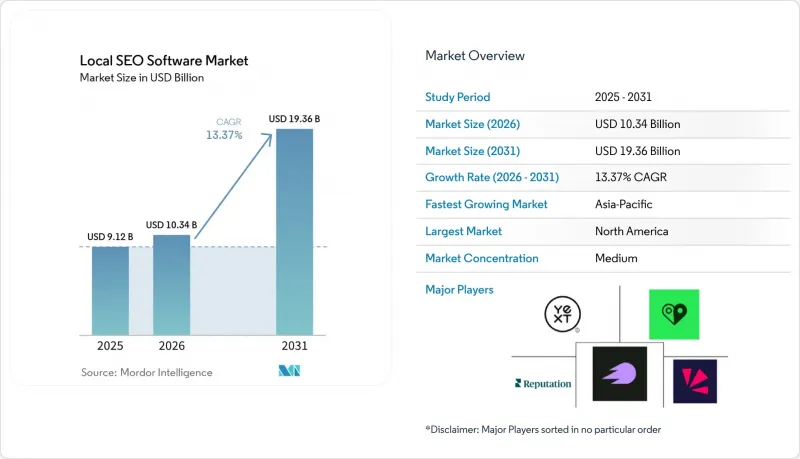
本報告按部署模式(雲端部署和本地部署)、組織規模(中小企業和大型企業)、功能(關鍵字研究、本地商家資訊管理、聲譽管理等)、最終用戶(本地商家、行銷機構、SEO 專業人員和顧問)以及地區進行細分。市場預測以美元計價。
全球本地SEO軟體市場趨勢與洞察
拓展多地點和特許經營行銷計劃
特許經營體系和分散式零售網路的擴張持續推動著本地SEO軟體市場的發展,因為每個門市都需要確保自身的曝光度。由於僅靠品牌總部投入無法保證門市層級的搜尋排名,企業正在尋求能夠管理大規模網路而無需額外人員投入的平台。根據SOCi的報告,ChatGPT僅推薦了1.2%的商家門市,而Google本地搜尋結果前三名(Local 3Pack)的曝光率則高達35.9%。這表明,在人工智慧時代,對於擁有多個門市的品牌而言,本地搜尋的搜尋結果篩選標準變得愈發嚴格。美國商會報告稱,到2025年,58%的小型企業將開始使用生成式人工智慧。這表明,企業在人工智慧驅動的本地行銷方面已經超越了早期採用階段。因此,本地SEO軟體市場對能夠擴展到數百甚至數千家門市的工作流程自動化、品牌管理以及執行模型的需求日益成長。
對線上評論和聲譽訊號的依賴性日益增強
評論管理已成為本地SEO軟體市場的核心要素,因為人工智慧系統不再僅僅統計評分,而是能夠從評論內容中解讀用戶情緒、服務主題和貼文時效性。這也改變了聲譽管理工具的價值,因為平台必須幫助品牌大規模地回應,並在眾多平台上保持訊息一致性。 Rio SEO在2025年發布的報告顯示,75%的消費者在做出購買決定前至少會閱讀四條評論,59%的消費者希望在24小時內收到企業的回覆。這給擁有多家門市的品牌帶來了越來越大的壓力。 BrightLocal在2026年4月發布的報告顯示,消費者在選擇公司前平均會查看六個評論網站。這使得消費者的考慮不再局限於谷歌。這些變化正推動本地SEO軟體市場轉型為整合監控、評論徵集和人工智慧驅動的回覆管理等功能的解決方案。
資料隱私、同意和平台合規性的負擔。
隱私和使用者許可法規是本地SEO軟體市場的一大障礙,因為許多高級行銷功能都依賴客戶資料、位置資訊和行為追蹤。根據GDPR,企業可能面臨高達2,000萬歐元的罰款,以美國國稅局引用的2025年平均外匯計算,約2,260萬美元。這些要求增加了供應商的功能實施成本,一些客戶對高度依賴個人化的本地行銷專案也更加謹慎。此外,當企業負責人要求ISO 27001認證、SOC 2 II型認證以及在採購過程中整合正式的使用者許可管理功能時,負擔會進一步加重。在本地SEO軟體市場,這造成了能夠承擔管治成本的供應商與可能難以達到企業標準的小規模供應商之間的差距。
細分市場分析
到 2025 年,基於雲端的本地 SEO 軟體市場佔有率將達到 67.45%。這表明大多數買家更傾向於採用能夠集中更新的基礎架構,以便在發布商標準變更時進行同步更新。這種模式適用於各種規模的企業,因為它既能減少內部維護的需求,又能確保商家資訊、評論和個人資料管理始終保持最新狀態。在本地 SEO 軟體市場,即使 Google 我的商家資訊政策、發布商架構或 AI 端點要求在未事先通知的情況下發生變化,基於雲端的交付也能實現快速回應。這項優勢意義重大,因為平台之間結構化資料、營業時間和個人資料屬性的同步中斷會迅速導致曝光率下降。
雲端供應商還能以統一的方式向所有客戶部署變更,從而受益匪淺。這減少了版本不符的情況,而版本不匹配在較靜態的環境中會降低響應速度。這一點如今尤其重要,因為搜尋引擎、地圖、目錄和人工智慧產生的本地搜尋結果之間的一致性會影響實體的可信度。雲端環境有助於與發布商保持直接協作,減少內容分發延遲,並降低本地SEO軟體產業中NAP(名稱、地址、電話號碼)不符的風險。雖然本地部署目前仍佔比小規模,但預計到2031年,其複合年成長率將達到13.40%,因為受監管行業的大型企業將繼續優先考慮資料居住、內部管治和混合控制模型。
到2025年,中小企業將佔據本地SEO軟體市場60.14%的佔有率,這反映出大量專注於本地市場的企業依賴本地搜尋來獲取客戶。訂閱式定價和雲端存取擴展了對清單管理、排名追蹤和評論監控等工具的使用權限,使中小企業能夠與本地和全國性品牌競爭。在本地SEO軟體市場,中小企業的需求依然旺盛,因為對於那些依賴實體店客流量和服務區域收入的企業而言,提升位置可見度已不再是可選項。此外,入門級和分級套餐的推出,使得成長型企業能夠輕鬆上手,並在升級到更高級的套餐之前逐步採用該軟體。
預計到2031年,大型企業市場將以14.10%的複合年成長率成長,其成長反映了以控制、規模和合規性為中心的不同採購邏輯。擁有數千個分支機構的品牌需要基於角色的授權、審計追蹤、結構化的工作流程和自動化功能,這些功能無需增加人員配置即永續運作。在本地SEO軟體市場,隨著人工智慧驅動的可見性與傳統本地排名一起成為管治的挑戰,大型企業的需求也在不斷成長。在本地SEO軟體產業,知名品牌越來越傾向於尋求能夠管理標準清單操作和人工智慧驅動的引用監控的單一平台,這使得分散式解決方案難以滿足這一需求。因此,儘管中小企業的需求仍然存在,但高價值的平台合約將繼續向大型企業買家轉移。
區域分析
2025年,北美仍是最大的區域貢獻者,佔據本地SEO軟體市場佔有率的41.34%。該地區受益於特許經營體系和多地點品牌的高度集中,以及成熟的數位行銷預算。美國憑藉其大規模的併購基礎、激烈的本地競爭以及對人工智慧驅動的視覺化工具的早期應用,仍然是核心國內市場。 Yext在2026年報告中指出,對於年收入超過15萬美元的美國家庭而言,人工智慧已經超越谷歌,成為他們搜尋本地企業的首選平台。這解釋了為什麼該地區的企業買家正在迅速採用人工智慧驅動的商家資訊功能。在加拿大,代理業務的成長和特許經營的擴張推動了市場發展,而隨著行動網際網路普及率和商業正規化的推進,墨西哥作為新興市場仍保持著其潛力。
預計到2031年,亞太地區將以15.20%的複合年成長率成長,成為本地SEO軟體市場成長最快的地區。這一成長主要得益於中小企業的數位轉型、行動優先的消費行為以及快速發展的城市市場對本地搜尋工具日益成長的需求。同時,該地區也面臨語言和在地化方面的挑戰,因為平台必須適應各國不同的文字系統、評論生態系統和搜尋習慣。這為全球供應商和本地專家在易用性、自動化和內容適應性方面競爭創造了空間。
2025年,歐洲在本地SEO軟體市場佔據了相當大的佔有率,其中德國、英國和法國在企業支出方面表現最為活躍。 2026年5月,Semrush將其AI可見性資料庫擴展至32個國家,其中包括多個歐洲市場,顯示該地區對平台供應商的戰略重要性日益凸顯。以巴西和阿根廷為首的南美洲仍處於應用初期,但受益於行動網際網路的普及和數位商務的活性化。在中東,沙烏地阿拉伯和阿拉伯聯合大公國的需求正在成長,智慧城市計畫和智慧型手機的高普及率提升了本地數位化業務的重要性。非洲仍然是最小的區域市場,但隨著行動網路存取的改善和商業活動的逐步恢復,南非、奈及利亞和肯亞繼續展現出良好的長期發展潛力。
其他好處:
- Excel格式的市場預測(ME)表
- 3個月的分析師支持
目錄
第1章:引言
- 研究假設和市場定義
- 調查範圍
第2章:調查方法
第3章執行摘要
第4章 市場狀況
- 市場概覽
- 市場促進因素
- 拓展多地點和特許經營行銷計劃
- 對網路評論和聲譽指標的依賴程度越來越高
- 遷移到基於雲端的本地行銷堆疊
- 擴展移動、地圖和“附近”搜尋活動
- 從整理引文資訊過渡到基於人工智慧的實體檢驗
- 搜尋、地圖和人工智慧終端之間需要即時位置資訊整合。
- 市場限制因素
- 資料隱私、同意和平台合規負擔
- 搜尋演算法和 Google 我的商家資訊政策的變更
- 零點擊 AI 驅動的回應可以減少基於點擊的歸因。
- 直接 API 和聚合網路之間的分發碎片化
- 宏觀經濟因素對市場的影響
- 產業價值鏈分析
- 監理情勢
- 技術展望
- 波特五力分析
第5章 市場規模與成長預測
- 按部署模式
- 基於雲端的
- 現場
- 按組織規模
- 小型企業
- 大公司
- 功能性別
- 關鍵字研究
- 本地列表管理
- 聲譽管理
- 分析與報告
- 最終用戶
- 本地企業
- 行銷機構
- 搜尋引擎最佳化專家和顧問
- 按地區
- 北美洲
- 美國
- 加拿大
- 墨西哥
- 南美洲
- 巴西
- 阿根廷
- 其他南美國家
- 歐洲
- 德國
- 英國
- 法國
- 義大利
- 西班牙
- 其他歐洲國家
- 亞太地區
- 中國
- 日本
- 印度
- 韓國
- 其他亞太國家
- 中東
- 沙烏地阿拉伯
- 阿拉伯聯合大公國
- 土耳其
- 其他中東國家
- 非洲
- 南非
- 奈及利亞
- 肯亞
- 其他非洲國家
- 北美洲
第6章 競爭情勢
- 市場集中度
- 策略趨勢
- 市佔率分析
- 公司簡介
- Yext, Inc.
- Semrush Holdings, Inc.
- BrightLocal Ltd
- Reputation.com, Inc.
- Whitespark Inc.
- Birdeye Inc.
- SOCi, Inc.
- uberall GmbH
- Moz, Inc.
- Chatmeter, Inc.
- Advice Interactive Group LLC
- Vendasta Technologies Limited
- Thryv, Inc.
- Milestone Inc.
- DAC Group Holdings Limited
- SE Ranking
- Synup
- Rio SEO
- LocaliQ
- LocalClarity
第7章 市場機會與未來展望
According to Mordor Intelligence, the local SEO software market size is expected to increase from USD 9.12 billion in 2025 to USD 10.34 billion in 2026 and reach USD 19.36 billion by 2031, growing at a CAGR of 13.37% over 2026-2031.
This report is Segmented by Deployment Model (Cloud-Based, and On-Premise), Organization Size (Small and Medium-Sized Enterprises, and Large Enterprises), Functionality (Keyword Research, Local Listings Management, Reputation Management, and More), End User (Local Businesses, Marketing Agencies, and SEO Professionals and Consultants), and Geography. The Market Forecasts are Provided in Terms of Value (USD).
Global Local SEO Software Market Trends and Insights
Expansion of Multi-Location and Franchise Marketing Programs
Expansion of franchise systems and distributed retail networks continues to support the local SEO software market because each location must win visibility on its own. Central brand spending does not guarantee location-level ranking strength, which pushes operators toward platforms that can manage large networks without adding matching labor. SOCi reported that only 1.2% of business locations are recommended by ChatGPT, compared with 35.9% visibility in Google's local 3-Pack, which shows how selective AI-era local discovery has become for multi-location brands. The U.S. Chamber of Commerce reported in 2025 that 58% of small businesses were already using generative AI, which shows that organizational readiness for AI-assisted local marketing has moved beyond early adopters. As a result, the local SEO software market is seeing stronger demand for workflow automation, brand controls, and execution models that scale across hundreds or thousands of locations.
Growing Dependence on Online Reviews and Reputation Signals
Review management has become a core part of the local SEO software market because AI systems now read review content for sentiment, service themes, and recency instead of only counting ratings. This changes the value of reputation tools because platforms must now help brands respond at scale and keep messaging consistent across many profiles. Rio SEO stated in 2025 that 75% of consumers read at least 4 reviews before making a purchase decision and 59% expect a business to respond within 24 hours, which raises the pressure on brands with large location footprints. BrightLocal said in April 2026 that consumers were checking an average of 6 review sites before choosing a business, which widened the operational scope beyond Google alone. These changes are pushing the local SEO software market toward solutions that combine monitoring, solicitation, and AI-assisted response management inside the same system.
Data Privacy, Consent, and Platform Compliance Burdens
Privacy and consent rules create friction for the local SEO software market because many advanced marketing functions depend on customer data, location signals, and behavioral tracking. Under GDPR, businesses can face fines of up to EUR 20 million, which equals USD 22.6 million using the 2025 yearly average exchange reference cited by the IRS. These requirements raise the cost of feature deployment for vendors and make some customers more cautious about personalization-heavy local marketing programs. The burden rises further when enterprise buyers require ISO 27001 certification, SOC 2 Type II attestation, and formal consent management integration during procurement. For the local SEO software market, this creates a gap between vendors that can absorb governance costs and smaller providers that may struggle to meet enterprise standards.
Other drivers and restraints analyzed in the detailed report include:
- Migration Toward Cloud-Based Local Marketing Stacks
- Growth in Mobile, Maps, and Near-Me Search Activity
- Search Algorithm And Google Business Profile Policy Volatility
For complete list of drivers and restraints, kindly check the Table Of Contents.
Segment Analysis
Cloud-based deployment accounted for 67.45% of the local SEO software market size in 2025, which shows that most buyers preferred infrastructure that can be updated centrally as publisher standards change. This model fits both enterprises and SMEs because it lowers the need for internal maintenance while keeping listings, reviews, and profile controls current. In the local SEO software market, cloud delivery also supports faster response when Google Business Profile policies, publisher schemas, or AI endpoint requirements shift with little notice. That advantage matters because visibility losses can appear quickly when structured data, hours, or profile attributes fall out of sync across platforms.
Cloud vendors also benefit from the ability to push changes across the entire customer base at once, which reduces the version mismatch that can slow reaction time in more static environments. This matters more now because entity trust is shaped by consistency across search engines, maps, directories, and AI-generated local answers. Direct publisher integrations become easier to maintain in the cloud, which helps reduce syndication lag and lowers the risk of NAP inconsistency across the local SEO software industry. On-premises deployments remained the smaller segment, yet they are projected to expand at a 13.40% CAGR through 2031 because large enterprises in regulated sectors still value data residency, internal governance, and hybrid control models.
SMEs held 60.14% of local SEO software market share in 2025, reflecting the volume of geographically bounded businesses that depend on local discovery to win customers. Subscription pricing and cloud access have widened availability for tools such as listings management, rank tracking, and review monitoring, which helps smaller firms compete with regional and national brands. In the local SEO software market, SME demand remains broad because location visibility is no longer optional for businesses that rely on walk-in or service-area revenue. Entry-level and tiered plans also make it easier for growing firms to adopt software before scaling into more advanced packages.
Large enterprises are projected to grow at a 14.10% CAGR through 2031, and that growth reflects a different buying logic centered on control, scale, and compliance. Brands with thousands of locations need role-based permissions, audit trails, structured workflows, and automation that can run continuously without matching headcount growth. The local SEO software market is also seeing enterprise demand rise because AI visibility now sits alongside traditional local ranking in the same governance problem. Within the local SEO software industry, point solutions are less suited to this need because large brands increasingly want a single platform that can manage both standard listings work and AI citation oversight. This keeps volume with SMEs, while higher-value platform contracts continue shifting toward enterprise buyers.
Complete Report Scope:
- By Deployment Model
- Cloud-Based
- On-Premises
- By Organization Size
- Small and Medium-Sized Enterprises
- Large Enterprises
- By Functionality
- Keyword Research
- Local Listings Management
- Reputation Management
- Analytics and Reporting
- By End User
- Local Businesses
- Marketing Agencies
- SEO Professionals and Consultants
- By Geography
- North America
- United States
- Canada
- Mexico
- South America
- Brazil
- Argentina
- Rest of South America
- Europe
- Germany
- United Kingdom
- France
- Italy
- Spain
- Rest of Europe
- Asia-Pacific
- China
- Japan
- India
- South Korea
- Rest of Asia-Pacific
- Middle East
- Saudi Arabia
- United Arab Emirates
- Turkey
- Rest of Middle East
- Africa
- South Africa
- Nigeria
- Kenya
- Rest of Africa
- North America
Geography Analysis
North America held 41.34% of local SEO software market share in 2025, which kept it as the largest regional contributor. The region benefits from a dense base of franchise systems, multi-location brands, and mature digital marketing budgets. The United States remained the core national market because of its large SME base, intense local competition, and early adoption of AI-enabled visibility tools. Yext reported in 2026 that AI has already overtaken Google as the starting point for local business discovery among U.S. households earning over USD 150,000, which shows why enterprise buyers in the region are moving faster on AI citation readiness. Canada added support through agency growth and franchise expansion, while Mexico remained an emerging opportunity tied to mobile internet growth and rising business formalization.
Asia-Pacific is projected to expand at a 15.20% CAGR through 2031, making it the fastest-growing region in the local SEO software market. Growth is supported by SME digitalization, mobile-first consumer behavior, and a wider need for local discovery tools in fast-growing urban markets. The region also presents a language and localization challenge because platforms must support varied scripts, review ecosystems, and search behavior across national markets. This gives both global providers and regional specialists room to compete on usability, automation, and content adaptation.
Europe held a meaningful share of the local SEO software market in 2025, with Germany, the United Kingdom, and France standing out as the strongest markets for enterprise spending. Semrush expanded its AI visibility database to 32 countries in May 2026, including several European markets, which shows the region's growing strategic weight for platform vendors. South America, led by Brazil and Argentina, is still earlier in adoption but benefits from mobile internet expansion and rising digital commerce activity. The Middle East is seeing stronger demand in Saudi Arabia and the United Arab Emirates, where smart-city programs and high smartphone use are lifting the importance of digital local presence. Africa remains the smallest regional segment, though South Africa, Nigeria, and Kenya continue to offer longer-term potential as mobile access and business formalization improve.
- Yext, Inc.
- Semrush Holdings, Inc.
- BrightLocal Ltd
- Reputation.com, Inc.
- Whitespark Inc.
- Birdeye Inc.
- SOCi, Inc.
- uberall GmbH
- Moz, Inc.
- Chatmeter, Inc.
- Advice Interactive Group LLC
- Vendasta Technologies Limited
- Thryv, Inc.
- Milestone Inc.
- DAC Group Holdings Limited
- SE Ranking
- Synup
- Rio SEO
- LocaliQ
- LocalClarity
Additional Benefits:
- The market estimate (ME) sheet in Excel format
- 3 months of analyst support
TABLE OF CONTENTS
1 INTRODUCTION
- 1.1 Study Assumptions and Market Definition
- 1.2 Scope of the Study
2 RESEARCH METHODOLOGY
3 EXECUTIVE SUMMARY
4 MARKET LANDSCAPE
- 4.1 Market Overview
- 4.2 Market Drivers
- 4.2.1 Expansion of Multi-Location and Franchise Marketing Programs
- 4.2.2 Growing Dependence on Online Reviews and Reputation Signals
- 4.2.3 Migration Toward Cloud-Based Local Marketing Stacks
- 4.2.4 Growth in Mobile, Maps, and Near-Me Search Activity
- 4.2.5 Shift From Citation Cleanup to AI Entity Verification
- 4.2.6 Need for Real-Time Location Data Syndication Across Search, Maps, and AI Endpoints
- 4.3 Market Restraints
- 4.3.1 Data Privacy, Consent, and Platform Compliance Burdens
- 4.3.2 Search Algorithm and Google Business Profile Policy Volatility
- 4.3.3 Zero-Click AI Answers Compressing Click-Based Attribution
- 4.3.4 Distribution Fragmentation Between Direct API and Aggregator Networks
- 4.4 Impact of Macroeconomic Factors on the Market
- 4.5 Industry Value Chain Analysis
- 4.6 Regulatory Landscape
- 4.7 Technological Outlook
- 4.8 Porter's Five Forces Analysis
- 4.8.1 Threat of New Entrants
- 4.8.2 Bargaining Power of Buyers
- 4.8.3 Bargaining Power of Suppliers
- 4.8.4 Threat of Substitutes
- 4.8.5 Competitive Rivalry
5 MARKET SIZE AND GROWTH FORECASTS (VALUE)
- 5.1 By Deployment Model
- 5.1.1 Cloud-Based
- 5.1.2 On-Premises
- 5.2 By Organization Size
- 5.2.1 Small and Medium-Sized Enterprises
- 5.2.2 Large Enterprises
- 5.3 By Functionality
- 5.3.1 Keyword Research
- 5.3.2 Local Listings Management
- 5.3.3 Reputation Management
- 5.3.4 Analytics and Reporting
- 5.4 By End User
- 5.4.1 Local Businesses
- 5.4.2 Marketing Agencies
- 5.4.3 SEO Professionals and Consultants
- 5.5 By Geography
- 5.5.1 North America
- 5.5.1.1 United States
- 5.5.1.2 Canada
- 5.5.1.3 Mexico
- 5.5.2 South America
- 5.5.2.1 Brazil
- 5.5.2.2 Argentina
- 5.5.2.3 Rest of South America
- 5.5.3 Europe
- 5.5.3.1 Germany
- 5.5.3.2 United Kingdom
- 5.5.3.3 France
- 5.5.3.4 Italy
- 5.5.3.5 Spain
- 5.5.3.6 Rest of Europe
- 5.5.4 Asia-Pacific
- 5.5.4.1 China
- 5.5.4.2 Japan
- 5.5.4.3 India
- 5.5.4.4 South Korea
- 5.5.4.5 Rest of Asia-Pacific
- 5.5.5 Middle East
- 5.5.5.1 Saudi Arabia
- 5.5.5.2 United Arab Emirates
- 5.5.5.3 Turkey
- 5.5.5.4 Rest of Middle East
- 5.5.6 Africa
- 5.5.6.1 South Africa
- 5.5.6.2 Nigeria
- 5.5.6.3 Kenya
- 5.5.6.4 Rest of Africa
- 5.5.1 North America
6 COMPETITIVE LANDSCAPE
- 6.1 Market Concentration
- 6.2 Strategic Moves
- 6.3 Market Share Analysis
- 6.4 Company Profiles (includes Global Level Overview, Market Level Overview, Core Segments, Financials as available, Strategic Information, Market Rank/Share, Products and Services, Recent Developments)
- 6.4.1 Yext, Inc.
- 6.4.2 Semrush Holdings, Inc.
- 6.4.3 BrightLocal Ltd
- 6.4.4 Reputation.com, Inc.
- 6.4.5 Whitespark Inc.
- 6.4.6 Birdeye Inc.
- 6.4.7 SOCi, Inc.
- 6.4.8 uberall GmbH
- 6.4.9 Moz, Inc.
- 6.4.10 Chatmeter, Inc.
- 6.4.11 Advice Interactive Group LLC
- 6.4.12 Vendasta Technologies Limited
- 6.4.13 Thryv, Inc.
- 6.4.14 Milestone Inc.
- 6.4.15 DAC Group Holdings Limited
- 6.4.16 SE Ranking
- 6.4.17 Synup
- 6.4.18 Rio SEO
- 6.4.19 LocaliQ
- 6.4.20 LocalClarity
7 MARKET OPPORTUNITIES AND FUTURE OUTLOOK
- 7.1 White-Space and Unmet-Need Assessment

 SEO軟體市場 - 全球市場預測(2026-2032年)
 注意力最佳化技術市場預測(2034 年)—按類型、部署模式、組件、應用、最終用戶和地區分類的全球分析
 GRC軟體:市佔率分析、產業趨勢與統計、成長預測(2026-2031年)
 導航最佳化工具 - 2026 年至 2032 年全球市場佔有率和排名、總收入和需求預測
 2026-2030年全球市場最佳化與詐欺預防技術市場
 2026年全球搜尋引擎最佳化(SEO)工具市場報告2026年全球線上市場最佳化工具市場報告
 SEO軟體市場規模、佔有率和成長分析(按行銷類型、公司規模、部署類型和地區分類)-2026-2033年產業預測
 本地SEO軟體市場規模、佔有率和成長分析(按公司規模、功能、部署模式、最終用戶和地區分類)-2026-2033年產業預測
 全球SEO軟體市場