


 |
市場調查報告書
商品編碼
2072632
身臨其境型培訓:市場佔有率分析、產業趨勢與統計、成長預測(2026-2031)Immersive Training - Market Share Analysis, Industry Trends & Statistics, Growth Forecasts (2026 - 2031) |
||||||

※ 本網頁內容可能與最新版本有所差異。詳細情況請與我們聯繫。
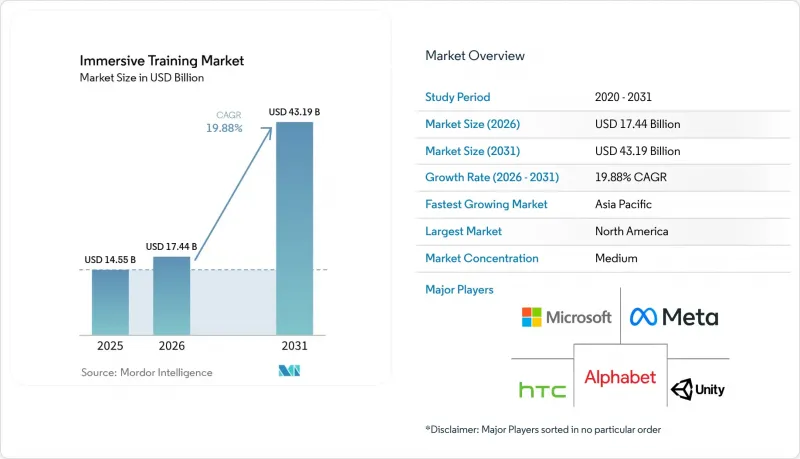
根據 Mordor Intelligence 估計,身臨其境型培訓市場在 2026 年的價值將達到 174.4 億美元,從 2025 年的 145.5 億美元成長到 2031 年的 431.9 億美元。
預計 2026 年至 2031 年的複合年成長率為 19.88%。
本報告按組件(硬體、軟體、服務)、技術(VR、AR、MR、XR、360度影片)、產業領域(醫療保健、航太與國防、製造業及其他)、部署模式(本地部署、雲端部署)、應用程式(基於模擬的學習及其他)和地區進行細分。市場預測以美元計價。
全球身臨其境型培訓市場趨勢與洞察
企業採用XR技術提升遠距員工技能的趨勢
企業正將XR模組整合到學習管理系統中,以便為遠距員工提供無需差旅或課堂準備的實務培訓。據領先企業稱,與主導講師授課模式相比,此舉已使每位員工的培訓成本降低了高達40%。混合辦公模式降低了准入門檻,使身臨其境型課程能夠在消費級頭戴裝置、筆記型電腦或行動裝置上運行,從而加速了專案規模的擴大。標準化的數位內容確保了不同地點技能品質的一致性,管理員可以透過分析儀表板即時追蹤員工能力。這些優勢正推動身臨其境型培訓市場走向主流化,並納入日常人才發展預算。
利用數位雙胞胎進行模擬訓練以降低成本
數位雙胞胎透過模擬複雜的設備和危險環境,使員工能夠在不中斷生產線的情況下學習。在汽車和電子工廠,採用模擬培訓代替現場培訓,已使新員工培訓期間的機器停機時間減少了 60%。在虛擬環境中進行重複練習,可以降低耗材成本,並減少員工受傷的風險。整合即時感測器數據,確保模擬場景能夠準確反映當前的運作狀況,從而保持訓練內容的時效性。企業通常在 18 個月內即可收回投資,這支撐了身臨其境型培訓市場的持續成長。
多用戶部署需要較高的初始硬體投資
一套完整的房間級培訓套件造價在 5 萬至 50 萬美元之間,給中小企業的預算帶來了沉重負擔。三年一次的硬體升級週期意味著持續的支出,而諸如追蹤鑽機之類的設施維修也增加了部署的複雜性。雖然雲端串流媒體可以減輕部分資金負擔,但某些地區的網路延遲和頻寬限制仍然需要本地部署設備,這減緩了注重成本的買家對身臨其境型培訓市場的接受度。
細分市場分析
隨著企業逐漸意識到專業內容和整合能夠提升培訓效果,業務收益正以21.75%的複合年成長率成長,超過了硬體和軟體的成長速度。儘管到2025年,硬體仍將佔據身臨其境型培訓市場51.68%的佔有率,但企業會將預算分配給場景設計、實施諮詢和持續支援。客製化模組的價格在10萬美元到100萬美元之間,具體取決於其逼真度、複雜性和監管要求。考慮到日常維護和內容更新的成本,預計從2028年起,以服務為主導的身臨其境型培訓市場將超越硬體市場。
內容創作工作室正受益於產業特定場景的長尾需求,例如無塵室中的半導體製造流程和緊急應變培訓。分析和績效儀錶板的管理服務正成為新的收入來源。儘管企業仍需要編寫工具並與學習管理系統整合,因此對軟體的需求仍然強勁,但隨著平台日益商品化,其相對市場佔有率正在下降。整體而言,身臨其境型培訓市場正持續從設備採購轉向全面、以結果為導向的服務合約。
隨著企業尋求能夠處理所有虛擬實境 (VR)、擴增實境 (AR) 和混合實境(MR) 功能的單一工具鏈,擴增實境(XR) 平台正以 20.54% 的複合年成長率 (CAGR) 成長。預計到 2025 年,虛擬實境將佔據身臨其境型訓練市場規模的 37.74%,這主要得益於外科手術和航空領域對高度沉浸式體驗的需求。然而,擴增實境疊加技術在現場指導應用中日益普及,而混合實境(MR) 則為複雜的維護任務提供空間精確的全像圖。與單獨的技術堆疊相比,整合式 XR 引擎可降低整合開銷,並將總部署成本降低高達 25%。
對於那些對互動式模擬猶豫不決的機構而言,360度影片仍然是一個入門選擇,它以犧牲互動性為代價,降低了開發成本。人工智慧驅動的自適應內容正逐漸興起,能夠根據生物識別回饋調整難度。隨著頭戴式設備功能的整合度不斷提高,許可模式也日趨簡化,身臨其境型培訓市場正朝著平台無關的XR運行時環境發展,這些運行時環境足夠靈活,可以在不同用例之間切換,而無需依賴特定硬體。
區域分析
預計到2025年,北美將佔全球收入的38.62%,這主要得益於早期採用者的存在、成熟的雲端基礎設施以及政府預算撥款,例如美國國防部12億美元的身臨其境型舉措。高寬頻普及率使得企業能夠以極低的延遲進行多用戶會話。在加拿大,一些省份正在強制推行基於VR的手術檢驗;在墨西哥,XR技術正被用於汽車工廠的組裝訓練。與現有企業軟體生態系統的整合降低了大規模買家的准入門檻,北美將繼續引領身臨其境型培訓市場。
預計亞太地區將錄得最高成長率,到2031年年複合成長率(CAGR)將達到21.12%。在國家數位化補貼的支持下,中國製造商正在部署數位雙胞胎以減少停機時間和品質缺陷。日本汽車製造商正在將混合實境(MR)技術整合到精密扭矩調節操作中,而韓國半導體製造工廠則在亞微米微影術維護過程中利用擴增實境(AR)疊加技術。印度的IT服務業正利用其低成本的開發人才,為全球客戶提供經濟高效的身臨其境型內容。 5G的快速部署和跨境雲端服務的擴展正在消除傳統的連接壁壘,從而推動身臨其境型培訓市場解決方案的更廣泛應用。
在歐洲,在嚴格的安全和資料隱私法規的推動下,沉浸式培訓市場正穩步發展,這些法規促進了組織內部標準化能力檢驗的實施。德國的「工業4.0」計畫正在將擴展實境(XR)技術與即時生產數據相結合,而英國國家醫療服務體系(NHS)則在試驗基於虛擬實境(VR)的醫療服務義務計畫。法國航太叢集正在使用觸覺回饋駕駛艙模擬器來縮短飛行員的過渡時間。受《一般資料保護規則》(GDPR)的影響,平台設計優先考慮設備端加密和匿名分析,這種對合規性的重視為歐洲供應商在隱私敏感領域贏得主要合約奠定了基礎。這些區域趨勢共同為身臨其境型培訓市場創造了一個平衡的全球前景。
其他好處
- Excel格式的市場預測(ME)表
- 3個月的分析師支持
目錄
第1章:引言
- 研究假設和市場定義
- 調查範圍
第2章:調查方法
第3章執行摘要
第4章 市場狀況
- 市場概覽
- 市場促進因素
- 企業採用XR技術提升遠距員工技能
- 利用數位雙胞胎進行模擬訓練以降低成本
- 監管機構正在推廣使用虛擬實境技術來檢驗外科手術技能。
- 國防元宇宙資金籌措管道的興起
- 身臨其境型內容的雲端串流媒體支援自帶裝置 (BYOD) 培訓。
- 自我調整回饋指標可提高學習維持率
- 市場限制因素
- 多用戶部署中較高的初始硬體投資成本
- 與持續性暈動症和乘客舒適度相關的挑戰
- 生物識別遙測資料收集中的資料隱私問題
- 身臨其境型評估缺乏教育設計標準
- 價值鏈分析
- 監理情勢
- 技術展望
- 波特五力分析
第5章 市場規模與成長預測
- 按組件
- 硬體
- VR頭戴裝置
- AR眼鏡
- 觸覺回饋裝置
- 運動感應器和追蹤器
- 穿戴式裝置和配件
- 軟體
- 學習管理系統(LMS)
- 模擬軟體
- 內容管理系統
- 可自訂的培訓內容
- 服務
- 內容開發
- 整合與部署
- 支援與維護
- 諮詢和培訓服務
- 硬體
- 透過技術
- 虛擬實境(VR)
- 擴增實境(AR)
- 混合實境(MR)
- 擴增實境(XR)
- 360度影片
- 其他技術(人工智慧驅動的身臨其境型平台、觸覺模擬)
- 按行業細分
- 醫療保健
- 外科培訓
- 患者照護模擬
- 航太/國防
- 戰鬥模擬
- 任務計劃
- 製造業
- 設備培訓
- 安全訓練
- 車
- 教育和學術領域
- 媒體與娛樂
- 零售與電子商務
- 企業培訓
- 其他汽車應用領域(能源、建築、物流)
- 醫療保健
- 按實現類型
- 現場
- 基於雲端的
- 透過使用
- 基於模擬的學習
- 互動學習
- 虛擬講師主導培訓 (VILT)
- 遊戲化
- 軟性技能培訓
- 技術技能培訓
- 合規培訓
- 按地區
- 北美洲
- 美國
- 加拿大
- 墨西哥
- 歐洲
- 英國
- 德國
- 法國
- 義大利
- 其他歐洲國家
- 亞太地區
- 中國
- 日本
- 印度
- 韓國
- 其他亞太國家
- 中東
- 以色列
- 沙烏地阿拉伯
- 阿拉伯聯合大公國
- 土耳其
- 其他中東國家
- 非洲
- 南非
- 埃及
- 其他非洲國家
- 南美洲
- 巴西
- 阿根廷
- 南美洲其他地區
- 北美洲
第6章 競爭情勢
- 市場集中度
- 策略趨勢
- 市佔率分析
- 公司簡介
- Microsoft Corporation
- Meta Platforms, Inc.
- Alphabet Inc.(Google LLC)
- HTC Corporation
- Samsung Electronics Co., Ltd.
- Lenovo Group Limited
- Unity Technologies, Inc.
- PTC Inc.
- Dassault Systemes SE
- CAE Inc.
- Boeing Company
- Lockheed Martin Corporation
- BAE Systems plc
- Honeywell International Inc.
- Siemens AG
- IBM Corporation
- VirtaMed AG
- Strivr Labs, Inc.
- EON Reality, Inc.
- Axon Enterprise, Inc.(Focal X)
第7章 市場機會與未來展望
According to Mordor Intelligence, immersive training market size in 2026 is estimated at USD 17.44 billion, growing from 2025 value of USD 14.55 billion with 2031 projections showing USD 43.19 billion, growing at 19.88% CAGR over 2026-2031.
This report is Segmented by Component (Hardware, Software, and Services), Technology (VR, AR, MR, XR, and 360-Degree Video), Industry Verticals (Healthcare, Aerospace and Defense, Manufacturing, and More), Deployment Mode (On-Premises, and Cloud-Based), Application (Simulation-Based Learning, and More), and Geography. The Market Forecasts are Provided in Terms of Value (USD).
Global Immersive Training Market Trends and Insights
Enterprise Adoption of XR-Based Remote Workforce Upskilling
Enterprises embed XR modules into learning management systems to give dispersed staff hands-on practice without travel or classroom setup. Large employers report up to 40% reductions in per-employee training expense versus instructor-led models. Hybrid work policies accelerate program scale because immersive sessions run on consumer-grade headsets, laptops, or mobiles, lifting adoption barriers. Standardized digital content keeps skill quality uniform across sites, and analytics dashboards let managers track competence in real time. These benefits push the immersive training market toward mainstream use within routine workforce development budgets.
Cost Reduction Through Digital-Twin Simulated Training
Digital twins recreate complex equipment and hazardous environments, so staff learn without shutting down production lines. Automotive and electronics factories record 60% fewer machine stoppages during onboarding cycles when simulations replace real-world practice. Repetition in virtual space eliminates consumable materials costs and mitigates worker injury risk. Integrating live sensor data ensures scenarios mirror current operating conditions, keeping instruction relevant. Enterprises typically realize payback inside 18 months, feeding sustained growth in the immersive training market.
High Upfront Hardware CapEx for Multi-User Installations
Complete room-scale training suites cost between USD 50,000 and USD 500,000, straining budgets of small enterprises. Hardware refresh cycles every three years add repeat expense, while facility retrofits such as tracking rigs increase complexity. Cloud streaming mitigates some capital load, yet network latency and bandwidth limits in certain regions still necessitate on-premises gear, slowing the immersive training market rollout among cost-sensitive buyers.
Other drivers and restraints analyzed in the detailed report include:
- Regulatory Push for Surgical Competence Validation via VR
- Cloud Streaming of Immersive Content Enabling BYOD Training
- Persistent Motion Sickness and User Comfort Issues
For complete list of drivers and restraints, kindly check the Table Of Contents.
Segment Analysis
Services revenue grows at 21.75% CAGR, outpacing hardware and software as enterprises realize that expert content and integration drive training impact. In 2025, hardware still controlled 51.68% of immersive training market share, but enterprises redirect budgets toward scenario design, deployment consulting, and ongoing support. Custom modules range from USD 100,000 to USD 1 million depending on fidelity, complexity, and regulatory requirements. The immersive training market size attributable to services is projected to overtake hardware after 2028, given recurring maintenance and content refresh fees.
Content creation studios benefit from long-tail demand for vertical-specific scenarios such as clean-room semiconductor procedures or emergency response drills. Managed services for analytics and performance dashboards add incremental revenue streams. Software retains steady demand because enterprises still require authoring tools and learning management connectors, yet its relative share declines as platform commoditization sets in. Overall, the immersive training market continues a pivot from device procurement toward holistic outcome-oriented service engagements.
Extended reality platforms grow at 20.54% CAGR as enterprises seek single toolchains that handle VR, AR, and mixed reality functions. Virtual reality owns 37.74% of the immersive training market size in 2025 owing to high-immersion requirements in surgery and aviation. However, AR overlays gain popularity for on-the-job guidance, while mixed reality provides spatially precise holograms for complex maintenance tasks. Unified XR engines reduce integration overhead, cutting total deployment cost by up to 25% when compared with discrete stacks.
360-degree video remains a gateway for organizations hesitant about interactable simulations, offering lower development overhead at the expense of interactivity. AI-driven adaptive content begins to surface, tailoring difficulty based on biometric feedback. As headset capabilities converge and licensing models simplify, the immersive training market aligns around agnostic XR runtimes that can flex between use cases without hardware lock-in.
Complete Report Scope:
- By Component
- Hardware
- VR Headsets
- AR Glasses
- Haptic Feedback Devices
- Motion Sensors and Trackers
- Wearables and Accessories
- Software
- Learning Management Systems (LMS)
- Simulation Software
- Content Management Systems
- Customized Training Content
- Services
- Content Development
- Integration and Deployment
- Support and Maintenance
- Consulting and Training Services
- Hardware
- By Technology
- Virtual Reality (VR)
- Augmented Reality (AR)
- Mixed Reality (MR)
- Extended Reality (XR)
- 360-Degree Video Training
- Others Technology (AI-Enabled Immersive Platforms, Haptic Simulations)
- By Industry Vertical Use
- Healthcare
- Surgical Training
- Patient Care Simulations
- Aerospace and Defense
- Combat Simulations
- Mission Planning
- Manufacturing
- Equipment Training
- Safety Drills
- Automotive
- Education and Academia
- Media and Entertainment
- Retail and E-commerce
- Corporate / Enterprise Training
- Other Automotive Uses (Energy, Construction, Logistics)
- Healthcare
- By Deployment Mode
- On-Premises Deployment
- Cloud-Based Deployment
- By Application
- Simulation-Based Learning
- Interactive Learning
- Virtual Instructor-Led Training (VILT)
- Gamification
- Soft Skills Training
- Technical Skills Training
- Compliance Training
- By Geography
- North America
- United States
- Canada
- Mexico
- Europe
- United Kingdom
- Germany
- France
- Italy
- Rest of Europe
- Asia-Pacific
- China
- Japan
- India
- South Korea
- Rest of Asia-Pacific
- Middle East
- Israel
- Saudi Arabia
- United Arab Emirates
- Turkey
- Rest of Middle East
- Africa
- South Africa
- Egypt
- Rest of Africa
- South America
- Brazil
- Argentina
- Rest of South America
- North America
Geography Analysis
North America generated 38.62% of 2025 revenues thanks to early adopters, mature cloud infrastructure, and government budget allocations such as the U.S. Department of Defense USD 1.2 billion immersive initiative. High broadband penetration lets enterprises stream multi-user sessions with minimal latency. Canada mandates VR surgical validation in select provinces, while Mexico's automotive plants use XR for assembly training. Integration with established enterprise software ecosystems lowers friction for large buyers, keeping North America at the forefront of the immersive training market.
Asia-Pacific records the fastest CAGR at 21.12% through 2031. Chinese manufacturers, supported by state digitization subsidies, deploy digital twins to cut downtime and quality defects. Japanese automakers integrate mixed reality into precision torque procedures, and South Korean semiconductor fabs rely on AR overlays during sub-micron lithography maintenance. India's IT services sector supplies cost-effective immersive content to global clients, leveraging low-cost development talent. Rapid 5G rollout and cross-border cloud expansions remove historical connectivity hurdles, enabling broader uptake of immersive training market solutions.
Europe experiences steady progress, driven by stringent safety and data privacy regulations that push organizations toward standardized competency validation. Germany's Industry 4.0 agenda merges XR with real-time production data, while the United Kingdom NHS experiments with VR duty-of-care programs. France's aerospace cluster adopts haptic flight deck simulators to shorten pilot conversion times. GDPR influences platform design to prioritize on-device encryption and anonymized analytics, and this compliance focus positions European vendors for premium contracts in privacy-sensitive domains. Collectively, regional dynamics create a balanced global outlook for the immersive training market.
- Microsoft Corporation
- Meta Platforms, Inc.
- Alphabet Inc. (Google LLC)
- HTC Corporation
- Samsung Electronics Co., Ltd.
- Lenovo Group Limited
- Unity Technologies, Inc.
- PTC Inc.
- Dassault Systemes SE
- CAE Inc.
- Boeing Company
- Lockheed Martin Corporation
- BAE Systems plc
- Honeywell International Inc.
- Siemens AG
- IBM Corporation
- VirtaMed AG
- Strivr Labs, Inc.
- EON Reality, Inc.
- Axon Enterprise, Inc. (Focal X)
Additional Benefits:
- The market estimate (ME) sheet in Excel format
- 3 months of analyst support
TABLE OF CONTENTS
1 INTRODUCTION
- 1.1 Study Assumptions and Market Definition
- 1.2 Scope of the Study
2 RESEARCH METHODOLOGY
3 EXECUTIVE SUMMARY
4 MARKET LANDSCAPE
- 4.1 Market Overview
- 4.2 Market Drivers
- 4.2.1 Enterprise Adoption of XR-Based Remote Workforce Upskilling
- 4.2.2 Cost Reduction Through Digital-Twin Simulated Training
- 4.2.3 Regulatory Push for Surgical Competence Validation Via VR
- 4.2.4 Rise of Defense Metaverse Funding Pipelines
- 4.2.5 Cloud Streaming of Immersive Content Enabling BYOD Training
- 4.2.6 Neuroadaptive Feedback Enhancing Learning Retention Metrics
- 4.3 Market Restraints
- 4.3.1 High Upfront Hardware CapEx for Multi-User Installations
- 4.3.2 Persistent Motion Sickness and User Comfort Issues
- 4.3.3 Data Privacy Concerns in Biometric Telemetry Capture
- 4.3.4 Lack of Instructional Design Standards for Immersive Assessments
- 4.4 Value-Chain Analysis
- 4.5 Regulatory Landscape
- 4.6 Technological Outlook
- 4.7 Porter's Five Forces Analysis
- 4.7.1 Threat of New Entrants
- 4.7.2 Bargaining Power of Suppliers
- 4.7.3 Bargaining Power of Buyers
- 4.7.4 Threat of Substitutes
- 4.7.5 Competitive Rivalry
5 MARKET SIZE AND GROWTH FORECASTS (VALUE)
- 5.1 By Component
- 5.1.1 Hardware
- 5.1.1.1 VR Headsets
- 5.1.1.2 AR Glasses
- 5.1.1.3 Haptic Feedback Devices
- 5.1.1.4 Motion Sensors and Trackers
- 5.1.1.5 Wearables and Accessories
- 5.1.2 Software
- 5.1.2.1 Learning Management Systems (LMS)
- 5.1.2.2 Simulation Software
- 5.1.2.3 Content Management Systems
- 5.1.2.4 Customized Training Content
- 5.1.3 Services
- 5.1.3.1 Content Development
- 5.1.3.2 Integration and Deployment
- 5.1.3.3 Support and Maintenance
- 5.1.3.4 Consulting and Training Services
- 5.1.1 Hardware
- 5.2 By Technology
- 5.2.1 Virtual Reality (VR)
- 5.2.2 Augmented Reality (AR)
- 5.2.3 Mixed Reality (MR)
- 5.2.4 Extended Reality (XR)
- 5.2.5 360-Degree Video Training
- 5.2.6 Others Technology (AI-Enabled Immersive Platforms, Haptic Simulations)
- 5.3 By Industry Vertical Use
- 5.3.1 Healthcare
- 5.3.1.1 Surgical Training
- 5.3.1.2 Patient Care Simulations
- 5.3.2 Aerospace and Defense
- 5.3.2.1 Combat Simulations
- 5.3.2.2 Mission Planning
- 5.3.3 Manufacturing
- 5.3.3.1 Equipment Training
- 5.3.3.2 Safety Drills
- 5.3.4 Automotive
- 5.3.5 Education and Academia
- 5.3.6 Media and Entertainment
- 5.3.7 Retail and E-commerce
- 5.3.8 Corporate / Enterprise Training
- 5.3.9 Other Automotive Uses (Energy, Construction, Logistics)
- 5.3.1 Healthcare
- 5.4 By Deployment Mode
- 5.4.1 On-Premises Deployment
- 5.4.2 Cloud-Based Deployment
- 5.5 By Application
- 5.5.1 Simulation-Based Learning
- 5.5.2 Interactive Learning
- 5.5.3 Virtual Instructor-Led Training (VILT)
- 5.5.4 Gamification
- 5.5.5 Soft Skills Training
- 5.5.6 Technical Skills Training
- 5.5.7 Compliance Training
- 5.6 By Geography
- 5.6.1 North America
- 5.6.1.1 United States
- 5.6.1.2 Canada
- 5.6.1.3 Mexico
- 5.6.2 Europe
- 5.6.2.1 United Kingdom
- 5.6.2.2 Germany
- 5.6.2.3 France
- 5.6.2.4 Italy
- 5.6.2.5 Rest of Europe
- 5.6.3 Asia-Pacific
- 5.6.3.1 China
- 5.6.3.2 Japan
- 5.6.3.3 India
- 5.6.3.4 South Korea
- 5.6.3.5 Rest of Asia-Pacific
- 5.6.4 Middle East
- 5.6.4.1 Israel
- 5.6.4.2 Saudi Arabia
- 5.6.4.3 United Arab Emirates
- 5.6.4.4 Turkey
- 5.6.4.5 Rest of Middle East
- 5.6.5 Africa
- 5.6.5.1 South Africa
- 5.6.5.2 Egypt
- 5.6.5.3 Rest of Africa
- 5.6.6 South America
- 5.6.6.1 Brazil
- 5.6.6.2 Argentina
- 5.6.6.3 Rest of South America
- 5.6.1 North America
6 COMPETITIVE LANDSCAPE
- 6.1 Market Concentration
- 6.2 Strategic Moves
- 6.3 Market Share Analysis
- 6.4 Company Profiles (includes Global level Overview, Market level overview, Core Segments, Financials as available, Strategic Information, Market Rank/Share for key companies, Products and Services, and Recent Developments)
- 6.4.1 Microsoft Corporation
- 6.4.2 Meta Platforms, Inc.
- 6.4.3 Alphabet Inc. (Google LLC)
- 6.4.4 HTC Corporation
- 6.4.5 Samsung Electronics Co., Ltd.
- 6.4.6 Lenovo Group Limited
- 6.4.7 Unity Technologies, Inc.
- 6.4.8 PTC Inc.
- 6.4.9 Dassault Systemes SE
- 6.4.10 CAE Inc.
- 6.4.11 Boeing Company
- 6.4.12 Lockheed Martin Corporation
- 6.4.13 BAE Systems plc
- 6.4.14 Honeywell International Inc.
- 6.4.15 Siemens AG
- 6.4.16 IBM Corporation
- 6.4.17 VirtaMed AG
- 6.4.18 Strivr Labs, Inc.
- 6.4.19 EON Reality, Inc.
- 6.4.20 Axon Enterprise, Inc. (Focal X)
7 MARKET OPPORTUNITIES AND FUTURE OUTLOOK
- 7.1 White-Space and Unmet-Need Assessment

 2026-2030年全球沉浸式媒體市場
 自我調整虛擬實境(VR)環境市場:按組件、技術、應用、設備類型、國家和地區分類—全球產業分析、市場規模、市場佔有率和預測(2026-2033 年)
 身臨其境型VR教育市場預測至2034年-按組件、部署模式、設備類型、組織規模、應用、最終用戶和地區分類的全球分析身臨其境型語言訓練市場預測至2034年-全球分析(按組件、設備類型、技術、應用、最終用戶和地區分類)
 2026年全球延展實境(XR)虛擬工作室市場報告2026年全球國防沉浸式現實市場報告2026年全球智慧虛擬商店設計解決方案市場報告2026年全球沉浸式虛擬商店市場報告2026年全球沉浸式虛擬實境市場報告2026年身臨其境型時尚全球市場報告