


 |
市場調查報告書
商品編碼
2072631
歐洲專業電子代工和設計服務:市場佔有率分析、行業趨勢和統計數據以及成長預測(2025-2030 年)Europe Electronic Contract Manufacturing and Design Services - Market Share Analysis, Industry Trends & Statistics, Growth Forecasts (2025 - 2030) |
||||||

※ 本網頁內容可能與最新版本有所差異。詳細情況請與我們聯繫。
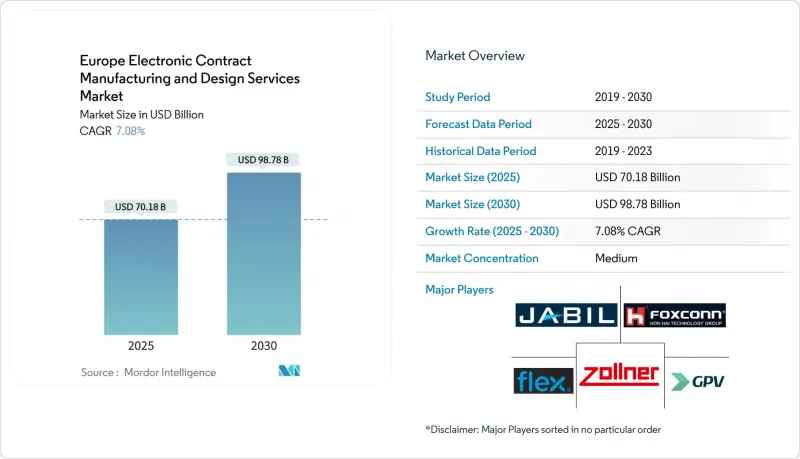
根據 Mordor Intelligence 預測,歐洲專業電子代工和設計服務市場規模預計將在 2025 年達到 701.8 億美元,到 2030 年達到 987.8 億美元,預測期內複合年成長率為 7.08%。
本報告按服務類型(例如,工程設計)、最終用戶行業(例如,資訊通訊技術/通訊、家用電子電器)、合約模式(例如,承包工程、部分工程)、公司規模(例如,大型公司:超過5億美元;中型公司:1億至5億美元)和國家(例如,德國、法國)進行分類。市場預測以美元計價。
歐洲專業電子代工和設計服務市場的趨勢和洞察。
歐洲原始設備製造商正在加速將複雜的電子設備外包。
一級汽車供應商和領先的工業自動化公司正在擴大與電子製造服務 (EMS)夥伴關係,將高級駕駛輔助系統 (ADAS)、高密度動力傳動系統和邊緣人工智慧模組的開發外包。這使他們能夠利用最先進的製造設施,同時避免新的資本支出 (CAPEX)。 2024 年,博世、大陸集團和採埃孚與區域性 EMS 供應商簽署了多年契約,用於生產下一代逆變器基板。英飛凌和安姆科在波爾圖的封裝和測試合作凸顯了曾經由企業內部完成的流程向外部專家的轉移。如今,更緊密的合作正在擴展,涵蓋生命週期測試和現場故障分析,EMS 供應商承擔了傳統上由 OEM 工程團隊負責的角色。
電動車對電力電子和電池管理系統的需求激增
預計到2025年,電動車在該地區的銷量佔比將超過輕型車總銷量的22%,這將加速對大電流基板、碳化矽逆變器堆和電池管理控制器的訂單。賽米克隆丹納赫和英飛凌已擴大其壓組裝的組裝規模,以支援博世第九代電力驅動橋的部署。由於汽車功能安全方面的限制,這項工作集中在已獲得ASIL-D認證且業績卓著的歐洲現有工廠進行。
製造地面臨技術純熟勞工短缺和工資持續上漲的問題
光是在德國,預計到2025年,計畫興建的半導體工廠將面臨13,000名SMT技術人員、壓接專家和測試工程師的缺口。 2024年,巴伐利亞州和巴登-符騰堡州的薪資年增6-8%,縮小了與亞洲部分地區的整體成本差距。政策制定者已透過資助雙元製教育計畫來應對這一問題,但熟練人員短缺問題依然嚴峻,尤其是在需要專業工藝能力的高品種、小批量生產線上。
細分市場分析
隨著原始設備製造商 (OEM) 尋求協作式創意生成框架以縮短產品上市時間,工程設計再次成為重中之重,預計到 2030 年將以 7.81% 的複合年成長率成長。 2024 年,在強勁的消費者和工業需求支撐下,電子組裝將繼續佔據歐洲專業電子代工和設計服務市場 46.12% 的佔有率。系統整合正在蓬勃發展,這主要得益於承包邊緣人工智慧閘道器的普及,而售後服務正在滿足循環經濟的需求並實現盈利。
隨著IC'Alps等ASIC設計公司正式與代工廠建立合作關係,涵蓋從流片到最終測試的整個流程,歐洲專業電子代工和設計服務市場的工程設計市場規模預計將進一步擴大,原型週期最多可縮短30天。同樣,合作協定的複合年成長率也高達8.56%,凸顯了整合式可製造性設計(DFM)、法規遵循檢驗和量產過渡能力的重要性。
預計醫療保健和醫療設備電子製造服務將以 8.12% 的複合年成長率成長,主要驅動力來自手術機器人、連網藥物輸送平台以及需要符合 ISO 13485 可追溯性的 III 類植入式醫療設備。工業和機器人領域仍將保持其最大佔有率,在 2024 年將佔歐洲電子契約製造和設計服務市場規模的 28.36%,這主要得益於歐盟各地工廠持續進行的自動化投資。
歐洲電子契約製造和設計服務產業正受益於醫療設備製造商 (OEM) 將 PCB-A 的生產外包,因為 PCB-A 對生物相容性要求極高,且需要 100% 的電子批次歷史記錄。波蘭的電子製造服務 (EMS) 公司,例如 Assel,已投資升級其生物潔淨室,以搶佔這一高階市場。同時,汽車電氣化也透過逆變器基板和溫度控管控制器,為中期產量成長提供了支撐。
其他好處:
- Excel格式的市場預測(ME)表
- 3個月的分析師支持
目錄
第1章:引言
- 研究假設和市場定義
- 調查範圍
第2章:調查方法
第3章執行摘要
第4章 市場狀況
- 市場概覽
- 市場促進因素
- 歐洲原始設備製造商正在加速將複雜的電子元件外包。
- 回流激勵措施和供應鏈本地化計劃
- 在EMS工廠中擴大工業4.0數位雙胞胎技術的應用
- 電動車對電力電子和電池管理系統的需求激增
- 擴大智慧醫療技術和穿戴式裝置的生產規模。
- 針對 2022-2023 年牛鞭效應造成的市場扭曲,進行短期庫存最佳化。
- 市場限制因素
- 製造地面臨技術純熟勞工短缺和工資持續上漲的問題
- 零件前置作業時間和分配風險的持續波動
- 先進組裝和測試生產線的高額資本投資壁壘
- 能源價格波動加劇對成本結構的影響
- 產業價值鏈分析
- 監理情勢
- 技術展望
- 波特五力分析
- 宏觀經濟因素對市場的影響
第5章 市場規模與成長預測
- 按服務類型
- 工程設計
- 電子設備組裝
- 系統整合
- 售後服務
- 產業最終用途
- 汽車與出行
- 工業和機器人領域
- 醫療保健和醫療設備
- 航太/國防
- 資訊通訊技術與通訊
- 家用電子產品
- 按合約模式
- 承包醫療服務
- 寄售/依設計圖進行生產
- 聯合設計與製造
- 部分EMS
- 按公司規模分類的急救醫療服務提供者
- 大規模(超過5億美元)
- 中型(1億美元至5億美元)
- 小規模(2000萬美元至1億美元)
- 微型企業(低於2000萬美元)
- 國家
- 德國
- 英國
- 法國
- 義大利
- 西班牙
- 俄羅斯
- 其他歐洲國家
第6章 競爭情勢
- 市場集中度
- 策略趨勢
- 市佔率分析
- 公司簡介
- Hon Hai Precision Industry Co. Ltd.(Foxconn)
- Flex Ltd.
- Jabil Inc.
- Zollner Elektronik AG
- GPV International A/S
- Scanfil Oyj
- Asteelflash SAS
- Videoton Holding Zrt.
- Katek SE
- Kitron ASA
- Celestica Inc.
- Cicor Group AG
- Neways Electronics International NV
- LACROIX Group SA
- TQ-Systems GmbH
- Bitron SPA
- Melecs EWS GmbH
- Plexus Services Corp.
- NOTE AB
- Fideltronik Poland Sp. z oo
第7章 市場機會與未來展望
According to Mordor Intelligence, the europe electronic contract manufacturing and design services market size stands at USD 70.18 billion in 2025 and is on track to reach USD 98.78 billion by 2030, reflecting a 7.08% CAGR through the forecast period.
This report is Segmented by Service Type (Engineering Design, and More), End-Use Industry (ICT and Telecom, Consumer Electronics, and More), Contract Model (Turnkey EMS, Partial EMS, and More), Company Size (Large >=USD 500m, Mid-Tier USD 100-500m, and More), and Country (Germany, France, and More). The Market Forecasts are Provided in Terms of Value (USD).
Europe Electronic Contract Manufacturing and Design Services Market Trends and Insights
Accelerating Outsourcing of Complex Electronics by European OEMs
Automotive tier-ones and industrial automation leaders are expanding EMS partnerships to offload advanced driver-assistance, high-density powertrain, and edge-AI modules, thereby avoiding fresh CAPEX while accessing state-of-the-art process equipment. Bosch, Continental, and ZF signed multi-year agreements with regional EMS houses for next-generation inverter boards in 2024. Infineon's packaging and test alliance with Amkor in Porto highlights the shift from in-house to external specialists for once-in-house steps. Stronger collaboration now spans life-cycle testing and field-failure analytics, pushing EMS providers into roles traditionally reserved for OEM engineering teams.
Demand Spike from E-Mobility Power Electronics and Battery Management Systems
EV penetration surpassed 22% of regional light-vehicle sales in 2025, catalyzing call-offs for high-current boards, SiC inverter stacks, and battery management controllers. Semikron-Danaher and Infineon expanded the outsourcing of press-fit assembly to support Bosch's rollout of the ninth-generation e-axle. Automotive functional-safety constraints anchor this work in established European sites where ASIL-D certification experience exists.
Skilled Labour Shortage and Rising Wage Inflation in Manufacturing Hubs
Germany alone is expected to enter 2025 short of 13,000 SMT technicians, press-fit specialists, and test engineers needed for planned semiconductor fabs. Wage rates in Bavaria and Baden-Wurttemberg increased by 6-8% year-on-year in 2024, narrowing the landed-cost gap with select Asian locations. Policymakers responded by funding dual-education pathways; however, the talent deficit remains acute for high-mix, low-volume lines that require process-capability expertise.
Other drivers and restraints analyzed in the detailed report include:
- Expansion of Smart-MedTech and Wearable Device Manufacturing
- Near-Term Inventory Rightsizing After 2022-2023 Bullwhip Distortion
- Persistent Component Lead-Time Volatility and Allocation Risk
For complete list of drivers and restraints, kindly check the Table Of Contents.
Segment Analysis
Engineering design captured renewed priority, expanding at a 7.81% CAGR through 2030 as OEMs seek collaborative ideation frameworks that compress time-to-market. Electronics assembly still supplied 46.12% of the Europe electronic contract manufacturing and design services market share in 2024, anchored by steady consumer and industrial volumes. System integration rose on the back of turnkey edge-AI gateways, while aftermarket services monetized circular economy mandates.
The Europe electronic contract manufacturing and design services market size for engineering design is projected to climb further as ASIC design houses such as IC'Alps formalize foundry alliances that cover tape-out to final test, shortening prototype cycles by up to 30 days. Joint design-manufacturing arrangements likewise grow at an 8.56% CAGR, underscoring the competitive weight of unified DFM, regulatory validation, and volume transfer capabilities.
Electronic manufacturing services for healthcare and medical devices are expected to register an 8.12% CAGR, driven by surgical robotics, connected drug-delivery platforms, and Class III implantables that require ISO 13485 traceability. Industrial and robotics maintained the largest slice, equal to 28.36% of the Europe electronic contract manufacturing and design services market size in 2024, thanks to sustained automation spending across EU factories.
The Europe electronic contract manufacturing and design services industry benefits where medical OEMs outsource PCB-As requiring stringent biocompatibility and 100% electronic lot history. Polish EMS entities such as Assel invested in bio-cleanroom upgrades to capture this premium segment. Automotive electrification, meanwhile, anchors mid-term volume through inverter boards and thermal-management controllers.
Complete Report Scope:
- By Service Type
- Engineering Design
- Electronics Assembly
- System Integration
- After-Market Services
- By End-Use Industry
- Automotive And Mobility
- Industrial And Robotics
- Healthcare And Medical Devices
- Aerospace And Defence
- ICT And Telecom
- Consumer Electronics
- By Contract Model
- Turnkey EMS
- Consignment/Build-to-Print
- Joint Design-Manufacturing
- Partial EMS
- By Company Size Of EMS Provider
- Large (>=USD 500 m)
- Mid-Tier (USD 100-500 m)
- Small (USD 20-100 m)
List of Companies Covered in this Report:
- Hon Hai Precision Industry Co. Ltd. (Foxconn)
- Flex Ltd.
- Jabil Inc.
- Zollner Elektronik AG
- GPV International A/S
- Scanfil Oyj
- Asteelflash SAS
- Videoton Holding Zrt.
- Katek SE
- Kitron ASA
- Celestica Inc.
- Cicor Group AG
- Neways Electronics International N.V.
- LACROIX Group SA
- TQ-Systems GmbH
- Bitron SPA
- Melecs EWS GmbH
- Plexus Services Corp.
- NOTE AB
- Fideltronik Poland Sp. z o.o.
Additional Benefits:
- The market estimate (ME) sheet in Excel format
- 3 months of analyst support
TABLE OF CONTENTS
1 INTRODUCTION
- 1.1 Study Assumptions and Market Definition
- 1.2 Scope of the Study
2 RESEARCH METHODOLOGY
3 EXECUTIVE SUMMARY
4 MARKET LANDSCAPE
- 4.1 Market Overview
- 4.2 Market Drivers
- 4.2.1 Accelerating Outsourcing Of Complex Electronics By European OEMs
- 4.2.2 Reshoring Incentives And Supply-Chain Nationalisation Programs
- 4.2.3 Growing Adoption Of Industry 4.0 And Digital Twins Across EMS Plants
- 4.2.4 Demand Spike From E-Mobility Power Electronics And Battery Management Systems
- 4.2.5 Expansion Of Smart-MedTech And Wearable Device Manufacturing
- 4.2.6 Near-Term Inventory Rightsizing After 2022-2023 Bullwhip Distortion
- 4.3 Market Restraints
- 4.3.1 Skilled Labour Shortage And Rising Wage Inflation In Manufacturing Hubs
- 4.3.2 Persistent Component Lead-Time Volatility And Allocation Risk
- 4.3.3 High Capex Barrier For Advanced Assembly And Testing Lines
- 4.3.4 Intensifying Energy-Price Volatility Impacting Cost Structures
- 4.4 Industry Value Chain Analysis
- 4.5 Regulatory Landscape
- 4.6 Technological Outlook
- 4.7 Porter's Five Forces Analysis
- 4.7.1 Threat of New Entrants
- 4.7.2 Bargaining Power of Suppliers
- 4.7.3 Bargaining Power of Buyers
- 4.7.4 Threat of Substitutes
- 4.7.5 Intensity Competitive Rivalry
- 4.8 Impact of Macroeconomic Factors on the Market
5 MARKET SIZE AND GROWTH FORECASTS
- 5.1 By Service Type
- 5.1.1 Engineering Design
- 5.1.2 Electronics Assembly
- 5.1.3 System Integration
- 5.1.4 After-Market Services
- 5.2 By End-Use Industry
- 5.2.1 Automotive And Mobility
- 5.2.2 Industrial And Robotics
- 5.2.3 Healthcare And Medical Devices
- 5.2.4 Aerospace And Defence
- 5.2.5 ICT And Telecom
- 5.2.6 Consumer Electronics
- 5.3 By Contract Model
- 5.3.1 Turnkey EMS
- 5.3.2 Consignment/Build-to-Print
- 5.3.3 Joint Design-Manufacturing
- 5.3.4 Partial EMS
- 5.4 By Company Size Of EMS Provider
- 5.4.1 Large (>=USD 500 m)
- 5.4.2 Mid-Tier (USD 100-500 m)
- 5.4.3 Small (USD 20-100 m)
- 5.4.4 Micro (<USD 20 m)
- 5.5 By Country
- 5.5.1 Germany
- 5.5.2 United Kingdom
- 5.5.3 France
- 5.5.4 Italy
- 5.5.5 Spain
- 5.5.6 Russia
- 5.5.7 Rest of Europe
6 COMPETITIVE LANDSCAPE
- 6.1 Market Concentration
- 6.2 Strategic Moves
- 6.3 Market Share Analysis
- 6.4 Company Profiles (includes Global Level Overview, Market Level Overview, Core Segments, Financials as available, Strategic Information, Market Rank/Share for key companies, Products and Services, and Recent Developments)
- 6.4.1 Hon Hai Precision Industry Co. Ltd. (Foxconn)
- 6.4.2 Flex Ltd.
- 6.4.3 Jabil Inc.
- 6.4.4 Zollner Elektronik AG
- 6.4.5 GPV International A/S
- 6.4.6 Scanfil Oyj
- 6.4.7 Asteelflash SAS
- 6.4.8 Videoton Holding Zrt.
- 6.4.9 Katek SE
- 6.4.10 Kitron ASA
- 6.4.11 Celestica Inc.
- 6.4.12 Cicor Group AG
- 6.4.13 Neways Electronics International N.V.
- 6.4.14 LACROIX Group SA
- 6.4.15 TQ-Systems GmbH
- 6.4.16 Bitron SPA
- 6.4.17 Melecs EWS GmbH
- 6.4.18 Plexus Services Corp.
- 6.4.19 NOTE AB
- 6.4.20 Fideltronik Poland Sp. z o.o.
7 MARKET OPPORTUNITIES AND FUTURE OUTLOOK
- 7.1 White-Space and Unmet-Need Assessment

 電子產品契約製造與設計服務市場-2026-2032年全球市場預測
 專業電子代工和設計服務市場規模、佔有率和趨勢分析報告:按服務、最終用途、地區和細分市場分類(2026-2033 年)
 2026年全球專業電子代工與設計服務市場報告
 全球專業電子代工與設計服務市場(依服務類型、製造服務、最終用戶產業、產量、國家及地區分類)-產業分析、市場規模、市場佔有率及2025-2032年預測
 專業電子代工和設計服務市場分析及預測(至2035年):按類型、產品、服務、技術、組件、應用、形式、設備和最終用戶分類
 專業電子代工和設計服務市場-全球產業規模、佔有率、趨勢、機會及預測(按服務、最終用途、地區和競爭格局分類),2021-2031年專業電子代工與設計服務市場報告:趨勢、預測及競爭分析(至2031年)
 專業電子代工和設計服務市場(按服務、最終用戶和地區分類),2026 年至 2032 年