


 |
市場調查報告書
商品編碼
2072617
區域細分:市場佔有率分析、產業趨勢與統計、成長預測(2026-2031 年)Zonal Isolation - Market Share Analysis, Industry Trends & Statistics, Growth Forecasts (2026 - 2031) |
||||||

※ 本網頁內容可能與最新版本有所差異。詳細情況請與我們聯繫。
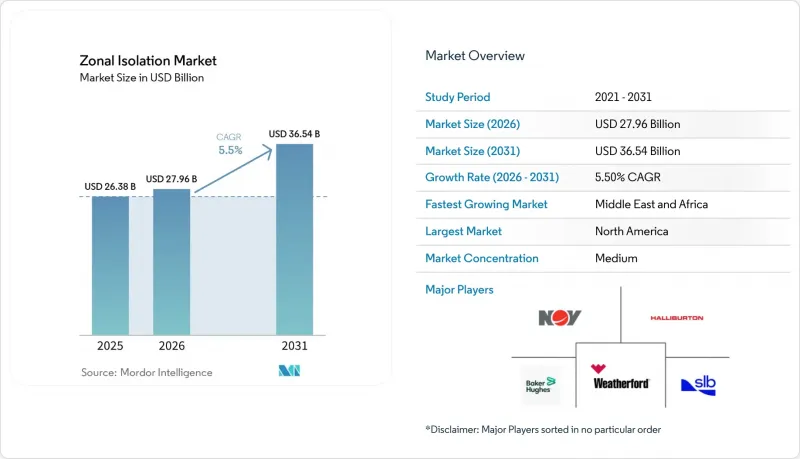
據 Mordor Intelligence 稱,區域隔離市場預計將從 2025 年的 263.8 億美元成長到 2026 年的 279.6 億美元,到 2031 年達到 365.4 億美元,預計 2026 年至 2031 年的複合年成長率為 5.5%。
本報告按技術(機械式、化學式)、井型(垂直井、傾斜井、水平井、多向井)、儲存環境(常規油藏、其他油藏)、生命週期階段(鑽井階段、其他階段)、應用領域(一次開採、修復、封井)、位置(陸上、海上)和地區(北美、歐洲、亞太地區、其他地區)進行細分。市場預測以美元計價。
全球區域分離市場趨勢與洞察
頁岩氣和緻密氣鑽探熱潮
在二疊紀盆地,同步壓裂技術目前可同時對多達八口水平井進行壓裂,縮短了壓裂週期,同時也增加了對複合封隔器的需求,這種封隔器每段可在15分鐘內鑽出。單一井場可能需要多達300個封隔器,雖然單井成本正在下降,但總需求卻在增加。在沙烏地阿拉伯的傑夫拉碳酸鹽岩地層,需要一個耐酸彈性體封裝超過10,000英尺的側井,並使其能夠承受富含二氧化碳的流體。在阿根廷的瓦卡穆埃爾塔,預計到2026年將完成28,040段的鑽井作業,這需要橋塞和水泥封隔器供應鏈的局部化。同樣,在中國四川頁岩氣開發案中,計畫到2030年鑽探6,000口新的水平井,每口井需要30至50個封隔器。
深海和超深海開發激增
斯洛伐克公司(SLB)在巴西的35口鹽層下訂單採用全電完井法,該方法減少了封隔器的數量,但需要在2000米深的環境中實現精確的水泥粘結。印度石油天然氣公司(ONGC)價值50.8億美元的「二期叢集」計畫涉及鑽探35口井,總深度達4,200米,每口注水井都需要耐壓超過5,000磅/平方英吋的隔離裝置。埃克森美孚預計到2026年在圭亞那的日產量將達到90萬桶,但使用高性能水泥對於抑制沉積濁積岩層中的水錐效應至關重要。
原油價格波動抑制了資本投資週期。
2026年初,布蘭特原油價格在每桶75美元至85美元之間波動,迫使雪佛龍公司將2026年的支出上限設定為190億美元,並推遲了深海探勘鑽井計畫。 2025年下半年,美國頁岩油鑽井鑽機數量下降了8%,導致完井數量減少,封堵器消耗量也隨之下降。中東國家石油公司透過維持數十億美元的項目,部分緩解了這些下降趨勢,並確保了業務的持續運作。
細分市場分析
儘管機械工具在2025年仍佔據大部分收入,但化學技術的進步,例如自修復能力和無機聚合物混合物,預計將推動市場在2031年之前以6.2%的複合年成長率成長。貝克休斯公司的「InvictaSet」可促進微裂縫內碳酸鈣的沉澱,進而延長超臨界二氧化碳條件下碳捕集與封存(CCS)井的使用壽命。同樣,SLB公司的「SqueezeCRETE」可在40-320°F的溫度範圍內滲透120微米的縫隙,提供優於傳統微水泥的中壽命修復方案。在歐洲和北美脫碳政策的推動下,使用化學系統進行插層隔離的市場規模預計將會擴大。同時,諸如威德福公司在土庫曼斯坦使用的旋轉襯管吊架和油田服務專業公司在墨西哥灣使用的34,000英尺鑄鐵固定器等機械創新,展現了為應對嚴苛的井下環境而不斷改進的硬體技術。這種混合方法,即先安裝橋塞,再在其上註入水泥,結合了機械工具的即時隔離效果和硬化水泥的耐久性。基於ISO 14310和API 65-3的監管測試確保機械系統和化學系統都符合相同的完整性標準,從而促進兩者的共存而非相互替代。
預計到2025年,垂直鑽井將佔市場價值的41.4%,而水平井則以6.4%的複合年成長率成長,業者正致力於最大化與儲存的接觸面積。在二疊紀盆地,水平延伸長度現已超過15,000英尺,每口井的鑽井段數超過60段,儘管水平井的數量仍然不多,但每口井的材料消耗量幾乎加倍,這推動了層間隔離市場的成長。同樣,瓦卡穆爾塔地區的10,000英尺水平井也呈現類似的建設密度,預計到2026年,GeoPark、YPF、殼牌和雪佛龍等業者將完成28,040段鑽井。科威特和阿曼等地區的支管井正作為新興成長領域而備受關注。在這些地區,樹脂基密封劑被用於隔離支管點,而無需額外的地面鑽孔。因此,水平井在區域隔離的市場佔有率預計將繼續擴大。然而,Montney地區的滑動套管法已展現出透過使用套管代替塞子來減少工具使用量的潛力,這再次引發了人們對水泥品質的關注。
區域分析
預計到2025年,北美將佔全球銷售額的39.1%。由於二疊紀盆地同步壓裂(simul-frac)計畫的興起,對封堵器的需求不斷成長;同時,由於美國安全與環境執法局(BSEE)對休眠井的監管日益嚴格,墨西哥灣封堵和封堵作業(P&A)的支出也在加速成長。在加拿大,Montney組正在測試一種滑動套筒系統,該系統可以減少硬體需求,但精確的注水泥對於防止套筒間相互干擾至關重要。這些進展凸顯了該地區致力於提高作業效率並遵守監管要求的決心。
中東和非洲地區是成長最快的地區,年複合成長率達6.5%。在沙烏地阿拉伯,傑夫拉緻密碳酸鹽岩地層中含有15%二氧化碳的流體需要耐酸彈性體來處理。此外,阿布達比國家石油公司鑽井部門將完井時間縮短了10%,使得資金得以重新分配,用於擴大在阿曼和科威特的鑽機網路,運作兩國運營鑽機的總數超過300台。該地區的成長得益於探勘和生產活動的擴大,以及鑽井技術的進步。
亞太地區和南美洲正蓄勢待發,即將迎來下一階段的成長。在中國,四川盆地預計將鑽探6,000口新的水平井,每口井需要30至50個防滲層。在南美洲,巴西鹽層下下層和圭亞那斯塔布布魯克區塊正在開發大量海底井,這些井需要能夠承受2000公尺深度的超高規格水泥。由於上游領域投資的增加和基礎設施建設的擴展,這些地區預計將迎來顯著成長。
在歐洲,關注點正轉向退休活動。北海過渡管理局 (NSTA) 管理的大量專案積壓正在推動海洋即插即用 (P&A) 服務市場的蓬勃發展。這一趨勢反映了該地區優先解決基礎設施老化問題並遵守環境標準的舉措,從而確保了對退役服務的持續需求。
其他好處:
- Excel格式的市場預測(ME)表
- 3個月的分析師支持
目錄
第1章:引言
- 研究假設和市場定義
- 調查範圍
第2章:調查方法
第3章執行摘要
第4章 市場狀況
- 市場概覽
- 市場促進因素
- 頁岩緻密氣鑽探熱潮
- 深海和超深海開發建設的快速成長
- 更嚴格的油井完整性法規(API 標準 65-3,ISO 14310)
- 水平和多級壓裂導致完工工程量增加
- 地熱循環井需要高溫絕緣材料。
- 需要超長壽命屏障的碳捕集與封存注入井
- 市場限制因素
- 原油價格波動抑制了資本投資週期。
- 關注水泥的永續性和二氧化碳排放量
- 加強特種可膨脹彈性體的供應鏈管理
- 無需機械工具的全電動建築工程的興起。
- 供應鏈分析
- 監理情勢
- 技術展望
- 波特五力模型
第5章 市場規模與成長預測
- 透過技術
- 機械區隔離
- 化學區分離
- 按井類型
- 垂直井
- 角度井
- 水平井
- 分支井
- 儲存環境
- 傳統的
- 傳統型
- HPHT儲存
- 依生命週期階段
- 挖掘
- 完成
- 生產
- 廢棄礦井
- 透過使用
- 初級區域分離
- 復原區隔離
- Plug and Abundance (P&A)
- 按位置
- 陸上
- 離岸
- 按地區
- 北美洲
- 美國
- 加拿大
- 墨西哥
- 歐洲
- 德國
- 英國
- 法國
- 義大利
- 北歐國家
- 俄羅斯
- 其他歐洲國家
- 亞太地區
- 中國
- 印度
- 日本
- 韓國
- 東南亞國協
- 其他亞太國家
- 南美洲
- 巴西
- 阿根廷
- 其他南美國家
- 中東和非洲
- 沙烏地阿拉伯
- 阿拉伯聯合大公國
- 南非
- 埃及
- 其他中東和非洲國家
- 北美洲
第6章 競爭情勢
- 市場集中度
- 策略趨勢(併購、聯盟、購電協議)
- 市場佔有率分析(主要公司的市場排名和佔有率)
- 公司簡介
- Schlumberger Ltd.
- Halliburton Co.
- Baker Hughes Co.
- Weatherford Intl. plc
- NOV Inc.
- TechnipFMC plc
- Expro Group Holdings
- Tendeka(TGS)
- Superior Energy Services
- Nine Energy Service
- Welltec A/S
- TAM International
- Core Laboratories
- Trican Well Service
- Rubicon Oilfield Intl.
- Packers Plus Energy Svcs.
- Archer Ltd.
- Vallourec SA
- Forum Energy Technologies
- Elite Downhole Tools
第7章 市場機會與未來展望
According to Mordor Intelligence, the zonal isolation market size is expected to increase from USD 26.38 billion in 2025 to USD 27.96 billion in 2026 and reach USD 36.54 billion by 2031, growing at a CAGR of 5.5% over 2026-2031.
This report is Segmented by Technology (Mechanical, Chemical), Well Type (Vertical, Deviated, Horizontal, Multilateral), Reservoir Environment (Conventional, and More), Lifecycle Stage (Drilling, and More), Application (Primary, Remedial, P&A), Location (Onshore, Offshore), and Geography (North America, Europe, Asia-Pacific, and More). The Market Forecasts are Provided in Terms of Value (USD).
Global Zonal Isolation Market Trends and Insights
Shale and Tight-Gas Drilling Boom
Permian simul-frac programs now fracture up to eight horizontal wells simultaneously, reducing cycle times and increasing the demand for composite plugs that can be drilled out in under 15 minutes per stage. A single pad may require up to 300 plugs, driving higher volumes despite a lower cost per well. In Saudi Arabia's Jafurah carbonate formation, acid-resistant elastomers are needed to seal laterals exceeding 10,000 feet while withstanding CO2-rich fluids. Argentina's Vaca Muerta is projected to complete 28,040 stages by 2026, necessitating the localization of a supply chain for bridge plugs and cement retainers. Similarly, China's Sichuan shale gas initiative plans for 6,000 new horizontal wells by 2030, each requiring 30-50 barriers.
Deep- and Ultra-Deepwater Development Upsurge
SLB's 35-well pre-salt contract in Brazil includes all-electric completions, which reduce the number of packers but require precise cement bonding at water depths of 2,000 meters. ONGC's USD 5.08 billion Cluster 2 project involves 35 wells reaching a total depth of 4,200 meters, with each injector requiring isolation rated above 5,000 psi. ExxonMobil's production in Guyana reached 900,000 barrels per day in 2026, with stacked turbidites necessitating the use of high-performance cements to mitigate water coning.
Crude-Price Volatility Curbing CAPEX Cycles
Brent crude prices ranged between USD 75 - 85 per barrel in early 2026, leading Chevron to cap its 2026 spending at USD 19 billion and postpone exploratory deepwater drilling projects. An 8% decline in U.S. shale rigs during late 2025 resulted in reduced well completions and decreased plug consumption. Middle Eastern NOCs partially mitigated these reductions by maintaining their multi-billion-dollar programs, ensuring continued activity.
Other drivers and restraints analyzed in the detailed report include:
- Stricter Well-Integrity Mandates
- Horizontal and Multistage Frac Completions
- Cement Sustainability and CO2 Footprint Scrutiny
For complete list of drivers and restraints, kindly check the Table Of Contents.
Segment Analysis
Mechanical tools accounted for the majority of revenue in 2025; however, chemical advancements, such as self-healing and geopolymer blends, are projected to grow at a 6.2% CAGR through 2031. Baker Hughes' InvictaSet facilitates calcium carbonate precipitation in micro-cracks, enhancing the lifespan of CCS wells under super-critical CO2 conditions. Similarly, SLB's SqueezeCRETE penetrates 120-micron slots at temperatures ranging from 40 to 320 °F, providing a mid-life repair solution that surpasses traditional micro-cements. The zonal isolation market size for chemical systems is expected to expand, driven by low-carbon mandates in Europe and North America. Concurrently, mechanical innovations, such as Weatherford's rotating liner hanger in Turkmenistan and Oilfield Service Professionals' 34,000-foot cast-iron retainer in the Gulf, demonstrate ongoing advancements in hardware for extreme well conditions. Hybrid approaches, which involve setting a bridge plug followed by cement squeezing above it, combine the immediate isolation provided by mechanical tools with the durability of cured cement. Regulatory testing under ISO 14310 and API 65-3 ensures that both mechanical and chemical systems meet the same integrity standards, promoting coexistence rather than replacement.
Vertical drilling is projected to account for 41.4% of the market value in 2025, while horizontal wells are growing at a compound annual growth rate (CAGR) of 6.4% as operators focus on maximizing reservoir contact. In the Permian Basin, lateral lengths now exceed 15,000 feet, with over 60 stages per well, effectively doubling the consumption of materials per well and driving growth in the zonal isolation market, even as well counts stabilize. Similarly, Vaca Muerta's 10,000-foot horizontal wells demonstrate comparable intensity, with operators such as GeoPark, YPF, Shell, and Chevron expected to complete 28,040 stages by 2026. Multilateral wells in regions like Kuwait and Oman highlight niche growth, where resin sealants are used to isolate branch junctions without requiring additional surface holes. Consequently, the market share for horizontal wells in zonal isolation is anticipated to continue increasing. However, sliding-sleeve completions in the Montney region indicate that tool intensity can decrease when sleeves replace plugs, shifting the focus back to cement quality.
Complete Report Scope:
- By Technology
- Mechanical Zonal Isolation
- Chemical Zonal Isolation
- By Well Type
- Vertical Wells
- Deviated Wells
- Horizontal Wells
- Multilateral Wells
- By Reservoir Environment
- Conventional
- Unconventional
- HPHT Reservoirs
- By Lifecycle Stage
- Drilling
- Completion
- Production
- Abandonment
- By Application
- Primary Zonal Isolation
- Remedial Zonal Isolation
- Plug and Abandonment (P&A)
- By Location
- Onshore
- Offshore
- By Geography
- North America
- United States
- Canada
- Mexico
- Europe
- Germany
- United Kingdom
- France
- Italy
- NORDIC Countries
- Russia
- Rest of Europe
- Asia-Pacific
- China
- India
- Japan
- South Korea
- ASEAN Countries
- Rest of Asia-Pacific
- South America
- Brazil
- Argentina
- Rest of South America
- Middle East and Africa
- Saudi Arabia
- United Arab Emirates
- South Africa
- Egypt
- Rest of Middle East and Africa
- North America
Geography Analysis
North America is projected to account for 39.1% of the 2025 revenue. The rise in Permian simul-frac programs has increased demand for plugs, while stricter idle-well regulations from the Bureau of Safety and Environmental Enforcement (BSEE) have accelerated spending on plug and abandonment (P&A) activities in the Gulf of Mexico. In Canada, the Montney formation is testing sliding-sleeve systems, which reduce hardware requirements but rely on precise cementing to prevent sleeve cross-talk. These developments underscore the region's focus on improving operational efficiency and adhering to regulatory requirements.
The Middle East & Africa is the fastest-growing region, with a compound annual growth rate (CAGR) of 6.5%. In Saudi Arabia, the Jafurah tight carbonate formations require acid-resistant elastomers to manage fluids containing 15% CO2. Additionally, ADNOC Drilling's 10% improvement in well delivery times has enabled capital reallocation for expanding rig fleets in Oman and Kuwait, which together operate over 300 units. Growth in this region is driven by increased exploration and production activities, supported by advancements in drilling technologies.
Asia-Pacific and South America represent the next tier of growth. In China, the Sichuan Basin is expected to see the drilling of 6,000 new horizontal wells, each requiring 30-50 barriers. In South America, Brazil's pre-salt fields and Guyana's Stabroek block are contributing to the development of numerous subsea wells, necessitating high-specification cements capable of withstanding water depths of up to 2,000 meters. These regions are positioned for significant growth due to increasing investments in upstream activities and infrastructure development.
Europe is shifting its focus toward decommissioning activities. The backlog managed by the North Sea Transition Authority (NSTA) is driving a robust offshore plug and abandonment (P&A) services market. This trend reflects the region's priority on addressing aging infrastructure and meeting environmental compliance standards, ensuring sustained demand for decommissioning services.
- Schlumberger Ltd.
- Halliburton Co.
- Baker Hughes Co.
- Weatherford Intl. plc
- NOV Inc.
- TechnipFMC plc
- Expro Group Holdings
- Tendeka (TGS)
- Superior Energy Services
- Nine Energy Service
- Welltec A/S
- TAM International
- Core Laboratories
- Trican Well Service
- Rubicon Oilfield Intl.
- Packers Plus Energy Svcs.
- Archer Ltd.
- Vallourec S.A.
- Forum Energy Technologies
- Elite Downhole Tools
Additional Benefits:
- The market estimate (ME) sheet in Excel format
- 3 months of analyst support
TABLE OF CONTENTS
1 Introduction
- 1.1 Study Assumptions & Market Definition
- 1.2 Scope of the Study
2 Research Methodology
3 Executive Summary
4 Market Landscape
- 4.1 Market Overview
- 4.2 Market Drivers
- 4.2.1 Shale & tight-gas drilling boom
- 4.2.2 Deep- & ultra-deepwater development upsurge
- 4.2.3 Stricter well-integrity mandates (API Std 65-3, ISO 14310)
- 4.2.4 Rising horizontal & multistage frac completions
- 4.2.5 Geothermal heat-loop wells demanding high-temp isolation
- 4.2.6 CCS injection wells needing ultra-long-life barriers
- 4.3 Market Restraints
- 4.3.1 Crude-price volatility curbing CAPEX cycles
- 4.3.2 Cement-sustainability & CO2 footprint scrutiny
- 4.3.3 Supply-chain pinch in specialty swell-elastomers
- 4.3.4 Rise of all-electric completions bypassing mechanical tools
- 4.4 Supply-Chain Analysis
- 4.5 Regulatory Landscape
- 4.6 Technological Outlook
- 4.7 Porter's Five Forces
- 4.7.1 Threat of New Entrants
- 4.7.2 Bargaining Power of Buyers
- 4.7.3 Bargaining Power of Suppliers
- 4.7.4 Threat of Substitutes
- 4.7.5 Competitive Rivalry
5 Market Size & Growth Forecasts
- 5.1 By Technology
- 5.1.1 Mechanical Zonal Isolation
- 5.1.2 Chemical Zonal Isolation
- 5.2 By Well Type
- 5.2.1 Vertical Wells
- 5.2.2 Deviated Wells
- 5.2.3 Horizontal Wells
- 5.2.4 Multilateral Wells
- 5.3 By Reservoir Environment
- 5.3.1 Conventional
- 5.3.2 Unconventional
- 5.3.3 HPHT Reservoirs
- 5.4 By Lifecycle Stage
- 5.4.1 Drilling
- 5.4.2 Completion
- 5.4.3 Production
- 5.4.4 Abandonment
- 5.5 By Application
- 5.5.1 Primary Zonal Isolation
- 5.5.2 Remedial Zonal Isolation
- 5.5.3 Plug and Abandonment (P&A)
- 5.6 By Location
- 5.6.1 Onshore
- 5.6.2 Offshore
- 5.7 By Geography
- 5.7.1 North America
- 5.7.1.1 United States
- 5.7.1.2 Canada
- 5.7.1.3 Mexico
- 5.7.2 Europe
- 5.7.2.1 Germany
- 5.7.2.2 United Kingdom
- 5.7.2.3 France
- 5.7.2.4 Italy
- 5.7.2.5 NORDIC Countries
- 5.7.2.6 Russia
- 5.7.2.7 Rest of Europe
- 5.7.3 Asia-Pacific
- 5.7.3.1 China
- 5.7.3.2 India
- 5.7.3.3 Japan
- 5.7.3.4 South Korea
- 5.7.3.5 ASEAN Countries
- 5.7.3.6 Rest of Asia-Pacific
- 5.7.4 South America
- 5.7.4.1 Brazil
- 5.7.4.2 Argentina
- 5.7.4.3 Rest of South America
- 5.7.5 Middle East and Africa
- 5.7.5.1 Saudi Arabia
- 5.7.5.2 United Arab Emirates
- 5.7.5.3 South Africa
- 5.7.5.4 Egypt
- 5.7.5.5 Rest of Middle East and Africa
- 5.7.1 North America
6 Competitive Landscape
- 6.1 Market Concentration
- 6.2 Strategic Moves (M&A, Partnerships, PPAs)
- 6.3 Market Share Analysis (Market Rank/Share for key companies)
- 6.4 Company Profiles (includes Global level Overview, Market level overview, Core Segments, Financials as available, Strategic Information, Products & Services, and Recent Developments)
- 6.4.1 Schlumberger Ltd.
- 6.4.2 Halliburton Co.
- 6.4.3 Baker Hughes Co.
- 6.4.4 Weatherford Intl. plc
- 6.4.5 NOV Inc.
- 6.4.6 TechnipFMC plc
- 6.4.7 Expro Group Holdings
- 6.4.8 Tendeka (TGS)
- 6.4.9 Superior Energy Services
- 6.4.10 Nine Energy Service
- 6.4.11 Welltec A/S
- 6.4.12 TAM International
- 6.4.13 Core Laboratories
- 6.4.14 Trican Well Service
- 6.4.15 Rubicon Oilfield Intl.
- 6.4.16 Packers Plus Energy Svcs.
- 6.4.17 Archer Ltd.
- 6.4.18 Vallourec S.A.
- 6.4.19 Forum Energy Technologies
- 6.4.20 Elite Downhole Tools
7 Market Opportunities & Future Outlook
- 7.1 White-Space & Unmet-Need Assessment


