


 |
市場調查報告書
商品編碼
2072593
非色散紅外光譜(NDIR):市場佔有率分析、產業趨勢與統計、成長預測(2026-2031)Non-Dispersive Infrared (NDIR) - Market Share Analysis, Industry Trends & Statistics, Growth Forecasts (2026 - 2031) |
||||||

※ 本網頁內容可能與最新版本有所差異。詳細情況請與我們聯繫。
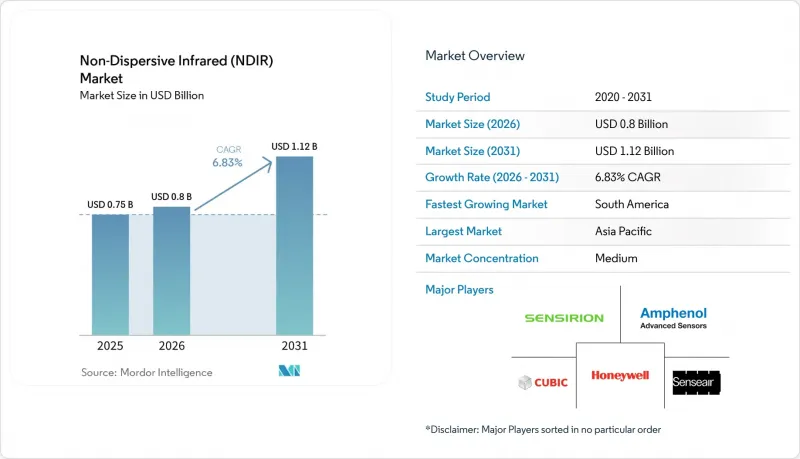
根據 Mordor Intelligence 預測,非色散紅外線 (NDIR) 市場規模將從 2025 年的 7.5 億美元和 2026 年的 8 億美元成長到 2031 年的 11.2 億美元,2026 年至 2031 年的年複合成長率(CAGR)為 6.83%。
本報告按產品類型(固定/壁掛式模組、工業製程分析儀及其他)、檢測氣體(二氧化碳 (CO2)、碳氫化合物 (CH4、C3H8) 及其他)、終端用戶產業(暖通空調和建築自動化、工業安全和製程控制及其他)、平台(PCB貼片式晶片感測器及其他)和地區進行細分。市場預測以美元 (USD) 為單位。
全球非色散紅外線 (NDIR) 市場趨勢與洞察
加強商業建築室內空氣品質(IAQ)法規
學校董事會、衛生署和綠建築委員會正攜手合作,將持續的二氧化碳監測作為通風指標。加州AB 2232法案強制要求在教室中使用精度為±75 ppm的設備,並進行年度檢驗,其他七個州也正在製定類似的法規。中國已於2023年將室內二氧化碳允許濃度限值降至800 ppm,這將推動約300億平方公尺的占地面積進行維修。市場需求正轉向具有自動基準校正功能的模組,這些模組可將二氧化碳漂移控制在五年內±50 ppm以內。推廣基於Matter標準的自癒式網狀網路的供應商,由於避免使用專有閘道器,正在贏得維修專案的競標。
更嚴格的汽車和工業排放標準
歐7和EPA Tier 4排放標準已將監測範圍從排氣管擴展到車廂空氣和工廠排氣煙囪。汽車製造商目前正將NDIR二氧化碳感測器整合到電動車的HVAC迴路中,以平衡電池消耗和乘員舒適度。在工業領域,新的甲烷排放上限規定了每季進行洩漏測試,靈敏度為0.40 kg h⁻¹,開啟了先前使用蠕動幫浦系統的可攜式分析儀的更換週期。能確保在-40 度C至+80 度C的工作溫度範圍內,精度仍能達到±200 ppm的供應商,正與一級系統整合商簽訂多年供貨合約。
價格下降和感測器商品化
在深圳大型製造商的帶動下,到2025年,基礎型5000ppm二氧化碳檢測模組的平均售價將降至20美元以下。隨著西方公司毛利率縮減至20%左右,將基於韌體的分析功能和校準服務捆綁成訂閱服務已成為加速發展的趨勢。 RESET和Title 24認證仍然是企業競標中的差異化因素,使得高階型號能夠保持兩位數的價格差異,但消費級物聯網買家則普遍選擇成本最低且符合標準的選項。
細分市場分析
隨著設施管理人員追求預測性維護能力,智慧連網設備正蓬勃發展,預計在預測期內將以7.31%的複合年成長率成長。到2025年,固定式和壁掛式模組將佔據主導地位,佔非分散紅外線(NDIR)市場佔有率的38.00%,但只有雲端型號的銷售額持續超過基準成長率。這些型號的無線韌體更新減少了技術人員的上門服務次數,而Thread網路的採用則使承包商安裝的中繼器數量減少了30%。可攜式分析儀在職業安全審核中繼續發揮至關重要的作用,尤其關注那些已獲得SIL2認證並能滿足煉油廠檢修計劃的型號。工業機架式分析儀在大型石化工廠中正變得不可或缺,這得歸功於其符合ISO 14064標準的防爆外殼。
供應商正轉向「感測器即服務 (SaaS)」契約,將硬體、校準和儀錶板打包到一個月費套餐中。 Sensirion 的 Wi-Fi 版 SCD43 型號展示了自動化合規報告如何減少 WELL 和加州能源法規第 24 條規定的文書工作。 Matter 的互通性消除了供應商鎖定,並允許當地電工進行維修,而無需專門的安裝人員。行動裝置現在標配可充電鋰離子電池,足以運作一周,解決了傳統的正常運行時間問題。工業分析儀正在利用邊緣人工智慧及早偵測污染,防止意外運作,避免數百萬單位產品的損失。
2025年,二氧化碳仍是核心細分市場,佔銷售額的46.00%,但其成長率已趨於穩定,接近整個非色散紅外線(NDIR)市場的平均水準。同時,冷媒檢測細分市場正以7.78%的複合年成長率成長,目前正受益於為遵守F-gas法規和《基加利協定》而投入的資金。該細分市場需要窄頻光學裝置來分離R-1234yf和水蒸氣,這增加了設計的複雜性,但也帶來了更高的定價。碳氫化合物模組正從催化式Pellistor轉向NDIR,這在H2S含量高、火花無法接受的環境中是一種更安全的選擇。醫用氣體監測儀符合手術室的ISO 80601要求,代表一個規模雖小但利潤豐厚的細分市場,其精確度要求為±0.3 vol%。
霍尼韋爾的雙波長碳氫化合物感測器可即時補償濕度誤差,在 5,000 ppm 量程內達到 ±5% 的精度。溫室營運商正在採購 20,000 ppm 量程的模組,即使在相對濕度高達 95% 的環境下,也能將測量精度保持在 ±50 ppm 以內。對於石油生產商而言,物流成本佔其海上總成本的很大一部分,因此即使價格較高,無需每季進行校準的設備也是可以接受的。麻醉氣體測量設備正從側流採樣轉向可直接連接到氣道的主流感測器,從而消除測量延遲,避免了兒童手術的複雜性。
區域分析
隨著中國將室內二氧化碳濃度限值降至800ppm,辦公大樓和購物中心掀起了一波維修,總面積達300億平方米,預計到2025年,亞太地區的銷售額將佔全球的42.80%。印度的「智慧城市計畫」和日本修訂後的學校建築標準均要求將非耗散紅外線(NDIR)通風控制設備作為標準配置,保障了基本需求。韓國和澳洲均採用ASHRAE 62.1標準,使得海外感測器的批准更加便捷,並規範了跨國物業管理公司的競標流程。
在中東地區,預計年複合成長率將達到7.88%,綠色建築法規「2030願景」和ESTIDAMA Pearl系統的引入(該系統將室內二氧化碳濃度超過800ppm視為違規)正在推動該地區的發展。為2022年卡達世界盃建造的體育場館安裝了超過1萬個感測器,即使在攝氏50度C的氣候下也能有效發揮作用,類似的舉措也正在機場和購物中心推廣。沙烏地阿拉伯的工業甲烷清單計畫現已強制要求在煉油廠的排氣煙囪中安裝非分散紅外線(NDIR)感測器,從而確保透過校準服務獲得持續的收入。在埃及的“新行政首都”,市中心180萬平方米的建築必須獲得LEED金級認證,每棟大樓的所有空調機組都必須安裝二氧化碳感測器。
到2025年,北美和歐洲非分散式紅外線光譜儀(NDIR)的市佔率合計約為40%。加州教室相關法律的修訂以及歐盟建築能源性能法規(EPBD)強制要求進行持續監測,推動了學校、飯店和護理機構的維修浪潮。美國聯邦政府的稅收優惠政策可報銷三分之一的感測器安裝成本,提高了中檔飯店的投資報酬率。德國已將職場二氧化碳濃度上限降至3000ppm,鼓勵工廠升級設備。在英國,冬季檢查發現60%的教室不符合標準,因此建議將教室二氧化碳濃度保持在1500ppm以下,預計將創造30萬台設備的需求。南美洲和非洲仍處於起步階段,但巴西正在製定校準標準,南非正在考慮強制在深層礦井中安裝二氧化碳感測器,這表明未來市場具有成長潛力。
其他好處
- Excel格式的市場預測(ME)表
- 3個月的分析師支持
目錄
第1章:引言
- 研究假設和市場定義
- 調查範圍
第2章:調查方法
第3章執行摘要
第4章 市場狀況
- 市場概覽
- 市場促進因素
- 加強商業建築室內空氣品質(IAQ)法規
- 加強汽車和工業領域的排放法規
- 加速暖通空調系統的自動化和智慧恆溫器的廣泛應用。
- 邊緣AI NDIR模組支援感測器端分析
- 碳定價將推動對油氣井進行持續的甲烷監測。
- 藍牙 5.3 功率預算的增加使得消費性穿戴裝置能夠實現多氣體 NDIR 技術。
- 市場限制因素
- 感測器價格降低和商品化
- 極端溫度和濕度條件下的性能漂移。
- 氦氣短缺對校準氣體供應的影響
- 長波長TDLAS和光聲技術的應用日益廣泛
- 產業價值鏈分析
- 監理情勢
- 技術展望
- 宏觀經濟因素對市場的影響
- 波特五力分析
第5章 市場規模與成長預測
- 依產品類型
- 固定/壁掛式模組
- 可攜式/手持終端機
- 智慧/連網NDIR感測器
- 工業製程分析儀
- 透過檢測到的氣體
- 二氧化碳(CO2)
- 烴類(CH4、C3H8)
- 冷媒(HFC、HFO)
- 麻醉氣體和醫用氣體
- 按最終用途行業分類
- 暖通空調和建築自動化
- 工業安全與製程
- 汽車和運輸業
- 醫療保健和生命科學
- 食品和農業
- 按平台
- PCB貼片式晶片感測器
- 模組級感測器
- 完整分析系統
- 按地區
- 北美洲
- 美國
- 加拿大
- 墨西哥
- 歐洲
- 德國
- 英國
- 法國
- 俄羅斯
- 其他歐洲國家
- 亞太地區
- 中國
- 日本
- 印度
- 韓國
- 澳洲
- 其他亞太國家
- 中東
- 沙烏地阿拉伯
- 阿拉伯聯合大公國
- 其他中東國家
- 非洲
- 南非
- 埃及
- 其他非洲國家
- 南美洲
- 巴西
- 阿根廷
- 南美洲其他地區
- 北美洲
第6章 競爭情勢
- 市場集中度
- 策略趨勢
- 市佔率分析
- 公司簡介
- Senseair AB
- Sensirion AG
- Cubic Sensor and Instrument Co., Ltd.
- Dynament Limited
- Gas Sensing Solutions Ltd.
- ELT SENSOR Corp.
- Zhengzhou Winsen Electronics Technology Co., Ltd.
- Figaro Engineering Inc.
- Amphenol Advanced Sensors(Telaire)
- Honeywell International Inc.
- Vaisala Oyj
- Edinburgh Instruments Ltd.
- CO2Meter, Inc.
- AlphaSense Inc.
- Heitronics Infrarot Messtechnik GmbH
- Alphasense Ltd.
- InfraTec GmbH Infrarotsensorik und Messtechnik
- NevadaNano, Inc.
- City Technology Ltd.
- Sick AG
第7章 市場機會與未來展望
According to Mordor Intelligence, the non-Dispersive infrared market size is projected to expand from USD 0.75 billion in 2025 and USD 0.80 billion in 2026 to USD 1.12 billion by 2031, registering a CAGR of 6.83% between 2026 and 2031.
This report is Segmented by Product Type (Fixed/Wall-Mount Modules, Industrial Process Analyzers, and More), Gas Detected (Carbon Dioxide (CO2), Hydrocarbons (CH4, C3H8), and More), End-Use Industry (HVAC and Building Automation, Industrial Safety and Process, and More), Platform (PCB-Mount Chip Sensors, and More), and Geography. The Market Forecasts are Provided in Terms of Value (USD).
Global Non-Dispersive Infrared (NDIR) Market Trends and Insights
Intensifying IAQ Regulation in Commercial Buildings
School boards, ministries of health, and green-building councils are converging on permanent CO2 sensing as a proxy for ventilation. California's AB 2232 requires classrooms to use devices with +-75 ppm accuracy and requires yearly verification, and similar statutes are emerging in seven other US states. China lowered the permissible indoor CO2 ceiling to 800 ppm in 2023, driving retrofits across roughly 30 billion m2 of floor space. Market preference is shifting toward modules with automatic baseline correction that hold drift below +-50 ppm across five years. Vendors promoting self-healing mesh networks under the Matter standard are winning retrofit bids by avoiding proprietary gateways.
Stricter Automotive and Industrial Emission Norms
Euro 7 and EPA Tier 4 standards extend monitoring from tailpipes to cabin air and factory stacks. Automakers now embed NDIR CO2 sensors in electric-vehicle HVAC loops to balance battery drain with occupant comfort. On the industrial side, new methane caps require quarterly leak checks at 0.40 kg h-1 sensitivity, opening a replacement cycle for portable analyzers that previously used pellistors. Suppliers that can certify to the -40 °C to +80 °C operating range without sacrificing +-200 ppm accuracy are securing multi-year supply agreements with Tier 1 system integrators.
Price Erosion and Sensor Commoditization
Average selling prices for basic 5 000 ppm CO2 modules dropped below USD 20 in 2025, led by large-scale producers in Shenzhen.Gross margins for Western firms tightened to low-20% territory, encouraging them to bundle firmware analytics and calibration services as subscription offerings. RESET and Title 24 certifications remain differentiators in enterprise bids, allowing premium models to keep double-digit price deltas, yet consumer IoT buyers overwhelmingly select the least-cost-compliant option.
Other drivers and restraints analyzed in the detailed report include:
- Accelerated HVAC Automation and Smart Thermostat Uptake
- Edge-AI NDIR Modules Enabling On-Sensor Analytics
- Performance Drift in Harsh Temperature and Humidity
For complete list of drivers and restraints, kindly check the Table Of Contents.
Segment Analysis
Smart and connected units gained momentum, with a CAGR of 7.31% over the forecast period, as facility managers pursued predictive maintenance capabilities. Although fixed and wall-mount modules dominated the Non-Dispersive Infrared market share at 38.00% in 2025, cloud-ready models are the only category consistently outselling the baseline growth rate. Their wireless firmware updates curb technician visits, and Thread networking lets contractors install 30% fewer repeaters. Portable analyzers retain relevance for occupational safety audits, especially models certified to SIL2 that meet refinery turnaround schedules. Industrial rack analyzers benefit from explosion-proof enclosures that meet ISO 14064 compliance requirements, making them a staple of petrochemical megasites.
Vendors are pivoting toward sensor-as-a-service agreements that bundle hardware, calibration, and dashboards for one monthly fee. Sensirion's Wi-Fi-enabled SCD43 illustrates how automatic compliance reports reduce paperwork under WELL and Title 24 rules. Matter interoperability has ended vendor lock-in, opening retrofit work to local electricians rather than proprietary installers. Portable devices now ship with rechargeable lithium-ion packs that last a full workweek, solving past runtime complaints. Industrial analyzers leverage edge AI to detect fouling early and prevent unplanned shutdowns that cost millions in lost throughput.
Carbon dioxide held the revenue anchor at 46.00% in 2025, yet growth stalled near the overall Non-Dispersive Infrared market average. Refrigerant sensing, growing at 7.78% CAGR, now captures capital allocated to comply with F-Gas and Kigali deadlines. The segment requires narrow-bandpass optics to separate R-1234yf from water vapor, adding design complexity but opening premium pricing. Hydrocarbon modules are moving from catalytic pellistors to NDIR, a safer option in high-H2S fields where sparks are unacceptable. Medical-gas monitors meet ISO 80601 mandates in operating rooms, a small but margin-rich niche that requires +-0.3 vol-% accuracy.
Honeywell's dual-wavelength hydrocarbon sensor compensates for humidity error in real time, achieving +-5% precision across 5 000 ppm. Greenhouse operators are buying 20 000 ppm-range modules that keep readings within +-50 ppm despite 95% relative humidity. Oil producers accept higher list prices if a device negates the need for quarterly calibration gas, because logistics dominate total cost offshore. Anesthetic-gas instruments are drifting away from sidestream sampling toward mainstream sensors mounted directly in the airway, eliminating lag that complicates pediatric procedures.
Complete Report Scope:
- By Product Type
- Fixed/Wall-Mount Modules
- Portable/Handheld Devices
- Smart/Connected NDIR Sensors
- Industrial Process Analyzers
- By Gas Detected
- Carbon Dioxide (CO2)
- Hydrocarbons (CH4, C3H8)
- Refrigerants (HFCs, HFOs)
- Anesthetic and Medical Gases
- By End-Use Industry
- HVAC and Building Automation
- Industrial Safety and Process
- Automotive and Transportation
- Healthcare and Life-Science
- Food and Agriculture
- By Platform
- PCB-Mount Chip Sensors
- Module-Level Sensors
- Complete Analyzer Systems
- By Geography
- North America
- United States
- Canada
- Mexico
- Europe
- Germany
- United Kingdom
- France
- Russia
- Rest of Europe
- Asia-Pacific
- China
- Japan
- India
- South Korea
- Australia
- Rest of Asia-Pacific
- Middle East
- Saudi Arabia
- United Arab Emirates
- Rest of Middle East
- Africa
- South Africa
- Egypt
- Rest of Africa
- South America
- Brazil
- Argentina
- Rest of South America
- North America
Geography Analysis
Asia-Pacific delivered 42.80% of 2025 revenue after China cut indoor CO2 limits to 800 ppm, triggering retrofits across 30 billion m2 of offices and malls. India's Smart Cities Mission and Japan's updated school codes both hard-wire NDIR into ventilation controllers, guaranteeing baseline demand. South Korea and Australia align with ASHRAE 62.1, easing foreign sensor approvals and unifying tender processes for multinational property managers.
The Middle East, forecast to grow at a 7.88% CAGR, benefits from Vision 2030 green-building decrees and the ESTIDAMA Pearl system, which classifies indoor CO2 levels above 800 ppm as a compliance breach. Stadiums built for the 2022 World Cup in Qatar embedded more than 10 000 sensors, demonstrating their viability in 50 °C climates and spurring airports and malls to follow suit. Saudi Arabia's industrial methane inventory program now mandates NDIR on refinery stacks, stitching a recurring revenue stream for calibration services. Egypt's New Administrative Capital orders LEED Gold across 1.8 million m2 of downtown core, each tower specifying CO2 sensors on every air-handling unit.
North America and Europe together represented roughly 40% of the NDIR market in 2025. California's classroom law and the EU Energy Performance of Buildings recast both stipulate continuous monitoring, creating retrofit waves in schools, hotels, and care homes. US federal tax incentives can rebate one-third of sensor project costs, lifting payback models for mid-tier hotels. Germany lowered workplace CO2 limits to 3 000 ppm, nudging factories to upgrade. The UK recommended sub-1 500 ppm classrooms after winter tests showed 60% non-compliance, adding an estimated 300 000-unit opportunity. South America and Africa are early-stage, yet Brazil is drafting calibration norms, while South Africa weighs mandatory CO2 sensing in deep mines, hinting at future upside.
- Senseair AB
- Sensirion AG
- Cubic Sensor and Instrument Co., Ltd.
- Dynament Limited
- Gas Sensing Solutions Ltd.
- ELT SENSOR Corp.
- Zhengzhou Winsen Electronics Technology Co., Ltd.
- Figaro Engineering Inc.
- Amphenol Advanced Sensors (Telaire)
- Honeywell International Inc.
- Vaisala Oyj
- Edinburgh Instruments Ltd.
- CO2Meter, Inc.
- AlphaSense Inc.
- Heitronics Infrarot Messtechnik GmbH
- Alphasense Ltd.
- InfraTec GmbH Infrarotsensorik und Messtechnik
- NevadaNano, Inc.
- City Technology Ltd.
- Sick AG
Additional Benefits:
- The market estimate (ME) sheet in Excel format
- 3 months of analyst support
TABLE OF CONTENTS
1 INTRODUCTION
- 1.1 Study Assumptions and Market Definition
- 1.2 Scope of the Study
2 RESEARCH METHODOLOGY
3 EXECUTIVE SUMMARY
4 MARKET LANDSCAPE
- 4.1 Market Overview
- 4.2 Market Drivers
- 4.2.1 Intensifying IAQ Regulation in Commercial Buildings
- 4.2.2 Stricter Automotive and Industrial Emission Norms
- 4.2.3 Accelerated HVAC Automation and Smart Thermostat Uptake
- 4.2.4 Edge-AI NDIR Modules Enabling On-Sensor Analytics
- 4.2.5 Carbon Pricing Driving Continuous Methane Monitoring at Oil & Gas Wellheads
- 4.2.6 Bluetooth 5.3's Higher Power Budgets Allowing Multi-Gas NDIR in Consumer Wearables
- 4.3 Market Restraints
- 4.3.1 Price Erosion and Sensor Commoditisation
- 4.3.2 Performance Drift in Harsh Temperature/Humidity
- 4.3.3 Helium Shortage Impacting Calibration Gas Supply
- 4.3.4 Growing Adoption of Long-Wave TDLAS and Photo-Acoustic Techniques
- 4.4 Industry Value Chain Analysis
- 4.5 Regulatory Landscape
- 4.6 Technological Outlook
- 4.7 Impact of Macroeconomic Factors on the Market
- 4.8 Porter's Five Forces Analysis
- 4.8.1 Bargaining Power of Suppliers
- 4.8.2 Bargaining Power of Buyers
- 4.8.3 Threat of New Entrants
- 4.8.4 Threat of Substitutes
- 4.8.5 Competitive Rivalry
5 MARKET SIZE AND GROWTH FORECASTS (VALUE)
- 5.1 By Product Type
- 5.1.1 Fixed/Wall-Mount Modules
- 5.1.2 Portable/Handheld Devices
- 5.1.3 Smart/Connected NDIR Sensors
- 5.1.4 Industrial Process Analyzers
- 5.2 By Gas Detected
- 5.2.1 Carbon Dioxide (CO2)
- 5.2.2 Hydrocarbons (CH4, C3H8)
- 5.2.3 Refrigerants (HFCs, HFOs)
- 5.2.4 Anesthetic and Medical Gases
- 5.3 By End-Use Industry
- 5.3.1 HVAC and Building Automation
- 5.3.2 Industrial Safety and Process
- 5.3.3 Automotive and Transportation
- 5.3.4 Healthcare and Life-Science
- 5.3.5 Food and Agriculture
- 5.4 By Platform
- 5.4.1 PCB-Mount Chip Sensors
- 5.4.2 Module-Level Sensors
- 5.4.3 Complete Analyzer Systems
- 5.5 By Geography
- 5.5.1 North America
- 5.5.1.1 United States
- 5.5.1.2 Canada
- 5.5.1.3 Mexico
- 5.5.2 Europe
- 5.5.2.1 Germany
- 5.5.2.2 United Kingdom
- 5.5.2.3 France
- 5.5.2.4 Russia
- 5.5.2.5 Rest of Europe
- 5.5.3 Asia-Pacific
- 5.5.3.1 China
- 5.5.3.2 Japan
- 5.5.3.3 India
- 5.5.3.4 South Korea
- 5.5.3.5 Australia
- 5.5.3.6 Rest of Asia-Pacific
- 5.5.4 Middle East
- 5.5.4.1 Saudi Arabia
- 5.5.4.2 United Arab Emirates
- 5.5.4.3 Rest of Middle East
- 5.5.5 Africa
- 5.5.5.1 South Africa
- 5.5.5.2 Egypt
- 5.5.5.3 Rest of Africa
- 5.5.6 South America
- 5.5.6.1 Brazil
- 5.5.6.2 Argentina
- 5.5.6.3 Rest of South America
- 5.5.1 North America
6 COMPETITIVE LANDSCAPE
- 6.1 Market Concentration
- 6.2 Strategic Moves
- 6.3 Market Share Analysis
- 6.4 Company Profiles (includes Global Level Overview, Market Level Overview, Core Segments, Financials as available, Strategic Information, Market Rank/Share, Products and Services, Recent Developments)
- 6.4.1 Senseair AB
- 6.4.2 Sensirion AG
- 6.4.3 Cubic Sensor and Instrument Co., Ltd.
- 6.4.4 Dynament Limited
- 6.4.5 Gas Sensing Solutions Ltd.
- 6.4.6 ELT SENSOR Corp.
- 6.4.7 Zhengzhou Winsen Electronics Technology Co., Ltd.
- 6.4.8 Figaro Engineering Inc.
- 6.4.9 Amphenol Advanced Sensors (Telaire)
- 6.4.10 Honeywell International Inc.
- 6.4.11 Vaisala Oyj
- 6.4.12 Edinburgh Instruments Ltd.
- 6.4.13 CO2Meter, Inc.
- 6.4.14 AlphaSense Inc.
- 6.4.15 Heitronics Infrarot Messtechnik GmbH
- 6.4.16 Alphasense Ltd.
- 6.4.17 InfraTec GmbH Infrarotsensorik und Messtechnik
- 6.4.18 NevadaNano, Inc.
- 6.4.19 City Technology Ltd.
- 6.4.20 Sick AG
7 MARKET OPPORTUNITIES AND FUTURE OUTLOOK
- 7.1 White-Space and Unmet-Need Assessment

 非色散紅外線市場-2026-2032年全球市場預測
 非色散紅外線 (NDIR) 市場規模、佔有率和成長分析:按氣體類型、應用、最終用戶、分銷和地區分類-2026-2033 年產業預測非色散紅外線感測器市場:全球預測(2026-2032 年),按產業分類:環境監測、石油化學、醫療、暖通空調、汽車及其他
 2026年全球非色散紅外線(NDIR)市場報告NDIR CO2感測器市場按類型、應用、最終用途和通路分類-2026年至2032年全球預測NDIR氣體感測器元件市場(依氣體類型、產品類型、終端用戶產業、應用和銷售管道)——2026-2032年全球預測NDIR氣體感測器市場按氣體類型、產品類型、濃度範圍、應用、終端用戶產業和分銷管道分類 - 全球預測(2026-2032年)NDIR氣體感測器市場按產品類型、安裝方式、連接類型、最終用戶產業、應用和銷售管道分類-2026年至2032年全球預測先進非色散紅外線(NDIR) 感測器市場:按產品類型、技術、應用、終端用戶產業和分銷管道分類 - 全球預測 2026-2032 年非色散紅外線二氧化碳感測器市場:按產品類型、校準技術、整合、應用和銷售管道-2026-2032年全球預測