


 |
市場調查報告書
商品編碼
2072577
微型和奈米PLC:市場佔有率分析、行業趨勢和統計數據、成長預測(2026-2031年)Micro And Nano PLC - Market Share Analysis, Industry Trends & Statistics, Growth Forecasts (2026 - 2031) |
||||||

※ 本網頁內容可能與最新版本有所差異。詳細情況請與我們聯繫。
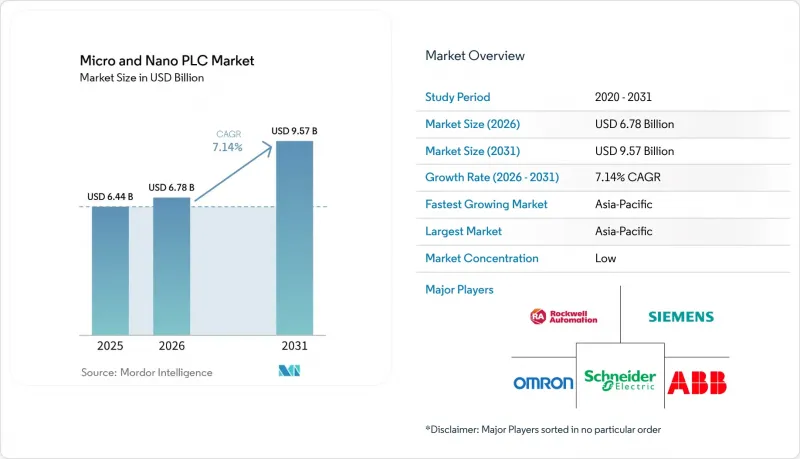
根據 Mordor Intelligence 預測,微型和奈米 PLC 市場規模將從 2025 年的 64.4 億美元成長到 2026 年的 67.8 億美元,然後在 2031 年達到 95.7 億美元,2026 年至 2031 年的複合年成長率為 7.14%。
本報告按產品尺寸(奈米PLC和微型PLC)、交付方式(硬體、軟體和服務)、架構(固定/整合和模組化)、終端用戶產業(汽車和交通運輸、食品和飲料、電力和能源、化學、製藥、金屬和礦業、半導體和電子等)以及地區進行細分。市場預測以美元(USD)為單位。
全球微型與奈米PLC市場趨勢與洞察
亞太地區中小企業的工廠自動化
亞太地區仍然是微型和奈米PLC市場最大的需求來源,因為自動化需求正日益滲透到小規模工廠而非大型工業設施。這一轉變的一個顯著例證是,中小型機械製造商擴大使用緊湊型控制器,他們需要低成本的邏輯電路、快速試運行和易於操作人員培訓。在日本,Keyence的「KV Nano」和捷太格特的「TOYOPUC-Nano」等成熟的緊湊型控制器產品線,充分展現了其緊湊的設計如何滿足OEM環境對高循環率和高精度的需求,這持續影響著鄰近亞洲國家的系統整合商和設備供應商。 JEMA的2025年用戶調查也表明,日本精密加工和電子設備OEM應用中對高耐用性PLC的採用率很高,這證實了全部區域對緊湊型控制系統的廣泛投資。因此,亞太地區的微型和奈米PLC市場競爭日益激烈,不僅體現在硬體初始價格上,也體現在軟體效能、服務支援和生態系統相容性等方面。
緊湊型控制器中的工業物聯網和邊緣連接
微型和奈米PLC市場正受益於能夠在同一個緊湊單元內處理確定性機械邏輯和本地數據傳輸的控制器。這降低了材料清單,簡化了機櫃設計,並縮短了操作人員的安裝時間,使他們無需添加單獨的邊緣閘道器即可獲得基本的分析功能。OMRON的Sysmac-Edge DX1資料流控制器於2025年9月在全球發布,它體現了這一趨勢,支援在現場從多個PLC品牌進行無程式碼資料擷取,且不會中斷生產。 NTT和東芝也透過IOWN APN展示了雲PLC配置,並在製造測試中實現了300公里距離下20毫秒的控制週期。這印證了本地緊湊節點和遠端軟體功能將日益協同工作的觀點。這種轉變正在提升微型和奈米PLC市場的標準功能集,因為乙太網路連接、協定柔軟性和可程式設計邊緣邏輯不再局限於高階配置。
與中階PLC相比,性能有其局限性
微型和奈米PLC市場最明顯的結構性限制在於其處理能力的上限,尤其是在應用場景擴展到高密度I/O、同步運動或更複雜的批次環境時,這個限制會更加明顯。緊湊型控制器對於許多獨立設備來說運作良好,但當使用者需要更寬的控制範圍、更高級的運動控制功能或更廣泛的原生製程處理能力時,它們仍然無法滿足需求。羅克韋爾自動化公司旗下Vreugdenhil Dairy Foods的案例就體現了這一點,這是一個大型整合生產環境,由於工廠的複雜性超過了緊湊型設備的實際處理能力,因此仍然需要更高級別的控制平台。隨著入門級中階控制器的效能不斷提升,而價格卻逐漸接近高階微型PLC產品,此問題在微型和奈米PLC市場尤為突出。為了應對競爭對手,供應商不斷增加安全功能、運動控制功能或高級軟體功能,這可能會導致成本上升,並削弱緊湊型控制器最初吸引人的尺寸優勢。
細分市場分析
2025年,微型PLC在全球微型和奈米PLC市場佔據61.23%的佔有率,並持續保持其在緊湊型工業控制設備市場的領先地位。微型PLC的優點在於其均衡的功能集,適用於包裝器材、輸送機、暖通空調控制面板、泵浦系統和小型工具機等應用,而無需使用者轉向更高成本的模組化平台。這種中間定位在微型和奈米PLC市場仍然具有價值,因為許多OEM廠商需要比智慧繼電器更強大的邏輯功能和連接性,但又不需要功能齊全的中階PLC架構。羅克韋爾自動化於2025年10月推出的Allen-Bradley Micro820 L20E正是這一趨勢的體現,它支援EtherNet/IP Class 1通訊、USB-C性能驗證介面以及FactoryTalk Design Workbench相容性。微型PLC的市場地位也得到了實際應用案例的支持。例如,在羅克韋爾的植物蛋白微量添加案例中,緊湊型控制系統幫助伺服驅動的食品加工設備保持了計量精度。
預計到2031年,奈米PLC將以7.91%的複合年成長率成長,成為微型和奈米PLC市場中成長最快的細分市場。這種成長動能在那些需要在機櫃空間極為有限的情況下,或在嵌入式控制和高度局部的控制任務中仍需確定性邏輯的使用者群體中尤為明顯。Keyence的「KV Nano」系列展現了其不斷擴大的價值提案,該平台將超高速處理和內建網路功能整合到極其小的尺寸中。捷太格特的TOYOPUC-Nano系列進一步凸顯了緊湊型、機器專用控制設計的有效性,這些設計無需大型硬體即可滿足OEM廠商對精度要求極高的需求。這意味著,儘管微型PLC仍佔據更廣泛的應用領域,但在微型和奈米PLC市場中,小型控制器和大型緊湊型PLC之間的傳統功能差距實際上正在縮小。
預計到2025年,硬體將佔全球微型和奈米PLC市場規模的69.38%,這意味著控制器銷售仍然是收入的基石。這反映了工廠自動化的資本密集特性,顯示實體設備、I/O和相關控制硬體仍然是採購決策中的首要考慮因素。此外,硬體層在微型和奈米PLC市場中仍然佔據核心地位,因為買家在選擇品牌生態系統之前,仍然優先考慮耐用性、通訊能力以及與現有系統的兼容性。 2025年10月,羅克韋爾自動化發表了Micro820 L20E,進一步強化了這種硬體驅動的模式。 Micro820 L20E在一個緊湊的控制器平台上增加了強大的連接性和簡化的試運行功能。然而,隨著軟體和服務在機器整個生命週期的決策中變得越來越重要,硬體主導的主導逐漸受到擠壓。
預計到2031年,軟體市場將以7.87%的複合年成長率成長,成為微型和奈米PLC市場中成長最快的服務層。這項成長不僅受授權收入的驅動,還得益於程式設計工具、故障排除平台、視覺化功能和工程工作流程在維繫供應商生態系統使用者方面所扮演的角色。羅克韋爾自動化公司於2025年10月發布的FactoryTalk Design Workbench就是一個典型的例子。該產品將其面向Micro800用戶的免費編程和故障排除環境定位為提升客戶維繫和易用性的工具,而非直接盈利的產品。同樣,倍福公司於2026年發布的TwinCAT PLC++也強調了開發速度、連續性和與現代軟體工作流程的兼容性如何影響消費者的購買決策,而不僅限於控制器硬體本身。隨著這一趨勢的深化,微型和奈米PLC產業將越來越重視那些能夠簡化緊湊型控制系統的設計、更新和長期維護的供應商。
區域分析
預計到2025年,亞太地區將佔全球微型和奈米PLC市場規模的46.34%,並將在2031年之前維持7.71%的複合年成長率。這將使該地區成為規模最大且成長最快的地區。這種雙重角色在工業自動化領域並不常見,其成因在於製造業活動的集中、中小企業自動化程度的提高以及電子、汽車和機械製造等行業的廣泛需求。亞太地區的微型和奈米PLC市場也受益於國內外供應商的廣泛選擇,使買家能夠更好地滿足其在價格、功能和服務方面的需求。日本仍然是一個重要的參考市場。根據JEMA發布的《2025年PLC用戶調查》,精密加工和電子產業對小型PLC的需求持續成長,這些產業將小型控制器與運動和視覺系統緊密整合。此外,NTT和東芝共同進行的2025年雲端PLC試點計畫展示了將本地控制和遠端數位功能相結合的切實可行的方案,使該地區在下一階段的軟體整合型小型自動化中佔據有利地位。
北美和歐洲是微型和奈米PLC市場的第二大需求市場,但其成長模式更受升級、合規性和現代化改造的影響,而非僅僅依賴新安裝量。在北美,緊湊型控制器在食品加工、汽車和電子製造業中仍然需求旺盛,因為這些行業非常重視機器級可靠性和易於整合性。在歐洲,2024年12月實施的《網路安全彈性法案》使得安全控制器升級變得特別重要。該法案強制要求從2026年9月起進行漏洞報告,並從2027年12月起提出更廣泛的產品要求。這項監管時間表透過促進缺乏安全啟動、安全升級路徑或已記錄的安全流程的傳統設備的升級,為微型和奈米PLC市場提供了支援。此外,歐洲採購更加重視符合IEC 62443標準的組件安全性,這提高了服務工業客戶的供應商的認證標準。
儘管南美洲、中東和非洲的銷售額相對小規模,但它們為微型和奈米PLC市場提供了巨大的成長潛力。在南美,食品加工、農產品和採礦業對能夠在偏遠地區和網路連接有限的地區可靠運作的緊湊型控制設備的需求日益成長。在中東,隨著產業多元化和基礎設施相關製造業活動的發展,新的自動化需求正在出現。同時,在非洲,緊湊型自動化技術在採礦、食品加工和輕工業領域的應用仍處於起步階段。這些地區對微型和奈米PLC市場尤其重要,因為固定式整合平台通常能夠實現有效的自動化,而無需像更複雜的架構那樣承擔繁重的工程負擔。
其他好處:
- Excel格式的市場預測(ME)表
- 3個月的分析師支持
目錄
第1章:引言
- 研究假設和市場定義
- 調查範圍
第2章:調查方法
第3章執行摘要
第4章 市場狀況
- 市場概覽
- 市場促進因素
- 亞太地區中小企業的工廠自動化
- OEM設備對節省空間的整合控制的需求
- 緊湊型控制器中的工業物聯網和邊緣連接
- 半導體和電子設備產能提升
- 歐洲網路安全控制器的更新週期
- 電動移動和非公路設備的控制系統
- 市場限制因素
- 高效能PLC與中階PLC的比較
- 現有設備的整合和試運行成本
- 中小供應商遵守CRA和IEC 62443的負擔
- 邊緣控制器與工業MCU替代方案
- 產業價值鏈分析
- 監理情勢
- 技術展望
- 波特五力分析
- 市場宏觀經濟趨勢的評估
第5章 市場規模與成長預測
- 產品尺寸
- NanoPLC
- 微型PLC
- 報價
- 硬體
- 軟體
- 服務
- 以建築學為例
- Fixed/Integrated
- 模組化的
- 按最終用戶行業分類
- 汽車和運輸業
- 食品/飲料
- 石油和天然氣
- 電力和能源
- 化學品
- 製藥
- 金屬和採礦
- 水和污水處理
- 半導體和電子學
- 其他終端用戶產業
- 按地區
- 北美洲
- 美國
- 加拿大
- 墨西哥
- 南美洲
- 巴西
- 阿根廷
- 其他南美國家
- 歐洲
- 德國
- 英國
- 法國
- 義大利
- 西班牙
- 其他歐洲國家
- 亞太地區
- 中國
- 日本
- 印度
- 韓國
- ASEAN
- 其他亞太國家
- 中東和非洲
- 中東
- 沙烏地阿拉伯
- 阿拉伯聯合大公國
- 土耳其
- 其他中東國家
- 非洲
- 南非
- 奈及利亞
- 其他非洲國家
- 中東
- 北美洲
第6章 競爭情勢
- 市場集中度
- 策略趨勢
- 市佔率分析
- 公司簡介
- Rockwell Automation, Inc.
- Siemens AG
- Omron Corporation
- Schneider Electric SE
- ABB Ltd.
- Mitsubishi Electric Corporation
- Keyence Corporation
- IDEC Corporation
- Beckhoff Automation GmbH & Co. KG
- B&R Industrial Automation GmbH
- Emerson Electric Co.
- Eaton Corporation Plc
- WAGO Kontakttechnik GmbH & Co. KG
- LS Electric Co., Ltd.
- Delta Electronics, Inc.
- Fuji Electric Co., Ltd.
- Yokogawa Electric Corporation
- Phoenix Contact GmbH & Co. KG
- Toshiba Corporation
- Hitachi, Ltd.
第7章 市場機會與未來展望
According to Mordor Intelligence, the micro and nano PLC market size is expected to grow from USD 6.44 billion in 2025 to USD 6.78 billion in 2026 and is forecast to reach USD 9.57 billion by 2031 at 7.14% CAGR over 2026-2031.
This report is Segmented by Product Size (Nano PLC, and Micro PLC), Offering (Hardware, Software, and Services), Architecture (Fixed/Integrated, and Modular), End-User Industry (Automotive and Transportation, Food and Beverage, Power and Energy, Chemicals, Pharmaceuticals, Metals and Mining, Semiconductors and Electronics, and More), and Geography. The Market Forecasts are Provided in Terms of Value (USD).
Global Micro And Nano PLC Market Trends and Insights
SME Factory Automation in Asia-Pacific
Asia-Pacific remains the strongest volume engine for the micro and nano PLC market because automation demand is spreading deeper into smaller factories rather than staying concentrated in large industrial sites. A visible part of this shift is the wider use of compact controllers by small and mid-sized machine builders that need low-cost logic, faster commissioning, and easier operator training. In Japan, established compact controller lines such as Keyence KV Nano and JTEKT TOYOPUC-Nano show how tightly packaged products are being built for high-cycle and precision-oriented OEM environments, which continues to influence neighboring Asian integrators and equipment suppliers. JEMA's 2025 user survey also points to durable PLC adoption across precision machining and electronics equipment OEM applications in Japan, which supports the broader regional case for compact control investment. As a result, the micro and nano PLC market in Asia-Pacific is becoming more competitive on software familiarity, service support, and ecosystem fit, not only on upfront hardware pricing.
IIoT and Edge Connectivity in Compact Controllers
The micro and nano PLC market is gaining from controllers that now handle deterministic machine logic and local data movement in the same compact unit. This reduces the bill of materials, simplifies cabinet design, and shortens installation time for operators who want basic analytics without adding a separate edge gateway. Omron's Sysmac-Edge DX1 Data Flow Controller, launched globally in September 2025, illustrates this direction because it enables no-code data collection from multiple PLC brands on the shop floor without stopping production. NTT and Toshiba also demonstrated a cloud PLC configuration over IOWN APN that achieved a 20 ms control cycle across 300 km in a manufacturing test, which supports the view that local compact nodes and remote software functions will increasingly work together. That shift is raising the baseline feature set in the micro and nano PLC market because Ethernet connectivity, protocol flexibility, and programmable edge logic are no longer limited to premium configurations.
Performance Ceiling Versus Mid-Range PLCs
The clearest structural limit on the micro and nano PLC market is the processing ceiling that appears when applications move into high-density I/O, synchronized motion, or more complex batch environments. Compact controllers work well in many standalone machines, but they still lose ground when users need a larger control scope, deeper motion capability, or broader native process functions. Rockwell Automation's Vreugdenhil Dairy Foods case shows the kind of large-scale, integrated production setting where higher-tier control platforms remain necessary because plant complexity extends beyond the practical headroom of compact devices. This matters in the micro and nano PLC market because entry-level mid-range controllers are becoming more capable while also moving closer in price to upper micro-tier products. As vendors add safety, motion, or advanced software functions to defend against substitution, they risk raising cost and weakening the size advantage that made compact controllers attractive in the first place.
Other drivers and restraints analyzed in the detailed report include:
- Demand for Space-Saving Integrated Control in OEM Machines
- Semiconductor and Electronics Capacity Additions
- Brownfield Integration and Commissioning Costs
For complete list of drivers and restraints, kindly check the Table Of Contents.
Segment Analysis
Micro PLCs held 61.23% of the global micro and nano PLC market share in 2025, which kept them in the leading position across compact industrial control. Their advantage came from a balanced feature set that fits packaging machinery, conveyors, HVAC panels, pump systems, and small machine tools without pushing buyers into higher-cost modular platforms. In the micro and nano PLC market, this middle ground remains valuable because many OEMs need more logic and connectivity than a smart relay can provide, but they do not need full mid-range PLC architecture. Rockwell Automation's Allen-Bradley Micro820 L20E, launched in October 2025, reflects that direction with EtherNet/IP Class 1 messaging, a USB-C commissioning interface, and compatibility with FactoryTalk Design Workbench. The micro PLC position is also supported by practical application depth, including Rockwell's plant-protein microdosing case, where compact control helped maintain dosing accuracy in servo-driven food processing equipment.
Nano PLCs are projected to grow at a 7.91% CAGR through 2031, making them the fastest-moving part of the micro and nano PLC market. Their momentum is strongest where cabinet space is extremely limited and where users still need deterministic logic in embedded or highly localized control tasks. Keyence's KV Nano line shows how that value proposition is broadening, because the platform combines ultra-fast processing with built-in networking in a very small form factor. JTEKT's TOYOPUC-Nano series further supports the case for compact, machine-specific control designs that can serve precision-oriented OEM requirements without oversized hardware. This means the micro and nano PLC market is seeing a real narrowing of the historical capability gap between small-form-factor controllers and larger compact PLCs, even though micro PLCs still hold the broader installed base.
Hardware captured 69.38% of the global micro and nano PLC market size in 2025, which shows that controller sales still anchor the revenue base. That position reflects the capital-heavy nature of factory automation, where physical devices, I/O, and related control hardware remain the first purchase decision. The hardware layer also remains central in the micro and nano PLC market because buyers still weigh durability, communication support, and installed compatibility before they commit to a brand ecosystem. Rockwell Automation reinforced that hardware-led model in October 2025 with the Micro820 L20E launch, which added stronger connectivity and simpler commissioning to a compact controller platform. Even so, the hardware lead is gradually being pressured as software and services become more important in ongoing machine lifecycle decisions.
Software is forecast to grow at a 7.87% CAGR through 2031, making it the faster-expanding offering layer within the micro and nano PLC market. The driver is not only licensing revenue, but also the role of programming tools, troubleshooting platforms, visualization functions, and engineering workflows in locking users into a vendor ecosystem. Rockwell Automation's FactoryTalk Design Workbench launch in October 2025 is a strong example because the company positioned a free programming and troubleshooting environment for Micro800 users as a retention and ease-of-use tool rather than a direct monetization product. Beckhoff's TwinCAT PLC++ recognition in 2026 also highlights how development speed, continuity, and modern software workflow alignment are shaping buying decisions beyond controller hardware alone. As this pattern deepens, the micro and nano PLC industry will increasingly reward suppliers that can make compact control easier to engineer, update, and maintain over time.
Complete Report Scope:
- By Product Size
- Nano PLC
- Micro PLC
- By Offering
- Hardware
- Software
- Services
- By Architecture
- Fixed / Integrated
- Modular
- By End-User Industry
- Automotive and Transportation
- Food and Beverage
- Oil and Gas
- Power and Energy
- Chemicals
- Pharmaceuticals
- Metals and Mining
- Water and Wastewater
- Semiconductors and Electronics
- Other End-User Industries
- By Geography
- North America
- United States
- Canada
- Mexico
- South America
- Brazil
- Argentina
- Rest of South America
- Europe
- Germany
- United Kingdom
- France
- Italy
- Spain
- Rest of Europe
- Asia-Pacific
- China
- Japan
- India
- South Korea
- ASEAN
- Rest of Asia-Pacific
- Middle East and Africa
- Middle East
- Saudi Arabia
- United Arab Emirates
- Turkey
- Rest of the Middle East
- Africa
- South Africa
- Nigeria
- Rest of Africa
- Middle East
- North America
Geography Analysis
Asia-Pacific accounted for 46.34% of the global micro and nano PLC market size in 2025 and is expected to post a 7.71% CAGR through 2031, which gives it both the largest and fastest-growing regional position. This dual role is unusual in industrial automation and reflects a combination of dense manufacturing activity, rising SME automation, and broad demand across electronics, automotive, and machinery production. The micro and nano PLC market in Asia-Pacific also benefits from a wide range of local and international supplier options, which helps buyers match price, features, and service needs more closely. Japan remains an important reference market because JEMA's 2025 PLC user survey shows continued adoption in precision machining and electronics equipment segments, where compact controllers integrate closely with motion and vision systems. The region is also well positioned for the next stage of software-linked compact automation because NTT and Toshiba's 2025 cloud PLC test pointed to practical pathways for combining local control and remote digital functions.
North America and Europe form the second major demand base for the micro and nano PLC market, but their growth pattern is shaped more by replacement, compliance, and modernization than by greenfield volume alone. North America continues to rely on compact control in food processing, automotive, and electronics manufacturing, where machine-level reliability and easier integration carry a high value. Europe is becoming especially important in secure controller replacement because the Cyber Resilience Act entered into force in December 2024, with vulnerability reporting obligations applying from September 2026 and broader product requirements applying from December 2027. That regulatory calendar supports the micro and nano PLC market by encouraging upgrades away from legacy devices that lack Secure Boot, secure update paths, or documented security processes. European procurement is also placing greater weight on IEC 62443-aligned component security, which raises the qualification threshold for vendors serving industrial accounts.
South America, the Middle East, and Africa remain smaller in revenue terms, but they offer an important expansion path for the micro and nano PLC market. In South America, food processing, agribusiness, and mining create demand for compact control that can operate reliably in remote or network-limited environments. The Middle East is adding greenfield automation demand through industrial diversification and infrastructure-linked manufacturing activity, while Africa is seeing earlier-stage compact automation adoption in mining, food processing, and light manufacturing. These regions are especially relevant to the micro and nano PLC market because fixed and integrated platforms can often deliver useful automation without the engineering overhead that more complex architectures require.
- Rockwell Automation, Inc.
- Siemens AG
- Omron Corporation
- Schneider Electric SE
- ABB Ltd.
- Mitsubishi Electric Corporation
- Keyence Corporation
- IDEC Corporation
- Beckhoff Automation GmbH & Co. KG
- B&R Industrial Automation GmbH
- Emerson Electric Co.
- Eaton Corporation Plc
- WAGO Kontakttechnik GmbH & Co. KG
- LS Electric Co., Ltd.
- Delta Electronics, Inc.
- Fuji Electric Co., Ltd.
- Yokogawa Electric Corporation
- Phoenix Contact GmbH & Co. KG
- Toshiba Corporation
- Hitachi, Ltd.
Additional Benefits:
- The market estimate (ME) sheet in Excel format
- 3 months of analyst support
TABLE OF CONTENTS
1 INTRODUCTION
- 1.1 Study Assumptions and Market Definition
- 1.2 Scope of the Study
2 RESEARCH METHODOLOGY
3 EXECUTIVE SUMMARY
4 MARKET LANDSCAPE
- 4.1 Market Overview
- 4.2 Market Drivers
- 4.2.1 SME Factory Automation in Asia-Pacific
- 4.2.2 Demand for Space-Saving Integrated Control in OEM Machines
- 4.2.3 IIoT and Edge Connectivity in Compact Controllers
- 4.2.4 Semiconductor and Electronics Capacity Additions
- 4.2.5 Cyber-Ready Controller Replacement Cycle in Europe
- 4.2.6 Electrified Mobile and Off-Highway Equipment Controls
- 4.3 Market Restraints
- 4.3.1 Performance Ceiling Versus Mid-Range PLCs
- 4.3.2 Brownfield Integration and Commissioning Costs
- 4.3.3 CRA and IEC 62443 Compliance Burden on Smaller Vendors
- 4.3.4 Edge Controller and Industrial MCU Substitution
- 4.4 Industry Value Chain Analysis
- 4.5 Regulatory Landscape
- 4.6 Technological Outlook
- 4.7 Porter's Five Forces Analysis
- 4.7.1 Bargaining Power of Suppliers
- 4.7.2 Bargaining Power of Buyers
- 4.7.3 Threat of New Entrants
- 4.7.4 Threat of Substitutes
- 4.7.5 Intensity of Competitive Rivalry
- 4.8 Assessment of Macroeconomic Trends on the Market
5 MARKET SIZE AND GROWTH FORECASTS (VALUE)
- 5.1 By Product Size
- 5.1.1 Nano PLC
- 5.1.2 Micro PLC
- 5.2 By Offering
- 5.2.1 Hardware
- 5.2.2 Software
- 5.2.3 Services
- 5.3 By Architecture
- 5.3.1 Fixed / Integrated
- 5.3.2 Modular
- 5.4 By End-User Industry
- 5.4.1 Automotive and Transportation
- 5.4.2 Food and Beverage
- 5.4.3 Oil and Gas
- 5.4.4 Power and Energy
- 5.4.5 Chemicals
- 5.4.6 Pharmaceuticals
- 5.4.7 Metals and Mining
- 5.4.8 Water and Wastewater
- 5.4.9 Semiconductors and Electronics
- 5.4.10 Other End-User Industries
- 5.5 By Geography
- 5.5.1 North America
- 5.5.1.1 United States
- 5.5.1.2 Canada
- 5.5.1.3 Mexico
- 5.5.2 South America
- 5.5.2.1 Brazil
- 5.5.2.2 Argentina
- 5.5.2.3 Rest of South America
- 5.5.3 Europe
- 5.5.3.1 Germany
- 5.5.3.2 United Kingdom
- 5.5.3.3 France
- 5.5.3.4 Italy
- 5.5.3.5 Spain
- 5.5.3.6 Rest of Europe
- 5.5.4 Asia-Pacific
- 5.5.4.1 China
- 5.5.4.2 Japan
- 5.5.4.3 India
- 5.5.4.4 South Korea
- 5.5.4.5 ASEAN
- 5.5.4.6 Rest of Asia-Pacific
- 5.5.5 Middle East and Africa
- 5.5.5.1 Middle East
- 5.5.5.1.1 Saudi Arabia
- 5.5.5.1.2 United Arab Emirates
- 5.5.5.1.3 Turkey
- 5.5.5.1.4 Rest of the Middle East
- 5.5.5.2 Africa
- 5.5.5.2.1 South Africa
- 5.5.5.2.2 Nigeria
- 5.5.5.2.3 Rest of Africa
- 5.5.5.1 Middle East
- 5.5.1 North America
6 COMPETITIVE LANDSCAPE
- 6.1 Market Concentration
- 6.2 Strategic Moves
- 6.3 Market Share Analysis
- 6.4 Company Profiles (includes Global level Overview, Market level overview, Core Segments, Financials as available, Strategic Information, Market Rank/Share for key companies, Products and Services, and Recent Developments)
- 6.4.1 Rockwell Automation, Inc.
- 6.4.2 Siemens AG
- 6.4.3 Omron Corporation
- 6.4.4 Schneider Electric SE
- 6.4.5 ABB Ltd.
- 6.4.6 Mitsubishi Electric Corporation
- 6.4.7 Keyence Corporation
- 6.4.8 IDEC Corporation
- 6.4.9 Beckhoff Automation GmbH & Co. KG
- 6.4.10 B&R Industrial Automation GmbH
- 6.4.11 Emerson Electric Co.
- 6.4.12 Eaton Corporation Plc
- 6.4.13 WAGO Kontakttechnik GmbH & Co. KG
- 6.4.14 LS Electric Co., Ltd.
- 6.4.15 Delta Electronics, Inc.
- 6.4.16 Fuji Electric Co., Ltd.
- 6.4.17 Yokogawa Electric Corporation
- 6.4.18 Phoenix Contact GmbH & Co. KG
- 6.4.19 Toshiba Corporation
- 6.4.20 Hitachi, Ltd.
7 MARKET OPPORTUNITIES AND FUTURE OUTLOOK
- 7.1 White-space and Unmet-Need Assessment


