


 |
市場調查報告書
商品編碼
2072529
高純度石英:市場佔有率分析、產業趨勢與統計、成長預測(2026-2031)High Purity Quartz - Market Share Analysis, Industry Trends & Statistics, Growth Forecasts (2026 - 2031) |
||||||

※ 本網頁內容可能與最新版本有所差異。詳細情況請與我們聯繫。
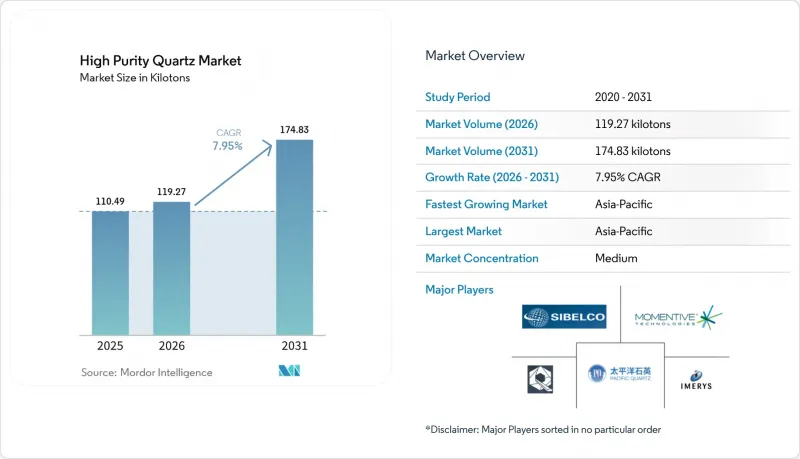
據 Mordor Intelligence 稱,2026 年高純度石英的市場規模預計將達到 119.27 千噸,高於 2025 年的 110.49 千噸,預計到 2031 年將達到 174.83 千噸。
預計從 2026 年到 2031 年,其複合年成長率將達到 7.95%。
本報告按原料類型(天然石英(偉晶岩)、合成石英(水熱/化學氣相沉積法)、精製石英砂(固相法))、應用領域(半導體、太陽能、照明、通訊/光學及其他)和地區(亞太、北美、歐洲、南美、中東和非洲)進行細分。市場預測以噸為單位。
全球超高純石英市場趨勢與洞察
對下一代邏輯和記憶體晶片的需求激增
全球計劃在2025年至2027年間投資4,000億美元用於建造新的300毫米晶圓廠,這將推動對高純度製程組件(例如石英坩堝、石英管和石英舟)的需求成長。向2奈米邏輯節點過渡的晶圓代工廠需要將金屬污染物控制在十億分之一的水平,增加了每片晶圓的石英用量。記憶體製造商為生產高頻寬模組而採用更大的晶體生長爐,這需要具有更嚴格抗熱衝擊性能的坩堝。韓國和台灣的工廠認證計畫現已強制要求4N+純度標準,促使上游供應商在亞太地區的晶圓廠附近擴大精煉產能。在美國,受《晶片保護和整合法案》(CHIPS Act)支持的工廠正在採購合約中加入長期採購條款,力求引入來自兩個來源的合成替代材料,以避免對單一礦場依賴的風險。
提高太陽能發電錠的產能
受全球對晶體矽組件需求的推動,預計到2030年,太陽能級石英的複合年成長率將達到12.40%。中國和東南亞的製造商正在加速採用直徑2600毫米的拉片設備,這種設備每次循環需要更大的坩堝,增加了石英的單位負荷。歐洲製造商正利用類似《通膨控制法案》(IRA)的激勵措施來促進本地晶圓生產,從而擴大區域原料需求。純度標準仍嚴格(鐵含量低於5ppm,總雜質含量低於300ppm),促使亞洲選礦廠採用先進的酸浸製程。採用封閉回路型水處理系統的供應商能夠更快獲得環境核准,並縮短產品上市時間。
偉晶岩開採產量與價格波動
2024年,中國市場價格的劇烈波動凸顯了下游製造商在供應和管理天然高純度石英庫存方面所面臨的挑戰。 2024年9月,颶風海倫對雲杉松礦區營運的影響暴露了供應集中帶來的風險。西貝爾科公司和石英公司暫停了運營,石英公司告訴CNBC,其「沒有明確的復工時間表」。由於偉晶岩礦床的地質變異性,持續評估和品位管理至關重要,但小規模的採礦作業也面臨著天氣相關干擾、設備故障和授權延誤等諸多不確定性。高純度石英的價格波動對半導體和太陽能電池製造商影響巨大,促使採購團隊實施雙通路採購策略和庫存緩衝,以降低供應風險。
細分市場分析
到2025年,天然石英仍將佔據高純度石英市場61.12%的佔有率,這主要得益於其與坩堝和管材製造商之間穩固的供應關係。然而,合成石英的產量正以8.68%的複合年成長率成長,這主要得益於日本、韓國和美國水熱法產能的提升。合成高純度石英市場的擴張主要得益於其穩定的雜質含量,這顯著降低了2奈米製程生產線中的晶圓缺陷率。此外,合成石英製造商無需依賴政治風險的採礦權即可滿足歐洲的含量法規要求,而這正是《基本原料法》規定的關鍵因素。
天然石英供應商正致力於改進選礦工藝,以防止市場佔有率下滑。新型磁選迴路可去除雲母和長石成分,高溫氯化設備則可減少微量鹼金屬。這些技術的結合使天然石英的純度提升至4N+,縮小了與合成石英的品質差距。然而,偉晶岩的生產仍然容易受到氣候變遷和「易開採」蘊藏量枯竭的影響,因此下游企業正在尋求採購合約的多元化。隨著兩種供應途徑的成本結構日趨接近,買方在權衡供應穩定性與特殊光學應用所需的晶體尺寸要求時,談判動態也在改變。
區域分析
預計到2025年,亞太地區將佔全球消費量的64.40%,並將在2031年之前維持8.22%的年複合成長率,創歷史新高。這主要得益於中國擴大多晶矽生產規模,以及台灣穩定推動2奈米邏輯晶片生產。 2025年4月,中國政府將高純度石英列為戰略礦產,這將加速秦嶺和阿爾泰山脈的探勘,同時低利率貸款也將流向加工基地。日本材料供應商正加強與國內晶圓廠的合作,並專注於合成路線,以減少對單一礦場進口的依賴。韓國憑藉其在記憶體領域的領先地位,保持著穩定的需求,而澳洲正在推進沿海矽礦計畫的商業化,從而縮短運往亞洲的運輸路線。
北美地區石英石使用量則位居第二。北卡羅來納州的斯普魯斯派恩仍然是全球最大的天然高純度石英(HPQ)塊產地,Sibelco公司投資2億美元的生產線升級項目預計將在2025年前提升破碎產能。一家獲得CHIPS基金支持的當地晶圓廠正在利用一家區域性合成石英新創公司,該公司宣稱其運輸過程中的排放接近零。加拿大得益於聯邦政府簡化的關鍵礦產許可程序,正將大西洋沿岸的石英礦藏定位為戰略性原料。該地區的市場趨勢取決於美國晶圓廠投產三條新的300毫米石英生產線的速度,而這一變數可能導致每年需求量出現1萬噸的波動。
歐洲高純度石英砂市場正受惠於一系列扶持政策。 《基本原料法》規定,2030年,歐盟境內開採量需佔總開採量的10%,加工量需佔總加工量的40%。法國高純度石英砂市場也受惠於法國「光學谷」和德國微電子園區共同實施的先導計畫。該項目採用利用當地地熱能的水熱反應器,從而降低了能源消耗。斯堪地那維亞礦業公司正在探索價值創造,而非僅僅運輸原砂。南美和中東等新興市場雖然規模較小,但正尋求與太陽能組件和玻璃纖維等下游供應鏈進行整合,預計將推動全球供應持續穩定的成長。
其他好處:
- Excel格式的市場預測(ME)表
- 3個月的分析師支持
目錄
第1章:引言
- 研究假設和市場定義
- 調查範圍
第2章:調查方法
第3章執行摘要
第4章 市場狀況
- 市場概覽
- 市場促進因素
- 對下一代邏輯和記憶體晶片的需求激增
- 提高太陽能發電錠的產能
- 關鍵礦產供應鏈的國內轉移(美國/歐盟)
- 超快雷射光學應用的新興領域
- 合成石英與天然原料的成本相當
- 市場限制因素
- 偉晶岩產量波動與價格波動
- 亞太地區礦業嚴格的環境許可製度
- 新HPQ供應商的認證過程耗時很長。
- 價值鏈分析
- 波特五力模型
第5章 市場規模與成長預測
- 依原料類型
- 天然石英(偉晶岩)
- 合成石英(水熱法/化學氣相沉積法)
- 精製石英砂(固相法)
- 透過使用
- 半導體
- 太陽的
- 照明
- 電信和光纖通訊
- 微電子學
- 其他用途
- 按地區
- 亞太地區
- 中國
- 印度
- 日本
- 韓國
- 其他亞太國家
- 北美洲
- 美國
- 加拿大
- 墨西哥
- 歐洲
- 德國
- 英國
- 法國
- 義大利
- 西班牙
- 其他歐洲國家
- 南美洲
- 巴西
- 阿根廷
- 其他南美國家
- 中東和非洲
- 沙烏地阿拉伯
- 南非
- 其他中東和非洲國家
- 亞太地區
第6章 競爭情勢
- 市場集中度
- 策略趨勢
- 市佔率和排名分析
- 公司簡介
- Australian Silica Quartz Group Ltd
- Covia Holdings LLC
- Greentech Minerals Limited
- Imerys
- Jiangsu Pacific Quartz Co., Ltd
- Momentive Technologies
- Nihon Dempa Kogyo Co., Ltd.
- Russian Quartz LLC
- Sibelco
- SIMCOA
- The Quartz Corp
- ULTRA HPQ
第7章 市場機會與未來展望
According to Mordor Intelligence, high purity quartz market size in 2026 is estimated at 119.27 kilotons, growing from 2025 value of 110.49 kilotons with 2031 projections showing 174.83 kilotons, growing at 7.95% CAGR over 2026-2031.
This report is Segmented by Source Type (Natural Quartz (Pegmatite), Synthetic Quartz (Hydrothermal/CVD), and Purified Quartz Sand (Solid-State)), Application (Semiconductor, Solar, Lighting, Telecom and Optics, and More), and Geography (Asia-Pacific, North America, Europe, South America, and Middle-East and Africa). The Market Forecasts are Provided in Terms of Volume (Tons).
Global High Purity Quartz Market Trends and Insights
Surging Demand for Next-Gen Logic and Memory Fabs
Global equipment outlays of USD 400 billion for new 300 mm facilities scheduled between 2025 and 2027 intensify consumption of high-purity process components, including quartz crucibles, tubes, and boats. Foundries migrating to 2 nm logic nodes must control metallic contaminants at parts-per-billion thresholds, which lifts per-wafer quartz usage. Memory makers scaling high-bandwidth modules adopt larger crystal-growth furnaces requiring crucibles with tighter thermal-shock resistance. Qualification programs at Korean and Taiwanese sites now specify 4N + purity benchmarks, prompting upstream suppliers to broaden refining capacity near Asia-Pacific fabs. In the United States, CHIPS-supported plants request dual-sourced synthetic alternatives to hedge against single-mine risk, embedding long-term offtake clauses in procurement contracts.
Rising Solar-Grade Ingot Capacity Additions
Global crystalline-silicon module demand underpins a 12.40% CAGR for solar-class quartz to 2030. Chinese and Southeast Asian producers accelerate 2600 mm diameter pullers that consume larger crucibles per cycle, increasing unit quartz loadings. European manufacturers leverage Inflation Reduction Act-style incentives to localize wafers, widening regional raw-material pull. Purity criteria remain stringent-iron below 5 ppm and total impurities under 300 ppm-driving deployment of advanced acid-leach circuits in Asian beneficiation hubs. Suppliers installing closed-loop water treatment secure faster environmental approvals, shortening time-to-market.
Volatile Pegmatite Mining Output and Price Swings
In 2024, extreme price fluctuations in Chinese markets highlighted the challenges of managing a natural high purity quartz supply and inventory for downstream manufacturers. Hurricane Helene's impact on Spruce Pine operations in September 2024 exposed supply concentration risks, with Sibelco and The Quartz Corp halting operations and The Quartz Corp reporting "no visibility" on restart timelines to CNBC. The geological variability of pegmatite deposits necessitates continuous assessments and grade control, while smaller mining operations face added unpredictability from weather disruptions, equipment failures, and permitting delays. High purity quartz price volatility significantly affects semiconductor and solar manufacturers, prompting procurement teams to adopt dual-sourcing strategies and inventory buffers to mitigate supply risks.
Other drivers and restraints analyzed in the detailed report include:
- On-Shoring of Critical Mineral Supply Chains (U.S./EU)
- Emerging Ultrafast-Laser Optics Applications
- Stringent Environmental Licensing in APAC Mines
For complete list of drivers and restraints, kindly check the Table Of Contents.
Segment Analysis
Natural quartz retained a 61.12% share of the high purity quartz market in 2025, mainly due to ingrained supply ties with crucible and tube fabricators. However, synthetic output is rising at an 8.68% CAGR, supported by hydrothermal capacity additions in Japan, South Korea, and the United States. The high purity quartz market size for synthetic grades is driven by consistent impurity profiles that slash wafer scrap rates in 2 nm process lines. Synthetic producers also meet European content rules without relying on politically exposed mining concessions, a decisive factor under the Critical Raw Materials Act.
Natural-grade suppliers concentrate on beneficiation upgrades to stave off share erosion. New magnetic-separation circuits remove mica and feldspar phases, while high-temperature chlorination units reduce alkali traces. The combination lifts achievable purity to 4N +, narrowing quality gaps with synthetic alternatives. Still, pegmatite output remains vulnerable to climatic events and shovel-ready reserve depletion, prompting downstream firms to diversify purchase contracts. The convergence of cost structures between the two routes reshapes bargaining dynamics as buyers weigh supply security against crystal-size requirements for specialty optics.
Complete Report Scope:
- By Source Type
- Natural Quartz (Pegmatite)
- Synthetic Quartz (Hydrothermal/CVD)
- Purified Quartz Sand (Solid-state)
- By Application
- Semiconductor
- Solar
- Lighting
- Telecom and Optics
- Microelectronics
- Other Applications
- By Geography
- Asia-Pacific
- China
- India
- Japan
- South Korea
- Rest of Asia-Pacific
- North America
- United States
- Canada
- Mexico
- Europe
- Germany
- United Kingdom
- France
- Italy
- Spain
- Rest of Europe
- South America
- Brazil
- Argentina
- Rest of South America
- Middle-East and Africa
- Saudi Arabia
- South Africa
- Rest of Middle-East and Africa
- Asia-Pacific
Geography Analysis
Asia-Pacific accounted for 64.40% of 2025 consumption and is projected to post the highest 8.22% CAGR through 2031 as China expands polysilicon and Taiwan inches toward 2 nm logic production. Beijing's decision in April 2025 to classify high purity quartz as a strategic mineral accelerates exploration in Qinling and Altay while steering low-interest credit to processing hubs. Japan's materials suppliers deepen ties with domestic fabs, emphasizing synthetic routes to reduce dependence on single-mine imports. South Korea maintains a steady pull anchored by memory leadership, while Australia commercializes coastal silica projects that shorten Asian shipping lanes.
North America ranks second in usage. Spruce Pine, North Carolina, remains the world's largest source of natural HPQ blocks, and Sibelco's USD 200 million line upgrade will lift milling throughput by 2025. Local fabs under CHIPS funding tap regional synthetic startups that tout near-zero transportation emissions. Canada positions its Atlantic quartz veins as strategic feedstock, supported by streamlined federal permitting for critical minerals. The region's market trajectory hinges on the pace at which U.S. fabs ramp three new 300 mm lines, a swing factor that could shift 10 kilo tons of annual demand.
Europe high purity quartz sand market benefits from supportive policy. The Critical Raw Materials Act enforces a 10% extraction and 40% processing target within the Union by 2030. France high purity quartz sand market benefits from France's optics valley and Germany's microelectronics parks' joint pilot hydrothermal reactors that use local geothermal heat, lowering energy intensity. Scandinavian miners evaluate value addition instead of shipping crude sand. Emerging markets in South America and the Middle East start from a low base but pursue downstream integration with PV module and glass fiber chains, promising incremental yet persistent pull on global supply.
- Australian Silica Quartz Group Ltd
- Covia Holdings LLC
- Greentech Minerals Limited
- Imerys
- Jiangsu Pacific Quartz Co., Ltd
- Momentive Technologies
- Nihon Dempa Kogyo Co., Ltd.
- Russian Quartz LLC
- Sibelco
- SIMCOA
- The Quartz Corp
- ULTRA HPQ
Additional Benefits:
- The market estimate (ME) sheet in Excel format
- 3 months of analyst support
TABLE OF CONTENTS
1 Introduction
- 1.1 Study Assumptions and Market Definition
- 1.2 Scope of the Study
2 Research Methodology
3 Executive Summary
4 Market Landscape
- 4.1 Market Overview
- 4.2 Market Drivers
- 4.2.1 Surging demand for next-gen logic and memory fabs
- 4.2.2 Rising solar-grade ingot capacity additions
- 4.2.3 On-shoring of critical mineral supply chains (U.S./EU)
- 4.2.4 Emerging ultrafast-laser optics applications
- 4.2.5 Synthetic-quartz cost parity vs. natural feedstock
- 4.3 Market Restraints
- 4.3.1 Volatile pegmatite mining output and price swings
- 4.3.2 Stringent environmental licensing in APAC mines
- 4.3.3 Slow qualification cycles for new HPQ vendors
- 4.4 Value Chain Analysis
- 4.5 Porter's Five Forces
- 4.5.1 Bargaining Power of Suppliers
- 4.5.2 Bargaining Power of Buyers
- 4.5.3 Threat of New Entrants
- 4.5.4 Threat of Substitutes
- 4.5.5 Degree of Competition
5 Market Size and Growth Forecasts (Volume)
- 5.1 By Source Type
- 5.1.1 Natural Quartz (Pegmatite)
- 5.1.2 Synthetic Quartz (Hydrothermal/CVD)
- 5.1.3 Purified Quartz Sand (Solid-state)
- 5.2 By Application
- 5.2.1 Semiconductor
- 5.2.2 Solar
- 5.2.3 Lighting
- 5.2.4 Telecom and Optics
- 5.2.5 Microelectronics
- 5.2.6 Other Applications
- 5.3 By Geography
- 5.3.1 Asia-Pacific
- 5.3.1.1 China
- 5.3.1.2 India
- 5.3.1.3 Japan
- 5.3.1.4 South Korea
- 5.3.1.5 Rest of Asia-Pacific
- 5.3.2 North America
- 5.3.2.1 United States
- 5.3.2.2 Canada
- 5.3.2.3 Mexico
- 5.3.3 Europe
- 5.3.3.1 Germany
- 5.3.3.2 United Kingdom
- 5.3.3.3 France
- 5.3.3.4 Italy
- 5.3.3.5 Spain
- 5.3.3.6 Rest of Europe
- 5.3.4 South America
- 5.3.4.1 Brazil
- 5.3.4.2 Argentina
- 5.3.4.3 Rest of South America
- 5.3.5 Middle-East and Africa
- 5.3.5.1 Saudi Arabia
- 5.3.5.2 South Africa
- 5.3.5.3 Rest of Middle-East and Africa
- 5.3.1 Asia-Pacific
6 Competitive Landscape
- 6.1 Market Concentration
- 6.2 Strategic Moves
- 6.3 Market Share (%)/Ranking Analysis
- 6.4 Company Profiles (includes Global level Overview, Market level overview, Core Segments, Financials as available, Strategic Information, Market Rank/Share for key companies, Products and Services, and Recent Developments)
- 6.4.1 Australian Silica Quartz Group Ltd
- 6.4.2 Covia Holdings LLC
- 6.4.3 Greentech Minerals Limited
- 6.4.4 Imerys
- 6.4.5 Jiangsu Pacific Quartz Co., Ltd
- 6.4.6 Momentive Technologies
- 6.4.7 Nihon Dempa Kogyo Co., Ltd.
- 6.4.8 Russian Quartz LLC
- 6.4.9 Sibelco
- 6.4.10 SIMCOA
- 6.4.11 The Quartz Corp
- 6.4.12 ULTRA HPQ
7 Market Opportunities and Future Outlook
- 7.1 White-space and Unmet-Need Assessment


