


 |
市場調查報告書
商品編碼
2072522
歐洲家居收納整理產品:市佔率分析、產業趨勢與統計及成長預測(2026-2031)Europe Home Organizers and Storage - Market Share Analysis, Industry Trends & Statistics, Growth Forecasts (2026 - 2031) |
||||||

※ 本網頁內容可能與最新版本有所差異。詳細情況請與我們聯繫。
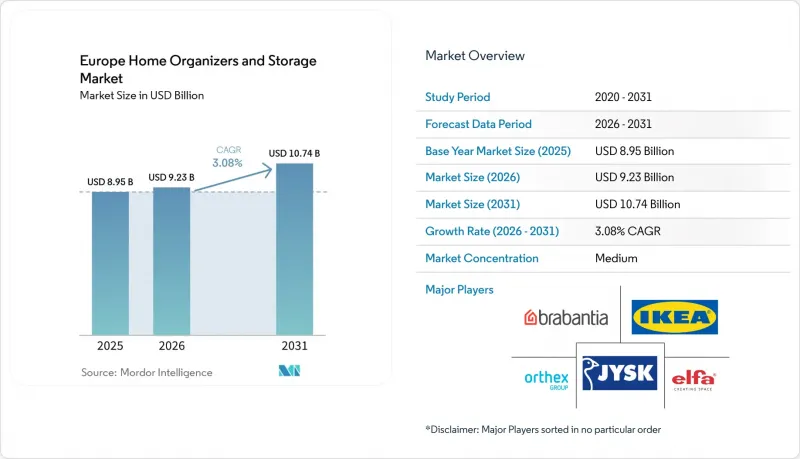
據 Mordor Intelligence 稱,歐洲家居收納產品市場預計到 2026 年價值 92.3 億美元,高於 2025 年的 89.5 億美元,預計到 2031 年將達到 107.4 億美元。
預計 2026 年至 2031 年的複合年成長率為 3.08%。
本報告按產品(收納籃、收納箱、收納袋等)、應用(臥室衣櫃、洗衣房等)、通路(大賣場/超級市場、專賣店、線上通路及其他)及地區(英國、德國、法國、西班牙、義大利等)細分。市場預測以美元計價。
歐洲家居收納和儲存市場的趨勢和洞察
DIY與住宅維修文化的日益盛行
在通貨膨脹推動住宅維修成本削減的背景下,歐洲家庭正將可支配預算用於自願性的自由裁量權改造。預計2025年至2029年間,歐洲DIY市場規模將成長至329億美元,複合年成長率達3.2%,對組裝收納解決方案產生了穩定的需求。教學影片和零售商提供的教學降低了技術門檻,即使是初次購買者也能在沒有專家幫助的情況下安裝模組化衣櫃。零售商透過提供帶有QR碼的組裝指南和零件清單,簡化了複雜的組裝流程,方便消費者一鍵購買所需組裝。宜家的「Keep good things going」計畫旨在在2025年回收3,250萬件二手產品,展現了DIY文化如何支持循環經濟目標。人們對週末DIY專案的熱情也帶動了螺絲、襯墊和標籤套裝等相關產品的銷售,使儲物解決方案成為大型家居建材商店中周轉率的品類之一。隨著消費者信心趨於穩定,DIY 趨勢預計將持續推動銷售量成長至 2030 年。
家用收納產品優質化
隨著多功能住宅環境的普及,消費者越來越重視收納方案,不再僅僅將其視為實用的收納盒,而是將其視為室內設計的一部分。他們更願意為媲美家具品質標準的配置買單,例如實木抽屜、粉末塗層鋼架和緩閉鉸鏈。像The Container Store這樣的零售商正在拓展其客製化空間產品線,融入LED照明和永續飾面,從而提升了消費者的平均消費。高階飾面激發了人們對室內設計的濃厚興趣,社交媒體上分享的完美儲藏室和色彩協調的衣櫥進一步強化了這一趨勢。價格區間的擴大為利潤空間提供了彌補原物料成本上漲的空間,同時也為店內設計諮詢服務提供了資金來源。此外,產品使用壽命的更換頻率,從而提升了耐用性,也有助於環境的永續發展。因此,優質化同時滿足了經濟效益、美觀性和永續性這三大目標,鞏固了其作為結構性成長驅動力的地位。
供應鏈成本上升
不斷上漲的運費和樹脂價格正在擠壓利潤空間,尤其是在大眾市場塑膠儲物盒領域,消費者對價格上漲的抵制情緒尤其強烈。格里芬集團旗下的ClosetMaid部門報告稱,由於需求疲軟以及物流中斷期間庫存積壓,2022年至2023年間在歐洲的銷售額下降了52%。為了恢復盈利,供應商正在簡化材料清單並實現零件本地化採購,但模具變更增加了初始成本。外匯波動進一步加劇了依賴亞洲原料的製造商的成本規劃難度。零售商試圖透過環保升級將成本上漲轉嫁給消費者,但如果價格超過可接受的限度,價格彈性高的細分市場的銷售量將會下降。一些品牌正在透過改用更輕的包裝來規避風險,從而降低體積重量費用,但消費者可能會將材料替代視為品質下降。在運費指數恢復正常之前,成本上漲仍將是盈利面臨的主要阻力。
細分市場分析
預計到2031年,模組化單元將以4.52%的複合年成長率(CAGR)實現最高成長,這反映出消費者越來越偏好可擴展的組件以滿足家庭需求。儲物箱仍然是最大的市場佔有率貢獻者,到2025年將佔據家庭收納市場28.86%的佔有率。同年,家庭收納市場中與箱子相關的市場規模將達到25.8億美元,印證了該品類的穩定性。消費者傾向於使用透明聚丙烯托特包來裝換季衣物,而選擇堅固的瓦楞紙箱用於閣樓的長期存放。製造商正透過增加產品的可堆疊性和加固的箱蓋來打造差異化優勢,以滿足倉庫式垂直儲存的需求。
都市區居住者偏好適合單身公寓的模組化立方體家具,它們今天可以用作書架,明天又可以用作鞋架,凸顯了其可重構性。像STOCUBO這樣的公司正在推廣無需工具的連接件和1厘米的增量,讓買家無需客製化即可打造整面牆的書架。旅行箱收納整理盒和吊掛式布藝收納盒專注於解決諸如行李箱打包和門上配件收納等特定難題,因此銷量穩步成長。隨著循環設計逐漸成為主流,各大品牌紛紛推出零件更換計劃,以延長產品壽命,增強家居收納市場的顧客忠誠度。
其他好處:
- Excel格式的市場預測(ME)表
- 3個月的分析師支持
目錄
第1章:引言
- 研究假設和市場定義
- 調查範圍
第2章:調查方法
第3章執行摘要
第4章 市場狀況
- 市場概覽
- 市場促進因素
- DIY與住宅維修文化的日益盛行
- 家用收納產品優質化
- 人口老化社會需要符合人體工學設計的收納解決方案。
- 循環經濟驅動的模組化設計
- 影響者主導的微組織的發展趨勢
- 都市區微型公寓的興起
- 市場限制因素
- 供應鏈成本上升
- 新房住宅數放緩
- 塑膠永續性檢驗
- 家具租賃和倉儲即服務模式
- 產業價值鏈分析
- 波特五力分析
- 洞察最新市場趨勢與創新
- 洞察近期市場趨勢(新產品發布、策略性舉措、投資、合作、合資、業務擴張、併購等)
第5章 市場規模與成長預測
- 依產品
- 收納籃
- 收納盒
- 收納袋
- 吊掛式收納
- 多功能收納盒
- 旅行箱收納包
- 模組化單元
- 其他
- 透過使用
- 臥室衣櫃
- 洗衣房
- 總部
- 食品儲藏室廚房
- 車庫
- 其他
- 透過分銷管道
- 大賣場和超級市場
- 專賣店
- 線上
- 其他
- 按地區
- 英國
- 德國
- 法國
- 西班牙
- 義大利
- 比荷盧經濟聯盟(比利時、荷蘭、盧森堡)
- 北歐國家(丹麥、芬蘭、冰島、挪威、瑞典)
- 其他歐洲國家
第6章 競爭情勢
- 市場集中度
- 策略趨勢
- 市佔率分析
- 公司簡介
- IKEA Group
- Elfa International AB
- JYSK A/S
- Brabantia Branding BV
- Orthex Group
- Hettich Holding GmbH
- Hafele SE & Co KG
- Curver(Keter Group)
- Whitmor Inc.
- The Container Store Group Inc.
- Blum GmbH
- John Lewis PLC
- Leroy Merlin SA
- Muji Europe Holdings Ltd.
- Umbra LLC
- Tiger(Flying Tiger Copenhagen)
- Addis Housewares Ltd.
- Plast Team
- Wenko-Wenselaar GmbH
- Really Useful Products Ltd.
- H&M Home
第7章 市場機會與未來展望
According to Mordor Intelligence, the home organizers and storage market size in Europe in 2026 is estimated at USD 9.23 billion, growing from 2025 value of USD 8.95 billion with 2031 projections showing USD 10.74 billion, growing at 3.08% CAGR over 2026-2031.
This report is Segmented by Product (Storage Baskets, Storage Boxes, Storage Bags, and More), Application (Bedroom Closets, Laundry Rooms, and More), Distribution Channel (Hypermarkets and Supermarkets, Specialty Stores, Online, Other Distribution Channels), and Geography (United Kingdom, Germany, France, Spain, Italy, and More). The Market Forecasts are Provided in Terms of Value (USD).
Europe Home Organizers and Storage Market Trends and Insights
Rising DIY & Home-Improvement Culture
European households channel discretionary budgets into self-directed renovations as inflation encourages cost-saving home upgrades. The regional DIY segment is forecast to gain USD 32.9 billion between 2025 and 2029 at a 3.2% CAGR, creating steady demand for flat-pack organizers. How-to videos and retailer tutorials lower skill barriers, letting first-time buyers install modular closets without professional help. Retailers respond with QR-coded assembly guides and click-to-buy parts lists that simplify complex builds. IKEA's "Keep good things going" program reused 32.5 million pre-owned products in 2025, showing how DIY culture supports circular goals. Weekend project enthusiasm also lifts ancillary sales of screws, liners, and labelling kits, making storage one of the fastest-turning categories in big-box home centers. As consumer confidence stabilizes, DIY momentum is expected to remain a reliable volume driver through 2030.
Premiumization of Home Storage Products
The multifunctional home pushes buyers to view organizers as decor elements rather than utility bins. Consumers increasingly pay for solid-wood drawers, powder-coated steel frames, and soft-close hinges that match furniture quality standards. Retailers like The Container Store expand Custom Spaces offerings that embed LED lighting and sustainable veneers, raising average ticket sizes. Premium finishes complement rising interest in interior design, a trend amplified by social media tours of "perfect pantries" and color-coordinated closets. Higher price points create margin headroom that offsets raw-material inflation while funding store-level design consultations. Durability also speaks to environmental priorities because longer product life reduces replacement frequency. Premiumization, therefore, serves economic, aesthetic, and sustainability objectives simultaneously, reinforcing its status as a structural growth lever.
Supply-Chain Cost Inflation
Surging freight rates and resin prices squeeze margins, especially for mass-market plastic bins where consumers resist price hikes. Griffon's ClosetMaid division reported a 52% revenue drop in Europe between 2022 and 2023, citing weak demand and excess inventories built during logistics disruptions. To recover profitability, suppliers shorten bill-of-materials lists and localize component sourcing, but tooling changes raise upfront costs. Currency volatility further complicates cost planning for manufacturers reliant on Asian inputs. Retailers attempt to pass higher costs to consumers through "eco-upgrade" positioning, yet elastic segments experience volume declines when price thresholds are breached. Some brands hedge by shifting to lighter packaging that lowers dimensional weight charges, though material substitutions risk customer perception of reduced quality. Until freight indices normalize, cost inflation remains a prominent profitability headwind.
Other drivers and restraints analyzed in the detailed report include:
- Ageing Population Requiring Ergonomic Storage
- Circular-Economy Driven Modular Designs
- Slowdown in New Housing Starts
For complete list of drivers and restraints, kindly check the Table Of Contents.
Segment Analysis
Modular Units are projected to deliver the steepest 4.52% CAGR through 2031, reflecting rising preference for components that expand with household needs. Storage Boxes remain the largest contributor, holding 28.86% of the home organizers and storage market share in 2025. The home organizers and storage market size devoted to Boxes equaled USD 2.58 billion that year, underpinning category stability. Consumers favor clear polypropylene totes for seasonal clothing rotation and heavy-duty corrugate boxes for long-term attic storage. Manufacturers differentiate through stackability indexes and reinforced lids to support warehouse-style vertical storage.
Urban renters gravitate toward modular cubes that fit studio apartments as bookcases today and shoe racks tomorrow, underscoring the value of reconfiguration. Players such as STOCUBO promote tool-free connectors and 1 cm increment sizing that lets buyers build wall-to-wall libraries without custom carpentry. Travel luggage organizers and hanging fabric compartments post steady gains by targeting specific pain points like suitcase packing and door-mounted accessory storage. As circular design moves mainstream, brands highlight component replacement programs that extend unit life and cement customer loyalty within the home organizers and storage market.
Complete Report Scope:
- By Product
- Storage Baskets
- Storage Boxes
- Storage Bags
- Hanging Storage
- Multipurpose Organizers
- Travel Luggage Organizers
- Modular Units
- Other Products
- By Application
- Bedroom Closets
- Laundry Rooms
- Home Offices
- Pantries and Kitchen
- Garages
- Other Applications
- By Distribution Channel
- Hypermarkets and Supermarkets
- Specialty Stores
- Online
- Other Distribution Channels
- By Geography
- United Kingdom
- Germany
- France
- Spain
- Italy
- BENELUX (Belgium, Netherlands, and Luxembourg)
- NORDICS (Denmark, Finland, Iceland, Norway, and Sweden)
- Rest of Europe
List of Companies Covered in this Report:
- IKEA Group
- Elfa International AB
- JYSK A/S
- Brabantia Branding BV
- Orthex Group
- Hettich Holding GmbH
- Hafele SE & Co KG
- Curver (Keter Group)
- Whitmor Inc.
- The Container Store Group Inc.
- Blum GmbH
- John Lewis PLC
- Leroy Merlin SA
- Muji Europe Holdings Ltd.
- Umbra LLC
- Tiger (Flying Tiger Copenhagen)
- Addis Housewares Ltd.
- Plast Team
- Wenko-Wenselaar GmbH
- Really Useful Products Ltd.
- H&M Home
Additional Benefits:
- The market estimate (ME) sheet in Excel format
- 3 months of analyst support
TABLE OF CONTENTS
1 Introduction
- 1.1 Study Assumptions & Market Definition
- 1.2 Scope of the Study
2 Research Methodology
3 Executive Summary
4 Market Landscape
- 4.1 Market Overview
- 4.2 Market Drivers
- 4.2.1 Rising DIY & Home-Improvement Culture
- 4.2.2 Premiumization of Home Storage Products
- 4.2.3 Ageing Population Requiring Ergonomic Storage
- 4.2.4 Circular-Economy Driven Modular Designs
- 4.2.5 Influencer-Led Micro-Organizing Trends
- 4.2.6 Rise of Urban Micro-Apartments
- 4.3 Market Restraints
- 4.3.1 Supply-Chain Cost Inflation
- 4.3.2 Slowdown in New Housing Starts
- 4.3.3 Sustainability Scrutiny on Plastics
- 4.3.4 Rental Furniture & Storage-as-a-Service Models
- 4.4 Industry Value Chain Analysis
- 4.5 Porter's Five Forces Analysis
- 4.5.1 Competitive Rivalry
- 4.5.2 Threat of New Entrants
- 4.5.3 Bargaining Power of Suppliers
- 4.5.4 Bargaining Power of Buyers
- 4.5.5 Threat of Substitutes
- 4.6 Insights Into The Latest Trends And Innovations in the Market
- 4.7 Insights On Recent Developments (New Product Launches, Strategic Initiatives, Investments, Partnerships, JVs, Expansion, M&As, Etc.) In The Market
5 Market Size & Growth Forecasts (Value)
- 5.1 By Product
- 5.1.1 Storage Baskets
- 5.1.2 Storage Boxes
- 5.1.3 Storage Bags
- 5.1.4 Hanging Storage
- 5.1.5 Multipurpose Organizers
- 5.1.6 Travel Luggage Organizers
- 5.1.7 Modular Units
- 5.1.8 Other Products
- 5.2 By Application
- 5.2.1 Bedroom Closets
- 5.2.2 Laundry Rooms
- 5.2.3 Home Offices
- 5.2.4 Pantries and Kitchen
- 5.2.5 Garages
- 5.2.6 Other Applications
- 5.3 By Distribution Channel
- 5.3.1 Hypermarkets and Supermarkets
- 5.3.2 Specialty Stores
- 5.3.3 Online
- 5.3.4 Other Distribution Channels
- 5.4 By Geography
- 5.4.1 United Kingdom
- 5.4.2 Germany
- 5.4.3 France
- 5.4.4 Spain
- 5.4.5 Italy
- 5.4.6 BENELUX (Belgium, Netherlands, and Luxembourg)
- 5.4.7 NORDICS (Denmark, Finland, Iceland, Norway, and Sweden)
- 5.4.8 Rest of Europe
6 Competitive Landscape
- 6.1 Market Concentration
- 6.2 Strategic Moves
- 6.3 Market Share Analysis
- 6.4 Company Profiles (includes Global level Overview, Market level overview, Core Segments, Financials as available, Strategic Information, Market Rank/Share for key companies, Products & Services, and Recent Developments)
- 6.4.1 IKEA Group
- 6.4.2 Elfa International AB
- 6.4.3 JYSK A/S
- 6.4.4 Brabantia Branding BV
- 6.4.5 Orthex Group
- 6.4.6 Hettich Holding GmbH
- 6.4.7 Hafele SE & Co KG
- 6.4.8 Curver (Keter Group)
- 6.4.9 Whitmor Inc.
- 6.4.10 The Container Store Group Inc.
- 6.4.11 Blum GmbH
- 6.4.12 John Lewis PLC
- 6.4.13 Leroy Merlin SA
- 6.4.14 Muji Europe Holdings Ltd.
- 6.4.15 Umbra LLC
- 6.4.16 Tiger (Flying Tiger Copenhagen)
- 6.4.17 Addis Housewares Ltd.
- 6.4.18 Plast Team
- 6.4.19 Wenko-Wenselaar GmbH
- 6.4.20 Really Useful Products Ltd.
- 6.4.21 H&M Home
7 Market Opportunities & Future Outlook
- 7.1 Premiumization of Home Storage and Organizers
- 7.2 Urban Living Constraints Boosting Compact Storage Designs

 食品級FRP儲存槽市場規模、佔有率和成長分析:按樹脂類型、容量、安裝類型、應用、最終用戶和地區分類 - 產業預測,2026-2033年
 2026 年至 2034 年抽屜收納盒的市場規模、佔有率、成長、全球產業分析、區域趨勢和預測。
 食品容器市場:2026-2032年全球市場預測(按材料、產品類型、應用、產業、最終用戶和分銷管道分類)
 食品容器市場-全球產業規模、佔有率、趨勢、機會和預測:按產品類型、材料、分銷管道、地區和競爭格局分類,2021-2031年
 食品儲存容器市場機會、成長要素、產業趨勢分析及2026-2035年預測。
 2026年全球散裝食品儲存產品市場報告家用食品儲存容器市場:2026-2032年全球市場預測(依產品類型、材質、容量、封蓋類型、最終用途及通路分類)陽台儲能市場:按電池技術、儲能容量、系統類型、充電方式、應用、最終用途和銷售管道分類-2026-2032年全球預測家用儲能分體器市場:按技術、電壓、相數、容量、最終用戶和應用分類,全球預測,2026-2032年
 保溫食品容器市場:依產品類型、分銷通路和地區分類