


 |
市場調查報告書
商品編碼
2072490
碳氈和石墨氈:市場佔有率分析、行業趨勢和統計數據以及成長預測(2026-2031 年)Carbon Felt and Graphite Felt - Market Share Analysis, Industry Trends & Statistics, Growth Forecasts (2026 - 2031) |
||||||

※ 本網頁內容可能與最新版本有所差異。詳細情況請與我們聯繫。
根據 Mordor Intelligence 預測,碳氈和石墨氈市場規模將從 2025 年的 5.9613 億美元成長到 2026 年的 6.4406 億美元,然後在 2031 年達到 9.4773 億美元,2026 年至 2031 年的複合年成長率為 8.04%。
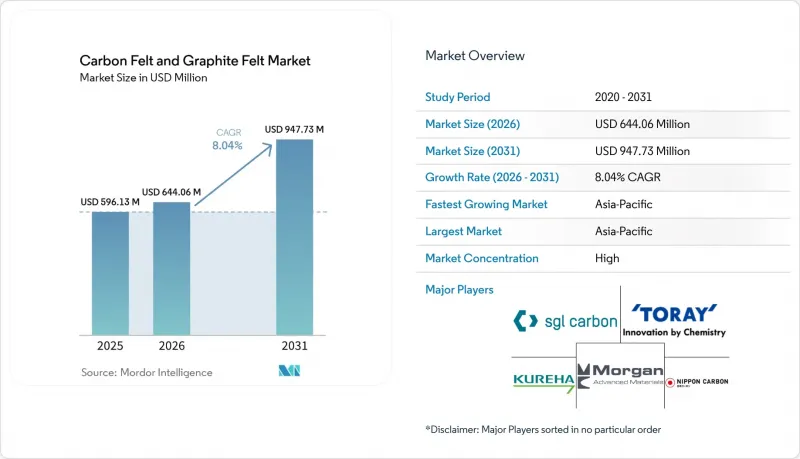
本報告按原料類型(聚丙烯腈(PAN)、人造絲、其他)、表面處理(碳化、石墨化、氧化/功能化)、類型(碳氈、石墨氈)、應用(絕緣、電池等)和地區(亞太地區、北美、歐洲、南美、中東和非洲)對產業進行分類。
全球碳氈及石墨氈市場趨勢及洞察
提高碳氈在高溫下的性能
碳氈的隔熱效率比陶瓷高出15-30%,且在惰性氣氛中可承受超過2000 度C的高溫,降低鋼鐵製造商和半導體外延生產線的能源成本。沉澱塗層可在不影響熱性能的前提下,將零件壽命延長40-60%,減少維修停機時間。半導體設備製造商在向200毫米碳化矽晶圓過渡時,由於碳氈在熱循環下具有尺寸穩定性,因此嚴格指定使用碳氈。隨著下游產業推動脫碳,這種材料的優越性正逐漸成為採購標準,而不再是碳氈和石墨氈市場的利基選擇。能夠將可控纖維結構與先進塗層技術結合的供應商,正獲得更高的價格和多年的供貨合約。
鋰離子電池和液流電池製造商的需求激增
自2019年以來,北美鋰離子電池工廠的數量已從3家增加到10家,並顯著提升了該地區對電極的需求。氧化還原液流電解技術也推動了這一需求,其中,經MOF衍生奈米複合材料改性的石墨氈電極具有優異的電解滲透性,驅動電壓效率超過87%。電網儲能系統整合商高度重視石墨氈的電化學表面積和透水性之間的平衡,並積極推進新等級石墨氈的認證專案。這一發展動能正使碳氈和石墨氈市場在全球能源轉型藍圖中佔據核心地位,目前已簽訂了數吉瓦時的採購合約。
石墨化過程生產成本高、耗能大
石墨化爐每噸耗電15-20兆瓦時,因此隨著電費和碳排放稅的上漲,營運成本也增加。每條生產線超過5000萬美元的高資本密集度阻礙了新進入者,並減緩了產能擴張。雖然一些工廠透過熱回收設計回收了20-30%的熱量,但投資回收期仍取決於當地的電價。在碳氈和石墨氈市場,這些經濟因素導致需求成長時供應緊張,使現有企業擁有定價權,同時抑制了整體銷售量成長。
細分市場分析
預計到2025年,聚丙烯腈(PAN)纖維將佔據碳氈和石墨氈市場46.25%的佔有率,並在2031年之前以9.28%的複合年成長率成長。使用PAN前驅體可以更好地控制穩定化和碳化過程,從而生產出直徑均勻、雜質含量低的纖維,滿足電池和半導體行業客戶的需求。雖然人造絲在低負荷隔熱應用中仍佔有一席之地,但瀝青基氈能夠滿足對特定高導熱性能要求的應用,同時又面臨嚴格的環境審查。
供應鏈整合正在提升PAN的競爭優勢。前驅體紡絲技術的進步降低了廢品率,單位成本降低了15-20%,進一步拉大了與人造絲的差距。採用可再生丙烯腈原料的先導計畫也強化了PAN對永續性的承諾,並提升了其市場吸引力。隨著製造商簽訂多年電極契約,PAN品質的穩定性至關重要,這進一步鞏固了PAN在碳氈和石墨氈市場的領先地位。
到2025年,碳化物氈將佔據40.10%的市場佔有率,其價值在於價格實惠且在2000 度C以下的溫度範圍內性能良好。石墨產品雖然價格較高,但其複合年成長率仍達8.77%,這主要得益於航太和半導體製程的爐溫不斷提高。氧化或功能化石墨在液流電池領域也備受關注,因為可以透過表面化學來精細調控其催化性能。
先進的製造流程正成為供應商之間的差異化優勢。 SGL Carbon 的 SIGRAFINE 系列產品採用 SiC 塗層,可將使用壽命延長 40-60%,並降低晶圓廠業者的整體擁有成本 (TCO)。客戶對涵蓋從碳化絕緣塊到用於高溫區域的石墨化塗層氈等各種產品系列的需求日益成長,這促成了全面的合約簽訂,並實現了碳氈和石墨氈市場收入的多元化。
區域分析
亞太地區佔碳氈和石墨氈市場45.20%的佔有率,並以9.41%的複合年成長率成長,這主要得益於中國強大的原料供應能力、日本的工藝精度以及韓國的半導體需求。中國供應商受益於國內石墨產量(佔全球總產量的77%),從而確保了低成本的原料採購和穩定的供應。與日本塗層專家的合資企業正在提升產品質量,並協助區域企業贏得全球晶圓製造廠的競標。印度的生產連結獎勵計畫計畫(PLI)正在加速國內電池工廠的建設,並推動中期碳氈消費的成長。
北美地區的擴張得益於聯邦政府支持的在地化政策。僅位於田納西州的Novonix工廠每年就能處理32.5萬輛電動車的碳氈,構成了美國國內合成石墨供應鏈的基礎。與電池原始設備製造商(OEM)簽訂的預購協議涵蓋了初期產量,並保證了當地碳氈供應商的最低運轉率保障。政策獎勵縮短了決策週期,使該地區成為亞太地區以外碳氈和石墨氈市場中最具發展潛力的新興力量。
歐洲正著力發展高附加價值應用和更注重環保的生產方式。 SGL Carbon公司對其位於邁廷根的工廠維修,目標是半導體和氫能項目,並計劃透過利用再生能源來減少範圍2排放。同時,隨著中國收緊出口限制,巴西和馬達加斯加的礦場擴建為這兩大洲提供了更多選擇。中東、非洲和南美洲的產量目前落後於歐洲,但隨著工業脫碳計畫的成熟,這些地區具有長期成長潛力,預計將成為碳氈和石墨氈市場的戰略前沿市場。
其他好處:
- Excel格式的市場預測(ME)表
- 3個月的分析師支持
目錄
第1章:引言
- 研究假設和市場定義
- 調查範圍
第2章:調查方法
第3章執行摘要
第4章 市場狀況
- 市場概覽
- 市場促進因素
- 提高碳氈在高溫下的性能
- 鋰離子電池和液流電池製造商的需求激增
- 政府強制要求電動車電池用石墨必須在地採購。
- 新一代採用石墨氈的氫氣熱解反應器
- 採用碳氈吸附劑的高溫碳回收系統
- 市場限制因素
- 石墨化生產成本高、耗能大
- 中國對合成石墨出口的限制不穩定
- 碳粉塵的職業暴露限值
- 價值鏈分析
- 波特五力模型
第5章 市場規模與成長預測
- 依原料類型
- 聚丙烯腈(PAN)
- 人造絲
- 其他(音調等)
- 透過表面處理
- 碳化
- 石墨化
- 氧化/官能化
- 按類型
- 碳氈
- 石墨氈
- 透過使用
- 絕緣
- 電池
- 半導體
- 吸收材料
- 其他(冶金和真空爐)
- 按地區
- 亞太地區
- 中國
- 日本
- 韓國
- 印度
- 其他亞太國家
- 北美洲
- 美國
- 加拿大
- 墨西哥
- 歐洲
- 德國
- 英國
- 法國
- 義大利
- 其他歐洲國家
- 南美洲
- 巴西
- 阿根廷
- 其他南美國家
- 中東和非洲
- 沙烏地阿拉伯
- 南非
- 其他中東和非洲國家
- 亞太地區
第6章 競爭情勢
- 市場集中度
- 策略趨勢
- 市佔率和排名分析
- 公司簡介
- Advanced Graphite Materials LLC
- Beijing Great Wall Co.,Ltd.
- CeraMaterials
- CeTech Co. Ltd.
- CFCCARBON Co., Ltd.
- CGT Carbon GmbH
- Fiber Materials Inc.
- Gansu Hao's Carbon Fiber Co. Ltd.
- Graphite India Ltd.
- JNTG
- Kureha Corporation
- Morgan Advanced Materials plc
- Nippon Carbon Co. Ltd.
- SGL Carbon
- Sinotek Materials Co. Ltd.
- Tokai Carbon Co. Ltd.
- Toray Industries Inc.
第7章 市場機會與未來展望
According to Mordor Intelligence, the carbon felt and graphite felt market size is expected to grow from USD 596.13 million in 2025 to USD 644.06 million in 2026 and is forecast to reach USD 947.73 million by 2031 at 8.04% CAGR over 2026-2031.
This report Segments the Industry by Raw Material Type (Polyacrylonitrile (PAN), Rayon, and Other Raw Material Types), Surface Treatment (Carbonised, Graphitised, Oxidised/Functionalised), Type (Carbon Felt and Graphite Felt), Application (Heat Insulation, Batteries, and More), and Geography (Asia-Pacific, North America, Europe, South America, and Middle East and Africa).
Global Carbon Felt and Graphite Felt Market Trends and Insights
Improved Performance of Carbon Felt at High Temperatures
Carbon felt withstands inert-atmosphere temperatures above 2,000 °C while insulating furnaces 15-30% more efficiently than ceramics, reducing energy bills for steelmakers and semiconductor epitaxy lines. SiC vapor-deposited coatings further extend component life 40-60% without sacrificing thermal properties, translating to fewer maintenance shutdowns. Semiconductor toolmakers transitioning to 200 mm silicon-carbide wafers specify carbon felt strictly for its dimensional stability under thermal cycling. As downstream industries push decarbonization, this material advantage becomes a procurement standard rather than a niche option across the carbon felt and graphite felt market. Suppliers capable of pairing fiber architecture control with advanced coatings secure premium pricing and multiyear supply contracts.
Soaring Demand from Li-ion and Redox-Flow Battery Makers
North American lithium-ion cell factories have grown from three to ten since 2019, sharply raising regional electrode demand. Redox flow technology reinforces the pull; graphite felt electrodes achieve superior electrolyte penetration and drive voltage efficiency above 87% when modified with MOF-derived nanocomposites. Grid-storage integrators value the felt's electrochemical surface area and permeability balance, pushing continuous qualification programs for new grades. This momentum secures a central role for the carbon felt and graphite felt market in global energy-transition roadmaps, locking in multi-gigawatt-hour purchase commitments.
High Production Cost & Energy Intensity of Graphitisation
Graphitising furnaces draw 15-20 MWh per ton, raising operational expense as electricity and carbon fees climb. Capital intensity-USD 50 million plus per line-deters greenfield entrants and slows capacity additions. Some plants reclaim 20-30% heat via recuperative designs, yet the payback still hinges on regional power tariffs. For the carbon felt and graphite felt market, these economics tighten supply during demand upswings, affording incumbents pricing power but tempering overall volume growth.
Other drivers and restraints analyzed in the detailed report include:
- Government EV-Battery Graphite Localisation Mandates
- Emerging Hydrogen Pyrolysis Reactors Using Graphite Felt
- Occupational Exposure Limits for Carbon Dust Emissions
For complete list of drivers and restraints, kindly check the Table Of Contents.
Segment Analysis
Polyacrylonitrile-based grades captured 46.25% of the carbon felt and graphite felt market share in 2025 and are forecast to grow at a 9.28% CAGR to 2031. PAN precursors enable controlled stabilization and carbonisation, yielding fibers with uniform diameter and low impurity content that battery and semiconductor clients demand. Rayon maintains a foothold in less strenuous insulation services, whereas pitch-based felts address selected high-thermal-conductivity duties but face environmental scrutiny.
Supply chain integration favors PAN leadership. Advances in precursor spinning trim scrap rates and shave 15-20% from unit cost, widening the gap versus rayon. Renewable acrylonitrile feedstock pilots also boost sustainability credentials, enhancing PAN's appeal. As manufacturers lock multiyear electrode contracts, consistent PAN quality becomes non-negotiable, reinforcing its lead in the carbon felt and graphite felt market.
Carbonised felts held 40.10% market share in 2025, valued for affordability and sufficient performance below 2,000 °C. Graphitised products, though dearer, post a 8.77% CAGR on the back of rising furnace temperatures in aerospace and semiconductor processes. Oxidised or functionalised variants gain traction in flow batteries, where surface chemistry fine-tunes catalytic behavior.
Process sophistication differentiates suppliers; SGL Carbon's SiC-coated SIGRAFINE series extends lifespan by 40-60%, lowering total cost of ownership for fab operators. Customers increasingly request hybrid portfolios spanning carbonised insulation blocks to graphitised, coated felt for hot zones, locking in bundled contracts and boosting revenue diversity in the carbon felt and graphite felt market.
Complete Report Scope:
- By Raw Material Type
- Polyacrylonitrile (PAN)
- Rayon
- Other Raw Material Types (Pitch and Others)
- By Surface Treatment
- Carbonised
- Graphitised
- Oxidised / Functionalised
- By Type
- Carbon Felt
- Graphite Felt
- By Application
- Heat Insulation
- Batteries
- Semiconductors
- Absorptive Materials
- Other Applications (Metallurgy and Vacuum Furnaces)
- By Geography
- Asia-Pacific
- China
- Japan
- South Korea
- India
- Rest of Asia-Pacific
- North America
- United States
- Canada
- Mexico
- Europe
- Germany
- United Kingdom
- France
- Italy
- Rest of Europe
- South America
- Brazil
- Argentina
- Rest of South America
- Middle East and Africa
- Saudi Arabia
- South Africa
- Rest of Middle East and Africa
- Asia-Pacific
Geography Analysis
Asia-Pacific wields a 45.20% share of the carbon felt and graphite felt market and is growing at 9.41% CAGR as China's feedstock dominance meets Japan's process precision and South Korea's chip demand. Chinese suppliers benefit from local graphite commanding 77% of global output, ensuring low-cost input and supply security. Joint ventures with Japanese coating specialists elevate product quality, allowing regional firms to win global wafer-fab tenders. India's Production-Linked Incentive schemes accelerate domestic cell plants, bolstering mid-term felt consumption.
North America's expansion rides on federally backed localization. The NOVONIX Tennessee facility alone can support 325,000 EVs annually, anchoring a homegrown synthetic graphite chain. Battery OEM pre-purchase agreements absorb early output, guaranteeing baseline utilization for local felt suppliers. Policy incentives shorten decision cycles, making the region the fastest-emerging challenger in the carbon felt and graphite felt market outside Asia-Pacific.
Europe focuses on value-added applications and greener production. SGL Carbon's Meitingen plant upgrade targets semiconductor and hydrogen projects with recycled electricity inputs to lower scope-2 emissions. Meanwhile, Brazil and Madagascar mine expansions provide both continents optionality as Chinese export controls tighten. Middle East & Africa and South America trail in volume but present long-range upside once industrial decarbonisation projects mature, positioning them as strategic frontier markets for the carbon felt and graphite felt market.
- Advanced Graphite Materials LLC
- Beijing Great Wall Co.,Ltd.
- CeraMaterials
- CeTech Co. Ltd.
- CFCCARBON Co., Ltd.
- CGT Carbon GmbH
- Fiber Materials Inc.
- Gansu Hao's Carbon Fiber Co. Ltd.
- Graphite India Ltd.
- JNTG
- Kureha Corporation
- Morgan Advanced Materials plc
- Nippon Carbon Co. Ltd.
- SGL Carbon
- Sinotek Materials Co. Ltd.
- Tokai Carbon Co. Ltd.
- Toray Industries Inc.
Additional Benefits:
- The market estimate (ME) sheet in Excel format
- 3 months of analyst support
TABLE OF CONTENTS
1 Introduction
- 1.1 Study Assumptions and Market Definition
- 1.2 Scope of the Study
2 Research Methodology
3 Executive Summary
4 Market Landscape
- 4.1 Market Overview
- 4.2 Market Drivers
- 4.2.1 Improved Performance of Carbon Felt at High Temperatures
- 4.2.2 Soaring Demand from Li-Ion and Redox-Flow Battery Makers
- 4.2.3 Government EV-Battery Graphite Localisation Mandates
- 4.2.4 Emerging Hydrogen Pyrolysis Reactors Using Graphite Felt
- 4.2.5 High-Temperature Carbon Capture Units Adopting Carbon Felt Sorbents
- 4.3 Market Restraints
- 4.3.1 High Production Cost and Energy Intensity of Graphitisation
- 4.3.2 Volatile Chinese Export Controls on Synthetic Graphite
- 4.3.3 Occupational Exposure Limits for Carbon Dust Emissions
- 4.4 Value Chain Analysis
- 4.5 Porter's Five Forces
- 4.5.1 Bargaining Power of Suppliers
- 4.5.2 Bargaining Power of Buyers
- 4.5.3 Threat of New Entrants
- 4.5.4 Threat of Substitutes
- 4.5.5 Degree of Competition
5 Market Size and Growth Forecasts (Value)
- 5.1 By Raw Material Type
- 5.1.1 Polyacrylonitrile (PAN)
- 5.1.2 Rayon
- 5.1.3 Other Raw Material Types (Pitch and Others)
- 5.2 By Surface Treatment
- 5.2.1 Carbonised
- 5.2.2 Graphitised
- 5.2.3 Oxidised / Functionalised
- 5.3 By Type
- 5.3.1 Carbon Felt
- 5.3.2 Graphite Felt
- 5.4 By Application
- 5.4.1 Heat Insulation
- 5.4.2 Batteries
- 5.4.3 Semiconductors
- 5.4.4 Absorptive Materials
- 5.4.5 Other Applications (Metallurgy and Vacuum Furnaces)
- 5.5 By Geography
- 5.5.1 Asia-Pacific
- 5.5.1.1 China
- 5.5.1.2 Japan
- 5.5.1.3 South Korea
- 5.5.1.4 India
- 5.5.1.5 Rest of Asia-Pacific
- 5.5.2 North America
- 5.5.2.1 United States
- 5.5.2.2 Canada
- 5.5.2.3 Mexico
- 5.5.3 Europe
- 5.5.3.1 Germany
- 5.5.3.2 United Kingdom
- 5.5.3.3 France
- 5.5.3.4 Italy
- 5.5.3.5 Rest of Europe
- 5.5.4 South America
- 5.5.4.1 Brazil
- 5.5.4.2 Argentina
- 5.5.4.3 Rest of South America
- 5.5.5 Middle East and Africa
- 5.5.5.1 Saudi Arabia
- 5.5.5.2 South Africa
- 5.5.5.3 Rest of Middle East and Africa
- 5.5.1 Asia-Pacific
6 Competitive Landscape
- 6.1 Market Concentration
- 6.2 Strategic Moves
- 6.3 Market Share(%)/Ranking Analysis
- 6.4 Company Profiles (includes Global level Overview, Market level overview, Core Segments, Financials as available, Strategic Information, Market Rank/Share for key companies, Products and Services, and Recent Developments)
- 6.4.1 Advanced Graphite Materials LLC
- 6.4.2 Beijing Great Wall Co.,Ltd.
- 6.4.3 CeraMaterials
- 6.4.4 CeTech Co. Ltd.
- 6.4.5 CFCCARBON Co., Ltd.
- 6.4.6 CGT Carbon GmbH
- 6.4.7 Fiber Materials Inc.
- 6.4.8 Gansu Hao's Carbon Fiber Co. Ltd.
- 6.4.9 Graphite India Ltd.
- 6.4.10 JNTG
- 6.4.11 Kureha Corporation
- 6.4.12 Morgan Advanced Materials plc
- 6.4.13 Nippon Carbon Co. Ltd.
- 6.4.14 SGL Carbon
- 6.4.15 Sinotek Materials Co. Ltd.
- 6.4.16 Tokai Carbon Co. Ltd.
- 6.4.17 Toray Industries Inc.
7 Market Opportunities and Future Outlook
- 7.1 White-space and Unmet-need Assessment

 碳石墨氈市場:按類型、形狀、應用、終端用戶產業和銷售管道分類-2026-2032年全球市場預測
 碳氈和石墨氈市場規模、佔有率和成長分析:按產品類型、類型、應用、終端用戶產業、耐熱性、分銷通路和地區分類-2026-2033年產業預測
 碳氈和石墨氈市場-全球產業規模、佔有率、趨勢、機會、預測:按類型、應用、產品類型、地區和競爭對手分類,2021-2031年
 碳氈和石墨氈市場分析:按類型、產品、原料、應用和地區分類(2026-2034 年)
 全球碳氈和石墨氈市場:市場規模、佔有率、成長率、行業分析、依類型、應用和地區劃分的分析以及未來預測(2026-2034)PET毛氈板市場:依產品類型、安裝方式、厚度、通路、最終用途和應用分類-2026-2032年全球預測PET氈吸音板市場按面板類型、安裝方式、通路和應用分類-2026年至2032年全球預測基於聚丙烯腈(PAN)的石墨氈市場—按纖維等級、厚度、密度、形狀、應用和終端用戶產業分類—2026-2032年全球預測液流電池電極氈市場按電池類型、材料、製造流程、應用、最終用戶和銷售管道分類 - 全球預測 2026-2032複合石墨流場板市場按產品類型、製造流程、材料等級及最終用戶產業分類-2026年至2032年全球預測