


 |
市場調查報告書
商品編碼
2072455
基於雲端的電子郵件安全軟體:市場佔有率分析、行業趨勢和統計數據以及成長預測(2026-2031 年)Cloud-Based Email Security Software - Market Share Analysis, Industry Trends & Statistics, Growth Forecasts (2026 - 2031) |
||||||

※ 本網頁內容可能與最新版本有所差異。詳細情況請與我們聯繫。
據 Mordor Intelligence 稱,2026 年基於雲端的電子郵件安全軟體市場規模估計為 62.4 億美元,高於 2025 年的 55.5 億美元,預計到 2031 年將達到 112.2 億美元。
預計 2026 年至 2031 年的複合年成長率為 12.45%。
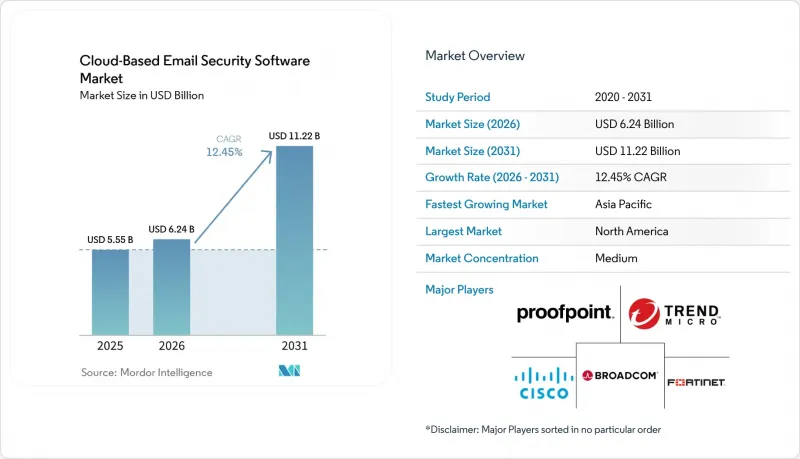
本報告按服務類型(過濾和反垃圾郵件、惡意軟體和進階威脅防護等)、平台整合(安全郵件閘道 (SEG) 等)、組織規模(大型企業和中小企業 (SME))、產業(銀行、金融服務和保險 (BFSI)、政府和國防等)以及地區進行細分。市場預測以價值(美元)表示。
全球雲端電子郵件安全軟體市場趨勢與洞察
人工智慧驅動的網路釣魚和商業電子郵件詐騙攻擊的興起。
生成式人工智慧工具的出現使得攻擊者能夠創建模仿高階主管語氣和時間的客製化電子郵件,導致網路釣魚攻擊的成功率高達 60%,預計到 2024 年,商業電子郵件詐騙(BEC) 攻擊造成的損失將達到 29 億美元。暗網上銷售的釣魚工具包中有 75% 具備人工智慧功能,凸顯了詐騙經濟的產業化。在醫療產業,人工智慧驅動的 BEC 事件激增 279%,平均每起事件造成的損失高達 12.5 萬美元。因此,各組織正在建立基準值溝通模式,並部署自然語言處理引擎來偵測語言異常。由於員工仍然是抵禦複雜陷阱的最後查核點,因此行為識別程序正在為技術提供補充。
從SEG到基於API的ICES的快速過渡
70% 的企業正在主動以整合式雲端郵件安全 (ICES) 平台取代其安全郵件閘道器,這些平台透過 API 直接連接到 Microsoft 365 和 Google Workspace。 API 整合無需重新路由郵件流即可提供內部流量和使用者行為的可見性,從而將客戶環境中的偵測效率提高 30%。來自雲端套件的即時遙測資料會提供給機器學習模型,以便在幾分鐘內隔離被盜用的帳戶。供應商合作夥伴關係,例如 Proofpoint 和 Azure 安全 API 的整合,正在加速架構遷移,將部署時間從數月縮短到數天。
雲端保全行動。
儘管全球網路安全專業人員數量達550萬,但仍有480萬的缺口,90%的公司表示,招募具備雲端安全和人工智慧安全專業知識的人才最為困難。歐盟網路安全和資訊安全局(ENISA)已證實,99%的雲端安全故障是由客戶配置錯誤造成的,而非服務提供者的缺陷。金融服務和科技公司的職缺率仍高達28%左右,阻礙了需要專家協調的行為分析工具的普及應用。因此,許多組織正在轉向資安管理服務和人工智慧輔助工具來彌補人才短缺,但即便實現了自動化,策略管治的監督仍然至關重要。
細分市場分析
到2025年,過濾和反垃圾郵件解決方案將佔據雲端電子郵件安全軟體市場41.02%的佔有率。同時,預防資料外泄(DLP)預計將以13.22%的複合年成長率快速成長,因為遠距辦公的普及加速了電子郵件工作流程中非結構化資料的暴露。企業目前正從傳統的基於正規表示式的模式匹配轉向情境感知DLP,後者能夠即時追蹤內容、用戶和位置元資料。惡意軟體和進階威脅防禦服務正在整合大規模語言模型,這些模型能夠掃描附件中的行為指標,而不是靜態簽章。隨著一些先行公司引入後量子演算法,加密和令牌化解決方案也在不斷擴展,幫助客戶為美國國家標準與技術研究院(NIST)的過渡計畫做好準備。這些變化共同標誌著安全策略正從邊界防禦轉向以資料為中心的控制。
隨著 HIPAA 和 PCI-DSS 等法規結構的擴展,企業不得不記錄和審計電子郵件中的資料流。谷歌為 Gmail 企業用戶提供的端對端加密服務就是一個典型的例子,表明供應商正在將合規功能整合到其預設設定中。由於企業不僅要應對外部威脅,還要應對內部相關人員,因此,以資料防洩漏 (DLP) 為主導的雲端電子郵件安全軟體市場規模預計將會成長,其在總支出中的佔比也將隨之提高。此外,供應商還在捆綁安全意識提升培訓模組,以加強策略合規性,並建立整合平台,從而減少警報疲勞和合規負擔。
預計到 2025 年,儘管安全郵件閘道仍將佔據 54.95% 的收入佔有率,但支援 API 的整合式雲端郵件安全 (ICES) 解決方案的複合年成長率將達到 13.55%。這反映了雲端原生套件中閘道器代理程式的架構限制。 ICES 可直接連接到 Microsoft 365 和 Google Workspace,分析內部流量,並將社交工程的偵測率提高 30%。此外,雲端原生郵件安全平台提供自動擴充功能,使其成為應對突發工作負載和地理分散團隊的理想選擇。在嚴格監管的行業中,混合方案仍然盛行,即保留本地閘道器用於合規性日誌記錄,同時利用 API 進行行為分析。
隨著夥伴關係的深化(例如,微軟近期擴展了與Proofpoint基於Azure的威脅訊號共用),客戶將獲得整合的遙測數據,這些數據可為下游的XDR平台提供資訊。這將顯著提高效率,並將事件的平均偵測時間(MTD)縮短高達40%。受API優先普及的推動,預計到2029年,隨著設備部署因更新換代而逐步淘汰,基於雲端的電子郵件安全軟體市場規模將超過安全邊緣(SEG)市場規模。
區域分析
2025年,北美將引領雲端電子郵件安全軟體市場,佔38.10%的市場。微軟365的廣泛應用和高事件揭露率推動了投資成長,而日益嚴格的資料外洩通知期限則要求快速部署自動化回應工具。該地區的供應商整合正在擴展平台產品範圍,透過單一合約提供電子郵件、終端和身分安全捆綁解決方案。美國網路安全戰略等政府指南正在推廣零信任電子郵件架構,從而支撐了持續的需求。
亞太地區預計將成為成長最快的地區,到2031年複合年成長率將達到12.74%,這主要得益於該地區快速的數位轉型以及全球31%的網路攻擊源自該地區。預計到2028年,中國和日本的複合年成長率將達到16.9%。這是因為資料在地化的需求推動了對整合了電子郵件安全控制的、基於國家特定資料中心的自主雲端實例的需求。印度正在崛起成為成長熱點,這得益於其不斷擴張的IT服務業以及政府主導的「數位印度」計劃,該計劃為網路安全投資提供稅收優惠。
歐洲的強勁勢頭得益於嚴格的監管。 GDPR 對透過電子郵件洩露資料的行為處以的罰款,以及新的 NIS 2 指令,已將安全支出推高至 IT 預算的 9% 左右。德國和法國的企業要求供應商實施抗量子加密技術,並使用 ESG 認證的資料中心。在其他地區,南美、中東和非洲仍是發展中市場,但由於雲端供應商在當地擴張的共同努力以及勒索軟體攻擊的增加,這些地區的採用率正在逐步加快。隨著超大規模資料中心業者開放本地可用區,延遲障礙正在降低,電子郵件保全服務也越來越符合新的資料居住法規。
其他好處:
- Excel格式的市場預測(ME)表
- 3個月的分析師支持
目錄
第1章:引言
- 研究假設和市場定義
- 調查範圍
第2章:調查方法
第3章執行摘要
第4章 市場狀況
- 市場概覽
- 市場促進因素
- 人工智慧驅動的網路釣魚和商業電子郵件詐騙攻擊的興起。
- 從SEG到基於API的ICES的快速過渡
- 雲端交付的成本和敏捷性優勢
- 人工智慧驅動的深度造假電子郵件
- 抗量子加密的緊迫性
- 受ESG(環境、社會和治理)因素驅動,低碳電子郵件安全的需求日益成長。
- 市場限制因素
- 雲端保全行動。
- 與延遲和數據主權相關的合規性挑戰
- 多重雲端中的可利用配置錯誤
- 人工智慧驅動的沙箱規避技術的興起
- 價值鏈分析
- 監理情勢
- 技術展望
- 波特五力分析
- 評估宏觀經濟趨勢對市場的影響
第5章 市場規模與成長預測
- 按服務類型
- 過濾和垃圾郵件防護
- 惡意軟體和進階威脅防護
- 預防資料外泄
- 加密和令牌化
- 其他
- 透過平台整合
- 安全郵件閘道 (SEG)
- 整合雲端電子郵件安全(ICES/API)
- 雲端原生電子郵件安全平台
- 混合閘道器和API
- 按組織規模
- 大公司
- 中小企業
- 按行業分類
- BFSI
- 政府/國防
- 資訊科技/通訊
- 醫療保健和生命科學
- 零售與電子商務
- 其他工業部門
- 按地區
- 北美洲
- 美國
- 加拿大
- 墨西哥
- 歐洲
- 德國
- 英國
- 法國
- 義大利
- 西班牙
- 其他歐洲國家
- 亞太地區
- 中國
- 日本
- 印度
- 韓國
- 澳洲
- 其他亞太國家
- 南美洲
- 巴西
- 阿根廷
- 其他南美國家
- 中東和非洲
- 中東
- 沙烏地阿拉伯
- 阿拉伯聯合大公國
- 土耳其
- 其他中東國家
- 非洲
- 南非
- 埃及
- 奈及利亞
- 其他非洲國家
- 中東
- 北美洲
第6章 競爭情勢
- 市場集中度分析
- 策略舉措和趨勢
- 市佔率分析
- 公司簡介
- Barracuda Networks Inc.
- Proofpoint Inc.
- Mimecast Ltd.
- Cisco Systems Inc.
- Trend Micro Inc.
- Microsoft Corporation
- Google LLC(Google Cloud)
- Fortinet Inc.
- Broadcom Inc.(Symantec)
- Check Point Software Technologies Ltd.
- Sophos Group PLC
- Forcepoint LLC
- Dell Technologies Inc.
- Zscaler Inc.
- Cloudflare Inc.
- Ironscales Ltd.
- Egress Software Technologies Ltd.
- Trellix(Musarubra US LLC)
- OpenText Cybersecurity
第7章 市場機會與未來展望
According to Mordor Intelligence, cloud-based email security software market size in 2026 is estimated at USD 6.24 billion, growing from 2025 value of USD 5.55 billion with 2031 projections showing USD 11.22 billion, growing at 12.45% CAGR over 2026-2031.
This report is Segmented by Service Type (Filtering and Anti-Spam, Malware and Advanced Threat Protection, and More), Platform Integration (Secure Email Gateway (SEG), and More), Organization Size (Large Enterprises and Small and Medium Enterprises (SMEs)), Industry Vertical (BFSI, Government and Defense, and More), and Geography. The Market Forecasts are Provided in Terms of Value (USD).
Global Cloud-Based Email Security Software Market Trends and Insights
Rise in AI-driven phishing and BEC attacks
Generative-AI tooling now allows adversaries to craft tailored emails that mimic executive tone and timing, driving phishing success rates to 60% and pushing 2024 business email compromise losses to USD 2.9 billion. Seventy-five percent of phishing kits marketed on the dark web advertise AI functionality, underscoring an industrialized threat economy. Healthcare recorded a 279% jump in AI-enabled BEC incidents with average losses of USD 125,000 per case. Organizations therefore deploy natural-language processing engines that baseline communication patterns and flag linguistic anomalies. Behavioral awareness programs complement technology as employees remain the final checkpoint against well-crafted lures.
Rapid migration from SEG to API-based ICES
Seventy percent of enterprises are actively replacing secure email gateways with Integrated Cloud Email Security platforms that connect directly into Microsoft 365 or Google Workspace via APIs. API integration brings visibility into internal traffic and user behavior without mail-flow rerouting, improving detection efficacy by 30% in customer environments. Real-time telemetry from cloud suites feeds machine-learning models that isolate compromised accounts within minutes. Vendor alliances-such as Proofpoint's integration with Azure security APIs-lower deployment timelines from months to days, hastening the architectural shift.
Persistent skills gap in cloud-security operations
The global workforce counts 5.5 million cybersecurity professionals, yet faces a 4.8 million shortfall, and 90% of companies cite cloud and AI security expertise as the hardest to hire. ENISA confirms that 99% of cloud security failures originate from customer misconfigurations rather than provider flaws. Financial services and technology firms hold vacancy rates around 28%, slowing the rollout of behavioral analytics tools that demand specialized tuning. Many organizations therefore shift to managed security services and AI-assisted tooling to offset human shortages, though automation still requires oversight for policy governance.
Other drivers and restraints analyzed in the detailed report include:
- Cost and agility benefits of cloud delivery
- Generative-AI deepfake emails
- Latency and data-sovereignty compliance hurdles
For complete list of drivers and restraints, kindly check the Table Of Contents.
Segment Analysis
Filtering and Anti-Spam retained 41.02% of the cloud-based email security software market in 2025. Data Loss Prevention, however, is projected to grow fastest at 13.22% CAGR because remote work accelerates unstructured data exposure in email workflows. Organizations now value context-aware DLP that tracks content, user, and location metadata in real time, replacing legacy regex pattern matching. Malware and Advanced Threat Protection services integrate large language models that scan attachments for behavioral indicators rather than static signatures. Encryption and Tokenization offerings expand as early movers embed post-quantum algorithms, preparing customers for National Institute of Standards and Technology transition timelines. Collectively, these shifts mark a pivot from perimeter defense to data-centric controls.
Expanding regulatory frameworks such as HIPAA and PCI-DSS compel enterprises to log and audit email-borne data flows. Google's delivery of end-to-end encryption for Gmail enterprise users illustrates how vendors package compliance inside default settings. The cloud-based email security software market size for DLP-driven offerings is expected to capture a rising share of total spend as organizations tackle insider risk alongside external threat vectors. Vendors also bundle security-awareness training modules that reinforce policy adherence, creating unified platforms that reduce alert fatigue and compliance overhead.
Secure Email Gateways still controlled 54.95% revenue in 2025, yet API-enabled Integrated Cloud Email Security solutions are forecast to rise at 13.55% CAGR, reflecting architectural limitations of gateway proxies in cloud-native suites. ICES connects directly into Microsoft 365 and Google Workspace to analyze internal traffic, delivering 30% uplift in social-engineering detection rates. Cloud-native email security platforms also auto-scale, making them attractive for burst workloads and geographically distributed teams. Hybrid approaches persist where heavily regulated sectors maintain on-prem gateways for compliance logging but wrap APIs for behavioral analytics.
As partnerships deepen-Microsoft recently extended Azure-based threat-signal sharing with Proofpoint-customers gain unified telemetry that feeds downstream XDR platforms. Resulting efficiencies shorten mean-time-to-detect incidents by up to 40%. The cloud-based email security software market size attached to API-first deployments is projected to overtake SEG allocations before 2029 as refresh cycles retire appliance footprints.
Complete Report Scope:
- By Service Type
- Filtering and Anti-Spam
- Malware and Advanced Threat Protection
- Data Loss Prevention
- Encryption and Tokenization
- Others
- By Platform Integration
- Secure Email Gateway (SEG)
- Integrated Cloud Email Security (ICES/API)
- Cloud-Native Email Security Platform
- Hybrid Gateway and API
- By Organization Size
- Large Enterprises
- Small and Medium Enterprises (SMEs)
- By Industry Vertical
- BFSI
- Government and Defense
- IT and Telecommunications
- Healthcare and Life Sciences
- Retail and E-Commerce
- Other Industry Verticals
- By Geography
- North America
- United States
- Canada
- Mexico
- Europe
- Germany
- United Kingdom
- France
- Italy
- Spain
- Rest of Europe
- Asia-Pacific
- China
- Japan
- India
- South Korea
- Australia
- Rest of Asia-Pacific
- South America
- Brazil
- Argentina
- Rest of South America
- Middle East and Africa
- Middle East
- Saudi Arabia
- United Arab Emirates
- Turkey
- Rest of Middle East
- Africa
- South Africa
- Egypt
- Nigeria
- Rest of Africa
- Middle East
- North America
Geography Analysis
North America led the cloud-based email security software market with 38.10% revenue in 2025. Widespread Microsoft 365 adoption and high incident disclosure rates drive investment, while tight breach-notification windows compel rapid deployment of automated response tooling. Vendor consolidation in the region accelerates platform breadth, offering bundled email, endpoint, and identity security under single contracts. Government directives such as the US Cybersecurity Strategy promote zero-trust email architectures, underpinning continued demand.
Asia-Pacific is forecast for the highest 12.74% CAGR through 2031 amid rapid digital transformation and the region's 31% share of global cyberattacks. China and Japan together are projected to expand at 16.9% CAGR through 2028 as data-localization requirements fuel demand for sovereign cloud instances that embed email security controls in country-specific data centers. India emerges as a growth hotspot, buoyed by its expanding IT services sector and government-led "Digital India" program that offers tax incentives for cybersecurity investment.
Europe's momentum rests on stringent regulations: GDPR fines for data-exfiltration via email and the new NIS 2 Directive have elevated security spending to 9% of IT budgets on average. Organizations in Germany and France push suppliers for quantum-resilient encryption and ESG-validated data centers. Elsewhere, South America and the Middle East and Africa remain nascent markets, yet cloud vendor region launches combined with rising ransomware incidents foster gradual uptake. As hyperscalers open local availability zones, latency barriers fall, and email security services become compliant with emerging data-residency laws.
- Barracuda Networks Inc.
- Proofpoint Inc.
- Mimecast Ltd.
- Cisco Systems Inc.
- Trend Micro Inc.
- Microsoft Corporation
- Google LLC (Google Cloud)
- Fortinet Inc.
- Broadcom Inc. (Symantec)
- Check Point Software Technologies Ltd.
- Sophos Group PLC
- Forcepoint LLC
- Dell Technologies Inc.
- Zscaler Inc.
- Cloudflare Inc.
- Ironscales Ltd.
- Egress Software Technologies Ltd.
- Trellix (Musarubra US LLC)
- OpenText Cybersecurity
Additional Benefits:
- The market estimate (ME) sheet in Excel format
- 3 months of analyst support
TABLE OF CONTENTS
1 INTRODUCTION
- 1.1 Study Assumptions and Market Definition
- 1.2 Scope of the Study
2 RESEARCH METHODOLOGY
3 EXECUTIVE SUMMARY
4 MARKET LANDSCAPE
- 4.1 Market Overview
- 4.2 Market Drivers
- 4.2.1 Rise in AI-driven phishing and BEC attacks
- 4.2.2 Rapid migration from SEG to API-based ICES
- 4.2.3 Cost and agility benefits of cloud delivery
- 4.2.4 Generative-AI-powered deepfake emails
- 4.2.5 Urgency around quantum-resilient encryption
- 4.2.6 ESG-driven demand for carbon-light email security
- 4.3 Market Restraints
- 4.3.1 Persistent skills gap in cloud-security ops
- 4.3.2 Latency and data-sovereignty compliance hurdles
- 4.3.3 Exploitable mis-configurations in multi-cloud
- 4.3.4 Emerging AI-based evasion of sandboxing
- 4.4 Value Chain Analysis
- 4.5 Regulatory Landscape
- 4.6 Technological Outlook
- 4.7 Porter's Five Forces Analysis
- 4.7.1 Bargaining Power of Suppliers
- 4.7.2 Bargaining Power of Buyers
- 4.7.3 Threat of New Entrants
- 4.7.4 Threat of Substitutes
- 4.7.5 Intensity of Competitive Rivalry
- 4.8 Assessment of the Impact of Macroeconomic Trends on the Market
5 MARKET SIZE AND GROWTH FORECASTS (VALUE)
- 5.1 By Service Type
- 5.1.1 Filtering and Anti-Spam
- 5.1.2 Malware and Advanced Threat Protection
- 5.1.3 Data Loss Prevention
- 5.1.4 Encryption and Tokenization
- 5.1.5 Others
- 5.2 By Platform Integration
- 5.2.1 Secure Email Gateway (SEG)
- 5.2.2 Integrated Cloud Email Security (ICES/API)
- 5.2.3 Cloud-Native Email Security Platform
- 5.2.4 Hybrid Gateway and API
- 5.3 By Organization Size
- 5.3.1 Large Enterprises
- 5.3.2 Small and Medium Enterprises (SMEs)
- 5.4 By Industry Vertical
- 5.4.1 BFSI
- 5.4.2 Government and Defense
- 5.4.3 IT and Telecommunications
- 5.4.4 Healthcare and Life Sciences
- 5.4.5 Retail and E-Commerce
- 5.4.6 Other Industry Verticals
- 5.5 By Geography
- 5.5.1 North America
- 5.5.1.1 United States
- 5.5.1.2 Canada
- 5.5.1.3 Mexico
- 5.5.2 Europe
- 5.5.2.1 Germany
- 5.5.2.2 United Kingdom
- 5.5.2.3 France
- 5.5.2.4 Italy
- 5.5.2.5 Spain
- 5.5.2.6 Rest of Europe
- 5.5.3 Asia-Pacific
- 5.5.3.1 China
- 5.5.3.2 Japan
- 5.5.3.3 India
- 5.5.3.4 South Korea
- 5.5.3.5 Australia
- 5.5.3.6 Rest of Asia-Pacific
- 5.5.4 South America
- 5.5.4.1 Brazil
- 5.5.4.2 Argentina
- 5.5.4.3 Rest of South America
- 5.5.5 Middle East and Africa
- 5.5.5.1 Middle East
- 5.5.5.1.1 Saudi Arabia
- 5.5.5.1.2 United Arab Emirates
- 5.5.5.1.3 Turkey
- 5.5.5.1.4 Rest of Middle East
- 5.5.5.2 Africa
- 5.5.5.2.1 South Africa
- 5.5.5.2.2 Egypt
- 5.5.5.2.3 Nigeria
- 5.5.5.2.4 Rest of Africa
- 5.5.5.1 Middle East
- 5.5.1 North America
6 COMPETITIVE LANDSCAPE
- 6.1 Market Concentration Analysis
- 6.2 Strategic Moves and Developments
- 6.3 Market Share Analysis
- 6.4 Company Profiles (includes Global level Overview, Market level overview, Core Segments, Financials as available, Strategic Information, Market Rank/Share for key companies, Products and Services, and Recent Developments)
- 6.4.1 Barracuda Networks Inc.
- 6.4.2 Proofpoint Inc.
- 6.4.3 Mimecast Ltd.
- 6.4.4 Cisco Systems Inc.
- 6.4.5 Trend Micro Inc.
- 6.4.6 Microsoft Corporation
- 6.4.7 Google LLC (Google Cloud)
- 6.4.8 Fortinet Inc.
- 6.4.9 Broadcom Inc. (Symantec)
- 6.4.10 Check Point Software Technologies Ltd.
- 6.4.11 Sophos Group PLC
- 6.4.12 Forcepoint LLC
- 6.4.13 Dell Technologies Inc.
- 6.4.14 Zscaler Inc.
- 6.4.15 Cloudflare Inc.
- 6.4.16 Ironscales Ltd.
- 6.4.17 Egress Software Technologies Ltd.
- 6.4.18 Trellix (Musarubra US LLC)
- 6.4.19 OpenText Cybersecurity
7 MARKET OPPORTUNITIES AND FUTURE OUTLOOK
- 7.1 White-space and Unmet-Need Assessment

 2026年全球雲端電子郵件安全市場報告
 商業電子郵件詐騙市場:按組件、部署模式、組織規模和行業分類 - 2026-2032 年全球市場預測
 電子郵件安全(2026): Frost Radar(TM)2026年全球抗量子安全遠端列印市場報告2026年全球抗量子攻擊安全網路覆蓋市場報告2026年全球抗量子攻擊安全路由器市場報告2026年全球抗量子攻擊安全郵件伺服器市場報告2026年全球商業電子郵件詐騙市場報告量子安全加密路由器市場:按產品類型、部署方式、加密標準、應用、最終用戶分類,全球預測(2026-2032 年)2023-2028年全球電子郵件安全市場