


 |
市場調查報告書
商品編碼
2066755
紡織品回收:市場佔有率分析、產業趨勢與統計、成長預測(2026-2031)Textile Recycling - Market Share Analysis, Industry Trends & Statistics, Growth Forecasts (2026 - 2031) |
||||||

※ 本網頁內容可能與最新版本有所差異。詳細情況請與我們聯繫。
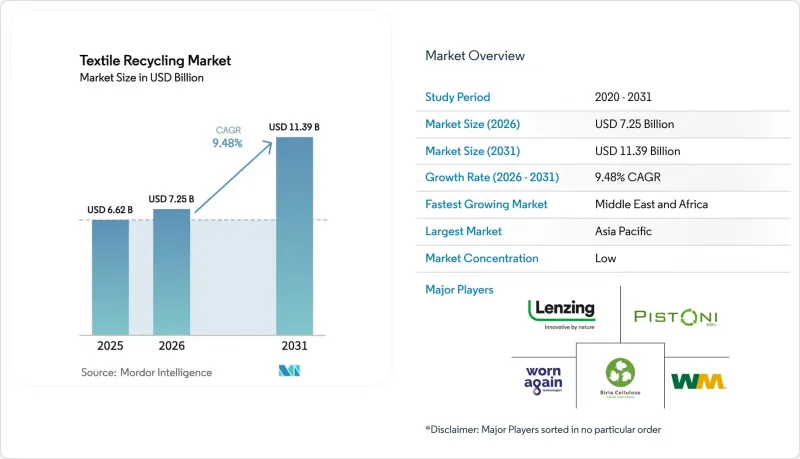
據 Mordor Intelligence 稱,2025 年紡織品回收市場價值為 66.2 億美元,預計到 2031 年將達到 113.9 億美元,高於 2026 年的 72.5 億美元,預測期(2026-2031 年)的複合年成長率為 9.48%。
本報告按材料(棉、聚酯及聚酯纖維、其他)、廢棄物來源(生產前廢棄物和消費後廢棄物)、最終用戶應用(服裝時尚、工業、其他)、回收工藝(機械回收、化學回收、其他)以及地區(北美、南美、歐洲、亞太、其他)進行細分。市場預測以美元計價。
全球紡織品回收市場趨勢與洞察
歐盟綠色新政主導的生產者延伸責任制(EPR)實施
自2025年1月起,歐盟將強制實施紡織品分類回收,並將處置成本透過環保收費機制轉嫁給生產者。在法國,該系統每年已產生約1億歐元的收入,用於建造可處理24萬噸廢棄物的回收基礎設施。荷蘭等先驅者提前兩年實現了50%的回收率,比歐盟目標提前了兩年,證明了該模式的擴充性。加州的SB 707法案也體現了這一模式,旨在防止監管套利並統一最低迴收標準。可預測的收費收入降低了專案風險,並加速了區域處理中心的建設。
快時尚品牌致力於2026年使用超過50%的再生纖維。
H&M集團與Syre公司簽署的為期七年、價值6億美元的收購協議凸顯了採購擔保如何降低化學回收的投資風險。 Gap公司和Carter's公司也擁有類似的供應鏈目標,合約下的總需求超過20億美元。如今,再生聚酯的價格比原生材料高出15%至20%,增強了供應商的獲利前景。長期合約降低了客戶獲取成本,並透過貸款支持工廠建設,尤其是在亞洲和歐洲,各大品牌正在整合其生產基地。
高昂的資本投入和高能耗的化工廠阻礙了商業化進程。
一座典型的工廠建設需要2億至5億美元,能源需求每噸15至25吉焦,是機械加工方法的五倍。 Renewcell在2024年的破產凸顯了其在資金籌措的脆弱性,儘管它擁有品牌合作關係。伊士曼公司曾獲得的(現已撤銷的)美國能源局津貼等補貼表明,該公司高度依賴政策支持。由於其高資本密集度,項目往往集中在經合組織地區,而新興市場(即使原料豐富)的供應不足。
細分市場分析
到2025年,聚酯纖維將佔紡織品回收市場的44.30%,這得益於成熟的PET供應鏈和消費者對其的熟悉度。機械處理過程能夠有效率地處理透明的原料流,而化學解聚則能消除品質損失,並擴大其在高階服裝領域的應用。尼龍市場正以9.41%的複合年成長率成長,這主要得益於汽車和運動服裝等需要高拉伸強度的混紡材料的應用。 ECONYL等技術正在推動閉合迴路的構建,並預示著其已具備商業化條件。儘管棉花在中國面臨政策限制,但REFIBRA等混紡回收技術正在開拓新的細分市場。羊毛、絲綢和腈綸等小規模的品類也取得了進展,試點生產線驗證了其技術可行性,品牌也正在實現原料策略的多元化。
到2025年,消費後紡織品將佔紡織品回收市場的60.40%,這反映了強制性掩埋規避政策以及慈善機構建立的完善的回收網路。然而,消費前廢棄物預計將以8.52%的複合年成長率成長,因為工廠廢料成分更均勻,回收率更高,預計其價值溢價可達20-30%。隨著歐盟分類收集法規於2025年生效,預計到2030年,該地區處理的消費後紡織品廢棄物量將加倍,除非自動化分揀技術得到改進,否則這將對利潤率構成壓力。數位護照和顏色分類機器人作為新的解決方案正在興起,它們可以透過提高識別準確性來釋放潛在價值。
區域分析
預計到2025年,亞太地區將引領紡織品回收市場,佔46.10%的市佔率。這得歸功於該地區龐大的紡織品生產規模和以出口為導向的服裝中心,這些中心會產生大量的廢料。中國的廢棄物排放量高達2,600萬噸,遠超過世界其他地區,但由於對再生材料含量的限制,大部分產品被出口到海外,抑制了國內需求。越南憑藉其政策激勵措施和接近性製造群的地理優勢,正成為建造超大型工廠的理想地點。印度的基礎設施相對落後,廢棄物回收率僅13%,但中央政府的努力和私部門的夥伴關係正在取得進展。
中東和非洲是紡織品回收市場成長最快的地區,複合年成長率達8.74%。阿拉伯聯合大公國的Circulife等項目將零售回收活動與加工能力結合,使沿岸地區成為區域回收中心。土耳其利用其與歐盟的關稅同盟地位,從歐洲進口大量廢舊紡織品,進行低成本加工,然後將其作為紗線重新出口,從而開發了兩個主要消費區域之間此前未充分利用的鄰近市場。
歐洲是紡織品回收市場監管方面的標竿。隨著生產者延伸責任制(EPR)於2025年開始實施,預計到2030年,回收量將達到450萬至720萬噸。在北美,各州層級的法規(例如加州的SB 707法案)和聯邦層級的協調工作正在推進,預計將創造一個價值15億美元的「纖維到纖維」市場。在南美,巴西和智利的新興計畫正日益受到關注,尤其是在那些政府將回收視為創造就業機會的地區。
其他好處:
- Excel格式的市場預測(ME)表
- 3個月的分析師支持
目錄
第1章:引言
- 研究假設和市場定義
- 調查範圍
第2章:調查方法
第3章執行摘要
第4章 市場狀況
- 市場概覽
- 市場促進因素
- 在綠色新政)。
- 快時尚品牌致力於2026年使用超過50%的再生纖維。
- 擴大化學解聚合可實現閉合迴路聚酯的生產。
- 中國的掩埋和焚燒配額迫使國內造紙廠投資回收。
- 基於區塊鏈的溯源平台(例如 TextileGenesis)正在提高品牌接受度。
- 北美汽車NVH領域對再生不織布的需求
- 市場限制因素
- 高額資本投入和高能耗的化學生產線阻礙了商業化進程。
- 纖維混合物的加入使得自動分類和產量測試變得困難。
- 缺乏捆包等級定價基準削弱了投資人信心。
- 美國和新興亞洲國家的回收基礎設施分散問題
- 價值供應鏈分析
- 監理展望
- 技術展望
- 產業吸引力—五力分析
- 供應商的議價能力
- 買方的議價能力
- 新進入者的威脅
- 替代品的威脅
- 競爭公司之間的競爭
第5章 市場規模與成長預測
- 材料
- 棉布
- 聚酯和聚酯纖維
- 羊毛
- 尼龍和尼龍纖維
- 其他(絲綢、腈綸、混紡)
- 依廢棄物來源分類
- 生產前廢棄物(工廠邊角料、線頭邊角料)
- 二手(廢棄物衣物和家用紡織品)
- 按應用程式和最終用戶
- 服裝與時尚
- 工業用途(擦拭巾、過濾、安全設備)
- 室內裝飾和地毯
- 汽車和運輸業
- 建築/施工
- 其他(零售、消費品等)
- 透過回收過程
- 機械回收
- 化學回收(解聚、溶解)
- 熱能能源回收
- 按地區
- 北美洲
- 美國
- 加拿大
- 墨西哥
- 南美洲
- 巴西
- 阿根廷
- 智利
- 其他南美國家
- 歐洲
- 德國
- 英國
- 法國
- 義大利
- 西班牙
- 比荷盧經濟聯盟(比利時、荷蘭、盧森堡)
- 北歐國家(丹麥、芬蘭、冰島、挪威、瑞典)
- 其他歐洲國家
- 亞太地區
- 中國
- 印度
- 日本
- 韓國
- 東協(印尼、泰國、菲律賓、馬來西亞、越南)
- 其他亞太國家
- 中東和非洲
- 沙烏地阿拉伯
- 阿拉伯聯合大公國
- 土耳其
- 南非
- 奈及利亞
- 埃及
- 其他中東和非洲國家
- 北美洲
第6章 競爭情勢
- 市場集中度
- 策略性舉措(併購、提高產能、品牌銷售協議)
- 市佔率分析
- 公司簡介
- Lenzing AG
- Birla Cellulose(Aditya Birla)
- Unifi Inc.
- Renewcell AB
- Worn Again Technologies
- Waste Management Inc.
- American Textile Recycling Service
- Boer Group Recycling Solutions
- I:Collect GmbH(I:CO)
- Infinited Fiber Co.
- Eastman Chemical Co.(Naia(TM)Renew)
- Circ LLC
- Carbios SA
- Loop Industries Inc.
- Soex Group
- Textile Recycling International
- Evrnu SPC
- Pistoni SRL
- Gemini Corporation NV
- The Woolmark Company*
第7章 市場機會與未來展望
According to Mordor Intelligence, the textile recycling market size was valued at USD 6.62 billion in 2025 and is estimated to grow from USD 7.25 billion in 2026 to reach USD 11.39 billion by 2031, at a CAGR of 9.48% during the forecast period (2026-2031).
This report is Segmented by Material (Cotton, Polyester & Polyester Fiber, and Others), by Waste Source (Pre-Consumer and Post-Consumer), by End-User Application (Apparel & Fashion, Industrial, and Others), by Recycling Process (Mechanical, Chemical, and Others), and by Geography (North America, South America, Europe, Asia-Pacific, and Others). The Market Forecasts are Provided in Terms of Value (USD).
Global Textile Recycling Market Trends and Insights
Green Deal-driven Extended Producer Responsibility Rollout in the EU
Mandatory separate textile collection begins across the bloc in January 2025, shifting disposal costs to producers through eco-modulated fees. France already channels about EUR 100 million a year from its scheme into collection infrastructure that processes 240,000 tons of waste. Early adopters such as the Netherlands hit 50% recycling rates two years ahead of the EU target, demonstrating scalability. California's SB 707 mirrors the model, preventing regulatory arbitrage and standardising minimum recycling thresholds. Predictable fee income lowers project risk, accelerating deployments of regional processing hubs.
Fast-fashion Brand Commitments to >=50% Recycled Fiber by 2026
H&M Group's seven-year USD 600 million offtake deal with Syre underscores how purchase guarantees are derisking chemical-recycling investments. Gap Inc. and Carter's share comparable supply-chain goals, pushing aggregate contracted demand above USD 2 billion. Recycled polyester currently commands 15-20% price premiums over virgin equivalents, strengthening revenue visibility for suppliers. Long-term contracts reduce customer acquisition cost and support debt-financed facility builds, especially in Asia and Europe, where brands maintain production clusters.
High CAPEX & Energy-intensive Chemical Lines Limiting Commercialisation
Typical units require USD 200-500 million, and energy demand ranges from 15-25 GJ per ton, fivefold the mechanical alternative. Renewcell's 2024 bankruptcy illustrated financing fragility despite brand partnerships. Subsidies such as Eastman's now-revoked Department of Energy grant highlight reliance on policy support. Capital intensity often localises projects in OECD regions, leaving feedstock-rich emerging markets underserved.
Other drivers and restraints analyzed in the detailed report include:
- Chemical depolymerisation scale-ups unlocking closed-loop polyester
- China Landfill and Incineration Quotas Forcing Domestic Mill Recycling Investments
- Fiber-blend Contamination Complicating Automated Sorting & Yield
For complete list of drivers and restraints, kindly check the Table Of Contents.
Segment Analysis
Polyester accounted for 44.30% of the textile recycling market in 2025 on the back of established PET supply chains and consumer familiarity. Mechanical processes handle clear streams efficiently, while chemical depolymerisation eliminates quality drop-offs, widening usage in high-end apparel. The nylon segment is expanding at 9.41% CAGR, buoyed by automotive and sportswear blends that demand high tensile strength. Technologies such as ECONYL feed closed-loop loops, signalling commercial readiness. Cotton encounters policy limits in China, but blend-recovery chemistries like REFIBRA open incremental niches. Smaller categories, wool, silk, and acrylic advance as pilot lines prove technical feasibility, and brands diversify raw-material strategies.
Post-consumer streams held a 60.40% share of the textile recycling market in 2025, reflecting landfill diversion mandates and established charity-collection networks. Yet pre-consumer waste is projected to expand at 8.52% CAGR as factory off-cuts deliver uniform composition, higher yields, and 20-30% value premiums. The EU separate-collection rule, effective in 2025, will double regional post-consumer volumes by 2030, squeezing margins unless automated sorting improves. Digital passports and colour-sort robotics are emerging fixes that can unlock latent value by boosting identification accuracy.
Geography Analysis
Asia-Pacific led the textile recycling market with a 46.10% share in 2025, anchored by massive fiber production and export-oriented apparel hubs that generate sizeable scrap volumes. China's 26 million-ton waste stream dwarfs global peers, yet recycled-content restrictions funnel much of the output abroad, muting domestic demand. Vietnam emerges as a preferred build site for gigascale plants because of policy incentives and proximity to manufacturing clusters. India lags on infrastructure: only 13% of waste is reused, but central-government initiatives and private partnerships are gaining traction.
The Middle East and Africa is the fastest-growing region in the textile recycling market at an 8.74% CAGR. UAE programs such as Circulife pair retail-collection drives with processing capacity, positioning the Gulf as a regional recycling hub. Turkey leverages its customs-union status with the EU to import European post-consumer bales, process them cost-effectively and re-export yarns, tapping an under-served adjacency between two large consumption zones.
Europe acts as the regulatory bellwether in the textile recycling market; EPR implementation starting 2025 is projected to lift collected volumes to 4.5-7.2 million tons by 2030. North America follows with state-level mandates like California's SB 707 and federal coordination efforts that could unlock a USD 1.5 billion fiber-to-fiber opportunity. South America's incipient projects in Brazil and Chile illustrate growing interest, especially where governments view recycling as a job-creation lever.
- Lenzing AG
- Birla Cellulose (Aditya Birla)
- Unifi Inc.
- Renewcell AB
- Worn Again Technologies
- Waste Management Inc.
- American Textile Recycling Service
- Boer Group Recycling Solutions
- I:Collect GmbH (I:CO)
- Infinited Fiber Co.
- Eastman Chemical Co. (Naia(TM) Renew)
- Circ LLC
- Carbios SA
- Loop Industries Inc.
- Soex Group
- Textile Recycling International
- Evrnu SPC
- Pistoni SRL
- Gemini Corporation NV
- The Woolmark Company*
Additional Benefits:
- The market estimate (ME) sheet in Excel format
- 3 months of analyst support
TABLE OF CONTENTS
1 Introduction
- 1.1 Study Assumptions & Market Definition
- 1.2 Scope of the Study
2 Research Methodology
3 Executive Summary
4 Market Landscape
- 4.1 Market Overview
- 4.2 Market Drivers
- 4.2.1 Green Deal-Driven Extended Producer Responsibility (EPR) Roll-out in the EU
- 4.2.2 Fast-Fashion Brand Commitments to >=50 % Recycled Fiber by 2026
- 4.2.3 Chemical Depolymerisation Scale-ups Unlocking Closed-Loop Polyester
- 4.2.4 China's Landfill/Incineration Quotas Forcing Domestic Mill Recycling Investments
- 4.2.5 Block-Chain Traceability Platforms (e.g., TextileGenesis) Boosting Brand Acceptance
- 4.2.6 Automotive NVH Demand for Recycled Non-wovens in North America
- 4.3 Market Restraints
- 4.3.1 High-CAPEX & Energy-Intensive Chemical Lines Limiting Commercialisation
- 4.3.2 Fiber-Blend Contamination Complicating Automated Sorting & Yield
- 4.3.3 Absence of Bale-Grade Pricing Benchmarks Dampening Investor Confidence
- 4.3.4 Fragmented Collection Infrastructure in US & Emerging Asia
- 4.4 Value / Supply-Chain Analysis
- 4.5 Regulatory Outlook
- 4.6 Technological Outlook
- 4.7 Industry Attractiveness - Porter's Five Forces
- 4.7.1 Bargaining Power of Suppliers
- 4.7.2 Bargaining Power of Buyers
- 4.7.3 Threat of New Entrants
- 4.7.4 Threat of Substitutes
- 4.7.5 Intensity of Competitive Rivalry
5 Market Size & Growth Forecasts (Value, USD Billion)
- 5.1 By Material
- 5.1.1 Cotton
- 5.1.2 Polyester & Polyester Fiber
- 5.1.3 Wool
- 5.1.4 Nylon & Nylon Fiber
- 5.1.5 Others (Silk, Acrylic, Blends)
- 5.2 By Waste Source
- 5.2.1 Pre-consumer (Factory off-cuts, Yarn waste)
- 5.2.2 Post-consumer (Discarded Garments & Household Textiles)
- 5.3 By Application End-user
- 5.3.1 Apparel & Fashion
- 5.3.2 Industrial (Wipes, Filtration, Safety Gear)
- 5.3.3 Home Furnishings & Carpets
- 5.3.4 Automotive & Transportation
- 5.3.5 Building & Construction
- 5.3.6 Others (Retail/Consumer Products, etc.)
- 5.4 By Recycling Process
- 5.4.1 Mechanical Recycling
- 5.4.2 Chemical Recycling (Depolymerisation, Dissolution)
- 5.4.3 Thermal/Energy Recovery
- 5.5 By Geography
- 5.5.1 North America
- 5.5.1.1 United States
- 5.5.1.2 Canada
- 5.5.1.3 Mexico
- 5.5.2 South America
- 5.5.2.1 Brazil
- 5.5.2.2 Argentina
- 5.5.2.3 Chile
- 5.5.2.4 Rest of South America
- 5.5.3 Europe
- 5.5.3.1 Germany
- 5.5.3.2 United Kingdom
- 5.5.3.3 France
- 5.5.3.4 Italy
- 5.5.3.5 Spain
- 5.5.3.6 BENELUX (Belgium, Netherlands, and Luxembourg)
- 5.5.3.7 NORDICS (Denmark, Finland, Iceland, Norway, and Sweden)
- 5.5.3.8 Rest of Europe
- 5.5.4 Asia-Pacific
- 5.5.4.1 China
- 5.5.4.2 India
- 5.5.4.3 Japan
- 5.5.4.4 South Korea
- 5.5.4.5 ASEAN (Indonesia, Thailand, Philippines, Malaysia, Vietnam)
- 5.5.4.6 Rest of Asia-Pacific
- 5.5.5 Middle East and Africa
- 5.5.5.1 Saudi Arabia
- 5.5.5.2 United Arab Emirates
- 5.5.5.3 Turkey
- 5.5.5.4 South Africa
- 5.5.5.5 Nigeria
- 5.5.5.6 Egypt
- 5.5.5.7 Rest of Middle East and Africa
- 5.5.1 North America
6 Competitive Landscape
- 6.1 Market Concentration
- 6.2 Strategic Moves (M&A, Capacity Adds, Brand Off-take Deals)
- 6.3 Market Share Analysis
- 6.4 Company Profiles {(includes Global level Overview, Market level overview, Core Segments, Financials as available, Strategic Information, Products & Services, and Recent Developments)}
- 6.4.1 Lenzing AG
- 6.4.2 Birla Cellulose (Aditya Birla)
- 6.4.3 Unifi Inc.
- 6.4.4 Renewcell AB
- 6.4.5 Worn Again Technologies
- 6.4.6 Waste Management Inc.
- 6.4.7 American Textile Recycling Service
- 6.4.8 Boer Group Recycling Solutions
- 6.4.9 I:Collect GmbH (I:CO)
- 6.4.10 Infinited Fiber Co.
- 6.4.11 Eastman Chemical Co. (Naia(TM) Renew)
- 6.4.12 Circ LLC
- 6.4.13 Carbios SA
- 6.4.14 Loop Industries Inc.
- 6.4.15 Soex Group
- 6.4.16 Textile Recycling International
- 6.4.17 Evrnu SPC
- 6.4.18 Pistoni SRL
- 6.4.19 Gemini Corporation NV
- 6.4.20 The Woolmark Company*
7 Market Opportunities & Future Outlook
- 7.1 White-space & Unmet-Need Assessment

 回收織物環保建材市場分析及預測(至2035年):類型、產品、技術、應用、材料類型、製程、最終用戶、功能、安裝類型
 紡織品回收市場:全球市場預測,2026-2032年
 再生纖維市場:依材料、紡織廢棄物來源、終端用途產業、回收方法、分銷通路及地區分類
 紡織品回收市場預測至2034年:按材料、技術、工藝、應用、最終用戶和地區分類的全球分析
 紡織品回收市場規模、佔有率、成長及全球產業分析:按類型和應用、區域洞察及2026-2034年預測
 紡織品回收市場報告:按產品類型、紡織廢棄物、分銷管道、最終用途和地區分類(2026-2034 年)
 全球紡織品回收市場:市場規模、佔有率和趨勢分析(按材料、來源、製程和地區分類),細分市場預測(2026-2033 年)全球紡織品回收市場規模、佔有率、趨勢和成長分析報告(2026-2034)按產品類型、組織規模、產業、部署類型和分銷管道分類的文本型AIGC市場-全球預測,2026-2032年紡織品回收設備市場(按設備類型、技術、材料類型、應用、最終用戶和分銷管道分類)-2026-2032年全球預測