


 |
市場調查報告書
商品編碼
2066720
鋁回收:市佔率分析、產業趨勢與統計及成長預測(2026-2031)Aluminum Recycling - Market Share Analysis, Industry Trends & Statistics, Growth Forecasts (2026 - 2031) |
||||||

※ 本網頁內容可能與最新版本有所差異。詳細情況請與我們聯繫。
據 Mordor Intelligence 稱,預計到 2026 年,鋁回收市場將達到 4,114 萬噸,高於 2025 年的 3,935 萬噸,預計到 2031 年將達到 5,136 萬噸。
預計從 2026 年到 2031 年,其複合年成長率將達到 4.54%。
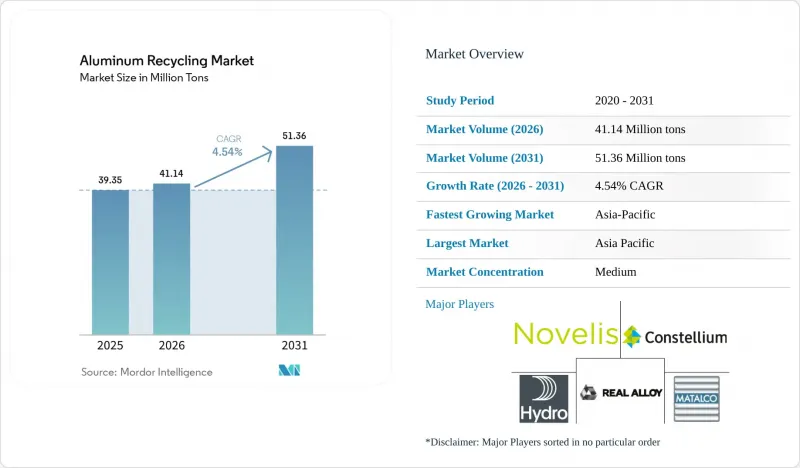
本報告按產品類型(鑄造合金、擠壓材料、板材及其他)、終端用戶行業(汽車、航太與國防、建築與施工、電氣與電子、包裝及其他終端用戶行業)和地區(亞太地區、北美、歐洲、南美以及中東和非洲)進行細分。市場預測以噸為單位。
全球鋁回收市場趨勢與洞察
原生鋁生產的節能優勢
與電解提煉製程相比,二次提煉可降低95%的能源消耗。如果電價飆升或碳排放稅緊,這一差距將進一步擴大。 2020年至2024年間,北美二次精煉生產商的平均碳足跡減少了60%,從而與汽車製造商和飛機原始設備製造商(OEM)簽訂了供應契約,這些製造商目前正在進行範圍3排放審計。 2024年12月,氧化鋁現貨價格超過每噸800美元,但回收商透過完全取消氧化鋁精煉製程避免了這項成本。隨後,投資銀行提高了2025年鋁業價格的預測,為二次提煉提供了更大的利潤空間。因此,在歐盟和北美部分地區等已實施碳定價機制的地區,再生原生鋁的趨勢正在加速發展。
擴大再生鋁在建築業的應用
快速的都市化和綠色建築標準的推行正促使建築公司採用高可回收性的擠壓材料建造幕牆、外觀系統和窗框。 LEED 和 BREEAM 等認證體系為使用回收材料提供加分,進一步強化了其在降低成本之外的推動作用。預計 2022 年至 2024 年,亞洲的建築需求將增加 9%,並預計在 2027 年之前保持類似的增速,這主要得益於印度、印尼和菲律賓等大都會圈公共交通和住宅計畫的擴張。歐洲擠壓廠的回收率已超過 90%,為加拿大和日本的「材料護照」舉措提供了政策參考。建築業的強勁需求也縮短了廢料回收週期,並確保了重型熔爐所需廢舊型材的穩定供應。
存在不良雜質(鐵、鎂、鋅)
當鋁材中的鐵含量超過0.20%時,它便無法用於航太和電動車(EV)的大多數結構應用,迫使回收商以大幅折扣將受污染的鋁材轉售至鑄造和脫氧市場。拆除現場的混合廢料通常含有6000系和7000系合金以及塗漆建築型材,這增加了精煉成本和能源消耗。大規模冶煉廠會添加助熔劑並使用電磁攪拌器來降低鐵含量,但高昂的投資成本阻礙了小規模企業進入高階市場。此外,鐵污染也會導致凝固過程中出現微觀偏析,進而降低疲勞強度。飛機原始設備製造商(OEM)透過嚴格的供應商認證審核密切關注此問題。
細分市場分析
到了2025年,擠壓鋁材在鋁回收市場佔據35.10%的主導地位,這主要得益於建築師和汽車製造商對輕質、耐腐蝕型材在建築外觀、底盤部件和電池機殼等領域的廣泛應用。預計到2031年,該細分市場將以5.29%的複合年成長率成長,並持續擴大與板材和鑄造鋁材的差距。由於擠壓鋁材通常採用單一合金成分,因此是閉合迴路回收的理想選擇,閉迴路回收能夠保持合金的化學成分,並將等級損失降至最低。在2024年的一項測試中,康斯坦鋁業公司成功地將廢棄飛機蒙皮重熔為航太級鋁坯,證明了在不稀釋合金的情況下實現多重回收循環的技術可行性。
板材是主要產品類別,廣泛應用於汽車車身面板和飲料罐罐體,這些應用對錶面品質要求極高。板材廠正在投資建造連鑄生產線,以應對更高的廢料含量,同時滿足嚴格的殘料率和成形性要求。鑄造合金雖然產量較小,但在引擎缸體和馬達外殼等領域需求強勁,這些應用需要複雜的形狀和良好的導熱性能。箔材和線材應用仍然是一個穩定的細分市場,但由於軟包裝行業擴大使用再生聚合物,箔材市場的成長速度正在放緩。
區域分析
預計到2025年,亞太地區將佔全球鋁回收市場佔有率的61.20%,並在2031年之前以5.55%的複合年成長率成長。中國再生鋁產能的提升與4,500萬噸的原生鋁產能上限相符,促使冶煉廠轉向進口廢棄物和國內回收計畫。印度的「智慧城市計畫」進一步推動了對鋁坯的需求,因為再生擠壓型材正被用於交通走廊和經濟適用住宅。日本和韓國擁有高品質的廢棄物分類技術,加強了從回收到成品生產的區域垂直整合。
北美和歐洲合計佔據全球鋁需求的很大一部分。 2024年,美國超過80%的鋁產量來自再生鋁,與40年前未超過30%的比例相比,增幅顯著。美國10個州的押金返還計畫以及聯邦政府對使用再生材料的稅額扣抵抵免政策,保障了飲料罐板材的穩定供應。歐盟強制要求在2029年實現金屬飲料容器90%的回收率,這正在加速對專用易拉罐回收廠的投資。這兩個地區的高電價也進一步推動了可再生能源的普及。西班牙海德魯公司計劃在其位於托里亞、投資1.8億歐元的工廠利用現場太陽能發電來降低熔煉成本。
儘管中東和非洲的鋁加工量落後於其他地區,但它們正蓄勢待發,即將迎來爆發式成長。阿拉伯聯合大公國環球鋁業公司(EGA)以8,000萬美元收購了位於明尼蘇達州的Spectro Alloys公司,並於2025年7月恢復生產。此舉旨在搶佔海灣合作理事會(GCC)國家價值60億美元的鋁回收市場。摩洛哥利用太陽能發電成本低廉的優勢,於2024年運作了其首個僅加工廢鋁的提煉。南美洲的鋁加工前景主要集中在巴西,該國90%的電網都使用可再生能源,這降低了再生金屬的碳排放強度,並滿足了跨國飲料和汽車品牌的永續性標準。
其他好處:
- Excel格式的市場預測(ME)表
- 3個月的分析師支持
目錄
第1章:引言
- 研究假設和市場定義
- 調查範圍
第2章:調查方法
第3章執行摘要
第4章 市場狀況
- 市場概覽
- 市場促進因素
- 與原生鋁生產相比,具有節能優勢
- 擴大再生鋁在建築業的應用
- 汽車重量減輕導致需求激增
- 歐盟擴大飲料罐閉合迴路計劃
- 推出人工智慧驅動的廢料分類平台。
- 市場限制因素
- 存在不良雜質(鐵、鎂、鋅)
- 廢鋼價格波動給二次提煉企業的利潤率帶來了壓力。
- 在供應過剩時期,與低成本的閒置金屬競爭。
- 價值鏈分析
- 波特五力模型
第5章 市場規模與成長預測
- 依產品類型
- 鑄造合金
- 擠壓
- 座位
- 其他類型
- 按最終用戶行業分類
- 車
- 航太/國防
- 建築/施工
- 電氣和電子設備
- 包裝
- 其他終端用戶產業
- 按地區
- 亞太地區
- 中國
- 印度
- 日本
- 韓國
- 馬來西亞
- 泰國
- 印尼
- 越南
- 其他亞太國家
- 北美洲
- 美國
- 加拿大
- 墨西哥
- 歐洲
- 德國
- 英國
- 義大利
- 法國
- 俄羅斯
- 西班牙
- 土耳其
- 北歐國家
- 其他歐洲國家
- 南美洲
- 巴西
- 阿根廷
- 哥倫比亞
- 其他南美國家
- 中東和非洲
- 沙烏地阿拉伯
- 阿拉伯聯合大公國
- 卡達
- 埃及
- 奈及利亞
- 南非
- 其他中東和非洲國家
- 亞太地區
第6章 競爭情勢
- 市場集中度
- 策略趨勢
- 市佔率(%)** / 排名分析
- 公司簡介
- Alcoa Corporation
- AMAG Austria Metall AG
- Constellium
- Emirates Global Aluminium PJSC
- Kuusakoski Oy
- Matalco Inc
- Norsk Hydro ASA
- Novelis Inc.
- Raffmetal
- REAL ALLOY
- Speira GmbH
- Stena Metall AB
- Ye Chiu Group
第7章 市場機會與未來展望
According to Mordor Intelligence, aluminum recycling market size in 2026 is estimated at 41.14 million tons, growing from 2025 value of 39.35 million tons with 2031 projections showing 51.36 million tons, growing at 4.54% CAGR over 2026-2031.
This report is Segmented by Product Type (Casting Alloys, Extrusion, Sheets, Other Types), End-User Industry (Automotive, Aerospace and Defense, Building and Construction, Electrical and Electronics, Packaging, Other End-User Industries), and Geography (Asia-Pacific, North America, Europe, South America, Middle-East and Africa). The Market Forecasts are Provided in Terms of Volume (Tons).
Global Aluminum Recycling Market Trends and Insights
Energy-saving advantage over primary aluminum production
Secondary smelting cuts energy use by 95% compared with electrolytic processes, a gap that widens when electricity prices spike and carbon fees tighten. North American secondary producers slashed their average carbon footprint by 60% between 2020 and 2024, enabling them to win supply contracts with automakers and aircraft OEMs that now audit Scope 3 emissions. Spot alumina breached USD 800 per ton in December 2024, but recyclers avoided that cost because they bypassed alumina refining entirely. Investment banks subsequently lifted 2025 aluminum- industry price forecasts, giving secondary smelters additional margin headroom. Regions with carbon-price regimes, such as the EU and parts of North America, are therefore accelerating substitution of primary with recycled metal.
Growing utilization of recycled aluminum in construction
Rapid urbanization and green-building codes are driving builders to specify high-recycled-content extrusions for curtain walls, facade systems, and window frames. Certification schemes such as LEED and BREEAM award credits for recycled content, magnifying the pull effect beyond pure cost savings. Asian construction demand climbed 9% between 2022 and 2024, and similar momentum is forecast through 2027 as megacities in India, Indonesia, and the Philippines expand mass-transit and residential projects. Europe's extrusion plants already operate at recycling rates above 90%, serving as policy templates for new material-passport initiatives in Canada and Japan. Strong construction uptake also shortens scrap collection loops, ensuring a stable inflow of post-consumer profiles for remelt furnaces.
Presence of undesirable impurities (Fe, Mg, Zn)
Contamination above 0.20% iron disqualifies aluminum for most aerospace and EV structural uses, forcing recyclers to divert tainted batches to foundry or de-oxidation markets at steep discounts. Mixed streams from demolition sites often blend 6000-series and 7000-series alloys with painted architectural profiles, raising purification costs and energy consumption. Large smelters add fluxing agents and employ electromagnetic stirrers to lower iron pick-up, but the capital hurdle keeps smaller operators out of premium markets. Iron contamination also creates micro-segregation during solidification, impairing fatigue resistance-an issue that aircraft OEMs monitor closely through rigid supplier-qualification audits.
Other drivers and restraints analyzed in the detailed report include:
- Booming demand from automotive lightweighting
- Adoption of AI-enabled scrap-sorting platforms
- Scrap-price volatility compressing secondary-smelter margins
For complete list of drivers and restraints, kindly check the Table Of Contents.
Segment Analysis
Extrusions held a commanding 35.10% aluminum recycling market share in 2025 as architects and automakers turned to light, corrosion-resistant profiles for facades, chassis members, and battery enclosures. The segment is on track for a 5.29% CAGR through 2031, steadily widening its gap over sheet and casting grades. Extruded sections often use single-alloy compositions, making them ideal candidates for closed-loop recycling, which conserves alloy chemistry and minimizes downgrading losses. Constellium successfully remelted end-of-life aircraft skins into aerospace-grade billet during 2024 trials, demonstrating the technical viability of multiple recycling loops without alloy dilution.
Sheets represent a key category, supplying automotive outer panels and beverage can bodies where surface quality is critical. Sheet mills are investing in continuous casting lines that accept higher scrap percentages while meeting strict earing and formability targets. Casting alloys account for a smaller volume but enjoy robust demand in engine blocks and e-motor housings that require complex geometry and thermal conductivity. Foil and wire applications remain steady niche outlets; however, rising substitution by recycled polymers in flexible packaging is capping foil growth.
Geography Analysis
Asia-Pacific accounted for 61.20% of global aluminum recycling market share in 2025 and is projected to expand at a 5.55% CAGR through 2031. China's secondary capacity additions align with its 45 million-ton primary cap, nudging smelters toward scrap imports and domestic collection schemes. India's Smart Cities Mission is injecting recycled extrusions into transit corridors and affordable housing, further lifting billet demand. Japan and South Korea supply high-grade scrap sorting technology, reinforcing regional vertical integration from collection to finished goods.
North America and Europe collectively represent a significant portion of global demand. More than 80% of U.S. aluminum production was secondary in 2024, up from less than 30% four decades earlier. Deposit-return laws in ten U.S. states and federal tax credits for recycled content underpin stable can-sheet flows. The EU's 90% collection requirement for metal beverage containers by 2029 is accelerating investment in dedicated can-recycling plants. Both regions face high power tariffs, creating extra impetus to integrate renewables: Hydro's EUR 180 million Torija plant in Spain will source on-site solar to cut melt costs.
The Middle East and Africa trail in volume but offer outsized growth. Emirates Global Aluminium (EGA) acquired Minnesota-based Spectro Alloys for USD 80 million and restarted production in July 2025, signaling a push to capture the GCC's USD 6 billion recycling potential. Morocco commissioned its first dedicated aluminum scrap refinery in 2024, leveraging low solar power costs. South America's prospects cluster around Brazil, where a 90% renewable-electricity grid lowers the carbon intensity of secondary metal and meets the sustainability thresholds of multinational beverage and auto brands.
- Alcoa Corporation
- AMAG Austria Metall AG
- Constellium
- Emirates Global Aluminium PJSC
- Kuusakoski Oy
- Matalco Inc
- Norsk Hydro ASA
- Novelis Inc.
- Raffmetal
- REAL ALLOY
- Speira GmbH
- Stena Metall AB
- Ye Chiu Group
Additional Benefits:
- The market estimate (ME) sheet in Excel format
- 3 months of analyst support
TABLE OF CONTENTS
1 Introduction
- 1.1 Study Assumptions and Market Definition
- 1.2 Scope of the Study
2 Research Methodology
3 Executive Summary
4 Market Landscape
- 4.1 Market Overview
- 4.2 Market Drivers
- 4.2.1 Energy-saving advantage over primary aluminium production
- 4.2.2 Growing utilisation of recycled aluminium in construction
- 4.2.3 Booming demand from automotive lightweighting
- 4.2.4 EU beverage-can closed-loop programmes scaling up
- 4.2.5 Adoption of AI-enabled scrap-sorting platforms
- 4.3 Market Restraints
- 4.3.1 Presence of undesirable impurities (Fe, Mg, Zn)
- 4.3.2 Scrap-price volatility compressing secondary-smelter margins
- 4.3.3 Competition from low-cost virgin metal in periods of surplus
- 4.4 Value Chain Analysis
- 4.5 Porter's Five Forces
- 4.5.1 Bargaining Power of Suppliers
- 4.5.2 Bargaining Power of Buyers
- 4.5.3 Threat of New Entrants
- 4.5.4 Threat of Substitutes
- 4.5.5 Degree of Competition
5 Market Size and Growth Forecasts (Volume)
- 5.1 By Product Type
- 5.1.1 Casting Alloys
- 5.1.2 Extrusion
- 5.1.3 Sheets
- 5.1.4 Other Types
- 5.2 By End-user Industry
- 5.2.1 Automotive
- 5.2.2 Aerospace and Defense
- 5.2.3 Building and Construction
- 5.2.4 Electrical and Electronics
- 5.2.5 Packaging
- 5.2.6 Other End-user Industries
- 5.3 By Geography
- 5.3.1 Asia-Pacific
- 5.3.1.1 China
- 5.3.1.2 India
- 5.3.1.3 Japan
- 5.3.1.4 South Korea
- 5.3.1.5 Malaysia
- 5.3.1.6 Thailand
- 5.3.1.7 Indonesia
- 5.3.1.8 Vietnam
- 5.3.1.9 Rest of Asia-Pacific
- 5.3.2 North America
- 5.3.2.1 United States
- 5.3.2.2 Canada
- 5.3.2.3 Mexico
- 5.3.3 Europe
- 5.3.3.1 Germany
- 5.3.3.2 United Kingdom
- 5.3.3.3 Italy
- 5.3.3.4 France
- 5.3.3.5 Russia
- 5.3.3.6 Spain
- 5.3.3.7 Turkey
- 5.3.3.8 NORDIC Countries
- 5.3.3.9 Rest of Europe
- 5.3.4 South America
- 5.3.4.1 Brazil
- 5.3.4.2 Argentina
- 5.3.4.3 Colombia
- 5.3.4.4 Rest of South America
- 5.3.5 Middle-East and Africa
- 5.3.5.1 Saudi Arabia
- 5.3.5.2 United Arab Emirates
- 5.3.5.3 Qatar
- 5.3.5.4 Egypt
- 5.3.5.5 Nigeria
- 5.3.5.6 South Africa
- 5.3.5.7 Rest of Middle-East and Africa
- 5.3.1 Asia-Pacific
6 Competitive Landscape
- 6.1 Market Concentration
- 6.2 Strategic Moves
- 6.3 Market Share (%)**/Ranking Analysis
- 6.4 Company Profiles {(includes Global level Overview, Market level overview, Core Segments, Financials as available, Strategic Information, Market Rank/Share for key companies, Products and Services, and Recent Developments)}
- 6.4.1 Alcoa Corporation
- 6.4.2 AMAG Austria Metall AG
- 6.4.3 Constellium
- 6.4.4 Emirates Global Aluminium PJSC
- 6.4.5 Kuusakoski Oy
- 6.4.6 Matalco Inc
- 6.4.7 Norsk Hydro ASA
- 6.4.8 Novelis Inc.
- 6.4.9 Raffmetal
- 6.4.10 REAL ALLOY
- 6.4.11 Speira GmbH
- 6.4.12 Stena Metall AB
- 6.4.13 Ye Chiu Group
7 Market Opportunities and Future Outlook
- 7.1 White-space and Unmet-Need Assessment

 磷酸鋁片市場規模、佔有率和成長分析:按等級、應用、片劑規格、最終用戶、分銷管道和地區分類-2026-2033年產業預測
 鋁導體市場:全球市場預測,2026-2032年鋁系統市場:2026-2032年全球市場預測(依產品類型、製造流程、合金類型、安裝類型、應用和分銷管道分類)
 鋁板市場:依合金系列、產品類型、加工方法、終端用戶產業及地區分類鋁市場:按類型、形態、原料、等級、加工方法、應用和分銷通路分類-2026-2032年全球市場預測
 鋁包裝市場預測至2034年-全球分析(按產品類型、包裝類型、材料形式、厚度、製造流程、封蓋類型、可回收來源、最終用途產業、分銷管道和地區分類)
 鋁粉市場規模、佔有率和成長分析:按產品類型、應用、等級、終端用戶產業、粒度、分銷管道和地區分類-2026-2033年產業預測
 全球最小框架鋁合金窗系統市場-產業規模、佔有率、趨勢、機會、預測:按類型、應用、地區和競爭對手分類,2021-2031年
 鋁市場規模、佔有率和成長分析:按產品類型、合金類型、最終用途產業、加工方法、鋁品種和地區分類-2026-2033年產業預測
 2026-2030年全球鋁型材市場