


 |
市場調查報告書
商品編碼
2066710
電動摩托車:市場佔有率分析、產業趨勢與統計、成長預測(2026-2031)Electric Two-Wheeler - Market Share Analysis, Industry Trends & Statistics, Growth Forecasts (2026 - 2031) |
||||||

※ 本網頁內容可能與最新版本有所差異。詳細情況請與我們聯繫。
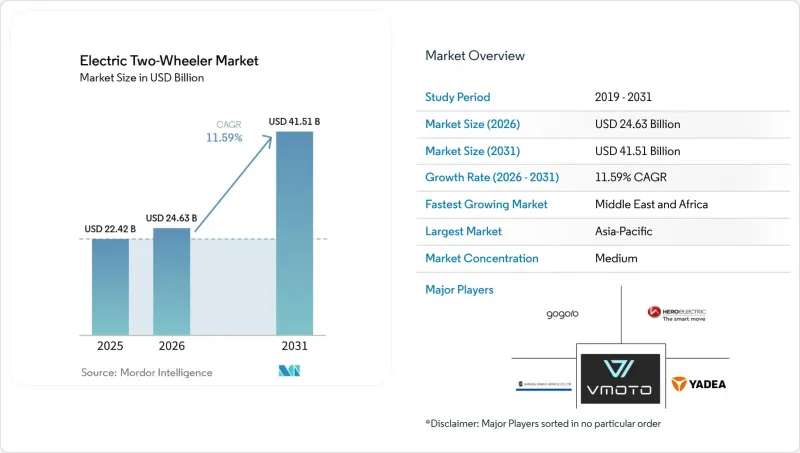
根據 Mordor Intelligence 估計,2026 年電動摩托車市值為 246.3 億美元,預計在預測期(2026-2031 年)內將以 11.59% 的複合年成長率成長,到 2031 年達到 415.1 億美元。
本報告按車輛類型(踏板車和摩托車)、電機功率(1.0 kW 以下和以上)、電壓(48 V、60 V、72 V 及其他)、電池配置(固定式及其他)、電機類型(無刷直流電機及其他)、價格區間(1000 美元以下和以上)、最終用戶(B2C 及其他)、銷售管道(B2C 及其他)預測數據以價值(美元)和銷售(輛)呈現。
全球電動摩托車市場趨勢及洞察
電池價格的下降正在加速總擁有成本與能源價格趨於一致的進程。
2024年,鋰離子電池組的成本顯著下降,較前一年大幅降低。預計未來幾年還將進一步下降。這項里程碑式的進展消除了印度、印尼和越南等市場對125cc汽油踏板車高昂初始成本的固有印象。這種轉變正在為不依賴補貼的需求自然成長鋪平道路。尤其是在印度的二線城市,Ather Energy和TVS Motor等品牌報告稱,無補貼電動踏板車的銷量目前已佔其每月銷量的很大一部分。製造商正利用這些成本節約來擴展產品線。例如,Ola Electric在2025年初推出了延長保固計畫。總體而言,供應鏈規模的擴大和電池成本的最佳化仍然是電動二輪車市場成長要素。
零工經濟中送貨車輛的快速擴張
像Zomato這樣的外送平台設定了雄心勃勃的目標,計劃在2020年代末部署大量電動車。同時,Swiggy已與Zypp Electric簽署契約,並計劃在未來幾年內部署大規模的電動滑板車車隊。對於中長途日常營運而言,與汽油車相比,電動車可以顯著降低總擁有成本,尤其是在透過電池更換最大限度地減少停機時間的情況下。 2024年,Gogoro與Uber和Rapido簽署了車隊協議,利用其廣泛的電池更換站網路在班加羅爾和海德拉巴建立了營運基地。根據政府法規,印尼GoTo集團預計將在未來幾年內將Gojek車隊的大部分車輛電動化,凸顯了亞洲在推廣電動車方面的主導地位。雖然除台灣以外,電池更換協議尚未統一,但聯盟的成立表明未來標準化進程正在取得進展。
中國和歐洲逐步取消補貼
2024年初,德國取消了原定於2023年底到期的購車補貼,法國也在2024年初削減了環保獎勵,導致車輛註冊量大幅下降。中國於2022年底終止了直接消費者補貼,但購置稅豁免政策仍將持續數年。隨著獎勵的減少,整車製造商被迫削減零件成本,規模較小的製造商受到的影響尤其嚴重。而像印度的FAME-II計畫這樣以多年期專案可預測性著稱的市場,其需求曲線則較為穩定。鑑於當前的財政壓力,未來的延期補貼不太可能像以前那樣慷慨,這也凸顯了內在成本競爭力的重要性。
細分市場分析
到2025年,踏板車將主導電動二輪車市場,佔全球94.71%的銷售量。其跨騎式設計、座下儲物空間和輕量化車架使其成為穿梭於擁擠都市區和宅配服務的理想選擇。配送平台更青睞踏板車,因為騎士上下車快速方便,縮短了服務時間。雖然摩托車仍佔市場佔有率的一小部分,但其年複合成長率(CAGR)正以11.61%的速度成長,這主要得益於追求性能的騎士對高速公路更高限速和更具動感外觀的需求。 Revolt RV400和Emflux液冷ONE等車型正是這種轉變為高功率輸出的例子。
摩托車市場的這股動能預示著電動二輪車市場將出現兩極化。至2031年,大眾市場的滲透率可能仍將以踏板車為主。然而,高階消費者願意為那些0-100公里/小時加速時間低於4秒、實際續航里程超過100公里的車型支付更高的價格。在運動和旅行車型領域擁有內燃機傳統的品牌,隨著電池成本的持續下降,其潛在的品牌價值可以充分利用。反之,除非現有踏板車製造商將產品線擴展到摩托車的車型,否則他們將面臨失去高階客戶群的風險。因此,該領域的創新很可能圍繞著拓展車型外形規格展開,而非僅僅提升續航里程。
到2025年,功率在1.1-3.0千瓦之間的車型將佔總銷量的39.78%,在成本、車重和都市區性能方面實現了良好的平衡。這些車型適合60公里以下的日常通勤,仍然是價格敏感型消費者的首選。然而,功率超過5.0千瓦的車型成長最快,年複合成長率高達11.67%。這是因為東協和拉丁美洲的監管機構統一了牌照標準,允許高功率踏板車與汽車一起在主幹道上行駛。 Ather的「450 Apex」車型展現了其強大的吸引力,即使在等紅燈時也能幾乎瞬間輸出扭矩,而且續航里程不受影響。
曾經在中國農村地區風靡一時的1.0千瓦以下低功率滑板車市場,隨著電池價格的下降,其原本足以彌補性能不足的成本優勢正在逐漸消失。相較之下,中功率(3.1-5.0千瓦)電動滑板車市場正成為入門級電動滑板轉換用戶以及那些尚未準備好接受大容量電池帶來的價格溢價和重量增加的騎行者的過渡選擇。隨著每千瓦時電池成本降至90美元以下,功率等級的分佈將繼續向上移動。這將使汽車製造商能夠在不超出大眾市場價格範圍的情況下,採用更大容量的電池組。
到2025年,60伏特系統將佔據電動摩托車市場37.73%的佔有率。這主要歸功於其組件生態系統(控制器、充電器和電池模組)的成熟和成本最佳化。同時,72伏特平台正以11.71%的複合年成長率成長,這得益於3千瓦直流快速充電器的普及,這些充電器可將最短充電時間縮短至約90分鐘。 Gogoro透過串聯50.4伏特電池組,實現了100.8伏特的電壓,從而展現了其模組化配置的柔軟性,以滿足高佔空比的需求。
公共充電站密度的不斷提高對電壓選擇的影響遠大於對車輛本身效率的影響,因為車主現在會根據相容硬體的可用性來比較車輛。曾經在鉛酸電池過渡階段佔據主導地位的48V架構,隨著鋰離子電池技術的出現打破了先前的電壓上限,正逐漸失去市場。在標準制定之前,96V和120V的實驗性原型產品仍將保持小眾地位。因此,汽車製造商面臨一個策略性權衡:要麼遵守通用電網電壓標準,要麼冒著客戶在都市區無法使用充電設施的風險。
區域分析
其他好處:
- Excel格式的市場預測(ME)表
- 3個月的分析師支持
目錄
第1章:引言
- 研究假設和市場定義
- 調查範圍
第2章:調查方法
第3章執行摘要
第4章 市場狀況
- 主要行業趨勢
- 人口和都市化
- 人均GDP(購買力平價)和可支配所得中位數
- 汽車和公共交通消費支出(CVP)
- 燃油價格
- 摩托車和汽車貸款的利率和信貸使用情況
- 摩托車擁有率(每千人擁有的車輛數)和車輛擁有量
- 經銷商和服務網路密度
- 摩托車貿易和銷售(進口/出口)
- 電氣化準備(基礎設施和電力)
- 電池組價格和化學成分
- 電池更換站(網路密度和使用情況)
- 新車型和OEM覆蓋範圍的開發計劃
- 價值鏈本地化和組裝能力
- 法律規範
- 市場促進因素
- 電池價格的下降正在加速總擁有成本與能源價格趨於一致的進程。
- 零工經濟配送車輛的快速擴張
- 都市區的低排放氣體區政策正在促進低排放技術的普及。
- 鼓勵本地電池到包裝的生產
- OEM模組化平台縮短開發週期
- 人工智慧電池管理技術可延長保固。
- 市場限制因素
- 中國和歐洲逐步取消補貼
- 專門針對摩托車的金融服務仍未充分利用。
- 收費標準的差異阻礙了漫遊服務。
- 與高溫相關的事故會損害消費者信心。
- 價值供應鏈分析
- 監理情勢
- 技術展望
- 波特五力模型
第5章 市場規模與成長預測
- 車輛類型
- 小型摩托車
- 摩托車
- 馬達輸出
- 1.0 千瓦或以下
- 1.1~3.0 kW
- 3.1~5.0 kW
- 5.0度或以上
- 透過電壓
- 48 V
- 60 V
- 72 V
- 其他
- 電池配置
- 固定套餐
- 可更換(單一)
- 可互換(雙)
- 依馬達類型
- BLDC
- PMSM
- 其他
- 價格範圍(美元)
- 1000人或以下
- 1,000~1,500
- 1,501~2,000
- 2,001~3,000
- 3,001~5,000
- 超過5000
- 最終用戶
- B2C
- B2B
- 共乘/自行車計程車/租賃/觀光
- 配送/物流
- 大中小型企業的車隊
- 其他(政府、非政府組織、其他機構)
- 按銷售管道
- 線上
- 離線
- 按地區
- 北美洲
- 美國
- 加拿大
- 其他北美國家
- 南美洲
- 巴西
- 阿根廷
- 其他南美國家
- 歐洲
- 德國
- 英國
- 法國
- 義大利
- 俄羅斯
- 西班牙
- 其他歐洲國家
- 亞太地區
- 中國
- 印度
- 日本
- 韓國
- 其他亞太國家
- 中東和非洲
- 沙烏地阿拉伯
- 阿拉伯聯合大公國
- 南非
- 土耳其
- 其他中東和非洲國家
- 北美洲
第6章 競爭情勢
- 市場集中度
- 策略趨勢
- 市佔率分析
- 公司簡介
- Yadea Group Holdings Ltd.
- Jiangsu Xinri E-Vehicle Co. Ltd.
- Hero Electric Vehicles Pvt. Ltd.
- VMOTO SOCO ITALY SRL
- Gogoro Limited
- Ather Energy Pvt. Ltd.
- NIU Technologies
- Ola Electric Technologies Pvt. Ltd.
- TVS Motor Company Ltd.
- Bajaj Auto Ltd.
- Revolt Intellicorp Pvt. Ltd.
- Segway-Ninebot Group
- Horwin Global
- Aima Technology Group
- Super Soco Italy SRL
- Emflux Motors
- Lifan Technology Group
- Pure EV
第7章 市場機會與未來展望
第8章:執行長應考慮的關鍵策略問題
According to Mordor Intelligence, the electric two-Wheeler market size is estimated at USD 24.63 billion in 2026, and is expected to reach USD 41.51 billion by 2031, at a CAGR of 11.59% during the forecast period (2026-2031).
This report is Segmented by Vehicle Type (Scooters and Motorcycles), Motor Power (Less Than or Equal To 1. 0 KW and More), Voltage (48 V, 60 V, 72 V, and Others), Battery Config (Fixed and More), Motor Type (BLDC and Others), Price Band (Less Than or Equal To USD 1, 000 and More), End User (B2C and More), Sales Channel (Online and Offline), and Geography. Forecasts in Value (USD) and Volume (Units).
Global Electric Two-Wheeler Market Trends and Insights
Falling Battery Prices Accelerate TCO Parity
In 2024, lithium-ion pack costs experienced a significant decline, marking a notable year-on-year reduction. Projections suggest further decreases in the near future. Achieving this milestone eliminates the upfront premium over 125 cc petrol scooters in markets like India, Indonesia, and Vietnam. This shift paves the way for organic demand, independent of subsidies. Notably, in Tier-2 Indian cities, brands like Ather Energy and TVS Motor report that sales of electric scooters, free from subsidies, now account for a substantial portion of their monthly volumes. Manufacturers are channeling these cost savings into enhanced offerings; for instance, Ola Electric rolled out an extended warranty program in early 2025 . Overall, supply-chain scaling and battery cost optimization continue to be the primary growth drivers for the electric two-wheeler market.
Rapid Growth of Gig-Economy Delivery Fleets
Food-delivery platforms, such as Zomato, are setting ambitious targets, aiming for a significant number of electric units by the end of the decade. Meanwhile, Swiggy has inked a deal with Zypp Electric, planning to roll out a substantial fleet of scooters within the next few years. With daily runs covering moderate to long distances, electric vehicles can reduce total ownership costs significantly compared to petrol, especially when battery swapping minimizes downtime. In 2024, Gogoro clinched fleet contracts with Uber and Rapido, establishing a presence in Bangalore and Hyderabad, due to its extensive swap-station network . Under government mandates, Indonesia's GoTo Group is on track to electrify a considerable portion of its Gojek fleet within the next few years, underscoring Asia's leading role in the electric vehicle push. While standardized swapping protocols face fragmentation outside Taiwan, the formation of consortia hints at a future convergence.
Subsidy Phase-Outs in China & Europe
In early 2024, Germany's termination of purchase grants in late 2023 and France's reduction of its ecological bonus at the beginning of 2024 resulted in significant declines in registrations. While China ended direct consumer subsidies in late 2022, purchase-tax exemptions remain in effect for a few more years. As incentives dwindle, OEMs are compelled to tighten their bill-of-materials costs, particularly impacting smaller players with limited scale. Markets like India's FAME-II scheme, known for their predictable multiyear programs, showcase steadier demand curves. Given the fiscal pressures, it's likely that any future extensions will be less generous, underscoring the importance of intrinsic cost competitiveness.
Other drivers and restraints analyzed in the detailed report include:
- Urban Low-Emission-Zone Policies Spur Adoption
- Localised Cell-To-Pack Manufacturing Incentives
- Fragmented Charging Standards Hamper Roaming
For complete list of drivers and restraints, kindly check the Table Of Contents.
Segment Analysis
Scooters dominated the electric two-wheeler market with 94.71% of global volume in 2025. Their step-through design, under-seat storage, and lightweight frames suit congested urban trips and courier stops. Delivery platforms prefer scooters because riders can mount and dismount quickly, lowering service times. Motorcycles, although a residual share, are expanding at 11.61% CAGR as performance-oriented riders seek highway-legal speed ceilings and aggressive styling. Revolt's RV400 and Emflux's liquid-cooled ONE exemplify this transition toward higher power figures.
Momentum around motorcycles suggests a bifurcation of the electric two-wheeler market. Mass-market adoption will remain scooter-centric through 2031; however, premium customers are willing to pay for acceleration under four seconds and 100 km-plus real-world range. Brands with combustion heritage in sport and touring categories hold latent brand equity that they can leverage once battery cost curves allow. Conversely, scooter incumbents risk losing aspirational buyers unless they extend line-ups into motorcycle silhouettes. Segment innovation, therefore, revolves around expanding form factors rather than incremental range gains.
Models in the 1.1-3.0 kW bracket accounted for 39.78% of sales in 2025, balancing cost, curb weight, and city-grade performance. They suit daily commutes under 60 km and remain the default for price-sensitive buyers. Yet the above-5.0 kW class is the fastest-growing, logging an 11.67% CAGR as ASEAN and Latin American regulators align licensing norms so higher-output scooters can share arterial roads with cars. Ather's 450 Apex demonstrates the appeal of near-instant torque at traffic lights without sacrificing range.
The low-power less than or equal to 1.0 kW sub-segment, once popular in China's rural regions, is losing relevance because dropping battery prices erode the savings that justified limited performance. Conversely, the mid-power 3.1-5.0 kW tier is becoming a transitional step for riders upgrading from entry scooters but not yet ready to absorb the price premium or added weight of larger batteries. Power-class distribution will keep tilting upward as the cost per kWh settles below USD 90, enabling OEMs to ship larger packs without overshooting mass-market price bands.
Sixty-volt systems held 37.73% of the electric two-wheeler market share in 2025, largely because their component ecosystem-controllers, chargers, and battery modules-is mature and cost-optimized. Seventy-two-volt platforms, however, are growing at an 11.71% CAGR, aided by DC fast-chargers that deliver 3 kW and reduce minimal charge times to around 90 minutes. Gogoro uses 50.4 V packs in series to reach 100.8 V for high-duty cycles, demonstrating the flexibility of modular configurations.
Growing public-charging density influences voltage selection more than intrinsic efficiency because owners now cross-shop vehicles against the availability of compatible hardware. Forty-eight-volt architectures, once dominant in lead-acid conversions, are sliding as lithium chemistries eliminate past voltage ceilings. Experimental 96-V and 120-V prototypes will remain niche until standards emerge. OEMs therefore face a strategic trade-off: align with prevailing grid voltage norms or risk orphaning customers when traveling outside urban centers.
Geography Analysis
List of Companies Covered in this Report:
- Yadea Group Holdings Ltd.
- Jiangsu Xinri E-Vehicle Co. Ltd.
- Hero Electric Vehicles Pvt. Ltd.
- VMOTO SOCO ITALY SRL
- Gogoro Limited
- Ather Energy Pvt. Ltd.
- NIU Technologies
- Ola Electric Technologies Pvt. Ltd.
- TVS Motor Company Ltd.
- Bajaj Auto Ltd.
- Revolt Intellicorp Pvt. Ltd.
- Segway-Ninebot Group
- Horwin Global
- Aima Technology Group
- Super Soco Italy SRL
- Emflux Motors
- Lifan Technology Group
- Pure EV
Additional Benefits:
- The market estimate (ME) sheet in Excel format
- 3 months of analyst support
TABLE OF CONTENTS
1 Introduction
- 1.1 Study Assumptions & Market Definition
- 1.2 Scope of the Study
2 Research Methodology
3 Executive Summary
4 Market Landscape
- 4.1 Key Industry Trends
- 4.1.1 Population & Urbanization Rate
- 4.1.2 GDP per Capita (PPP) & Median Disposable Income
- 4.1.3 Consumer Spend on Vehicle Purchase/Transport (CVP)
- 4.1.4 Fuel Prices
- 4.1.5 Interest Rate for 2W/Auto Loans & Credit Access
- 4.1.6 2W Penetration (units/1,000 people) & Parc
- 4.1.7 Dealer/Service Network Density
- 4.1.8 Two-Wheeler Trade & Revenue (Imports/Exports)
- 4.1.9 Electrification Readiness (Infrastructure & Power)
- 4.1.10 Battery Pack Price & Chemistry Mix
- 4.1.11 Battery Swapping Stations (Network Density & Util.)
- 4.1.12 New Model Pipeline & OEM Coverage
- 4.1.13 Value-Chain Localization & Assembly Capacity
- 4.1.14 Regulatory Framework
- 4.2 Market Drivers
- 4.2.1 Falling Battery Prices Accelerate TCO Parity
- 4.2.2 Rapid Growth of Gig-Economy Delivery Fleets
- 4.2.3 Urban Low-Emission-Zone Policies Spur Adoption
- 4.2.4 Localised Cell-To-Pack Manufacturing Incentives
- 4.2.5 OEM Modular Platforms Cut Development Cycles
- 4.2.6 AI-Based Battery Management Extends Warranty Life
- 4.3 Market Restraints
- 4.3.1 Subsidy Phase-Outs in China & Europe
- 4.3.2 2W-Specific Finance Remains Under-Penetrated
- 4.3.3 Fragmented Charging Standards Hamper Roaming
- 4.3.4 Thermal Events Damage Consumer Trust
- 4.4 Value / Supply-Chain Analysis
- 4.5 Regulatory Landscape
- 4.6 Technological Outlook
- 4.7 Porter's Five Forces
- 4.7.1 Threat of New Entrants
- 4.7.2 Bargaining Power of Suppliers
- 4.7.3 Bargaining Power of Buyers
- 4.7.4 Threat of Substitutes
- 4.7.5 Competitive Rivalry
5 Market Size & Growth Forecasts (Value (USD) and Volume (Units))
- 5.1 By Vehicle Type
- 5.1.1 Scooters
- 5.1.2 Motorcycles
- 5.2 By Motor Power
- 5.2.1 Less than or equal to 1.0 kW
- 5.2.2 1.1-3.0 kW
- 5.2.3 3.1-5.0 kW
- 5.2.4 More than 5.0 kW
- 5.3 By Voltage Platform
- 5.3.1 48 V
- 5.3.2 60 V
- 5.3.3 72 V
- 5.3.4 Others
- 5.4 By Battery Configuration
- 5.4.1 Fixed Pack
- 5.4.2 Swappable (Single)
- 5.4.3 Swappable (Dual)
- 5.5 By Motor Type
- 5.5.1 BLDC
- 5.5.2 PMSM
- 5.5.3 Others
- 5.6 By Price Band (USD)
- 5.6.1 Less than or equal to 1,000
- 5.6.2 1,000-1,500
- 5.6.3 1,501-2,000
- 5.6.4 2,001-3,000
- 5.6.5 3,001-5,000
- 5.6.6 More than 5,000
- 5.7 By End User
- 5.7.1 B2C
- 5.7.2 B2B
- 5.7.3 Ride-hail / Bike-Taxi / Rental / Tourism
- 5.7.4 Delivery & Logistics
- 5.7.5 Corporate & SME Fleets
- 5.7.6 Others (Govt., NGO, Institutional)
- 5.8 By Sales Channel
- 5.8.1 Online
- 5.8.2 Offline
- 5.9 By Geography
- 5.9.1 North America
- 5.9.1.1 United States
- 5.9.1.2 Canada
- 5.9.1.3 Rest of North America
- 5.9.2 South America
- 5.9.2.1 Brazil
- 5.9.2.2 Argentina
- 5.9.2.3 Rest of South America
- 5.9.3 Europe
- 5.9.3.1 Germany
- 5.9.3.2 United Kingdom
- 5.9.3.3 France
- 5.9.3.4 Italy
- 5.9.3.5 Russia
- 5.9.3.6 Spain
- 5.9.3.7 Rest of Europe
- 5.9.4 Asia Pacific
- 5.9.4.1 China
- 5.9.4.2 India
- 5.9.4.3 Japan
- 5.9.4.4 South Korea
- 5.9.4.5 Rest of Asia Pacific
- 5.9.5 Middle East and Africa
- 5.9.5.1 Saudi Arabia
- 5.9.5.2 United Arab Emirates
- 5.9.5.3 South Africa
- 5.9.5.4 Turkey
- 5.9.5.5 Rest of Middle East and Africa
- 5.9.1 North America
6 Competitive Landscape
- 6.1 Market Concentration
- 6.2 Strategic Moves
- 6.3 Market Share Analysis
- 6.4 Company Profiles (includes Global Level Overview, Market Level Overview, Core Segments, Financials as Available, Strategic Information, Market Rank/Share for Key Companies, Products and Services, SWOT Analysis, and Recent Developments)
- 6.4.1 Yadea Group Holdings Ltd.
- 6.4.2 Jiangsu Xinri E-Vehicle Co. Ltd.
- 6.4.3 Hero Electric Vehicles Pvt. Ltd.
- 6.4.4 VMOTO SOCO ITALY SRL
- 6.4.5 Gogoro Limited
- 6.4.6 Ather Energy Pvt. Ltd.
- 6.4.7 NIU Technologies
- 6.4.8 Ola Electric Technologies Pvt. Ltd.
- 6.4.9 TVS Motor Company Ltd.
- 6.4.10 Bajaj Auto Ltd.
- 6.4.11 Revolt Intellicorp Pvt. Ltd.
- 6.4.12 Segway-Ninebot Group
- 6.4.13 Horwin Global
- 6.4.14 Aima Technology Group
- 6.4.15 Super Soco Italy SRL
- 6.4.16 Emflux Motors
- 6.4.17 Lifan Technology Group
- 6.4.18 Pure EV
7 Market Opportunities & Future Outlook
8 Key Strategic Questions for CEOs

 2026年全球電動摩托車市場報告
 電動二輪車及三輪車市場分析及預測(至2035年):類型、產品、服務、技術、組件、應用、最終用戶、安裝類型、模式、階段電動兩輪及三輪車的物聯網市場分析及預測(至2035年):類型、產品、服務、技術、組件、應用、部署、最終用戶、功能、解決方案電動摩托車市場分析及預測(至2035年):類型、產品、服務、技術、組件、應用、最終用戶、功能、安裝類型、模式
 倒車模式摩托車市場 - 全球產業規模、佔有率、趨勢、機會、預測:按車輛類型、動力系統、銷售管道、地區和競爭格局分類,2021-2031年
 電動摩托車市場規模、佔有率、趨勢和預測:按車型、電池類型、電壓類型、峰值功率、電池技術、電機配置和地區分類,2026-2034年
 電動摩托車市場:按車型、馬達類型、最終用戶和應用分類-2026-2032年全球市場預測日本電動摩托車電池市場規模、佔有率、趨勢及預測(按電池類型、車輛類型和地區分類,2026-2034年)摩托車中冷器市場 - 全球產業規模、佔有率、趨勢、機會與預測:按類型、引擎類型、設計類型、地區和競爭格局分類,2021-2031年摩托車扶手市場 - 全球產業規模、佔有率、趨勢、機會和預測:按車輛類型、需求類別、地區和競爭格局分類,2021-2031年