


 |
市場調查報告書
商品編碼
2066705
汽車維修設備:市佔率分析、產業趨勢與統計、成長預測(2026-2031)Automotive Garage Equipment - Market Share Analysis, Industry Trends & Statistics, Growth Forecasts (2026 - 2031) |
||||||

※ 本網頁內容可能與最新版本有所差異。詳細情況請與我們聯繫。
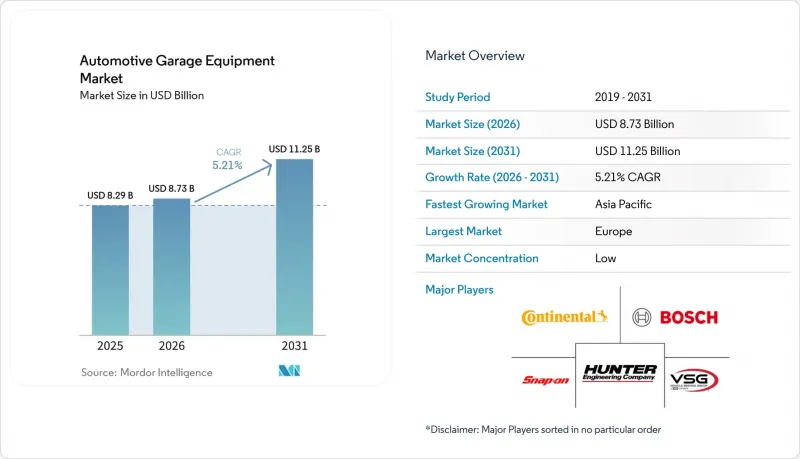
根據 Mordor Intelligence 預測,汽車維修設備市場規模預計將在 2025 年達到 82.9 億美元,2026 年達到 87.3 億美元,到 2031 年達到 112.5 億美元,2026 年至 2031 年的複合年成長率為 5.21%。
本報告按設備類型(例如,升降機)、車輛類型(例如,乘用車)、車庫類型(例如,OEM)、所有權類型(例如,購買)和地區進行分類。預測值以貨幣價值(美元)和數量(單位)表示。
全球汽車維修設備市場趨勢與洞察
嚴格的排放氣體法規
將於2027年生效的歐7排放標準將強制要求維修店進行實際道路排放氣體測試,預計將推動歐盟27個成員國可攜式分析儀和OBD-II掃描儀的新銷售成長。美國環保署(EPA)將於2024年最終確定的Tier 4重型車輛排放標準將強制要求商用車維修車間安裝氮氧化物(NOx)和顆粒物(PM)感測器,預計將增加成本。旨在控制蒸發損失的中國國六(b)排放標準已經導致蒸氣洩漏檢測器訂單增加。此外,計畫在印度實施的Bharat Stage VII排放標準可能會使國內檢測設備市場擴大30%。隨著排放標準的不斷收緊,設備逐漸成為消耗品,由此產生的重複購買(例如重新校準和韌體授權)將帶來收入,從而增強對汽車維修設備的長期需求。
獨立售後服務中心的擴張
2025年,在消費者對價格透明度和便利性的需求驅動下,獨立服務中心在全球服務收入中佔據了顯著佔有率。在大量私募股權資金的支持下,整合型公司成功地與工具供應商達成了車隊定價協議。作為一項策略性舉措,像Midas這樣的特許經營集團利用博世的合約數據大幅降低了初始投資,並將其大部分門市的購買模式轉向了訂閱模式。同時,在印度,包括GoMechanic在內的其他領先公司也大幅擴張了業務,並透過在其網路中統一使用升降機和掃描工具來加強技工培訓。隨著行業的整合,對提供遠端診斷和運轉率分析等配套服務的供應商的需求不斷成長,從而推動了汽車服務設備市場的成長。
先進設備需要高額資本投入
由於高級駕駛輔助系統 (ADAS) 校準工位成本極高,許多新興市場的維修店發現其年度設備預算超支。歐洲一家產業協會最近的一項調查發現,相當一部分受訪者表示價格是採用電動車工具的最大障礙。多品牌維修店經常會發現庫存積壓,因為他們需要購買單獨的掃描器來存取每個原始設備製造商 (OEM) 的獨特代碼。雖然設備即服務 (EaaS) 提供了一種現金流多元化的途徑,但它會消耗總收入的很大一部分,並在需求下降時期產生沉重的固定成本。亞太地區面臨尤為嚴峻的挑戰。隨著汽車數量的激增,維修店的設備投資未能跟上,導致工位利用率低下,顧客等待時間延長。這凸顯了汽車維修設備市場的結構性限制。
細分市場分析
排放氣體分析儀和煙度計是成長最快的產品類別,預計到2031年將以5.23%的年均成長率成長,超過整個汽車維修設備市場的成長速度。儘管如此,2025年舉升系統仍佔銷售額的35.17%。加州和歐盟試點推行的即時合規報告製度,迫使維修店採用支援雲端功能的測試設備,將資料直接上傳至監管機構,從而將週期性義務轉變為持續的服務請求。供應商預計校準氣體和軟體授權(每12個月續訂一次)的輔助銷售額也將隨之成長。舉升系統仍然是維修店必不可少的設備,因為任何維修工作都始於舉升車輛,但隨著安全標準趨於穩定,其成長速度已落後於檢測設備。將舉昇平台與車輪定位攝影機整合在一起的供應商,透過節省工作空間來脫穎而出。
目前,車輪和輪胎維護設備約佔銷售額的五分之一,這得益於美國強制要求每次更換輪胎時都必須進行胎壓監測系統 (TPMS) 檢查。現代汽車配備超過 150 個電子控制單元 (ECU),如果沒有多重通訊協定支持,故障識別將無法進行,因此,汽車維護設備市場中診斷手持終端機的市場佔有率預計將會上升。雖然車身維修設備的成長落後於高級駕駛輔助系統 (ADAS)(後者已降低了碰撞事故的發生頻率),但在公用事業成本飆升的地區,配備節能氣流的噴漆房正逐漸獲得市場認可。諸如液體分配器和壓縮機等小規模的產品也透過捆綁銷售的方式保持著穩定的銷售量,這些捆綁銷售通常與大型升降機和分析設備的合約捆綁在一起。
到2025年,乘用車維修車間將佔行業收入的63.37%,隨著擋風玻璃和保險桿維修後攝影機和雷達重新校準成為常規操作,預計這一比例還將略有成長。原廠維修單要求在維修後校準所有感測器,因此即使是小規模獨立維修店也開始採用專用校準板和雷射工具。因此,乘用車領域在汽車維修設備市場的佔有率正在擴大,年複合成長率達5.31%。豪華車的軟體程式碼已超過1.5億行,因此對韌體刷新站和安全閘道存取套件的需求正在激增。
隨著加州和歐盟零排放法規加速商用車隊的電氣化進程,商用車業者正在投資購買更大的升降機和電池組支架。每班次可處理12輛卡車的自動化車道清晰地表明,在技工短缺日益嚴重的背景下,降低人事費用至關重要。雖然摩托車維修店仍是工具領域中規模最小的細分市場,但售價低於500美元且能夠解碼國內OEM協議的設備蘊藏著銷售量潛力,預計在未來十年內提升摩托車在汽車維修設備市場的佔有率。
區域分析
預計到2025年,歐洲將佔全球銷售額的34.46%。這主要得益於龐大的車輛保有量和年度檢驗制度所推動的設備現代化進程穩步推進。德國的維修店已在新型分析儀和掃描儀方面投入巨資,以確保符合最新的排放氣體標準並為未來的法規做好準備。繼去年英國車輛年檢(MOT)制度對新型煞車測試儀的需求激增之後,英國駕駛員和車輛標準局(DVSA)已認證了更多供應商。同時,法國和義大利的獨立維修店受益於國家補貼計劃,這些計劃有助於補貼電動車工具的購買成本,從而幫助他們應對各種經濟挑戰。然而,西歐維修店的高密度限制了該地區的產能擴張,也限制了汽車維修設備市場的長期成長潛力。
預計到2031年,亞太地區將達到5.33%的最高成長率,主要得益於2025年中國設備的安裝量成長。去年,由於地方政府對老舊車輛進行強制性檢驗,分析和診斷設備的銷售量顯著成長。在印度,隨著多品牌連鎖店開設新店並對升降機、平衡機和掃描儀進行大量投資,非正規部門的汽車維修業務顯著減少。為了應對車主數量的下降,日本和韓國正在增加對電動車服務通道的投資,以保持經銷商的競爭力。在設備嚴重短缺的東南亞地區,印尼和越南等國的汽車保有量總計達數千萬輛,但維修工位數量有限,凸顯了汽車維修設備市場的龐大商機。
受車輛老化和連鎖加盟店整合趨勢的推動,北美地區將在2025年佔據相當大的銷售佔有率。在美國,連鎖店正在實現門市工具的標準化,從而推動了對四輪定位系統和雲端授權診斷設備的批量採購。加拿大各省的車輛年檢法規刺激了對分析設備的需求,不列顛哥倫比亞省的新維修店也紛紛選擇高階抗震升降機。南美、中東和非洲雖然在全球整體銷售額中所佔佔有率較小,但佔有重要的地位。巴西由於每兩年一次的排放氣體檢測,需求穩定;阿根廷近期放寬了掃描儀的關稅,一旦外匯波動趨於穩定,可能會引發採購量激增。海灣國家對老舊車輛的強制性年度檢測推動了煞車和懸吊測試儀進口量的成長,從而支撐了汽車維修設備市場的穩定需求。
其他好處:
- Excel格式的市場預測(ME)表
- 3個月的分析師支持
目錄
第1章:引言
- 研究假設和市場定義
- 調查範圍
第2章:調查方法
第3章執行摘要
第4章 市場狀況
- 市場概覽
- 市場促進因素
- 嚴格的排放氣體法規
- 獨立售後服務中心的擴張
- 乘用車數量增加
- 經合組織國家的車輛報廢情況
- 對專用於電動車的高壓維護工具的需求
- 設備即服務訂閱模式
- 市場限制因素
- 對先進設備的大量投資
- 熟練診斷技術人員短缺
- 仿冒品汽車維修工具氾濫。
- 設備故障導致的停機
- 價值供應鏈分析
- 監理情勢
- 技術展望
- 波特五力模型
第5章 市場規模與成長預測
- 依設備類型
- 升降設備
- 排放氣體檢測設備
- 汽車修理廠設備
- 車輪和輪胎維護設備
- 汽車診斷和測試設備
- 洗滌和清潔設備
- 其他小眾車庫工具
- 按車輛類型
- 搭乘用車
- 商用車輛
- 摩托車
- 車庫類型
- OEM經銷商服務中心
- 獨立經營的修理店
- 連鎖/加盟維修店
- 依所有權類型
- 大量購買
- 租賃/出租
- 訂閱(設備即服務)
- 按地區
- 北美洲
- 美國
- 加拿大
- 其他北美國家
- 南美洲
- 巴西
- 阿根廷
- 其他南美國家
- 歐洲
- 德國
- 英國
- 法國
- 義大利
- 其他歐洲國家
- 亞太地區
- 中國
- 日本
- 印度
- 韓國
- 其他亞太國家
- 中東和非洲
- 阿拉伯聯合大公國
- 沙烏地阿拉伯
- 埃及
- 南非
- 其他中東和非洲國家
- 北美洲
第6章 競爭情勢
- 市場集中度
- 策略趨勢
- 市佔率分析
- 公司簡介
- Robert Bosch GmbH
- Continental AG
- Snap-on Incorporated
- Hunter Engineering Company
- Vehicle Service Group(Dover)
- MAHA GmbH & Co. KG
- Istobal SA
- Gray Manufacturing Company
- Launch Tech Co. Ltd
- Autel Intelligent Technology Corp.
- BendPak Inc.
- ATS ELGI
- Arex Test Systems BV
- Hofmann Megaplan
第7章 市場機會與未來展望
According to Mordor Intelligence, the automotive garage equipment market size is projected to be USD 8.29 billion in 2025, USD 8.73 billion in 2026, and reach USD 11.25 billion by 2031, growing at a CAGR of 5.21% from 2026 to 2031.
This report is Segmented by Equipment Type (Lifting and More), Vehicle Type (Passenger Cars and More), Garage Type (OEM and More), Ownership Model (Purchase and More), and Geography. Forecasts in Value (USD) and Volume (Units).
Global Automotive Garage Equipment Market Trends and Insights
Stringent Emission Regulations
Euro 7 rules coming in 2027 obligate workshops to measure real-world emissions, which is expected to drive new sales of portable analyzers and OBD-II scanners across 27 EU states . The U.S. EPA's Tier 4 heavy-duty mandate, finalized in 2024, requires commercial-vehicle bays to install NOx and PM sensors at a higher cost . China's National VI(b) curb on evaporative losses has already lifted orders for vapor-leak detectors, while India's forthcoming Bharat Stage VII scheme could grow the national testing park by 30%. Each tightening cycle turns equipment into consumables, creating repeat-purchase revenue tied to recalibration and firmware rights, strengthening long-term demand in the automotive garage equipment market.
Expansion of Independent Aftermarket Service Centres
In 2025, independents captured a significant share of the global service income, driven by a consumer shift towards price clarity and proximity. Rollups, supported by substantial private-equity inflows, successfully negotiated fleet-pricing deals with tool vendors. In a strategic move, franchise groups like Midas transitioned a considerable portion of their outlets to a subscription-based procurement model, leveraging Bosch contract data to significantly reduce upfront capital needs. Meanwhile, in India, GoMechanic and other players notably expanded their operations, standardizing lifts and scan tools across networks to enhance technician training. As consolidation progresses, demand increasingly favors suppliers offering bundled services like remote diagnostics and utilization analytics, reinforcing growth in the automotive garage equipment market.
High Capex of Advanced Equipment
Many emerging-market garages find themselves overshooting their annual equipment budgets, as ADAS calibration bays are significantly expensive. A recent survey conducted by a European federation found that a substantial proportion of respondents identified pricing as the primary obstacle to adopting EV tools. Multi-brand garages often inflate their inventory by purchasing separate scanners to access proprietary OEM codes. While Equipment-as-a-Service offers a way to spread cash flows, it can consume a notable share of gross revenue, introducing fixed charges that become burdensome during periods of reduced demand. The Asia-Pacific region grapples with a pronounced challenge: as vehicle numbers surge, the pace of workshop capital formation lags, resulting in stretched bay utilization and longer customer wait times, highlighting structural constraints in the automotive garage equipment market.
Other drivers and restraints analyzed in the detailed report include:
- Rising Passenger-Car Parc
- EV-Specific High-Voltage Workshop Tools Demand
- Shortage of Trained Diagnostic Technicians
For complete list of drivers and restraints, kindly check the Table Of Contents.
Segment Analysis
Emission analyzers and smoke meters are the fastest-growing line, rising at a 5.23% clip through 2031, outpacing the broader automotive garage equipment market, even though lifting systems accounted for a 35.17% revenue share in 2025. Real-time compliance reporting pilots in California and the EU force garages to install cloud-enabled testers that upload data directly to regulators, turning a periodic obligation into a continuous service call. Vendors see pull-through sales of calibration gases and software licenses that are renewed every 12 months. Lifting gear remains the essential workshop backbone because each repair still starts with vehicle elevation, yet its growth now trails test equipment as safety standards plateau. Suppliers that integrate lift platforms with wheel-alignment cameras are eking out differentiation by saving bay floor space.
Wheel and tire machines account for nearly a fifth of current turnover and benefit from mandatory TPMS checks at every tire change in the United States. The automotive garage equipment market share for diagnostic handhelds is set to climb as ECUs in modern cars top 150 units, making fault isolation impossible without multi-protocol coverage. Body-shop gear lags behind ADAS, which has reduced collision frequency; however, paint booths with energy-efficient airflow are gaining ground in regions where utility costs soar. Smaller categories such as fluid dispensers and compressors still move steady volumes through bundle sales that ride on larger lift or analyzer contracts.
Passenger-car bays absorbed 63.37% of industry revenue in 2025, and that slice inches higher as camera and radar recalibrations become routine after windshield or bumper service. OEM work instructions now mandate post-repair alignment on every sensor, pushing specialized target boards and laser tools into even small independents. Consequently, the passenger-car slice within the automotive garage equipment market size grows alongside a 5.31% segment CAGR. Software content already crosses 150 million lines in luxury cars, swelling demand for firmware-flash stations and secure gateway access kits.
Commercial-vehicle operators invest in heavier lifts and battery-pack cradles as California and EU zero-emission mandates accelerate fleet electrification. Automated lanes that process a dozen trucks each shift illustrate the labor-saving theme as technician scarcity bites. Two-wheeler workshops remain the least tool segment; sub-USD 500 devices that decode domestic OEM protocols, presenting a volume opportunity that could lift two-wheeler contributions to the automotive garage equipment market share over the next decade.
Geography Analysis
Europe accounted for 34.46% of 2025 revenue, as dense vehicle fleets and annual testing schemes drive steady equipment turnover. German workshops made substantial investments in new analyzers and scanners, ensuring compliance with the latest emission standards and preparing for upcoming regulations. The UK's MOT regime's demand for new brake testers last year led the Driver and Vehicle Standards Agency to accredit more suppliers. Meanwhile, independent workshops in France and Italy benefited from state subsidies, which reimbursed them for EV-tool purchases, helping them navigate broader economic challenges. However, with high bay density in Western Europe, the region faces limitations in expanding capacity, capping the long-term growth potential of its automotive garage equipment market.
Asia-Pacific is the fastest climber at 5.33% through 2031, anchored by China's equipment take in 2025. Provincial inspection mandates for older vehicles drove significant sales of analyzers and diagnostic units last year. In India, multi-brand chains inaugurated new locations, making notable investments in lifts, balancers, and scanners, marking a significant shift away from the informal sector. To counter dwindling owner demographics, Japan and South Korea are channeling investments into EV service lanes, ensuring their dealerships remain relevant. Southeast Asia, notably under-equipped, sees countries like Indonesia and Vietnam with a limited number of organized bays, despite a combined vehicle parc exceeding tens of millions, highlighting a significant opportunity for the automotive garage equipment market.
North America contributed a substantial portion to 2025 sales, driven by an aging vehicle fleet and a trend of consolidation among franchise chains. In the U.S., chains are standardizing tool sets across their stores, leading to bulk purchases of alignment systems and cloud-licensed diagnostics. Provincial inspection mandates in Canada bolster the demand for analyzers, while new workshops in British Columbia are opting for premium earthquake-rated lifts. Together, South America and the Middle East & Africa account for a smaller but notable share of the global revenue. Brazil's biennial emission checks ensure consistent demand, while Argentina's recent tariff relief on scanners might trigger a surge in purchases once currency fluctuations stabilize. In the Gulf states, legislation mandates annual inspections for older vehicles, driving brisk imports of brake and suspension testers, reinforcing steady demand in the automotive garage equipment market.
- Robert Bosch GmbH
- Continental AG
- Snap-on Incorporated
- Hunter Engineering Company
- Vehicle Service Group (Dover)
- MAHA GmbH & Co. KG
- Istobal S.A.
- Gray Manufacturing Company
- Launch Tech Co. Ltd
- Autel Intelligent Technology Corp.
- BendPak Inc.
- ATS ELGI
- Arex Test Systems B.V.
- Hofmann Megaplan
Additional Benefits:
- The market estimate (ME) sheet in Excel format
- 3 months of analyst support
TABLE OF CONTENTS
1 Introduction
- 1.1 Study Assumptions & Market Definition
- 1.2 Scope of the Study
2 Research Methodology
3 Executive Summary
4 Market Landscape
- 4.1 Market Overview
- 4.2 Market Drivers
- 4.2.1 Stringent Emission Regulations
- 4.2.2 Expansion of Independent Aftermarket Service Centres
- 4.2.3 Rising Passenger-Car Parc
- 4.2.4 Ageing Vehicle Fleet in OECD Economies
- 4.2.5 EV-Specific High-Voltage Workshop Tools Demand
- 4.2.6 Equipment-As-A-Service Subscription Models
- 4.3 Market Restraints
- 4.3.1 High Capex of Advanced Equipment
- 4.3.2 Shortage of Trained Diagnostic Technicians
- 4.3.3 Proliferation of Counterfeit Garage Tools
- 4.3.4 Downtime Due to Equipment Failure
- 4.4 Value / Supply-Chain Analysis
- 4.5 Regulatory Landscape
- 4.6 Technological Outlook
- 4.7 Porter's Five Forces
- 4.7.1 Threat of New Entrants
- 4.7.2 Bargaining Power of Suppliers
- 4.7.3 Bargaining Power of Buyers
- 4.7.4 Threat of Substitute Products
- 4.7.5 Competitive Rivalry
5 Market Size & Growth Forecasts (Value (USD) and Volume (Units))
- 5.1 By Equipment Type
- 5.1.1 Lifting Equipment
- 5.1.2 Emission Testing Equipment
- 5.1.3 Body-Shop Equipment
- 5.1.4 Wheel & Tire Service Equipment
- 5.1.5 Vehicle Diagnostic & Testing Equipment
- 5.1.6 Washing & Cleaning Equipment
- 5.1.7 Other Niche Garage Tools
- 5.2 By Vehicle Type
- 5.2.1 Passenger Cars
- 5.2.2 Commercial Vehicles
- 5.2.3 Two-Wheelers
- 5.3 By Garage Type
- 5.3.1 OEM Dealership Garages
- 5.3.2 Independent Garages
- 5.3.3 Franchise / Chain Workshops
- 5.4 By Ownership Model
- 5.4.1 Outright Purchase
- 5.4.2 Lease / Rental
- 5.4.3 Subscription (Equipment-as-a-Service)
- 5.5 By Geography
- 5.5.1 North America
- 5.5.1.1 United States
- 5.5.1.2 Canada
- 5.5.1.3 Rest of North America
- 5.5.2 South America
- 5.5.2.1 Brazil
- 5.5.2.2 Argentina
- 5.5.2.3 Rest of South America
- 5.5.3 Europe
- 5.5.3.1 Germany
- 5.5.3.2 United Kingdom
- 5.5.3.3 France
- 5.5.3.4 Italy
- 5.5.3.5 Rest of Europe
- 5.5.4 Asia-Pacific
- 5.5.4.1 China
- 5.5.4.2 Japan
- 5.5.4.3 India
- 5.5.4.4 South Korea
- 5.5.4.5 Rest of Asia-Pacific
- 5.5.5 Middle-East and Africa
- 5.5.5.1 United Arab Emirates
- 5.5.5.2 Saudi Arabia
- 5.5.5.3 Egypt
- 5.5.5.4 South Africa
- 5.5.5.5 Rest of Middle-East and Africa
- 5.5.1 North America
6 Competitive Landscape
- 6.1 Market Concentration
- 6.2 Strategic Moves
- 6.3 Market Share Analysis
- 6.4 Company Profiles (includes Global Level Overview, Market Level Overview, Core Segments, Financials as Available, Strategic Information, Market Rank/Share for Key Companies, Products and Services, SWOT Analysis, and Recent Developments)
- 6.4.1 Robert Bosch GmbH
- 6.4.2 Continental AG
- 6.4.3 Snap-on Incorporated
- 6.4.4 Hunter Engineering Company
- 6.4.5 Vehicle Service Group (Dover)
- 6.4.6 MAHA GmbH & Co. KG
- 6.4.7 Istobal S.A.
- 6.4.8 Gray Manufacturing Company
- 6.4.9 Launch Tech Co. Ltd
- 6.4.10 Autel Intelligent Technology Corp.
- 6.4.11 BendPak Inc.
- 6.4.12 ATS ELGI
- 6.4.13 Arex Test Systems B.V.
- 6.4.14 Hofmann Megaplan
7 Market Opportunities & Future Outlook
- 7.1 White-space & Unmet-Need Assessment

 汽車維修店設備市場:依設備類型、行動類型、技術、應用、最終用戶和銷售管道分類-2026-2032年全球市場預測
 汽車維修設備市場分析及預測(至2035年):類型、產品、服務、技術、組件、應用、最終用戶、安裝類型、設備
 2026年全球車庫設備市場報告
 2026-2034年全球汽車維修廠設備市場規模、佔有率、趨勢與成長分析報告2026年全球汽車維修設備市場報告
 汽車車身修理設備市場規模、佔有率和成長分析(按車身修理類型、設備類型、車輛類型、分銷管道、應用和地區分類)-2026-2033年產業預測
 汽車維修設備市場 - 全球產業規模、佔有率、趨勢、機會和預測,按車輛類型、設備類型、車庫類型、地區和競爭格局分類,2020-2030 年預測
 汽車車庫設備市場規模、佔有率、趨勢分析報告:按設備、車庫類型、分銷管道、應用、車輛類型、地區和細分市場分類,預測 2025 年至 2030 年