


 |
市場調查報告書
商品編碼
2066647
碳酸鋰:市場佔有率分析、產業趨勢與統計、成長預測(2026-2031)Lithium Carbonate - Market Share Analysis, Industry Trends & Statistics, Growth Forecasts (2026 - 2031) |
||||||

※ 本網頁內容可能與最新版本有所差異。詳細情況請與我們聯繫。
根據 Mordor Intelligence 預測,碳酸鋰市場預計將從 2025 年的 115 萬 LCE 噸成長到 2026 年的 141 萬 LCE 噸,到 2031 年達到 393 萬 LCE 噸,2026 年至 2031 年的複合年成長率為 22.74%。
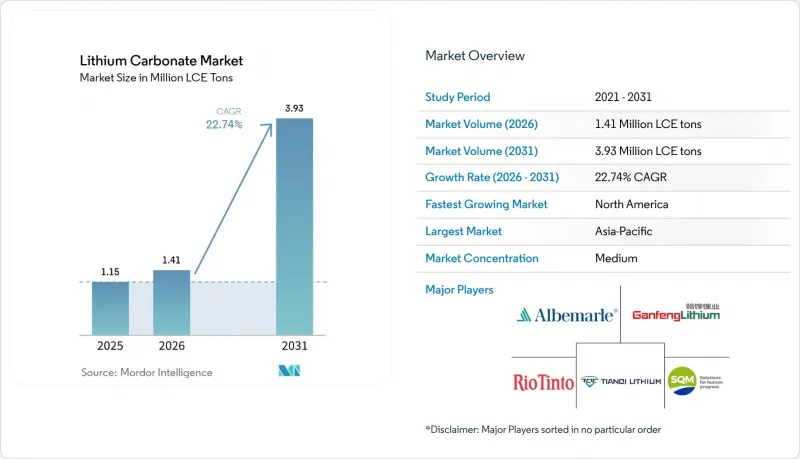
本報告按等級(電池級、技術級、工業級)、原料(氯化鈉、鋰輝石等)、應用(鋰離子電池、玻璃和陶瓷等)、終端用戶行業(汽車、家用電子電器等)以及地區(亞太、北美、歐洲、南美、中東和非洲)進行細分。市場預測以噸(LCE噸)為單位。
全球碳酸鋰市場趨勢及洞察
加速推廣電動車並擴大電池產能
預計到2025年,全球搭乘用電動車交車量將超過1,500萬輛,而2026年公佈的生產計畫預計將進一步提升電池產能600GWh。 2025年1月至11月,磷酸鋰鐵鋰(LFP)電池在中國電動車銷量中佔比超過80%,這種化學成分上的偏好正在推動碳酸鋰市場需求的成長。福特位於密西根州的「藍橢圓電池園」(Blue Oval Battery Park Michigan)將於2026年開始量產,而通用汽車和三星SDI已在印第安納州啟動一座30GWh磷酸鐵鋰工廠的建設,並共同簽署了一項多年碳酸鋰採購協議。對於汽車正極材料製造商而言,長期採購合約目前比現貨交易更為重要,這有助於價格形成,但也限制了流動性。此外,汽車製造商還在上游資產方面進行聯合投資,例如福特與Lithium Americas的「Soccer Pass」礦場簽訂的供應協議,從而降低了商品價格波動的風險。
快速引入能源儲存系統以穩定電網
預計到2025年,美國公用事業規模的電池部署量將達到57.6吉瓦時(GWh),是2022年基準的四倍。由於磷酸鋰鐵(LFP)模組相比鎳基複合材料(NMC)具有更優的經濟性,其循環壽命超過6000次,價格為每千瓦時80-100美元,因此電錶前端(FOM)供應商更傾向於選擇LFP模組。中國的「十五」規劃要求各省安裝的儲能設施容量至少相當於可再生能源尖峰發電量的10%,預計到2026年,這將使固定儲能需求達到150-180吉瓦時。分析師預測,到2035年,能源儲存系統將佔全球鋰消費量的42%,較2020年的8%大幅成長,這將永久削弱汽車產業長期以來的主導地位。多年期可再生能源購電協議現在要求可靠的儲存能力,開發商擴大在其工程、採購和施工 (EPC) 合約中加入碳酸鹽供應條款,從而有效地確保未來幾年的原料供應。
價格波動和供應鏈中斷
2025年,中國碳酸鹽現貨價格在每噸6萬至12萬元人民幣之間波動,年波動幅度高達100%,對提煉的利潤率帶來壓力。 2026年初,來自澳洲的新精礦湧入市場,導致期貨價格從每噸18萬元人民幣調整至14.4萬元人民幣,但隨後隨著兩座中型礦場停產,價格再次反彈。這種劇烈的價格波動,加上合約結構流動性仍然較低,抑制了避險,使中小型生產商的現金成本低於損益平衡點,並進一步加速了下一輪價格上漲。此外,中國決策者在2026年取消了新能源車購置稅的免稅政策,改為徵收5%的課稅,導致2025年底需求提前激增,之後需求觸底反彈。
細分市場分析
到2025年,電池級碳酸鋰將佔82.62%的市場佔有率,預計到2031年將以23.95%的複合年成長率成長。 99.5%的純度標準最大限度地減少了促進枝晶生長的金屬雜質,從而降低了電池故障率,因此其價格比99.0%純度的工業級碳酸鋰高出15-20%。目前,美國、韓國和德國的幾家超級工廠營運商已將純度保證納入其「照付不議」條款,從而有效地保障了高規格供應商的供應。
用於玻璃、陶瓷和冶金行業的工業級碳酸鋰產量正經歷中等個位數的年成長率。此細分市場波動性較小,但成長潛力也有限,因為建築需求與住宅和基礎設施週期的相關性高於與電動車銷售的相關性。藥用級碳酸鋰僅佔碳酸鋰市場不到1%的佔有率,但由於符合美國藥典(USP)標準,其價格維持在每噸5萬美元以上。生產商通常會設立專用生產線以防止交叉污染,雖然增加了固定成本,但卻確保了該細分市場穩定的利潤率。
到2025年,鹽水礦床將佔總產量的65.22%,但來自西澳大利亞和北美新興地區的鋰輝石(硬岩)是成長最快的供應來源,預計到2031年將實現23.16%的複合年成長率。雖然鹽水蒸發法的營運成本為每噸液態碳當量(LCE)3300至4900美元,但其12至18個月的池塘週期不足以快速應對需求的突然變化,從而限制了供應彈性。硬岩精礦通常可實現70%至80%的高回收率,一旦新的壓裂生產線投入運作,產量可在6至12個月內擴大,但其3600至8000美元的成本範圍使礦商容易受到價格下跌的影響。
在直接鋰電萃取(DLE)技術取得重大進展,將萃取率提升至90%以上之前,黏土和鋰雲母礦床的開採一直獲利能力。世紀鋰業位於內華達州的先導工廠目前每噸鋰的營運成本約為4000美元,並且顯著降低了用水量。目前,再生碳酸鋰的市佔率估計為3-4%,但隨著歐盟禁止向非經合組織國家出口黑塊碳酸鋰的禁令於2026年12月生效,到2031年,其市場佔有率可能達到10-12%。
區域分析
到2025年,亞太地區將佔全球產量的79.13%,這主要得益於中國完善的價值鏈,從江西和四川省的提煉到廣東和浙江省的電池組裝。儘管中國80%的鋰輝石精礦依賴從澳洲進口,但遍布亞太地區的加工廠網路確保了大部分增值環節留在國內。預計到2025年,現貨價格將下跌,這將對利潤率造成壓力,並導致一些提煉運轉率%。日本和韓國容易受到中國出口政策的影響,因為它們依賴進口電池碳酸鹽來生產Panasonic、LG能源解決方案和三星SDI等產品。
北美地區將以28.13%的複合年成長率推動鋰產業成長,預計到2031年將持續成長。根據《通貨膨脹控制法案》(IRA),每千瓦時電池可享有35美元的稅額扣抵,這使得美國本土生產的碳酸鋰對於密西根州、俄亥俄州、田納西州和安大略省的超級工廠至關重要。聯邦政府的融資支持了塔克山口、金斯山和皮埃蒙特鋰礦項目,這三家公司計劃在2028年使這些項目的年總合超過10萬噸。儘管授權延遲仍然是一個重大挑戰,但與福特和通用汽車的承購協議正在降低企劃案融資風險。
在歐洲,該地區正受惠於耗資15億歐元的電池增效設施,該設施為精煉和回收基礎設施提供支援。BASF位於施瓦茨海德的工廠和ACC位於法國的工廠正在滿足該地區的需求。將於2026年12月生效的黑鋰出口禁令將迫使回收商將其產能本地化,從而使碳酸鋰重新流入超級工廠的供應鏈。
預計到2025年,南美洲(主要是智利和阿根廷)的滷水產量將佔全球總產量的約40%。智利40萬噸的配額限制了其進一步擴張,但SQM公司年產21萬噸的「阿塔卡馬鹽田」(Saral de Atacama)和阿爾貝瑪公司年產20萬噸的「拉內格拉三號」(La Negra III)均在配額範圍內運作。阿根廷的三座鹽礦——奧拉羅斯·考查里(Olaros Cauchari)、薩爾德維達(Sal de Vida)和帕斯托斯·格蘭德斯(Pastos Grandes)——總產量將達到8.75萬噸,但基礎設施不足以及州政府核准流程的延誤擴張可能會減緩其產量的速度。
其他好處:
- Excel格式的市場預測(ME)表
- 3個月的分析師支持
目錄
第1章:引言
- 研究假設和市場定義
- 調查範圍
第2章:調查方法
第3章執行摘要
第4章 市場狀況
- 市場概覽
- 市場促進因素
- 加速推廣電動車並擴大電池產能
- 快速部署能源儲存系統系統以穩定電網
- 政府獎勵和國內採購要求促進本地化
- 電池化學成分從NMC到LFP的轉變將有利於碳酸鋰的發展。
- 鋰直接萃取和回收的技術創新
- 市場限制因素
- 價格波動和供應鏈中斷
- 處理能力瓶頸與地理集中度
- 鋰提取中的環境和水資源限制
- 價值鏈分析
- 波特五力模型
第5章 市場規模與成長預測
- 按年級
- 電池級
- 技術級
- 工業級
- 來源
- 鹽水
- 鋰輝石(硬岩)
- 鋰雲母/黏土
- 回收碳酸鋰
- 透過使用
- 鋰離子電池
- 玻璃和陶瓷
- 製藥和牙科
- 鋁生產
- 水泥業
- 其他用途
- 按最終用戶行業分類
- 車
- 家用電子產品
- 能源儲存系統
- 工業/冶金
- 衛生保健
- 建造
- 按地區
- 亞太地區
- 中國
- 日本
- 印度
- 韓國
- 其他亞太國家
- 北美洲
- 美國
- 加拿大
- 墨西哥
- 歐洲
- 德國
- 英國
- 法國
- 義大利
- 西班牙
- 俄羅斯
- 其他歐洲國家
- 南美洲
- 巴西
- 阿根廷
- 其他南美國家
- 中東和非洲
- 沙烏地阿拉伯
- 阿拉伯聯合大公國
- 南非
- 其他中東和非洲國家
- 亞太地區
第6章 競爭情勢
- 市場集中度
- 策略趨勢
- 市佔率和排名分析
- 公司簡介
- Albemarle Corporation
- Ganfeng Lithium Group Co., Ltd
- Jiangxi Jiuling Lithium Co., Ltd.
- LevertonHELM Limited.
- Lithium Americas Corp.
- Lithium Argentina AG
- Nemaska Lithium
- Pilbara Minerals Limited
- Rio Tinto
- Shandong Ruifu Lithium Co., Ltd.
- Shengxin Lithium Energy Group Co., Ltd.
- SQM
- Tianqi Lithium Corporation
- Xinjiang Zhicun Lithium Industry Co.
第7章 市場機會與未來展望
According to Mordor Intelligence, the lithium carbonate market size is expected to increase from 1.15 Million LCE tons in 2025 to 1.41 Million LCE tons in 2026 and reach 3.93 Million LCE tons by 2031, growing at a CAGR of 22.74% over 2026-2031.
This report is Segmented by Grade (Battery Grade, Technical Grade, and Industrial Grade), Source (Brine, Spodumene, and More), Application (Li-Ion Battery, Glass and Ceramics, and More), End-User Industry (Automotive, Consumer Electronics, and More), and Geography (Asia-Pacific, North America, Europe, South America, and Middle-East and Africa). The Market Forecasts are Provided in Volume (LCE Tons).
Global Lithium Carbonate Market Trends and Insights
Accelerating EV adoption and Battery Manufacturing Capacity Expansion
Global passenger-EV deliveries surpassed 15 million units in 2025, and production plans announced in 2026 will lift cell capacity additions by another 600 GWh. China's LFP penetration exceeded 80% of domestic EV sales between January and November 2025, a chemistry tilt that swings incremental demand toward the lithium carbonate market. Ford's BlueOval Battery Park Michigan entered mass production in Michigan during 2026, while General Motors and Samsung SDI broke ground on a 30 GWh LFP plant in Indiana, jointly locking up multi-year carbonate offtake. Long-term procurement contracts now outnumber spot transactions for automotive cathode manufacturers, helping price discovery but limiting liquidity. Automakers are also co-investing in upstream assets, as evidenced by Ford's offtake tie-up with Lithium Americas' Thacker Pass, reducing exposure to commodity swings.
Rapid Deployment of Energy Storage Systems for Grid Stabilization
Utility-scale battery additions in the United States rose to 57.6 GWh in 2025, four times the 2022 baseline. Front-of-meter providers favor lithium iron phosphate (LFP) modules because 6,000-plus cycle life and a USD 80-100 per kWh price point outperform NMC economics. China's 15th Five-Year Plan calls for every province to install storage equal to at least 10% of peak renewable output, elevating stationary demand to a projected 150-180 GWh in 2026. Analysts expect energy-storage systems to consume 42% of global lithium by 2035, up from 8% in 2020, permanently diluting the automotive industry's historical dominance. Multi-year power-purchase agreements for renewables now require firm storage capacity, and developers are increasingly embedding carbonate supply clauses in engineering-procurement-construction contracts, effectively reserving feedstock years ahead.
Price Volatility and Supply Chain Disruptions
Chinese spot carbonate traded between CNY 60,000 and CNY 120,000 per ton in 2025, a 100% intrayear range that squeezed converter margins. Futures corrected from CNY 180,000 per ton to CNY 144,000 per ton in early 2026 as new Australian concentrate cargoes hit the market, only to rebound when two mid-tier mines idled. Such whiplash discourages hedging because contract structures remain illiquid, pushing smaller producers below cash-cost breakeven and amplifying the next upward spike. Policymakers in China also replaced the new-energy-vehicle purchase-tax exemption with a 5% levy in 2026, causing a front-loaded demand rush in late 2025 and a subsequent trough.
Other drivers and restraints analyzed in the detailed report include:
- Government Incentives and Domestic Content Requirements Driving Localization
- Technology Innovations in Direct Lithium Extraction and Recycling
- Processing Capacity Bottlenecks and Geographic Concentration
For complete list of drivers and restraints, kindly check the Table Of Contents.
Segment Analysis
Battery-grade controlled 82.62% of the lithium carbonate market share in 2025 and is expected to advance at a 23.95% CAGR through 2031. Purity thresholds of 99.5% minimize metal contaminants that catalyze dendrite growth, lowering cell failure rates and justifying a 15-20% price premium over 99.0% industrial grade. Multi-gigafactory operators in the United States, South Korea, and Germany now embed purity guarantees into take-or-pay clauses, effectively ring-fencing volume for high-spec suppliers.
Industrial-grade output, applied in glass, ceramics, and metallurgy, trails at mid-single-digit annual growth. Construction demand correlates with housing and infrastructure cycles rather than EV sales, so the segment experiences less volatility but lower upside. Pharmaceutical-grade carbonate represents under 1% of the lithium carbonate market size yet commands prices above USD 50,000 per ton because of U.S. Pharmacopeia compliance. Producers often maintain dedicated production lines to avoid cross-contamination, creating high fixed costs but steady niche margins.
Brine fields supplied 65.22% of output in 2025, but spodumene (hard-rock) from Western Australia and emerging North American hubs is the fastest-growing source, registering a 23.16% CAGR to 2031. Brine evaporation enjoys operating costs of USD 3,300-4,900 per ton LCE; however, 12-to-18-month pond cycles cannot respond quickly to demand surprises, limiting supply elasticity. Hard-rock concentrate delivers higher recovery rates, typically 70-80%, and can ramp within 6-12 months once a new crusher line is in place, though its USD 3,600-8,000 cost range makes miners sensitive to price dips.
Clay and lepidolite deposits stayed marginal until DLE breakthroughs improved extraction yields beyond 90%. Century Lithium's Nevada pilot now logs operating costs near USD 4,000 per ton and cuts water use dramatically. Recycled carbonate contributes an estimated 3-4% today, but could reach 10-12% of the lithium carbonate market share by 2031 because the European Union's export ban on black mass to non-OECD countries takes effect in December 2026.
Geography Analysis
Asia-Pacific retained 79.13% of global volume in 2025, anchored by China's integrated value chain from refining in Jiangxi and Sichuan to cell assembly in Guangdong and Zhejiang. Although China imports 80% of its spodumene concentrate from Australia, the region's extensive converter park keeps most value addition in-country. Margin pressure emerged in 2025 when spot prices cooled, dropping utilization below 70% in several converters. Japan and South Korea rely on imports of battery-grade carbonate for Panasonic, LG Energy Solution, and Samsung SDI, making them sensitive to Chinese export policy.
North America leads growth with a 28.13% CAGR to 2031. The IRA's USD 35 per kWh cell credit makes domestic carbonate an economic imperative for gigafactories in Michigan, Ohio, Tennessee, and Ontario. Federal loans unlocked Thacker Pass, Kings Mountain, and Piedmont Lithium, collectively targeting over 100,000 tons per year by 2028. Permitting delays remain material, but offtake contracts with Ford and GM de-risk project finance.
Europe benefits from the EUR 1.5 billion Battery Booster Facility supporting refinery and recycling infrastructure. BASF's Schwarzheide plant and ACC's unit in France underpin regional demand. The December 2026 export ban on black mass will compel recyclers to localize capacity, which will back-feed carbonate into gigafactory supply chains.
South America, primarily Chile and Argentina, controlled roughly 40% of brine-based output in 2025. Chile's 400,000 ton quota caps further expansion, while SQM's 210,000 ton Salar de Atacama and Albemarle's 200,000 ton La Negra III operate within that ceiling. Argentina's Olaroz-Cauchari, Sal de Vida, and Pastos Grandes together add 87,500 tons, yet infrastructure gaps and provincial permitting could slow ramp-ups.
- Albemarle Corporation
- Ganfeng Lithium Group Co., Ltd
- Jiangxi Jiuling Lithium Co., Ltd.
- LevertonHELM Limited.
- Lithium Americas Corp.
- Lithium Argentina AG
- Nemaska Lithium
- Pilbara Minerals Limited
- Rio Tinto
- Shandong Ruifu Lithium Co., Ltd.
- Shengxin Lithium Energy Group Co., Ltd.
- SQM
- Tianqi Lithium Corporation
- Xinjiang Zhicun Lithium Industry Co.
Additional Benefits:
- The market estimate (ME) sheet in Excel format
- 3 months of analyst support
TABLE OF CONTENTS
1 Introduction
- 1.1 Study Assumptions and Market Definition
- 1.2 Scope of the Study
2 Research Methodology
3 Executive Summary
4 Market Landscape
- 4.1 Market Overview
- 4.2 Market Drivers
- 4.2.1 Accelerating EV adoption and battery manufacturing capacity expansion
- 4.2.2 Rapid deployment of energy storage systems for grid stabilization
- 4.2.3 Government incentives and domestic content requirements driving localization
- 4.2.4 Battery chemistry transition from NMC to LFP favoring lithium carbonate
- 4.2.5 Technology innovations in direct lithium extraction and recycling
- 4.3 Market Restraints
- 4.3.1 Price volatility and supply chain disruptions
- 4.3.2 Processing capacity bottlenecks and geographic concentration
- 4.3.3 Environmental and water resource constraints in lithium extraction
- 4.4 Value Chain Analysis
- 4.5 Porter's Five Forces
- 4.5.1 Bargaining Power of Suppliers
- 4.5.2 Bargaining Power of Buyers
- 4.5.3 Threat of New Entrants
- 4.5.4 Threat of Substitutes
- 4.5.5 Intensity of Competitive Rivalry
5 Market Size and Growth Forecasts (Volume)
- 5.1 By Grade
- 5.1.1 Battery Grade
- 5.1.2 Technical Grade
- 5.1.3 Industrial Grade
- 5.2 By Source
- 5.2.1 Brine
- 5.2.2 Spodumene (Hard-rock)
- 5.2.3 Lepidolite/Clay
- 5.2.4 Recycled Lithium Carbonate
- 5.3 By Application
- 5.3.1 Li-ion Battery
- 5.3.2 Glass and Ceramics
- 5.3.3 Pharmaceuticals and Dental
- 5.3.4 Aluminum Production
- 5.3.5 Cement Industry
- 5.3.6 Other Applications
- 5.4 By End-user Industry
- 5.4.1 Automotive
- 5.4.2 Consumer Electronics
- 5.4.3 Energy Storage Systems
- 5.4.4 Industrial and Metallurgy
- 5.4.5 Healthcare
- 5.4.6 Construction
- 5.5 By Geography
- 5.5.1 Asia-Pacific
- 5.5.1.1 China
- 5.5.1.2 Japan
- 5.5.1.3 India
- 5.5.1.4 South Korea
- 5.5.1.5 Rest of Asia-Pacific
- 5.5.2 North America
- 5.5.2.1 United States
- 5.5.2.2 Canada
- 5.5.2.3 Mexico
- 5.5.3 Europe
- 5.5.3.1 Germany
- 5.5.3.2 United Kingdom
- 5.5.3.3 France
- 5.5.3.4 Italy
- 5.5.3.5 Spain
- 5.5.3.6 Russia
- 5.5.3.7 Rest of Europe
- 5.5.4 South America
- 5.5.4.1 Brazil
- 5.5.4.2 Argentina
- 5.5.4.3 Rest of South America
- 5.5.5 Middle-East and Africa
- 5.5.5.1 Saudi Arabia
- 5.5.5.2 United Arab Emirates
- 5.5.5.3 South Africa
- 5.5.5.4 Rest of Middle-East and Africa
- 5.5.1 Asia-Pacific
6 Competitive Landscape
- 6.1 Market Concentration
- 6.2 Strategic Moves
- 6.3 Market Share (%)/Ranking Analysis
- 6.4 Company Profiles (includes Global level Overview, Market level overview, Core Segments, Financials as available, Strategic Information, Products and Services, and Recent Developments)
- 6.4.1 Albemarle Corporation
- 6.4.2 Ganfeng Lithium Group Co., Ltd
- 6.4.3 Jiangxi Jiuling Lithium Co., Ltd.
- 6.4.4 LevertonHELM Limited.
- 6.4.5 Lithium Americas Corp.
- 6.4.6 Lithium Argentina AG
- 6.4.7 Nemaska Lithium
- 6.4.8 Pilbara Minerals Limited
- 6.4.9 Rio Tinto
- 6.4.10 Shandong Ruifu Lithium Co., Ltd.
- 6.4.11 Shengxin Lithium Energy Group Co., Ltd.
- 6.4.12 SQM
- 6.4.13 Tianqi Lithium Corporation
- 6.4.14 Xinjiang Zhicun Lithium Industry Co.
7 Market Opportunities and Future Outlook
- 7.1 White-space and Unmet-need Assessment

 碳酸鋰市場-2026-2032年全球市場預測
 醫藥級碳酸鋰市場分析及預測(至2035年):類型、產品類型、服務、應用、劑型、最終用戶、技術、製程、功能、階段
 醫藥級碳酸鋰市場-全球產業規模、佔有率、趨勢、機會、預測:依純度、應用、地區和競爭格局分類,2021-2031年
 碳酸鋰:全球市場佔有率和排名、總銷售額和需求預測(2025-2031 年)
 2025-2029 年全球碳酸鋰市場
 碳酸鋰市場規模、佔有率、趨勢分析報告:按電池、等級、應用、地區、細分市場預測,2025-2030 年
 醫藥級碳酸銫市場報告:2030 年趨勢、預測與競爭分析