


 |
市場調查報告書
商品編碼
2066638
繼電器:市場佔有率分析、行業趨勢和統計數據、成長預測(2026-2031 年)Relay - Market Share Analysis, Industry Trends & Statistics, Growth Forecasts (2026 - 2031) |
||||||

※ 本網頁內容可能與最新版本有所差異。詳細情況請與我們聯繫。
根據 Mordor Intelligence 估計,到 2026 年,繼電器市場規模將達到 96.4 億美元,高於 2025 年的 91.3 億美元,預計到 2031 年將達到 126.7 億美元。
預計從 2026 年到 2031 年,其複合年成長率將達到 5.63%。
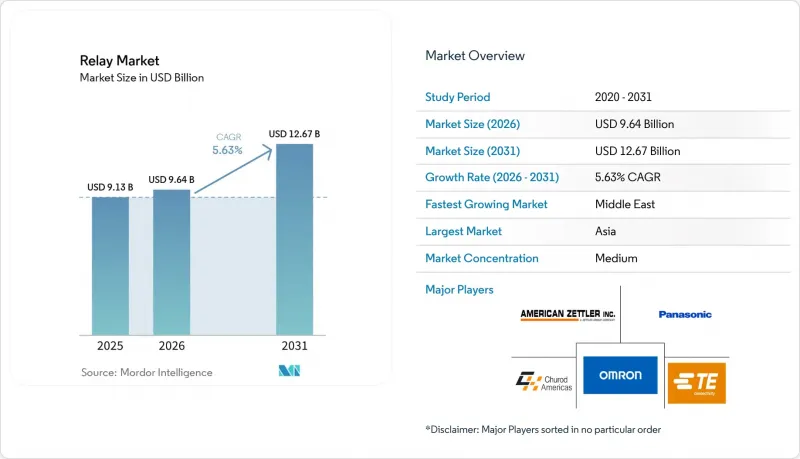
本報告按繼電器類型(電子機械、磁簧繼電器繼電器)、額定電壓(低壓、中壓、高壓)、安裝方式(PCB安裝、DIN導軌安裝等)、終端用戶產業(汽車/電動車、能源/電力、工業自動化/機器人等)和地區進行細分。市場預測以美元計價。
全球繼電器市場趨勢及洞察
分散式可再生能源微電網正在加速中壓配電保護繼電器的需求。
亞洲和非洲的農村電氣化計畫正轉向結合太陽能和電池儲能的混合微電網。雙向電力流動、波動的故障電流以及頻繁的孤島運作現象,使得自適應方向過電流繼電器成為安全可靠配電的關鍵。電網營運商越來越依賴符合IEC 61850標準的通訊設備和同步控制設備,以確保多個分散式電源之間的無縫協調,同時降低停電風險。更低的組件成本和多年的政府補貼進一步刺激了市場需求,保護繼電器正在成為新興市場能源獲取策略的核心組成部分。
電動車中直流電力電子產品的激增,帶動了對高壓固態繼電器的需求成長。
為了實現更快的充電速度和更輕的佈線,電動車平台正從400V架構過渡到800V架構。能夠處理250A連續電流的高壓固態繼電器,例如TE Connectivity的EVC 250-800,如今已成為電池斷開、預充電和快速充電電路的基礎。Panasonic開創性的氫氣滅弧和陶瓷絕緣技術,使得這些繼電器能夠在空間受限的電力電子設備艙內實現緊湊安裝。隨著高階電動車銷量的成長,繼電器市場正迅速轉向低損耗、無電弧的開關解決方案,這些方案能夠承受高環境溫度、振動和反覆的負載循環。
通用電子機械繼電器價格的快速下降給供應商的利潤率帶來了壓力。
自2024年以來,來自中國製造商日益激烈的價格競爭導致標準繼電器的平均售價出現兩位數下降。為此,全球經銷商要求縮短前置作業時間並提供增值測試以彰顯產品品質差異。隨著利潤率的下降,現有製造商被迫將產能重新分配到高附加價值產品——例如高壓接觸器、智慧安全繼電器和物聯網模組——以維持在繼電器市場的盈利。
細分市場分析
到2025年,電子機械繼電器將佔據繼電器市場61.05%的佔有率。這主要歸功於其久經考驗的耐用性、電弧處理能力和具有競爭力的成本,這些特性在工業馬達控制和電網保護領域備受青睞。設計人員高度重視此類繼電器的完全電氣隔離和2 kA突波電流耐受能力,即使在採礦、船舶和鐵路牽引等嚴苛環境下,這些特性也推動了市場對機電式繼電器的強勁需求,因為在這些環境下,半導體開關由於熱限制而無法使用。同時,固態繼電器是繼電器市場成長最快的細分領域,其複合年成長率高達6.82%,這主要得益於汽車OEM廠商轉向800V電池系統以及通訊業者提高5G節點密度,從而對低漏電流和微秒開關速度提出了更高的要求。
固態繼電器在碳化矽 (SiC) 和氮化鎵 (GaN) 裝置的成本曲線上處於領先地位,並且由於其長壽命和無電弧運行,在電動汽車電池斷路器、太陽能快速切割盒和醫療成像設備等對觸點抖動要求極高的應用領域中需求旺盛。混合型繼電器結合了 MOSFET 的高速和機械隔離特性,降低了純半導體模組被替換的風險,但其高的元件成本和檢驗費用限制了其應用。電子機械繼電器供應商正在透過低電阻合金來應對這項挑戰,這些合金可將鎖存線圈和接點路徑的電阻降低 20 mΩ。同時,像 KG Technologies 這樣的繼電器廠商正在擴大智慧電錶鎖存設計的專利聯盟,以將待機損耗降低到接近零。
預計到2025年,100V以下的低壓繼電器將佔據繼電器市場44.62%的佔有率,主要得益於家用電子電器、穿戴式裝置和建築自動化自動化領域標準化封裝的應用。該市場成長穩健但緩慢,現有製造商正努力從亞洲大宗商品供應商處爭取利潤空間,並採用複合塑膠來降低封裝高度15%。 100V至1kV的中壓繼電器仍然是電機控制中心和太陽能組串匯流器的主要應用,其堅固的封裝和清漆線圈能夠承受工廠環境和沙漠太陽能發電廠日常溫度的波動。
在1千伏範圍內,隨著1500伏直流母線在超快速電動車充電器、離岸風力發電轉換器和電池逆變器中成為標準配置,市場需求正以6.12%的複合年成長率加速成長。真空和充氣結構在該繼電器市場領域佔據主導地位,其滅弧性能是機械空氣間隙無法實現的。三菱馬達的3.3千伏高壓絕緣體雙極型電晶體(HVIGBT)模組凸顯了下游市場對具有更大絕緣距離、聚合物絕緣體和整合溫度感測器的兼容繼電器的需求。由於系統整合商尋求認證的高壓合作夥伴,無法取得IEC 62955和UL 1973產品認證的供應商被迫縮小市場佔有率。
區域分析
到2025年,亞洲將佔據繼電器市場43.78%的佔有率。這主要得益於中國強大的零件製造工廠、日本的高壓技術創新以及韓國的通訊級射頻組裝線。區域OEM廠商透過垂直整合以及政府降低關稅和物流成本的激勵措施,實現了極具競爭力的價格,從而重塑了全球採購格局。隨著契約製造製造商將生產基地遷至越南、泰國和馬來西亞以實現供應鏈多元化,東南亞國家正崛起為第二個成長引擎。
在北美,電力系統現代化和機器人技術投資正成為關注的焦點,而安全至關重要。聯邦基礎設施支援計畫正在資助符合IEC 61850標準的保護裝置升級、數位化變電站維修以及採用自鎖式PCB繼電器的自主倉庫車輛。航太產業的領導者正在推動對高密封性和抗輻射性能裝置的需求,而矽谷的雲端服務供應商則正在採購數千個用於資料中心匯流排的低電阻PCB元件。
在歐洲,脫碳政策與成熟的工業自動化生態系統相融合,使得提供具有CE標誌、RoHS認證和功能安全認證產品的供應商更具優勢。電力公司正在部署非常規的互感器,這些互感器可為數位繼電器提供採樣值流,從而縮短銅線佈線距離並實現遠端韌體更新。在中東,智慧城市計畫和嚴格的建築規範正在推動商業建築中物聯網暖通空調繼電器的應用,其複合年成長率高達5.95%,位居全球成長之首。非洲雖然絕對規模較小,但隨著太陽能、電池和微電網的部署推動農村地區的電氣化,中壓保護繼電器正在崛起,成為新興市場。
其他好處:
- Excel格式的市場預測(ME)表
- 3個月的分析師支持
目錄
第1章:引言
- 研究假設和市場定義
- 調查範圍
第2章:調查方法
第3章執行摘要
第4章 市場狀況
- 市場概覽
- 市場促進因素
- 分散式可再生能源微電網正在加速中壓配電領域(亞洲、非洲)對保護繼電器的需求。
- 電動車中汽車直流電力電子產品的激增,帶動了高壓固態繼電器的需求成長。
- 利用IEC-61850數位變電站對歐洲和北美老舊的輸配電基礎設施維修
- 緊湊型 5G 無線單元的普及推動了對射頻開關磁簧繼電器和光電 MOS繼電器的需求。
- 自主工業機器人中安全關鍵的冗餘要求正在推動對自鎖式PCB繼電器的需求。
- 中東地區的節能建築標準正在推動具有物聯網連接功能的智慧暖通空調繼電器的應用。
- 市場限制因素
- 通用電子機械繼電器價格的快速下降給供應商的利潤率帶來了壓力。
- 超過 60 A 的固態繼電器的溫度控管難題阻礙了它們在重載應用中的廣泛應用。
- 來自亞洲非官方供應商的假冒偽劣繼電器存在可靠性風險。
- 功率半導體開關(MOSFET/IGBT模組)替代品的威脅
- 產業價值鏈分析
- 監管和技術展望
- 宏觀經濟影響分析(供應鏈、能源價格、地緣政治因素、貿易關稅)
- 波特五力分析
- 價格分析
第5章 市場規模與成長預測
- 按繼電器類型
- 電子機械
- 磁簧繼電器
- 自鎖繼電器
- 固態繼電器(SSR)
- 光電MOS/光隔離
- 基於IGBT/MOSFET的
- 混合繼電器
- 額定電壓
- 低電壓(低於100伏特)
- 中壓(100-1000伏特)
- 高壓(1000伏特或以上)
- 按實現類型
- PCB實施
- DIN導軌安裝
- 插件/套接字
- 面板/底盤安裝
- 按最終用戶行業分類
- 汽車和電動旅行
- 能源與電力(輸配電、可再生能源)
- 工業自動化與機器人技術
- 通訊和5G基礎設施
- 航太/國防
- 家用電子電器和家用電器
- 建築自動化/暖通空調
- 鐵路和公共交通
- 按地區
- 北美洲
- 美國
- 加拿大
- 墨西哥
- 歐洲
- 德國
- 英國
- 法國
- 北歐的
- 其他歐洲國家
- 南美洲
- 巴西
- 其他南美國家
- 亞太地區
- 中國
- 日本
- 印度
- 東南亞
- 其他亞太國家
- 中東和非洲
- 中東
- 波灣合作理事會(GCC)成員國
- 土耳其
- 其他中東國家
- 非洲
- 南非
- 其他非洲國家
- 中東
- 北美洲
第6章 競爭情勢
- 市場集中度
- 策略趨勢
- 市佔率分析
- 公司簡介
- TE Connectivity Ltd.
- Omron Corp.
- Panasonic Corp.
- Siemens AG
- Schneider Electric SE
- ABB Ltd.
- Fujitsu Ltd.
- Song Chuan Group
- Littelfuse Inc.
- Eaton Corp. plc
- Phoenix Contact GmbH and Co. KG
- American Zettler Inc.
- Sensata Technologies Inc.
- Coto Technology Inc.
- KEMET(-Yageo)
- Toshiba Electronic Devices and Storage
- Denso Corp.
- Rockwell Automation Inc.
- Panasonic Industry(EU)
- Crydom(Sensata)
- Axicom Relays
第7章 市場機會與未來展望
According to Mordor Intelligence, relay market size market size in 2026 is estimated at USD 9.64 billion, growing from 2025 value of USD 9.13 billion with 2031 projections showing USD 12.67 billion, growing at 5.63% CAGR over 2026-2031.
This report is Segmented by Relay Type (Electromechanical, Reed Relay, Latching Relay, and More), Voltage Rating (Low Voltage, Medium Voltage, and High Voltage), Mounting Configuration (PCB-Mount, DIN-Rail Mount, and More), End-User Industry (Automotive and E-Mobility, Energy and Power, Industrial Automation and Robotics, and More), and Geography. The Market Forecasts are Provided in Terms of Value (USD).
Global Relay Market Trends and Insights
Decentralized Renewable Microgrids Accelerating Demand for Protective Relays in Medium-Voltage Distribution
Rural electrification programs across Asia and Africa are pivoting toward hybrid solar-battery microgrids. Bidirectional power flows, variable fault currents, and frequent islanding events make adaptive directional overcurrent relays indispensable for safe, reliable distribution. Grid operators increasingly favor devices with IEC 61850 communication and synchrophasor support, ensuring seamless coordination among multiple distributed generation sources while reducing blackout risk. Lower component costs and multiyear government subsidies further strengthen market pull, positioning protective relays as a core element of emerging-market energy access strategies.
Surge in On-Board DC Power Electronics in EVs Requiring High-Voltage Solid-State Relays
EV platforms are shifting from 400 V to 800 V architectures to enable faster charging and lighter cabling. High-voltage solid-state relays capable of 250 A continuous current, such as TE Connectivity's EVC 250-800, now underpin battery disconnect, pre-charge, and fast-charge circuits. Hydrogen-gas arc suppression and ceramic insulation, pioneered by Panasonic, support compact footprints inside crowded power-electronics bays. As premium EV volumes rise, the relay market rapidly migrates toward low-loss, arc-free switching solutions that can withstand elevated ambient temperatures, vibration, and repetitive load cycling.
Rapid Price Erosion in Commodity Electromechanical Relays Undermines Vendor Margins
Chinese manufacturers have intensified price-based competition, lowering average selling prices in standard relay categories by double-digit percentages since 2024. Global distributors respond by demanding shorter lead times and value-added testing to differentiate quality. Margins narrow, compelling incumbents to redeploy capacity toward higher-value designs-HV contactors, smart safety relays, and IoT-enabled modules-to preserve profitability within the relay market.
Other drivers and restraints analyzed in the detailed report include:
- Retrofitting of Aging T&D Infrastructure with IEC-61850 Digital Substations
- Proliferation of Compact 5G Radio Units Driving Reed and PhotoMOS Relays for RF Switching
- Solid-State Relay Thermal Management Issues Above 60 A Limiting Heavy-Duty Penetration
For complete list of drivers and restraints, kindly check the Table Of Contents.
Segment Analysis
Electromechanical devices held 61.05% of relay market share in 2025, benefiting from proven durability, arc-handling capacity, and competitive cost within industrial motor control and grid protection. Designers value the class's full galvanic isolation and tolerance for 2 kA surge currents, traits that keep demand steady in harsh mining, marine, and rail traction settings where thermal limits rule out semiconductor switches. At the same time, the fastest-growing slice of the relay market size is solid-state, advancing 6.82% CAGR as automotive OEMs migrate to 800 V battery systems and telecom operators densify 5 G nodes that require low-leakage, micro-second switching.
Solid-state relays ride the cost curve of SiC and GaN devices, offering arc-free longevity that appeals to EV battery disconnect units, photovoltaic rapid-shutdown boxes, and medical imaging where contact bounce is unacceptable. Hybrid formats merge MOSFET speed with mechanical isolation to blunt substitution threats from pure semiconductor modules, although adoption remains modest due to higher bill-of-materials cost and validation overheads. Electromechanical vendors respond with latching coils and low-resistance alloys that shave 20 mΩ from contact paths, while niche players such as KG Technologies expand the relay industry patent pool for smart-meter latching designs that cut standby loss to near-zero.
Low-voltage designs below 100 V captured 44.62% of relay market share in 2025 on the back of standardized footprints inside consumer electronics, wearables, and building automation. Growth is steady but muted, with margin pressure from commodity Asian suppliers spurring incumbents to automate SMT placement and adopt composite plastics that shrink package height by 15%. Medium-voltage relays between 100 V and 1 kV remain workhorses of motor control centers and photovoltaic string combiners, where ruggedized contacts and varnish-sealed coils withstand daily temperature swings on factory floors and desert solar farms.
Above 1 kV, demand accelerates at a 6.12% CAGR as ultra-fast EV chargers, offshore wind converters, and battery-energy-storage inverters standardize 1 ,500 V DC buses. Vacuum and gas-filled architectures dominate this relay market segment, delivering arc-quenching performance that mechanical air gaps cannot match. Mitsubishi Electric's 3.3 kV HVIGBT modules underscore the downstream pull for companion relays with expanded creepage distances, polymer insulators, and integrated temperature sensors. Suppliers unable to certify products to IEC 62955 and UL 1973 face dwindling share as system integrators lock in qualified high-voltage partners.
Geography Analysis
Asia commanded 43.78% of relay market share in 2025, anchored by China's component fabs, Japan's high-voltage innovation, and South Korea's telecom-grade RF assembly lines. Regional OEMs pair vertical integration with government incentives that trim duty and logistics cost, enabling aggressive price points that reshape global sourcing patterns. Southeast Asian economies add a second engine as contract manufacturers relocate to Vietnam, Thailand, and Malaysia to diversify supply chains.
North America focuses investment on grid modernization and safety-critical robotics. Federal infrastructure packages channel capital into IEC 61850 protection upgrades, digital substation retrofits, and autonomous warehouse fleets that depend on latching PCB relays. Aerospace primes drive demand for hermetically sealed, radiation-tolerant units, while Silicon Valley cloud operators procure thousands of low-on-resistance PCB devices for data-center busbars.
Europe blends decarbonization policy with mature industrial automation ecosystems, rewarding suppliers that certify products for CE marking, RoHS, and functional-safety standards. Utilities deploy non-conventional instrument transformers feeding sampled-value streams into digital relays, shrinking copper runs and enabling remote firmware updates. The Middle East records the fastest growth at 5.95% CAGR as smart-city programs and stringent building codes embed IoT-ready HVAC relays across commercial towers. Africa, though smaller in absolute terms, emerges as a frontier for medium-voltage protective relays tied to solar-battery microgrid rollouts that electrify rural communities.
- TE Connectivity Ltd.
- Omron Corp.
- Panasonic Corp.
- Siemens AG
- Schneider Electric SE
- ABB Ltd.
- Fujitsu Ltd.
- Song Chuan Group
- Littelfuse Inc.
- Eaton Corp. plc
- Phoenix Contact GmbH and Co. KG
- American Zettler Inc.
- Sensata Technologies Inc.
- Coto Technology Inc.
- KEMET (-Yageo)
- Toshiba Electronic Devices and Storage
- Denso Corp.
- Rockwell Automation Inc.
- Panasonic Industry (EU)
- Crydom (Sensata)
- Axicom Relays
Additional Benefits:
- The market estimate (ME) sheet in Excel format
- 3 months of analyst support
TABLE OF CONTENTS
1 INTRODUCTION
- 1.1 Study Assumptions and Market Definition
- 1.2 Scope of the Study
2 RESEARCH METHODOLOGY
3 EXECUTIVE SUMMARY
4 MARKET LANDSCAPE
- 4.1 Market Overview
- 4.2 Market Drivers
- 4.2.1 Decentralized Renewable Microgrids Accelerating Demand for Protective Relays in Medium-Voltage Distribution (Asia, Africa)
- 4.2.2 Surge in On-Board DC Power Electronics in EVs Requiring High-Voltage Solid-State Relays
- 4.2.3 Retrofitting of Aging T&D Infrastructure with IEC-61850 Digital Substations in Europe and North America
- 4.2.4 Proliferation of Compact 5G Radio Units Driving Reed and PhotoMOS Relays for RF Switching
- 4.2.5 Safety-Critical Redundancy Mandates in Autonomous Industrial Robots Boosting Latching PCB Relays
- 4.2.6 Energy-Efficient Building Codes in the Middle East Stimulating Smart HVAC Relays with IoT Connectivity
- 4.3 Market Restraints
- 4.3.1 Rapid Price Erosion in Commodity Electromechanical Relays Undermines Vendor Margins
- 4.3.2 Solid-State Relay Thermal Management Issues Above 60 A Limiting Heavy-Duty Penetration
- 4.3.3 Counterfeit Low-Quality Relays from Informal Asian Suppliers Introducing Reliability Risks
- 4.3.4 Substitution Threat from Power Semiconductor Switches (MOSFET/IGBT Modules)
- 4.4 Industry Value Chain Analysis
- 4.5 Regulatory and Technological Outlook
- 4.6 Macroeconomic Impact Analysis (Supply Chain, Energy Prices, Geo-Political Factors, Trade Tariffs)
- 4.7 Porter's Five Forces Analysis
- 4.7.1 Bargaining Power of Buyers
- 4.7.2 Bargaining Power of Suppliers
- 4.7.3 Threat of Substitutes
- 4.7.4 Threat of New Entrants
- 4.7.5 Competitive Rivalry
- 4.8 Pricing Analysis
5 MARKET SIZE AND GROWTH FORECASTS (VALUES)
- 5.1 By Relay Type
- 5.1.1 Electromechanical
- 5.1.2 Reed Relay
- 5.1.3 Latching Relay
- 5.1.4 Solid-State Relay (SSR)
- 5.1.5 PhotoMOS/Optically-Isolated
- 5.1.6 IGBT/MOSFET-Based
- 5.1.7 Hybrid Relay
- 5.2 By Voltage Rating
- 5.2.1 Low Voltage (Less than 100 V)
- 5.2.2 Medium Voltage (100-1000 V)
- 5.2.3 High Voltage (Above 1000 V)
- 5.3 By Mounting Configuration
- 5.3.1 PCB-Mount
- 5.3.2 DIN-Rail Mount
- 5.3.3 Plug-in/Socket
- 5.3.4 Panel/Chassis Mount
- 5.4 By End-user Industry
- 5.4.1 Automotive and E-Mobility
- 5.4.2 Energy and Power (T&D, Renewables)
- 5.4.3 Industrial Automation and Robotics
- 5.4.4 Telecommunications and 5G Infrastructure
- 5.4.5 Aerospace and Defense
- 5.4.6 Consumer Electronics and Appliances
- 5.4.7 Building Automation/HVAC
- 5.4.8 Rail and Mass Transit
- 5.5 By Geography
- 5.5.1 North America
- 5.5.1.1 United States
- 5.5.1.2 Canada
- 5.5.1.3 Mexico
- 5.5.2 Europe
- 5.5.2.1 Germany
- 5.5.2.2 United Kingdom
- 5.5.2.3 France
- 5.5.2.4 Nordics
- 5.5.2.5 Rest of Europe
- 5.5.3 South America
- 5.5.3.1 Brazil
- 5.5.3.2 Rest of South America
- 5.5.4 Asia-Pacific
- 5.5.4.1 China
- 5.5.4.2 Japan
- 5.5.4.3 India
- 5.5.4.4 South-East Asia
- 5.5.4.5 Rest of Asia-Pacific
- 5.5.5 Middle East and Africa
- 5.5.5.1 Middle East
- 5.5.5.1.1 Gulf Cooperation Council Countries
- 5.5.5.1.2 Turkey
- 5.5.5.1.3 Rest of Middle East
- 5.5.5.2 Africa
- 5.5.5.2.1 South Africa
- 5.5.5.2.2 Rest of Africa
- 5.5.5.1 Middle East
- 5.5.1 North America
6 COMPETITIVE LANDSCAPE
- 6.1 Market Concentration
- 6.2 Strategic Moves
- 6.3 Market Share Analysis
- 6.4 Company Profiles {(includes Global level Overview, Market level overview, Core Segments, Financials as available, Strategic Information, Market Rank/Share for key companies, Products and Services, and Recent Developments)}
- 6.4.1 TE Connectivity Ltd.
- 6.4.2 Omron Corp.
- 6.4.3 Panasonic Corp.
- 6.4.4 Siemens AG
- 6.4.5 Schneider Electric SE
- 6.4.6 ABB Ltd.
- 6.4.7 Fujitsu Ltd.
- 6.4.8 Song Chuan Group
- 6.4.9 Littelfuse Inc.
- 6.4.10 Eaton Corp. plc
- 6.4.11 Phoenix Contact GmbH and Co. KG
- 6.4.12 American Zettler Inc.
- 6.4.13 Sensata Technologies Inc.
- 6.4.14 Coto Technology Inc.
- 6.4.15 KEMET (-Yageo)
- 6.4.16 Toshiba Electronic Devices and Storage
- 6.4.17 Denso Corp.
- 6.4.18 Rockwell Automation Inc.
- 6.4.19 Panasonic Industry (EU)
- 6.4.20 Crydom (Sensata)
- 6.4.21 Axicom Relays
7 MARKET OPPORTUNITIES AND FUTURE OUTLOOK
- 7.1 White-space and Unmet-Need Assessment

 電氣LRD過載繼電器市場:按類型、應用、額定電壓、相數、國家及地區分類-全球產業分析、市場規模、市場佔有率及2026年至2033年預測
 感應繼電器市場規模、佔有率和成長分析:按繼電器類型、電壓等級、應用、最終用戶、銷售管道和地區分類-2026年至2033年產業預測
 接線端子繼電器市場規模、佔有率和成長分析:按繼電器類型、安裝方式、電壓、最終用戶、應用和地區分類-2026-2033年產業預測
 氣密繼電器市場規模、佔有率和成長分析:按繼電器類型、觸點配置、應用、最終用戶和地區分類-2026-2033年產業預測
 2034年電力繼電器市場預測-全球市場分析(依繼電器類型、接點配置、安裝方式、額定電壓、應用、最終用戶、銷售管道和地區分類)
 磁簧繼電器市場:全球市場預測,2026-2032年通訊中繼器市場-2026-2032年全球市場預測電子機械繼電器市場:2026-2032年全球市場預測(依產品、運行原理、功能、接點配置、安裝方式、最終用戶及通路分類)
 2026-2030年全球工業繼電器市場差動保護市場:2026-2032年全球市場預測(依產品類型、保護方式、電壓等級、安裝配置、應用和最終用戶分類)