


 |
市場調查報告書
商品編碼
2066627
英國電動自行車:市場佔有率分析、產業趨勢與統計及成長預測(2026-2031)United Kingdom E-Bike - Market Share Analysis, Industry Trends & Statistics, Growth Forecasts (2026 - 2031) |
||||||

※ 本網頁內容可能與最新版本有所差異。詳細情況請與我們聯繫。
根據 Mordor Intelligence 預測,英國電動自行車市場規模將從 2025 年的 5.3444 億美元成長到 2026 年的 5.5411 億美元,到 2031 年將達到 6.6385 億美元,2026 年至 2031 年的複合年成長率為 3.68%。
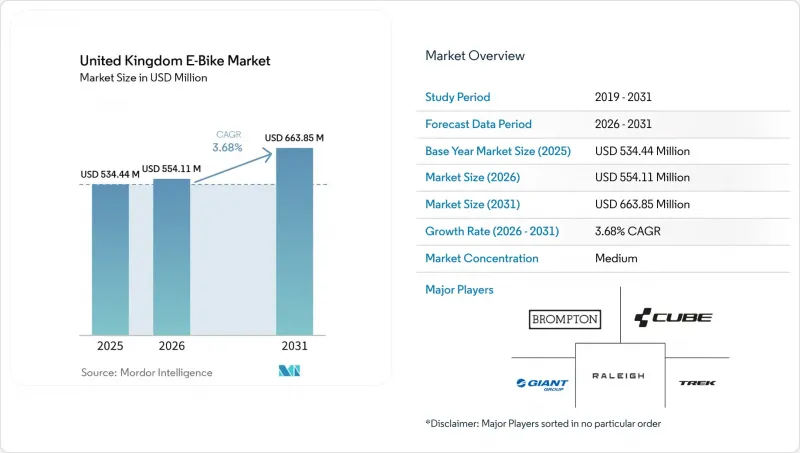
本報告按驅動系統(例如,腳踏輔助)、應用領域(例如,貨運、多用途)、電池類型(例如,鉛酸電池)、馬達位置(輪轂馬達(前/後輪)和中置馬達)、驅動方式(鏈條傳動和皮帶傳動)、馬達功率、價格範圍、銷售管道、最終用途和地區進行細分。市場預測以價值(美元)和銷售(台)表示。
英國電動自行車市場趨勢與洞察
電動貨運自行車在最後一公里配送中的成長。
倫敦的貨運自行車數量年增了63%,倫敦交通局 (TfL) 預測,到2030年,貨運自行車可望取代倫敦市中心約17%的貨車配送。像Evri這樣的營運商計劃在2024年至2025年間將其電動貨運自行車車隊規模擴大三倍,這體現了降低營運成本和緩解交通堵塞等諸多優勢。外送員約佔倫敦自行車出行量的10%,這是一個現成的需求群體。政府對貨運創新的津貼以及對進入倫敦市區的限制進一步增強了貨運自行車的商業可行性,使其成為成長最快的應用領域。
擴大受保護的自行車基礎設施
2025-2026會計年度,綜合積極旅遊基金將撥款1.685億英鎊(約2.11億美元),其中76%將用於基礎建設。新建的受保護自行車道將降低“風險感知”,這是老年騎行者及其家人出行的一大障礙,同時,隨著路線的連貫性增強,也將促進網路效應。大曼徹斯特、西米德蘭茲和西約克郡獲得了最大筆津貼,確保了高密度城市走廊的開發,從而最大限度地提高利用率。隨著安全性的提高,潛在的通勤需求將轉化為實際收入,從而支持政策週期結束後的永續發展。
電池起火事故增多及安全法規日益增多
安全事故一直是監管上最大的阻力。 2024年,英國共記錄了211起涉及電動自行車和電動滑板車的火災事故,造成多人死亡,促使當局推出更嚴格的產品安全法規。倫敦交通局(TfL)於2025年3月禁止折疊式電動自行車上火車,擾亂了多模態的通勤方式。英國執法機關查獲了937輛非法改裝的自行車,比前一年增加了83%,顯示執法力道有所加強。雖然新參與企業合規成本將會增加,但獲得認證的品牌可以將安全性作為賣點。
細分市場分析
2025年,輔助電動自行車在英國市場佔據主導地位,市佔率高達79.91%。這個市場主導地位主要歸功於250瓦的法定功率限制,這使得這類自行車被歸類為自行車而非輕型摩托車。這個分類帶來了許多優勢,例如可以使用輕型機踏車自行車道、無需車輛登記以及更低的保險費用,因此深受通勤者和休閒騎行者的青睞。製造商正在改進扭矩感測器演算法,使助力騎行更加自然流暢,這項改進廣受好評,促進了消費者的重複購買,進一步鞏固了該細分市場的地位。因此,預計到2031年,英國助力電動自行車市場將穩定成長,整體市場複合年成長率將達到3.68%。
儘管目前油門輔助電動自行車的市場規模仍然較小,但預計其複合年成長率將達到3.67%。這類自行車尤其受到需要在走走停停的交通狀況下快速獲得動力的送貨人員的青睞。監管措施,例如到2024年8月查獲937輛非法高功率自行車,顯示當局正在努力確保合規。然而,在生產力提升超過合規挑戰的地區,經過認證的油門輔助車型仍然吸引買家的目光。為了應對這項挑戰,零件供應商正在提供具有韌體的油門,其功率可以調節至250瓦的法定限值,使企業能夠在不影響功能的前提下遵守法規。雖然腳踏助力自行車仍然佔據主導地位,但這種新模式正在推動油門輔助車型在某些商業領域的蓬勃發展。此外,都市區堵塞費的上漲和對貨車通行限制的日益嚴格,也迫使企業積極尋求合法途徑,以確保小包裹的快速高效遞送。
到2025年,都市區出行將佔總收入的71.34%,這主要得益於人口密度高、專用自行車道建設以及停車費上漲等因素。這使得電動自行車成為便捷的門到門出行選擇。 2025年至2026年間,大曼徹斯特、西米德蘭茲郡和西約克郡在新建專用自行車道方面投入巨資,改善了基礎設施,增強了通勤者的信心。雇主也透過「騎車上班」計畫支持這項轉變,降低了購置成本,使電池輔助成為日常騎乘者的必備功能。因此,預計英國電動自行車市場將在整個預測期內保持銷售主導地位,都市區通勤領域也將穩定成長。
目前,貨運自行車和多用途自行車的市佔率相對較小,但預計其成長速度將超過其他任何用途,到2031年年複合成長率(CAGR)將達到3.67%。對每件包裹成本的研究表明,與柴油貨車相比,貨運自行車可節省20%以上的成本,尤其是在考慮交通罰款和堵塞費的情況下,這使其對物流行業的首席財務官們極具吸引力。倫敦交通局估計,到2030年,貨運自行車在市中心的貨車配送量可能占到約17%,這將帶來數千輛的額外需求。車隊營運商越來越要求車輛在出廠時就配備遠端資訊處理系統,以提高物流管理效率,這提高了低價品牌的市場進入門檻。受這些趨勢的影響,儘管通勤自行車的銷售量依然居高不下,但貨運自行車正成為商業領域電氣化過程中的核心力量。
2025年,鋰離子電池技術在英國電動自行車市場佔了99.37%的佔有率。預計到2031年,該市場將以3.68%的複合年成長率穩定成長。這一成長主要得益於鋰離子電池的高能量密度,它能夠在不顯著增加重量的情況下提供足夠的續航里程,使其成為深受鐵路通勤者歡迎的折疊式電動自行車的必備特性。隨著電池價格的持續下降,各品牌面臨兩種主要選擇:維持廠商建議零售價(MSRP)或在相同價格下提供更高容量的電池組。這兩種策略都有助於擴大潛在市場規模(TAM)。儘管安全法規日益嚴格,但成熟的製造商已經採用了經認證的電池管理系統,從而增強了自身的競爭力。因此,預計鋰離子電池技術將與英國整體電動自行車市場保持3.68%的複合年成長率同步成長,在預測期內預計不會受到其他化學電池的顯著競爭。
在地採購仍面臨挑戰。計劃在考文垂建造的超級工廠旨在生產高達 60 GWh 的小型電池。然而,法拉第研究所的數據顯示,預計需求與已發表的產能之間存在 47% 的缺口。這種對進口的依賴使原始設備製造商 (OEM) 容易受到外匯波動和運輸延誤的影響,迫使他們在定價和物流方面都面臨風險。為了應對潛在的供應中斷,一些品牌正在設計模組化電池倉,以便容納來自多個供應商的電芯。如果國內生產按計劃擴大,製造商將受益於更短的前置作業時間,並能夠將「英國製造」的電池組作為額外的安全保障進行銷售。
其他好處:
- Excel格式的市場預測(ME)表
- 3個月的分析師支持
目錄
第1章:引言
- 研究假設和市場定義
- 調查範圍
第2章:調查方法
第3章執行摘要
第4章:主要產業趨勢
- 年度自行車銷售額
- 平均售價和價格範圍構成
- 電動自行車及其零件的跨境貿易
- 電動自行車在自行車總銷量中所佔的百分比
- 單程通勤距離為 5-15 公里的通勤者 (%)
- 自行車和電動自行車租賃市場的規模
- 電動自行車電池組的價格
- 電池化學物質價格比較
- 最後一公里(超本地化)配送量
- 受保護的自行車道(公里)
- 參與健行/戶外活動
- 電動自行車電池容量(瓦時)
- 都市交通壅塞指數
- 法律規範
- 型式認可和認證
- 出口、進口和貿易法規
- 分類、道路使用和使用者規定
- 電池、充電器和充電安全
第5章 市場狀況
- 市場概覽
- 市場促進因素
- 電子商務在最後一公里配送中的成長
- 擴大自行車防護基礎設施
- 「自行車通勤」的稅務優惠及雇主採納狀況
- 降低鋰離子電池的成本
- 英國小型基地台超級工廠項目
- 建議的 500W 輸出限制將促進新型號的出現。
- 市場限制因素
- 電池起火事故增多及安全法規日益增多
- 庫存過剩和自行車零售疲軟
- 倫敦交通局禁止將非折疊式電動自行車帶入其鐵路網。
- 禁止在出租住宅內停放電動自行車。
- 價值/供應鏈分析
- 監理情勢
- 技術展望
- 波特五力模型
第6章 市場規模與成長預測
- 依推進類型
- 腳踏輔助型
- 斯皮德雷克
- 油門輔助類型
- 按應用程式類型
- 貨物/多用途
- 城市/都市區
- 健行/登山
- 依電池類型
- 鉛酸電池
- 鋰離子電池
- 其他
- 馬達佈置
- 輪轂(前/後)
- 中置馬達
- 透過驅動系統
- 鏈傳動
- 皮帶傳動
- 馬達輸出
- 小於250瓦
- 251~350 W
- 351~500 W
- 501~600 W
- 600瓦或以上
- 按價格範圍
- 低於1000歐元
- 1,000–1,499 歐元
- 1500-2499歐元
- 2,500–3,499 歐元
- 3,500–5,999 歐元
- 超過6000歐元
- 按銷售管道
- 線上
- 離線
- 按最終用途
- 商業航運
- 零售和產品配送
- 食品和飲料配送
- 服務供應商
- 供個人和家庭使用
- 對機構而言
- 其他
- 商業航運
- 按地區
- 英格蘭
- 蘇格蘭
- 威爾斯
- 北愛爾蘭
第7章 競爭情勢
- 市場集中度
- 策略趨勢
- 市佔率分析
- 公司簡介
- Brompton Bicycle Ltd
- CUBE Bikes
- Evans Cycles
- Giant Manufacturing Co. Ltd
- Karbon Kinetics Ltd
- Maxon Group
- Powabyke UK Ltd
- Raleigh UK Ltd
- Tandem Group Cycles Ltd
- Trek Bicycle Corporation
- Volt Electric Bikes Ltd
- Estarli Ltd
- Whyte Bikes Ltd
- Ribble Cycles Ltd
第8章 市場機會與未來展望
第9章:電動自行車執行長面臨的關鍵策略挑戰
According to Mordor Intelligence, the united kingdom e-bike market size is expected to grow from USD 534.44 million in 2025 to USD 554.11 million in 2026 and is forecast to reach USD 663.85 million by 2031 at a 3.68% CAGR over 2026-2031.
This report is Segmented by Propulsion Type (Pedal Assisted and More), Application Type (Cargo/Utility and More), Battery Type (Lead-Acid Battery and More), Motor Placement (Hub Front/Rear and Mid-Drive), Drive Systems (Chain Drive and Belt Drive), Motor Power, Price Band, Sales Channel, End-Use, and Geography. The Market Forecasts are Provided in Terms of Value (USD) and Volume (Units).
United Kingdom E-Bike Market Trends and Insights
Growth of E-Cargo in Last-Mile Delivery
Cargo bike deployments jumped 63% year-on-year in London, and Transport for London forecasts that approximately 17% of van deliveries in central London could be replaced by cargo bikes by 2030. Operators like Evri are committed to tripling their e-cargo bike fleets between 2024 and 2025, validating the operational cost savings and congestion benefits. Food-delivery couriers represent a ready demand pool, accounting for around 10% of London cycle trips. Freight-innovation grants and city access rules strengthen the commercial case, making cargo the fastest-growing professional use case.
Expansion of Protected Cycling Infrastructure
The Consolidated Active Travel Fund has awarded GBP 168.5 million (USD 211 million) for 2025-26, 76% of which is earmarked for hard infrastructure. New protected lanes reduce perceived risk, a chief deterrent among older riders and families, and spur network effects as routes become contiguous. Greater Manchester, West Midlands, and West Yorkshire secure the largest grants, ensuring dense urban corridors that maximize usage. As safety improves, latent commuter demand converts into sales, supporting sustained growth beyond initial policy cycles.
Rising Battery-Fire Incidents and Safety Regulation
Safety incidents pose the most significant regulatory headwind, with 211 e-bike and e-scooter fires recorded in 2024, resulting in several fatalities and leading to tighter product-safety rules. Transport for London introduced a ban on folding e-bikes on rail in March 2025, hampering multimodal commutes. The United Kingdom's forces seized 937 illegally modified bikes, up 83%, signaling stricter enforcement. Compliance costs increase for new entrants, but certified brands can turn safety credentials into a selling point.
Other drivers and restraints analyzed in the detailed report include:
- Cycle-to-Work Tax Incentives and Employer Uptake
- Falling Lithium-Ion Battery Costs
- Inventory Overhang and Weak Bicycle Retail Sales
For complete list of drivers and restraints, kindly check the Table Of Contents.
Segment Analysis
Pedal-assisted e-bikes led the United Kingdom's market, accounting for a significant 79.91% share in 2025. This dominance is largely due to the legal 250 W power limit, which classifies them as bicycles instead of mopeds. This classification provides key benefits like access to bike lanes, no need for vehicle registration, and lower insurance costs, making it popular among commuters and leisure riders. Manufacturers are improving torque-sensor algorithms to make the assistance feel more natural, which has led to positive reviews and repeat purchases, further strengthening the segment's position. As a result, the market for pedal-assist models in the UK is expected to grow steadily, aligning with the overall market's 3.68% CAGR through 2031.
Throttle-assisted e-bikes, while a smaller segment, are projected to grow at a 3.67% CAGR. These bikes are particularly favored by delivery couriers who need quick power in stop-and-go traffic. Regulatory actions, such as the seizure of 937 illegal high-power bikes by August 2024, show that authorities are enforcing compliance. However, certified throttle models still attract buyers where the productivity benefits outweigh the challenges of meeting regulations. To address this, component suppliers are offering firmware-locked throttles that can be adjusted to the legal 250 W limit, giving fleets a way to comply without losing functionality. While pedal-assist bikes maintain their lead, this approach allows throttle-assist models to thrive in specific commercial niches. Additionally, increasing urban congestion charges and restricted van access are pushing operators to adopt any legal option that ensures fast and efficient parcel delivery.
Urban trips accounted for 71.34% of total revenue in 2025, driven by factors such as dense populations, dedicated bike lanes, and high parking costs, which made e-bikes a convenient option for door-to-door travel. During 2025-26, Greater Manchester, West Midlands, and West Yorkshire received significant investments to develop new cycle corridors, boosting commuter confidence with improved infrastructure. Employers are also supporting this shift through Cycle-to-Work schemes that reduce purchase costs, making battery assistance indispensable for daily riders. As a result, the e-bike market in the United Kingdom is expected to grow steadily in urban commuting while maintaining its leadership in volume throughout the forecast period.
Although cargo and utility bikes currently represent a smaller segment, they are expected to grow faster than any other use case, with a 3.67% CAGR through 2031. Studies on cost-per-parcel show savings of over 20% compared to diesel vans, especially when factoring in traffic fines and congestion fees - a finding that appeals to logistics CFOs. Transport for London estimates that cargo bikes could handle around 17% of inner-city van deliveries by 2030, creating demand for thousands of additional units. Fleet operators are increasingly requesting factory-installed telematics for better logistics oversight, which raises entry barriers for low-cost brands. These trends place cargo bikes at the center of commercial electrification efforts, even though commuter volumes remain higher.
Lithium-ion technology accounted for 99.37% of the United Kingdom e-bike market in 2025. It is expected to grow steadily at a 3.68% CAGR through 2031. This growth is driven by lithium-ion's high energy density, which provides a good range without adding too much weight-an essential feature for folding e-bikes popular among rail commuters. As cell prices continue to decline, brands have two key options: keep their Manufacturer's Suggested Retail Prices (MSRPs) unchanged or offer higher-capacity battery packs at the same price. Both approaches help expand the total addressable market. While safety regulations are becoming stricter, established manufacturers already use certified battery management systems, thereby strengthening their competitive position. As a result, lithium-ion technology is expected to grow in line with the United Kingdom's overall 3.68% CAGR in the e-bike market, with no significant competition from alternative chemistries during the forecast period.
Local sourcing remains a challenge. The planned gigafactory in Coventry aims to produce up to 60 GWh of small-format batteries. However, data from the Faraday Institution show a 47% gap between projected demand and announced production capacity. This reliance on imports leaves OEMs vulnerable to currency fluctuations and shipping delays, forcing them to manage risks across both pricing and logistics. To address potential supply disruptions, some brands are designing modular battery bays that can work with cells from multiple suppliers. If domestic production ramps up as planned, manufacturers could benefit from shorter lead times and the ability to market "British-made" battery packs as an additional safety feature.
List of Companies Covered in this Report:
- Brompton Bicycle Ltd
- CUBE Bikes
- Evans Cycles
- Giant Manufacturing Co. Ltd
- Karbon Kinetics Ltd
- Maxon Group
- Powabyke UK Ltd
- Raleigh UK Ltd
- Tandem Group Cycles Ltd
- Trek Bicycle Corporation
- Volt Electric Bikes Ltd
- Estarli Ltd
- Whyte Bikes Ltd
- Ribble Cycles Ltd
Additional Benefits:
- The market estimate (ME) sheet in Excel format
- 3 months of analyst support
TABLE OF CONTENTS
1 Introduction
- 1.1 Study Assumptions and Market Definition
- 1.2 Scope of the Study
2 Research Methodology
3 Executive Summary
4 Key Industry Trends
- 4.1 Annual Bicycle Sales
- 4.2 Average Selling Price and Price to Band Mix
- 4.3 Cross to Border Trade in E to Bikes and Parts
- 4.4 E to Bike Share of Total Bicycle Sales
- 4.5 Commuters with 5to15 km One to Way Trips (%)
- 4.6 Bicycle / E to Bike Rental Market Size
- 4.7 E to Bike Battery Pack Price
- 4.8 Battery Chemistry Price Comparison
- 4.9 Last to Mile (Hyper to Local) Delivery Volume
- 4.10 Protected Bicycle Lanes (km)
- 4.11 Trekking / Outdoor Activity Participation
- 4.12 E to Bike Battery Capacity (Wh)
- 4.13 Urban Traffic Congestion Index
- 4.14 Regulatory Framework
- 4.14.1 Homologation and Certification
- 4.14.2 ExporttoImport and Trade Rules
- 4.14.3 Classification, Road Access and User Rules
- 4.14.4 Battery, Charger and Charging Safety
5 Market Landscape
- 5.1 Market Overview
- 5.2 Market Drivers
- 5.2.1 Growth of E-Cargo in Last-Mile Delivery
- 5.2.2 Expansion of Protected Cycling Infrastructure
- 5.2.3 Cycle to Work Tax Incentives and Employer Uptake
- 5.2.4 Falling Lithium-Ion Battery Costs
- 5.2.5 U.K. Gigafactory Plans for Small-Format Cells
- 5.2.6 500W Power-Limit Proposal Unlocking New Models
- 5.3 Market Restraints
- 5.3.1 Rising Battery-Fire Incidents and Safety Regulation
- 5.3.2 Inventory Overhang and Weak Bicycle Retail Sales
- 5.3.3 TfL Ban on Non-Folding E-Bikes on Rail Network
- 5.3.4 Rental-Housing Storage Bans for E-Bikes
- 5.4 Value / Supply to Chain Analysis
- 5.5 Regulatory Landscape
- 5.6 Technological Outlook
- 5.7 Porter's Five Forces
- 5.7.1 Threat of New Entrants
- 5.7.2 Bargaining Power of Suppliers
- 5.7.3 Bargaining Power of Buyers
- 5.7.4 Threat of Substitutes
- 5.7.5 Intensity of Industry Rivalry
6 Market Size and Growth Forecasts (Value and Volume)
- 6.1 By Propulsion Type
- 6.1.1 Pedal Assisted
- 6.1.2 Speed Pedelec
- 6.1.3 Throttle Assisted
- 6.2 By Application Type
- 6.2.1 Cargo / Utility
- 6.2.2 City / Urban
- 6.2.3 Trekking / Mountain
- 6.3 By Battery Type
- 6.3.1 Lead-Acid Battery
- 6.3.2 Lithium-ion Battery
- 6.3.3 Others
- 6.4 By Motor Placement
- 6.4.1 Hub (Front / Rear)
- 6.4.2 Mid-Drive
- 6.5 By Drive Systems
- 6.5.1 Chain Drive
- 6.5.2 Belt Drive
- 6.6 By Motor Power
- 6.6.1 Below 250 W
- 6.6.2 251 to 350 W
- 6.6.3 351 to 500 W
- 6.6.4 501 to 600 W
- 6.6.5 Above 600 W
- 6.7 By Price Band
- 6.7.1 Up to EUR 1,000
- 6.7.2 EUR 1,000 to 1,499
- 6.7.3 EUR 1,500 to 2,499
- 6.7.4 EUR 2,500 to 3,499
- 6.7.5 EUR 3,500 to 5,999
- 6.7.6 Above EUR 6,000
- 6.8 By Sales Channel
- 6.8.1 Online
- 6.8.2 Offline
- 6.9 By End to Use
- 6.9.1 Commercial Delivery
- 6.9.1.1 Retail and Goods Delivery
- 6.9.1.2 Food and Beverage Delivery
- 6.9.2 Service Providers
- 6.9.3 Personal and Family Use
- 6.9.4 Institutional
- 6.9.5 Others
- 6.9.1 Commercial Delivery
- 6.10 By Region
- 6.10.1 England
- 6.10.2 Scotland
- 6.10.3 Wales
- 6.10.4 Northern Ireland
7 Competitive Landscape
- 7.1 Market Concentration
- 7.2 Strategic Moves
- 7.3 Market Share Analysis
- 7.4 Company Profiles (Includes Global level Overview, Market level overview, Core Segments, Financials as available, Strategic Information, Market Rank/Share for key companies, Products and Services, and Recent Developments)
- 7.4.1 Brompton Bicycle Ltd
- 7.4.2 CUBE Bikes
- 7.4.3 Evans Cycles
- 7.4.4 Giant Manufacturing Co. Ltd
- 7.4.5 Karbon Kinetics Ltd
- 7.4.6 Maxon Group
- 7.4.7 Powabyke UK Ltd
- 7.4.8 Raleigh UK Ltd
- 7.4.9 Tandem Group Cycles Ltd
- 7.4.10 Trek Bicycle Corporation
- 7.4.11 Volt Electric Bikes Ltd
- 7.4.12 Estarli Ltd
- 7.4.13 Whyte Bikes Ltd
- 7.4.14 Ribble Cycles Ltd
8 Market Opportunities and Future Outlook
9 Key Strategic Questions for E to Bikes CEOs

 電動自行車市場:按電池類型、應用、驅動機制、插電式/電池式、運作模式、等級、銷售管道和地區分類
 東協電動自行車市場:市場佔有率分析、產業趨勢與統計及成長預測(2026-2031)
 折疊式電動自行車市場-2026-2032年全球市場預測電動自行車市場:2026-2032年全球市場預測(按推進類型、馬達配置、電池類型、電池容量、最終用戶和分銷管道分類)
 共享電動滑板車市場預測至2034年-全球分析(按滑板車類型、電池類型、營運模式、所有權模式、充電基礎設施、最終用戶和地區分類)電動自行車市場預測至2034年—全球產品類型、電池類型、驅動系統、分銷管道、應用、最終用戶和區域分析
 折疊式電動車市場報告:按車型、電池類型、銷售管道、用戶年齡層和地區分類(2026-2034 年)
 全球電動自行車市場:按類別、電池、馬達、系統、應用、速度、電池容量、組件和地區分類-預測(至2035年)
 全球電動自行車市場規模、佔有率、趨勢和成長分析報告(2026-2034)電動自行車市場:2026-2032年全球市場預測(依產品類型、電池類型、驅動系統、功率輸出、速度類型、應用和銷售管道)