


 |
市場調查報告書
商品編碼
2066614
微型熱電聯產(CHP):市場佔有率分析、產業趨勢與統計、成長預測(2026-2031 年)Micro Combined Heat and Power (CHP) - Market Share Analysis, Industry Trends & Statistics, Growth Forecasts (2026 - 2031) |
||||||

※ 本網頁內容可能與最新版本有所差異。詳細情況請與我們聯繫。
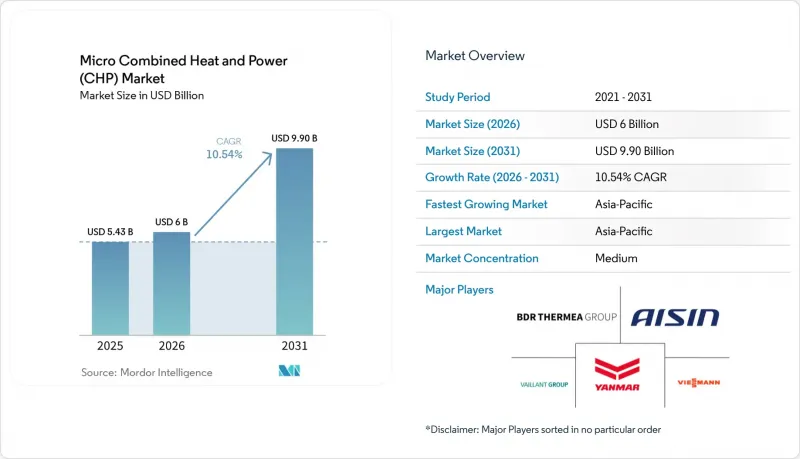
根據 Mordor Intelligence 預測,微型熱電聯產 (MIC) 市場規模將從 2025 年的 54.3 億美元和 2026 年的 60 億美元成長到 2031 年的 99 億美元,2026 年至 2031 年的年複合成長率(CAGR)為 10.54%。
本報告按燃料類型(天然氣、沼氣/生質能、氫兼容/合成氣)、原動機技術(內燃機等)、功率輸出等級(小於5千瓦、5-20千瓦、20-50千瓦、50-100千瓦)、應用領域(住宅、多用戶住宅/區域供熱、商業、工業)以及其他地區(北美、歐洲、亞洲地區進行細分、歐洲和非洲地區進行細分。市場預測以美元(USD)計價。
全球微型熱電聯產(CHP)市場趨勢與洞察
在日本和歐盟,住宅燃料電池微型熱電聯產系統的應用正在迅速成長。
日本長期推行的「ENE-FARM」計畫一直支持著微型熱電聯產(CH)市場的發展,該計畫持續推動住宅燃料電池的大規模應用。日本經濟產業省(METI)的「2025年節能獎勵計畫」為每台基本型設備提供16萬日圓(約1050美元)的補貼,併網型設備則可獲得4萬日元(約260美元)的補貼。該體系顯然更傾向於能夠並網運作的設備,而非僅作為獨立發電機運作的設備。這種設計有利於微型熱電聯產(CH)市場的發展,因為每套獲得補貼的設備都為未來住宅領域的虛擬電廠奠定了基礎。德國也正在透過修訂其燃料電池供熱支持計畫來推進類似的舉措。 2024年1月更新的KfW 433框架規定,燃料電池設備可獲得30%至70%的財政補貼。愛信的「ENE-FARM Type S(太陽能優先型)」將於 2026 年 3 月發布,其基於低熱輸出標準,發電效率提高了 55%,並整合了太陽能優先運行控制功能,這表明微型熱電聯產市場正在從熱回收轉向家庭能源管理硬體。
在後俄烏衝突時代,促進現場發電以保障能源安全。
俄烏衝突後歐洲能源政策的轉變,推動了微型熱電聯產(CPC)市場的發展,而能源安全已成為投資決策的核心。在這個市場中,現場發電不再只是被視為一種減碳選擇。許多買家現在將其視為一種具有韌性的資產,即使在電網或燃料供應中斷的情況下,也能確保熱能和電力的持續供應。醫院、飯店和資料中心等能源需求持續存在的設施,如果能夠降低營運風險,越來越願意接受更高的系統成本。 Capstone Green Energy與MicroGrid4AI於2025年10月簽署的合作備忘錄(MOU)表明,微型熱電聯產市場正在遠遠超出傳統的住宅供暖需求,涵蓋人工智慧相關資料中心的冗餘等應用場景。買家群體的擴大降低了對特定補貼項目的依賴,使微型熱電聯產市場能夠在商業、公共和特殊電力應用領域建立更具韌性的需求基礎。
與冷凝式鍋爐和熱泵相比,初始成本較高。
微型熱電聯產(CPC)市場在住宅應用領域仍面臨巨大的成本障礙。這是因為許多系統的安裝成本遠高於冷凝鍋爐和許多其他標準加熱方式。對於住宅住宅而言,這種價格差異尤其具有挑戰性,因為高運轉率、優惠的上網電價補貼和豐厚的補貼對於投資回報至關重要。此外,燃料電池系統在CPC市場的安裝更為複雜,在技術熟練的技工短缺地區,專案成本更高。買家往往只比較表面的安裝價格,而忽略了整個生命週期的價值,這削弱了那些在更長運作內提供節能效益的系統的銷售吸引力。在產量大幅提升且建立大規模生產能力之前,初始成本仍將是價格敏感地區CPC市場發展的主要阻礙。
細分市場分析
到2025年,天然氣將佔微型熱電聯產(CH)市場64.1%的佔有率。這反映了歐洲、北美和東亞現有天然氣供應網路基礎設施的廣泛應用,以及已針對天然氣使用進行最佳化的機組的大量成功案例。在熱電聯產市場,成功案例仍然是一個關鍵因素,因為成熟的天然氣系統在維護技術、燃料供應和客戶熟悉度方面都優於新型系統。東京燃氣公司已啟動一項針對ENE-FARM機組的20%氫氣混合燃料試點項目,顯示天然氣市場並非一成不變,而是在逐步整合更清潔的燃料。儘管規模仍然較小,但沼氣和生質能在北歐和中歐具有戰略價值,因為這些地區的農業殘餘物和本地燃料支持分散式發電。 µBIO CHP計畫於2026年3月完工,該計畫將一台2.5千瓦的固體氧化物燃料電池(SOFC)與一台15千瓦的木質顆粒氣化爐相結合,實現了超過90%的整體效率。這證明了生質能燃料系統在離網和農村應用情境中的有效性。
在微型熱電聯產 (MCH) 市場中,氫能平台和合成氣平台是成長最快的燃料細分市場,預計到 2031 年將以 15.3% 的複合年成長率成長。這種成長反映了採購者著眼於未來監管合規性的心態,他們尋求的是即使在氫氣摻混比例擴大、排放法規日益嚴格的情況下也能繼續運作的系統。 MWM 的「25H2」改裝方案為現有燃氣引擎用戶提供了一種無需更換整個系統即可過渡到混合燃料運行的實用方法,這對於成本敏感的商業資產至關重要。 「SO-FREE」計畫和愛信的純氫固態氧化物燃料電池 (SOFC) 示範計畫表明,微型熱電聯產產業正朝著能夠逐步從部分混合燃料運作過渡到完全氫能運作的系統發展。由於資產使用壽命更長,非住宅採購中「擱淺資產」的風險更大,因此商業和公共部門買家比住宅買家更快地接受了這一領域。
到2025年,內燃機將佔據微型熱電聯產(CHP)市場40.7%的佔有率,其重要性依然不減,這得益於其成熟的服務網路、易於獲取的零件以及相比燃料電池系統更低的安裝成本。這項優勢使內燃機供應商在微型熱電聯產市場,尤其是在商業設施中,維護便利性比最大發電效率更為重要,因此佔據了穩固的地位。 2024年發表在《自然通訊》上的一項研究報告稱,對置活塞引擎的交流電效率超過35.2%,熱電聯產系統的整體效率超過93%,這表明引擎創新仍在不斷進步,並未停滯在以往的性能水平。史特靈引擎繼續應用於需要更安靜運行的住宅環境,而微型燃氣渦輪機則受到尋求多燃料柔軟性和透過系統化服務合約進行遠端監控的商業用戶的青睞。簡而言之,即使人們的注意力轉向高效的電化學系統,各種技術的組合仍然十分廣泛。
燃料電池系統是微型熱電聯產(CH)市場中成長最快的原動機類別,預計到2031年將成長13.2%。 SO-FREE平台在氫氣摻混比例為0-100%的情況下,整體效率可達90-94%,這使得燃料電池在以效率為導向的產品定位方面具有明顯的優勢。 2026年5月,Elcogen公司推出了elcoStack E3000 G2,進一步擴大了在塔林的電堆生產能力,使其產能達到360兆瓦。該公司聲稱該平台的電效率為75%。這些進步對熱電聯產市場意義重大,因為更高的功率輸出可以改善現場經濟效益,並增強併網運作和電力銷售的收入基礎。隨著供應規模的進一步擴大,競爭差異化預計將從電堆生產本身轉向控制、整合、數位服務和現場可靠性。
區域分析
到2025年,亞太地區將佔微型熱電聯產(CH)市場規模的49.2%,預計到2031年將以10.8%的複合年成長率成長。在日本,「ENE-FARM」扶持計畫持續推動對住宅燃料電池和併網設備的需求,使日本成為區域熱電聯產市場的核心參與者。日本經濟產業省(METI)2025年的補貼計畫將為併網機型提供額外支持,預計將進一步擴大協調分散式能源服務的普及基礎。日本第七次能源戰略計畫重申氫能作為下一代能源載體的地位,東京燃氣公司針對ENE-FARM機組開展的20%氫能注入試點計畫表明,政策目標與實際網路測試正在逐步融合。中國正透過支持分散式能源政策擴大規模,而韓國和澳洲則透過與更廣泛的脫碳目標相聯繫的、以韌性為重點的能源戰略來推動需求。
歐洲是微型熱電聯產(CHP)市場中市場佔有率第二大的區域集團,同時也是監管最嚴格的地區。德國支撐著住宅和商業領域的區域需求,而英國仍然是歐洲小規模商業和住宅系統需求的重要組成部分。歐盟監管合規計畫包括從2028年起實施更嚴格的高效標準,並於2035年才逐步淘汰石化燃料,因此微型熱電聯產市場的供應商正在設計其現有系統,以適應未來更清潔的燃料,而不僅僅是短期使用天然氣。法國、義大利、西班牙和荷蘭構成了歐洲市場的下一個重要組成部分,而愛爾蘭將於2026年1月推出的數位化高效熱電聯產認證流程,透過減少行政核准環節,有助於建構更穩定的專案體系。
在北美,儘管建築存量龐大且熱需求旺盛,但微型熱電聯產(CHP)市場仍未充分利用。在美國,低廉的天然氣價格、不一致的淨計量法規以及缺乏類似日本的住宅燃料電池補貼計劃限制了其在家庭中的應用,因此目前部署仍集中在輕工業和商業設施。在加拿大,一些較冷的省份正在試行部署較成熟的多用戶住宅應用案。同時,在墨西哥,隨著電力成本管理成為更具戰略意義的挑戰,微型燃氣渦輪機和內燃機(ICE)系統正在湧現新的市場機會。南美洲的焦點仍集中在巴西的沼氣一體化熱電聯產潛力以及阿根廷對電力系統韌性的需求。另一方面,中東和非洲仍處於起步階段,其發展動力主要來自沙烏地阿拉伯和阿拉伯聯合大公國的產業多元化以及對南非電網可靠性的擔憂。
其他好處:
- Excel格式的市場預測(ME)表
- 3個月的分析師支持
目錄
第1章:引言
- 調查範圍
- 研究假設和市場定義
第2章:調查方法
第3章執行摘要
第4章 市場狀況
- 市場概覽
- 市場促進因素
- 在日本和歐盟,住宅燃料電池微型熱電聯產系統的應用正在迅速成長。
- 在俄羅斯和烏克蘭局勢的影響下,促進能源安全中的電力自發性生產。
- 鼓勵高效熱電汽電共生的排放法規
- 氫能微型熱電聯產平台為未來燃料柔軟性提供了可能。
- 適用於寒冷氣候建築的混合式微型熱電聯產+熱泵解決方案
- 市場限制因素
- 與冷凝式鍋爐和熱泵相比,初始成本較高。
- 電熱泵和蓄熱系統的成本迅速下降。
- 燃料電池維修安裝人員技能差距
- 供應鏈分析
- 監理情勢
- 技術展望
- 波特五力模型
第5章 市場規模與成長預測
- 按燃料類型
- 天然氣
- 沼氣/生質能
- 氫氣相容/合成氣
- 透過引擎技術
- 內燃機(ICE)
- 史特靈引擎
- 微型渦輪機
- 燃料電池(PEM、SOFC)
- 按容量等級
- 小於5千瓦
- 5~20 kWe
- 20~50 kWe
- 50~100 kWe
- 透過使用
- 獨立式住宅
- 多用戶住宅/社區住宅
- 商業設施(零售、辦公室、飯店)
- 工業和公共設施
- 地區
- 北美洲
- 美國
- 加拿大
- 墨西哥
- 歐洲
- 德國
- 英國
- 法國
- 義大利
- 西班牙
- 俄羅斯
- 其他歐洲國家
- 亞太地區
- 中國
- 日本
- 韓國
- 印度
- 澳洲
- 其他亞太國家
- 南美洲
- 巴西
- 阿根廷
- 其他南美國家
- 中東和非洲
- 沙烏地阿拉伯
- 阿拉伯聯合大公國
- 土耳其
- 南非
- 奈及利亞
- 其他中東和非洲國家
- 北美洲
第6章 競爭情勢
- 市場集中度
- 策略趨勢
- 市佔率分析
- 公司簡介
- Vaillant Group
- Viessmann Group
- Yanmar Holdings
- BDR Thermea(Remeha)
- AISIN Corporation
- Navien Inc.
- Qnergy
- SOLIDpower Group
- 2G Energy AG
- EC Power A/S
- ATCO Ltd
- Enginuity Power Systems
- Helbio SA
- Enexor Bioenergy
- GRIDIRON LLC
- TEDOM AS
- M-TRONIC Microturbines
- Capstone Green Energy
- Axiom Energy Group
- Bosch Thermotechnology
第7章 市場機會與未來展望
According to Mordor Intelligence, the micro combined heat and power market size is projected to expand from USD 5.43 billion in 2025 and USD 6 billion in 2026 to USD 9.90 billion by 2031, registering a CAGR of 10.54% between 2026 and 2031.
This report is Segmented by Fuel Type (Natural Gas, Biogas/Biomass, Hydrogen-ready/Synthetic Gas), Prime-Mover Technology (ICE and More), Capacity Class (less Than 5, 5-20, 20-50, 50-100 KWe), Application (Residential, Multi-Family/District, Commercial, Industrial), and Geography (North America, Europe, Asia-Pacific, South America, Middle East and Africa). Market Forecasts are Provided in Value (USD).
Global Micro Combined Heat and Power (CHP) Market Trends and Insights
Surging Residential Fuel-Cell Micro-CHP Roll-outs in Japan and EU
The micro combined heat and power market is gaining support from Japan's long-running ENE-FARM framework, which continues to shape residential fuel-cell procurement at scale. METI's 2025 Kyutou Shoene subsidies provide JPY 160,000, USD 1,050, per base unit and JPY 40,000, USD 260, for network-connected models, and that structure clearly favors units that can participate in grid-interactive operation rather than act only as stand-alone generators. The micro combined heat and power market benefits from that design because each subsidized installation also strengthens a future virtual power plant base in the residential sector. Germany is following a similar path through revised fuel-cell heating support, with the KfW 433 framework updated in January 2024 to provide 30-70% funding coverage for fuel-cell appliances. AISIN's March 2026 launch of the solar-priority ENE-FARM type S, with 55% lower-heating-value electrical efficiency and integrated PV-priority dispatch, shows how the micro combined heat and power market is moving beyond heat recovery and into household energy-management hardware.
Energy-Security Push for On-site Generation Post-Russia-Ukraine
The micro combined heat and power market has been strengthened by the shift in European energy policy after the Russia-Ukraine conflict, which pushed energy security into the center of investment decisions. In this market, on-site generation is no longer viewed only as a carbon-saving option, because many buyers now value it as a resilience asset that protects heat and power continuity during grid or fuel disruptions. Hospitals, hotels, data centers, and other facilities with continuous energy loads are increasingly willing to accept a higher system cost when that cost reduces operational risk. Capstone Green Energy's October 2025 MOU with Microgrids 4 AI shows that the micro combined heat and power market is now also reaching AI-linked data-center redundancy use cases that sit well beyond traditional residential heating demand. This broader buyer mix reduces reliance on any single subsidy program and gives the micro combined heat and power market a more resilient demand base across commercial, institutional, and specialty power applications.
High Upfront Cost vs Condensing Boilers and Heat Pumps
The micro combined heat and power market still faces a clear cost barrier in residential applications because many systems remain far more expensive to install than condensing boilers and many standard heating alternatives. This price gap is especially difficult in single-family homes, where payback depends on high utilization, supportive export tariffs, and strong subsidy coverage. The micro combined heat and power market also carries additional installation complexity in fuel-cell systems, and that raises project costs where trained technicians are scarce. Buyers often compare headline installed price rather than full life-cycle value, which weakens the sales case for systems that deliver savings over a much longer operating period. Until production volumes rise enough to deliver broader manufacturing scale, upfront cost will remain a meaningful brake on the micro combined heat and power market in price-sensitive regions.
Other drivers and restraints analyzed in the detailed report include:
- Emissions Regulations Rewarding High-Efficiency Cogeneration
- Hydrogen-Ready Micro-CHP Platforms Unlock Future Fuel Flexibility
- Rapid Cost Declines of Electric Heat Pumps and Storage
For complete list of drivers and restraints, kindly check the Table Of Contents.
Segment Analysis
Natural gas commanded 64.1% of the micro combined heat and power market in 2025, reflecting the reach of existing gas-grid infrastructure in Europe, North America, and East Asia, and the large installed base of units already optimized around gas use. In the micro combined heat and power market, the installed base still matters because service know-how, fuel availability, and buyer familiarity all favor established gas-based systems over newer options. Tokyo Gas has already initiated a 20% hydrogen-blend pilot for ENE-FARM units, which shows that the gas segment is not fixed and is starting to absorb cleaner fuel content over time. Biogas and biomass remain smaller in volume, yet they hold strategic value in Northern and Central Europe, where agricultural residues and localized fuel supply can support distributed generation. The µBIO CHP project, completed in March 2026, demonstrated a 2.5 kWe SOFC combined with a 15 kW wood-pellet gasifier and achieved above 90% total efficiency, which supports the case for biomass-fed systems in off-grid or rural use cases.
Hydrogen-ready and synthetic-gas platforms are the fastest-growing fuel segment in the micro combined heat and power market, with a projected 15.3% CAGR through 2031. That growth reflects a purchasing mindset focused on future compliance, because buyers want systems that can continue operating as hydrogen blending expands and emissions rules tighten. MWM's 25H2 retrofit path gives existing gas-engine owners a practical route into blended-fuel operation without replacing complete systems, which is important for cost-sensitive commercial assets. The SO-FREE project and AISIN's pure-hydrogen SOFC demonstration show that the micro combined heat and power industry is also advancing toward systems that can move from partial blends to full hydrogen operation over time. Commercial and institutional buyers are adopting this segment faster than households because longer asset lives make stranded-asset risk more material in non-residential procurement.
Internal-combustion engines held 40.7% of the micro combined heat and power market in 2025, and they remain important because service networks are mature, replacement parts are easy to source, and installed costs are lower than for fuel-cell systems. This installed base gives ICE vendors a durable position in the micro combined heat and power market, especially in commercial sites where maintenance familiarity matters more than maximum electrical efficiency. A 2024 Nature Communications study reported an opposed-piston engine with 35.2% AC electrical efficiency and above 93% total CHP efficiency, which shows that engine innovation is still moving forward rather than stopping at legacy performance levels. Stirling engines continue to serve quieter residential settings, while micro-turbines appeal to commercial users who want multi-fuel flexibility and remote monitoring through structured service contracts. That means the technology mix remains broad even as attention shifts toward higher-efficiency electrochemical systems.
Fuel-cell systems are the fastest-growing prime-mover category in the micro combined heat and power market, with forecast growth of 13.2% through 2031. The SO-FREE platform reached 90-94% total efficiency across a 0-100% hydrogen range, which gives fuel cells a clear advantage in efficiency-led product positioning. Elcogen added another step in May 2026 by launching the elcoStack E3000 G2 and scaling stack manufacturing capacity to 360 MW at Tallinn, with a claimed 75% electrical efficiency for the platform. In the micro combined heat and power market, these gains matter because better electrical output improves on-site economics and can strengthen the case for grid-connected operation and export revenue. As supply scales further, competitive differentiation is likely to move away from stack production alone and more toward controls, integration, digital service, and field reliability.
Geography Analysis
Asia-Pacific represented 49.2% of the micro combined heat and power market size in 2025, and the region is projected to grow at a 10.8% CAGR through 2031. Japan remains the anchor of the regional micro combined heat and power market because ENE-FARM support continues to channel demand toward residential fuel cells and grid-connected installations. METI's 2025 subsidy design gives additional support to network-connected models, which helps build a broader installed base for coordinated distributed energy services. Japan's 7th Basic Energy Plan reaffirmed hydrogen as a next-generation energy carrier, and Tokyo Gas's 20% hydrogen-blend pilot for ENE-FARM units shows how policy ambition is being matched by practical network testing. China adds scale through distributed-energy policy support, while South Korea and Australia contribute demand through resilience-focused energy strategies tied to broader decarbonization goals.
Europe is the second-largest regional block in the micro combined heat and power market share structure, and it is also the most regulation-intensive. Germany anchors regional demand in both residential and commercial use, while the United Kingdom remains part of the European demand base for smaller commercial and residential systems. The EU's compliance timeline, with stricter high-efficiency thresholds from 2028 and fossil-only exclusion from 2035, is pushing vendors in the micro combined heat and power market to design current systems for cleaner future fuels rather than near-term gas use alone. France, Italy, Spain, and the Netherlands form the next group of European markets, and Ireland's digital HE CHP certification process from January 2026 supports a steadier project pipeline by lowering administrative friction.
North America remains underused in the micro combined heat and power market despite strong building stock and relevant thermal demand. The United States still concentrates deployment in light industrial and commercial settings because lower gas prices, uneven net-metering rules, and the absence of a Japan-style residential fuel-cell subsidy limit household penetration. Canada is beginning to test stronger multi-family use cases in colder provinces, while Mexico offers an emerging opening for micro-turbine and ICE systems where power-cost management is becoming more strategic. South America remains centered on Brazil's biogas-linked CHP potential and Argentina's resilience needs, while the Middle East and Africa stay early-stage markets led by industrial diversification in Saudi Arabia and the UAE and by grid-reliability concerns in South Africa.
- Vaillant Group
- Viessmann Group
- Yanmar Holdings
- BDR Thermea (Remeha)
- AISIN Corporation
- Navien Inc.
- Qnergy
- SOLIDpower Group
- 2G Energy AG
- EC Power A/S
- ATCO Ltd
- Enginuity Power Systems
- Helbio S.A.
- Enexor Bioenergy
- GRIDIRON LLC
- TEDOM A.S.
- M-TRONIC Microturbines
- Capstone Green Energy
- Axiom Energy Group
- Bosch Thermotechnology
Additional Benefits:
- The market estimate (ME) sheet in Excel format
- 3 months of analyst support
TABLE OF CONTENTS
1 Introduction
- 1.1 Scope of the Study
- 1.2 Study Assumptions & Market Definition
2 Research Methodology
3 Executive Summary
4 Market Landscape
- 4.1 Market Overview
- 4.2 Market Drivers
- 4.2.1 Surging residential fuel-cell Micro-CHP roll-outs in Japan & EU
- 4.2.2 Energy-security push for on-site generation post-Russia-Ukraine
- 4.2.3 Emissions regulations rewarding high-efficiency cogeneration
- 4.2.4 Hydrogen-ready Micro-CHP platforms unlock future fuel flexibility
- 4.2.5 Hybrid Micro-CHP?+?heat-pump solutions for cold-climate buildings
- 4.3 Market Restraints
- 4.3.1 High upfront cost vs condensing boilers & heat-pumps
- 4.3.2 Rapid cost declines of electric heat-pumps & storage
- 4.3.3 Installer skill-gap for fuel-cell maintenance
- 4.4 Supply-Chain Analysis
- 4.5 Regulatory Landscape
- 4.6 Technological Outlook
- 4.7 Porter's Five Forces
- 4.7.1 Bargaining Power of Suppliers
- 4.7.2 Bargaining Power of Consumers
- 4.7.3 Threat of New Entrants
- 4.7.4 Threat of Substitute Products & Services
- 4.7.5 Intensity of Competitive Rivalry
5 Market Size & Growth Forecasts (Value)
- 5.1 By Fuel Type
- 5.1.1 Natural Gas
- 5.1.2 Biogas / Biomass
- 5.1.3 Hydrogen-ready / Synthetic gas
- 5.2 By Prime-Mover Technology
- 5.2.1 Internal-Combustion Engine (ICE)
- 5.2.2 Stirling Engine
- 5.2.3 Micro-Turbine
- 5.2.4 Fuel Cell (PEM, SOFC)
- 5.3 By Capacity Class
- 5.3.1 Less than 5 kWe
- 5.3.2 5 - 20 kWe
- 5.3.3 20 - 50 kWe
- 5.3.4 50 - 100 kWe
- 5.4 By Application
- 5.4.1 Residential Single-Family
- 5.4.2 Multi-Family / District Housing
- 5.4.3 Commercial (Retail, Offices, Hospitality)
- 5.4.4 Industrial & Institutional Facilities
- 5.5 Geography
- 5.5.1 North America
- 5.5.1.1 United States
- 5.5.1.2 Canada
- 5.5.1.3 Mexico
- 5.5.2 Europe
- 5.5.2.1 Germany
- 5.5.2.2 United Kingdom
- 5.5.2.3 France
- 5.5.2.4 Italy
- 5.5.2.5 Spain
- 5.5.2.6 Russia
- 5.5.2.7 Rest of Europe
- 5.5.3 Asia-Pacific
- 5.5.3.1 China
- 5.5.3.2 Japan
- 5.5.3.3 South Korea
- 5.5.3.4 India
- 5.5.3.5 Australia
- 5.5.3.6 Rest of Asia-Pacific
- 5.5.4 South America
- 5.5.4.1 Brazil
- 5.5.4.2 Argentina
- 5.5.4.3 Rest of South America
- 5.5.5 Middle East and Africa
- 5.5.5.1 Saudi Arabia
- 5.5.5.2 United Arab Emirates
- 5.5.5.3 Turkey
- 5.5.5.4 South Africa
- 5.5.5.5 Nigeria
- 5.5.5.6 Rest of Middle East and Africa
- 5.5.1 North America
6 Competitive Landscape
- 6.1 Market Concentration
- 6.2 Strategic Moves
- 6.3 Market Share Analysis
- 6.4 Company Profiles (includes Global-level Overview, Market-level Overview, Core Segments, Financials as available, Strategic Information, Products & Services, Recent Developments)
- 6.4.1 Vaillant Group
- 6.4.2 Viessmann Group
- 6.4.3 Yanmar Holdings
- 6.4.4 BDR Thermea (Remeha)
- 6.4.5 AISIN Corporation
- 6.4.6 Navien Inc.
- 6.4.7 Qnergy
- 6.4.8 SOLIDpower Group
- 6.4.9 2G Energy AG
- 6.4.10 EC Power A/S
- 6.4.11 ATCO Ltd
- 6.4.12 Enginuity Power Systems
- 6.4.13 Helbio S.A.
- 6.4.14 Enexor Bioenergy
- 6.4.15 GRIDIRON LLC
- 6.4.16 TEDOM A.S.
- 6.4.17 M-TRONIC Microturbines
- 6.4.18 Capstone Green Energy
- 6.4.19 Axiom Energy Group
- 6.4.20 Bosch Thermotechnology
7 Market Opportunities & Future Outlook
- 7.1 White-space & Unmet-Need Assessment

 微型熱電聯產市場預測至2034年-按燃料類型、容量、技術、應用和地區分類的全球分析
 微型熱電聯產市場:2026-2032年全球市場預測(依技術類型、功率輸出、燃料類型、應用和銷售管道)
 微型熱電聯產市場規模、佔有率和成長分析:按引擎技術、燃料類型、容量、應用、系統類型和地區分類-2026-2033年產業預測
 微型汽電共生市場規模、佔有率、成長和全球產業分析:按類型、應用和地區的洞察,2026-2034年的預測全球微型熱電聯產市場:市場規模、佔有率、趨勢和成長分析(2026-2034 年)
 2026年全球微型熱電聯產(CHP)系統市場報告
 微型汽電共生市場-全球產業規模、佔有率、趨勢、機會及預測(依容量、原動機、燃料、應用、區域及競爭格局分類,2021-2031年)
 微型汽電共生(CHP) 市場分析及預測(至 2034 年):類型、產品、技術、組件、應用、最終用戶、安裝類型、設備、能力、服務
 微型熱電聯產市場規模、佔有率、趨勢分析報告:產品、應用、地區、細分市場預測,2025-2030 年
 微型熱電聯產市場、佔有率、規模、趨勢、產業分析報告:按燃料、原動機、按容量、按應用、按地區、按細分市場預測,2024-2032 年