


 |
市場調查報告書
商品編碼
2066613
銣:市場佔有率分析、產業趨勢與統計、成長預測(2026-2031)Rubidium - Market Share Analysis, Industry Trends & Statistics, Growth Forecasts (2026 - 2031) |
||||||

※ 本網頁內容可能與最新版本有所差異。詳細情況請與我們聯繫。
根據 Mordor Intelligence 預測,銣市場規模將從 2025 年的 6.95 噸和 2026 年的 7.27 噸成長到 2031 年的 9.07 噸,2026 年至 2031 年的年複合成長率(CAGR)為 4.53%。
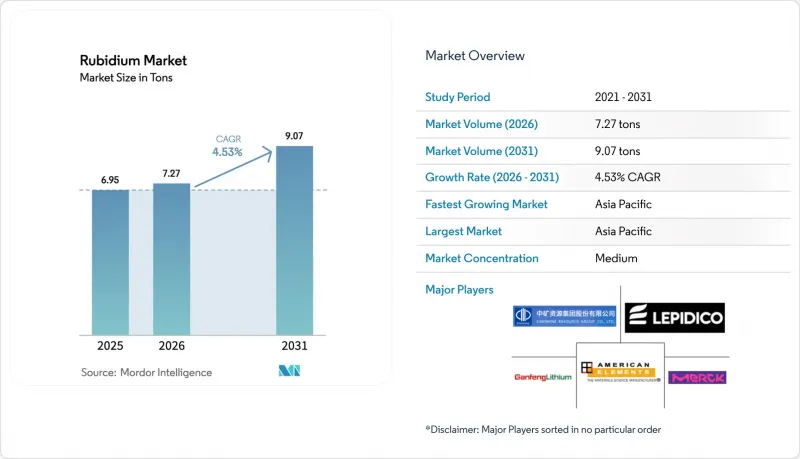
本報告按製造程序(鋰雲母、磷酸鈣及其他工藝)、應用領域(生物醫學研究、電子產品、特殊玻璃、煙火及其他應用)和地區(亞太地區、北美地區、歐洲地區、南美地區以及中東和非洲地區)進行細分。市場預測以噸為單位。
全球銣市場趨勢與洞察
在生物醫學領域不斷擴展的應用
銣-82 PET 發生器半衰期僅 76 秒,可取代傳統同位素,實現按需心肌顯像,無需每日輸注放射性藥物。臨床試驗表明,其在冠狀動脈疾病診斷方面的準確性高於 SPECT 掃描。美國、加拿大和德國的醫院在維修循環系統設施時,正擴大採用銣-82 PET 發生器。多種銣-82 產生器系統已獲得 FDA 和 EMA 的批准,這有助於獲得保險報銷,並降低了推廣應用的門檻。製藥公司也在使用銣化合物作為示蹤劑,但與診斷影像應用相比,其應用仍然小規模。銣-82 PET 產生器的持續成長取決於 PET 掃描的保險報銷水準能否維持,以及區域醫院能否推廣使用 PET-CT 混合掃描儀。如果保險報銷政策保持有利,隨著心臟影像影像技術的日益普及,銣-82 PET 市場仍有進一步成長的空間。
特種光學玻璃和光纖網路的應用不斷拓展。
碳酸銣和氧化銣在低色散玻璃中用作助熔劑和屈光調節劑,用於製造光纖電纜和高解析度透鏡。数据中心的爆炸式增长迫使超大規模資料中心業者数据中心运营商提高光連接模組密度,从而推动了对能够实现 400 Gbps 和 800 Gbps 传输速率并最大限度降低色散的单模光纤的需求。摻銣玻璃能夠提高熱穩定性並降低長距離海底鏈路中的訊號衰減。類似的化學性質也存在於用於LiDAR和積層製造的倍頻雷射的磷酸鈦銣晶體中。儘管玻璃製造商不斷尋求更低成本的替代方案,但海底網路和精密光學儀器對性能的要求使得在不犧牲設計的情況下難以完全去除銣。隨著光電整合技術的加速發展,特種玻璃仍將是銣市場的主要終端應用領域。
稀少的原生礦床和高昂的提煉成本
天然礦石中銣的產量極低,也沒有專門開採銣的礦場。據美國地質調查局(USGS)稱,全球蘊藏量有限,阻礙了產能的快速擴張。對於原子鐘和量子感測器等應用,精煉商的目標是達到99.9%的嚴格純度。為了達到這種純度,通常需要採用高能耗的方法,例如分餾結晶和真空蒸餾,這兩種方法都會產生有害的殘留物。雖然實驗室規模的微萃取技術已大幅降低了能耗,但其商業化仍需數年時間。客製化鹽類和金屬的交貨週期長,意味著買家可能面臨現貨價格飆升的風險。這些結構性挑戰不僅限制了短期供應成長,除非精煉技術取得突破性進展,否則也將限制銣市場的潛在成長。
細分市場分析
在2025年的生產流程細分中,鋰雲母佔銣市場規模的80.79%,預計到2031年將以5.06%的複合年成長率成長。鋰精煉廠可以利用聯產的經濟效益,在酸浸或焙燒製程中回收銣,而無需額外的資本投資。這項優勢鞏固了鋰雲母在銣市場的主導地位。初步的微萃取試驗表明,精煉過程中可顯著節能,如果該製程能夠規模化,預計利潤率將會提高。主要由中礦資源集團控股的寶麗石公司為航太相關企業提供高純度特殊產品,滿足蒸氣電池製造的嚴格要求。雖然諸如光鹵石和鹽水等替代資源仍處於試驗階段,但青海研究院開發的鹽水製程如果商業化,有望獲得發展動力。
儘管銫沸石的市佔率較低,但其高銫含量使其成為銫甲酸鑽井液的重要策略原料,對銣的生產具有互補作用。從鹽水中提取銣礦為銣產業提供了長期成長潛力,尤其是在能耗和試劑回收率與實驗室結果相當的情況下。然而,高資本密集度和授權延遲使得新參與企業持謹慎態度。因此,銣礦的供應成長仍依賴鋰和銫的供需週期,銣市場價格走勢對下游需求激增的敏感度高於對礦場直接投資的敏感度。
區域分析
預計到2025年,亞太地區將以39.43%的市佔率佔據銣市場榜首,預計在2031年之前以5.97%的複合年成長率成長。中國透過從採礦到化合物生產的垂直整合,在銣市場展現出壓倒性的主導地位。中礦集團(Sinomine)的銷售額實現了顯著的同比成長。同時,贛鋒鋰業新餘提煉不僅生產碳酸鋰,也回收硝酸銣,從而提高了國內鐘錶製造商的供應穩定性。日本和韓國依賴進口碳酸銣來製造高屈光相機鏡頭和精密光學儀器,而印度雄心勃勃的5G基地台部署計畫預計將在2027年前完成,這將進一步刺激銣的需求。
北美供應量有限,但國防和醫療領域的需求仍然穩定。 Frequency Electronics公司在長島生產蒸氣電池,用於保護GPS III和敏感衛星專案;Microchip公司的時鐘則為美國資料中心的同步提供支援。在既定兌換碼的支援下,美國醫院採用銣-82進行PET掃描的比例正穩定成長。然而,根據美國地質調查局(USGS)的報告,自2019年以來,美國國內的銣-82初級產量一直為零,迫使買家依賴進口和動用庫存。
歐洲面臨與北美類似的供應脆弱性,但得益於德國的加工廠對進口銣精礦的提煉,歐洲也從中受益。 Accubeat公司的銣鐘為遍布歐洲的伽利略地面站提供奈秒的計時。英國、法國和德國正在資助一項利用銣蒸氣電池進行自主導航的冷原子感測器項目,該項目正在形成一個以研究為主導的需求中心。目前,南美洲、中東和非洲的銣供應規模仍然較小,但位於奈米比亞的Karibib計畫(國際鋰業公司擁有該計畫2025年的優先購買權)如果資金籌措順利到位,可望成為該地區的銣供應來源。總體而言,這些區域性的發展凸顯了銣市場如何在集中供應與全球分散的技術需求之間取得平衡。
其他好處:
- Excel格式的市場預測(ME)表
- 3個月的分析師支持
目錄
第1章:引言
- 研究假設和市場定義
- 調查範圍
第2章:調查方法
第3章執行摘要
第4章 市場狀況
- 市場概覽
- 市場促進因素
- 在生物醫學領域不斷擴展的應用
- 在特種光學玻璃和光纖網路中的應用擴展
- 5G和衛星的部署正在推動對銣原子鐘的需求。
- 擴大量子技術(低溫原子感測器、量子位元)的研究與開發
- 利用鋰雲母廢棄物進行協同生產的綜效
- 市場限制因素
- 原生礦石短缺和精煉成本高昂
- 高活性金屬處理和運輸的安全措施
- 地緣政治風險:中國煉油量超過70%
- 價值鏈分析
- 波特五力模型
- 供應分析
- 監理政策分析
- 貿易分析
第5章 市場規模與成長預測
- 透過生產過程
- 鋰雲母
- Pollucite
- 其他流程
- 透過使用
- 生物醫學研究
- 電子設備
- 特種玻璃
- 焰火
- 其他用途
- 按地區
- 亞太地區
- 中國
- 印度
- 日本
- 韓國
- 東南亞國協
- 其他亞太國家
- 北美洲
- 美國
- 加拿大
- 墨西哥
- 歐洲
- 德國
- 英國
- 法國
- 義大利
- 西班牙
- 北歐國家
- 俄羅斯
- 其他歐洲國家
- 南美洲
- 巴西
- 阿根廷
- 其他南美國家
- 中東和非洲
- 沙烏地阿拉伯
- 南非
- 其他中東和非洲國家
- 亞太地區
第6章 競爭情勢
- 市場集中度
- 策略趨勢
- 市佔率和排名分析
- 公司簡介
- AccuBeat Ltd
- American Elements
- ESPI Metals
- Frequency Electronics, Inc.
- Ganfeng Lithium
- Hubei Baijierui Advanced Materials Co., Ltd
- INORGANIC VENTURES
- International Lithium Corp.
- IQD Frequency Products Ltd
- Jackson Laboratories Pvt. Ltd
- Jiangxi Special Electric Motor
- Lepidico
- Lithium Australia
- Merck KGaA
- Microchip Technology Inc.
- Nanjing Taiye Chemical Industry Co., Ltd.
- Otto Chemie Pvt Ltd
- Sinomine Resource Group
- Thermo Fisher Scientific
第7章 市場機會與未來展望
According to Mordor Intelligence, the rubidium market size is projected to expand from 6.95 tons in 2025 and 7.27 tons in 2026 to 9.07 tons by 2031, registering a CAGR of 4.53% between 2026 to 2031.
This report is Segmented by Production Process (Lepidolite, Pollucite, and Other Processes), Application Sector (Biomedical Research, Electronics, Specialty Glass, Pyrotechnics, and Other Applications), and Geography (Asia-Pacific, North America, Europe, South America, and Middle-East and Africa). The Market Forecasts are Provided in Terms of Volume (Tons).
Global Rubidium Market Trends and Insights
Growing Biomedical Applications
Rubidium-82 PET generators are displacing older isotopes because the 76-second half-life enables on-demand myocardial imaging without daily radiopharmaceutical deliveries. Clinical trials show higher diagnostic accuracy for coronary artery disease than SPECT scans, encouraging hospitals in the United States, Canada, and Germany to install generators during cardiology-suite upgrades. Multiple generator systems hold FDA and EMA clearance, smoothing reimbursement approvals and lowering adoption hurdles. Pharmaceutical laboratories also use rubidium compounds as tracers, although these volumes remain small relative to imaging. Continued growth depends on maintaining reimbursement levels for PET studies and on the rollout of hybrid PET-CT scanners in community hospitals. If reimbursement policy remains favorable, the rubidium market could capture additional upside from wider cardiac-imaging use.
Expanding Use in Specialty Optical Glass and Fiber Networks
Rubidium carbonate and oxide act as flux agents and index modifiers in low-dispersion glass for fiber-optic cables and high-resolution lenses. Explosive data-center growth is forcing hyperscalers to densify optical interconnects, pushing demand for single-mode fiber that supports 400 Gbps and 800 Gbps transmission with minimal chromatic dispersion. Rubidium-doped glass improves thermal stability, reducing signal attenuation on long-haul submarine routes. The same chemistry underpins rubidium titanyl phosphate crystals used in frequency-doubled lasers for lidar and additive manufacturing. Although glass producers continually seek lower-cost substitutes, performance requirements in subsea networks and precision optics make rubidium difficult to eliminate without design compromises. As long as photonics integration accelerates, specialty glass will stay the anchor end-use in the rubidium market.
Scarce Primary Deposits and High Purification Cost
Natural ores rarely yield rubidium in significant quantities, and dedicated mines for the element are nonexistent. The U.S. Geological Survey notes that global reserves are limited, which hampers swift capacity expansion. For applications in atomic clocks and quantum sensors, refiners aim for a stringent 99.9% purity. Achieving this purity often relies on energy-intensive methods like fractional crystallization or vacuum distillation, both of which produce hazardous by-products. While lab-scale micro-extraction has significantly reduced energy consumption, its commercial rollout remains several years away. Buyers face potential spot-price surges due to long lead times for custom salts and metals. These structural challenges not only cap short-term volume growth but also limit the rubidium market's potential unless there's a breakthrough in purification technologies.
Other drivers and restraints analyzed in the detailed report include:
- 5G and Satellite Rollout Driving Demand for Rubidium Atomic Clocks
- Quantum-Technology Scale-Up
- Geopolitical Risk: Greater Than 70% Refining in China
For complete list of drivers and restraints, kindly check the Table Of Contents.
Segment Analysis
Lepidolite contributed 80.79% of the rubidium market size under production-process segmentation in 2025 and is projected to climb at a 5.06% CAGR to 2031. Lithium refiners, leveraging co-production economics, can capture rubidium during acid-leach or roasting steps without incurring standalone capital expenditures. This advantage solidifies lepidolite's dominant position in the rubidium market. Preliminary micro-extraction trials indicate significant energy savings in purification, hinting at potential margin increases if the process is scaled. Pollucite, primarily controlled by Sinomine Resource Group, caters to aerospace contractors with its niche high-purity volumes, meeting the stringent requirements for vapor-cell fabrication. While alternative sources like carnallite and brine are still in the experimental phase, they could gain momentum if the Qinghai Institute's brine process achieves commercialization.
Pollucite's share lags but carries strategic significance because its high cesium content supports cesium formate drilling fluids, providing cross-subsidy for rubidium yields. Brine extraction offers longer-term upside for the rubidium industry, especially if energy use and reagent recovery mirror laboratory results. However, capital intensity and permitting delays keep new entrants cautious. Supply growth, therefore, remains tethered to lithium and cesium cycles, making price signals in the rubidium market more sensitive to downstream demand surges than to directed mine investment.
Geography Analysis
Asia-Pacific led with 39.43% of the rubidium market share in 2025 and is expected to grow at a 5.97% CAGR through 2031. China's dominance in the rubidium market is underscored by its vertical integration, spanning from mining to compound production. Sinomine reported a significant year-on-year revenue surge. Meanwhile, Ganfeng Lithium's Xinyu refinery is not just producing lithium carbonate but also capturing rubidium nitrate, bolstering supply security for domestic clock manufacturers. While Japan and South Korea turn to imports of rubidium carbonate for their high-index camera lenses and precision optics, India's ambitious target of establishing 5G base stations by 2027 is set to further fuel demand.
North America contributes modest volume but enjoys stable defense and medical demand. Frequency Electronics insulates GPS III and classified satellite programs by fabricating vapor cells on Long Island, while Microchip clocks underpin U.S. data-center synchronization. Rubidium-82 PET adoption grows steadily in U.S. hospitals, aided by established reimbursement codes. However, the U.S. Geological Survey reports zero domestic primary production post-2019, leaving buyers reliant on imports or stockpile drawdowns.
Europe mirrors North America's supply vulnerability but benefits from a processing plant in Germany that upgrades imported concentrates. AccuBeat's rubidium clocks secure nanosecond-level timing for Galileo ground stations across the continent. The United Kingdom, France, and Germany fund cold-atom sensor programs tapping rubidium vapor cells for autonomous navigation, creating research-driven demand pockets. South America, the Middle East, and Africa remain small today, though Namibia's Karibib project - optioned by International Lithium Corp in 2025 - could offer regional supply if financing aligns. Overall, geographic dynamics underscore how the rubidium market balances concentrated supply with globally dispersed technology pull.
- AccuBeat Ltd
- American Elements
- ESPI Metals
- Frequency Electronics, Inc.
- Ganfeng Lithium
- Hubei Baijierui Advanced Materials Co., Ltd
- INORGANIC VENTURES
- International Lithium Corp.
- IQD Frequency Products Ltd
- Jackson Laboratories Pvt. Ltd
- Jiangxi Special Electric Motor
- Lepidico
- Lithium Australia
- Merck KGaA
- Microchip Technology Inc.
- Nanjing Taiye Chemical Industry Co., Ltd.
- Otto Chemie Pvt Ltd
- Sinomine Resource Group
- Thermo Fisher Scientific
Additional Benefits:
- The market estimate (ME) sheet in Excel format
- 3 months of analyst support
TABLE OF CONTENTS
1 Introduction
- 1.1 Study Assumptions and Market Definition
- 1.2 Scope of the Study
2 Research Methodology
3 Executive Summary
4 Market Landscape
- 4.1 Market Overview
- 4.2 Market Drivers
- 4.2.1 Growing biomedical applications
- 4.2.2 Expanding use in specialty optical-glass and fibre networks
- 4.2.3 5G and satellite rollout driving demand for rubidium atomic clocks
- 4.2.4 Quantum-technology research and development scale-up (cold-atom sensors, qubits)
- 4.2.5 Co-production synergies from lithium-mica waste streams
- 4.3 Market Restraints
- 4.3.1 Scarce primary deposits and high purification cost
- 4.3.2 Handling/transport safety for highly reactive metal
- 4.3.3 Geopolitical risk: greater than 70% refining in China
- 4.4 Value Chain Analysis
- 4.5 Porter's Five Forces
- 4.5.1 Threat of New Entrants
- 4.5.2 Bargaining Power of Buyers
- 4.5.3 Bargaining Power of Suppliers
- 4.5.4 Threat of Substitutes
- 4.5.5 Degree of Competition
- 4.6 Supply Analysis
- 4.7 Regulatory Policy Analysis
- 4.8 Trade Analysis
5 Market Size and Growth Forecasts (Volume)
- 5.1 By Production Process
- 5.1.1 Lepidolite
- 5.1.2 Pollucite
- 5.1.3 Other Processes
- 5.2 By Application Sector
- 5.2.1 Biomedical Research
- 5.2.2 Electronics
- 5.2.3 Specialty Glass
- 5.2.4 Pyrotechnics
- 5.2.5 Other Applications
- 5.3 By Geography
- 5.3.1 Asia-Pacific
- 5.3.1.1 China
- 5.3.1.2 India
- 5.3.1.3 Japan
- 5.3.1.4 South Korea
- 5.3.1.5 ASEAN Countries
- 5.3.1.6 Rest of Asia-Pacific
- 5.3.2 North America
- 5.3.2.1 United States
- 5.3.2.2 Canada
- 5.3.2.3 Mexico
- 5.3.3 Europe
- 5.3.3.1 Germany
- 5.3.3.2 United Kingdom
- 5.3.3.3 France
- 5.3.3.4 Italy
- 5.3.3.5 Spain
- 5.3.3.6 NORDIC Countries
- 5.3.3.7 Russia
- 5.3.3.8 Rest of Europe
- 5.3.4 South America
- 5.3.4.1 Brazil
- 5.3.4.2 Argentina
- 5.3.4.3 Rest of South America
- 5.3.5 Middle-East and Africa
- 5.3.5.1 Saudi Arabia
- 5.3.5.2 South Africa
- 5.3.5.3 Rest of Middle-East and Africa
- 5.3.1 Asia-Pacific
6 Competitive Landscape
- 6.1 Market Concentration
- 6.2 Strategic Moves
- 6.3 Market Share/Ranking Analysis
- 6.4 Company Profiles (includes Global level Overview, Market level overview, Core Segments, Financials as available, Strategic Information, Market Rank/Share for key companies, Products and Services, and Recent Developments)
- 6.4.1 AccuBeat Ltd
- 6.4.2 American Elements
- 6.4.3 ESPI Metals
- 6.4.4 Frequency Electronics, Inc.
- 6.4.5 Ganfeng Lithium
- 6.4.6 Hubei Baijierui Advanced Materials Co., Ltd
- 6.4.7 INORGANIC VENTURES
- 6.4.8 International Lithium Corp.
- 6.4.9 IQD Frequency Products Ltd
- 6.4.10 Jackson Laboratories Pvt. Ltd
- 6.4.11 Jiangxi Special Electric Motor
- 6.4.12 Lepidico
- 6.4.13 Lithium Australia
- 6.4.14 Merck KGaA
- 6.4.15 Microchip Technology Inc.
- 6.4.16 Nanjing Taiye Chemical Industry Co., Ltd.
- 6.4.17 Otto Chemie Pvt Ltd
- 6.4.18 Sinomine Resource Group
- 6.4.19 Thermo Fisher Scientific
7 Market Opportunities and Future Outlook
- 7.1 White-space and Unmet-Need Assessment


